They Dug Up His Family Cemetery to Widen a Farm Road—Then He Found the Promise Buried in the Deed
Chapter 1: The Excavator Was Already Inside the Cemetery
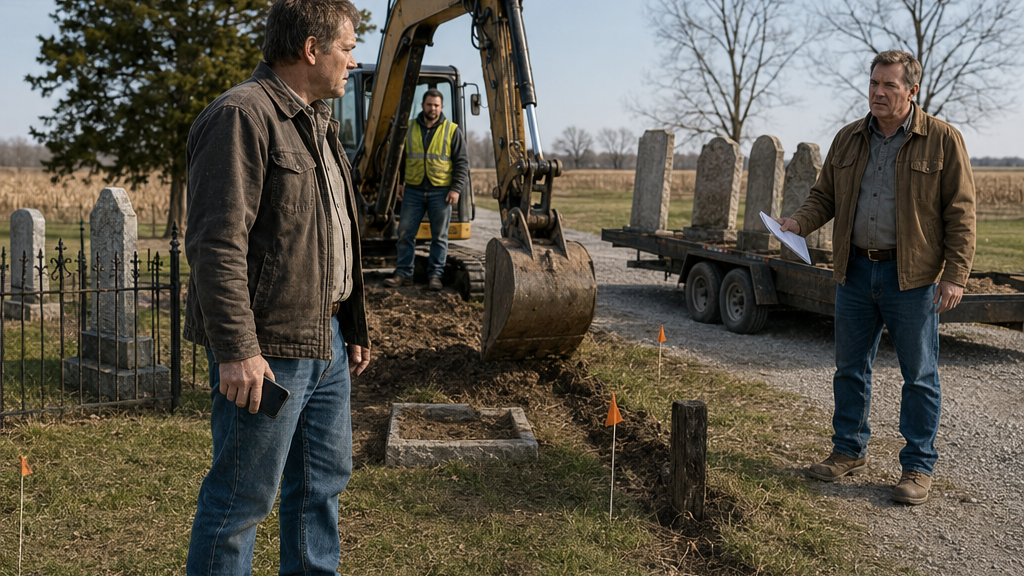
The excavator bucket hung three feet above the rectangular patch where James Hill’s grandmother’s headstone had stood for more than twenty-five years.
For several seconds, James did not understand what he was looking at.
He had turned off the county road expecting to find fresh gravel on the shared lane. Instead, orange flags ran through the grass beside the cemetery, the old wire fence had been rolled back, and three headstones stood against an equipment trailer like pieces of salvaged masonry.
His grandmother’s was one of them.
The machine’s engine rattled at idle.
James stopped his pickup across the lane and got out.
“Shut it down.”
The operator looked toward Joshua Brown, who stood beside the trailer checking something on a clipboard.
Joshua lifted a hand. The excavator went silent.
Dennis Mitchell came around the front of a parked pickup before Joshua could say anything.
“You can’t block the lane, James.”
James looked past him.
A pale rectangle of soil showed where his grandmother’s stone had been. Another marker had already been lifted from the row behind it. Fresh bucket teeth had scraped through the sod.
“Who authorized this?”
Dennis exhaled through his nose. “The road cooperative did. Same project we’ve been talking about since spring.”
“The road project.”
“Yes.”
James pointed toward the cemetery.
“That isn’t the road.”
“It’s the shoulder.”
James walked past him.
The family cemetery sat on a low rise beside the entrance lane, no larger than a modest house lot. There were sixteen marked graves and several older fieldstones whose names had worn away years ago. James had cut the grass there in June. He had meant to do it again.
He had not.
Goldenrod now pressed through parts of the fence.
Dennis followed.
“The engineer laid out the widening. We’re staying inside the surveyed strip.”
James crouched beside the empty base of his grandmother’s monument. One corner had chipped when it was lifted.
Something cold moved through him.
“You moved how many?”
“Three.”
Joshua corrected him quietly.
“Four.”
Dennis glanced at him.
Joshua nodded toward a smaller stone resting behind the trailer.
James stood.
“Put nothing else in the ground and take nothing else out.”
Dennis folded his arms. “We’re losing the whole morning already.”
“You’re done for the morning.”
“That’s not your call.”
James looked at Joshua. “You carry liability insurance?”
Joshua’s expression changed slightly.
“Of course.”
“Then I suggest you stop until somebody shows you the recorded instrument that gives this cooperative authority to disturb a burial ground.”
Dennis gave a short laugh.
“It’s on the survey.”
“Survey isn’t an easement.”
“It shows the property line.”
“That isn’t what I asked.”
Dennis walked back toward his pickup and returned with a rolled plan set.
He opened it across the hood.
“There.”
A heavy black line followed the existing gravel lane. Dashed lines widened it along both sides. The proposed shoulder clipped the cemetery’s western edge.
Dennis tapped a note.
“Current survey. Filed this summer. The old fence isn’t the boundary.”
James studied it.
The drawing looked professionally prepared. Bearings. Distances. Reference monuments. A certification block.
And one fact bothered him immediately.
The cemetery was shown as a three-sided shape.
Its western corner simply merged into the road right-of-way.
James looked toward the grass.
“Where’s the fourth corner?”
Dennis shrugged. “Ask the surveyor.”
“I’m asking you because you authorized excavation.”
“We’ve got a recorded road easement, James. We checked title.”
“What year?”
Dennis hesitated.
“Does it matter?”
“Yes.”
Joshua stepped closer, clearly wishing he were somewhere else.
Dennis flipped to another sheet.
“There. Access rights.”
James read the typed reference.
Book number. Page number. A description of a shared agricultural access easement.
The date was newer than the cemetery.
Much newer.
James felt the first hard edge of recognition.
He had seen similar language hundreds of times when he practiced law. More than that, something about this particular description was familiar—the phrase reserving rights “subject to preexisting family burial and ingress rights.”
But that phrase did not appear on Dennis’s sheet.
James walked into the grass along the disturbed boundary.
Orange flags marked a clean new line parallel to the lane.
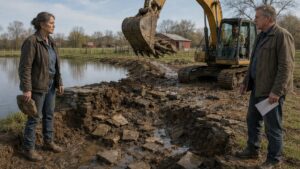
Near the excavator track, a splintered piece of dark wood protruded from beneath packed soil.
He knelt and pulled grass away from it.
It was not scrap lumber.
It was a cedar post, weathered almost black, its top softened by decades of rain. The machine had scraped dirt away from one side but had not pulled it loose.
James took out his phone and photographed it.
Dennis watched him.
“You taking pictures of fence posts now?”
James did not answer.
He photographed the post again with the orange survey flag visible behind it.
Then he looked at Joshua.
“Leave the stones where they are. Cover them if it rains. Nobody touches the bases.”
Joshua nodded.
Dennis said, “We’re not leaving equipment sitting here all weekend because you remember some old family story.”
James straightened.
“This isn’t a family story.”
“Then what is it?”
James pointed at the survey.
“Give me a copy of every sheet you’re working from.”
Dennis stared at him.
“You representing yourself now?”
“No.”
James had left legal practice nine years earlier. Dennis knew that much. Most people around there knew only that James had once worked in an office in the city before coming back to run cattle and hay on the Hill place.
They did not know what kind of law he had practiced.
James looked again at his grandmother’s headstone leaning against the trailer.
“I’m trying to make sure none of us does something on Saturday that becomes much more expensive on Monday.”
That landed differently.
Joshua began gathering his crew.
Dennis rolled the plans back up.
“Fine. Today.”
James held out his hand.
Dennis reluctantly gave him the duplicate survey set.
“But Monday morning, we start again unless you have something better than an old post.”
James took the plans.
As the excavator backed away from the cemetery, he remained beside the exposed cedar.
He could almost hear his grandmother complaining about the crooked fence line, telling him not to pull that particular post because it marked something older than the fence itself.
At the time, he had been twenty-three and barely listening.
Now he opened Dennis’s survey again.
At the bottom of the access-rights reference was a legal description containing a phrase he recognized with uncomfortable precision.
James had researched the instrument behind that wording when he was a young attorney.
And if his memory was right, the document Dennis had relied on was not the oldest claim attached to this land.
Chapter 2: The Promise Hidden Beneath the New Survey
The deed described a cedar post.
James found the words at 2:17 Saturday afternoon, buried in the fourth page of a photocopy so old that one edge had turned gray.
Beginning at the southwest corner of the Hill burial parcel, marked by cedar post—
He stopped reading.
The photograph on his phone showed the same object protruding from scraped earth beside the orange survey flag.
It should not have survived.
Fence lines had changed. Gates had moved. The original cattle lot was gone. His father had replaced nearly every wooden post along the road with steel before James returned to the farm.
Yet that one cedar post remained.
James spread the documents across the desk in the room he still called the farm office, though most of what happened there now involved feed bills and machinery invoices.
The old deed had come from a box of family papers.
The newer documents came from the county’s online index.
By evening, a sequence was taking shape.
The burial parcel had been carved out long before the modern road cooperative existed. A later recorded instrument guaranteed descendants access to it and prohibited interference with the graves without family consent.
Then came the agricultural road easement.
Then amendments.
Then the cooperative.
Each new document assumed the older rights still existed.
James leaned back.
For the first time since seeing the excavator, he felt something close to relief.
Dennis had not found a loophole.
He had found only the newest piece of paper.
James pulled a legal pad toward him and began listing record numbers.
Years earlier, this kind of work had been routine. Clients had brought him farms divided by handwritten deeds, abandoned lanes, missing fence corners, mineral reservations, cemetery rights nobody remembered until somebody sold acreage.
He had been good at finding the sentence everyone else had skipped.
He was still good at it.
That thought steadied him until he unfolded the modern plat again.
The cemetery did not close.
Three corners were dimensioned.
The fourth was not.
James compared it to the old legal description.
The historic deed relied on the cedar post and then ran east a stated distance. The modern survey used two newer monuments but treated the western edge as uncertain.
Not wrong.
Uncertain.
James stared at that distinction.
If the original post was authentic and still in place, it mattered.
If it had been moved sometime in the last sixty years, it might matter much less.
He returned to the cemetery before dusk with a tape, his phone, and a small shovel.
He did not dig around the post. He cleared only enough grass to photograph the base.
The cedar stood several feet inside the new orange line.
His grandmother’s grave was farther inside still.
That should have helped.
Instead, he noticed a second flag near the lane marked with a handwritten notation from the survey crew.
“Approx.”
James stood slowly.
Approximate.
So somebody had known the corner was unresolved.
The next morning, he drove to the county administration building even though the records counter was closed on Sundays. He used the public terminals in the lobby annex, where recorded images could still be accessed.
He printed the preservation instrument and the older plat.
On the preservation instrument, one sentence was as strong as he remembered:
Any roadway, utility, or agricultural access subsequently granted would remain subordinate to burial access and preservation rights.
James read it twice.
That was the answer he had wanted.
Then he found the attached drawing.
The cemetery’s western corner was represented by a small square with a notation that no longer appeared on later surveys.
He compared the measurements.
Something did not reconcile.
The old dimension from the northeast monument to the cedar corner was longer than the modern field distance by several feet.
It could be measurement error.
It could be an old chain survey.
Or the post could have been reset.
James felt his confidence narrow.
He gathered the copies and drove back to the farm.
Nancy Hill was waiting beside his porch when he arrived.
At seventy-four, his aunt had perfected a way of standing still that made other people feel late.
She held her purse under one arm.
“You weren’t answering.”
“I was at records.”
“I figured.”
James unlocked the door.
Nancy did not go inside.
“I went to the cemetery.”
He stopped.
“You shouldn’t have been walking around that equipment alone.”
“The equipment’s parked.”
“That isn’t the point.”
“No,” she said. “It isn’t.”
Her eyes moved to the document tube under his arm.
“You found the old papers?”
“I found enough to stop them.”
“Enough?”
“There’s a preservation easement. The road rights are subordinate.”
Nancy looked toward the lane.
“Then make them put the stones back.”
“I will.”
She turned toward him.
“Exactly where?”
James did not answer quickly enough.
Nancy’s face changed.
“What?”
“The western corner on the current plat is incomplete.”
“And?”
“And I need to verify the old monument before I tell anybody the precise line.”
“The cedar post?”
James looked at her.
“You remember it?”
“Of course I remember it.”
“Do you know whether it was ever moved?”
Nancy’s mouth tightened.
“You do.”
James felt something settle unpleasantly behind his ribs.
“What does that mean?”
“It means don’t stand there talking to me like you just discovered there was a problem.”
“Nancy—”
“You knew that corner needed surveying.”
“I knew the records didn’t match perfectly.”
“No. You knew more than that.”
James held the papers against his side.
“I don’t know what you think you remember.”
“I remember you saying we ought to have the whole cemetery surveyed after your mother died.”
“That was years ago.”
“Yes.”
“The family didn’t want to spend the money.”
Nancy gave him a long look.
“Is that what you’ve been telling yourself?”
She walked down the porch steps before he could answer.
At her car, she turned back.
“You can blame Dennis for what he did yesterday. I do. But don’t pretend yesterday was the first time somebody warned you about that line.”
She opened the door.
James stood on the porch with the old deed under his arm.
The preservation language was strong.
The cedar post might prove where the cemetery belonged.
But the question had changed.
It was no longer simply whether Dennis had ignored an older right.
It was why James himself had left that right uncertain.
Chapter 3: His Aunt Remembered the Promise He Avoided
Nancy pushed James’s proposed legal notice back across her kitchen table without signing it.
“No.”
James looked at the page.
“You haven’t read all of it.”
“I read enough.”
“It tells them they have no authority to resume excavation until the boundary is resolved.”
“Good.”
“It also preserves our claim for restoration costs.”
“Also good.”
“Then what’s the problem?”
Nancy folded her hands.
“The problem is you wrote six pages about what Dennis did and not one sentence about what you didn’t.”
James sat back.
Her kitchen had changed very little since his uncle died. Same oak table. Same wall clock that ticked loudly whenever conversation stopped. A jar of beans cooling on the counter.
He kept his voice even.
“This isn’t about me.”
“That’s why I’m not signing it.”
James looked down at the papers.
“If you want the stones restored, we need to establish the family’s position clearly.”
“Our position?”
“Yes.”
“You sound like you’re billing me.”
He said nothing.
Nancy reached for the notice again, turned to the first page, then placed one finger against his name.
“You promised your grandmother.”
James felt the room contract.
“Nancy.”
“You did.”
“That has nothing to do with Dennis taking an excavator into the cemetery.”
“It has everything to do with how he convinced himself it was abandoned.”
The word struck harder than James expected.
“It wasn’t abandoned.”
“You cut it twice this year.”
“I’ve had cattle out, hay down, equipment breaking—”
“And last year?”
James’s jaw tightened.
Nancy looked toward the window above the sink.
“She asked you because she thought you’d stay.”
James knew immediately which conversation she meant.
His grandmother had been sick by then, though the family still avoided saying exactly how sick. James had been finishing law school and talking about jobs three hours away.
They had walked to the cemetery one evening because she wanted to show him where her parents were buried.
The cedar post had leaned even then.
She had kicked it lightly with her shoe and told him the fence could move but the corner could not.
Then she had said, Keep the place from disappearing.
James had answered the way young people answer requests they assume they will have decades to understand.
Of course.
Nancy watched him.
“You remember.”
“Yes.”
“And when she died?”
“I helped take care of it.”
“For a while.”
James stood and walked to the counter.
“This still doesn’t excuse Dennis.”
“I didn’t say it did.”
“He saw gravestones.”
“I know.”
“He saw flags showing a disputed corner.”
“I know.”
“He moved them anyway.”
Nancy’s voice hardened.
“And I want him held responsible.”
James turned.
“Then sign.”
“No. Not yet.”
He stared at her.
Nancy tapped the papers.
“You’ve written this as though the only graves that matter are ours.”
“They’re all covered.”
“Legally?”
“Yes.”
“I mean to you.”
James frowned.
“There are Smiths in there. A Campbell family. Two markers nobody can read anymore. You’re asking for the Hill stones to be restored by name.”
“They’re the ones we can establish ownership of.”
Nancy shook her head.
“There. That.”
“What?”
“You think if you can define your responsibility narrowly enough, you’ve met it.”
James almost laughed, but there was nothing funny in her face.
“You want me to represent families I don’t know?”
“I want you to stop pretending this is just about representation.”
The clock ticked behind him.
Nancy rose and pulled an old photograph from a drawer.
It showed the cemetery decades earlier, grass closely cut, fence straight, cedar post visible at the near corner. James’s grandmother stood beside it holding a rake.
Nancy laid the photograph next to his notice.
“She and your grandfather cleaned every grave. Not just family.”
James looked at the image.
“You said the post had been reset.”
“It was.”
His head lifted.
“When?”
“After a tractor clipped the old fence. Your grandmother made your father put it back.”
“Exactly where?”
Nancy gave him an impatient look.
“As close as they could tell.”
James closed his eyes briefly.
That explained the discrepancy.
Not necessarily all of it, but enough.
The post was historically meaningful. It might even have been returned to the original location with reasonable accuracy.
But it was not an untouched monument.
Dennis’s survey could not simply be defeated by pointing to cedar in the dirt.
Nancy sat again.
“You knew about that.”
“I’d forgotten.”
“No. You filed it away.”
James looked at her.
“There’s a difference?”
“For you, usually.”
He gathered the legal notice.
“I’ll revise it.”
“Not what I meant.”
“I know.”
He folded the photograph carefully and pushed it back toward her.
Nancy did not take it.
“Keep it tonight.”
James drove home after dark.
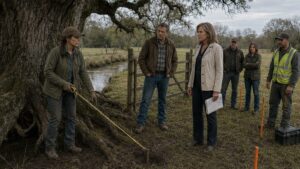
Instead of going inside, he walked to the cemetery with a flashlight.
The excavator sat fifty yards away, bucket lowered to the ground. The removed stones were covered with a tarp Joshua had tied securely over the trailer.
James went to the cedar post.
He placed one hand against it.
The wood was rough and cool.
He had spent most of his adult life believing records mattered because memory failed. Deeds remained when people died. Easements survived owners. Recorded words were durable precisely because families were not.
Yet here stood a boundary marker that had survived partly because people had remembered where it belonged.
Imperfectly.
Humanly.
He returned to the house and went through the bottom drawer of an old filing cabinet.
Tax records.
Farm leases.
His father’s estate documents.
Then a folder labeled CEMETERY.
Inside was a letter printed on his old law firm stationery.
James recognized the formatting before he read the date.
Twelve years earlier.
He had written the letter himself after reviewing the family cemetery records.
Because the existing monuments did not reconcile perfectly with modern mapping, he had recommended commissioning a boundary survey and recording a corrective plat before future road or land improvements created a dispute.
The last paragraph said the work should not be postponed merely because the cemetery had existed without conflict for generations.
James sat down.
Attached to the letter was an estimate from a survey company.
Across the top, in his father’s handwriting, were three words:
Ask James first.
There was no invoice.
No survey.
No corrective plat.
James remembered the conversation now.
His father had asked whether it really needed doing.
James had been busy.
He had said the old easement was strong enough and they could deal with the survey later.
Later had become twelve years.
Outside the office window, the cemetery was invisible in the dark.
James read his own final sentence again.
Do not postpone merely because no conflict has occurred yet.
On Monday morning, Dennis would argue that the cooperative had relied on the best current survey available.
And for the first time since the excavator stopped, James had to confront a possibility he did not like at all:
Dennis might still be responsible for crossing a warning line.
But James had helped create the uncertainty that made crossing it possible.
Chapter 4: The Road Was Necessary, but the Shortcut Wasn’t
The loaded hay trailer missed the gatepost by less than four inches.
James stood beside the cemetery fence Monday morning and watched the driver ease the rig forward, stop, reverse, and try again. The rear wheels dropped off the gravel into the soft shoulder. A bale shifted slightly against its straps.
The driver leaned out the window.
“This is why they’re widening it.”
James did not answer.
He watched until the trailer cleared the turn and climbed toward the neighboring farms.
Dennis had been saying the same thing for months. The lane had been built for wagons, pickups, and smaller machinery. Now headers arrived on wider trailers. Grain trucks met cattle trucks at the bend. Ambulances had once backed nearly a quarter mile because there was no safe place to turn around.
James had treated those complaints as Dennis’s problem.
That was becoming harder to do.
The excavator remained parked beyond the cemetery. Its bucket rested flat on the ground, exactly where Joshua’s crew had left it Saturday.
Nothing had moved.
James had spent Sunday night drafting a notice that did not accuse anyone of more than he could prove. By seven Monday morning, Dennis had received it. So had Joshua.
The notice demanded suspension of work within the disputed area until the cemetery boundary and burial rights were verified.
Dennis called ten minutes later.
“You froze the whole project.”
“I froze work beside the graves.”
“The contractor won’t mobilize half a crew.”
“That’s between you and the contractor.”
“No, James. It’s between six farms that need this road and you.”
James looked at the trailer disappearing up the lane.
“How much time do you actually have?”
Dennis was quiet for a moment.
“Come to the shed.”
The cooperative equipment shed sat a mile north of the Hill place, behind a row of grain bins. By the time James arrived, two other farmers were already there. Neither said much.
Dennis had spread invoices and schedules across a folding table.
“We financed the road work as one package,” he said. “Base stone, drainage, widening, resurfacing.”
James scanned the pages.
“Why September?”
“Because the contractor had the opening.”
“That isn’t what I asked.”
Dennis pushed a hauling schedule toward him.
“Corn starts coming off sooner than people think. Once it does, the heavy trucks start. If the road isn’t done, we either haul lighter loads or detour through county access.”
James knew the detour. It added nearly twelve miles each trip.
One of the farmers said, “Do that for three weeks and the fuel alone hurts.”
Dennis pointed at another page.
“The cooperative note has a completion condition. We miss it, the rate adjusts.”
“How much?”
Dennis told him.
James looked up.
It was not catastrophic.
But it was enough to matter, especially when spread across farms already carrying machinery payments and uncertain crop prices.
“So that’s the emergency,” James said.
“That’s part of it.”
“The other part?”
Dennis leaned back.
“The road is unsafe.”
James almost dismissed that automatically.
Then he remembered the hay trailer’s tires sliding into the shoulder.
Dennis saw the hesitation.
“You can be angry about the cemetery and still admit the road needs fixing.”
“I do admit it.”
That surprised the room into silence.
James folded the hauling schedule.
“The road problem is real.”
Dennis nodded once.
“The cemetery problem is also real.”
Dennis’s expression hardened again.
“And that’s where we’re stuck.”
James drove from the shed to the county records office.
Kathleen Perez met him at the counter with three bound plat books already open.
“You brought me a mess,” she said.
“I brought you old farming.”
“Same thing, usually.”
She examined the preservation instrument, then the later access easement.
“This one is still in the chain.”
“You agree the cemetery rights weren’t released?”
“I agree I don’t see a release.”
“That’s not the same answer.”
“It’s the only one you’re getting from me.”
James almost smiled.
Years earlier, he would have appreciated exactly that kind of caution.
Kathleen traced one line with a capped pen.
“The burial access right appears older. The road documents acknowledge prior interests. But this field corner—”
“Doesn’t close.”
“Correct.”
“I have the cedar post.”
“You have a cedar post.”
“The deed calls for one.”
“And your aunt says it was reset.”
James looked at her.
Kathleen raised an eyebrow.
“You told me yesterday.”
He had.
He was tired enough to forget what he had already admitted.
She slid the modern survey closer.
“The current surveyor didn’t pretend certainty. See this notation?”
James saw the same abbreviated warning he had noticed Sunday.
Approximate corner pending monument verification.
“So they knew.”
“The surveyor knew there was a question.”
“Dennis had this sheet.”
Kathleen looked at him.
“That is no longer a records question.”
James left with certified copies but no clean victory.
At the cemetery, the orange stakes seemed brighter than they had Saturday.
One stood several feet from the cedar post.
James paced the distance.
If the old description controlled, the road work had crossed well into protected ground.
If the reset post was wrong and the modern approximation proved closer to the original line, the exact amount of encroachment could shrink.
But the graves themselves had not moved.
That fact remained.
Joshua’s pickup came down the lane shortly after noon.
He parked beside the excavator and got out alone.
“I’m pulling the machine,” he said.
“Dennis tell you to?”
“My insurance agent did.”
James folded his arms.
Joshua walked toward the trailer where the stones remained covered.
“For what it’s worth, I thought everything was cleared.”
“Saturday morning?”
“At the start.”
James studied him.
“And later?”
Joshua looked toward the orange flags.
“The survey crew had two colors out here.”
“What do you mean?”
“Orange for the road. Pink around the questionable corner.”
James had seen only one faded pink flag in the grass.
“How long were they there?”
“Before we started.”
“Did you ask?”
“I asked Dennis.”
James waited.
Joshua rubbed a hand across the back of his neck.
“He said the surveyor had finished enough for us to proceed.”
“Those exact words?”
“Close enough.”
“What did you do?”
“Started cutting the shoulder.”
“And when you reached the cemetery?”
Joshua glanced at the covered stones.
“I stopped the operator.”
That was new.
“For how long?”
“Maybe fifteen minutes.”
“Why?”
“Because I didn’t like where the stakes ran.”
James felt the air change between them.
“What happened then?”
“Dennis came down.”
“And?”
Joshua looked directly at him.
“He told me the disputed corner had already been accounted for.”
“Did he show you anything?”
“No.”
“Did you tell him you were uncomfortable?”
“Yes.”
“What did he say?”
Joshua took a breath.
“He said the cooperative was accepting responsibility and told me to continue.”
James looked toward the cedar post.
Until that moment, he had assumed Dennis had relied too heavily on a modern survey.
That was careless.
What Joshua described was different.
Dennis had not simply failed to notice uncertainty.
He had stood inside it and made a choice.
Chapter 5: Dennis Had One Weekend to Choose
“I knew there was a question,” Dennis said. “I didn’t think there was time for it.”
He said it without apology.
The two men stood inside the cooperative shed Monday afternoon with the doors open to the lane. Dust hung in the light behind Dennis. On the table between them lay the modern survey, James’s legal notice, and a copy of the preservation easement.
James had expected denial.
Instead, Dennis had gone directly to justification.
“You knew the corner was disputed.”
“Yes.”
“You knew Joshua stopped.”
“Yes.”
“You told him to continue.”
Dennis looked at the floor once, then back at James.
“Yes.”
James felt something in him go still.
“Why?”
Dennis gave a tired laugh.
“You already know why.”
“No. I know what the road costs. I know what the hauling schedule looks like. I want to know why that became permission to move gravestones.”
“It didn’t.”
“You moved them.”
“The contractor moved them.”
“At your direction.”
Dennis’s jaw tightened.
“You want every sentence precise now?”
“Yes.”
“Fine. I told him the cooperative would take responsibility for any adjustment required after final verification.”
James stared at him.
“Adjustment.”
“I thought they were inside the widened shoulder.”
“They were graves.”
“I know what they were.”
“Do you?”
Dennis stepped away from the table.
For the first time, his irritation looked less like arrogance and more like exhaustion.
“You think I wanted this?”
“I think you wanted the road finished.”
“Yes.”
“At any cost?”
“No.”
“Then tell me where the line was.”
Dennis did not answer.
James waited.
Finally Dennis said, “We had a construction slot. If we lost it, Brown’s crew wasn’t coming back until after harvest.”
“That explains urgency.”
“It explains more than that.”
Dennis opened a folder and removed a financing sheet.
“We bundled the work because none of us wanted to pay twice for mobilization. Culvert first. Widening second. Surface last. The lender tied the rate to completion.”
“I saw that.”
“Then you saw what happens if we miss it.”
“A higher rate.”
“For you that may be a number on a page.”
James looked at him sharply.
Dennis continued.
“One of the farms is already carrying a combine note and two bad years. Another lost a lease this spring. We vote to delay the road because of a corner nobody can locate exactly, and I’m the one explaining why everybody’s cost went up.”
“So you gambled.”
“Yes.”
The admission came so cleanly that James almost missed it.
Dennis put both hands on the table.
“I gambled that the surveyor’s approximation was close enough, that the stones had been placed inside the cemetery but outside the old protected line, and that if we were off by a few feet we could correct it later.”
James looked at him.
“You gambled with something you didn’t own.”
Dennis flinched, barely.
“That’s fair.”
“No, it isn’t.”
“I mean the statement is fair.”
James turned away.
For three days he had imagined the satisfying version of this conversation. Dennis would refuse to listen. James would put the documents in front of him. The legal language would do the rest.
Instead, Dennis was telling him he had understood the risk and accepted it because other risks felt larger.
That made the choice more human.
It did not make it better.
A pickup stopped outside.
The insurance adjuster entered carrying a slim folder. He had spoken with both men earlier and had asked to review the site before the cooperative made additional commitments.
They walked together to the cemetery.
The adjuster photographed the removed stones, the scrape marks, the new survey flags, and the cedar post.
“What I need,” he said, “is a clear sequence.”
Joshua joined them near the trailer.
He gave it.
Survey uncertainty.
Crew stop.
Call to Dennis.
Instruction to proceed.
The adjuster wrote almost nothing while Joshua spoke.
That worried Dennis more than note-taking would have.
When Joshua finished, the adjuster closed his folder.
“If work continued after the contractor raised a known boundary concern, there may be a coverage issue.”
Dennis’s face changed.
“What kind of issue?”
“I’m not making a determination here.”
“You just suggested one.”
“I said there may be one.”
James watched Dennis absorb the same kind of cautious language Kathleen had used with him.
Nothing certain.
Nothing harmless.
Dennis looked toward James.
“You planned this.”
“No.”
“You knew insurance would become leverage.”
“I knew you should have called them Saturday.”
Dennis said nothing.
The adjuster left.
For several minutes, the only sound came from cattle in James’s lower pasture.
James looked at the road.
If he filed immediately for an injunction broad enough to stop construction inside the entire access corridor, he could probably freeze the project until the title issues were resolved.
That would protect the cemetery.
It might also stop drainage work, resurfacing, and the only practical route used by several farms during harvest.
Dennis seemed to read the direction of his thoughts.
“You could shut us down.”
“Yes.”
“For how long?”
“I don’t know.”
“Weeks?”
“Possibly.”
Dennis looked toward the road.
“That’ll cost everybody.”
James almost said, You should have thought of that.
The words reached his mouth and stopped.
He had his own letter in the farmhouse.
Do not postpone merely because no conflict has occurred yet.
He had known the cemetery records needed repair.
Dennis had crossed a warning line.
James had left the warning line blurry.
Those facts could exist together.
“What if the road doesn’t have to run there?” James asked.
Dennis looked back.
“It does.”
“No. The design does.”
“There’s a ditch on the other side.”
“I know.”
“And your pasture starts beyond the cemetery.”
“I know that too.”
Dennis stared at him.
James walked several yards south and looked across his own fence.
The pasture sloped gently away from the road before leveling near the hayfield. Moving the widening west would take more fill and require a shallow drainage adjustment.
It would also take land from James.
Dennis followed.
“You’re not serious.”
“I’m not promising anything.”
“What are you suggesting?”
“A standstill.”
“We already have one.”
“Forty-eight hours. No filing from me. No construction from you.”
Dennis narrowed his eyes.
“And then?”
“I get a surveyor in the field. We test an alignment that misses the cemetery completely.”
“Across your ground?”
“If it works.”
Dennis looked back toward the shed, then toward the farm lane.
“It’ll cost more.”
“Probably.”
“And the restoration?”
“Separate issue.”
Dennis shook his head.
“Of course it is.”
James faced him.
“You don’t get my land as a discount for what happened here.”
The anger returned to Dennis’s face, but only briefly.
“What do you want?”
“Every stone restored correctly. Every base repaired. Boundary recorded. Permanent cemetery access preserved.”
“And if the cooperative can’t afford all of that?”
“Then we have a different conversation.”
Dennis looked at the empty marker base.
James gave him forty-eight hours not because Dennis deserved relief, but because the road mattered to people who had never touched the cemetery.
“I’ll hold the filing until Wednesday afternoon,” James said.
Dennis nodded slowly.
“What happens Wednesday afternoon?”
James looked across his pasture.
“I’ll show you the line you should have used.”
Chapter 6: The Line They Should Have Followed
The first new survey stake went into James’s pasture.
The county survey technician drove it through sod twenty-three feet west of the existing gravel shoulder, checked the instrument, then moved farther south.
Dennis stood by the lane watching.
“So that’s yours,” he said.
James nodded.
“All of it?”
“From here to the bend, yes.”
The new alignment was not elegant.
It pushed the widened road away from the cemetery, crossed a narrow strip of James’s grazing ground, then curved back toward the existing lane after the graveyard boundary ended.
It required more base material.
A drainage swale would have to be reshaped.
Part of James’s fence would move.
But no grave would.
The technician placed another stake.
Then another.
The line began to emerge physically across the pasture.
Nancy arrived before noon.
She walked from the cemetery to the first stake and stood with her hands on her hips.
“You’re giving them this?”
“If the cooperative accepts the alignment.”
“How much land?”
“Not enough to hurt the farm.”
“That wasn’t my question.”
James watched the technician sight the next point.
“A little under half an acre when you count the permanent access strip and drainage.”
Nancy turned toward him.
“You fought three days over a few feet beside the cemetery, and now you’re giving away half an acre?”
“It’s not the same thing.”
“No?”
“No.”
She waited.
James knew she would not let him escape with that.
“The graves aren’t replaceable,” he said. “Pasture is.”
Nancy looked toward the cattle.
“And you’re not charging them?”
“For the land itself, no.”
“You always charge for land.”
“This isn’t a sale.”
“What is it?”
James glanced toward the cedar post.
The technician had tied a bright ribbon near it without touching the wood. The corrected line now used a professionally located point beside the post as a reference, preserving the historical marker while establishing a modern monument nearby.
James said, “It’s me fixing part of what I should have fixed years ago.”
Nancy’s expression softened, but not much.
“That sounds expensive.”
“It is.”
“Good.”
James almost smiled.
By midafternoon, the survey showed the reroute could work.
The cooperative gathered at the shed.
James brought a draft easement, a restoration proposal, and a single-page diagram.
Dennis read the first two pages slowly.
“You’re conveying permanent road access across your pasture.”
“Yes.”
“No purchase price.”
“Correct.”
“Survey cost?”
“Mine.”
Dennis looked up.
“Why?”
“Because I should have corrected the cemetery line years ago.”
One of the neighboring farmers shifted in his chair.
Nobody commented.
Dennis continued reading.
Then he reached the restoration clause.
His finger stopped.
“This part isn’t going to work.”
James sat back.
“What part?”
“All of it.”
The clause required the cooperative to pay for professional resetting of every displaced marker, repair of damaged bases, verification of grave locations, replacement fencing where needed, and filing costs associated with the corrected cemetery boundary.
Dennis tapped the page.
“You’re treating four stones like a full cemetery restoration.”
“I’m treating the disturbance as the reason we now need certainty.”
“We didn’t touch twelve of them.”
“You drove equipment into the protected area.”
“Disputed area.”
“Protected area.”
Dennis pushed the document away.
“We’ll pay for what we damaged.”
James kept his voice level.
“You don’t know the full extent yet.”
“We know which stones moved.”
“And which bases were disturbed?”
Joshua, sitting near the door, looked down.
Dennis noticed.
“What?”
Joshua said, “We scraped around two more.”
“You didn’t move them.”
“No.”
“Then they’re fine.”
James looked at Joshua.
“You sure?”
“No.”
The room tightened.
Dennis rubbed his forehead.
“You’re using this to upgrade the whole place.”
Nancy’s accusation from Sunday came back to James: You think if you can define your responsibility narrowly enough, you’ve met it.
He could have made the same mistake in reverse.
So he took out a second sheet.
“I’m paying for ongoing maintenance improvements.”
Dennis frowned.
“What?”
“Brush removal. New gate. Future mowing. Anything beyond restoring what existed and establishing the boundary.”
He slid the sheet over.
“I’m not asking you to beautify it.”
Dennis scanned the numbers.
James continued.
“I’m asking the cooperative to put back what its project disturbed and pay the professional cost of determining where those things belong.”
One of the farmers said quietly, “That seems different.”
Dennis gave him a look.
The farmer shrugged.
“It does.”
Dennis leaned back.
“What about insurance?”
“If they cover part of it, that reduces the cooperative’s out-of-pocket cost.”
“And if they don’t?”
James said nothing.
Dennis understood.
They broke without signatures.
The forty-eight-hour standstill would expire the next afternoon.
James returned to the cemetery.
The new survey stakes now curved visibly through his pasture, away from the graves. For the first time, he could see a solution on the land instead of only on paper.
Nancy walked beside him.
“You’ll regret losing that ground when the fence needs moving.”
“Probably.”
“You’ll complain about it.”
“Definitely.”
She stopped at the cedar post.
“You remember when your grandmother made your father reset this?”
“Not clearly.”
“You were there.”
“I remember being bored.”
Nancy smiled once.
“That sounds more accurate.”
James crouched near the post.
Beside it, the survey technician had set a capped modern pin flush with the ground. The old cedar no longer had to carry the full legal burden alone.
James touched the wood.
For years he had thought protecting the cemetery meant ensuring nobody could legally take it.
Now he understood the harder version.
Protection sometimes cost something.
Land.
Money.
Time.
Attention.
The next morning, Dennis came to the farmhouse.
He carried the reroute agreement.
Signed.
James checked the signature page.
“The restoration clause?”
Dennis shook his head.
“I’ll sign the road. Not that.”
James closed the folder.
“Then we’re not done.”
“We’re nearly done.”
“No.”
“James, I’m not writing a blank check because you’ve decided every old stone needs a specialist.”
“They do.”
“That’s your opinion.”
James looked at him for several seconds.
Then he stood.
“Come with me.”
They walked to the equipment trailer.
James asked Joshua to remove the tarp.
One by one, the displaced headstones appeared.
The smallest had a scraped edge.
Another carried a fresh pale scar near its base.
Then Joshua uncovered James’s grandmother’s stone.
The chip James had noticed Saturday looked larger in full light.
A shallow crack ran from the lower corner into the granite.
Dennis stared at it.
James said nothing.
Joshua moved the last section of tarp.
Behind the four stones were fragments of two old concrete bases the crew had lifted from the soil after they broke loose.
Dennis’s face changed.
“That wasn’t on Saturday.”
“It was,” Joshua said.
“You didn’t tell me.”
“You didn’t ask what came up with the bases.”
Dennis looked at the fragments.
James did not need to threaten him.
He did not need the easement.
He did not need the insurance adjuster.
For that moment, the stones were enough.
“They don’t go back with a loader and a bag of mix,” James said.
Dennis ran one hand over his mouth.
James placed the unsigned restoration agreement on the trailer beside his grandmother’s marker.
“The road can move,” he said. “The responsibility doesn’t.”
Dennis stared at the page, then at the stones.
For the first time since Saturday, he had no answer ready.
Chapter 7: They Put Every Stone Back Where It Belonged
The first headstone returned on the same equipment trailer that had carried it away.
James stood beside the cemetery gate as Joshua backed the trailer slowly along the rebuilt shoulder. This time there was no excavator bucket hanging over the graves. The stones rested individually on padded timber supports, each one strapped upright and tagged with a number corresponding to the restoration mason’s layout.
Joshua shut off the truck.
For a moment, neither man moved.
Then Joshua climbed down and said, “Figured this was the right trailer.”
James looked at his grandmother’s stone near the front.
“Probably is.”
Two weeks had passed since Dennis finally signed the restoration agreement.
He had done it the morning after seeing the broken bases.
There had been no dramatic meeting. No apology in front of the cooperative. Dennis had driven to James’s farm before breakfast, put the signed pages on the hood of James’s pickup, and said only, “We’ll do it right.”
James had answered, “That’s all I’m asking.”
It had not been all he wanted.
Part of him had wanted Dennis to admit that the whole thing had been reckless from the start. Another part wanted the cooperative to feel the same sick disbelief James had felt when he saw the empty rectangle where his grandmother’s marker belonged.
But by then he understood that punishment and repair were not always the same thing.
The restoration mason arrived shortly after Joshua.
He began with measurements rather than stone.
The corrected cemetery boundary had already been surveyed and recorded. A new metal monument sat flush with the ground beside the cedar post, its coordinates tied into the modern plat. The old preservation easement remained in place. The new road easement curved west through James’s pasture and then returned to the original lane beyond the cemetery.
Heavy trucks could now make the turn without clipping the gate.
The graves would never again be part of the shoulder.
The mason stretched lines between verified reference points and compared them to old photographs, surviving bases, and burial records.
James watched him work.
“You sure about this one?” James asked when the mason marked the position for his grandmother’s stone.
“As sure as the evidence lets me be.”
James looked at the ground.
“That’s not a lawyer’s answer.”
The mason glanced at him.
“It’s a mason’s answer.”
James nodded.
He had spent too many years believing certainty was something a document either contained or failed to contain. The last few weeks had taught him that land remembered through layers: paper, stone, fence lines, family stories, scars in the soil.
None was perfect alone.
Together, they could be enough.
By noon, two markers were back in place.
Dennis arrived carrying work gloves.
James saw him park but did not walk over.
Dennis crossed the grass, stopped near Joshua, and asked what needed doing.
Joshua pointed toward a pile of old fence wire.
“Could start there.”
Dennis did.
No one announced his presence.
No one thanked him.
He coiled rusted wire, carried damaged posts away, and helped unload gravel for the narrow walking path inside the cemetery.
Later, James found him beside the cedar post.
Dennis had one hand resting on a new pressure-treated replacement post still lying on the ground.
“The mason says this old thing’s about finished,” Dennis said.
James looked at the cedar.
The top had split. One side showed the pale scrape left by the excavator. It leaned several degrees toward the lane.
The survey technician had suggested replacing it now that the modern monument fixed the corner legally.
James had almost agreed.
A clean post would last longer.
It would look better.
He thought of his grandmother kicking the cedar with the toe of her shoe. He thought of Nancy saying his father had reset it after the tractor struck the fence.
“Leave it.”
Dennis frowned.
“It’ll rot.”
“Eventually.”
“You’ve got the new pin now.”
“I know.”
Dennis studied him.
“So why keep it?”
James ran his thumb over the splintered scrape.
“Because it was never just a survey monument.”
Dennis waited for more.
James did not give him any.
After a moment, Dennis nodded.
They set the new fence several inches away, leaving the old cedar standing inside the protected corner.
By late afternoon, James’s grandmother’s headstone was ready.
The crack had been stabilized. The chipped corner had been repaired without trying to disguise every mark. The stone looked older than the polished granite monuments in newer cemeteries.
James preferred it that way.
The mason guided it onto the rebuilt base.
When the lifting straps came free, Nancy stepped closer.
She had spent most of the day carrying records and telling people when they were about to set something in the wrong place.
Now she stood in front of the restored stone without speaking.
James came beside her.
“You want a minute?”
“No.”
He waited.
Nancy brushed dirt from the edge of the base with her shoe.
“Your grandmother would say it needs washing.”
James smiled.
“She’d say we were wasting daylight standing here.”
“That too.”
Nancy looked across the cemetery.
Four displaced stones were back where they belonged. The two scraped bases had been repaired. The older unreadable fieldstones remained untouched except for careful clearing around them.
Nothing had been modernized.
Nothing had been made uniform.
It looked like a small rural cemetery again.
Not impressive.
Not decorative.
Kept.
A local reporter had called twice asking whether the family planned any kind of reopening or rededication once the work finished.
James had ignored the first call.
Nancy answered the second.
She told the reporter there would be no ceremony.
When James asked why, she said, “We don’t need people coming out here to watch us act like we discovered our own cemetery.”
Now, standing beside the restored markers, she handed James a sheet of paper.
“What’s this?”
“A schedule.”
He unfolded it.
March cleanup.
First mowing in May.
Monthly mowing through September.
Fence inspection every spring.
Marker inspection every other year.
Brush removal before winter.
James looked at her.
“You made a maintenance schedule.”
“Somebody had to.”
“You volunteering?”
“I’m seventy-four.”
“That didn’t answer the question.”
Nancy pointed at the paper.
“Your name goes first.”
James looked down.
Several blank lines waited beneath each task.
For years, he would have preferred the easement.
An easement was clean. Record it once, and its obligations lived in an archive where nobody had to discuss them.
This sheet demanded somebody show up.
“I’ll do it,” he said.
Nancy studied his face.
“Don’t tell me. Put your name on it.”
She handed him a pen.
James signed.
Dennis approached as Nancy was folding the schedule.
He had dust on his jeans and a red mark across one forearm from carrying fence wire.
“The road crew starts surface stone tomorrow,” he said.
James nodded.
“They know the new line?”
“They’d better.”
A trace of humor entered Dennis’s voice, then disappeared.
He looked at the restored stones.
“I should’ve stopped when Joshua did.”
James said nothing.
Dennis rubbed his gloves together.
“I kept thinking if we missed the schedule, everybody would blame me for not making a decision.”
“They might have.”
“I know.”
“That doesn’t mean the decision was yours to make.”
Dennis nodded.
“No.”
It was not an apology polished for acceptance.
James appreciated that more than he expected.
“I should’ve fixed the boundary years ago,” he said.
Dennis looked at him.
“That doesn’t make what I did okay.”
“No.”
Another pause.
“But it made the mistake easier to make.”
Dennis considered that.
Then he held out his hand.
James looked at it before taking it.
Nothing between them was erased.
They would still argue about drainage. Dennis would still push schedules. James would still distrust any sentence beginning with the cooperative has decided.
But the road would remain shared.
So would the consequences of living beside one another.
By late October, harvest traffic was using the widened lane.
James sometimes stopped working when a loaded grain truck came through just to watch it take the new curve. The tires remained well away from the cemetery fence. Beyond them, the cedar post still leaned beside the bright cap of the modern survey monument.
Old memory and new certainty, side by side.
One Saturday morning, James carried a rake and pruning shears through the cemetery gate.
He cleared leaves from the markers, trimmed grass around the bases, and pulled a young mulberry shoot growing beside one of the unreadable stones.
His grandmother’s photograph now sat on the wall of the farm office.
Beside it hung Nancy’s maintenance calendar.
Not filed.
Not stored.
Visible.
When James finished working, he paused at the cedar corner.
The old post would not last forever.
Neither would the fence.
Neither would he.
That had once seemed like an argument for relying on records.
Now it felt like an argument for something else.
He checked the gate latch, picked up his tools, and walked back toward the farmhouse.
Before lunch, he would mark October’s cemetery inspection complete.
Next spring, he would come back.
The story has ended.