They Banned My Kids From the Farm Lane—Then Learned Who Had Powered Their Lights for Twenty Years
Chapter 1: Twelve Minutes Past the New Farm-Lane Curfew
Ronald Harris stepped into the middle of the gravel lane and raised one hand.
Tyler Brown’s son hit the brakes hard enough for the rear tire of his bicycle to slide sideways. Loose stones scattered beneath it.
Ronald looked first at the boy, then deliberately at his wristwatch.
“Seven twelve.”
Tyler heard him from the equipment shed.
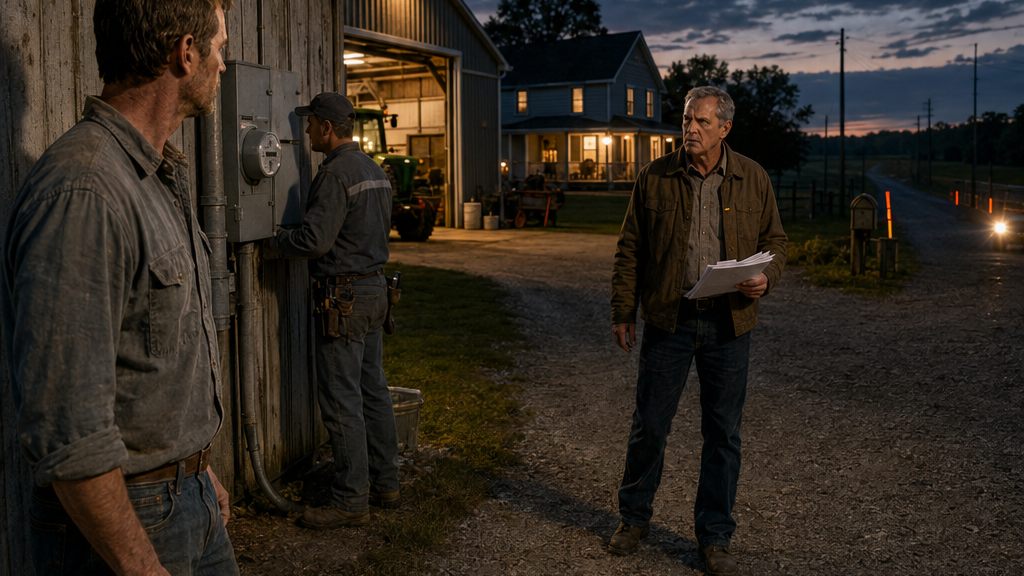
He set the grease gun down on the tractor tire and walked toward them, wiping his hands on a shop rag. Behind Ronald, the pole lights along the shared lane were beginning to glow one after another in the fading evening. The nearest stood beside the mailbox shelter; another marked the turn toward William Scott’s hay ground. Beyond them, cattle moved darkly against the pasture fence.
Tyler’s son kept one foot on the ground.
“I was coming home.”
“I know where you were going,” Ronald said.
There was a sheet of paper clipped to the board in his hand.
Tyler stopped beside the bicycle. “What’s this?”
“A warning.”
“For riding home?”
“For violating the evening-use rule.”
The lane committee had discussed traffic safety at its meeting the previous week. Tyler had been there. He had heard Ronald talk about tractors, delivery trucks and trailers entering after dusk. Tyler had even agreed that children should stay clear when heavy equipment was moving.
What he had not heard was that the discussion had become a curfew.
“When did a safety recommendation become a violation?” Tyler asked.
Ronald extended the paper.
“Committee vote Sunday night.”
Tyler did not take it.
Sunday night he had been repairing a hay rake with William. Nobody had called him.
Ronald seemed to read the question on his face.
“Notice was sent.”
“To where?”
“Everyone on the lane.”
Tyler’s son shifted his bicycle between them.
The paper showed a typed rule prohibiting bicycles, scooters, basketball and “unsupervised recreational activity” on common portions of the lane after seven in the evening.
The boy looked down.
That bothered Tyler more than the rule.
“Go put your bike in the shed,” he said.
His son hesitated. “Dad, I—”
“You’re fine. Go ahead.”
Only when the bicycle wheels crunched away did Tyler look back at Ronald.
“You stopped a kid twelve minutes after seven to hand him paperwork?”
“I stopped an unsafe activity.”
“He was fifty yards from our driveway.”
“That doesn’t change the rule.”
Tyler folded the shop rag once, then again.
He had known Ronald most of his adult life. Ronald liked gates latched, gravel graded and bills paid before they were due. If a culvert clogged, he was usually the first man standing in the ditch with a shovel. That part of him had always been useful.
Lately, useful had begun to turn into supervisory.
“We can talk about traffic,” Tyler said. “We can talk about where the kids should move when a truck comes through. But seven o’clock doesn’t make a bicycle dangerous.”
“It gets darker.”
“Then write a rule about visibility.”
Ronald’s mouth tightened.
“We tried suggestions. Suggestions depend on people using judgment.”
The implication landed exactly where Ronald intended it.
Tyler looked toward the equipment shed. His son had disappeared inside.
Ronald lowered his voice.
“Responsible families shouldn’t need somebody else telling them where their children belong after dark.”
For one second Tyler pictured taking the clipboard out of Ronald’s hand and throwing it into the ditch.
Instead he said, “Don’t talk about my family that way.”
“I’m talking about responsibility.”
“You came onto my frontage and stopped my son.”
“The lane is shared.”
“So is respect.”
A pickup approached from the county road, and both men moved aside. Its headlights swept over the mailbox shelter, the cedar posts and the orange reflective flags Ronald had installed near the entrance.
When the truck passed, Ronald held the warning out again.
“I need your signature acknowledging receipt.”
Tyler looked at the signature line.
“No.”
“It doesn’t mean you agree.”
“I know what a signature means.”
“It means you received it.”
“You can write down that you handed it to me.”
Ronald gave a small, humorless breath.
“Second violation carries a twenty-five-dollar assessment. Third is fifty.”
Tyler almost laughed.
“You’re fining children now?”
“The property owner receives the assessment.”
“Of course he does.”
Ronald clipped the sheet back to his board.
“This isn’t personal, Tyler.”
That was the first thing he had said all evening that made Tyler angry enough to feel it in his chest.
He looked past Ronald at the row of glowing lights.
For years they had been part of the lane without anyone thinking about them. Warm circles on gravel. Light over the mailboxes in winter. Enough illumination for a truck to find the turn after dark.
The nearest cable disappeared underground near Tyler’s property and reappeared beside his weathered equipment shed, not far from an old gray meter box he had walked past thousands of times.
A faint electrical hum came from it.
Tyler had never once wondered what else was attached.
“Take your warning home,” he said.
Ronald nodded as if Tyler had merely confirmed something disappointing.
“There’ll be another one if it happens again.”
He walked away beneath the lights.
At dinner, Tyler said very little.
His son pushed potatoes around his plate.
“Can I still ride in the pasture?”
“Of course.”
“What about the lane?”
Tyler glanced at Catherine.
She was watching him.
“We’ll figure it out,” he said.
Later, after the children were upstairs, Catherine opened the farm bookkeeping program at the kitchen table. Tyler was halfway through washing a coffee mug when she stopped clicking.
“What?”
She leaned closer to the screen.
“Come here.”
He dried his hands and stood behind her.
Catherine had opened the latest electric statement and was comparing it with the farm’s recurring expense entries.
She pointed to a notation she had copied years earlier from the account description.
“Why does this say lane lighting?”
Tyler stared at the words.
Catherine looked up at him.
“Tyler, why are we paying for the lane lights?”
Chapter 2: The Bill Nobody Had Questioned for Years
At six the next morning, Tyler switched off the first breaker.
Nothing happened.
He switched off the second.
The machine shed went silent.
The third killed the exterior light over the cattle lot.
Then he flipped the fourth.
Across the gravel lane, the lamp above the mailbox shelter went dark.
Tyler stood perfectly still.
Fifty yards farther down, another pole light blinked out.
Then a third.
He pushed the breaker back on.
One by one, the lights returned.
Behind him Catherine said, “Well.”
Tyler turned.
She stood in the shed doorway holding two mugs of coffee.
“That seems fairly clear.”
“No,” Tyler said. “It seems strange.”
She handed him a mug.
“Those can both be true.”
The circuit panel was older than most of the equipment around it. Tyler remembered his father replacing labels after mice had damaged a paper diagram years before. Some markings were precise—WELL PUMP, NORTH BARN, SHOP OUTLETS.
The fourth breaker simply said EXT.
Tyler had assumed it meant exterior.
Apparently it meant considerably more exterior than he thought.
He walked around the shed to the gray meter.
The conduit left the bottom of the box, ran down the wall and disappeared beneath the gravel. Another line continued toward the barn. The underground branch toward the lane looked old enough to have been installed when Tyler was still in school.
He photographed the meter number, the panel and the conduit.
Catherine stood beside him.
“You knew something was on our bill.”
“I knew there were exterior lights.”
“Those aren’t our exterior lights.”
“I never broke the account apart.”
That was true, but not complete.
His father had always treated shared expenses casually. A neighbor borrowed a post driver; somebody else hauled gravel; Tyler’s father paid for fuel one month and got help repairing a fence the next.
Tyler had inherited some of that habit.
He had also inherited the weakness inside it: if a cost was small enough, he preferred not to start an argument.
Catherine knew it.
“How many years have you been paying this?”
“I don’t know.”
She folded her arms.
“That means a long time.”
By eight-thirty Tyler was at the county records office with a folder of property documents and the photographs from the shed.
The clerk brought up parcel maps and utility easements on a monitor.
Tyler traced the private lane through the cluster of properties.
“There should be a service point around here.”
The clerk zoomed in.
“There’s an easement for utilities.”
“I see that. I’m looking for a meter or separate service for the lane association.”
The clerk searched several records.
Nothing.
They checked the entrance parcel.
Nothing.
They checked the mailbox structure and the narrow strip where the first pole stood.
Still nothing.
The clerk finally turned the screen slightly toward him.
“If there’s a separate account, I can’t see evidence of the installation in these filings.”
“What about this?”
Tyler pointed to a faint line on an older scanned plan.
The line ran from his current farm parcel toward the shared entrance.
The clerk enlarged it.
“Electrical service, probably.”
“To the lane?”
“Looks that way.”
The plan was dated more than twenty years earlier.
Tyler sat back.
The anger he had carried into the building lost some of its heat and became something harder to place.
This was not Ronald wiring into his property.
Ronald had not created it at all.
The connection was older than the current committee.
Older than several houses on the lane.
Tyler asked for copies.
Before leaving, he checked one more thing.
“Is there anything here requiring my parcel to provide electricity indefinitely?”
The clerk shook her head.
“I can tell you what’s recorded. I can’t give you legal advice.”
“Understood.”
“I don’t see a recorded utility agreement saying that.”
That sentence stayed with him all the way home.
At the farm, he laid the records across the kitchen table.
Catherine compared them with old electric bills.
The amounts were not dramatic. That almost irritated Tyler more. Nobody had stolen some enormous sum. Nobody had committed a spectacular fraud.
The expense had simply been there.
Month after month.
Year after year.
Small enough that everyone could forget who carried it.
Catherine tapped one of the bills.
“You could call the utility.”
“I could.”
“But?”
Tyler looked toward the window.
From the kitchen he could see part of the shared lane and the roof of the mailbox shelter.
“But I want to know what I’m looking at first.”
“You mean before Ronald knows.”
“Yes.”
She studied him.
“That’s not exactly the same thing.”
Tyler gathered the bills.
“I’m not shutting anything off.”
“I didn’t say you were.”
“You were thinking it.”
“I was thinking you’re angry.”
“So are you.”
“I am. That doesn’t make every angry idea smart.”
He carried the box of older farm records into the office.
Most had belonged to his father.
Insurance papers. Seed invoices. handwritten cattle records. Utility statements saved long past any reasonable accounting need.
Tyler worked backward through them.
Ten years.
Fifteen.
The same service number.
The same recurring notation.
Then, inside an envelope from years before the current committee existed, he found a bill with a handwritten mark beside the electricity charge.
His father’s initials.
T.B.
Tyler’s thumb stopped on the ink.
Next to the initials was a small arrow pointing toward the lane-light entry.
Not an accountant’s code.
Not a utility-company notation.
His father had noticed it.
Tyler stared at the page until Catherine came to the doorway.
“What did you find?”
He turned the bill toward her.
“My dad knew.”
Chapter 3: What His Father Had Quietly Kept Running
The note was folded behind the bill.
Tyler almost missed it.
A narrow piece of yellowed paper had been tucked into the envelope, creased twice and written in his father’s blocky handwriting.
Leave lane lights on until they get their own service.
That was all.
Tyler read it again.
Catherine stood on the opposite side of the desk.
“So it wasn’t accidental.”
“No.”
“Does it say who ‘they’ are?”
He shook his head.
There was no date on the note, but the bill beside it was from the period when several properties along the lane had been subdivided and the shared entrance rebuilt.
Tyler remembered some of it.
He had been young enough then to care more about leaving the farm on Friday nights than about where electrical conduit ran. His father had attended meetings at kitchen tables and stood in ditches with contractors. When neighbors needed something practical, he rarely made a ceremony of helping.
That memory made Tyler’s anger more complicated.
His father had not been tricked.
He had chosen this.
Tyler searched the next box.
There were invoices from the original electrical contractor and a rough sketch showing a temporary feed from the Brown farm service to the lane fixtures. Another paper mentioned a future independent service connection.
Future.
Tyler checked the date.
Twenty-one years earlier.
Catherine read over his shoulder.
“They never did it.”
“No.”
“Did your dad ever remind them?”
“Maybe.”
“You’d remember?”
“I wasn’t here for half of those conversations.”
Tyler had left for several years before returning to work the farm full-time. By then, the lane lights were simply there. His father paid the electric bill. Later Tyler paid it. Nobody discussed why.
He found no written promise to continue indefinitely.
No transfer agreement.
No reimbursement schedule.
Just the temporary connection and his father’s instruction not to shut it off until the neighbors had their own service.
Catherine sat down.
“He was helping them.”
“Yes.”
“And they forgot.”
Tyler rubbed the paper between his fingers.
“Maybe everybody forgot.”
Including him.
That was the part he did not enjoy admitting.
For years Tyler had seen unexplained costs and minor inconveniences and treated asking questions as somehow less neighborly than absorbing them. He had thought that was patience.
Now Ronald had built rules on top of an arrangement Tyler himself had never bothered to clarify.
His phone buzzed.
A message from William Scott.
You seeing the new committee notice?
Tyler opened the attachment.
The restrictions had expanded.
No basketball near the old concrete milk pad after seven.
No sidewalk chalk or temporary markings around the mailbox shelter or shared entrance.
No “recreational congregation” that could interfere with vehicles.
Tyler read the phrase twice.
Catherine leaned over.
“Recreational congregation?”
“My daughter and two pieces of chalk, apparently.”
That afternoon Tyler found Ronald near the entrance placing another orange reflective flag beside the ditch.
His daughter’s chalk drawing from the weekend—a crooked blue barn with three oversized cows—still marked the edge of the old concrete pad.
Ronald noticed Tyler looking.
“That’ll need to be cleaned off.”
“It washes away when it rains.”
“The rule says no markings in the common area.”
“She’s six.”
“The rule isn’t based on age.”
Tyler felt the folded note from his father in his shirt pocket.
He had brought it outside without deciding why.
“You added this after Tuesday?”
“We clarified it.”
“You expanded it.”
Ronald pushed the flag deeper into the soil.
“We’re trying to make the entrance predictable.”
“A chalk cow makes traffic unpredictable?”
“Kids gather where the chalk is.”
“Then say children need to clear the lane when vehicles enter.”
“We’ve tried common sense.”
There it was again.
The suggestion that if Ronald had to write a rule, somebody else had failed first.
Tyler looked down the lane.
The underground electrical line ran beneath some portion of that gravel. Every light Ronald was using to define the committee’s orderly little corridor ultimately traced back to Tyler’s meter.
He could tell him.
Right now.
One sentence would change the conversation.
Instead Tyler asked, “Did the committee ever get its own electric service?”
Ronald frowned.
“What?”
“For the lane lights.”
“I assume so.”
“You’re the chairman.”
“I don’t manage utility wiring.”
“Who pays the electric bill?”
“The maintenance account handles common expenses.”
“Does it?”
Ronald straightened.
“What exactly are you asking?”
Tyler nearly answered.
Then he stopped himself.
He did not yet know whether he was withholding the information because he wanted facts—or because, for once, he liked knowing something Ronald did not.
That realization embarrassed him.
“I’m asking what belongs to the committee,” Tyler said.
Ronald gave him a suspicious look.
“The entrance improvements belong to everyone on the lane.”
“That wasn’t my question.”
Before Ronald could answer, a tractor appeared at the far turn, towing an empty hay wagon.
Both men stepped aside.
Tyler watched the machine pass between the orange flags.
The lane was narrow there. A child on a bicycle would have needed to move decisively.
For the first time since Tuesday, Tyler saw the problem without seeing Ronald attached to it.
There was a real safety question buried somewhere under all the rules.
Ronald had simply decided that because the question was real, every answer he chose must also be right.
That evening Tyler spread the records across the farm office floor.
He followed every reference he could find.
Temporary connection.
Future independent service.
No later installation.
No recorded transfer.
His father’s handwritten instruction sat at the center of it all.
Leave lane lights on until they get their own service.
Tyler finally understood what bothered him most.
His father had not promised forever.
He had expected somebody to finish the job.
And Tyler, by never asking, had helped turn a favor into something everyone assumed was permanent.
His phone chimed again.
This time the message had been sent to every property owner on the lane.
Ronald’s name appeared at the bottom.
Tyler read the committee notice slowly.
It cited “continued noncompliance” and warned that unsupervised children remained “a recurring safety nuisance” near shared access areas.
He heard footsteps and looked up.
His son stood in the doorway.
“Am I allowed to ride tomorrow?”
Tyler looked from the boy to his father’s note.
For twenty-one years, electricity had been flowing through a promise nobody had bothered to finish.
Now Ronald was using that same illuminated lane to tell Tyler where his children belonged.
Tyler folded the committee notice once and placed it beside the old bill.
Tomorrow, he decided, somebody was finally going to ask what the lane had been taking for granted.
Chapter 4: The Fear Behind Ronald’s Seven O’Clock Rule
The orange flags had multiplied overnight.
Tyler counted six of them before he reached the shared entrance Thursday morning, each driven into the grass along the inside edge of the ditch. Ronald stood beside the pasture fence pushing a seventh into the ground with both hands.
Tyler stopped his pickup.
“What are those marking?”
Ronald did not look up. “Visibility points.”
“They weren’t there yesterday.”
“They should’ve been.”
Tyler got out.
Near the third flag, two pale black streaks remained on the pavement where the gravel lane met the county road. They were old enough to have faded but too straight to be tractor tracks.
Tyler stared at them.
“Braking marks?”
Ronald drove the flag another inch down.
“Last fall.”
Tyler waited.
Ronald finally stood.
“A feed truck came through too fast.”
“That happens more than it should.”
“My granddaughter was right there.”
The answer landed differently than Tyler expected.
He looked again at the marks.
“How close?”
Ronald’s jaw moved once before he spoke.
“Close enough.”
That was not a farmer’s measurement. Ronald usually measured everything.
Fence gaps. Gravel depth. Culvert diameter.
If he refused a number, Tyler understood there probably was not one he wanted to remember.
“What was she doing?”
“Riding.”
“On the lane?”
“Coming across from the mailbox.”
The picture assembled itself without much help. Late afternoon. Dust in the air. A child moving faster than an adult expected. A heavy truck entering from the county road.
Tyler looked toward the curve where his own son had been stopped two nights earlier.
“You could’ve told me.”
Ronald gave a short laugh.
“I tried telling everybody we needed rules.”
“You told us there was too much traffic at dusk. That’s not the same thing.”
“What difference would it make?”
“A lot.”
“The truck missed her because the driver hit his brakes. That’s the difference that mattered.”
For once there was no smugness in Ronald’s voice.
Only anger that had been sitting somewhere for a long time.
Tyler leaned against the hood of his pickup.
“So that’s why seven?”
“That’s when activity needs to stop.”
“No. That’s not what I asked.”
Ronald looked at him.
“Why seven?”
“Because we needed a line.”
“A feed truck doesn’t become safe at six fifty-nine and dangerous at seven.”
“That’s exactly why you need a fixed time. People remember fixed rules.”
Tyler pointed toward the orange flags.
“This is useful.”
Ronald’s expression hardened slightly, as though praise made him suspicious.
“Reflectors help.”
“And telling kids to pull off when equipment is coming through helps.”
“Yes.”
“Then do that.”
“We did.”
“No. You banned bikes.”
“Because nobody follows suggestions.”
Tyler almost answered sharply, then stopped.
The faded skid marks were still between them.
For the first time, Ronald’s obsession with the lane looked less like a man searching for control and more like a man trying to guarantee that one terrifying moment could never repeat.
The trouble was that fear had made him certain.
And certainty had made everyone else’s judgment irrelevant.
That evening the committee met inside William Scott’s machinery shed.
A row of folding chairs faced a scarred workbench. The smell of oil and dry hay clung to the rafters.
William sat near the end with his cap in his hands.
Two other landowners were there.
Ronald opened with traffic.
Tyler waited until he finished.
Then he said, “I agree we have a visibility problem.”
Ronald glanced at him.
William did too.
Tyler continued.
“We have semis, tractors, livestock trailers and kids using the same narrow entrance. Put reflective markers in. Set a rule that recreation clears the entrance when commercial or farm equipment is moving. Add lights to bikes after dusk.”
One of the landowners nodded.
Ronald did not.
“And when someone ignores it?”
“Then deal with the person who ignored it.”
“We already tried individual judgment.”
“You keep saying that like judgment is the problem.”
“It is when the consequence is a child under a truck.”
The room went still.
William looked toward the floor.
Tyler said, “Ronald told me about your granddaughter.”
Ronald’s eyes narrowed.
“That’s not committee business.”
“It became committee business when it became the reason for these rules.”
Ronald stood.
“I still hear those brakes.”
Nobody moved.
He looked around the shed, but his attention seemed fixed somewhere else.
“Every time a kid comes flying around that entrance, I hear them. I was twenty feet away. She never saw the truck. The driver never saw her until she was in front of him.”
Tyler said nothing.
Ronald rubbed his thumb against the edge of the workbench.
“I don’t intend to stand there again and hope somebody remembers a suggestion.”
The admission changed the room.
It did not make the chalk rule sensible.
It did not make stopping Tyler’s son at 7:12 reasonable.
But it made Ronald human in a way Tyler had been resisting.
William cleared his throat.
“Maybe we can separate the entrance from the rest of the lane.”
Ronald looked at him.
“Meaning?”
“Restricted zone around the turn when trucks are active. Not a blanket curfew.”
“No.”
William frowned. “Why not?”
“Because exceptions turn into arguments.”
Tyler understood then.
The fear was real.
So was the choice Ronald was making with it.
“You don’t want safety,” Tyler said quietly. “You want obedience because obedience feels safer.”
Ronald’s face tightened.
“And you think because it’s your kid, your judgment is better?”
“No. I think my kid isn’t a nuisance because you got scared.”
Ronald looked away first.
The meeting ended without agreement.
Outside, William caught Tyler beside his pickup.
“You pushed him hard.”
“He pushed first.”
“That doesn’t make it smart.”
Tyler opened his door.
William hesitated.
“You really think the lights are on your meter?”
Tyler looked at him.
“I know they are.”
William’s brows rose.
“Ronald know?”
“Not yet.”
“That sounds like trouble.”
“It’s twenty-one years of trouble nobody bothered naming.”
William stared back toward the shed.
“What are you going to do?”
Tyler did not answer.
At home, Catherine was at the kitchen counter when he came in.
“How bad?”
“Better than I expected.”
“That doesn’t sound good.”
“Ronald’s granddaughter almost got hit by a feed truck last year.”
Catherine stopped.
“Oh.”
“He isn’t making the danger up.”
“But?”
“But he thinks fear gives him the right to decide everything.”
She studied him.
“And what do you think anger gives you?”
Tyler looked toward the farm office.
His father’s note was still on the desk.
Leave lane lights on until they get their own service.
He had spent two days deciding whether that sentence obligated him.
Now he realized the more important word was until.
The favor had an end built into it.
Someone simply had to choose it.
Tyler opened his laptop, found the utility contact page and entered the service number.
Catherine read over his shoulder.
“What are you doing?”
“Separating the circuit.”
“When?”
“The first appointment they have.”
A confirmation appeared.
Friday afternoon.
Catherine said nothing for several seconds.
Then, “Does Ronald know?”
“No.”
Tyler closed the laptop.
He had told himself he was drawing a boundary.
But as the confirmation sat glowing on the screen, he could not quite silence another question.
Was he ending an old favor because it needed to end—or because, after years of saying nothing, he finally wanted Ronald to feel what it was like to lose control?
Chapter 5: When the Shared Lane Went Dark at Dusk
The utility technician held one gloved finger against the diagram.
“This one?”
Tyler looked at the line running from the old gray meter toward the underground conduit.
“That’s the shared lane circuit.”
“And everything else stays?”
“House, barn, cattle lot, shop.”
The technician nodded.
“I’m asking because once I isolate this, those exterior fixtures aren’t coming back through this service without another work order.”
Tyler looked past him.
The afternoon sun was still high enough that the pole lights had not switched on. The mailbox shelter sat quiet at the entrance. Beyond it, orange flags moved in the wind.
“Do it.”
The technician returned to the meter box.
Tyler stayed outside.
He had expected the moment to feel larger.
Instead there was only the click of tools, the scrape of a metal cover and the technician checking voltage twice before securing the disconnected branch.
No sparks.
No dramatic silence.
Nothing that looked like revenge.
Just a man doing ordinary utility work because an account holder had requested that one service stop feeding property that was not his.
Catherine came from the house carrying a glass of water.
“You told William?”
“Yes.”
“Anyone else?”
Tyler hesitated.
“Not yet.”
She handed him the glass.
“That means no.”
“The committee never notified me they were using it.”
“They didn’t know.”
“That’s part of the problem.”
Catherine watched the technician.
“Maybe.”
Tyler looked at her.
“You think I should’ve warned Ronald.”
“I think if you want this to be about boundaries, you should act like it’s about boundaries.”
“He would’ve tried to stop it.”
“Could he?”
“No.”
“Then warning him wouldn’t have changed that.”
Tyler drank the water.
The technician closed the panel.
“All set.”
“That’s it?”
“That’s it.”
He handed Tyler a service sheet and drove away.
For the rest of the afternoon, nothing happened.
Tyler repaired a gate hinge.
His son helped carry mineral blocks.
His daughter drew with chalk on the concrete pad beside their own barn, where no committee rule applied.
At five-thirty Ronald’s pickup passed without stopping.
At six-fifteen William hauled an empty wagon toward his place.
At six-forty Tyler found himself watching the lane.
He told himself he was checking the cattle fence.
At six-fifty the automatic yard light over Tyler’s barn snapped on.
The porch light followed.
The security lamp above the equipment shed cast a white circle across the gravel.
Tyler looked toward the shared entrance.
Nothing.
The mailbox lamp remained dark.
The first pole did not come on.
Neither did the second.
Farther along the lane, the fixture at the bend stayed black.
The effect was stranger than Tyler expected.
His farm sat normally illuminated behind him while the shared lane beyond the property line seemed to vanish into evening.
His son came out of the barn.
“Dad.”
“I see it.”
“Did you turn them off?”
“No.”
The boy looked at the bright lamp over the equipment shed, then at the darkness beyond it.
“But they’re off.”
“They’re not connected to us anymore.”
His son considered that.
“Because of Ronald?”
Tyler looked down.
“Because they should have their own service.”
It was the answer he wanted to believe completely.
Headlights appeared at the county road.
A pickup slowed too early, searching for the entrance that had always been marked by light.
It found the turn.
A few minutes later another vehicle arrived.
Then Tyler’s phone buzzed.
William.
Lights out at your end too?
Tyler typed back.
Shared circuit was separated today.
The reply came almost immediately.
You might want to explain that fast.
A second message arrived from another neighbor.
Then a third.
Catherine stepped onto the porch carrying Tyler’s phone charger.
“Starting?”
“Starting.”
His screen lit again.
Ronald.
CALL ME.
Tyler put the phone in his pocket.
“Not yet.”
Catherine sighed.
“You’ve been waiting two days for this.”
“For the circuit to be separated.”
“That isn’t what I meant.”
Before he could respond, a low diesel rumble came from the county road.
Tyler turned.
A livestock truck was approaching.
Unlike the pickups before it, the truck did not glide into the entrance. It slowed, braked, moved forward, then stopped.
Its headlights washed across the ditch instead of the lane.
The driver backed slightly.
The trailer swung.
Tyler was moving before he thought about it.
He grabbed a flashlight from the shed and walked toward the entrance, waving the beam low across the gravel.
The driver rolled down the window.
“Can’t see the corner.”
“I know.”
“Your marker light out?”
“All of them are.”
The driver muttered something and eased forward while Tyler guided him past the mailbox structure.
The trailer cleared the ditch by less than a foot.
When it passed, Tyler stood beside the orange flags with the flashlight in his hand.
The satisfaction he had expected was gone.
Ronald had been wrong about the children.
He had not been wrong that visibility mattered.
Catherine came up behind him.
“That’s what I was talking about.”
Tyler nodded.
He did not defend himself.
The dark lane no longer looked like proof.
It looked like a problem.
Then headlights swung into Tyler’s driveway.
Ronald’s pickup stopped hard enough to throw gravel.
He got out carrying a thick folder.
“What did you do?”
Tyler lowered the flashlight.
“I separated my electric service from the lane.”
“You shut off the entrance lights.”
“The utility disconnected a circuit on my account.”
“Put it back.”
Tyler almost smiled at the command.
Almost.
Instead he said, “No.”
Ronald came closer.
“You can’t just black out a shared entrance.”
“I didn’t cut anything. I requested separation.”
“You knew people depend on those lights.”
“I found out this week that people have been depending on my meter for twenty-one years.”
Ronald stared at him.
“What are you talking about?”
Tyler pointed toward the equipment shed.
“That meter has been feeding the entrance, mailbox lights and pole fixtures since the original temporary setup.”
“That’s committee infrastructure.”
“The fixtures are. The electric service isn’t.”
Ronald’s face changed.
For the first time since Tuesday, Tyler saw uncertainty instead of authority.
“You’re wrong.”
“I have the plans.”
Ronald held up the folder.
“I have the violation packet and committee records.”
“Good.”
“What does that mean?”
“It means tomorrow we can put all the paperwork on one table.”
Ronald stepped closer.
“Fix the lights tonight.”
Another truck appeared on the county road and slowed at the dark entrance.
Both men turned.
Tyler felt the weight of that sight.
He had wanted Ronald to discover that the lane did not belong entirely to him.
He had not fully considered what everyone else would discover at the same time.
Still, restoring the old circuit would put them exactly where they had been yesterday: one undocumented favor, one assumed entitlement, one man pretending silence was peace.
“I’ll put temporary reflectors out,” Tyler said. “I’ll help guide deliveries tonight if I have to.”
“That is not enough.”
“It’s what I’m offering tonight.”
Ronald thrust the violation packet toward him.
“These rules exist because that entrance is dangerous.”
“And those lights existed because my father helped your predecessors while they were supposed to get separate service.”
Ronald froze.
Tyler saw that sentence reach him.
“Your father?”
“Yes.”
Ronald lowered the folder slightly.
Tyler continued.
“He left a note. Temporary service until the lane got its own meter.”
Ronald looked past him toward the equipment shed.
For years he had driven beneath those lights without asking where the power came from.
So had Tyler.
Ronald’s voice was quieter when he spoke again.
“You should’ve told us before doing this.”
Tyler could not honestly argue with that.
So he said, “You should’ve known what your committee owned before telling everybody else what they could do with theirs.”
Ronald’s jaw tightened.
Neither man moved.
Finally Ronald held the folder out again.
“Tomorrow. Eight o’clock.”
Tyler took it.
Ronald pointed toward the dark lane.
“And bring whatever you think proves this.”
Tyler looked at the violation notices in his hand.
“Bring your utility bills.”
Ronald turned back toward his pickup.
Before climbing in, he looked once more at the darkness.
“Put it back,” he said.
Tyler did not answer.
Chapter 6: The Paperwork Changed Who Owed Whom
At eight Saturday morning, Ronald placed the violation packet on Tyler’s kitchen table.
Tyler placed the utility diagram beside it.
Neither man sat.
For several seconds, the two stacks of paper seemed to be having the argument for them.
Catherine stood near the counter.
William Scott had arrived with a legal pad and the expression of a man who had already decided he regretted agreeing to come.
Ronald pointed at the diagram.
“What exactly am I looking at?”
“The original service layout.”
Tyler traced the line with one finger.
“Farm meter here. Underground branch here. Entrance lighting, mailbox shelter, first three lane fixtures.”
“And you’re saying the committee never had another meter.”
“I’m saying the county records don’t show one, the utility doesn’t have one attached to the entrance parcel, and the circuit they disconnected yesterday was on my account.”
Ronald sat down.
That was the first sign Tyler had seen that the information had truly landed.
William leaned over the plan.
“How long?”
“Twenty-one years, give or take.”
Ronald looked at Tyler.
“You expect reimbursement for twenty-one years?”
“I haven’t said what I expect.”
“You’ve got bills.”
“Some.”
Tyler put several statements on the table.
The numbers were frustratingly ordinary. Seasonal variation. Barn loads. Pumps. Exterior lighting. No neat line showing precisely how many dollars belonged to the lane every month.
William flipped through them.
“You couldn’t separate this cleanly.”
“No.”
“So nobody’s writing Tyler a twenty-year check.”
“I didn’t ask for one.”
Ronald leaned back.
“Then what is this?”
Tyler felt the old temptation—to make Ronald sit with uncertainty a little longer.
He recognized it now.
It was the same kind of control he had resented.
“This,” he said, “is me saying the old arrangement is over.”
Ronald’s eyes moved toward the window.
The lane lights were invisible in daylight, but everyone at the table knew what would happen after sunset.
“We need those lights.”
“Then the committee needs a meter.”
“That takes time.”
“Use temporary lighting.”
“You created the emergency.”
Tyler felt his shoulders tighten.
Before he answered, Catherine said, “He created part of it.”
Both men looked at her.
She met Tyler’s eyes.
“You knew there would be no lights last night.”
“Yes.”
“And you didn’t warn everybody.”
“No.”
Ronald made a small sound of agreement.
Catherine turned to him.
“That doesn’t make the old arrangement yours.”
Ronald’s expression closed again.
She continued.
“Both things can be true.”
Tyler disliked how simple she made it sound.
Mostly because she was right.
He had been legally entitled to separate his service.
He had also chosen the moment in a way that allowed him to enjoy Ronald being surprised.
That choice belonged to him.
William tapped his pen on the legal pad.
“I’ve got two portable LED towers from harvest.”
Ronald looked at him.
“You do?”
“One works. The other works if you kick the starter.”
Despite himself, Tyler laughed.
William shrugged.
“We can put one at the county turn and one by the mailboxes until permanent service goes in.”
“How soon?” Ronald asked.
“Today.”
It was the first practical sentence anyone had spoken in half an hour.
Tyler nodded.
“I’ll help move them.”
Ronald looked at him as if surprised.
“I thought you wanted it dark.”
“I want it off my meter.”
“That isn’t what Friday looked like.”
Tyler held his gaze.
“No. Friday looked like I was angry.”
Silence.
Catherine turned back to the coffee pot.
William wrote something down.
Ronald picked up the violation packet.
“If I withdraw these, will you restore the old circuit until a new service is installed?”
Tyler stared at him.
There it was.
A clean private bargain.
The fines disappeared.
The children got relief.
Ronald got the lights back.
Everything returned to normal without anyone admitting what normal had been built on.
A week earlier, Tyler might have accepted just to end the argument.
Two days earlier, he might have refused simply to make Ronald pay.
Now both options felt like versions of the same mistake.
“No.”
Ronald’s face hardened.
“Then why are we sitting here?”
“Because I’ll help install temporary lighting. I’ll cooperate with the utility. I’ll give the committee access across my frontage where the new service needs to run.”
“But you won’t reconnect.”
“No.”
“You’re willing to inconvenience everyone over principle.”
Tyler looked at his father’s yellowed note.
“I’ve been telling myself this is about principle.”
He slid the note across the table.
Ronald read it.
Leave lane lights on until they get their own service.
For the first time all morning, Ronald did not have an immediate answer.
Tyler said, “My father meant to help. Everybody got comfortable. Me included. Nobody finished what was supposed to be temporary.”
Ronald set the note down.
“And that excuses yesterday?”
“No.”
The answer surprised Ronald.
Tyler continued.
“I should’ve warned the lane before the separation. I didn’t because I wanted you to find out after it happened.”
Catherine said nothing.
She did not need to.
Ronald looked at the diagram again.
Finally he said, “At least you admit it.”
“Your turn.”
Ronald’s eyes lifted.
“You made a safety rule.”
“Yes.”
“Some of it was justified.”
Ronald waited.
“The seven o’clock ban wasn’t. Stopping my son twelve minutes late wasn’t. Calling kids a nuisance wasn’t. Chalk wasn’t blocking a feed truck.”
Ronald picked up his pen and rolled it between his fingers.
“The entrance needs control.”
“It needs rules tied to the danger.”
“Who decides when a truck is active?”
“The same people who already schedule feed, cattle and equipment deliveries.”
“And kids are supposed to know?”
“We post it. Parents know. Reflective flags. Bike lights after dusk. No riding through the entrance while heavy vehicles are moving.”
William nodded slowly.
“That’s workable.”
Ronald looked at him.
“You supported the curfew.”
“I supported doing something.”
“That’s convenient.”
“So is pretending the first idea has to be the permanent one.”
Ronald pushed back his chair.
“You all think this is simple.”
“No,” Tyler said. “That’s the problem. You started acting like it was.”
Ronald stopped.
For a moment Tyler thought he would leave.
Instead Ronald looked toward the kitchen window.
“My granddaughter still won’t ride near that entrance.”
His voice had lost its committee tone.
Tyler answered quietly.
“I understand why.”
“No, you don’t.”
“Maybe not.”
Ronald’s eyes shifted back to him.
“But my son shouldn’t carry your fear for her.”
That landed harder than Tyler intended.
Ronald looked down at the papers.
When he spoke again, the edge had gone out of his voice.
“What are you proposing?”
Tyler pulled a blank sheet toward him.
“Independent meter paid by the committee. Temporary lights until it’s active. Shared cost according to the existing lane agreement.”
Ronald said nothing.
“Then rewrite the safety rule.”
“How?”
“No blanket curfew. Heavy-equipment windows when scheduled. Entrance clears when trucks or machinery are moving. Reflective gear after dusk. No playing in the turn itself.”
“And the penalties?”
“Only for actual violations of those rules.”
William leaned forward.
“What about the old electric bills?”
Tyler looked at the stacks.
He could demand repayment.
Maybe he could calculate a reasonable estimate and spend months fighting over it.
But he thought about his father’s handwriting.
The old man had chosen to help.
Turning that choice into an invoice now felt wrong.
“I’m not asking for twenty-one years back.”
Ronald’s eyebrows rose.
Tyler added, “But not one more month goes through my farm account.”
That distinction mattered to him.
He was not erasing his father’s generosity.
He was finally giving it the ending his father had expected.
Ronald gathered the violation sheets.
“Committee has to vote.”
“Then vote.”
“And if it doesn’t pass?”
Tyler folded his hands on the table.
“The temporary lights stay temporary. My meter stays separate.”
Ronald studied him.
This time Tyler did not look away.
William tore a page from his legal pad.
“I’ll bring the light towers over at noon.”
Ronald stood with the packet under his arm.
At the doorway he paused.
“You want the children’s violations dismissed as part of this.”
Tyler shook his head.
“I want the rule replaced because it’s wrong. Don’t trade me my own kids for electricity.”
Ronald stared at him for a long second.
Then he left.
Tyler listened to the screen door close.
Catherine came to the table and picked up his father’s note.
“You realize that was the harder option.”
“What?”
“Not winning.”
Tyler looked through the window at the dark fixtures along the lane.
By noon, he would help light them again.
Just not from the old meter.
He took the blank page and began writing the terms Ronald would have to decide whether he could live with.
Chapter 7: Separate Meters, Clear Rules, and Children Back Outside
The electrician unhooked the last temporary work light just after three in the afternoon.
For three weeks, the yellow LED tower had stood beside the mailbox shelter like construction equipment abandoned after a storm. Its generator had coughed every evening, illuminating the entrance with a harsh white glare that reached farther than the old pole lamps ever had.
Now the new meter box was bolted to a cedar post beside the shared entrance.
Not Tyler’s post.
Not Tyler’s account.
Not Tyler’s electric bill.
The electrician closed the service panel and looked toward Ronald.
“You’re live.”
Ronald nodded.
No ceremony followed.
The electrician packed his tools into the truck, William helped roll the extension cable from the temporary tower, and Tyler stood near the ditch holding the revised lane agreement in one hand.
It had taken three committee meetings to produce six pages everyone could tolerate.
The seven o’clock curfew was gone.
So was the prohibition on chalk.
So was the language describing children as a nuisance.
In its place were rules that were almost boring, which Tyler had come to consider a sign that they might actually work.
Scheduled livestock, feed and heavy-equipment deliveries would be posted when practical. Children and recreational traffic had to clear the entrance whenever large vehicles were actively entering or leaving. Bicycles needed lights or reflectors after dusk. Nobody was allowed to play in the narrow county-road turn itself.
There were penalties, but only for violating specific safety rules.
Not for existing outdoors twelve minutes too late.
William came beside Tyler and looked at the new meter.
“Ugly little thing for causing this much trouble.”
Tyler smiled.
“The old one wasn’t any prettier.”
“No, but nobody noticed it.”
That was exactly the problem.
For twenty-one years, the old gray meter behind Tyler’s equipment shed had quietly carried something that belonged to everyone. Because it had worked, nobody had asked why.
Including Tyler.
Especially Tyler.
Ronald walked toward them with a clipboard.
Tyler glanced at it.
Ronald noticed.
“This is the final utility inspection.”
“Good.”
“No violations attached.”
William coughed into his fist, hiding a laugh.
Ronald ignored him.
The weeks since the blackout had not turned Ronald friendly. He still spoke as though each sentence ought to fit into meeting minutes. He still checked gates when he drove past them. He still believed most problems could be reduced by making the rules precise enough.
But something had shifted.
Not dramatically.
Ronald had simply stopped assuming his preferred answer was the only serious one.
The strongest proof was twenty yards away.
One of the orange flags that had once marked the no-play area had been moved.
Tyler had noticed it that morning.
Instead of standing beside the lane like a warning, it now marked the outer edge of a small gravel turnaround William had widened near the pasture fence. Children riding from the Brown farm could circle there without entering the narrow county-road approach.
Tyler nodded toward it.
“You move that?”
Ronald followed his gaze.
“The flag?”
“The turnaround marker.”
Ronald adjusted the papers on his clipboard.
“Kids were cutting too close to the entrance.”
“So you gave them somewhere else to turn.”
“It was the practical option.”
Tyler waited.
Ronald looked mildly annoyed.
“What?”
“Nothing.”
“You’re smiling.”
“I’m not.”
William said, “You are.”
Tyler stopped.
Ronald walked away.
But before he reached the mailbox shelter, he said, “Reflective tape still needs to go on that fence post.”
Tyler watched him go.
“That sounded more like him.”
William nodded. “I was getting worried.”
The financial question had taken nearly as long as the safety rules.
Catherine had built spreadsheets from years of bills, but every calculation depended on assumptions about wattage, replacement fixtures and seasonal operating times. Tyler could have demanded an estimated reimbursement.
Several neighbors had even suggested it.
He declined.
His father had knowingly kept the electricity running.
Whatever else had happened afterward, Tyler would not turn his father’s voluntary kindness into a debt after the man was gone.
But he had drawn one line clearly.
No future shared expense would disappear into the Brown farm account.
The new agreement named every recurring cost, who owed it, and how it would be divided.
For the first time, neighborliness had paperwork.
Tyler had once thought those things opposed each other.
Now he was less sure.
Catherine joined him near the new meter.
“Electrician finished?”
“Yep.”
“And the account?”
“Committee’s.”
She looked toward the equipment shed in the distance.
“You going to miss paying everybody’s light bill?”
“Terribly.”
“I figured.”
His son came riding down from the farm, slowing before he reached the turnaround.
His younger sister followed on her scooter.
Both stopped well short of the entrance because a farm-equipment contractor was backing a trailer from William’s property.
Tyler watched his son put one foot down and wait.
No yelling.
No clipboard.
No adult standing in front of the bicycle.
When the trailer cleared, Ronald raised one hand from beside the mailbox shelter.
Not to stop them.
To tell them the lane was clear.
The boy pushed off.
His sister followed.
Catherine watched them.
“That looks safer than a curfew.”
Tyler nodded.
“It probably is.”
The children circled the new turnaround and headed back toward the Brown farm.
Ronald remained beside the mailbox shelter.
After a moment, he walked toward Tyler.
“I owe you something.”
Tyler expected another form.
Ronald stopped several feet away.
“The nuisance wording was unnecessary.”
Tyler said nothing.
Ronald looked toward the lane.
“And stopping your boy the way I did.”
He paused.
“I went too far.”
It was not quite an apology.
Tyler understood that Ronald probably knew it.
For a second, Tyler considered making him say more.
Then he remembered how easily a need to be right could turn into a need to make someone submit.
“I should’ve warned everyone before I separated the circuit,” Tyler said.
Ronald looked at him.
“Yes.”
Tyler almost laughed.
Ronald did not.
Then Ronald said, “Your father ever tell you why he agreed to power the lights?”
“No.”
“My guess?”
Tyler waited.
“He figured somebody needed to get the job done.”
That sounded enough like his father that Tyler felt the words somewhere behind his ribs.
“He also figured you’d eventually get your own service.”
Ronald looked at the new meter.
“Took us a while.”
“Twenty-one years.”
“I said a while.”
This time Tyler did laugh.
Ronald almost did.
Almost.
By evening, the temporary towers were gone.
The lane looked darker for a few minutes as the sun dropped behind the pasture. Tyler stood near the equipment shed, beside the old gray meter that had started all of it.
The box still powered his farm.
Nothing more.
There was something smaller about it now.
Not less important.
Just properly sized.
His son and daughter appeared near the lane again, bicycle and scooter rolling through the gravel.
Tyler checked the road out of habit.
No trucks.
No trailers.
No equipment moving.
The children headed toward the turnaround.
Behind them, at the shared entrance, the first new lamp came on.
Then the mailbox light.
Then the second pole farther down the lane.
Warm circles spread across the gravel one after another.
The children rode beneath them and kept going.
Tyler listened to their wheels fade toward the house.
For years, he had mistaken keeping quiet for keeping peace.
His father’s favor had taught him something else in the end.
Generosity did not need to be permanent to be real.
And a boundary did not have to be hostile to be kind.
Across the lane, Ronald checked one of the orange flags, straightened it slightly, then left it marking the children’s safe turn home.
The new lights stayed on behind him.
The story has ended.