The HOA Tried to Shut Down His Grandfather’s Cabin—Then the Survey Line Crossed Their Community Garden
Chapter 1: The Morning Kevin Came With a Locksmith
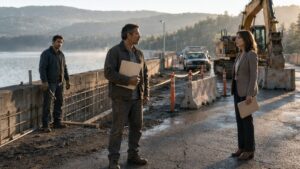
The locksmith van was parked crooked across the cabin driveway when Scott Hill turned in from the county road.
For half a second, he thought one of his renters had locked themselves out.
Then he saw the sheriff’s cruiser.
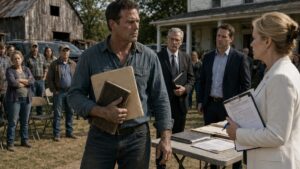
Scott slowed his pickup before the gravel bend. A uniformed deputy stood near the porch with his hands resting loosely on his belt. Beside him was Kevin White, the newly elected HOA president, wearing a blue polo and holding a folder thick enough to look official from twenty yards away.
The locksmith had an open tool case on the porch.
Scott’s two renters stood beside their luggage.
That was when Scott stopped the truck.
He killed the engine but remained behind the wheel long enough to look at the scene once more. The cabin had belonged to his grandfather before there was a subdivision here, before ornamental pear trees lined the road, before identical black mailboxes marched past trimmed lawns toward the lake.
Now Kevin stood in front of it as though he had come to repossess something.
Scott got out.
“What’s going on?”
The younger renter, a man in his thirties, answered first.
“They said we have to leave.”
Kevin stepped forward before Scott could ask who “they” meant.
“This rental is in violation of the association rules.”
He held out a sheet of paper.
Scott did not take it immediately.
“What association rules?”
Kevin’s mouth tightened. “The short-term occupancy restriction. You’ve been notified.”
“No, I haven’t.”
“We sent notice to the property.”
“You sent mail here?”
“To the address of record.”
Scott finally took the paper.
At the top was the HOA’s name. Under that, in heavy print, was a demand that short-term rental activity cease immediately. Near the bottom was a penalty amount.
Five thousand dollars.
Scott read that number twice.
“You brought a locksmith over a fine?”
Kevin glanced toward the renters. “They were given one hour to vacate.”
The woman renter folded her arms. “He told us the locks would be changed.”
The locksmith looked down at his case.
Scott turned to the deputy. “Are you here to evict them?”
The deputy’s expression changed slightly.
“I’m here to keep the peace.”
“That wasn’t my question.”
“No,” the deputy said. “I do not have an eviction order.”
Kevin cut in. “The association has enforcement rights.”
The deputy looked at him. “And I told you I’m not enforcing a private HOA notice.”
For the first time since Scott arrived, something in Kevin’s confidence shifted.
Only slightly.
Kevin recovered quickly. “They’re leaving voluntarily.”
The man renter gave a humorless laugh. “After you showed up with law enforcement and a locksmith.”
“I didn’t tell him to come,” the deputy said.
“I called because there was a concern about a confrontation,” Kevin said.
Scott looked at the locksmith’s case again. Picks, drivers, a cordless drill, replacement cylinders arranged in molded plastic.
His anger came fast enough that he felt it in his hands.
Years earlier, he would have said exactly what he was thinking. He had inherited that much from his grandfather—the conviction that a boundary meant nothing if you were afraid to defend it.
Instead, Scott put the notice back into Kevin’s folder.
“Who decided my property was subject to this?”
“The board.”
“When?”
“Thursday.”
“And you verified the property?”
Kevin gave him a look that managed to be both impatient and puzzled.
“You’re surrounded by the association.”
“That wasn’t what I asked.”
“The property is within the development.”
Scott looked past Kevin.
From the porch, he could see the newer houses climbing the slope beyond the trees. Their backyards ended at a landscaped strip maintained by the HOA. Past that were garden plots, then a paved walking path leading toward the lake.
The cabin looked almost misplaced among them, a dark timber structure that had survived while everything around it had been subdivided, graded and planted.
Kevin tapped the folder against his palm.
“You’ve spent two years operating a commercial rental in a residential community. We have complaints about vehicles, unfamiliar people using the lake path, late arrivals. The insurer is asking questions about short-term occupancy.”
Those were not absurd concerns.
Scott knew that.
He also knew Kevin had skipped something important.
“You could’ve called me.”
“We did.”
“You emailed the cabin booking address.”
“We used the contact information we had.”
“And when I didn’t answer, you brought a locksmith.”
Kevin’s face colored. “You ignored multiple notices.”
Scott almost corrected him again.
Then he stopped.
There was no point winning an argument on the driveway if the paperwork was wrong.
He looked at his watch.
It was 9:17.
Kevin noticed. “Are you expecting someone?”
“No.”
“Then what are you doing?”
“Deciding what deserves an answer.”
Kevin stared at him.
The renters had already begun loading their bags into their car. The woman approached Scott quietly.
“We’re going to leave.”
“You don’t have to.”
“We know. But this isn’t what we came here for.”
Scott could not blame them.
He refunded the rest of their stay on his phone while they stood there. Three nights gone, plus the refund for that morning. The man renter thanked him, though Scott felt he was the one who ought to apologize.
Their car disappeared down the road several minutes later.
The deputy left soon afterward.
The locksmith closed his case without touching the cabin door.
That should have felt like a small victory.
Instead, Scott stood in his own driveway holding a five-thousand-dollar notice while Kevin remained beside his SUV.
“This can end easily,” Kevin said.
Scott looked at him.
“Stop renting the cabin. Pay the fine. Bring the property into compliance.”
“Bring it into compliance with what?”
Kevin exhaled. “Scott, everybody else follows the same rules.”
That sentence bothered him more than the threat.
Everybody else.
Scott watched Kevin drive away.
Only after the SUV vanished did he walk back toward the porch.
At the edge of the landscaped bed, beneath a low spray of ornamental grass, something rusty sat hidden under years of mulch. Scott did not notice it. His grandfather once had, but whatever it marked had long since disappeared from ordinary view.
Inside the cabin, Scott spread Kevin’s notice on the kitchen counter.
Beside it, he opened the county property-tax website on his laptop.
He typed in his parcel number.
Then he typed the legal description from Kevin’s notice.
The two descriptions were not the same.
Scott leaned closer.
Kevin’s document referenced a subdivision lot designation.
Scott’s tax record did not.
His record described three acres by metes and bounds, beginning at an old monument near the eastern road.
Scott read both descriptions again.
Then he reached for the folder where he kept the oldest papers from his grandfather’s estate.
Whatever Kevin believed he controlled, Scott was no longer sure it was the cabin.
Chapter 2: The Cabin Was Older Than Every House Around It
Scott found the first thing that did not belong in Kevin’s version of the property just after noon.
It was an annexation exhibit from the early years of the subdivision.
Rows of numbered lots covered the page.
Scott searched once.
Then again.
His grandfather’s parcel number was not there.
He printed the exhibit and laid it beside the five-thousand-dollar notice.
For most of his life, Scott had treated the cabin’s history as something obvious.
His grandfather had owned it.
Then Scott’s mother had inherited it.
Then Scott had bought out the remaining family interest in 2012.
The land had always been the land.
He had never needed to explain it.
That confidence began to look less like certainty and more like habit.
He opened another county record.
The subdivision plat was recorded years after the original cabin deed. Its roads wrapped around the older tract in a shape Scott had seen dozens of times without really examining.
His parcel sat inside the larger neighborhood like a piece of an earlier map someone had drawn around rather than erased.
That made him feel better.
For about ten minutes.
Then he remembered how much money he had put into the cabin without ever ordering a full title review.
Eighty thousand dollars.
New plumbing. Electrical work. Roof repairs. A rebuilt porch. Insulation, flooring, windows, kitchen cabinets.
He had done much of the labor himself, evenings and weekends, with the confidence of a contractor accustomed to solving what he could see.
The invisible parts had seemed settled.
Property lines.
Access.
Ownership.
He had never questioned those because his grandfather hadn’t.
That was not the same thing as proof.
Scott stood at the kitchen windows and looked toward the subdivision.
When he was a boy, there had been trees where the nearest houses now stood. His grandfather had kept an aluminum fishing boat beside the cabin and an old refrigerator that rattled loudly enough to hear from the porch.
Back then, the only road was narrower.
The lake path had been dirt.
There was certainly no community garden.
Scott remembered his grandfather complaining when the first developer’s trucks appeared.
He also remembered him accepting a load of gravel from that same developer after spring rains washed out the access road.
Memory, Scott realized, was rarely as clean as property law.
He returned to the computer.
The HOA’s declaration was easier to find than he expected. It listed the original parcels subjected to the covenants, along with procedures for adding later property.
He searched for his parcel number.
Nothing.
He searched his grandfather’s surname.
Nothing.
He searched the legal description.
Nothing.
By midafternoon, Scott had convinced himself Kevin had made a serious mistake.
At four, he nearly called Kevin simply to tell him so.
His phone was already in his hand when he stopped.
Confidence had gotten both of them here.
He wanted something better.
Scott drove to the county records office before it closed and requested copies of everything tied to the tract.
The clerk returned with scanned deeds, plats and several instruments filed under neighboring parcels.
One document caught Scott’s attention because of the date.
It had been recorded during the subdivision’s first phase.
ROAD ACCESS AGREEMENT.
His grandfather’s signature was at the bottom.
Scott sat down.
The agreement was only a few pages long, but the language was dense. It granted rights involving access across a portion of the existing road. It referred to maintenance contributions, drainage work and continued passage.
The association’s predecessor was named.
So was his grandfather.
Scott’s earlier certainty loosened.
He read the signature again.
There was no question it was genuine.
His grandfather’s handwriting had a hard backward slant, especially on the H.
Scott remembered that signature from birthday cards, checks and a handwritten note still taped inside an old tackle box.
He took the document home.
By evening, the kitchen table was buried under paper.
Scott drew three columns on a legal pad.
OWNERSHIP.
HOA.
ACCESS.
Under ownership, he wrote: three-acre deed predates subdivision.
Under HOA, he wrote: no covenant located.
Under access, he placed a question mark.
The distinction had seemed academic that morning.
Now it felt like the entire dispute.
He called Laura Hernandez, a property attorney he had worked with once on a construction easement problem.
She returned his call after seven.
“You have the deed?”
“Yes.”
“Declaration?”
“Yes.”
“Annexation documents?”
“I found an exhibit. My parcel isn’t listed.”
“Good. Don’t celebrate yet.”
Scott frowned. “I wasn’t.”
“You sound like you were.”
He looked at the five-thousand-dollar notice.
“There’s a road agreement.”
“That matters.”
“It says access and maintenance.”
“That can mean several things.”
“It doesn’t say HOA membership.”
“That can also matter.”
Scott leaned against the counter.
“So am I in or out?”
Laura paused.
“That’s the wrong question.”
“How?”
“Ownership, restrictive covenants and easement rights aren’t interchangeable. You can own land that’s subject to an easement. You can use an HOA-maintained road without being an HOA member. You can also have restrictions recorded somewhere you haven’t found yet.”
Scott rubbed a hand over his face.
“So what do I actually know?”
“You know Kevin shouldn’t be threatening to change locks based on a map somebody printed from the association office.”
That was something.
Laura continued. “Send me everything. And don’t put up a fence, block the road, remove landscaping or do anything dramatic.”
“I didn’t say I would.”
“You’re a contractor with a property dispute.”
“That’s profiling.”
“It’s experience.”
He almost laughed.
After the call, Scott opened the old plat one more time.
Near the eastern edge of the parcel was a survey notation he had skimmed past earlier.
IRON MONUMENT FOUND.
He enlarged the image.
The mark appeared close to the landscaped border between the cabin property and the neighborhood garden.
Scott could not remember ever seeing an iron pin there.
The HOA had been mowing that edge for years.
They maintained the flower beds too.
He had never objected.
Why would he? It saved him work.
That realization sat uncomfortably beside his anger at Kevin.
Scott had always insisted the HOA had nothing to do with his land.
But he had not complained when its landscaping crew crossed onto ground he believed was his.
Silence had been useful then.
He closed the laptop and went outside with a flashlight.
Along the garden-facing edge, mulch had been spread beneath shrubs and ornamental grasses. Scott moved slowly, trying to match the old plat to the ground.
He found nothing.
No pipe.
No visible stake.
No monument.
Only smooth landscaping and the distant sound of sprinklers.
The next morning, Laura called.
“I reviewed what you sent.”
Scott sat up straighter.
“And?”
“I don’t see anything putting your parcel under the declaration.”
He waited.
“But?”
“But the road agreement is real, and we need a survey before anybody claims more than that.”
Scott looked through the window toward the garden.
“So Kevin doesn’t control the cabin.”
“Based on what I’ve seen, I would be very uncomfortable making his claim.”
It was not the triumphant answer Scott wanted.
It was better.
It was careful.
He scheduled an independent survey for Tuesday.
Before hanging up, Laura said, “Scott, one more thing.”
“What?”
“That road document grants access. It does not grant ownership.”
He looked at his grandfather’s signature.
“And it does not say your grandfather joined the HOA.”
Scott ended the call and stared at the page.
Kevin’s biggest mistake might have been assuming one document meant more than it did.
Scott’s problem was that he still had no idea what his grandfather had intended it to mean.
Chapter 3: The Survey Line Entered the Community Garden
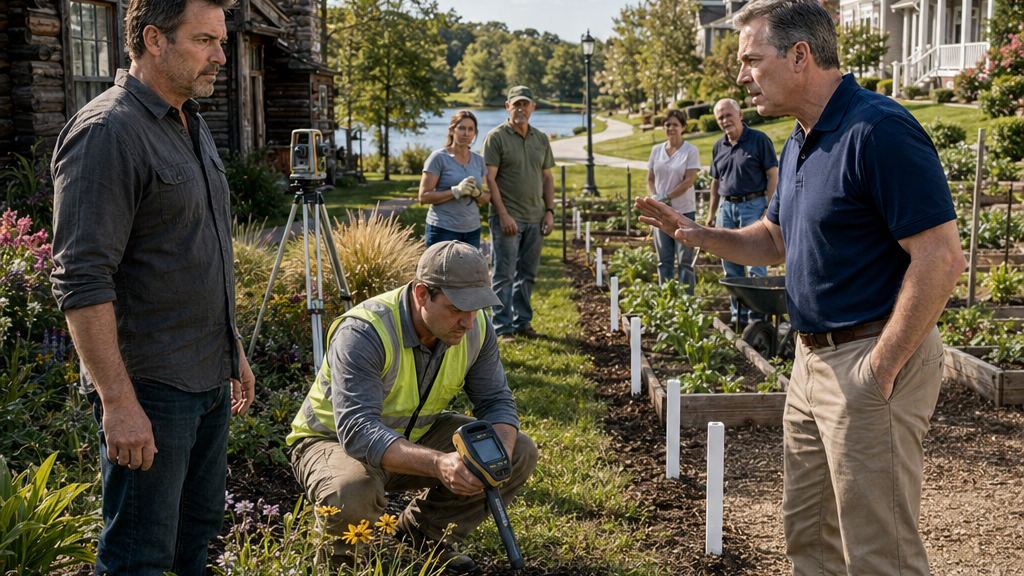
The surveyor’s metal detector began screaming beneath the HOA’s flower bed at 9:43 Tuesday morning.
Everyone nearby stopped talking.
The surveyor passed the detector over the mulch again.
A sharp electronic tone sounded beneath a clump of ornamental grass.
“That’s promising,” he said.
Kevin White stood six feet away with his arms crossed.
“It’s inside association landscaping.”
The surveyor did not look at him. “That doesn’t tell me what it is.”
Scott watched the field assistant kneel and pull mulch aside.
Dark soil appeared.
Then the edge of something rusted.
The assistant scraped carefully with a hand tool until a round iron pin emerged from the ground.
It looked ordinary.
That was what struck Scott most.
After three days of documents, accusations and phone calls, the thing that might settle where his grandfather’s property actually began was a piece of iron no wider than his thumb.
The surveyor checked measurements against his equipment.
Then he checked them again.
“This matches the monument call.”
Scott felt something release in his chest.
Kevin stepped closer.
“You’re saying that’s the property corner?”
“I’m saying it corresponds to the recorded call I’m retracing.”
Kevin pointed toward the garden. “That would put the line through common area.”
The surveyor finally looked at him.
“I don’t determine ownership based on how an area is being used.”
Kevin’s jaw tightened.
By then several residents had gathered along the paved path.
News traveled fast in a neighborhood where landscaping crews usually created more interest than police cruisers.
One woman still wore gardening gloves. Another resident stood beside a wheelbarrow filled with pulled weeds.
Kevin lowered his voice.
“Scott, whatever this crew thinks it found, nobody is putting stakes through HOA-maintained property.”
Scott looked at the exposed iron pin.
“Let them finish.”
“You can’t authorize work on association land.”
“I authorized a survey of my deed.”
Kevin gestured toward the garden. “This has been maintained by the association for years.”
Scott almost answered, So?
Then he remembered his own notes.
OWNERSHIP.
HOA.
ACCESS.
Laura’s distinction.
He kept his voice level.
“Then the survey will tell us something useful.”
The first bright stake went into the ground ten minutes later.
The second went farther north.
The third went directly beside a raised garden bed.
Residents began murmuring.
The surveyor moved his equipment again, sighted down the line and placed another marker.
This one landed between two active plots.
Tomato vines climbed metal cages on one side. On the other, herbs grew beneath a low wooden border.
The line continued straight through them.
Kevin stared at the stakes.
“That can’t be right.”
The surveyor said nothing.
A resident with gardening gloves looked from Kevin to Scott.
“My plot is on his property?”
“Nobody said that yet,” Kevin answered quickly.
The surveyor straightened.
“I’m retracing a recorded boundary. You’ll need an attorney for conclusions beyond that.”
Scott appreciated the wording.
Kevin did not.
“You’re using old information.”
“It’s a recorded plat tied to existing monuments.”
“The development was redesigned.”
“Then there may be later instruments.”
“There are.”
“Provide them.”
Kevin’s expression hardened.
Scott had seen that look in construction meetings: the moment when someone realized confidence was no longer enough.
The survey crew kept working.
By late morning, the visible outline of Scott’s parcel had changed the landscape.
What residents thought was a narrow landscaped buffer appeared to sit substantially inside the old tract. Several garden plots crossed the line. A portion of the paved approach toward the lake path ran close enough to create another question the surveyor refused to answer without reviewing additional easement documents.
Scott stood beside the first iron pin.
For three days, he had imagined this moment.
He had pictured Kevin seeing the proof.
He had pictured the fine disappearing.
He had even pictured fence posts.
Now that the boundary was visible, satisfaction came—but it did not arrive alone.
The residents in the garden were not Kevin.
They were simply standing beside tomatoes, watering cans and raised beds that many of them apparently believed belonged to their community.
An older resident approached Scott.
“Your grandfather knew about this garden.”
Scott turned.
“What?”
“He used to come down here.”
Kevin looked over sharply.
The resident continued. “Not this exact setup. It was smaller then. A few plots. But he knew.”
Scott glanced toward the exposed iron pin.
“Did he say it was association land?”
“I don’t know what he called it. He never stopped anybody.”
Another resident joined them.
“He let us use the path too.”
Kevin seized on that.
“Exactly.”
Scott looked at him. “Permission and ownership aren’t the same thing.”
“No, but you can’t stand there pretending this all happened behind your family’s back.”
The accusation landed because part of it was true.
Scott had known the HOA mowed near the cabin.
He had known residents crossed toward the lake.
He had seen garden beds expand over the years.
He had simply never cared enough to measure where they sat.
Kevin had assumed authority because the association behaved like an owner.
Scott had assumed independence while accepting some of the benefits of that same behavior.
Neither assumption changed the deed.
But the story was getting harder to tell cleanly.
The surveyor approached with a preliminary field sketch.
“We’ve got enough to establish the primary line. I’ll reconcile the rest at the office and issue the signed survey.”
Scott studied the rough shape.
The three acres extended farther into the manicured side of the development than most residents had believed.
Kevin looked at it over his shoulder.
“If you start tearing up landscaping based on that, the association will respond.”
Scott folded the sketch.
“I’m not tearing up anything today.”
“Good.”
“That’s not permission.”
Kevin met his eyes.
For a moment neither spoke.
Then Kevin said, quieter than before, “You think I wanted this?”
Scott almost laughed.
“You came with a locksmith.”
“I had residents demanding action. People complained for months. Cars in the wrong places. Guests who didn’t know where private amenities started. Our insurer asked whether rentals were being operated inside association property. You ignored notices.”
“You didn’t verify the parcel.”
Kevin’s face tightened. “I used the records we had.”
“That was your choice.”
“Yes.”
The admission surprised Scott.
Then Kevin added, “And renting without cleaning this up first was yours.”
Scott had no immediate answer.
Kevin walked away.
By noon, photographs of the stakes were already circulating among residents.
Scott took one himself.
The image showed the old iron pin in the foreground and a line of bright markers cutting through green garden beds behind it.
He sent the photograph to Laura.
Then, after a hesitation, he sent it to his aunt Janet.
He wrote only:
Found Grandpa’s old corner.
Her phone call came less than a minute later.
Scott answered.
“You saw the picture?”
“I did.”
“The surveyor found the original iron pin.”
“I can see that.”
Her voice sounded strange.
Not surprised.
Scott looked down at the rust-darkened metal.
“You knew where it was?”
Janet was quiet.
Then she described the corner without asking a single question.
“The one below the flowering shrubs? About two steps from where the old path used to bend?”
Scott stared at the garden.
“Yes.”
Another pause.
When Janet spoke again, her voice had lost its softness.
“Scott, your grandfather knew exactly where that line was.”
Chapter 4: What His Grandfather Allowed but Never Gave Away
Janet described the iron pin before Scott told her where the survey crew had found it.
“Below the flowering shrubs,” she said over the phone. “A little downhill from the old bend in the path.”
Scott stood beside the kitchen window, looking toward the garden.
“Yes.”
“And there used to be a flat rock next to it.”
“The rock’s gone.”
“I figured.”
He tightened his grip on the phone.
“You knew that was the property line.”
“Your grandfather knew.”
“That isn’t what I asked.”
Janet went quiet.
Scott could hear a television somewhere in her house and the faint click of dishes being moved.
Finally she said, “Come over.”
He almost told her to explain it now.
Instead, he looked at the photograph of the survey stakes on his phone. The line cut through the garden so cleanly that it seemed impossible anyone could have misunderstood it for decades.
He drove to Janet’s that evening.
She had already placed a cardboard file box on her dining-room table.
Scott recognized it immediately.
His grandfather had kept receipts in boxes like that—tax records, fishing licenses, equipment manuals, envelopes containing screws whose purpose nobody remembered.
Janet touched the lid.
“I should have given you this when you bought the other family shares.”
Scott remained standing.
“What’s in it?”
“Mostly nothing important.”
“That usually means something important.”
Janet gave him a tired look.
“You sound like your grandfather.”
“Apparently that’s becoming relevant.”
She opened the box.
Inside were old tax bills, photographs and folded correspondence from the early development years.
Janet pulled out a photograph.
The cabin sat in the background, younger-looking but otherwise unchanged. In front of it, where the subdivision garden now stood, several people were working a rough strip of soil.
No raised beds.
No paved path.
Just rows of vegetables and wooden stakes.
Scott recognized his grandfather near the edge of the photograph.
“He let them garden there?”
Janet nodded.
“After the first houses went up, some families asked if they could use the sunny strip. Your grandfather said yes.”
“For free?”
“He didn’t want money.”
Scott sat down.
“Did he sign anything?”
“Not for the garden.”
“What about the path?”
“That came later.”
Janet folded her hands.
“When the developer built the road, your grandfather had a problem. The old access was washing out. The developer wanted a clean connection. Your grandfather agreed to let them improve the road and maintain part of it.”
“The agreement I found.”
“Probably.”
Scott studied her face.
“And he never joined the HOA.”
“No.”
“You’re sure?”
Janet gave him a sharp look.
“I sat in this room when they asked him.”
Scott leaned back.
“What happened?”
“They wanted the strip by the road. Eventually they wanted the garden area too. They said it would simplify maintenance.”
“Meaning deed it over.”
“Yes.”
“And he refused.”
“Every time.”
That should have felt like vindication.
Instead, Scott looked again at the photograph.
His grandfather was smiling.
That detail bothered him more than anything else.
Scott had built a version of the old man in his memory: stubborn, independent, suspicious of anybody who arrived with forms.
The man in the picture was handing a garden hose to a neighbor.
“He let people use it anyway,” Scott said.
Janet nodded.
“He didn’t mind sharing.”
“He minded giving it away.”
“Exactly.”
Scott looked toward the box.
“Why didn’t anyone tell me?”
“I thought you understood.”
“I understood that it was our land.”
“It was.”
“You knew the HOA was maintaining part of it.”
“So did you.”
The words landed harder than Scott expected.
Janet did not raise her voice.
“You’ve watched their crews mow that edge for years.”
Scott looked down.
“They were already doing it.”
“And you stopped them?”
“No.”
“You sent them a bill?”
“No.”
“You told them they were trespassing?”
“No.”
He pushed the photograph away.
“I didn’t authorize them.”
“No. You just benefited from it.”
Scott stood and walked to the window.
He wanted to object.
Instead, he remembered the landscapers trimming around the cabin-side shrubs while he worked on the porch. He had waved to them.
Once, he had even asked a crew member to cut a little farther around the drainage swale.
Silence, when it saved him money, had never felt like surrender.
Janet came to stand behind him.
“Your grandfather wasn’t trying to build a private kingdom, Scott.”
“I know.”
“Do you?”
He turned.
“You think I’m doing this because I want the garden?”
“I think you’re angry because Kevin embarrassed you.”
Scott said nothing.
“He had no business showing up with a locksmith,” Janet continued. “I’m not defending that. But anger can make a property line feel like a weapon.”
“He tried to shut down the cabin.”
“Then stop him from doing that.”
“That’s what I’m doing.”
“Good. Just make sure you know where defending ends.”
Scott looked back at the photograph.
His grandfather had known exactly where the iron pin stood.
He had also allowed people across it.
Not because he thought they owned the land.
Because he trusted permission to remain permission.
That distinction had survived in his head.
It had not survived on any map the HOA used.
The next morning, Scott met Laura at the cabin.
She spread the signed survey across the kitchen table.
The boundary matched the old deed closely. The garden encroachment was real. So was part of the landscaped strip.
The paved lake approach was more complicated.
“There are arguments on both sides,” Laura said.
“For ownership?”
“No. For use.”
Scott pointed to the road agreement.
“It doesn’t mention the garden.”
“No.”
“The path?”
“Not clearly.”
“Then what are we arguing about?”
“History.”
Scott frowned.
Laura tapped the survey.
“You probably have the stronger title position. That doesn’t mean every longtime use disappears because you found a pin.”
“You’re saying they own an easement.”
“I’m saying I’m not promising they don’t.”
Scott walked to the window.
Several bright survey stakes remained visible in the garden.
Kevin had not removed them.
That, at least, meant the message had landed.
Scott said, “I could fence the deed line.”
Laura looked at him.
“You could hire somebody to start putting posts in the ground.”
“That wasn’t my question.”
“I know.”
She gathered the road papers.
“If you fence every historic access point immediately, you may turn one dispute into three.”
Scott faced her.
“So Kevin can threaten my renters, and I’m supposed to worry about inconveniencing people using my property?”
“You’re supposed to decide what you actually want.”
“My property left alone.”
“Then define ‘left alone.’”
Scott did not answer.
Laura slipped the survey into its folder.
“You can stop Kevin from pretending the HOA owns your cabin. I think we can stop the fines too.”
She paused at the door.
“But if you want to use this survey to erase every arrangement your grandfather tolerated—and every arrangement you tolerated after him—you may discover the law isn’t as simple as the line on that paper.”
Scott looked toward the garden.
For the first time, the bright stakes did not look like proof of victory.
They looked like a question he would have to answer himself.
Chapter 5: The Board Meeting Where Both Maps Failed
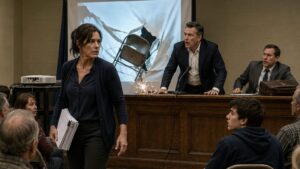
Patrick Johnson noticed the missing recording information less than five minutes into the board meeting.
He had the HOA’s laminated property map spread across one side of the conference table and Scott’s signed survey on the other.
Patrick leaned close to the laminated map.
Then he removed his glasses.
“Where’s the recording number?”
Kevin looked up.
“What?”
“The plat reference.”
Patrick ran one finger along the bottom edge of the map.
“There isn’t one.”
One of the other board members shifted in her chair.
Kevin said, “That’s the association’s official map.”
“I know what we call it.”
“That’s what management has used for years.”
Patrick looked at Scott.
Then at Laura.
“Is this actually recorded anywhere?”
Laura answered carefully.
“Not that I’ve found.”
Kevin sat straighter.
“It came from the developer.”
“That doesn’t answer his question,” Scott said.
Kevin’s eyes moved to him.
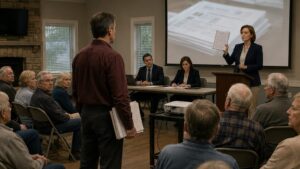
The clubhouse room was fuller than Scott expected.
Residents occupied chairs along the rear wall, including several people from the garden. The property manager sat beside two board members. Laura had placed three folders in front of Scott and instructed him before the meeting not to speak simply because silence became uncomfortable.
He was discovering how often silence became uncomfortable.
Patrick turned the laminated map around.
“Management sent me the original file this afternoon. It’s labeled concept plan.”
Nobody spoke.
Scott watched Kevin.
For the first time since the locksmith morning, Kevin did not have a quick answer.
Laura placed the recorded plat beside the concept plan.
“This is part of the problem,” she said. “The association has been treating several different questions as though they were one.”
Kevin folded his hands.
“And your position is that Scott gets to run an unrestricted commercial operation because of a drafting technicality.”
“No,” Laura said. “My position is that restrictions require a legal basis.”
“We have one.”
“Then identify it.”
Kevin looked toward the property manager.
The manager opened a binder.
“The declaration applies to all lots within the community.”
Laura nodded. “Correct.”
“And Scott’s property is inside the community boundary.”
“According to which recorded instrument?”
The manager hesitated.
Patrick looked down at the concept plan again.
Scott felt the old urge to press.
To make Kevin say it.
To force the admission in front of everyone.
He kept quiet.
Laura continued.
“There are three issues. First, whether Scott’s parcel is subject to the HOA declaration. Second, what access rights exist under the recorded road agreement. Third, whether any additional rights have developed from historic use.”
A resident from the garden spoke from the back.
“So we lose our garden because he wants weekend renters?”
Scott turned.
“That’s not what I said.”
“You had it surveyed.”
“Because the HOA tried to change my locks.”
Kevin’s voice sharpened.
“Nobody changed your locks.”
“You brought the locksmith.”
“To enforce a violation if the occupants abandoned—”
The property manager interrupted.
“Kevin.”
The room went still.
It was the first time Scott had heard someone from Kevin’s own side stop him publicly.
The manager lowered her voice.
“We should not characterize that further until counsel finishes reviewing it.”
Kevin’s face changed.
Scott noticed Patrick watching him.
“What does that mean?” Patrick asked.
The property manager closed the binder.
“The association’s insurer has questions.”
Kevin looked at her.
“You already told them?”
“We were required to.”
Patrick leaned back.
“What questions?”
The manager glanced toward Scott and Laura before answering.
“Whether the association had verified covenant authority over the parcel before directing enforcement. Whether the locksmith was acting under board authorization. Whether law enforcement was represented to the occupants as having eviction authority.”
Scott felt the room change.
This was not applause.
Nobody smiled.
The shift was quieter and more serious than that.
Kevin’s certainty had become a liability question.
One board member turned toward him.
“Was the locksmith approved in the meeting?”
Kevin’s jaw tightened.
“The board approved enforcement.”
“That isn’t what I asked.”
“We approved stopping the rental.”
Patrick looked at the minutes.
“I remember authorizing notice and fines.”
Kevin said nothing.
Scott should have enjoyed the moment.
Instead, he remembered Janet’s photograph.
His grandfather handing a hose across a line everyone now wanted to turn into a legal weapon.
Laura nudged one folder toward Scott.
He understood.
She wanted the next part to come from him.
Scott opened it.
“I’m not claiming nobody ever used that strip.”
Several residents looked at him.
“I’m not even claiming the HOA never maintained it. They did. I knew they did.”
Kevin stared at him, surprised.
Scott continued.
“I didn’t object when the crews mowed near the cabin. That was convenient for me. My grandfather allowed people to garden there. Apparently he allowed people to cross toward the lake.”
A woman in the back said, “Then why are we here?”
“Because permission isn’t ownership.”
The room quieted.
“And neither is maintenance,” Scott added. “But I’m not going to stand here and pretend my family never allowed any of this. We did.”
Laura spoke next.
“That acknowledgment does not place the cabin under HOA covenants.”
Patrick looked at the road agreement.
“So what does?”
“Nothing I have seen yet,” Laura said.
The sentence sat in the room.
Kevin looked toward the other board members.
“We have a responsibility to residents. We have complaints about strangers using amenities. Parking problems. Insurance exposure. If his rental sits physically inside this neighborhood, we cannot simply pretend it has no effect on anybody else.”
Scott looked at him.
That was the strongest thing Kevin had said all evening.
Not because it proved authority.
Because it was true.
Scott’s renters did affect the neighborhood.
The question was whether Kevin could solve that by pretending ownership existed where it did not.
Patrick rubbed his forehead.
“We need a temporary position.”
Laura answered. “Suspend enforcement until title and access are resolved.”
Kevin shook his head.
“That rewards noncompliance.”
“With which covenant?” Patrick asked.
Kevin turned toward him.
Patrick did not look away.
After a short closed discussion with the manager, the board returned.
Patrick read the motion.
The five-thousand-dollar fine would be suspended.
All short-term-rental enforcement against Scott’s parcel would be paused pending legal review.
The association would not remove survey markers.
Scott felt relief move through him, but it was smaller than he had expected.
A resident immediately raised her hand.
“What happens to the garden?”
Another asked, “And the lake path?”
Patrick looked at Scott.
Those questions were now his problem too.
Laura answered before he could.
“Nothing changes tonight.”
That satisfied nobody.
The meeting ended twenty minutes later.
Residents clustered in small groups. The garden users left together without looking at Scott.
He gathered his folders.
Kevin was waiting by the hallway door.
“Can I talk to you?”
Laura glanced at Scott.
He nodded.
Kevin led him into the empty entry area.
For several seconds, neither spoke.
Then Kevin said, “This can still be solved without turning the neighborhood upside down.”
Scott almost smiled.
“That sounds familiar.”
Kevin ignored it.
“Sign the parcel into the association.”
Scott stared at him.
“We withdraw the fines permanently. We grandfather the existing rental for a limited period. We formalize the garden and path. Everybody knows where they stand.”
“You mean I give you the authority you claimed you already had.”
“I mean we fix a bad historical arrangement.”
“By giving the HOA my property rights.”
“By making the property consistent with everything around it.”
There it was.
Not greed.
Not even anger.
Consistency.
Kevin needed the map to look clean.
Scott thought about how tempting the opposite impulse felt.
To make it as messy as possible.
He closed his folder.
“No.”
Kevin exhaled.
“Then what do you want?”
Scott looked through the glass doors toward the dark shape of the neighborhood beyond.
A week earlier, his answer would have been easy.
A fence.
An apology.
Money.
Maybe all three.
Now he was no longer sure those things answered the right question.
“I want everybody to stop pretending the old arrangement means whatever is convenient today.”
Kevin’s expression hardened.
“That includes you.”
Scott met his eyes.
“I know.”
For once, Kevin had nothing ready to say.
Scott walked out carrying the survey under his arm.
The fines were suspended.
The HOA’s map had failed.
Kevin’s authority over the cabin was collapsing.
Yet Scott drove home knowing the hardest decision had somehow become his.
Chapter 6: The Fence Scott Almost Built in Anger
The fencing truck arrived before sunrise.
By seven, three rolls of six-foot chain link were lying beside Scott’s gravel drive, along with galvanized posts, bags of concrete and a gas-powered auger.
A resident walking a dog stopped at the edge of the road.
The man stared at the materials.
“You’re fencing the garden?”
Scott did not answer immediately.
“I’m fencing part of my boundary.”
The distinction did nothing to reassure him.
Within an hour, cars slowed as they passed.
By eight, Kevin’s SUV appeared.
He parked near the community garden and walked toward Scott.
“You’re actually doing it.”
Scott stood beside the old iron pin.
The surveyor had left it exposed after locating it. Rust covered the top, but the metal remained solid beneath the dirt.
Scott had spent the previous two nights imagining fence lines.
The simplest followed the deed.
Straight through the landscaped strip.
Past the garden.
Toward the section where residents crossed on the way to the lake.
Legally clean.
Visually brutal.
The fencing contractor approached with a marking wand.
“You still want the first corner here?”
Scott looked toward the auger.
“Yes.”
The contractor marked a spot.
Kevin gave a short laugh.
“So that’s your answer.”
Scott faced him.
“You offered to solve this by taking the parcel into the HOA.”
“I offered a compromise.”
“You offered to make your mistake legal after the fact.”
Kevin’s jaw tightened.
“And this isn’t retaliation?”
Scott looked at the fence rolls.
That question had followed him since Janet’s kitchen table.
He could answer Kevin easily.
He could say boundaries were not retaliation.
He could say ownership meant nothing if everyone ignored it.
Both statements were true.
Neither fully answered why the fence truck was here this morning instead of after negotiations.
The contractor rolled the auger into position.
Its engine coughed once, then caught.
The sound carried across the garden.
Residents turned.
Scott watched the spinning bit hover over the first marked spot.
“Stop.”
The contractor released the throttle.
The auger wound down.
Kevin frowned.
Scott walked toward the garden with the survey in his hand.
“Give me ten minutes.”
He had spent part of the previous afternoon with Laura and the property manager looking at alternatives.
There were more than he had wanted to admit.
Most of the garden could be relocated onto confirmed HOA land fifty yards uphill.
The paved approach could be rerouted without affecting Scott’s cabin.
One narrow pedestrian route, however, had been used for years and could remain without interfering with rental parking or private cabin space.
Scott unfolded the survey on the hood of his pickup.
Kevin approached reluctantly.
Scott pointed.
“Garden moves here.”
“To common lawn?”
“Yes.”
“We’d lose irrigation.”
“You can extend it.”
“With whose money?”
“The HOA’s.”
Kevin gave him a look.
“You’re generous with other people’s dues.”
“You were generous with my land.”
Kevin started to answer, then stopped.
Scott pointed to another area.
“Most lake access gets rerouted along the common parcel.”
“That adds distance.”
“About a hundred and twenty yards.”
“For older residents, that matters.”
“I know.”
Scott moved his finger to the narrow strip near the existing path.
“This stays.”
Kevin looked closer.
“What?”
“A pedestrian easement. Recorded. Fixed width. No vehicles. No garden expansion. No landscaping beyond maintenance necessary for the path.”
Kevin studied him.
“You’d give us that?”
“I’d record it.”
“That’s different.”
“Exactly.”
Scott folded his arms.
“My grandfather gave permission because he trusted people to understand permission. That worked until nobody remembered what belonged to whom.”
Kevin looked toward the iron pin.
“So the fence?”
“Protects the private portion. It doesn’t cut off the path.”
Kevin shook his head.
“You realize what you’re asking the board to admit.”
Scott knew.
The settlement could not work without revised maps.
The revised maps would show the community garden had occupied land outside the HOA parcel.
The minutes would have to reflect that Scott’s property was not subject to the declaration.
Kevin could accept practical terms.
What he could not easily accept was the written correction.
“You want the land,” Scott said, “or you want the map to look like you were right?”
Kevin’s eyes narrowed.
“That’s not fair.”
“Neither was bringing a locksmith.”
“I have said that could have been handled differently.”
“That isn’t the same as saying you were wrong.”
Kevin looked toward the garden.
Several residents stood nearby pretending not to listen.
Finally he said, “I’m not signing something that exposes the association.”
“You already have exposure.”
“You think your attorney’s survey settles everything?”
“No.”
The answer seemed to surprise him.
Scott continued.
“That’s why I’m offering the path.”
Kevin looked at him carefully.
A week earlier, Scott would have wanted Kevin to hear triumph in his voice.
There was none now.
Only exhaustion.
“I’m not joining the HOA,” Scott said. “The cabin stays outside the covenants. The rental follows county rules, not rules that were never recorded against my parcel. The garden comes off my property. The old access gets narrowed and recorded so nobody has to guess again.”
“And damages?”
“My canceled booking. Survey. Legal costs related to your enforcement.”
Kevin looked away.
“That’s going to be a problem.”
“It already is.”
The contractor waited beside the silent auger.
Scott walked back toward him.
“Move the first post twenty-eight feet west.”
The contractor checked the survey.
“That leaves the path open.”
“Yes.”
“You sure?”
Scott looked at the iron pin.
“Yes.”
The first hole was drilled on the revised line.
Not through the garden.
Not across the historic pedestrian route.
Along the area Scott actually needed protected around the cabin.
By noon, several posts stood in concrete.
The fence rolls remained mostly untouched.
Laura arrived shortly afterward.
She examined Scott’s marked-up survey.
“You changed it.”
“I decided I don’t need every inch fenced just because I own it.”
“That’s not the same as giving it away.”
“I’m starting to understand that.”
She pointed toward the path.
“Recorded easement?”
“Narrow. Pedestrian only.”
“And the rest?”
“Defined.”
Laura looked toward Kevin, who was speaking with Patrick near the garden.
“You know he may reject it.”
“He probably will.”
“Then what?”
Scott watched Patrick hand Kevin a phone.
Kevin listened for less than a minute.
Even from a distance, Scott could see the change in his posture.
When the call ended, Patrick remained beside him.
They argued quietly.
Then Patrick walked toward Scott.
“The insurer responded.”
Laura straightened.
“What did they say?”
Patrick looked uncomfortable.
“They’re reserving rights on anything tied to the rental enforcement.”
Scott waited.
Patrick continued.
“They specifically won’t agree to defend the locksmith decision as an authorized property-control action unless the board can produce evidence the cabin was subject to the declaration.”
Kevin approached behind him.
“That is not the same as denying coverage.”
Patrick turned.
“No, but it’s enough.”
“For what?”
“For me to call an emergency meeting.”
Kevin stared at him.
Patrick’s voice remained calm.
“We have a survey. We have a concept map we treated like a recorded plat. We have an access agreement that doesn’t say what we thought it said. And now we have an insurer telling us they may not stand behind the enforcement decision.”
Kevin looked from Patrick to Scott.
The fence posts behind Scott marked only part of the line.
Enough to establish a boundary.
Not enough to punish everyone who had crossed it.
Patrick raised his phone.
“I’m calling the vote for tonight.”
Kevin said nothing.
For the first time since the dispute began, the cost of refusing the boundary was no longer theoretical.
Chapter 7: The Boundary They Finally Put in Writing
The first sentence Scott read in the settlement draft was the one Kevin had spent weeks refusing to say.
The parcel owned by Scott Hill is not subject to the recorded declaration of covenants governing the association.
Scott read it twice.
Then a third time.
Laura Hernandez sat across from him at the small conference table in her office, watching without comment.
“You could frame that,” she said.
Scott lowered the pages.
“I thought lawyers discouraged framing legal documents.”
“Only the ugly ones.”
He almost smiled.
The settlement was seventeen pages long.
The sentence he cared about most occupied less than two lines.
Everything around it was harder.
The HOA would withdraw the five-thousand-dollar fine and any other rental-enforcement notices tied to its covenants. Scott would remain responsible for county rules and any generally applicable laws, but the association could not regulate the cabin as an HOA lot unless Scott voluntarily subjected the property to those restrictions in the future.
The garden would be relocated.
The association would remove irrigation lines, edging and other improvements from the portion confirmed to lie on Scott’s parcel.
A narrow pedestrian easement would be recorded along the path Scott had agreed to preserve.
The language defined its width, its purpose and who maintained it.
No vehicles.
No expansion.
No assumption of ownership created by maintenance.
Scott stopped at that sentence.
“That one stays.”
Laura glanced at the page.
“I wrote it because I assumed you’d say that.”
“It should’ve been written forty years ago.”
“Probably.”
Scott turned another page.
Compensation came later.
Canceled rental income.
Survey expenses.
Attorney fees associated with the enforcement dispute.
The amount was less dramatic than the number Scott had imagined during his angriest nights, when he had mentally added every inconvenience, insult and lost hour as if resentment could be itemized.
It covered what he could prove.
That mattered more now.
Then he reached the confidentiality clause.
He read it once.
His expression changed.
“No.”
Laura leaned back. “I expected that too.”
The clause barred Scott from discussing almost any aspect of the dispute, including the association’s use of the incorrect concept map and the circumstances surrounding the attempted enforcement.
“They want me quiet.”
“They want certainty.”
“They want nobody knowing what happened.”
“There’s overlap.”
Scott pushed the agreement across the table.
“I’m not agreeing to pretend their map was right.”
Laura folded her arms.
“They may offer more money if you do.”
“I don’t want more money.”
She waited.
Several weeks earlier, Scott would not have believed himself saying that.
He had wanted Kevin embarrassed.
He had wanted the board forced to explain itself.
He had wanted a check large enough to feel like proof that what happened at the cabin mattered.
Now he imagined the settlement recorded at the county office.
A clear parcel.
A clear easement.
A map that no future board president could reinterpret because the landscaping happened to extend a few feet too far.
That felt more useful than another number.
“Take out the broad confidentiality language,” he said. “I’ll agree not to disclose private insurance negotiations or personal information. I’m not hiding the property correction.”
Laura nodded.
“That’s defensible.”
“And the revised map has to go to every owner.”
“That’s already in the draft.”
“Good.”
She gathered the pages.
“You know the board may push back.”
“Then they push back.”
The final negotiation took another nine days.
Kevin did not attend the first session.
Patrick did.
He looked older than Scott remembered from the board meeting, though perhaps it was simply the absence of the polished certainty everyone had carried at the start.
“The garden people are angry,” Patrick said.
Scott nodded.
“I know.”
“They didn’t do anything wrong.”
“I know that too.”
That was the part no document could make painless.
The relocated garden area sat uphill on confirmed HOA property. It had better sun but worse irrigation. Volunteers would have to dismantle raised beds, move soil and extend water lines.
The residents who had planted tomatoes and herbs were paying for an error they had not created.
Scott had considered leaving the garden where it was.
Janet had asked him about that.
He had almost agreed.
Then Laura reminded him what would happen twenty years later if the next owner saw permanent community improvements sitting across an undocumented private boundary.
Generosity without clarity had already created one generation of confusion.
Scott would not create another.
So the garden moved.
He helped with it.
Not as part of the settlement.
He simply arrived one Saturday morning with his trailer and construction tools.
Nobody applauded.
One resident barely spoke to him while they unscrewed boards from a raised bed.
Another finally said, “Your grandfather never made us do this.”
Scott kept working.
“No.”
The resident waited.
Scott set the drill down.
“He also never gave the land away.”
The man looked toward the bright stakes still marking part of the old line.
After a moment, he nodded.
“That’s the part everybody forgot.”
Scott picked the drill up again.
“So did I.”
By afternoon, the first relocated beds were level.
The old garden area looked strangely bare.
For years, Scott had seen it without seeing it.
Now every empty patch seemed to reveal how much assumption could accumulate on top of a property line.
The final board vote came three days later.
Kevin attended.
He looked at Scott only once before the meeting began.
Patrick read the settlement terms aloud in practical, unemotional language.
Withdrawal of fines.
Recognition of parcel status.
Recorded pedestrian easement.
Relocation of improvements.
Reimbursement of documented losses and costs.
Revised association maps.
The vote passed.
Not unanimously.
Kevin voted for it.
Afterward, people gathered their papers without conversation.
Scott was almost at the door when Kevin spoke.
“I still think rentals create problems here.”
Scott turned.
“They can.”
Kevin seemed surprised by the answer.
Scott continued. “If my guests block somebody’s driveway or use amenities they don’t have permission to use, call me.”
“And if you don’t answer?”
“Then use whatever authority you actually have.”
Kevin looked down for a moment.
“I should have verified the parcel.”
Scott waited.
Kevin added, “Before the locksmith.”
It was not an apology.
Not exactly.
But it was closer than anything Scott expected.
“Yes,” he said. “You should have.”
Kevin nodded.
They did not shake hands.
That seemed more honest.
The recorded documents arrived several weeks later.
Scott carried a copy to the cabin.
The partial fence had been completed around the private cabin area, leaving the pedestrian route open exactly where the new easement described it.
The HOA’s new landscaping stopped short of the property line.
Near the eastern corner, Scott had asked the crew not to bury the old iron pin again.
Instead, a small permanent marker had been installed around it so the rusted top remained visible.
Janet came to see it.
She stood over the pin and smiled.
“He’d have hated the fancy marker.”
Scott laughed.
“He would’ve complained about what it cost.”
“He would’ve asked why anybody needed one when the iron was already there.”
Scott looked toward the relocated garden.
“You think he would’ve been mad that I moved it?”
Janet considered the question seriously.
“He might’ve been mad you let things get this confused.”
Scott nodded.
“That sounds more likely.”
“He believed people should know when they were being given something.”
Scott looked down at the pin.
“And when they weren’t.”
“Yes.”
The compensation arrived without ceremony.
No triumphant call.
No public announcement.
Just a deposit covering the canceled booking, survey and legal expenses.
Scott stared at the notification on his phone for a moment, then put it away.
The money did not feel like the ending.
Months later, Scott stood beside the same marker with his adult child.
He had brought the recorded survey outside in a plastic sleeve.
The cabin was visible through the trees behind them.
Scott pointed toward the iron pin.
“That’s the eastern corner.”
His child looked down.
“That rusty thing?”
“That rusty thing caused a lot of trouble.”
“How?”
“It didn’t.”
Scott unfolded the survey.
“People did, because nobody bothered to keep what it meant clear.”
He traced the boundary with one finger.
Then he pointed toward the narrow path crossing the edge of the parcel.
“That’s theirs to use.”
“Because of the HOA?”
“No.”
“Then why?”
“Because I agreed to it.”
His child looked at him.
Scott tapped the recorded easement.
“And because this time, we wrote it down.”
The old iron pin remained where his grandfather had known it was all along.
It no longer marked a secret, a weapon or a technical victory.
It marked the place where ownership stopped and permission began.
For the first time in decades, everyone could see the difference.
The story has ended.