The HOA President Kept Parking His Boat Across My Driveway—Until the Tow Records Exposed What He Had Been Hiding
Chapter 1: The Boat Was Across My Driveway Again
At 6:12 Saturday morning, I opened my garage and found Gregory Hill’s boat stretched across the mouth of my driveway like somebody had dropped a wall there overnight.
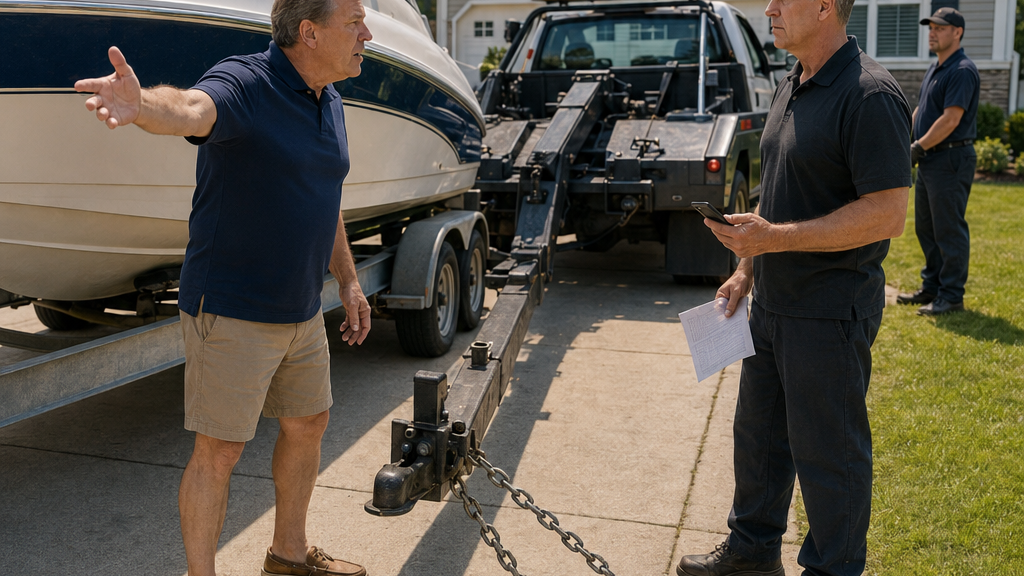
The trailer tongue sat three feet inside my property line. Its hitch pointed toward my garage. Two steel safety chains crossed beneath it, silver against the dark pavement, and the boat itself rose above my shrubs in a polished white curve that caught the first light.
My service truck was trapped behind it.
My phone buzzed in my pocket.
The dispatcher.
I already knew what she was going to say.
“Jonathan, we’ve got a rollover on Route 17. Police are asking for the heavy unit.”
I looked at Gregory’s boat.
“How long can they hold?”
“Not long.”
“I’m on my way.”
I ended the call without telling her I wasn’t moving anywhere.
For three months, I had photographed that boat in places it did not belong.
Across the edge of my driveway during the spring cookout.
Half over my apron when the landscapers needed access to the common strip.
Angled across my mailbox on a Thursday afternoon because Gregory said contractors were using his side of the street.
I had timestamps for all of it.
What I didn’t have was the thing I should have created the first week: a formal written demand telling him never to use my driveway again.
I had told him.
More than once.
But telling a neighbor over a hedge and sending a formal notice were not the same thing. I knew that professionally. Somehow, at home, I had convinced myself they were.
I walked around the trailer and took four photographs.
One from the garage.
One from the sidewalk.
One close enough to show the hitch over my property.
One with my service truck visible behind it.
Then I called Gregory.
He answered on the fourth ring.
“What?”
“Your boat is across my driveway.”
A pause.
Then, “It’s not across it.”
“I’m looking at it.”
“It’s along the curb.”
“The trailer tongue is on my property.”
Another pause, shorter this time.
“Jonathan, we’ve got the neighborhood cleanup today. We needed the turnaround space.”
“Who is we?”
“The association.”
“I need to leave.”
“You can get around it.”
“No, I can’t.”
He sighed in a way that made it sound like I had interrupted something more important than my own driveway.
“Give me ten minutes.”
I waited eleven.
Then fifteen.
The dispatcher called again.
“They gave it to another company.”
I stood in the garage with my keys in my hand.
That was the third call I had lost because of Gregory’s boat.
Not the third inconvenience.
The third paid call.
When you owned a towing company, people assumed losing a job meant losing a little gas money. They didn’t see the driver hours, the municipal rotation, the relationship with an agency that stopped calling if you missed too many response windows.
I had spent thirty-five years learning not to miss calls.
Gregory had cost me three in a month.
At 6:41, he appeared from two houses down wearing khaki shorts, boat shoes, and a navy polo with the neighborhood association logo stitched over the chest.
He didn’t hurry.
That irritated me more than if he had come out shouting.
He walked down my driveway, looked at the boat, then looked at me.
“You called me twice?”
“Yes.”
“You woke my wife.”
“Move the boat.”
He folded his arms.
“We’re staging cleanup equipment at the common area. The board approved temporary overflow use.”
“My driveway isn’t common area.”
“The apron is partly within the association streetscape.”
“Not the part your hitch is sitting on.”
“You want to argue inches at six-thirty in the morning?”
“I want to go to work.”
Gregory gave the trailer a quick glance, as if seeing it for the first time.
“Fine. I’ll move it when the volunteers get here.”
“That could be an hour.”
“They’ll be here at seven.”
I felt my jaw tighten.
I had always been good at staying quiet until I was sure of my facts.
At work, that served me.
At home, it had turned into something else.
Gregory knew I disliked association meetings. He knew I left before arguments about flower beds and pool rules became twenty-minute speeches. He knew that when he put the boat across my driveway before, I had photographed it, waited, and eventually let him move it.
Silence is easy to mistake for permission when permission is convenient.
I held up my phone.
“Who approved using my driveway?”
“The board.”
“When?”
“Jonathan.”
“When?”
“It’s been approved for years.”
“Then there should be a record.”
His expression changed slightly.
Not fear.
Annoyance.
“You’re making this harder than it needs to be.”
“You parked a twenty-foot trailer across my property.”
“And you’re acting like I parked it in your living room.”
“I missed a police rotation because I couldn’t get my truck out.”
That stopped him for half a second.
Then he said, “That’s unfortunate.”
The word landed harder than an insult.
Unfortunate.
As though my work had been delayed by rain.
I took another photograph.
Gregory watched me.
“What’s that for?”
“My records.”
He gave a small laugh.
“You and your records.”
“Yes.”
“Well, put this in them. The association has used temporary overflow areas since before you bought this house.”
“I bought this house fourteen years ago.”
“Exactly.”
He turned toward the boat.
I thought he was finally going to move it.
Instead, he leaned against the fender.
“You know what your problem is? You think every informal arrangement needs to turn into paperwork.”
“I think using my property needs my permission.”
“I think you should talk to Brenda before you turn this into a neighborhood war.”
“Good idea.”
I called her while he stood there.
Brenda Davis managed six communities for the property-management company the HOA used. She answered in a low voice that suggested I had caught her before coffee.
I explained the boat, the driveway, and Gregory’s claim.
Gregory interrupted loudly enough for the phone to catch him.
“Tell her it’s cleanup-day overflow.”
Brenda was quiet.
Then she said, “I know we’ve used overflow staging before.”
Gregory looked at me as if that settled it.
I asked, “Do you have authorization for my driveway?”
“Let me pull the current records.”
I heard keys tapping.
A drawer.
More keys.
Gregory shifted his weight.
Brenda said, “I have the cleanup-day notice. I have the common-area staging map.”
“And?”
“I don’t see your lot listed.”
Gregory straightened.
“Check the standing arrangement,” he said.
Brenda heard him.
“I’m looking.”
Nearly thirty seconds passed.
My phone screen dimmed.
Then Brenda said, “Gregory, I’m not finding anything in the current file that authorizes use of Jonathan’s driveway.”
Gregory’s face hardened.
“That doesn’t mean it doesn’t exist.”
“No,” Brenda said carefully. “It doesn’t.”
I looked at the crossed safety chains beneath the hitch.
For the first time that morning, the boat stopped looking like a nuisance.
It looked like evidence.
Chapter 2: The President Told Me to Tow It
“If you don’t like it there,” Gregory said, “have it towed.”
He said it at 6:53 in the morning, standing beside his boat with one hand on the trailer fender and the HOA logo over his heart.
I stared at him.
“Excuse me?”
“You heard me.”
Brenda was still on speakerphone.
She said, “Gregory, that is probably not the direction we should take.”
He ignored her.
“You own a towing truck, don’t you, Jonathan? Or work for one. Whatever it is.”
“I own the company.”
That finally shifted something in his expression.
Not much.
Enough.
“You own Riverside?”
“Yes.”
He looked past me toward the heavy unit trapped in my garage.
I could almost see him recalculating.
Then pride stepped in before caution could.
“Fine,” he said. “Then tow it. And when my attorney asks why an HOA homeowner used his business equipment to seize a board officer’s property during an association event, you can explain it to him.”
Brenda cut in.
“Both of you stop.”
I didn’t answer Gregory.
That mattered later.
At the time, it felt like the hardest thing I did all morning.
I wanted to back the heavy unit under the tongue, connect the chains, lift the trailer, and make the problem disappear.
Instead, I took out a paper tow authorization form from the truck.
Gregory laughed.
“Seriously?”
“Yes.”
I wrote the address.
Time.
Property owner.
Reason for removal: obstruction of private driveway.
Then I stopped.
In my business, the fastest way to make a legal tow look predatory was to act like you had nothing to lose.
I had plenty to lose.
My company’s contracts.
My reputation.
My insurance.
And if Gregory could show I had used a legitimate business process as a weapon in a personal dispute, I would spend months proving the difference.
“Brenda,” I said, “email me whatever you have showing association authority for private-driveway overflow.”
“There may be older material in archived records.”
“Send current first.”
“I can.”
“Gregory, do you have anything?”
He tapped his phone.
“I don’t carry board resolutions in my pocket.”
“An email? Meeting minutes? A policy?”
“It’s established practice.”
“That isn’t what I asked.”
His mouth tightened.
“You’re really enjoying this.”
That hit closer than I wanted it to.
I looked at the boat.
The truth was, part of me was.
Not the paperwork.
Not the risk.
The idea of Gregory having to stand on my driveway and wait for me to decide what happened to something he cared about.
That realization cooled me faster than Brenda’s warning could have.
I lowered the form.
“Not yet.”
Gregory blinked.
“You just threatened to tow it.”
“No. You told me to.”
I stepped away and called the municipal non-emergency line.
An officer from parking/code arrived twenty-six minutes later, looked at the trailer position, checked the property boundary near the apron, and told both of us the same thing: the city was not going to resolve an HOA/private-property dispute on the street unless the trailer violated a municipal obstruction rule.
It didn’t.
But he added, “If it’s on private property without permission, that’s between the property owner and whatever lawful removal process applies.”
I asked him to note the visit number.
Gregory shook his head.
“This is absurd.”
Maybe it was.
But I had already lost the call.
I was not going to lose the record.
By eight o’clock, volunteers in work gloves and bright shirts were moving mulch and folding tables around the common area. Gregory finally moved his boat just far enough that I could get the heavy unit out.
I drove straight to the towing office.
The dispatcher looked up from her monitors.
“You okay?”
“No.”
“That Hill guy again?”
I put my phone on the desk and started transferring photographs into the incident folder.
She had seen the folder before.
“Want me to call the rotation coordinator?”
“No. We missed it. Leave it.”
An email from Brenda came through.
Cleanup notice.
Staging map.
Board calendar.
No private-lot authorization.
Then another message.
She had searched the current governing file.
Still nothing.
At 9:17, Gregory returned the boat to the same area.
This time, he pulled farther forward.
The trailer tongue crossed my property line by nearly four feet.
I watched it happen through my doorbell camera from the office.
For a moment I said nothing.
Then I called Brenda.
“He put it back.”
She exhaled.
“Jonathan.”
“I have current confirmation there’s no authorization.”
“I said I couldn’t find one in the current file. That is not the same as saying none ever existed.”
“Do I have to give him another chance?”
“I can’t advise you on towing law.”
“I’m not asking you to.”
“Then what are you asking?”
“Whether the HOA is directing him to use my driveway.”
“No.”
That was enough for me to begin the process.
Not to tow immediately.
To verify.
I called another licensed operator I knew in the next county and described the situation without Gregory’s name. I asked him to review the photographs, property line, notice history, and my authorization form.
He called back twenty minutes later.
“If this were my call, I’d want the owner’s written statement that there’s no permission and I’d photograph everything before touching the trailer.”
“I am the owner.”
“That’s the ugly part.”
“Conflict?”
“Appearance of one.”
“Legality?”
“That’s for your lawyer. But process-wise, document like somebody hates you.”
That was advice I understood.
At 10:06, I drove home in a smaller company truck with a second employee behind me in the tow unit.
Gregory was waiting.
He had probably seen us on the neighborhood cameras.
He walked into the driveway before we had finished backing toward the trailer.
“You’re really doing this?”
“I’m documenting a removal.”
“You were told this is HOA use.”
“Brenda told me the HOA is not directing you to use my driveway.”
“That’s not what I said.”
“No. It’s what she said.”
I held out the authorization form.
“My property. My authorization. Photos before hookup. Standard rate.”
Gregory stepped closer.
“You think because you own the truck you get to decide the law?”
“No.”
I nodded toward the boat.
“But being HOA president doesn’t let you decide my property line.”
His eyes moved to the form.
Then to the truck.
Then to the safety chains under the trailer tongue.
For the first time, his confidence had a visible crack in it.
He took out his phone.
“You touch that trailer, I’m calling my attorney.”
“That’s your right.”
“My attorney knows people at the county.”
I looked at him.
“Then he’ll know where to send the letter.”
The employee beside the tow unit stopped moving until I gave the signal.
I didn’t.
Not yet.
I called Brenda one more time and put her on speaker.
“Can you confirm the HOA has no current instruction authorizing Gregory to park on my driveway?”
“Yes,” she said. “But Jonathan, I need to say this clearly. If you use your own company to tow a neighbor you’re personally disputing with, Gregory may claim you benefited financially from the conflict.”
Gregory smiled again.
There it was.
The opening he wanted.
I looked at the standard rate card clipped inside the truck.
Then at my employee.
“Photograph the hitch before hookup,” I said.
Gregory’s smile disappeared.
We completed the documentation.
The trailer rose.
The crossed safety chains tightened beneath the tongue, no longer blocking my truck but attached to mine.
As the tow unit pulled away, my phone vibrated.
An email had arrived from an address I didn’t recognize.
The subject line read: PRESERVATION OF PROPERTY AND RECORDS.
Gregory’s attorney had sent it before the boat reached our storage yard.
Chapter 3: Every Tow Leaves a Paper Trail
By Monday morning, Gregory Hill’s boat had been in my secure yard for forty-three hours, and I had twenty-three photographs proving I should have dealt with the problem months earlier.
I counted them twice.
Not twenty-three photographs total.
Twenty-three separate dates.
Different mornings.
Different angles.
Same boat.
Sometimes only the trailer tire crossed the edge of my driveway.
Sometimes the tongue did.
Twice the entire rear third of the trailer sat across the apron.
Three times my service vehicle was visible behind it.
I sat at my office desk with the photographs spread across two monitors while Gregory’s attorney’s preservation letter lay printed beside my keyboard.
The letter demanded that I retain all records related to the tow, including photographs, dispatch entries, rate schedules, employee communications, authorization forms, storage logs, and any prior communications between Gregory and me.
That part didn’t bother me.
Records were what I did.
The sentence below it did.
The letter alleged that I had “manufactured a financial claim from a longstanding consensual neighborhood practice.”
Consensual.
I leaned back.
My dispatcher walked in carrying coffee.
“You’ve got that face.”
“What face?”
“The one where somebody’s about to get a binder.”
I looked at the screens.
“Maybe me.”
She put the coffee down.
“What happened?”
“I documented this twenty-three times.”
“That sounds good for you.”
“I never sent a formal cease-use notice.”
“You told him.”
“That’s not the same.”
She frowned.
“He knew you didn’t like it.”
“Knowing I didn’t like it and knowing permission was revoked in writing are different things if his lawyer wants to make them different.”
I opened the incident folder.
There were notes.
Text messages.
A draft email I had written two months earlier.
I clicked it.
Subject: Driveway access.
Three paragraphs.
Clear.
Professional.
Never sent.
I remembered writing it after Gregory’s trailer blocked me during a Friday service call. I had typed everything I should have said: no permission, no future use, any unauthorized obstruction may be removed.
Then I had stared at it for ten minutes and closed the laptop.
I had told myself I didn’t want to make the neighborhood hostile.
What I had really wanted was to avoid being the difficult one.
Now the unsent draft looked worse than no draft at all.
It proved I knew exactly what formal notice should look like and chose not to give it.
At ten, Gregory called.
I almost let it go to voicemail.
Instead, I answered.
“When can I get my boat?”
“When the release conditions are met.”
“That means when I pay you.”
“It means when the authorized charges are resolved.”
“You mean the charges you created.”
“The tow rate is our published rate.”
“And storage?”
“Published.”
“You’re charging me to hold my own property after you used your own company to take it.”
“Yes.”
He gave a short laugh with no humor in it.
“You hear how that sounds?”
I did.
That was the problem.
“What exactly are you disputing?” I asked.
“All of it.”
“Then put it in writing.”
“My attorney already did.”
“He preserved records. He didn’t identify disputed amounts.”
“He will.”
Gregory went quiet.
Then he said, “You let me use that space for years.”
“I didn’t give you permission.”
“You didn’t stop me.”
“I complained.”
“You complained about everything around that boat. Where it sat. How long it sat. Whether volunteers could get around it. You never once sent me a notice saying I couldn’t use the apron.”
I looked at the unsent email on my screen.
He couldn’t see it.
It still felt like he could.
“You knew I wanted it moved.”
“I knew you were irritated.”
“That’s not consent.”
“No,” he said. “But silence isn’t always refusal either.”
After we hung up, I went to the yard.
The boat sat behind the chain-link fence beneath the security lights, clean and expensive and absurdly still.
Saturday morning it had felt like leverage.
By Monday, it felt like a test.
The boat-yard employee met me beside the gate.
“Storage clock still running?”
“For now.”
“Attorney called twice.”
“What did you tell him?”
“That you handle disputes.”
“Good.”
Back inside the office, I printed our rate sheet.
Standard private-property tow.
Trailer handling.
Daily secured storage.
Administrative documentation.
After-hours release.
I looked at the last two.
Both were permitted under our posted schedule.
Both were discretionary in this case.
And both would make the bill look exactly like Gregory claimed it was: a neighbor turning irritation into revenue.
I crossed them out.
The dispatcher watched.
“That’s money we charge everyone.”
“Not everyone lives two houses from me.”
“So he gets a discount because he’s difficult?”
“No. He gets the cleanest bill I can defend.”
I removed the after-hours release charge.
Removed the administrative add-on.
Kept the tow.
Kept standard daily storage.
Nothing else.
The total dropped enough to irritate me.
That told me I had made the right decision.
At noon, Brenda called.
“I found something.”
I put her on speaker and pulled up the HOA folder.
“Current authorization?”
“Older.”
“How old?”
“Eight years.”
Gregory had been board president for five.
Brenda continued.
“It’s an email chain between the previous manager and the board. It references temporary overflow parking for association events.”
My stomach tightened.
“So Gregory was right.”
“Not exactly.”
She hesitated.
“Send it.”
“I just did.”
The email arrived.
I opened the attachment.
The language was informal, not a resolution. No recorded easement. No permanent policy.
But it did explain why Gregory believed there had been an established arrangement.
Temporary overflow may be used on private driveway aprons adjacent to common-area activity—
I stopped reading.
“That’s what he’s been relying on.”
“Keep going,” Brenda said.
I read the next line.
—when owners agree and access is not materially obstructed.
I sat forward.
“Owners agree.”
“Yes.”
“Each time?”
“That’s how I read it.”
“Is there any blanket consent attached?”
“I haven’t found one.”
“Any consent from me?”
“No.”
I looked at the twenty-three dated photographs.
For two days I had been asking whether Gregory had invented the whole thing.
He hadn’t.
There had been an arrangement.
He had simply been repeating the part that gave him authority and leaving out the part that limited it.
Brenda lowered her voice.
“Jonathan, there’s something else.”
“What?”
“The email chain names three other private lots that were used for overflow.”
“And?”
“I checked the archived event files.”
A pause.
“I’m not finding written owner consent for those either.”
Chapter 4: The Word Gregory Left Out Was Consent
“The sentence doesn’t say what Gregory keeps saying it says.”
Brenda Davis had the old email open on a conference-room monitor when I arrived at the management office Wednesday morning.
Gregory was already there.
So was Ryan Campbell, the HOA treasurer.
The room was barely large enough for the four of us and a rectangular table covered with archived meeting packets. Gregory sat at one end with his arms folded. Ryan had a yellow legal pad in front of him. Brenda stood beside the monitor.
I remained near the door.
Brenda enlarged the email.
“Here,” she said.
The line we had already discussed appeared in the middle of a message written eight years earlier.
Temporary overflow may be used on private driveway aprons adjacent to common-area activity when owners agree and access is not materially obstructed.
Brenda pointed at the last half.
“When owners agree.”
Gregory leaned back.
“I understand what it says.”
“Do you?” I asked.
He looked at me.
“I’ve been doing this for five years.”
“That wasn’t my question.”
Ryan rubbed his forehead.
“Can we not start this way?”
I said nothing.
Brenda opened another folder.
“I checked the years before Gregory became president. The practice was informal even then. I found emails where individual homeowners said yes to using the edge of a driveway for a few hours.”
“Exactly,” Gregory said. “Established practice.”
Brenda shook her head.
“No. Individual permission was the established practice.”
The distinction sat between us.
Gregory stared at the screen.
For the first time since the tow, he did not immediately answer.
I had expected that discovery to feel better.
It didn’t.
I had imagined Gregory knowingly inventing a rule because he thought nobody would challenge him. That version was clean. It fit nicely into the folder in my head labeled arrogant neighbor.
But he had not invented the whole thing.
Someone really had created an overflow arrangement.
He had inherited it.
He had simply stopped asking the question that made the arrangement legitimate.
Ryan turned several pages on his pad.
“How many properties are we talking about?”
Brenda placed three printed maps on the table.
“Four that I can verify.”
“Including Jonathan?”
“Yes.”
One was a corner lot beside the clubhouse. Another bordered the pool access path. The third was a wide driveway near the playground.
Mine was the fourth.
I studied the dates beside each address.
Spring cleanup.
Summer barbecue.
Pool opening.
Holiday market.
Landscaping project.
The pattern went back years.
“Did those owners consent?” I asked.
Brenda hesitated.
“I found written consent on older events. Not recent ones.”
“How recent?”
“The last three years.”
Gregory leaned forward.
“Because everybody knew what we were doing.”
“That is not permission,” I said.
He looked at me sharply.
“No, Jonathan. It’s not paperwork.”
Ryan’s pen stopped.
Gregory continued.
“We’re talking about six hours twice a year. Sometimes less. We’re not taking anybody’s property.”
“My truck was trapped.”
“And that shouldn’t have happened.”
It was the first time he had said it that plainly.
I waited.
He looked down at the table.
“I told the volunteers not to block garage access.”
“You parked the boat.”
“Yes.”
“And after I told you it was blocking me, you left it there.”
His jaw worked.
“Yes.”
Brenda closed one folder and opened another.
“That still leaves a larger problem.”
She slid a stack of event records toward Ryan.
“We have vendors arriving before residents. Landscaping trailers. Dumpster staging. Temporary fencing. The association has been using private edges because there isn’t enough common-area space.”
Ryan gave a tired nod.
“I know.”
“You knew?”
“I knew we were tight on staging.”
“That isn’t what I asked.”
Ryan looked at me.
“No. I knew we had been borrowing space.”
“Borrowing usually involves asking.”
His eyes dropped to the legal pad.
“That’s fair.”
Gregory shifted in his chair.
“You’re both making this sound like some scheme.”
“No one said scheme,” Brenda replied.
“You’re building one.”
She looked at him steadily.
“I’m building a record.”
That silenced the room.
I recognized the tone.
It was the same one I used at work when a driver tried to explain around a missing signature.
Brenda pulled a budget sheet from another packet.
“Where is the event-storage line?”
Ryan answered without looking.
“There isn’t one.”
“Trailer staging?”
“No.”
“Temporary parking rental?”
“No.”
“Off-site storage?”
“No.”
I frowned.
“What does the association do with equipment between events?”
Gregory answered.
“We figure it out.”
The phrase carried more weight now.
Brenda asked, “Meaning?”
“The maintenance contractor holds some things. Volunteers take some. I keep some.”
“You keep association equipment?”
“Sometimes.”
“Where?”
“My garage. My side yard. Wherever there’s room.”
Ryan finally looked up.
“This is what I’ve been trying to explain.”
“To who?” I asked.
“The board.”
He flipped his pad around.
Numbers filled half the page.
“Residents want events. They want the pool furniture stored off-season. They want holiday decorations. They want landscaping contractors out of sight. They want cleanup days, shredding days, mulch delivery. But every time we put a storage or staging line in the draft budget, somebody asks why dues have to go up.”
Gregory gave a bitter laugh.
“Somebody? Half the room.”
Ryan continued.
“Two years ago we priced a small commercial storage unit and designated overflow lot access. It would have increased annual dues.”
“By how much?” I asked.
“Not much per house.”
Gregory said, “Enough to lose the vote.”
I glanced back at the map.
Suddenly the unauthorized driveway use looked less like one man helping himself and more like a system surviving by making invisible withdrawals from whoever complained the least.
That did not excuse Gregory.
It made the problem worse.
“You didn’t save money,” I said.
Gregory frowned.
“You moved the cost.”
“What cost?”
“My missed calls. Somebody else losing driveway access. Somebody storing association property in a garage. Whoever has to rearrange their day because the board doesn’t want a budget line.”
Ryan’s pen tapped once against the table.
Then stopped.
Brenda said, “That’s the governance issue.”
Gregory stood.
“Oh, come on.”
He paced to the end of the room.
“You all want to sit here now and act like I made this up because it was convenient for me. You know what happens when a dumpster company wants another three hundred dollars because they have to stage outside the neighborhood? You know who gets the calls?”
Ryan said quietly, “We all do.”
“No. I do.”
Gregory pointed toward himself.
“When the pool furniture isn’t out on time, residents call me. When mulch blocks the street, they call me. When the holiday event costs two hundred dollars more than last year, they call me. Then the same people show up at budget season and tell us dues are already too high.”
Nobody interrupted him.
He looked at me.
“That boat was mine. I used it because I could move it when we needed space. I wasn’t trying to steal your driveway.”
“You still used it after I said no.”
“I thought you were complaining about access, not withdrawing from the arrangement.”
“That distinction exists because you needed it to.”
His face tightened.
“Maybe.”
It was not an apology.
But it was the first answer that sounded like he had heard me.
Ryan flipped to another sheet.
“There’s something else Jonathan should know.”
Gregory turned.
“Ryan.”
“No. He should.”
Ryan reached into his folder and pulled out a copy of an invoice.
The amount was just over sixteen hundred dollars.
“What’s that?” I asked.
“Storage and equipment holding from last year.”
“Association expense?”
“It should have been.”
Gregory stared at him.
Ryan continued.
“The board rejected the midyear adjustment. We didn’t have enough in the event line.”
Brenda looked at Gregory.
“So how was it paid?”
Ryan placed the invoice flat on the table.
“Gregory paid it himself.”
For a few seconds, nobody moved.
I looked from the invoice to Gregory.
He seemed angrier about that page being visible than he had about the boat being towed.
“You reimbursed him later?” I asked.
Ryan shook his head.
“No.”
Gregory reached for the invoice.
“Put that away.”
Ryan did not.
The man I had spent days imagining as someone who treated the neighborhood like his private territory had apparently spent his own money keeping part of it running.
It did not erase my driveway.
It did not erase the dare, the threat, or the boat behind my fence.
But it made one question harder to answer.
Had Gregory been using the neighborhood because he thought he could?
Or had he been carrying an underfunded system so long that he had stopped noticing the difference between helping and taking?
Chapter 5: Cheap Dues Had Been Costing Someone Else
The first page Ryan Campbell handed me at the Saturday board workshop had Gregory Hill’s name on it twice.
Two budget requests.
Two different years.
Both rejected.
The first proposed money for off-site event storage and contractor staging. The second added temporary overflow parking for the larger neighborhood events.
Neither request was extravagant.
I read the figures again.
“You asked for this?”
Gregory sat across the clubhouse table, looking as if he would rather have been anywhere else.
“Yes.”
“And the board voted it down?”
Ryan answered.
“Both times.”
Around us, folding tables had been pushed into a square. A handful of residents occupied the outer chairs. Brenda had brought binders. One board member had a calculator. Another had a stack of emails.
The meeting was supposed to be a workshop, not a hearing.
It already felt like both.
Ryan pointed to the first proposal.
“The increase would have been less than the cost of one restaurant lunch per household over a year.”
A resident near the wall said, “That’s easy to say when every fee keeps going up.”
Ryan looked at him.
“That is exactly what people said.”
Gregory gave a small, humorless smile.
I turned to the second page.
“What happened after they rejected it?”
“We improvised,” Gregory said.
There was the word again.
Improvised.
He said it as though it described competence.
Maybe once it had.
Brenda opened her binder.
“Improvisation is where we lost the consent process.”
Gregory looked at her.
“We didn’t lose it.”
“What would you call it?”
He did not answer immediately.
Then he said, “We stopped asking every time.”
The room became still.
I had heard admissions in impound disputes before. Most came wrapped in explanations.
Gregory did not add one at first.
Brenda asked, “Why?”
He looked toward the windows.
“Because people stopped answering.”
“That doesn’t make silence permission.”
“I know that now.”
“You knew it then,” I said.
His eyes came back to mine.
“Yes.”
That surprised me more than denial would have.
He continued before I could speak.
“At first we asked. Then somebody would say yes one month and ignore the email the next. Or they’d tell me verbally that it was fine whenever. Or they’d complain after an event even though they’d agreed before it. After a while I started treating no objection as good enough.”
“Including mine?”
He nodded.
“You complained about blocking the driveway. I told myself that meant you cared about access, not the use itself.”
“You needed that to be true.”
“Yes.”
The answer was quiet.
It removed the satisfaction from the accusation.
One of the residents leaned forward.
“So why are we acting like Gregory did something terrible? The association created the problem. Jonathan should release the boat and waive the fees.”
Another resident agreed.
“If it was HOA business, why is Gregory personally paying?”
I looked at Brenda.
She said, “The boat was Gregory’s property. The association did not issue written authorization directing him to park on Jonathan’s lot.”
“But he was doing association work.”
“That doesn’t automatically make every action an association action.”
Gregory rubbed both hands over his face.
“This is why nobody wants to serve on a board.”
I almost laughed, but there was nothing funny in it.
Outside the clubhouse, across the neighborhood and several miles away, Gregory’s boat remained behind the fence at Riverside.
I had ordered the storage clock paused pending the internal review.
That had not been required.
I simply no longer wanted the bill growing while everybody argued about who had created what.
When I told Gregory, he had looked suspicious.
“You stopped storage?”
“Temporarily.”
“Why?”
“Because we’re reviewing the dispute.”
He had stared at me like he was waiting for the trick.
There wasn’t one.
That bothered him more than a trick might have.
At the workshop, Ryan passed around a breakdown of the previous three years.
Equipment transport.
Temporary storage.
Extra vendor trips.
Emergency pickup charges.
Volunteer reimbursements.
Nothing looked disastrous individually.
Together, they told a different story.
The HOA had saved money on a formal system by paying for disorder in pieces.
Sometimes with association funds.
Sometimes with volunteers’ time.
Once with Gregory’s own money.
And sometimes with property that did not belong to the association.
“Cheap dues,” Ryan said, “haven’t actually been cheap.”
The resident near the wall crossed his arms.
“So now you want to raise them because Jonathan towed a boat?”
“No,” Ryan said. “I want to stop pretending costs disappear because they aren’t printed on the budget.”
That line shifted the room.
Not dramatically.
Nobody applauded.
But several people looked down at the sheets in front of them.
I did too.
My own cost was not there.
Three missed calls.
Time spent photographing trailers.
Saturday morning lost to a dispute.
Resentment I had allowed to build because sending one firm email felt socially harder than taking twenty-three pictures.
Gregory turned toward Brenda.
“You can tell them you signed off on the staging.”
She stiffened.
“I signed off on common-area staging.”
“The maps went through management.”
“Yes.”
“You knew private edges were being used.”
Her mouth opened.
Before she could answer, Gregory said, “No.”
Everyone looked at him.
He leaned back.
“That’s not fair.”
Brenda stared at him.
Gregory looked at the board.
“She knew we used private areas sometimes. She didn’t know I had stopped getting consent every time.”
Ryan said, “Gregory—”
“I made that decision.”
The room went quiet again.
He continued.
“I told myself it was established practice. I told Brenda the same thing. If somebody wants to blame management because that’s easier, don’t.”
Brenda lowered her eyes for a moment.
That was the first time I understood why people kept electing Gregory.
Not because he was always right.
Because when things worked, he was willing to carry more than his share.
The trouble was that somewhere along the way, he had begun carrying things that were not his to carry.
Including other people’s permission.
A board member turned to me.
“So what do you want?”
The question was simple.
My answer wasn’t.
A week earlier, I would have known immediately.
Pay the tow.
Pay storage.
Never touch my driveway again.
Maybe resign while you’re at it.
Now the boat sitting behind my fence felt less like a trophy and more like an invoice for every shortcut in the room.
“I want the legitimate tow paid,” I said.
The resident near the wall made a noise.
I continued.
“The standard tow. Standard storage through the point when the dispute was formally under review. No extra administrative charges. No punitive add-ons.”
Gregory watched me carefully.
“And after that?”
“I’ll waive the disputed storage days.”
Someone said, “Then we’re done.”
“No.”
I looked at the board.
“I’ll do that if the association adopts a written rule ending unauthorized use of private property for staging, parking, storage, or event access.”
The room shifted.
I continued.
“Written consent. Specific event. Specific time. No silence treated as permission.”
Gregory’s expression hardened again.
Not because the rule was unreasonable.
Because accepting it meant admitting what he had done publicly.
“You’re tying my boat to association policy,” he said.
“I’m tying my compromise to fixing the thing that caused the dispute.”
“That sounds like leverage.”
“It is.”
Brenda looked at me.
I added, “But it’s not money.”
Gregory stood and walked toward the window.
Outside, two children rode bicycles around the common-area sidewalk while their parents talked beside parked cars.
Ordinary Saturday.
Ordinary neighborhood.
Inside, we were trying to decide who had been paying for the convenience of keeping it that way.
Gregory turned around.
“What exactly do you want me to say?”
I met his eyes.
“The truth.”
His jaw tightened.
“You think you’re the only one who has something to admit?”
“No.”
That answer stopped him.
Because by then I knew the hearing would not work if I arrived carrying only his mistakes.
My own unsent notice was still sitting in my records.
So was the decision I had made Saturday morning while angry.
The formal hearing was scheduled for Thursday.
If Gregory wanted his boat back under the compromise I had offered, he would have to acknowledge publicly that homeowners had never given blanket consent.
And if I wanted the board to believe I cared about process more than punishment, I was going to have to show them the evidence that made my own position weaker.
Chapter 6: The Hearing Was About More Than One Boat
I began the hearing by handing the board the document Gregory Hill’s attorney would have used against me.
It was the unsent email.
Three paragraphs dated almost two months before the tow.
Clear language.
No permission for future driveway use.
A warning that unauthorized obstruction could result in removal.
And no proof it had ever left my drafts folder.
Gregory looked at the page, then at me.
His attorney, seated beside him, said nothing.
The clubhouse was fuller than it had been for the workshop. Folding chairs filled most of the room. Brenda sat at one end of the board table with the records. Ryan had a spreadsheet open on a laptop.
The board chair looked at me.
“You’re saying you wrote this but did not send it?”
“Yes.”
“Why are you submitting it?”
“Because it matters.”
“To whose position?”
“Both.”
A murmur moved through the chairs behind me.
I continued.
“I told Gregory verbally that I wanted the boat moved. I documented repeated obstructions. But I also knew what formal notice looked like, and I avoided sending it because I didn’t want a neighborhood fight.”
Gregory’s attorney leaned forward.
“So you concede there was ambiguity.”
“I concede I helped create some.”
That answer cost me something.
I could feel it.
Not money.
The cleaner version of myself I had been carrying around since Saturday.
The board chair asked, “Does that change your towing claim?”
“It changes what I’m asking for.”
I placed the published Riverside rate sheet beside the email.
“Standard tow. Standard secured storage through the formal dispute date. Nothing discretionary.”
Gregory’s attorney glanced at the amounts.
“You removed the administrative charge?”
“Yes.”
“And after-hours release?”
“Yes.”
“Why?”
“Because this wasn’t an ordinary customer dispute.”
Gregory gave a short breath through his nose.
I looked at him.
“It involved me personally.”
The attorney sat back.
That did not end the argument.
It made the next part possible.
Brenda presented the archived email.
She read the sentence aloud.
“Temporary overflow may be used on private driveway aprons adjacent to common-area activity when owners agree and access is not materially obstructed.”
The board chair turned to Gregory.
“Did Jonathan Carter ever provide blanket written consent?”
“No.”
“Blanket verbal consent?”
Gregory looked toward me.
“No.”
“Did any current homeowner provide blanket consent?”
Gregory remained silent long enough that the room noticed.
Then he said, “Not that I can document.”
The chair asked, “That wasn’t the question.”
Gregory rubbed his thumb along the edge of the table.
“No.”
Something in the room loosened.
Not celebration.
Recognition.
The issue no longer depended on which one of us sounded more offended.
The facts were becoming narrower.
Brenda continued through the event records.
Four private lots.
Multiple dates.
Missing consent.
Then Ryan connected his laptop to the monitor.
A spreadsheet appeared.
“This is what we actually spent over three years handling event logistics without a dedicated budget.”
The numbers were not dramatic by themselves.
That was what made them persuasive.
Extra vendor trips.
Rush pickup charges.
Short-term storage.
Mileage reimbursements.
Equipment moves.
One personally paid invoice.
Then Ryan displayed another column.
“This is the estimate for a small contracted storage arrangement and designated temporary event parking.”
A resident called from the back, “How much more in dues?”
Ryan gave the amount.
Several people reacted.
Then he divided it by twelve months.
The room became quieter.
The difference per household was modest.
Ryan said, “We rejected this twice because the annual number sounded high. Then we paid nearly as much through inefficiency, volunteer labor, and unrecorded use of private space.”
A woman near the aisle asked, “So Gregory was trying to save us money?”
Ryan looked at him.
“In part.”
Gregory’s attorney shifted toward Brenda.
“There were management failures as well.”
Brenda stiffened.
Gregory spoke before she could.
“No.”
His attorney turned.
Gregory said, “Leave her out of that.”
“Gregory—”
“She worked from what I told her.”
Brenda watched him.
Gregory looked at the board.
“I told management we had established overflow practice. That was true, but incomplete.”
Nobody moved.
He went on.
“I knew the old arrangement was based on permission. Over time, I started treating previous permission, verbal comments, or no response as enough.”
The chair asked, “Why?”
Gregory looked around the room.
“Because asking every time was slow. Because contractors were waiting. Because people complained when things cost more. Because every time we proposed money for storage or staging, we got told to find another way.”
He paused.
“And because I got used to being the person who found another way.”
There it was.
Not corruption.
Not confusion.
Pride.
The same kind I recognized in myself.
The board chair asked me whether Gregory’s statement satisfied the condition I had proposed at the workshop.
“Part of it.”
“What remains?”
“The policy.”
Ryan displayed a draft.
Written owner consent.
Specific dates and hours.
No assumption from silence.
No obstruction of garage access.
No use of private property when consent was absent.
The board discussed amendments.
Then the room broke open.
A resident stood.
“If he knowingly ignored consent, why is Gregory still president?”
Another voice followed.
“He should resign.”
Then another.
“This wouldn’t have happened without him.”
Gregory sat very still.
I had imagined that moment more than once after the tow.
The neighborhood seeing what he had done.
His authority reduced.
My side vindicated.
Now that it was happening, it felt wrong.
Not because he was innocent.
Because the hearing was beginning to turn into the thing I had claimed I didn’t want.
Punishment for its own sake.
I stood.
The board chair looked at me.
“I’m not asking for his resignation.”
The room quieted.
Gregory turned toward me.
A resident said, “Why not? You’re the one he did this to.”
“Because removing him doesn’t fix the policy.”
“He abused his position.”
“Yes.”
Gregory flinched slightly.
I continued.
“And I waited too long to set a formal boundary because I didn’t want conflict. Then I used my own company when I was angry. If we’re fixing the process, fix it. If you want an election later, have one. But don’t make somebody’s humiliation the settlement.”
Gregory stared at the table.
Ryan slowly closed his laptop.
The chair called for a short recess before the vote.
People stood, talked, moved toward the coffee station.
I stayed where I was.
Gregory’s attorney leaned toward him and whispered something.
Gregory shook his head.
Then the attorney spoke again.
Gregory shook his head harder.
A minute later, he stood.
“Before you vote,” he said.
The conversations died down.
The chair looked at him.
“We’re technically in recess.”
“I know. But I need to say something before everybody decides what this was.”
He glanced at me, then at the printed photograph lying near the center of the table—the trailer hitch over my driveway, the two safety chains crossed beneath it.
Gregory rested both hands on the back of his chair.
“That boat was expensive,” he said. “The tow is expensive. The storage is expensive.”
He looked around the clubhouse.
“But the boat was never the most expensive part of this problem.”
Chapter 7: The Most Expensive Shortcut Was Silence
Gregory kept both hands on the back of his chair and looked around the clubhouse.
“The real debt,” he said, “was to every homeowner whose silence I decided meant yes.”
Nobody interrupted him.
He looked at me next.
“That includes Jonathan.”
The room had gone so quiet I could hear the air conditioner clicking behind the wall vent.
Gregory straightened.
“I kept telling myself I was solving problems. Most of the time, I was. But every time somebody didn’t answer an email, every time a contractor was waiting, every time we were short on storage or parking, I made the decision for them.”
He looked toward Ryan.
“I didn’t want to go back to the board and say we couldn’t afford what everybody expected.”
Ryan’s expression softened, but only slightly.
Gregory continued.
“I thought if I could keep things working, then I was doing the job. What I didn’t notice was that I was making other people pay for that appearance.”
His eyes dropped to the photograph of the trailer hitch across my driveway.
“Jonathan paid with his time. Other homeowners paid with their space. I paid a few invoices myself and convinced myself that made the whole thing fair.”
He exhaled.
“It didn’t.”
No one applauded.
I was glad.
Applause would have made the moment feel cheaper than it was.
The board chair ended the recess and called the meeting back to order.
Ryan reopened the proposed policy.
The changes were simple.
Private driveways, side lots, and parking aprons could not be used for HOA staging, temporary parking, contractor access, or storage without written owner consent.
Consent had to identify the date and time.
No response meant no permission.
Garage access could never be obstructed.
The association would also create a funded line for temporary parking and equipment storage instead of relying on improvised arrangements.
One board member objected to the expense.
Ryan turned his laptop around.
“We already spend this money,” he said. “We just spend it badly.”
That was the argument that carried the vote.
The policy passed.
The budget adjustment passed by a narrower margin.
Gregory voted yes to both.
Then came the boat.
The board chair looked at me.
“Can you state the final amount you’re seeking?”
I gave the standard tow charge and the storage through the formal dispute date.
Nothing after that.
No administrative add-on.
No after-hours fee.
No disputed days.
Gregory’s attorney reviewed the sheet for a few seconds.
Then he slid it toward Gregory.
Gregory looked at the total.
“I’ll pay it.”
Ryan said, “The association can reimburse the portion connected to the cleanup event.”
Gregory shook his head.
“No.”
“You were acting for the HOA.”
“I was also the one who put my boat there after Jonathan told me to move it.”
Ryan hesitated.
“The board created some of this.”
“Yes,” Gregory said. “And the board is fixing its part.”
He tapped the invoice.
“This part is mine.”
That settled the room more effectively than another hour of argument would have.
The next morning, the payment cleared.
I stood in my office staring at the remaining disputed-storage balance that no longer appeared on the invoice.
Technically, I could still have pursued some of it.
I had photographs.
Published rates.
A secure yard.
Arguments I could make.
A week earlier, I would have made every one of them.
The dispatcher leaned against the doorway.
“So that’s it?”
“Almost.”
“You leaving the rest off?”
I looked at the screen.
“Yes.”
“You sure?”
I thought about the unsent email.
Twenty-three photographs instead of one direct notice.
Three lost calls.
Gregory saying “have it towed.”
Me feeling, for one ugly second, pleased that I had the truck and he had the boat.
“Yes,” I said. “I’m sure.”
She nodded once.
“Good.”
I glanced at her.
“You sound relieved.”
“I work for a towing company, Jonathan. I know the difference between collecting what’s owed and enjoying the meter.”
That landed harder than I expected.
Saturday morning, Gregory arrived at Riverside just after eight.
No attorney.
No board members.
No audience.
The boat-yard employee brought the trailer around to the release lane.
Gregory stood beside me while I checked the receipt and release form.
Neither of us said much.
The boat looked exactly as it had the morning this started—white hull, polished hardware, expensive trailer.
Only the safety chains looked different to me.
A week earlier, crossed beneath the hitch in my driveway, they had felt like a line drawn through my morning.
Then they had become the thing my truck used to take control of the situation.
Now they were just chains again.
I unhooked the last one myself.
Gregory watched me coil it over the trailer tongue.
“You didn’t have to waive the rest,” he said.
“No.”
“Why did you?”
“Because I didn’t want to spend another month proving I could.”
He gave a faint nod.
“I probably would have.”
“I know.”
That almost became a smile.
Almost.
He signed the release form.
Before he climbed into his truck, he stopped.
“I was wrong about your driveway.”
“Yes.”
He looked at me.
“You could make this easier.”
“How?”
“Say I was wrong and you were right.”
I considered it.
“You were wrong about the driveway.”
“And?”
“I was wrong to wait until I was angry enough to tow you before I put the boundary in writing.”
Gregory looked down at the pavement.
“That sounds annoyingly fair.”
“I’ve been called worse.”
He opened his truck door.
Then paused.
“I’m still not resigning.”
“I didn’t ask you to.”
“I know.”
He drove out slowly with the boat behind him.
I followed later because I wanted to make sure the trailer lights were working before it entered traffic.
That was the sort of thing you noticed after enough years in towing.
When Gregory reached our subdivision, he did not turn toward my driveway.
He continued another half block, backed the boat into his own side yard, and shut off the truck.
No scene.
No neighbors gathered.
No final argument.
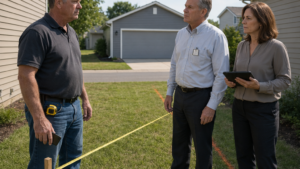
By the following week, a small permanent boundary marker had been installed near the edge of my driveway where the private lot met the association streetscape.
It was not dramatic.
Just a clean metal marker low enough not to interfere with mowing.
Brenda sent written consent forms before the next neighborhood event.
Ryan circulated the new budget.
Gregory still chaired meetings.
He was still impatient.
Still liked solving things quickly.
But the first time a landscaping trailer needed temporary space beside a homeowner’s lot, I saw him standing at the curb with his phone in his hand.
He waited.
The homeowner came outside.
They talked for less than a minute.
Then Gregory pointed toward the proposed parking spot and waited again.
The homeowner nodded.
Only then did the trailer move.
I watched from my garage.
My service truck sat behind me with a clear path to the street.
For years, I had believed boundaries became real when somebody finally enforced them.
I had been wrong about that too.
The strongest boundary we created was not the tow, the invoice, or the new marker beside my curb.
It was the moment both of us stopped treating silence as permission.
The story has ended.