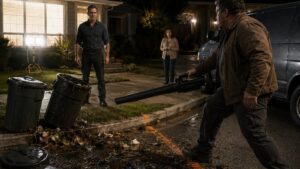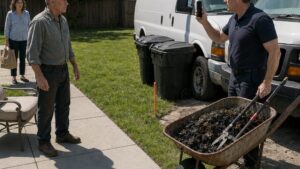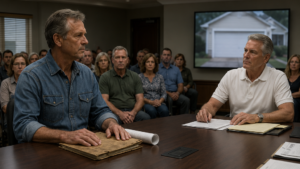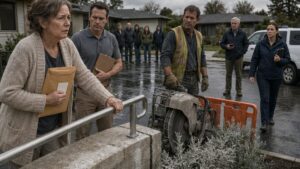
The HOA Blamed the Neighbor Everyone Distrusted—Then the Broken Car Window Exposed Who Had Been Lying
Chapter 1: The Neighbor Paul Said Not to Trust
“You’re seriously giving him the keys?”
Paul Walker’s question stopped Justin Williams with his hand halfway through the open window of his sedan.
Across the clubhouse parking lot, Kevin Moore stood beside a battered pickup that looked as though it had not moved in weeks. His work boots were stained with dried mud. The reflective strip on his old utility vest had gone gray at the edges. Beyond him, Justin’s restored black sedan reflected the white clubhouse columns so cleanly that the passenger window looked almost invisible.
Justin withdrew his hand and looked at Paul.
“I’m not giving him the keys.”
“You’re asking him to watch a car worth more than his house looks right now.”
Justin’s jaw tightened.
Paul immediately raised one palm. “I’m not trying to be cruel.”
“That helps.”
“I’m trying to stop you from doing something stupid.”
They had known each other for nearly fifteen years. Paul had helped Justin move into the subdivision. Justin had helped Paul win his first board election. They had argued over landscaping bids, pool rules, reserve contributions, and one memorable dispute involving a basketball hoop that had somehow occupied three meetings.
This felt different.
Saturday’s homeowner meeting had drawn more people than usual because an insurance representative was coming to discuss the association’s master policy. Cars filled nearly every marked space.
Kevin had come on foot.
Justin had seen him standing at the edge of the lot while the landscaping crew unloaded folding barricades. Kevin’s house, three streets over, had become a regular subject in enforcement reports: peeling fascia, weeds around the side fence, overdue dues, two broken shutters, and a driveway stained dark from an old oil leak.
Justin had defended him more than once.
Not strongly enough to change anything, perhaps. But enough that he thought of himself as someone who had.
Kevin noticed them looking.
“What?”
Paul gave Justin a look that said exactly what he expected to happen.
Justin ignored it and crossed the lot.
“I need to be inside for a while,” Justin said. “Could you keep an eye on my car?”
Kevin looked past him at the sedan.
Then back at Justin.
“You asking me?”
“Yes.”
“Why?”
The question was so flat that Justin almost laughed, but Kevin wasn’t joking.
“Because you’re standing here and I need someone I can find afterward.”
Kevin’s expression didn’t change.
Justin reached into his wallet and counted out three hundred-dollar bills.
Kevin stared at the money.
“No.”
“It’s three hours.”
“I said no.”
Justin lowered his hand. “Why?”
“Because I’m not taking charity from an HOA board member in the clubhouse parking lot.”
Several residents were close enough to hear.
That embarrassed Justin more than he wanted to admit.
“It isn’t charity.”
“Looks like cash.”
“It’s payment.”
“For standing here?”
“For keeping people away from the car, telling anyone who needs me that I’m inside, and calling me if there’s a problem.”
Kevin studied him for a long moment.
“Three hundred is too much.”
Justin almost said, You need it.
He caught himself.
Instead he said, “It’s what the job is worth to me.”
Something in Kevin’s face eased—not gratitude exactly, but the absence of insult.
He took the bills.
“Then it’s a job.”
Justin nodded.
“A job.”
Kevin folded the money once and put it in the front pocket of his vest.
Justin locked the sedan and held up the key fob.
“The keys stay with me.”
Kevin glanced toward Paul.
“Probably smarter.”
Justin turned.
Paul was watching from beside the clubhouse doors.
Inside, the meeting room smelled of coffee, carpet cleaner, and the pastries the property manager had arranged along the back wall.
Margaret Thomas was connecting a laptop to the projector.
“Your insurance guest is five minutes out,” she told Paul.
Paul straightened his jacket.
“To answer the question you didn’t ask,” he said quietly to Justin, “this is why I care.”
Justin followed his gaze to the stack of folders near Margaret.
Paul continued. “The carrier has already flagged exterior maintenance. If they decide we’re getting sloppy, every homeowner pays for it.”
“You mean Kevin.”
“I mean several properties. Kevin’s is the most obvious.”
Justin folded his arms.
“Then deal with the violations properly.”
“I have been.”
“You’ve been piling notices on a guy who lost steady work.”
“And the insurer doesn’t care why paint is peeling.”
Paul’s voice stayed controlled, which somehow made Justin more irritated.
“Standards are standards,” Paul said. “They only work if people believe we enforce them.”
Justin looked through the clubhouse window.
Kevin had moved closer to the sedan. He stood with his hands in his vest pockets, not leaning against it, not touching it.
Paul followed his gaze.
“You think doing one nice thing makes this situation different.”
“I think treating him like a criminal before he’s done anything is wrong.”
“I didn’t call him a criminal.”
“You didn’t have to.”
Paul sighed.
“Justin, I hope you’re right.”
The insurance representative arrived, and the meeting began.
For the next two hours, Justin listened to questions about roofs, liability exposure, pool fencing, reserve schedules, and renewal terms.
But whenever someone mentioned exterior conditions, his eyes drifted toward the window.
Kevin remained there.
Once, he helped an older resident carry a box toward the clubhouse.
Once, he waved off a delivery van trying to stop too close to Justin’s sedan.
Justin felt a small, private satisfaction.
Paul had been wrong.
More importantly, Justin had been right.
Near the end of the meeting, the insurance representative asked to see several common areas.
Paul volunteered to lead the walk.
Justin stayed behind to answer a homeowner’s question about reserve investments.
By the time he closed his notebook, the room had emptied.
He checked his phone.
No calls from Kevin.
He stepped outside.
The first thing he noticed was that Kevin was no longer standing beside the sedan.
The second was the silence.
No landscaping equipment. No nearby conversation. Just the faint hum of the clubhouse air conditioner.
Justin walked toward his car.
Something cracked beneath his right shoe.
He stopped.
Looked down.
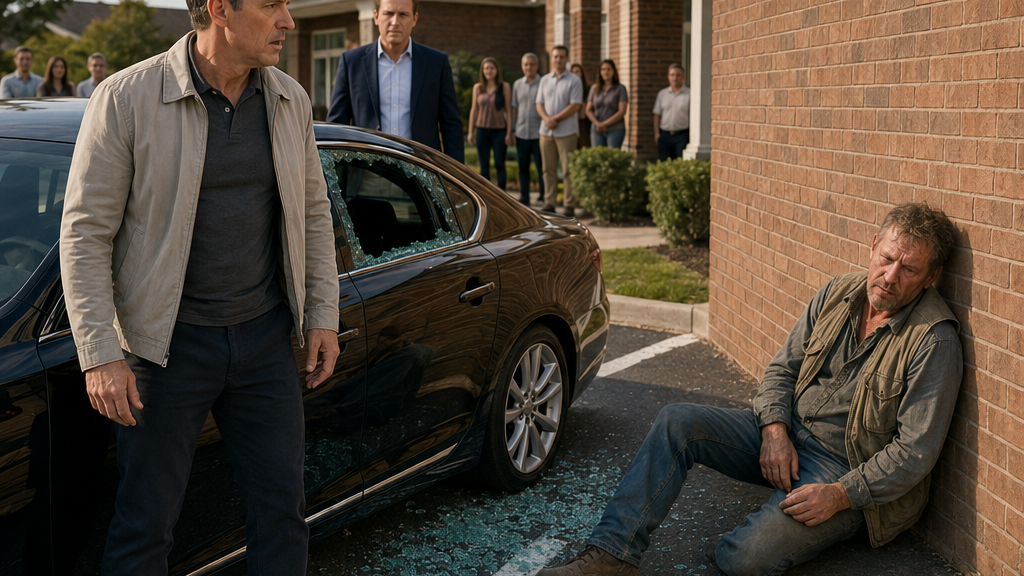
A field of blue-green safety glass glittered across the fresh white parking stripe.
Then he raised his eyes to the passenger side of the sedan.
The window was gone.
Chapter 2: Broken Glass Made Everyone Certain
Kevin was lying on the pavement ten feet from the car.
For one second, Justin did not connect the two things.
He saw the shattered passenger window first, then the empty black frame, then the glittering glass spread beneath it.
Then Kevin moved.
Barely.
His shoulder shifted against the concrete near the brick side wall of the clubhouse.
Justin’s pulse jumped.
“Kevin?”
No answer.
He crossed the space fast.
“Kevin.”
Kevin’s eyes opened halfway.
He looked at Justin without recognition.
Then his gaze drifted toward the parking lot.
“What time is it?”
Justin stopped beside him.
“What happened to my car?”
Kevin blinked.
“What?”
“My car.”
Justin pointed.
Kevin turned his head slowly.
The confusion on his face should have slowed Justin down.
It didn’t.
“What did you do?”
Kevin pushed himself onto one elbow.
“I didn’t—”
“My window is smashed.”
“I can see that.”
“And you’re lying ten feet away from it.”
A clubhouse door opened behind Justin.
Paul came out with the insurance representative and one of the board members.
Paul saw the glass.
His face changed instantly.
“Oh, hell.”
Justin barely heard him.
He reached through the broken passenger window.
The center console was open.
He had left his watch inside before the meeting, a habit he had because the heavy metal band bothered him when he typed notes.
The case was empty.
His stomach tightened.
“Where’s my watch?”
Kevin stared at him.
“What watch?”
Justin turned fully toward him.
“The watch that was in the car.”
Kevin sat up now, one hand pressed against his forehead.
“I never went in your car.”
“You were paid to watch it.”
“I did.”
“Then how did this happen?”
“I don’t know.”
Paul stopped at Justin’s shoulder.
“I told you.”
Justin snapped around.
“Not now.”
Paul looked at Kevin, then at the broken window.
“I’m not trying to make this worse.”
“Then don’t.”
Kevin got one knee under himself and tried to stand.
He nearly fell.
Justin caught his arm without thinking.
Kevin jerked away.
“Don’t.”
That single word, sharp with humiliation, made Justin’s anger flare again.
“I trusted you.”
Kevin stared at him.
“You paid me.”
“I paid you because I trusted you.”
“No.” Kevin’s breathing was uneven. “You paid me for a job.”
“And the car is broken into.”
A few homeowners had started gathering near the clubhouse doors.
Justin became aware of them only after he heard someone whisper Kevin’s name.
Not Mr. Moore.
Kevin.
The way people used it in violation meetings.
Kevin heard it too.
His shoulders tightened.
Paul took out his phone.
“We should call the police before this becomes everybody arguing about what they think happened.”
Kevin looked at him.
“You do that.”
Paul paused.
Kevin wiped a hand over his face.
“Call them.”
Justin stared.
Paul’s tone hardened.
“Before somebody changes his story.”
Kevin looked at Paul with sudden concentration.
“What did you say?”
Paul frowned.
“I said we need to document this.”
“No. Before that.”
“Kevin,” Justin said, “just tell me what happened.”
“I was here.”
“All afternoon?”
“Yes.”
“Then why were you on the ground?”
Kevin opened his mouth.
Nothing came out.
He pressed his fingers against his temple again.
“I don’t know.”
Paul gave Justin a quiet look.
It was worse than accusation.
It was pity.
The same expression he had worn that morning when Justin crossed the parking lot with the three hundred dollars.
Justin felt heat rise along the back of his neck.
“You took the money,” Justin said.
Kevin’s eyes moved to him.
“Yes.”
“You stayed by the car.”
“Yes.”
“The window gets smashed, my watch disappears, and you don’t remember anything.”
Kevin’s face went still.
Justin heard himself before he decided to say it.
“Did you take it?”
Silence spread across the lot.
Kevin looked at Justin as though the accusation had struck somewhere deeper than anger.
“No.”
“Did you break the window?”
“No.”
“Then tell me who did.”
“I said I don’t know.”
Justin stepped closer.
“And I’m supposed to believe that?”
“Justin.”
Margaret’s voice came from behind them.
She had walked out carrying a folder against her chest.
“That’s enough for right now.”
Justin turned.
“My property was stolen.”
“I can see that.”
“He was responsible for the car.”
Kevin laughed once.
There was no humor in it.
“There it is.”
Justin looked back at him.
“What?”
“The part where the money wasn’t charity until you needed it to be proof.”
Justin’s anger faltered.
Kevin reached into his vest pocket.
The three hundred-dollar bills were still there.
He pulled them out and held them toward Justin.
Justin did not take them.
Kevin’s hand shook slightly.
“You think I smashed your window for a watch while keeping your cash in my pocket?”
Paul stepped in.
“That doesn’t prove anything.”
Kevin looked at him.
And something shifted.
Not recognition exactly.
A fragment.
“You brought me water.”
Paul’s face remained calm.
“What?”
Kevin stared harder.
“A bottle.”
Justin looked between them.
“When?”
Kevin shut his eyes.
“I don’t know. After you went inside.”
Paul shook his head.
“You were standing in the sun. I handed you a drink. That’s hardly suspicious.”
“You never mentioned that,” Justin said.
Paul turned to him.
“Why would I?”
Kevin leaned against the wall.
“I remember drinking it.”
“And?”
Kevin opened his eyes.
“Nothing.”
The word landed differently this time.
Not I don’t remember.
Nothing.
A blank space.
The patrol officer arrived twenty minutes later.
By then the crowd had thinned.
Justin gave his statement.
Kevin gave his.
Paul gave his.
No watch was found on Kevin.
No hard object was found nearby.
The officer said they would document the damage and theft but could not determine responsibility from the scene alone.
That should have relieved Justin.
Instead it left him standing beside the sedan after everyone else had moved away, staring at the broken window as though it had accused him too.
Kevin was sitting on the clubhouse steps.
Justin walked over.
“You need someone to pick you up?”
“No.”
“You shouldn’t drive.”
“My truck doesn’t run.”
Justin hesitated.
“Family?”
Kevin gave him a tired look.
“That what we’re doing now?”
“I’m asking if somebody can help.”
Kevin stared at the parking lot.
For several seconds, he said nothing.
Then he recited a phone number.
“My sister.”
Justin entered it.
“Name?”
“Rebecca.”
“You want me to call her?”
Kevin’s jaw tightened.
“I haven’t seen her in almost a year.”
Justin looked up.
Kevin’s eyes stayed on the shattered car.
“She’ll tell you,” he said quietly.
“Tell me what?”
“What kind of man I was before everybody here decided what kind I am now.”
Chapter 3: His Sister Knew a Different Man
Rebecca Moore did not ask whether Kevin had stolen Justin’s watch.
Her first question was, “Did you check the cameras?”
Justin stood in his kitchen with his phone against his ear.
Outside the window, his sedan sat in the driveway with clear plastic taped over the missing passenger window.
“No,” he said.
“Why not?”
“The clubhouse cameras mostly cover the entrances.”
“Mostly?”
Justin looked toward the dark shape of the car.
“I don’t know exactly what they cover.”
“Then you don’t know what happened.”
Her voice was not loud.
That made the rebuke harder to dismiss.
Justin leaned against the counter.
“I’m the one who called you.”
“And I appreciate that.”
“I also spent the afternoon dealing with a broken car and missing property.”
“I’m not saying you didn’t.”
“Your brother was beside the car.”
“Was my brother holding your watch?”
“No.”
“Was there glass on him?”
Justin paused.
“I didn’t check.”
“Did the officer?”
“Not that I saw.”
Rebecca breathed out slowly.
Then her tone changed.
“Where is Kevin now?”
“At his house. I drove him back.”
“I’ll meet you there.”
“You don’t have to—”
“Yes,” she said. “I do.”
Kevin’s property looked different to Justin that evening.
He had driven past it dozens of times and mentally cataloged the same details everyone else did: faded trim, weeds at the fence line, one shutter hanging slightly lower than the other, an old pickup in the driveway.
Now he noticed what the violation photographs never showed.
A stack of cut lumber covered under a tarp.
Two paint cans beside the garage.
A repaired section of fence that had not yet weathered to match the rest.
Kevin had been working on the place.
Just not fast enough for the notices.
Rebecca pulled up ten minutes later.
She got out and stopped halfway up the driveway.
Kevin was sitting on the front steps.
Neither sibling moved.
“Hey,” Rebecca said.
Kevin looked away.
“You came.”
“You gave him my number.”
“I was out of options.”
Her face tightened.
“Is that what it takes now?”
Kevin stood.
“Don’t.”
“Almost a year, Kevin.”
“I said don’t.”
Justin took a step backward.
“This is probably where I leave.”
“No,” Rebecca said.
Kevin looked at her.
She turned to Justin.
“If you accused him, you can hear the rest too.”
Kevin’s face hardened.
Rebecca ignored it.
“You think he stopped calling us because he stopped caring.”
Justin said nothing.
“He lost his maintenance job last year. Company cut the department. He picked up contract work, then hurt his shoulder. Nothing dramatic enough for some big insurance payout. Just enough that he couldn’t keep taking every job.”
Kevin looked toward the garage.
Rebecca continued.
“He missed dues. Then the notices started.”
Kevin finally spoke.
“The notices started before I missed dues.”
Rebecca glanced at him.
“That isn’t what you told me.”
“I didn’t tell you much of anything.”
“No. You didn’t.”
The hurt in her voice silenced him.
Justin noticed a thick packet on a small table just inside the open front door.
White envelopes.
Photocopied photographs.
HOA letterhead.
“You kept all of them?” Justin asked.
Kevin followed his gaze.
“Every one.”
“Why?”
“Because some of them didn’t make sense.”
Justin entered the house only after Kevin nodded.
The packet was arranged by date.
Weed notice.
Paint notice.
Fence notice.
Late fee.
Second inspection.
Compliance deadline shortened from thirty days to fourteen.
Justin frowned.
“Why was this accelerated?”
Kevin gave him a thin smile.
“You’re on the board.”
“I didn’t vote on this.”
“That was my question.”
Rebecca picked up another page.
“You asked them?”
“Three times.”
Kevin opened a drawer and took out a printed email.
“I asked Margaret for enforcement records on comparable properties. Wanted to know why the house on the next block got two extensions for paint and I got fourteen days.”
Justin read the page.
The request was dated nine days before the car window broke.
“You were challenging the enforcement process.”
“I was asking for the rules they kept telling me I violated.”
“You never mentioned this today.”
Kevin looked at him.
“You weren’t exactly asking procedural questions in the parking lot.”
Justin flinched.
Rebecca sat on the edge of the couch.
“So you weren’t ignoring me because you were angry.”
Kevin’s expression changed.
This was the first time Justin saw him look afraid.
Not of the HOA.
Of his sister.
“I didn’t want you seeing this.”
Rebecca gestured toward the room.
“The house?”
“My life.”
Her eyes filled, but she did not cry.
“You decided that for me?”
“I kept thinking I’d catch up.”
“For a year?”
“I kept thinking next month.”
Rebecca looked down.
Justin quietly set the papers back into order.
His phone buzzed.
Paul.
He almost ignored it.
Then answered.
“We need an emergency enforcement meeting Monday,” Paul said.
“About Kevin?”
“About everything that happened today.”
“The police haven’t determined he did anything.”
“That doesn’t change the underlying violations.”
Justin stared at the packet.
“Why are you talking about his paint when my car was broken into?”
“Because the insurance representative witnessed the aftermath. We have a resident with chronic violations, an incident on common property, and a board member’s car vandalized.”
“You’re connecting those things.”
“So will the carrier.”
Justin’s eyes dropped to the date on Kevin’s records request.
“Paul, did Kevin ask you for enforcement comparisons?”
A pause.
“He’s asked for a lot of things.”
“That wasn’t my question.”
“He was trying to argue his way out of compliance.”
“So he did.”
Paul’s voice cooled.
“Justin, don’t let guilt over losing your temper rewrite what you saw.”
Justin looked through the doorway.
Kevin and Rebecca were sitting apart from each other, but Rebecca had moved from the couch to the front step beside him.
Not reconciled.
Closer.
“I’ll call you tomorrow,” Justin said.
He ended the call.
On the drive home, a faint rattle came from beneath the passenger seat every time Justin turned.
At a stop sign, he reached down.
His fingers found a triangular shard of safety glass trapped beneath the floor mat.
He carried it into the kitchen and set it on the counter.
Then he opened the photographs he had taken of Kevin’s violation packet.
One citation stopped him.
The approval line at the bottom carried Paul Walker’s name.
Justin checked the date twice.
He knew that date.
He had been out of town for a conference, and the board meeting scheduled that week had been canceled for lack of quorum.
There had been no enforcement vote.
Justin placed the shard of broken glass beside his phone and stared at Paul’s approval until the two things began to look less like separate problems.
Chapter 4: The Violations Started Before the Window Broke
Margaret Thomas had three folders open before Justin finished sitting down.
“These shouldn’t exist like this,” she said.
It was eight-thirty Sunday morning in the small management office behind the clubhouse. The building was technically closed, but Margaret had agreed to meet after Justin sent her photographs of Kevin’s citation packet.
She slid the first folder across the desk.
Kevin Moore’s address was printed at the top.
“First exterior notice,” she said. “Thirty-day correction period. Normal.”
She tapped the second page.
“Second inspection. Fourteen days.”
Then the third.
“Escalated compliance notice. No committee recommendation attached.”
Justin looked at the signature line.
Paul Walker.
“So Paul approved it himself.”
“He entered the approval.”
“Could that be clerical?”
Margaret gave him a tired look.
“Justin, you called me on a Sunday because you already know the answer.”
He leaned back.
Through the office window he could see the clubhouse lot. His sedan was at home, the broken opening covered in plastic, but he could still picture the glass across the white stripe.
Margaret pulled another file.
“Here’s a house two streets over. Peeling fascia. First extension, thirty days. Second extension, another thirty.”
“Who approved those?”
“The committee.”
Another folder.
“Dead lawn and broken fence panel. Forty-five additional days because the homeowner submitted a contractor estimate.”
Justin read the dates.
“And Kevin?”
“No comparable extension.”
“He’d started repairs.”
“I know.”
Justin looked up.
Margaret folded her hands.
“I photographed the property myself six weeks ago. The fence section had been repaired. The shutters were next. He was slow, but he wasn’t ignoring everything.”
“Why didn’t you say that?”
“I documented it.”
“That isn’t what I asked.”
Her expression tightened.
“You want an honest answer?”
“Yes.”
“Because Paul was president, you were on the board, and none of you seemed interested in slowing him down.”
The words landed harder because Margaret did not sound angry.
She sounded factual.
Justin looked again at the approval records.
He remembered meetings when Paul had said, “I’ll handle enforcement.”
Justin had been relieved.
Enforcement discussions were tedious and often ugly. Residents came angry. Board members grew defensive. Every fence became a referendum on fairness.
Justin preferred reserve planning and budgets, where numbers behaved.
“How many times did I vote on Kevin specifically?”
Margaret turned to her laptop.
“Not many.”
“That’s not reassuring.”
“No.”
She searched meeting minutes.
“You abstained twice when Paul proposed accelerated action against repeat violators.”
“I abstained because Kevin and I had talked privately.”
“You also said you didn’t want the appearance of favoritism.”
Justin remembered.
At the time, it had felt principled.
Now it looked suspiciously like convenience.
Margaret opened an insurance email.
“This is the other piece.”
The carrier’s renewal inspection was scheduled for the following month. The message listed concerns about inconsistent property maintenance, aging common-area fencing, and documentation of enforcement.
Justin frowned.
“They aren’t threatening cancellation.”
“Not yet.”
“So why has Paul been talking like the subdivision is one bad shutter away from losing coverage?”
Margaret hesitated.
“Premiums have already climbed. If underwriting decides our enforcement is inconsistent, the board will have to explain it at the annual meeting.”
“And Paul promised to keep increases down.”
“Yes.”
Justin rubbed his forehead.
For the first time since Saturday, Paul’s pressure made emotional sense.
Not the broken car.
Not the missing watch.
But the urgency.
Paul had spent two years telling homeowners that disciplined management separated their subdivision from the developments nearby where dues rose every year.
If the renewal came back badly, that promise would collapse.
Justin drove with Margaret through the subdivision shortly before noon.
They stopped without getting out at four houses from recent enforcement logs.
One had an unpainted side gate.
Another had overgrown shrubs covering half a front window.
A third had a visible roof stain that had existed for months.
None looked catastrophic.
Neither did Kevin’s.
His house simply looked tired.
And because Kevin had become difficult in meetings, because he sometimes answered notices with angry emails, because he owed money, every tired detail seemed to carry more meaning.
Justin lowered his window.
Kevin was outside sanding the repaired fence section.
He glanced toward Justin’s car, then returned to work.
No wave.
Justin deserved that.
Back at the office, Margaret laid Saturday’s insurance photographs beside the enforcement photos.
One image showed Justin’s shattered passenger window.
Another showed Kevin’s faded trim.
The two pictures had nothing to do with each other.
Yet Justin could hear Paul joining them in one sentence: chronic violations, incident on common property, insurance concern.
“You see what happened?” Margaret asked.
Justin did.
An untidy house had become evidence about a broken window.
He hated how natural the connection had felt yesterday.
His phone rang.
Paul.
Justin answered on speaker.
“I heard you’re at the office,” Paul said.
Margaret’s eyes narrowed.
“Who told you?”
“Does it matter?”
“Yes,” Justin said.
A pause.
“Fine. One of the board members drove past.”
Justin looked at Margaret.
“What happened with Kevin’s notices?”
Paul exhaled.
“We’re doing this now?”
“Yes.”
“I accelerated them.”
“Without a vote.”
“We had authority to enforce existing standards.”
“You had authority to send normal notices.”
“And normal notices weren’t working.”
“His fence is repaired.”
“After months.”
“Other people got extensions.”
“Other people communicated.”
“Kevin requested records.”
“He sent accusatory emails.”
Justin stood.
“So you punished him for being difficult?”
“No. I pushed him because we have an insurance inspection coming and his property is one of the first things anyone sees entering that section.”
At last, the fear under Paul’s certainty was audible.
“I’m trying to protect three hundred homes,” Paul said. “Do you understand what happens if premiums jump again? Retired people get hit. Families already stretched thin get hit. Everybody screams that the board did nothing.”
Justin looked at the insurance email.
“I understand the pressure.”
“Good.”
“I don’t understand breaking procedure.”
“Procedure doesn’t repaint houses.”
Margaret looked away.
Justin said, “Did you go back outside Saturday after the meeting started?”
Silence.
Then Paul laughed once.
“What kind of question is that?”
“A simple one.”
“I was in and out all morning.”
“You gave Kevin water.”
“He was standing in the sun.”
“That wasn’t an answer.”
Paul’s voice hardened.
“You’re letting one bad afternoon turn you paranoid.”
The call ended soon after.
Margaret remained still.
Then she turned back to her computer.
“There may be another way to answer that.”
Justin moved beside her.
The clubhouse used electronic access cards for staff, board officers, contractors, and vendors. Margaret opened the access log.
Rows of timestamps appeared.
“Meeting started at ten-oh-five,” she said.
Justin remembered taking his seat.
She scrolled.
Paul’s credential had opened the side clubhouse door at ten-fourteen.
Again at ten-thirty-six.
Justin leaned closer.
“That’s twenty-two minutes.”
Margaret nodded.
“What cameras cover that side?”
“Entrance camera. Service walkway. Part of the parking lot.”
Justin felt the room sharpen around him.
“Pull Saturday.”
Margaret clicked into the security system.
A warning appeared before the archive opened.
Storage retention: forty-eight hours.
Margaret stared at it.
“These overwrite Monday night.”
Justin looked toward the empty clubhouse lot.
For the first time, the shattered window no longer seemed like the biggest piece of evidence.
The clock did.
Chapter 5: Twenty Minutes Paul Never Mentioned
“Saving that footage will turn a neighborhood problem into something much worse.”
Paul stood inside the clubhouse security room Monday morning with the door closed behind him.
Justin had arrived before eight. Margaret was already exporting the Saturday files when Paul walked in.
Now the progress bar sat at thirty-two percent.
Justin looked at him.
“What exactly is the neighborhood problem?”
“You know what I mean.”
“No. I want you to say it.”
Paul glanced at Margaret.
“This should be between board members.”
Margaret did not move from the keyboard.
“It became a management matter when you used association access.”
Paul’s jaw tightened.
“I came outside. That isn’t misconduct.”
“Then preserving the video shouldn’t bother you,” Justin said.
The export reached thirty-six percent.
Paul stepped closer.
“You’re doing this because you feel guilty about accusing Kevin.”
“I do feel guilty.”
“Then apologize to him. Pay for whatever you think makes it right. But don’t blow apart an association because you lost your temper.”
Justin stared at his oldest friend on the board.
“You keep talking about the association like it’s something separate from what happened.”
“It is.”
“No. That’s what I’m starting to doubt.”
Margaret clicked open the first camera feed.
The footage had no sound.
At 10:07 Saturday morning, Justin appeared on-screen walking toward the clubhouse.
Kevin stood beside the sedan.
The passenger window was intact.
Justin watched himself disappear through the doors.
At 10:14, the side door opened.
Paul stepped outside.
No one spoke.
On-screen Paul crossed the lot toward Kevin.
The angle did not show their faces clearly, but it showed Paul holding something.
A plastic bottle.
Paul shifted beside Justin.
“He looked overheated.”
Justin did not take his eyes from the screen.
Kevin accepted the bottle.
Paul remained beside him for perhaps a minute, then returned inside.
The footage advanced.
Kevin moved around the parking lot normally at first.
He redirected a delivery van.
He helped an older resident with a box.
He sat briefly on the low brick wall.
At 10:27, his posture changed.
He bent forward.
At 10:31, he stood and grabbed the wall.
At 10:34, he lowered himself to the ground.
Justin felt cold.
“He was sick.”
Paul said nothing.
Margaret switched cameras.
The service walkway feed showed Paul leaving the building at 10:36.
He did not walk toward Kevin.
He walked toward Justin’s sedan.
The camera angle lost him behind a column for several seconds.
Then another feed caught him along the passenger side.
The window was still intact when he approached.
Margaret paused the frame.
The room was silent except for the computer fan.
“Keep going,” Justin said.
Paul spoke quietly.
“Justin.”
“Keep going.”
Margaret resumed.
Paul bent near the car.
His arm moved sharply.
The camera was too distant to show exactly what was in his hand, but the result was unmistakable.
The passenger window collapsed inward.
Margaret stopped the video again.
Justin heard himself inhale.
Paul put both hands on the edge of the desk.
“You need context.”
Justin looked at him.
“There is no context in which that’s my imagination.”
“I’m not saying it didn’t happen.”
The words were so unexpected that Justin almost missed them.
Margaret turned in her chair.
“You’re admitting you broke his window?”
Paul closed his eyes briefly.
“Yes.”
Justin stared.
“My watch.”
“I took it.”
“Where is it?”
“Safe.”
Justin laughed, but the sound came out wrong.
“You stole my watch.”
“I moved it.”
“You broke into my car.”
“I needed the incident to look real.”
Margaret pushed back from the desk.
Paul raised his voice for the first time.
“Because nothing else was working.”
Justin stepped toward him.
“Nothing else?”
“Kevin had turned every notice into a fight. He was demanding comparison files, accusing us of selective enforcement, threatening to drag every decision through hearings while the carrier is preparing to inspect.”
“So you framed him.”
“I created an incident.”
“You framed him.”
Paul looked toward the frozen image of himself beside the sedan.
“I thought if there was one documented safety event connected to him, we could move faster.”
“Connected to him?”
“He was already there.”
Justin felt something inside him recoil.
“That’s your explanation?”
“You want the ugly truth? Fine. People already didn’t trust him.”
Margaret’s face changed.
Paul continued before either could interrupt.
“He’s behind on dues. His property is deteriorating. He walks into meetings angry. Half the neighborhood thinks he’s unstable.”
“So you knew they’d believe it.”
Paul looked at Justin.
“You believed it.”
That stopped him.
Not because it excused Paul.
Because it was true.
Paul saw the effect.
“You stood in that parking lot and accused him before anyone found a single thing on him.”
Justin’s hands curled.
“Don’t use what I did to justify what you did.”
“I’m not. I’m telling you why it worked.”
Margaret returned to the footage.
“Kevin’s condition.”
Paul looked away.
“What was in the bottle?”
“Nothing illegal.”
“That wasn’t the question,” Justin said.
Paul rubbed both hands over his face.
“He’d complained at a previous meeting about not sleeping. I had some over-the-counter sleep aid in my bag from a trip. I put enough in the drink that I thought he’d get drowsy.”
Margaret stared at him.
“You drugged a resident.”
“I didn’t think he’d collapse.”
“But he did.”
“Yes.”
“And you left him there.”
Paul’s composure cracked.
“I panicked.”
Justin looked back at the footage.
Kevin on the pavement.
The broken window.
His own finger pointing.
His own voice asking, Did you take it?
The video cleared Kevin of smashing the car, but it did not make Justin feel relieved.
It made the accusation uglier.
He pulled out his phone.
Paul’s head snapped toward him.
“What are you doing?”
“Calling the officer who took the report.”
“Justin, think.”
“I am.”
“This can be handled.”
“You said that about the notices.”
“Because I was trying to hold this place together.”
“No. You were trying to control what everybody believed about it.”
Paul stepped between Justin and the door.
Not threateningly.
Desperately.
“You think I wanted this?”
Justin said nothing.
Paul pointed toward the folders outside.
“You know what the board is like. Every hard decision gets delayed. Every homeowner has an exception. Every violation has a story. Somebody has cancer. Somebody lost a job. Somebody’s contractor disappeared. Somebody’s mother died. Meanwhile roofs age, fences rot, premiums climb, reserves fall behind, and everyone still expects the president to keep the neighborhood looking like nothing is wrong.”
For the first time, Justin heard something other than calculation.
Exhaustion.
Fear.
It did not make what Paul had done smaller.
It made it more human and therefore harder to dismiss as madness.
“You could have stepped down,” Justin said.
“And leave it to who?”
Justin almost answered.
Then stopped.
Paul gave a bitter smile.
“Exactly.”
The export completed.
Margaret copied the files to a second drive.
Paul watched her.
“What happens now?”
Justin looked at him.
“The emergency hearing still happens.”
Paul shook his head.
“That will destroy confidence in the board.”
“Maybe confidence in us deserves to be destroyed.”
“Us.”
Justin heard the emphasis.
Paul stepped closer.
“You keep talking as if you were outside all of this.”
Justin’s stomach tightened.
“I didn’t break the window.”
“No.”
“I didn’t drug Kevin.”
“No.”
“I didn’t falsify his notices.”
Paul held his gaze.
“But you knew we were bending rules long before Saturday.”
Justin said nothing.
Paul’s voice dropped.
“You abstained whenever it got uncomfortable. You let me ‘handle it.’ You saw Kevin getting hammered and told yourself staying neutral was fairness.”
The security monitor still showed the intact passenger window one frame before Paul destroyed it.
Paul pointed at it.
“I crossed the line.”
Then he pointed at Justin.
“But don’t walk into that hearing pretending you just discovered there was a line.”
Chapter 6: The Board Had Practiced Looking Away
Paul offered to resign eleven minutes before the emergency hearing began.
Not publicly.
Not with Kevin in the room.
He caught Justin beside the clubhouse kitchenette and closed the door.
“I’ll step down tonight,” Paul said.
Justin stared at him.
“In exchange for what?”
“No spectacle.”
“That isn’t an answer.”
“We tell the board I exercised authority I didn’t have. Kevin’s car-related accusation is withdrawn. Your insurance claim gets corrected. I resign.”
“And Kevin’s violations?”
“They stay.”
Justin almost smiled.
Even now.
“That’s your condition.”
“They existed before Saturday.”
“So did the way you handled them.”
“Some notices were aggressive. That doesn’t mean his house suddenly complies.”
Justin crossed his arms.
“Independent review.”
Paul shook his head.
“You’re going to reopen every complaint he made because I did something unforgivable afterward?”
“I’m going to reopen them because we now know you were willing to manipulate evidence when procedure got in your way.”
Paul’s face tightened.
“That’s not the same thing.”
“It’s exactly why nobody should take your word for where the line was.”
Through the wall came the scrape of chairs.
Kevin had arrived with Rebecca.
Margaret was setting folders at each seat.
Paul lowered his voice.
“You can still protect the association.”
Justin looked at him.
“That sentence is how we got here.”
He opened the door.
The emergency hearing lasted less than an hour before the first thing Justin believed about himself began coming apart.
Margaret presented the access logs and preserved footage without commentary.
The two other board members watched in silence.
Kevin sat at the far end of the table with Rebecca beside him.
He did not look triumphant when the footage showed Paul breaking the window.
He looked tired.
When it ended, one board member asked Kevin whether he wanted all outstanding fines waived.
Kevin’s answer came immediately.
“No.”
Everyone looked at him.
Paul did too.
Kevin placed both forearms on the table.
“I want the ones that shouldn’t exist removed.”
The board member blinked.
“We can remove all of them.”
“That would be another favor.”
Justin felt the words before Kevin looked at him.
Kevin continued.
“If my fence was late, it was late. If I owed a legitimate fee, I owed it. I don’t need you pretending none of that happened because now you feel bad.”
Rebecca lowered her eyes.
Kevin pushed his violation packet toward the center.
“I want the same deadlines other people got. Same appeal process. Same extensions when the circumstances are comparable. That’s it.”
Paul sat very still.
The simplicity of the request exposed more than anger would have.
Justin had expected vindication to look like Kevin finally being given something.
Instead Kevin was refusing something.
Special treatment.
The very thing Justin had once told himself he was protecting the board from when he abstained.
Margaret opened the minutes from the previous year.
“There’s another issue,” she said.
Justin already knew what was coming.
His voting record.
On one enforcement escalation, Justin had abstained.
On another, he had abstained again.
A third motion had never formally occurred; Paul had proceeded administratively after an informal email exchange.
Justin had replied to that email with two words:
No objection.
He stared at the printout.
He remembered writing it between client calls.
At the time, it had seemed harmless.
Not approval.
Not opposition.
Just a way not to spend another evening arguing about Kevin Moore’s fence.
Paul leaned back.
“There.”
Justin looked at him.
Paul didn’t sound pleased.
“You wanted the whole record. That’s the whole record.”
One of the board members turned to Justin.
“Did you know Paul was escalating enforcement outside formal votes?”
Justin could have qualified the answer.
He could have said he knew only generally.
He could have distinguished emails from official motions.
He could have explained that Paul had not disclosed every individual action.
All of those statements would have contained truth.
None would have contained enough of it.
“I knew he was taking more discretion than our process contemplated,” Justin said.
Rebecca looked at him.
Kevin did not.
“And you objected?” the board member asked.
“Not clearly.”
“Why?”
Justin glanced toward the photographs Margaret had placed in the record.
The broken passenger window.
Kevin’s faded trim.
The repaired fence.
Different images that had been made to carry the same accusation.
“Because I didn’t want to be the person slowing everything down.”
Paul gave a small, humorless nod.
Justin continued.
“And because when Kevin got angry, I told myself that meant Paul was probably right about him.”
Kevin finally looked up.
Justin forced himself not to look away.
“I thought being nicer to you than Paul was made me fair.”
No one spoke.
Justin did not apologize again.
Not yet.
An apology in that moment felt too close to asking Kevin to relieve him.
Margaret turned to the procedural recommendations.
An independent review could be commissioned. Outstanding citations could be compared against similar cases. Any accelerated notice lacking proper authorization could be rescinded or reissued through the correct process.
Paul listened until she finished.
Then he said, “And what about the insurance renewal?”
Margaret answered.
“We deal with it honestly.”
“That could cost people money.”
“Yes.”
“You all understand that?”
Kevin spoke before anyone else.
“I do.”
Paul looked at him.
Kevin’s voice remained level.
“I also understand my house needed work.”
That seemed to surprise Paul more than accusation had.
Kevin continued.
“I never said every notice was fake. I said the rules changed depending on whose mailbox they went into.”
Paul looked down.
For one moment Justin saw what Paul might have been months earlier, before urgency became permission.
A man convinced that if he stopped pushing, everything would slip.
Then Paul had chosen to turn another man’s bad year into leverage.
Pressure explained him.
It did not absolve him.
Justin slid a second packet onto the table.
His own records.
Emails.
Abstentions.
Committee notes.
“I want these included.”
One board member frowned.
“Included in what?”
“The review.”
“You’re asking someone outside the board to review your decisions too?”
“Yes.”
Paul stared at him.
“That’s unnecessary.”
Justin looked at Kevin.
“No. I think it’s the first necessary thing I’ve done in this room.”
By the end of the hearing, Paul’s authority was suspended pending formal action. The preserved security files were provided for the existing police report. No one predicted the legal outcome.
The board did not erase Kevin’s record.
It froze enforcement until an independent comparison could determine which actions were valid and which had bypassed procedure.
Then Justin made one final motion.
Not about Kevin.
“Review every accelerated enforcement case from the last twelve months,” he said.
One board member shifted uneasily.
“That could be dozens.”
“I know.”
“Most of those homeowners haven’t complained.”
“I know.”
Paul looked at him from across the table.
Justin understood what the look meant.
This would be expensive.
Embarrassing.
Slow.
It might expose decisions Justin had ignored because they had never reached his own driveway.
He thought of the three hundred dollars in Kevin’s vest.
Payment, Kevin had insisted.
Not charity.
Fairness had rules too.
Justin placed his voting record beside Kevin’s violation packet.
“Start with the cases nobody thought were worth asking about.”
Chapter 7: What They Repaired After the Glass
Justin saw his reflection before he saw anything beyond the new passenger window.
For a moment, the glass turned the clubhouse parking lot into a dark mirror: his face, the collar of his shirt, the white stripe beneath the sedan where broken safety glass had glittered three weeks earlier.
The repair shop had replaced the window within days.
Everything else had taken longer.
Justin closed the car door and walked toward the clubhouse carrying a thin folder instead of the thick binders that had accumulated during the review.
Margaret was waiting inside.
“You’re early.”
“So are you.”
“I work here.”
“That never stopped you from complaining about Monday mornings.”
“It’s Thursday.”
Justin looked at her.
Margaret almost smiled.
It was the first ordinary exchange they had managed in weeks.
The independent review had finished the night before.
Thirty-one enforcement cases had been examined.
Seven were found to contain accelerated deadlines that had not been properly authorized. Four homeowners had been assessed fees before their full appeal periods expired. Several others had been handled correctly, even when the owners strongly disliked the decisions.
Kevin’s file contained both kinds.
His original paint notice was valid.
So was the notice concerning the damaged shutter.
The shortened correction deadlines were not.
Neither were two escalation fees Paul had imposed without committee approval.
The distinction mattered more to Kevin than the dollar amount.
Justin had learned that slowly.
The clubhouse meeting was smaller than the emergency hearing. No residents crowded the walls. No one had invited an audience.
Kevin arrived carrying the same worn violation packet.
Rebecca came with him but chose a chair against the wall rather than sitting at his elbow.
That, too, seemed different.
She was present without hovering.
Kevin acknowledged Justin with a nod.
Nothing more.
Justin returned it.
Margaret began with the review findings.
She did not soften them.
Paul’s actions had created procedural failures beyond Kevin’s case. New enforcement controls would require two-person authorization for accelerated deadlines. Comparable-property records would be maintained when extensions were granted or denied. Camera footage involving reported incidents on common property would be preserved automatically once management received notice.
The board had also accepted a recommendation that enforcement complaints could no longer be routed entirely through one officer.
One of the board members looked at Kevin.
“Your adjusted account is in the packet.”
Kevin opened it.
Justin watched his eyes move down the page.
Several fines had disappeared.
Others remained.
There was also a credit.
Kevin frowned.
“What’s this amount?”
Margaret answered.
“Reimbursement for fees assessed through improperly accelerated enforcement, plus the contractor charge you paid after the unauthorized second inspection.”
“I already paid that.”
“That’s why it’s reimbursement.”
Kevin looked at Justin.
Justin knew what he was asking.
Was this another favor?
“No discretionary payment,” Justin said. “The reviewer calculated it.”
Kevin returned his attention to the page.
After a moment, he nodded.
“Okay.”
The word was quiet.
But Justin understood its weight.
Kevin had accepted what was owed without being required to accept anyone’s pity along with it.
The board member cleared his throat.
“There was also discussion of additional assistance because of the circumstances surrounding the incident.”
Kevin’s expression closed immediately.
Justin raised a hand.
“That was my suggestion. I withdrew it.”
Kevin looked at him.
Justin continued.
“I offered because I felt responsible.”
“You were responsible for part of it.”
“Yes.”
The room went still.
Justin did not defend himself.
Kevin leaned back.
“That doesn’t mean you need to pay my mortgage.”
“I know that now.”
Rebecca glanced between them.
Justin opened his folder.
“There is one thing I still owe you.”
Kevin’s eyes narrowed slightly.
Justin slid a document across the table.
It was a simple payment authorization.
Three hours of contracted event assistance on the Saturday of the break-in, documented as temporary services requested by a board member during an association event.
Kevin read the amount.
Three hundred dollars.
His mouth tightened.
“I already got paid.”
“You returned the bills to me after the police came.”
“You wouldn’t take them.”
“You left them in my cup holder when I drove you home.”
That memory flickered between them.
Justin had found the folded bills the next morning.
For three weeks they had stayed in an envelope in his desk.
“The association approved the expense,” Justin said. “You did the job until you were prevented from doing it.”
Kevin stared at the authorization.
“You really put this through the books?”
“Yes.”
Margaret said, “With documentation.”
Kevin glanced at her.
“Of course.”
This time there was the beginning of humor in his voice.
The meeting continued.
No one applauded.
No one gave a speech about community.
There were votes, revised procedures, uncomfortable acknowledgments, and one discussion about legal fees that lasted longer than anyone wanted.
That felt more honest to Justin than celebration would have.
When the formal business ended, one board member asked Justin to remain on the enforcement committee.
“You know the problems better than anyone now,” the member said.
Justin closed his folder.
“That’s exactly why I shouldn’t.”
“We need experienced people.”
“You need people who haven’t spent a year deciding silence was neutrality.”
Margaret looked at him but said nothing.
Justin submitted his resignation from the committee.
He remained a homeowner.
He remained responsible for the votes he had cast and the ones he had avoided.
Stepping away did not erase either.
Outside, Kevin was standing beside the repaired passenger window.
Justin approached slowly.
“Looks expensive,” Kevin said.
“It was.”
“Insurance?”
“Mostly.”
Kevin nodded.
He touched nothing.
For a moment they stood where the glass had once covered the pavement.
Rebecca waited near Kevin’s truck.
The truck was running now.
Justin noticed that before anything else.
“You fixed it.”
Kevin glanced toward it.
“Starter and a cable.”
“You did it yourself?”
“Mostly.”
Justin caught himself before turning the question into admiration.
Kevin noticed.
A faint smile appeared.
“You’re getting better.”
“At what?”
“Not making everything I do into a lesson.”
Justin laughed once.
“Slowly.”
Rebecca called from the truck.
“You coming?”
Kevin lifted a hand.
“In a minute.”
Justin looked toward her.
“You two doing okay?”
Kevin considered the question.
“We talk.”
“That sounds good.”
“Sometimes it isn’t.”
Justin nodded.
Kevin looked toward his sister.
“She’s still mad.”
“At you?”
“At the year.”
“That seems fair.”
“It is.”
There was no dramatic reunion to describe.
Rebecca had not erased twelve months of hurt because she learned why Kevin disappeared.
Kevin had not suddenly become comfortable asking for help.
But she had been at his house three evenings the previous week. They had painted one side of the trim together, argued about dinner, and apparently disagreed over whether the old pickup was worth repairing.
It was something.
Kevin reached into his vest pocket.
Justin recognized the folded bills immediately.
The original three hundred dollars.
“You’ve been carrying those?”
“Not every day.”
Justin stared at them.
“I told you. The association paid you.”
“That payment cleared this morning.”
“So keep these too.”
Kevin shook his head.
“No.”
“Kevin—”
“No.”
He held the money out.
Justin did not take it.
Kevin looked at him steadily.
“The first time you gave me this, you thought you were proving something.”
Justin felt the old embarrassment return.
“I know.”
“You wanted Paul to be wrong about me.”
“Yes.”
“And maybe you wanted to be the kind of guy who hands somebody three hundred dollars without caring what anybody thinks.”
Justin considered denying it.
He didn’t.
“Probably.”
Kevin moved the bills closer.
“I took it because you finally called it work.”
Justin accepted the money.
Kevin continued.
“Now I got paid for the work. Properly.”
Justin looked down at the bills.
They no longer felt generous.
That surprised him.
They felt like evidence of how much meaning he had once tried to place inside a simple transaction.
Kevin stepped toward the truck.
Justin said, “I am sorry.”
Kevin stopped.
Justin had apologized before.
In the parking lot.
At the hearing.
In a written statement.
This time he added nothing.
No explanation.
No promise.
Kevin looked back at him.
“I know.”
It was not forgiveness.
Justin realized he did not need to force it into becoming that.
Kevin walked toward Rebecca.
Halfway there, he turned.
“For what it’s worth, I never liked that car.”
Justin looked at the sedan.
“Why?”
“Too shiny.”
Rebecca laughed from the driver’s seat.
Kevin climbed in beside her, and the pickup backed slowly out of the space.
Justin remained beside his car.
In the repaired passenger window he could see the clubhouse, the parking stripes, and his own reflection layered together.
The glass looked almost exactly as it had before Saturday.
That was the deceptive thing about repairs.
Sometimes the visible part could be replaced so neatly that a stranger would never know where it had broken.
Justin unfolded the three hundred dollars once, then folded it again.
This time he put it into his wallet without mistaking it for proof of what kind of man he was.
The story has ended.