My Neighbor Kept Driving Across My Lawn—Then the HOA Learned Why Fourteen Damage Notices Existed
Chapter 1: The Truck Crossed the Green Line Again
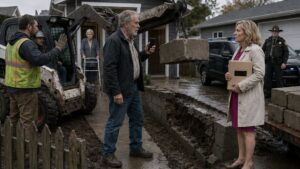
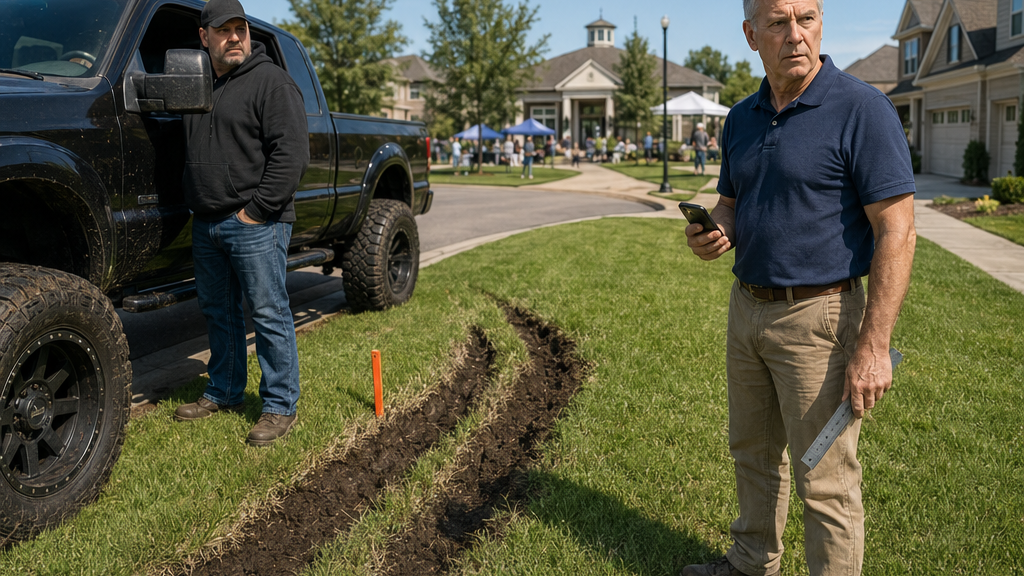
The front tire of Christopher Walker’s pickup rolled over the survey stake slowly enough for David Carter to watch the orange flag bend beneath the bumper.
For half a second, David thought the truck would stop.
It didn’t.
The lifted black pickup dropped off the curb cut, crossed the pale line David had sprayed beside the stake, and climbed onto the Bermuda grass. The oversized tire sank into a rut from the previous weekend, crushing the new growth David had spent three evenings coaxing back into place.
David was already standing there with a steel ruler in one hand and his phone in the other.
Christopher saw him.
That was what made it different.
The truck kept coming.
David stepped backward as the front wheel rolled past him, close enough that he could hear small pieces of dry soil snapping under the tread. The truck crossed the corner of his yard diagonally, then turned toward Christopher’s driveway next door.
By the time the rear tire left the grass, two fresh dark lines cut through the green.
David lifted his phone.
Christopher climbed out.
“Seriously?” he called.
David took one photograph, then another.
Christopher shut the truck door harder than necessary. He was a broad man in a black cap and work hoodie, the kind of person who seemed to fill whatever space he stood in. “You taking pictures of me now?”
“I’m taking pictures of the damage.”
Christopher glanced at the lawn. “Damage.”
David crouched beside the deepest track. He inserted the ruler vertically into the soft soil.
“Three and a quarter inches.”
“You’ve lost your mind.”
David photographed the ruler.
Christopher walked closer. “You’re measuring tire tracks?”
“You keep making them.”
“I’ve been turning through there for years.”
“Not with my permission.”
Christopher’s jaw tightened.
Across the street, two folding tables were being set up near the clubhouse entrance for the HOA’s neighborhood cleanup event. Nobody came over, but David noticed one of the volunteers look in their direction.
He hated that almost as much as the ruts.
The first time Christopher had crossed the lawn, David had walked outside furious and asked what he thought he was doing. Christopher had answered with a shrug and said he was just making the turn.
The second time, David had been sharper.
Christopher had been sharper back.
After that, David stopped arguing.
He documented.
He stood and brushed dirt from his knee.
“This is going in a separate notice.”
Christopher stared at him.
“A separate what?”
“A damage notice.”
“You’re mailing me bills now?”
“I’ve already mailed you notices.”
Christopher’s expression changed. Not much, but enough.
“You mean those envelopes?”
“Yes.”
“I thought that was HOA garbage.”
“They were certified.”
Christopher gave a short laugh. “You’re sending certified mail to the house twenty feet from yours.”
David said nothing.
That laugh landed harder than he wanted it to.
Christopher pointed toward the edge of the yard. “You know why people turn through here?”
“Because it’s convenient.”
“Because this corner has always been used.”
“It’s my lot.”
“It’s grass beside a street.”
“It’s inside my survey.”
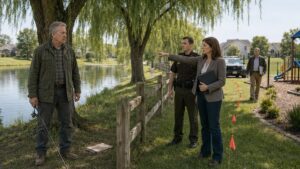
Christopher looked at the orange stake.
David had paid for the county survey technician to reset the corner after the third weekend of damage. The plat matched what David had always believed: the property line extended beyond the lawn’s visible edge farther than most neighbors realized.
There was no question where Christopher’s tires had gone.
David opened the photo gallery on his phone.
“You want to see something?”
Christopher folded his arms.
David swiped through timestamped images from the camera mounted beneath his eave.
Saturday, 7:41 a.m.
Christopher’s truck entering the grass.
Saturday, 7:42 a.m.
The rear tire leaving it.
The following weekend.
Then another.
Christopher leaned closer despite himself.
“You’ve got cameras pointed at my house?”
“They’re pointed at my driveway.”
“My truck’s in every picture.”
“Because your truck keeps coming into the frame.”
Christopher’s face reddened.
David swiped again. “Seven weekends.”
“You’ve been sitting inside counting?”
“I don’t have to sit anywhere. The footage records automatically.”
Christopher looked from the screen to the camera under the roofline.
Something in his posture shifted. Until that moment, he had treated David’s complaint as annoyance. Now there were dates. Angles. Measurements.
A record.
David should have felt satisfied.
Instead, the whole thing suddenly seemed uglier.
Christopher turned toward his truck.
“Don’t cross it again,” David said.
Christopher stopped.
Then he looked back.
“You really think I just decided one day your lawn was mine?”
“I think you know where your driveway is.”
“No. You think everybody but you is stupid.”
David felt heat rise behind his neck.
“I think a survey stake is hard to misunderstand.”
Christopher walked back toward him until they were several feet apart.
“You want to know what I was told?”
David didn’t answer.
“The corner was open for turning. Especially with work vehicles.”
“By who?”
Christopher shook his head as if David had confirmed something.
“That’s the problem. You never asked.”
“You never asked me.”
“Because nobody asked the last owner either.”
David’s grip tightened around the ruler.
Christopher nodded toward the clubhouse.
“HOA’s used that corner for years. Landscapers. Event trucks. Utility trailers. Everybody.”
“That doesn’t make it theirs.”
“I didn’t say it did.”
“You’re driving through it.”
“And I was told I could.”
David looked again at the fresh rut. The tire had cut directly beside the bright survey flag. Whatever anyone might have believed before, Christopher had seen the marker today.
“You saw the stake.”
“I saw it.”
“And still crossed.”
Christopher looked away for the first time.
That silence mattered.
David heard a lawn mower start somewhere behind the houses.
“Who told you?” he asked.
Christopher took a few steps toward his truck.
“Ask your board president.”
David frowned.
Christopher opened the door.
“Benjamin Clark,” he said. “He’s the one who told me that strip was open for turning.”
Then he climbed into the pickup, leaving David standing beside the fresh rut with the ruler still in his hand.
Chapter 2: Fourteen Envelopes Did Not Start Overnight
Fourteen green-and-white certified-mail receipts lay across David’s desk in two straight rows.
He had arranged them by date.
He had not meant to.
He had come inside after Christopher drove away intending only to put the newest measurement into his spreadsheet. But once he opened the file drawer, he started pulling out the receipts.
Week one.
Week two.
Week three.
Two separate crossings on several weekends.
Fourteen notices.
He sat down.
The total at the bottom of his spreadsheet read $620.
Not penalties.
Not guesses.
At least, that was what David had told himself every time he entered another number.
The first incident had cost forty-eight dollars by his calculation. A small section of Bermuda sod, soil preparation, and a fraction of the labor rate quoted by a local landscape contractor.
The second was less.
The third was more because the truck had crossed after rain and compressed the soil beneath the turf.
David had photographs for each one.
He had measurements.
He had dates.
He had market prices.
He had built commercial estimates for almost thirty years. He knew the difference between a number that felt right and one that could survive someone asking, Where did you get this?
Years earlier, he had lost several thousand dollars on a renovation job because a contractor changed scope after a handshake agreement. David had been certain memory and common sense would be enough.
They hadn’t been.
After that, he learned to keep things.
Emails.
Receipts.
Change orders.
Photographs.
The problem was that once David started building a file, stopping felt irresponsible.
He opened the folder marked LAWN DAMAGE.
The first photograph showed one shallow track.
The grass was barely torn.
He remembered standing there that morning, annoyed but not yet angry, thinking Christopher would probably apologize when he saw it.
Christopher hadn’t.
The next Saturday the truck crossed again.
David had walked over before breakfast.
“You cut across my yard again.”
Christopher had barely looked up from unloading something from the bed of the truck.
“I didn’t hurt anything.”
“There are tracks.”
“They’ll grow back.”
“That isn’t the point.”
Christopher had sighed.
That sigh stayed with David longer than the conversation.
It had made him feel ridiculous.
Like a man protecting six inches of grass because he had nothing better to do.
The following week, David ordered the first certified letter.
The clerk behind the post-office counter had glanced at the address and then at his driver’s license.
“This is your street?”
“Yes.”
“Close by?”
“Next door.”
The clerk had said nothing after that.
David had appreciated it.
When the delivery confirmation came back, he printed it.
Two mornings later, Christopher crossed again.
That was the moment David stopped expecting the notices to change anything.
He opened the surveillance archive.
The video loaded.
Christopher’s truck appeared at the edge of the frame, paused, then rolled onto the lawn.
There had been no mistake.
No emergency.
No vehicle blocking the street.
David watched the truck cross the exact area described in the certified letter Christopher had signed for forty-eight hours earlier.
He remembered what he felt then.
Not anger exactly.
Something colder.
Fine.
If Christopher wanted to pretend the damage didn’t matter, David would make it measurable.
After every crossing, he walked outside with his ruler and phone.
Depth.
Width.
Length.
Photograph.
Date.
Estimated square footage.
He checked sod prices each week because he did not want Christopher claiming the numbers were invented.
He saved screenshots of local labor rates.
He printed the relevant section of the community rules even though those rules did not settle ownership.
By week four, the process had become automatic.
Truck.
Rut.
Camera footage.
Measurement.
Envelope.
Christopher stopped acknowledging him.
David stopped trying to speak.
That should have bothered him sooner.
He looked at the fourteen receipts again.
The stack no longer looked like preparation.
It looked like distance measured on paper.
His phone rang.
The screen showed SHARON WILSON.
David answered.
“Mr. Carter?”
“Yes.”
“This is Sharon Wilson with the management office. I’ve been reviewing the material you emailed.”
David straightened.
“I sent everything.”
“I noticed.”
There was no judgment in her voice, but the pause after the sentence carried something close to it.
“Your photographs are unusually thorough.”
“I wanted there to be no question.”
“There isn’t much question about the truck.”
David waited.
“But I have a question about the location.”
He frowned.
“The survey shows it’s my property.”
“Yes. That isn’t what I mean.”
Paper moved on Sharon’s end.
“You sent pictures going back seven weeks.”
“Correct.”
“And there are older images from your security camera folders. Not part of your claim, but the system stored them.”
David turned toward his laptop.
“What older images?”
“Look at the photo you labeled background reference three.”
He opened the folder.
The image had been taken months earlier. He had included it only because it showed the lawn before Christopher’s repeated crossings.
A small HOA maintenance vehicle sat near the curb.
Behind it were two faint tire tracks across the same corner.
David enlarged the image.
He had never noticed them.
“Those aren’t Christopher’s tires,” Sharon said.
“No.”
“There’s another picture from last fall. A utility trailer.”
David clicked.
She was right.
The trailer’s wheels crossed the same strip.
David leaned closer.
One image showed temporary signs near the clubhouse. Another showed a landscaping truck turning wide with two tires on David’s grass.
The marks were lighter. Less destructive.
But they were there.
Sharon said, “I pulled our current site plan. It doesn’t show an easement.”
“There isn’t one.”
“I’m not saying there is.”
“Then what are you saying?”
“I’m saying I need to know why association vendors appear to have been using the same route.”
David looked at the fourteen envelopes.
For seven weeks he had asked one question: Why does Christopher keep crossing after being told to stop?
Now a different question had taken its place.
Sharon continued.
“I’m going into the older management records Monday morning. There may be maintenance notes.”
“About my property?”
“Maybe about the corner.”
David stared at the faint tracks on the old photograph.
Christopher’s claim no longer sounded impossible.
Sharon lowered her voice.
“Mr. Carter, before you send another damage notice, I suggest you wait until I find out who told people that strip was usable.”
Chapter 3: The Records Called It Access Without Owning It
Sharon placed the old maintenance map beside David’s recorded survey and flattened both pages with her palms.
The two drawings contradicted each other without technically disagreeing.
David noticed it immediately.
The county survey showed a clean property line running through the wide grass corner and continuing toward the sidewalk.
The HOA maintenance map showed the same area shaded in pale yellow.
Inside the yellow patch, someone had typed two words:
TURNING CLEARANCE.
“There,” Sharon said.
David leaned over the conference table.
“What does that mean?”
“That is exactly what I’ve spent this morning trying to determine.”
It was Monday, two days after Christopher had driven over the fresh survey stake. The management office occupied two rooms at the back of the clubhouse, with filing cabinets that looked older than the subdivision landscaping.
Sharon had already filled half the table.
Invoices.
Vendor diagrams.
Old event plans.
Printed emails.
David pointed at the yellow area.
“Is there an easement attached to that?”
“No.”
“A license agreement?”
“No.”
“Recorded consent?”
“I haven’t found one.”
“So somebody just colored my property yellow.”
Sharon looked at him.
“That is one interpretation.”
“What’s yours?”
“My interpretation is that someone created a maintenance convenience and nobody asked the next question.”
David sat back.
“What next question?”
“Who owns the ground underneath it?”
She slid another folder toward him.
Inside were photographs from a neighborhood event six years earlier. Folding tables lined the clubhouse entrance. A catering trailer had been parked near the curb.
In one photo, its wheels were on the edge of the same lawn.
Another showed a landscaping crew towing a small aerator across the corner.
Another showed a utility truck turning around.
David flipped faster.
“How long?”
“The oldest reference I found is nine years.”
“I’ve owned the house eleven.”
“Were you home during weekday maintenance?”
“Usually not.”
“There you are.”
He looked up.
“That doesn’t mean I allowed it.”
“I didn’t say it did.”
David heard Christopher’s voice in the answer.
He disliked that.
Sharon turned the maintenance map around.
“Look here.”
A handwritten note ran along the edge.
USE GRASS FOR WIDE TURNS—AVOID CURB.
No signature.
No parcel number.
No reference to permission.
“This isn’t authority,” David said.
“No.”
“It isn’t anything.”
“It is evidence of practice.”
“That’s not the same thing.”
“I know.”
“Does Benjamin?”
Sharon’s expression changed slightly.
“He will.”
That answer told David she had not spoken to him yet.
“Why not?”
“Because I wanted to know what I had before I asked him what he remembered.”
David stood and walked to the window.
Outside, the lawn looked ordinary from this angle. The ruts were hidden by distance. A person could look at the corner and understand exactly how the problem began. Wide grass. Tight turn. No fence. No shrubs. Nothing physically stopped a vehicle.
But ownership was not supposed to depend on whether something was easy to cross.
“I want the board to correct it.”
“We’re not there yet.”
“We know there’s no easement.”
“Yes.”
“You have my survey.”
“Yes.”
“Then what else do you need?”
Sharon folded her arms.
“To know whether the association contributed to Christopher’s belief.”
“He crossed after certified notice.”
“That may change his responsibility after notice. It doesn’t answer what happened before.”
David turned back.
“You’re making excuses for him.”
“No. I’m separating questions.”
That stopped him.
It was exactly what he had spent seven weeks doing with measurements.
Separating one incident from another.
One photograph from another.
One cost from another.
Sharon opened a second folder.
“This is an event-routing sheet from four years ago.”
David read the notes.
Delivery vehicles were instructed to enter near the clubhouse, unload, then exit using the residential loop.
At the bottom was a handwritten addition:
LARGE VEHICLES MAY SWING WIDE AT CARTER CORNER.
His surname sat there as casually as if the strip had been an HOA loading dock.
“Who wrote that?”
“I don’t know.”
David felt something sharper than anger.
Christopher had damaged the grass.
But the association had apparently spent years teaching people that David’s boundary was flexible whenever it was inconvenient.
“That’s my property.”
“Yes.”
“They used my name.”
“Yes.”
“And nobody called me.”
“I haven’t found evidence that they did.”
David looked again at the words.
CARTER CORNER.
Not Lot 18.
Not private lawn.
A nickname could do strange things to responsibility. It could turn somebody’s property into a landmark and then into a convenience.
Sharon slid the county survey closer.
“The good news is the ownership question is straightforward.”
He looked at her.
“Good news?”
“There is no recorded easement. No common-area designation. No association ownership. Nothing I’ve found gives the HOA permanent vehicle rights across that lawn.”
David exhaled.
For weeks, he had imagined someone finally saying those words.
He had expected relief.
Instead he thought of Christopher standing beside the survey stake saying, Nobody asked the last owner either.
David tapped the maintenance map.
“Then why did Benjamin tell him he could use it?”
“I don’t know that Benjamin did.”
“Christopher named him.”
“I know.”
“So ask.”
Sharon glanced at her laptop.
“I have.”
David waited.
“He hasn’t responded yet.”
The answer irritated him more than it should have.
Sharon continued sorting papers.
“Mr. Carter, I need you to understand something before this goes to the board.”
“I understand the boundary.”
“I’m talking about the conflict.”
He said nothing.
“If Christopher was told by a board officer that the area was available for wide turns, that does not give him legal rights to your property. But it does change whether his first crossings were knowingly hostile.”
“The later ones were.”
“Possibly.”
“He signed for the letters.”
“I know.”
“He saw the stakes Saturday.”
“I know.”
“And drove over anyway.”
Sharon closed the folder.
“I’m not asking you to excuse that.”
“Sounds like it.”
“I’m asking you not to flatten nine years of bad association practice into one man deciding to disrespect you for no reason.”
David almost answered.
His phone vibrated first.
An email notification appeared.
From Sharon.
She had forwarded something while they were talking.
“What is this?”
“Something the archive search found ten minutes ago.”
David opened it.
The message was three years old, sent to several homeowners before a neighborhood garage-sale weekend.
The subject concerned parking and delivery access.
Most of the text was ordinary.
Then David reached the final paragraph.
For trucks that cannot make the narrow turn near the clubhouse, use the Carter-side grass if necessary. That corner has always been open for turning.
The sender was Benjamin Clark.
David read the sentence twice.
Then a third time.
Sharon said quietly, “That’s why I asked you to come in.”
David looked at the old maintenance map, his recorded survey, and Benjamin’s email lined up on the table.
Christopher had been wrong about the boundary.
But he had not invented the permission.
David closed the laptop.
“When is the next board meeting?”
“Thursday.”
“Put me on the agenda.”
Sharon hesitated.
“I already did.”
David looked at her.
“And Benjamin?”
“He confirmed attendance twenty minutes ago.”
For the first time since the truck crossed his lawn, David was no longer wondering whether Christopher knew the grass belonged to him.
Now he wanted to know whether Benjamin Clark would admit that the HOA had spent years acting as though it didn’t.
Chapter 4: The Board Wanted Peace Without Taking Blame
Benjamin Clark opened the meeting by calling the damage to David’s lawn “a neighbor misunderstanding.”
David had not expected an apology.
He had expected more than that.
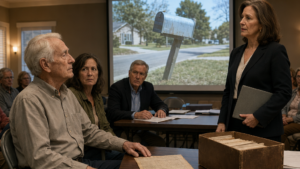
The clubhouse meeting room held two folding tables pushed into a rectangle, six plastic chairs, and a portable projector aimed at a blank wall. Sharon Wilson sat at one end with a stack of records. Benjamin sat opposite her, wearing a pale button-down shirt with the sleeves rolled once at the wrists.
Christopher Walker was already there.
He had taken the chair farthest from David.
Two other board members sat quietly beside Benjamin.
Benjamin folded his hands.
“I think everybody agrees this has gone farther than it needed to.”
David looked at him.
“Fourteen times farther?”
Christopher shifted in his chair.
Benjamin’s mouth tightened.
“David, that’s exactly the kind of framing I’m hoping we can move away from.”
“Fourteen notices aren’t framing.”
“No. But sending fourteen notices to your next-door neighbor is escalation.”
David felt Sharon glance toward him.
He ignored it.
“He drove over my property fourteen times.”
Christopher leaned forward.
“Not fourteen.”
David turned.
“I have fourteen documented crossings.”
“You have fourteen envelopes.”
“I have photographs.”
Christopher shook his head. “Some of those are two tires from the same turn.”
David almost answered immediately.
Then stopped.
That was the problem with a file. Once every incident had its own number, it became easy to defend the numbering instead of the point underneath it.
Sharon switched on the projector.
The first photograph appeared on the wall.
A dark rut curved across David’s lawn.
The second showed an older, lighter track.
Then a third.
Sharon changed slides.
An HOA landscaping trailer.
Another image.
A utility vehicle.
Another.
A delivery truck swinging wide during a neighborhood event.
The room grew quieter with every photograph.
“These predate Mr. Carter’s current complaint,” Sharon said. “Some by several years.”
Benjamin looked at the wall.
“I’m aware vehicles have turned there.”
David said, “Were you aware it was private property?”
Benjamin did not answer immediately.
“I knew it was adjacent to David’s lot.”
“That wasn’t the question.”
One of the board members shifted uncomfortably.
Benjamin exhaled.
“I did not pull the recorded plat every time somebody needed to get a trailer around that corner.”
“So you didn’t know.”
“I knew there had been a long-standing practice.”
David pushed the printed survey across the table.
“There’s the practice. And there’s the property line.”
Benjamin looked down.
“I’ve seen it.”
“Then say it.”
Christopher glanced between them.
Benjamin frowned. “Say what?”
“That there is no HOA easement across my lawn.”
Silence settled over the table.
Sharon spoke before Benjamin could redirect.
“We have not located a recorded easement, license agreement, common-area designation, or owner consent granting association vehicle access over that portion of the Carter lot.”
David kept his eyes on Benjamin.
Benjamin finally nodded.
“There is no recorded easement that we can find.”
It should have felt like winning.
For seven weeks David had wanted somebody with authority to say exactly that.
Instead he felt only the next question waiting.
Christopher reached into a folder beside his chair.
“You want to see why I thought I could turn there?”
He pulled out a printed email.
David recognized the format before he could read the words.
HOA event notice.
Christopher slid it across the table.
“This went to everybody three years ago.”
Benjamin’s posture changed.
Christopher tapped the final paragraph.
“For trucks that cannot make the narrow turn near the clubhouse, use the Carter-side grass if necessary.”
Nobody spoke.
Christopher looked at David.
“You think I made that up?”
David read the sentence again.
He had already seen the archived copy in Sharon’s office.
Seeing Christopher’s printed version was different.
The paper was creased twice, like it had been kept in a household folder instead of recently produced for a fight.
Christopher leaned back.
“I’ve got a work truck. My driveway is narrow. My son’s car is there half the weekends. I was told that corner was usable. So when you came outside acting like I’d driven through your living room, yeah, I thought you were being ridiculous.”
David felt the old anger stir.
“You kept doing it after I told you it was mine.”
“And you kept sending bills instead of talking.”
“You signed for the letters.”
“I signed for envelopes telling me what I owed you.”
“They told you to stop.”
Christopher’s voice sharpened.
“And you think a certified letter makes somebody want to come knock on your door?”
Benjamin raised a hand.
“Both of you—”
“No,” David said.
The word came out harder than he intended.
Benjamin looked at him.
“You told residents to use my lawn.”
“I gave practical guidance based on how the area had been used.”
“Without checking whether you had authority.”
Benjamin’s jaw worked.
“That was a mistake.”
It was the first sentence all evening that did not contain a qualifier.
David sat back.
Christopher stared at Benjamin.
“So you’re saying now I was wrong to believe you?”
“I’m saying I should have verified the property status.”
“That’s not the same thing.”
“No,” Benjamin said. “It isn’t.”
Sharon slid a one-page proposal onto the table.
“The practical question is what happens now.”
David read it.
Christopher would stop all vehicle use across the lawn immediately. The HOA would send written clarification that private lots could not be used as informal access routes. David would withdraw his accumulated damage demands if Christopher paid agreed restoration costs.
David looked up.
“You want me to withdraw all fourteen.”
Benjamin said, “In exchange for actual repair.”
“My numbers are actual repair.”
Christopher reached into his pocket, pulled out a folded sheet, and put it on the table.
“I called a landscaper.”
David unfolded it.
A written estimate.
Christopher said, “I’ll pay to fix what I damaged.”
David looked at the amount.
It was higher than several of his individual notices combined, but lower than the $620 total.
Christopher continued.
“I’m not paying fourteen separate charges like I got fourteen parking tickets.”
“They aren’t fines.”
“They feel like fines.”
“They’re documented damage.”
“Then fix the damage.”
The room went still.
There it was.
The simple version.
Repair what was broken.
David should have been satisfied.
Instead his mind moved immediately to dates, photographs, measurements, certified receipts.
All the work.
All the proof.
All the hours.
If he accepted one repair payment, what happened to everything he had built?
Sharon must have seen something on his face.
“David,” she said, “the documentation established the pattern. It did its job.”
He looked at her.
The sentence unsettled him.
Because part of him did not want the file merely to have done its job.
Part of him wanted it recognized.
Christopher’s chair scraped softly as he leaned forward.
“You know what I don’t understand?”
David waited.
“The first week, you came over.”
“Yes.”
“The second week, you yelled from the yard.”
“You drove through it again.”
“Fine. Then the letters started.”
David said nothing.
Christopher pointed toward the stack of copies Sharon had prepared.
“After that, you never knocked on my door once.”
“You knew what the letters said.”
“I knew you were building a case.”
“That should have told you to stop.”
Christopher stared at him.
Then he asked, quietly enough that the whole room leaned toward the words:
“Why did you keep mailing me new demands instead of knocking on my door after the first week?”
David opened his mouth.
Nothing came out.
Chapter 5: The Fourth Notice Was Where David Changed
The first rut was almost gone.
David found it the next morning only because he remembered exactly where he had pushed the ruler into the soil seven weeks earlier.
Bermuda runners had crossed the shallow depression from both sides. New blades covered the torn edge. Another few weeks and he might not have been able to identify it at all.
He stood over it with his coffee cooling in his hand.
Farther toward the driveway, the newer damage was still obvious.
Bare soil.
Compressed tracks.
A strip where water collected after the sprinklers ran.
The lawn had become a timeline.
David crouched.
The oldest wound was healing.
The newest ones were not.
Christopher’s question from the board meeting had followed him home.
Why did you keep mailing me new demands instead of knocking on my door after the first week?
David had answers.
Christopher was hostile.
The letters were clear.
The cameras proved everything.
Direct confrontation had gone badly.
All of those answers were true.
None explained the fourth notice.
David remembered that morning precisely.
Christopher’s truck had been idling next door.
David had seen it from the kitchen window.
He knew Christopher’s son’s compact car was parked halfway down the narrow driveway. He knew the big pickup would need a wider angle to get around it.
David could have walked outside.
He could have stood at the edge of the lawn.
He could have called across the property line, Don’t use my grass.
Instead he had stayed behind the glass.
The truck backed.
Turned.
Rolled across the corner.
And David had watched.
Not because he wanted the lawn damaged.
He told himself that first.
But when the rear tire left the grass, he had already been reaching for his phone.
He wanted another timestamp.
Another undeniable incident after notice.
The realization felt worse in daylight.
Christopher had caused the damage.
Christopher had ignored the first warning.
Christopher had crossed after receiving certified notice.
Nothing about David’s silence erased that.
But by the fourth incident, David had stopped asking, How do I make this stop?
He had started asking, How do I prove what he keeps doing?
Those were not the same question.
A truck door closed next door.
David stood quickly.
Christopher came around the side of his pickup carrying a travel mug.
For a second both men froze.
Neither spoke.
Christopher looked toward the ruts, then toward David.
David expected another challenge.
Christopher simply got into the truck.
He reversed carefully down his driveway, using three short corrections instead of swinging across the lawn.
The maneuver took perhaps twenty seconds longer.
Then he drove away.
David stared at the untouched grass.
So it could be done.
That irritated him too.
By midmorning, the landscape contractor arrived.
He walked the damaged strip with David, probing the worst areas with a narrow metal rod.
“You can patch sections,” the contractor said. “But this soil’s compacted deeper than it looks.”
“How much deeper?”
“Couple inches in places. You’ve got to loosen it, level it, replace some turf. Otherwise you’ll see these tracks every dry spell.”
He wrote numbers on a clipboard.
David watched.
When the estimate was finished, the total exceeded $620.
David read it twice.
“That’s for full restoration?”
“Labor, soil prep, sod, matching the edge. Not replacing the whole lawn.”
David had expected the estimate to validate his spreadsheet.
Instead it complicated it.
His fourteen notices had totaled every incident separately because that was how damage accumulation made sense to an estimator.
But the actual repair would happen once.
One mobilization.
One soil preparation.
One restoration.
The number on the contractor’s page was real.
So was David’s $620.
They just answered different questions.
His phone rang before the contractor reached his truck.
Sharon.
“Have you thought about last night?”
“Yes.”
“That sounded painful.”
“It was.”
She waited.
David looked toward Christopher’s driveway.
“He turned without crossing this morning.”
“That’s good.”
“It was possible the whole time.”
“Yes.”
Again, Sharon did not give him the answer he wanted.
David said, “I got a full restoration estimate.”
“And?”
“It’s higher than my total.”
“That may help.”
“Or make it worse.”
“How?”
“Because now I can prove I wasn’t inflating the damage.”
“Were you worried you were?”
David said nothing.
Sharon’s voice softened.
“I’m not asking whether Christopher caused it.”
“I know.”
“Then what are you deciding?”
David walked to the oldest rut.
A thin green runner stretched over the place where his ruler had once disappeared into mud.
“I had enough evidence after the fourth crossing.”
Sharon remained silent.
“I knew I did.”
“Okay.”
“I didn’t tell him that.”
“You didn’t need to.”
“No. But I also stopped trying to stop him in person.”
The admission sounded strange once spoken.
“I saw him getting ready to turn one Saturday. I stayed inside.”
“Why?”
David looked at the new growth.
“Because if he did it again, there’d be no way anybody could call the first few accidents.”
Sharon let out a slow breath.
“That doesn’t make the crossing your fault.”
“I know.”
“But?”
“But I wanted proof more than I wanted that particular crossing prevented.”
The words sat between them.
Sharon said, “What do you want now?”
David looked at the contractor’s estimate.
“The boundary recognized.”
“And the money?”
“I want the lawn restored.”
“The fourteen notices?”
David stared at the neat spreadsheet through the kitchen window, visible on his laptop screen.
Numbers had protected him before.
Numbers had also become a place to hide.
“I’ll withdraw the per-incident structure.”
Sharon did not respond immediately.
“On one condition,” David said.
“There it is.”
“The HOA doesn’t dump this entirely on Christopher.”
“What do you mean?”
“You found nine years of association practice. Benjamin sent that email. Vendors were directed over private property. Christopher still crossed after notice, and that’s his part. But the board helped create the belief that the route was legitimate.”
“I agree there’s exposure.”
“I’m not asking for legal language.”
“What are you asking for?”
“Responsibility.”
Sharon was quiet.
David continued.
“I’ll release the fourteen individual demands if the repair is treated as one restoration project and the association acknowledges its contribution.”
“That will require board approval for association funds.”
“Then take it to the board.”
“Benjamin may resist using HOA money on a private lot.”
“He used HOA authority on a private lot.”
Another pause.
This time Sharon did not argue.
“All right,” she said. “Give me the contractor’s estimate.”
“I’ll email it.”
“And David?”
“Yes?”
“If we do this, you don’t get to keep fourteen claims sitting in reserve in case you dislike the settlement.”
He looked through the window at the rows of certified receipts.
For weeks they had made him feel prepared.
Now they looked like a door he had kept locked from both sides.
“If the HOA accepts responsibility,” he said, “I’ll release them.”
Chapter 6: Nobody Owned the Mistake Alone
Sharon divided the photographs into two piles before anyone sat down.
BEFORE CLEAR NOTICE.
AFTER CLEAR NOTICE.
She had written the labels on plain white cards and placed them at opposite ends of the conference table.
David stopped beside the second pile.
There were fewer photographs there.
They looked worse.
The fresh survey stake appeared in several.
So did Christopher’s black pickup.
One image showed the right front tire crossing less than a foot from the orange flag.
Christopher entered behind David and saw the piles.
“What is this?”
Sharon closed the door.
“The part where we stop arguing as if every crossing happened under the same circumstances.”
Benjamin was already seated.
No other homeowners had been invited to the mediation. Only the four of them.
David took his chair.
Sharon tapped the first pile.
“These occurred while association records, historic practice, and prior board guidance could reasonably have contributed to confusion.”
Christopher nodded.
Then she touched the second.
“These occurred after Mr. Carter sent direct written notice, after the survey markers were reset, and after the property boundary was no longer reasonably ambiguous.”
Christopher’s expression hardened.
David expected him to argue.
He didn’t.
Sharon opened the contractor’s estimate.
“The proposed restoration is one project. Soil decompaction, grading, replacement turf, edge repair.”
Benjamin scanned the total.
“And the proposal is that the association pays part of this?”
“Yes.”
“For privately owned landscaping.”
“For damage occurring partly because the association historically directed vehicles over privately owned landscaping.”
Benjamin looked toward David.
“David has withdrawn the fourteen-demand structure?”
“If there’s an agreement,” David said.
Christopher turned toward him.
“All fourteen?”
“Yes.”
Something like suspicion crossed his face.
“What changed?”
David could have said the estimate.
The meeting.
Sharon’s records.
Instead he said, “I decided fixing the lawn mattered more than keeping fourteen separate numbers alive.”
Christopher watched him for another second, then nodded once.
Sharon continued.
“The responsibility recommendation is divided. The association contributes because its maintenance practices and written guidance created the appearance of authorized access. Christopher contributes because he physically caused much of the recent damage.”
Benjamin pointed to the second pile.
“And these?”
Sharon looked at Christopher.
“That depends on whether Mr. Walker disputes that he knew the boundary by then.”
Christopher’s jaw tightened.
He stared at the photographs.
One showed David beside the survey stake with his ruler.
Another showed the truck crossing after the certified letters had already been delivered.
Finally Christopher said, “No.”
Benjamin frowned. “No, you don’t dispute it?”
“I knew.”
The room went very still.
David had expected resistance.
A technical argument.
A claim that Christopher had not read the letters carefully.
Christopher rubbed one palm over his face.
“The last two times, I knew.”
Sharon did not move.
“Why did you cross?”
Christopher looked directly at David.
“Because I was mad.”
David felt something tighten in his chest.
Christopher continued before anyone could interrupt.
“I’d been using that turn for years. Landscapers did it. Delivery trucks did it. Benjamin’s email said it was fine. Then suddenly David’s taking pictures of me like I’m stealing something.”
“You were on my property,” David said.
“I know that now.”
“You knew then.”
Christopher’s eyes hardened.
“Those last two times? Yes.”
“Then why?”
“I just told you.”
“That isn’t a reason.”
“It’s the reason.”
Christopher leaned back.
“You put those stakes out. You stood there with that ruler. You sent letters. Every time I walked outside, I felt like I was being watched.”
“You were being recorded because you kept crossing.”
“I know.”
Christopher’s voice rose, then fell again.
“My son asked me why the neighbor was taking pictures of our truck. People at the clubhouse were looking over. I felt like you’d decided I was some kind of idiot who couldn’t understand a property line.”
David said nothing.
Christopher looked at the photographs.
“So I crossed it anyway.”
Not confusion.
Not custom.
Pride.
The admission did not make David less angry.
It made the anger cleaner.
The first crossings could be complicated.
The last ones were choices.
Christopher pushed the photographs away.
“I’m not proud of it.”
Nobody rushed to answer.
Benjamin finally said, “That distinction matters.”
Christopher laughed without humor.
“Now everybody wants distinctions.”
Sharon looked at Benjamin.
“Yes. They do.”
She slid the old HOA email toward him.
“And yours matters too.”
Benjamin stared at his own words.
USE THE CARTER-SIDE GRASS IF NECESSARY.
He had seen the email before, but this time there was nowhere to redirect attention.
“I wrote it.”
David waited.
Benjamin continued.
“I believed the area was part of the common edge beside the road.”
“Did you verify that?” Sharon asked.
“No.”
“Did the board vote to authorize private-lot access?”
“No.”
“Did David consent?”
Benjamin looked at him.
“Not that I can document.”
David almost corrected him.
Not at all.
But he stopped.
The meeting did not need another absolute sentence.
Benjamin folded the email.
“We were trying to manage events without trucks clipping the curb or backing through pedestrian traffic.”
“That explains it,” David said. “It doesn’t authorize it.”
“I agree.”
The words came easier than they had at the board meeting.
Sharon pushed the proposal to the center.
Christopher would pay a defined portion reflecting the post-notice damage and part of the physical restoration.
The HOA would fund the remainder because its historical practices had contributed to the repeated use.
David would release the fourteen individual demands once payment and repair were confirmed.
The HOA would adopt a written policy prohibiting informal routing across private lots without owner consent.
Benjamin read the last item twice.
“If we pay from association funds, some homeowners are going to ask why.”
“Tell them,” David said.
Benjamin looked up.
“That the board made a mistake?”
“Yes.”
“That will go over well.”
David almost smiled.
“Better than another nine years of pretending the grass belongs to whoever needs the widest turn.”
Christopher looked down, hiding what might have been the beginning of a smile himself.
Benjamin did not.
He tapped the proposal.
“I can support the policy. The funding has to go to a vote.”
“When?” Sharon asked.
“Next regular session.”
“That’s two weeks.”
“I know.”
David felt the old instinct rise.
Delay meant uncertainty.
Uncertainty meant he should keep every claim active, every option preserved.
He looked at the fourteen-release paragraph.
Then at Christopher.
Christopher said, “I’ll pay my part if they approve this.”
“No more crossings?”
“No more crossings.”
David glanced toward Sharon.
“And if they reject the HOA share?”
Benjamin answered.
“Then we’re back here.”
David shook his head.
“No.”
Benjamin frowned.
“No?”
“If the board rejects responsibility, I’m not renegotiating the facts privately. The record goes into the open meeting.”
Benjamin understood immediately.
The old event instructions.
The maintenance maps.
His email.
Not as humiliation.
As explanation.
Still, he disliked it.
David could see that.
Benjamin gathered the papers into one stack.
“All right.”
Sharon looked at him.
“All right what?”
“I’ll put the cost-sharing proposal and the access policy on the agenda.”
“As recommendations?”
Benjamin hesitated.
Then he looked at the photographs in both piles.
The old ruts.
The new ones.
The damage caused first by assumption, then by pride.
“As board-president recommendations,” he said.
For the first time, nobody at the table had managed to leave the mistake entirely in someone else’s yard.
Chapter 7: The Boundary Became Something More Than a Line
The landscape contractor did not fill the deepest rut.
He cut it out.
David stood near the driveway as a narrow strip of damaged Bermuda grass came up in sections, exposing compacted brown soil underneath. The rut that had spent weeks serving as evidence was suddenly no longer a mark on the lawn. It was loose turf in a wheelbarrow.
The contractor drove a fork into the soil.
“See that?”
The tines barely penetrated.
“Truck compressed it.”
David nodded.
Two weeks had passed since the mediation. During that time Christopher had not crossed the lawn once. He had backed his pickup down the driveway carefully, sometimes making two or three corrections to clear his son’s car.
The extra effort had made one thing undeniable.
The shortcut had always been convenient.
It had never been necessary.
The contractor loosened the soil and worked fresh material into the strip. Behind him lay squares of matching Bermuda sod.
David had imagined this repair for weeks.
He had thought watching the ruts disappear would feel like a verdict.
Instead it felt strangely ordinary.
A damaged piece was removed.
A new piece went in.
No speeches.
No acknowledgment from the neighborhood.
Just work.
A truck slowed at the curb.
David recognized Christopher’s pickup before he looked up.
For one reflexive second, his body tightened.
Then Christopher turned into his own driveway.
Entirely into his own driveway.
He shut off the engine and walked toward the lawn carrying an envelope.
The contractor glanced at David, then returned to his work.
Christopher stopped several feet away.
“The vote went through.”
David nodded. Sharon had called twenty minutes earlier.
The board had approved the restoration cost-sharing proposal and the new access rule. The decision had not been unanimous, but it had passed.
Private lots could no longer be designated informally as maneuvering areas, event routes, maintenance shortcuts, or overflow access without written owner permission.
The association would pay its share of the restoration.
Christopher would pay his.
David would release the fourteen individual claims.
Christopher held out the envelope.
“My part.”
David took it.
“You didn’t have to bring it over.”
Christopher looked at him.
“I figured certified mail would be excessive.”
David almost smiled.
Almost.
He opened the envelope.
The amount matched Sharon’s agreement exactly.
“No argument?” David asked.
“Already did that.”
Christopher looked toward the torn-up section of lawn.
“That’s deeper than I thought.”
“So did the contractor.”
Christopher put his hands into his pockets.
“I thought you were charging me for grass that would grow back.”
“Some of it would have.”
“And some wouldn’t.”
“Apparently.”
They stood without speaking while the contractor raked the soil level.
Christopher finally said, “I should’ve stopped when you put the survey markers out.”
David looked at him.
Christopher was not asking to be forgiven.
That helped.
“Yes,” David said.
Christopher nodded.
“You could’ve knocked again too.”
David felt the old resistance rise, then fade before it reached his mouth.
“Yes.”
That seemed to surprise Christopher more than any argument had.
Neither man added anything.
At the evening board meeting, Benjamin Clark read the new policy himself.
He did not hide behind Sharon’s report.
“The association historically treated portions of privately owned corner lots as informal turning areas without confirming permission,” he said. “That practice was improper and ends with this policy.”
There was no applause.
One homeowner asked whether landscaping crews would now have trouble making certain turns.
Benjamin answered that contractors would have to use public pavement or obtain owner permission.
Another board member asked whether association money should really repair David’s lawn.
Benjamin looked down at the documents before him.
“The association contributed to the conditions that caused the dispute.”
David watched him say it.
Not enthusiastically.
Not gracefully.
But publicly.
That was enough.
Then Sharon slid a release form across the table.
David knew it was coming.
He had helped draft the settlement language.
Still, seeing the fourteen claim numbers listed beneath one paragraph gave him pause.
Each number represented a morning.
A photograph.
A measurement.
An envelope.
A small moment when he had told himself that keeping track meant maintaining control.
Sharon placed a pen beside his hand.
“Once you sign, the separate demands are closed.”
David looked at Christopher.
Christopher sat three chairs away, saying nothing.
Benjamin waited.
David thought about the renovation dispute years earlier, the handshake agreement that had cost him money because he had trusted people to remember what they promised.
After that, documentation had become his defense against being dismissed.
The fourteen notices had served that purpose.
They had proven that the crossings were real.
They had forced people to examine the records.
They had exposed the HOA’s mistake.
But keeping them alive now would not protect the boundary.
It would protect his leverage.
David picked up the pen.
He signed.
Sharon collected the page without ceremony.
The next afternoon, the contractor finished the lawn.
Fresh sod ran in a smooth strip where the darkest tracks had been. Along the curve nearest the street, a low landscaped border now followed the actual property line—not a fence, not a wall, just enough stone and planting to make the private edge visually obvious.
The orange survey flags were no longer necessary.
David stood near the curb looking at the restored corner.
Christopher walked over from next door.
He studied the new border.
“That looks better than stakes.”
David nodded.
“Harder to drive through too.”
Christopher gave him a sideways look.
“Was that a joke?”
“Maybe.”
Christopher crouched near the edge, judging the distance between his driveway and the street.
Then he stood.
“I’ve been thinking about widening mine.”
David looked toward Christopher’s narrow driveway.
“There’s room on your side.”
“I think so.”
Christopher rubbed the back of his neck.
“You did estimating work, right?”
“For a long time.”
“You know how to tell if I’m getting quoted something ridiculous?”
David understood the question behind the question.
Not Are we friends?
Not Are we even?
Something smaller.
Can I ask you for help without either of us pretending none of this happened?
David looked once more at the fresh grass covering the old tire path.
“Bring me the quote when you get it,” he said.
Chapter 8: Saturday Morning Without Another Tire Track
David heard Christopher’s pickup reverse at 7:38 on Saturday morning.
He froze with one hand on the kitchen faucet.
Months had passed since the settlement, but his body remembered the sound before his mind caught up.
The low engine note.
The change in pitch as Christopher backed down his narrow driveway.
The pause before the turn.
David set his coffee cup down.
Through the front window, he could see the black truck moving toward the street.
Christopher’s driveway had been widened the previous week.
Not dramatically.
A narrow section of pavement had been added along one side, just enough to change the turning radius. David had looked over the contractor’s estimate before the work started and circled two charges that seemed unnecessary.
Christopher had taken his advice.
Now came the first real test.
His son’s car was parked in the driveway.
The pickup backed around it.
Christopher turned the steering wheel.
The front tire approached the edge of David’s restored lawn.
David found himself measuring the remaining distance with his eyes.
Two feet.
One foot.
Inches.
The truck stopped.
Christopher pulled forward slightly, corrected his angle, then backed again.
The tire stayed on pavement.
The pickup completed the turn and entered the street without touching a blade of David’s grass.
David remained at the window after it drove away.
He realized he had been holding his breath.
Outside, the lawn showed no mark.
The old ruts were gone now.
Not merely repaired.
Gone.
Bermuda runners had knitted the sod seams together over the summer. The low border had settled into the corner so naturally that it looked as though it had always been there.
David no longer kept the steel ruler by the front door.
For a while after the settlement, he had.
He had also continued checking the camera notifications whenever Christopher’s truck moved.
Then less often.
Then hardly at all.
Nothing dramatic had repaired the relationship.
Christopher did not invite David over for dinner.
David did not start wandering next door for conversation.
They waved sometimes.
They discussed the driveway quote.
Christopher once borrowed a socket wrench and returned it before sunset.
That was all.
It was enough.
Later that morning, David was trimming along the landscaped border when Christopher came home.
The truck turned cleanly into the widened driveway.
Christopher parked and walked toward David.
“Got a question.”
David switched off the trimmer.
Christopher nodded toward the house.
“You still have all those pictures?”
David knew immediately which ones.
“Yes.”
“All fourteen?”
“And more.”
Christopher rubbed his thumb against the side of his hand.
“My son asked about them.”
David waited.
“He remembers me getting mad about the cameras.”
Christopher looked toward the lawn.
“I told him I was wrong about the last couple crossings.”
The admission sounded harder this time than it had in mediation.
David said nothing.
Christopher continued.
“He wanted to know if you still kept the pictures.”
“Why?”
“He thinks it’s weird.”
David almost laughed.
“He’s probably right.”
Christopher smiled faintly.
“So are you going to keep them forever?”
David looked at the house.
The evidence folder still existed on his computer.
LAWN DAMAGE.
Inside were subfolders by date.
Photographs.
Videos.
Scanned receipts.
Sod prices.
Certified-mail confirmations.
A spreadsheet showing $620.
Even after signing the release, David had copied the folder to a backup drive.
Then made another duplicate.
Habit.
Protection.
Control.
“I don’t know,” he said.
Christopher nodded.
“Fair enough.”
He turned to leave.
“Christopher.”
He stopped.
David looked toward the driveway.
“You made that turn this morning with plenty of room.”
“Barely.”
“You stayed off the grass.”
Christopher glanced at the corner.
“That was the idea.”
He walked home.
That afternoon David opened the evidence folder.
Fourteen numbered directories filled the screen.
He clicked the first.
The original photograph appeared.
A shallow rut crossed the bright-green Bermuda grass. At the edge of the frame, David could see his own shoe.
It looked smaller than he remembered.
The second photograph showed the ruler.
The third showed Christopher’s truck.
David moved through the later folders.
The damage became deeper.
Then the survey markers appeared.
Then certified receipts.
Then the photographs from the day Christopher crossed while David stood outside.
For months, the images had been proof of what Christopher had done.
Now they showed something else too.
How long both men had continued doing what they were already doing.
Christopher turning.
David recording.
Christopher refusing to give ground.
David collecting proof.
Each new rut had deepened more than the lawn.
David selected the duplicate folders on the backup drive.
His finger paused over Delete.
Years ago, losing a contracting dispute had taught him that throwing away evidence could be expensive.
He still believed that.
The lesson had not been wrong.
He had simply stretched it too far.
David deleted the duplicate archive.
Then he returned to the main folder.
He did not erase everything.
He kept the final survey.
The settlement.
The HOA policy.
And one photograph.
The first rut.
He printed it.
Not large.
Just an ordinary sheet of paper.
He placed it behind the recorded survey in the property file and closed the drawer.
Outside, Christopher’s pickup started again.
David heard it reverse.
This time he did not go to the window.
The engine paused, turned, and faded down the street.
When David went outside later, the grass at the corner was untouched.
There was no new measurement to take.
No envelope to prepare.
No number to add.
Only a clear boundary that no longer needed an argument to make it visible.
The story has ended.