She Brought a Folder Marked Property Rights While a Machine Tore Apart His Safe Way Home
Chapter 1: The Machine Was Already Taking the Wall Apart
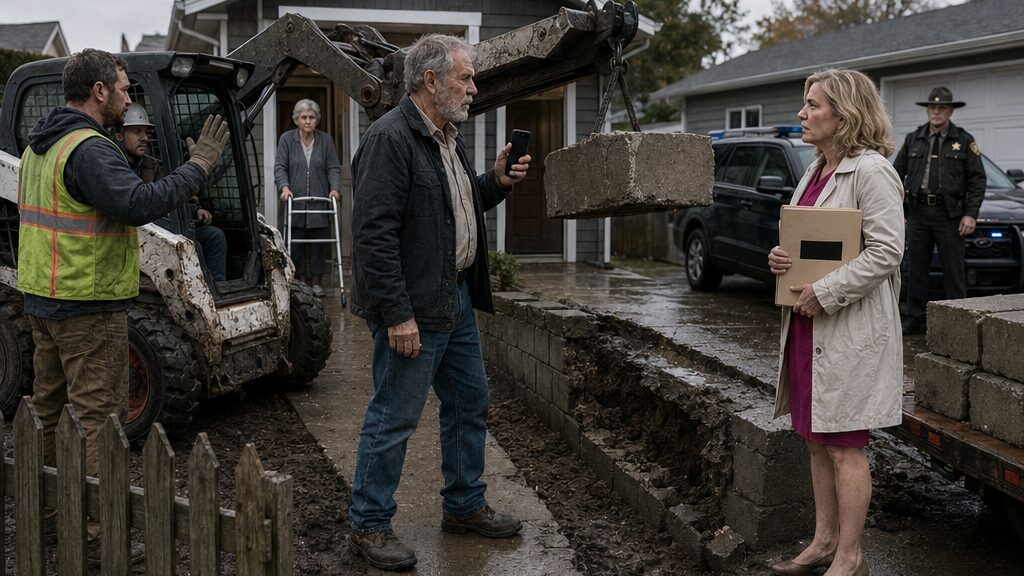
The skid-steer lifted the third concrete block before George Carter reached the driveway.
Rainwater streamed from its teeth as the operator swung the bucket toward a flatbed truck. The block landed against the first two with a crack that carried through the narrow side yard and into George’s chest.
“Stop the machine.”
The operator looked toward a man in a reflective vest. The supervisor looked past George to the street, where Kimberly Hall stood in a bright magenta dress beneath a cream raincoat, a beige folder pressed against her ribs.
The skid-steer reversed.
George stepped onto the remaining section of the side path.
“Shut it off.”
The engine continued growling. One of the removal workers had already pulled the capstones from nearly half the retaining wall. Behind the exposed gap, dark soil bulged beneath the concrete path Carol used to reach the driveway. Water glistened in a fresh crack running along its edge.
The supervisor raised both palms. “Sir, don’t stand in the work zone.”
“This is my property.”
“We have authorization.”
“From whom?”
Kimberly crossed the street in low shoes that sank slightly into the wet grass. She held the folder so the black lettering faced George.
PROPERTY RIGHTS.
“The association authorized removal,” she said. “You were notified that this structure violated the architectural standards.”
George took out his phone and began recording.
“State your name and your position.”
Her mouth tightened. “You know who I am.”
“For the record.”
“Kimberly Hall. Compliance chair for Brookfield Ridge Homeowners Association.”
“And you authorized a machine to enter my lot?”
“The wall occupies association-maintained landscape.”
“Parcel number?”
She glanced at the supervisor. “The relevant documents are in this folder.”
“That isn’t a parcel number.”
The skid-steer idled behind George. He could feel its vibration through the soles of his shoes. The operator kept both hands visible on the controls, waiting.
Across the picket fence, two neighbors watched from beneath an umbrella. Another had stopped beside a mailbox with a dog straining at its leash. George ignored them.
He pointed his phone toward the torn wall.
“Record the condition,” he said. “Three blocks removed. Capstones removed. Soil exposed after overnight rain. No temporary bracing installed.”
Kimberly exhaled sharply. “George, you are not turning this into an inspection.”
“It became an inspection when you uncovered a loaded slope.”
“It was an unauthorized structure.”
“It replaced a failing wall in the same location.”
“With different materials, a widened path, and an unapproved drainage system.”
“The old wall was leaning four inches.”
“You were instructed to stop.”
“After the trench was open.”
“And your contractor left.”
“Because you threatened his license.”
Brian Flores’s truck was nowhere in sight. George had called him twice after hearing machinery outside. Both calls had gone to voicemail.
The supervisor approached George by two cautious steps. “Sir, we’ve been hired to remove the blocks and load them. I don’t decide property questions.”
“Then don’t remove another one until the property question is answered.”
“Our work order says this strip belongs to the association.”
“Show it to me.”
The supervisor looked at Kimberly.
She opened the beige folder but did not hand anything over. Colored tabs divided the papers. George saw a photocopied map, a board resolution, several photographs, and the corner of the violation notice that had been taped to his front door four days earlier.
“You received the order,” she said.
“I received a demand. I did not receive proof you own the ground beneath my path.”
“The association maintains it.”
“Maintenance is not ownership.”
“The documents are clear.”
“Then this should take ten seconds. Show me the recorded plat.”
Kimberly closed the folder.
George heard the side door open behind him.
Carol stood inside the threshold with both hands on her walker. She wore a gray cardigan over her nightclothes. Her face had gone still in the way it did when pain forced her to spend energy on appearing composed.
“George?”
“Stay inside.”
Her eyes moved from him to the machine, then to the missing section of wall. The path between her and the driveway had narrowed to less than the width of her walker.
“What did they do?”
Kimberly turned, and something uncertain crossed her face before her expression settled again.
“Mrs. Carter, the association is removing an unapproved exterior alteration. Please remain inside while the equipment is operating.”
Carol looked at the exposed soil beneath the path.
“That’s how I get to the car.”
Kimberly’s grip shifted on the folder. “The front entrance remains available.”
“There are seven steps at the front entrance.”
“The association was not given documentation of an accessibility request.”
George saw Carol’s jaw tighten.
“That is not a question for my wife,” he said.
“It becomes relevant when you claim this work was necessary.”
George moved closer to Kimberly, leaving enough distance that no one could call it intimidation.
“The wall keeps water away from the foundation. The path above it is the only grade she can use safely. You had photographs of the failing wall. You had my emergency notice. You chose to send a demolition crew.”
“We sent a removal crew after you ignored a stop-work order.”
“You sent them before verifying the boundary.”
“The board has the authority to enforce the covenants.”
“Not by trespassing.”
The supervisor’s radio clicked. The skid-steer engine dropped to a lower idle.
Kimberly took out her phone.
“What are you doing?” George asked.
“Calling law enforcement.”
“For what?”
“You are obstructing an authorized crew and creating an unsafe confrontation.”
George held up his recording phone. “I am standing on my path and asking you not to remove my property.”
“You stepped into an active work area.”
“An active work area you created on land you haven’t proven you control.”
She turned away and gave the dispatcher the neighborhood entrance, then George’s address. Her voice was steady and professional. She said an agitated homeowner was preventing contractors from carrying out an HOA enforcement order.
George waited until she ended the call.
“Add to your report that I have not threatened anyone, touched anyone, or approached the machine.”
“I told them what was happening.”
“You told them your version.”
“You are recording. They can hear yours.”
The first police SUV arrived eight minutes later, though to George it felt faster. Its dark shape appeared behind the picket fence, rolled past the mailboxes, and stopped near his garage. A second vehicle followed. Several officers stepped into the driveway, one directing the skid-steer operator to shut down the engine.
The sudden silence exposed the smaller sounds: rain ticking from the gutters, water slipping through loose soil, Carol’s walker scraping as she backed into the house.
A senior sheriff wearing a broad-brimmed campaign hat approached Kimberly first. She had already opened the folder.
“Officer, thank you,” she said. “The association is enforcing a duly adopted resolution. Mr. Carter interfered with the contractors after repeated notices.”
The sheriff looked toward George. “Any weapons on you, sir?”
“No.”
“Anybody threatened anybody?”
“No.”
Kimberly said, “His conduct has prevented the crew from completing authorized work.”
The sheriff’s gaze moved to the missing wall blocks. “Whose land are they standing on?”
“The association controls this landscaped strip.”
“That wasn’t my question.”
Kimberly opened to the photocopied map. “This area is designated as association-maintained property.”
The sheriff studied it without taking it from her. “Is that a recorded plat?”
“It is part of our governing property documents.”
“Recorded with the county?”
“It was supplied to the association.”
“By whom?”
Kimberly hesitated. “It has been used for maintenance allocation since the community was developed.”
George kept the phone aimed at the exchange.
The sheriff turned to him. “What do you have showing ownership?”
“My closing survey is in a bank box. There should be a boundary marker at the lower corner, but the crew covered part of the line with the machine.”
“You don’t have the survey here?”
“Not the recorded copy.”
“So right now I have two people making civil claims and one machine sitting between them.”
“I’m asking for the machine to remain off.”
“That part is reasonable until we know whether the contractor has permission to be here.”
Kimberly’s face sharpened. “The HOA’s enforcement authority is not dependent on Mr. Carter’s consent.”
“It may not be. Entry onto private land is.”
She lifted the board resolution. “This authorizes removal.”
“It authorizes something. I haven’t seen anything establishing where the association property begins.”
The sheriff motioned to one of the officers. Together they walked along the edge of the driveway. George followed at a distance. The removed blocks had exposed the older compacted base, and beside it a thin line of orange survey paint remained from Brian’s layout.
Near the picket fence, rain had washed mud from a small circular glint.
George crouched and cleared the dirt with two fingers.
Brass.
“There,” he said. “Original pin.”
Kimberly came closer. “That does not prove what you think it proves.”
“No,” George said. “The recorded bearing does.”
The sheriff looked from the pin to the straight line of the remaining wall, then toward the skid-steer’s tracks. The tracks lay several feet inside the line George knew as his eastern boundary.
A section of wet soil dropped from beneath the path with a soft, heavy slap.
Everyone turned.
The crack along the concrete widened by the thickness of a pencil.
George’s certainty gave way to something colder. Even if the machine left now, Carol could not use the path. Another band of rain was moving across the county, and the wall no longer supported the section nearest the house.
He pointed his phone at the damage.
“I want it documented that the removal left the slope exposed.”
Kimberly said, “The unsafe condition exists because you constructed without approval.”
“The wall was standing when your crew arrived.”
“It was unauthorized.”
The sheriff raised one hand, ending both replies.
He pointed toward the brass pin, then looked directly at Kimberly.
“Who confirmed that this side of that marker belonged to your association?”
Chapter 2: The Repair George Started Before Permission Came
The crack inside the crawl-space wall had not been there before the crew arrived.
George found it less than an hour after the police left. It began behind a drainpipe, thin as a hair, then widened as it traveled toward the section where the retaining blocks had been removed. A bead of muddy water rested along its lower edge.
He photographed it with a ruler in frame.
Outside, orange caution tape stretched between two stakes. The sheriff had ordered the removal crew to leave the disputed strip until ownership could be established. He had also warned George that the police pause did not approve the construction or settle any covenant dispute.
The skid-steer was gone. Its tracks remained.
Carol stood at the open side door with her walker angled toward the path.
“Don’t,” George said.
“I’m looking.”
“The edge moved.”
“I can see that.”
The surviving section was just wide enough for a person to walk sideways. It was not wide enough for the walker’s rear wheels, and the unsupported concrete near the gap had settled visibly.
Carol stared at the three empty spaces in the wall.
“They took the blocks with them?”
“Loaded them before I got outside.”
“Those were ours.”
“I recorded every piece.”
“That isn’t the same as having them.”
George tied another strip of caution tape across the doorway. Carol watched him knot it.
Three weeks earlier, there had been no tape and no machinery. Only a wet smell rising from the crawl space after four consecutive days of rain.
He had found the first warning while checking the sump pump: a dark tide mark along the foundation and a soft patch in the insulation. Outside, the old timber retaining wall leaned toward the house. One post had split near the base. The narrow concrete path above it had tilted enough that water ran toward the siding instead of away.
George had measured everything twice.
Four inches of lean at the highest point. Two inches of settlement along the path. Standing water against the foundation after thirty minutes of moderate rain.
Brian Flores had arrived the next morning, pushed a probe into the saturated soil, and frowned.
“This isn’t a patch,” he had said. “We take the timbers out, rebuild with block, put drainage behind it, and redirect the water.”
“How soon?”
“If the rain holds, Monday.”
George had looked toward the side door. Carol’s walker waited inside.
“The path stays usable?”
“We widen it six inches and correct the slope. But once I open the wall, nobody uses it until I’m done.”
George had submitted the HOA form that afternoon. Under project description, he wrote: Replace failing retaining wall in existing footprint; install drainage; correct unsafe path slope. He attached photographs, Brian’s estimate, and a sketch showing the new French drain.
Carol read it at the kitchen table.
“You didn’t put anything about me.”
“It says unsafe path.”
“That could mean anything.”
“I thought you didn’t want your surgery discussed.”
“I don’t.”
“The board may ask why six inches matters.”
“Then tell them the old path doesn’t meet safe clearance.”
“They may want a therapist’s letter.”
Carol folded her hands around a cup of tea. The scar beneath her blouse still pulled when she turned too quickly. “Last year they read that woman’s request aloud at the meeting. Her diagnosis, the equipment, everything. By the next morning half the street knew.”
“We can ask for a private review.”
“You can ask. That doesn’t mean Kimberly will keep it private.”
George had left the medical portion blank.
He sent a second email two days later when the forecast worsened.
The subject line read: EMERGENCY STABILIZATION NOTICE—WATER INTRUSION AND FAILING WALL.
He cited the covenant provision permitting temporary measures necessary to prevent immediate property damage. He stated that permanent finishes would remain subject to architectural review. He asked for written confirmation by Friday.
No confirmation came.
Friday evening, another storm pushed water beneath the crawl-space vent. Carol tried to help him place towels along the utility-room threshold. On the wet side step, her rubber cane tip slipped. She caught the doorframe before she fell, but the movement twisted her back and left her shaking against the siding.
George called Brian that night.
“Start Monday.”
“You get approval?”
“I notified them under the emergency clause.”
“That isn’t what I asked.”
“The wall may not last another storm.”
Brian remained silent.
George said, “Temporary stabilization first. We’ll deal with finish approval when they answer.”
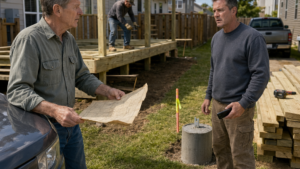
By Monday afternoon, the old timbers were stacked in Brian’s truck and the trench was open. Kimberly arrived before the first course of block was complete. She photographed the excavation, the pallet, the compacted base, and Carol’s walker visible through the side doorway.
She handed Brian a stop-work notice.
“You need approval before exterior alterations begin.”
George showed her the emergency email on his phone.
“You declared your own emergency,” Kimberly said. “The association did not.”
“Water is entering my foundation.”
“The board has not reviewed your drainage plan.”
“The wall cannot be left open.”
“Then your contractor should restore the prior condition.”
“The prior condition was failing.”
Kimberly had looked toward the trench as if the danger were merely an argument George had arranged.
Brian packed his tools after she warned him that continuing could expose him to claims for damage to common property. George had not forgiven him for leaving. He also understood why a contractor with three employees and an unpaid invoice from another dispute would not gamble his business on George’s interpretation of a covenant.
Now Brian’s truck returned to the driveway.
He stepped out, took one look at the caution tape, and swore softly.
“They actually removed it.”
“Three blocks and the caps.”
Brian photographed the crack in the path. “Did they brace anything?”
“No.”
“Cover the trench?”
“No.”
“Who hired them?”
“Kimberly says the association.”
Brian rubbed rain from the back of his neck. “I told her taking this apart would make it worse.”
“When?”
He lowered his phone.
“When she came by Friday.”
George stared at him. “Before the stop-work notice?”
“She was taking pictures. Asked what would happen if the block had to come out.”
“And you told her?”
“I said the soil was saturated and once the base was disturbed, removal needed an engineer or temporary shoring.”
“She knew that before she ordered the crew?”
“I don’t know when she ordered them.”
“You didn’t tell me she came Friday.”
“You were already angry enough to keep going.”
“That was my decision.”
“Yes,” Brian said. “And my license was attached to it.”
The words landed cleanly because they were true.
George opened the email on his phone and showed Brian the emergency notice.
“I gave them warning.”
“You asked for confirmation.”
“They didn’t respond.”
“That isn’t confirmation.”
George enlarged the covenant paragraph he had quoted.
“Temporary work necessary to prevent imminent damage may proceed while review is pending.”
Brian read the full section, then scrolled lower.
“Provided the owner limits the work to minimum stabilization and submits all supporting material.”
“I submitted photographs and your estimate.”
“You also widened the path.”
“Six inches.”
“And the drain outlet moved.”
“To get water away from the foundation.”
Brian handed back the phone. “Maybe all of that is the right work. But minimum stabilization and permanent redesign aren’t the same thing.”
Inside, Carol’s walker struck the doorframe. She tried to angle it through the narrowed opening, one wheel lifting over the threshold.
George crossed the yard.
“Carol, stop.”
“I need to get to the car tomorrow.”
“We’ll use the front.”
“I cannot use the front.”
“We’ll cancel therapy.”
“I already missed last week.”
She pushed the walker forward. Its left wheel reached the path. The right wheel met the caution tape and the broken concrete edge beyond it.
George took hold of the frame.
“Please.”
Her hands remained on the grips. “Don’t make the house smaller every time something goes wrong.”
He loosened his hold.
“This isn’t permanent.”
“That is what you said when we put the chair in the living room.”
He moved the walker back inside. Carol let him, but she would not look at him.
At the kitchen table, George opened the original application. The words seemed thinner than they had three weeks earlier.
Incidental access improvement.
He had chosen the phrase because it sounded ordinary. Because it avoided Carol’s diagnosis, avoided the letter, avoided giving Kimberly anything she could read aloud. He had expected the photographs and measurements to make the need self-evident.
Instead, the application made the widened path sound optional.
A notification appeared on his screen.
FORMAL ARCHITECTURAL DETERMINATION—CARTER PROPERTY.
Kimberly’s email contained a six-page denial. The project was described as an unauthorized retaining structure, an unapproved alteration to association-maintained landscaping, and a potential interference with a recorded drainage easement.
George read the final paragraph twice.
Removal of remaining noncompliant work was required. Daily penalties would begin at midnight. Additional costs associated with enforcement and site restoration could be charged to the property.
Attached beneath the denial was a map showing a shaded strip along the side yard.
Across it, in block letters, were the words:
DRAINAGE AND LANDSCAPE EASEMENT.
Chapter 3: The Map Inside the Property Rights Folder
Kimberly slid the beige folder across the conference table and kept one hand resting on it.
“The police pause changed nothing,” she said.
The Brookfield Ridge HOA office occupied the converted sales suite beside the clubhouse. Framed photographs of tidy entrances and flowering medians covered the walls. Through the window behind Kimberly, landscapers trimmed a hedge to a uniform height.
George did not touch the folder.
“The police determined your crew could not establish a right to enter my lot.”
“They declined to resolve a civil matter.”
“They ordered the machine off the property.”
“Temporarily.”
Rachel Allen sat at the end of the table with a calculator, a yellow legal pad, and the expression of someone already measuring the cost of every sentence.
Kimberly opened the folder. “The association is willing to suspend additional enforcement activity if you remove the remaining wall, restore the grade, and submit a complete application.”
“The remaining wall is supporting the path.”
“You may install temporary measures after approval.”
“You removed the temporary measures.”
“We removed unauthorized permanent masonry.”
“You took my materials.”
“They are being held by the contractor pending disposition.”
George placed copies of his photographs on the table. One showed the wall before removal. One showed the skid-steer’s tracks. The third showed the new crack inside the crawl space.
“This appeared after your crew opened the slope.”
Kimberly barely glanced at it. “Correlation does not establish responsibility.”
“No. An engineering inspection will.”
Rachel leaned forward. “Have you scheduled one?”
“This afternoon, if the engineer can fit me in.”
“Who is paying?”
“I am.”
Kimberly turned to a tabbed section and withdrew a colored site map.
“The wall is within association-maintained landscape and adjacent to a drainage easement. Your contractor altered both grade and runoff without review.”
George examined the map from where he sat. The shaded strip followed the side of his lot, widened near the rear fence, then curved toward the common swale. Lot numbers appeared in pale gray. Trees were drawn as green circles.
There was no survey seal.
No bearings.
No monument references.
No recording number.
He picked it up.
“What is the title of this sheet?”
“Brookfield Ridge Property Maintenance Plan.”
“That isn’t what the title block says.”
Kimberly’s chin lifted. “It is the map used by the association.”
George rotated the page toward Rachel and pointed to the lower corner.
“Landscape Exhibit L-4. Planting and Irrigation Responsibility.”
Rachel read it.
Kimberly said, “It identifies the maintained area.”
“It identifies who mows and irrigates,” George replied. “It does not establish ownership.”
“The association has relied on it for years.”
“Reliance does not turn a landscape drawing into a recorded plat.”
“The governing documents incorporate maintenance exhibits.”
“Then show me the incorporation language and the recorded boundary.”
Kimberly opened another tab. “Your fixation on ownership ignores the easement.”
“I’m not ignoring it. I’m separating it from ownership.”
“This is exactly the kind of distinction homeowners use when they want exceptions.”
“It is the distinction the law uses before someone sends machinery onto another person’s land.”
Rachel placed her pen down. “We need to lower the temperature.”
“The temperature rose when the bucket did,” George said.
Kimberly’s eyes flicked toward him. “And this is why the board cannot manage emergencies based on a homeowner’s personal judgment.”
Rachel turned to George. “The association’s insurer has asked us to identify every retaining structure near common drainage. There was a slope failure in another community last year. The claim exceeded their reserve, and our carrier has made it clear that undocumented structures could affect renewal.”
George looked at the calculator beside her.
“So this is about insurance.”
“It is about exposure,” Rachel said. “If runoff from one lot damages three others, every owner pays.”
“That is a legitimate concern.”
Kimberly seemed surprised by the concession.
George tapped the map. “It still does not prove ownership, and it does not justify dismantling a load-bearing wall without evaluating the slope.”
Rachel said, “It may justify stopping an unreviewed drain.”
“Stopping is not removing.”
Kimberly closed the folder halfway. “Mr. Carter, you began work without approval. You changed the wall material, widened the path, excavated near an easement, and relocated an outlet. The association did not create that sequence.”
“No. I did.”
The room went quiet.
George disliked how much the admission cost him, though it was not the full one he would eventually have to make. “I began emergency stabilization after notifying you. Whether I exceeded that exception is a review question. It is not permission for trespass.”
Kimberly folded her hands. “Daily fines remain in effect.”
“Based on this map?”
“Based on the covenants, the easement, and the absence of approval.”
“Then I will get the recorded documents.”
Rachel looked at the wet-soil photographs again. “Bring us the plat, the engineer’s opinion, and a complete drainage plan. I will ask the board not to authorize further physical work before review.”
“You will ask?”
“I cannot promise a board vote that has not occurred.”
George gathered his copies.
Kimberly kept the folder open, the words PROPERTY RIGHTS facing him across the table.
At the county records office, the clerk led him to a public terminal and searched by subdivision name, phase number, and recording year. George had used systems like it before retirement, though the software was newer and less forgiving.
The recorded plat appeared first.
He enlarged Lot 47.
His eastern boundary ran from the brass pin near the picket fence to a rear monument behind the common swale. The retaining wall sat inside the lot by three feet at its narrowest point. The association’s maintenance strip overlapped part of his property, but nothing on the plat transferred ownership.
For one clean moment, relief loosened his shoulders.
The land was his.
He printed the sheet with the recording stamp visible.
“Anything else attached to the lot?” he asked.
The clerk searched the parcel index. “There’s a declaration, utility easement, drainage easement, amendments to the covenants, and a landscape maintenance agreement.”
“Open the drainage easement.”
The document was twelve pages long. It granted the association access to inspect and maintain a common swale. It prohibited structures that blocked the designated flow path. It also prohibited owners from redirecting concentrated runoff in a manner that increased burden on neighboring lots or common property.
George read the paragraph again.
The easement did not give Kimberly ownership of the wall site. It did give the association a reason to review what left Brian’s new drain.
Back in his garage, George laid the recorded plat beside the photocopied map he had taken from the HOA office. One was a legal boundary document. The other was a planting plan made to look more powerful by the folder holding it.
He placed Brian’s proposal between them.
The French drain ran behind the wall, collected foundation water, and discharged through a solid pipe toward the rear swale. On the original plan, the outlet ended inside the shaded easement.
George traced the pipe with one finger.
His phone rang.
Brian had returned his earlier call.
“I’m looking at the drainage plan,” George said. “How much additional flow goes to the swale?”
“Depends on the storm.”
“Does it concentrate water that used to disperse across the side yard?”
“Yes. That’s the point of a drain.”
“Could it increase flow toward the neighboring lots?”
A pause.
“Not if the swale is functioning.”
“That isn’t what I asked.”
“In a heavy storm, it could deliver water faster to the swale than the old grade did.”
George looked toward the open garage door. Beyond the driveway, muddy water threaded through the gaps left in the retaining wall.
The map in Kimberly’s folder had been wrong about who owned the land.
But the recorded easement was real.
And Brian’s own plan showed that the new outlet entered it.
Chapter 4: The Boundary Was His but the Water Was Not
The first section of saturated earth broke loose while the engineer was still unfolding her measuring rod.
It slid from beneath the path in one dark sheet, struck the bottom of the trench, and collapsed around the exposed drainpipe. George heard the concrete above it give a faint grinding sound.
“Back up,” the engineer said.
George stepped away from the edge. Kimberly, standing near the picket fence with her arms folded, moved too, though she did it as if the warning had been intended for someone else.
The engineer crouched several feet from the opening and studied the underside of the path.
“How long has this section been unsupported?”
“Since Monday morning,” George said.
Kimberly answered at the same time. “The wall was removed because it was unauthorized.”
The engineer looked between them. “That did not answer my question.”
George checked the photographs on his phone. “Forty-nine hours.”
“And before removal?”
“The new block was in place on a compacted base. Drainage stone had been installed behind the first course.”
“Was the wall complete?”
“No.”
Kimberly opened the beige folder. “The contractor had been directed to stop before permanent construction continued.”
The engineer did not look at the folder. She inserted a probe into the exposed soil, withdrew it, and rubbed the wet clay between two gloved fingers.
“Temporary support should have been installed before removing any load-bearing course.”
Kimberly’s expression changed only slightly. “The association’s contractor understood this to be a decorative wall.”
George laughed once, without humor.
The engineer stood. “It is retaining soil beneath a hard-surface path. Whatever anyone called it, it was performing structural work.”
She followed the trench toward the rear yard, stopping where Brian’s drainpipe emerged behind the remaining blocks. George carried the recorded plat and easement documents in a clear sleeve. Kimberly carried the folder. The two sets of papers moved through the yard like opposing flags.
The engineer compared the brass pin near the fence with the measurements on the plat.
“The wall is inside Lot 47,” she said.
George felt vindication rise before he could stop it.
Kimberly said, “The easement still crosses the area.”
“It does,” the engineer replied. “Ownership and easement rights are separate.”
George looked at Kimberly. “That is what I told you.”
The engineer gave him a level glance. “And the easement matters.”
His satisfaction narrowed.
She followed Brian’s proposed drain route to the rear swale. Water stood between the grass blades. A shallow channel curved past three neighboring lots before entering a culvert beneath the road.
“Your contractor intended to discharge here?”
George showed her the plan.
“Perforated pipe behind the wall, then solid pipe from this point to the swale.”
“At what diameter?”
“Four inches.”
“Any flow control?”
“No.”
“Energy dissipation?”
“Gravel outlet.”
The engineer looked toward the nearest neighboring yard. “In an ordinary rain, probably manageable. In a high-volume event, this would concentrate water faster than the previous sheet flow.”
“The foundation is taking water now.”
“I believe you.”
“The swale is designed to carry runoff.”
“It is designed to carry distributed runoff from several lots. A direct four-inch outlet changes timing and velocity.”
Kimberly closed the folder with a quiet snap. “Then the denial was justified.”
“The design review was justified,” the engineer said. “Removing the supporting wall before resolving the design was not.”
For the first time since the machine arrived, Kimberly looked uncertain without immediately covering it with procedure.
The engineer walked back toward the damaged section and photographed the interior crack George had found. She measured the path settlement, the trench depth, the old timber post remains, and the missing block positions. Brian arrived midway through the inspection and answered questions about the base preparation and drainage stone.
When the engineer asked what immediate work she recommended, Brian glanced toward Kimberly before speaking.
“Rebuild enough support to keep the path and slope from moving.”
Kimberly said, “That would restore unauthorized work.”
The engineer straightened. “Temporary stabilization is not the same as permanent approval.”
“What material?”
“The existing block can be reset without final caps, braced as needed, and covered against additional saturation. Or a temporary timber support can be engineered. Leaving it open is the least defensible option.”
George said, “Your crew took the blocks.”
Kimberly turned toward him. “The contractor has them.”
“Then return them.”
“I do not have unilateral authority to approve reconstruction.”
“You had unilateral authority to approve removal.”
The engineer’s eyes shifted to Kimberly.
Kimberly’s voice hardened. “The board resolution authorized enforcement.”
“Did it specify physical removal?” George asked.
“You were given multiple opportunities to comply.”
“That is not an answer.”
The engineer closed her notebook. “I will issue a preliminary written finding today. It will state that temporary support should be restored immediately and that the final drainage outlet requires revision.”
George looked at the exposed slope. “How immediate?”
“Before the next significant rain.”
“The forecast says Friday night.”
“Then before Friday night.”
Carol’s physical therapy appointment had already been moved twice. That afternoon, George drove her through the rain to the clinic using the front entrance of the house. It took nearly fifteen minutes to get her down the seven steps.
He stood below her, one hand hovering near her elbow while she gripped the rail.
“Do not touch me unless I ask,” she said.
“I’m not touching you.”
“You’re breathing like you’re carrying me.”
He lowered his hand.
At the fourth step, her right foot trembled. She waited until it settled before moving again. By the time she reached the driveway, the therapist’s office had called to say they would hold the appointment for ten minutes.
In the car, Carol fastened her seat belt without looking at him.
“The side path was not incidental,” she said.
George started the engine.
“I know.”
“You wrote that it was.”
“I wrote what I thought would get approved without putting your medical records in front of the board.”
“You wrote around the truth.”
“I was trying to protect you.”
“From what?”
“From becoming neighborhood information.”
“And how well did that work?”
The question stayed between them all the way to the clinic.
When they returned, the engineer’s preliminary report was waiting in George’s email.
The recorded boundary placed the wall on the Carter lot. The drainage easement allowed association oversight of changes affecting common flow. The proposed outlet required modification. The removal of partially installed support had increased immediate slope instability and risk to the path and adjacent foundation. Temporary stabilization was recommended before additional rainfall.
George printed three copies.
Ten minutes later, Kimberly called.
“I have reviewed the engineer’s preliminary statement,” she said.
“Then return the blocks.”
“The board is willing to discuss an interim resolution.”
“Discuss it when?”
“Tonight by video conference.”
“What resolution?”
“If you sign an acknowledgment that the project was undertaken without approval, agree that all stabilization remains subject to association direction, and release the association from claims relating to removal, I will recommend suspension of fines and temporary support.”
George said nothing.
Kimberly continued. “This avoids unnecessary escalation.”
“You want me to admit the entire project was unauthorized.”
“You began without approval.”
“And you want a release for damage your own engineer says the removal increased.”
“She is not our engineer.”
“She is independent.”
“The report is preliminary.”
“The crack in my foundation is not.”
“George, I am trying to give you a path forward.”
“You are trying to trade safety for immunity.”
“That is not a fair description.”
“It is an exact description.”
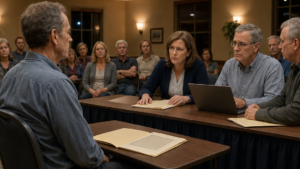
At seven that evening, the board video call began. Rachel appeared from an office with stacks of insurance documents behind her. Kimberly sat beneath the clubhouse photograph wall. Two other board members joined without cameras.
George held up the recorded plat.
“The wall is on my land.”
Kimberly held up the easement.
“The drainage remains subject to review.”
“The engineer agrees. I will revise the outlet.”
“Then sign the interim agreement.”
“No.”
Rachel rubbed her forehead. “George, without some written acknowledgment, the board is concerned that allowing work to resume will be treated as approval of the whole project.”
“Write an authorization limited to temporary stabilization.”
Kimberly said, “That language exposes the association if the wall fails.”
“Leaving it open exposes everyone.”
“The association did not design the wall.”
“The association removed it.”
Silence followed.
George placed the engineer’s report in front of his camera. “I will sign that permanent drainage work remains pending. I will not sign that the land is yours, that the entire repair was improper, or that your removal caused no damage.”
Rachel looked down, reading.
Kimberly said, “Then the fines remain.”
George felt Carol enter the room behind him. He did not turn.
Rachel spoke carefully. “I am prepared to ask the board to suspend fines until the engineering review is complete, but I need a revised plan.”
“Brian can produce one tomorrow.”
“And the accommodation documentation,” Kimberly added.
Carol’s walker stopped.
George looked back.
She stood in the kitchen doorway with one hand on the frame. Her face was pale from the front steps and the therapy session, but her voice was steady.
“That documentation was never submitted because I told him not to submit it.”
Kimberly leaned closer to her screen. “Mrs. Carter?”
Carol looked at George, not at the camera.
“It was me,” she said. “I was the reason the letter never went into the application.”
Chapter 5: Carol Would Not Become the Board’s Exhibit
Carol made it halfway down the front steps before her right leg stopped obeying her.
George saw the change in her shoulders first. They rose toward her ears as she tightened both hands around the rail. Her left foot remained on the fourth step. Her right hovered above the fifth, searching for a position it could trust.
“Go back up,” he said.
“No.”
“You’re shaking.”
“I know what I’m doing.”
Her foot touched the step, slid half an inch, and froze.
George moved below her.
“Don’t grab me.”
“I won’t.”
“You always say that right before you decide I’m falling.”
She tried to move again. Nothing happened.
The side path lay less than thirty feet away, fenced off with caution tape and unsupported along the damaged edge. Through the gap in the wall, muddy water ran over the compacted base where the missing blocks had stood.
Carol looked toward it.
Then she said, “Help me back up.”
George climbed beside her and offered his forearm. She used it without meeting his eyes.
Inside, she lowered herself into the chair near the window. Her breathing took time to settle.
“I wanted to see whether I could manage,” she said.
“You proved you shouldn’t have to.”
“I proved I cannot leave my house without planning every step around what my body might refuse.”
George went to the kitchen and brought her water.
On the table lay the therapist’s accommodation letter, still sealed in its original envelope. He had taken it from the desk after the video call.
Carol saw where he was looking.
“You think I was foolish.”
“No.”
“You think I made this harder.”
“Yes.”
She gave him a tired, almost amused look. “That sounded painful.”
“It was supposed to.”
He sat across from her.
“Why didn’t you tell me the full reason?”
“I did. I didn’t want them discussing my surgery.”
“You said privacy.”
“That is privacy.”
“There was more.”
Carol traced the rim of the glass with one finger. “Last spring, a woman on the next street asked for permission to keep a portable lift under her covered entry. At the board meeting, they read her doctor’s letter aloud. They said they needed the details for the minutes.”
George remembered the meeting only as a line item he had barely listened to.
“Kimberly wasn’t chair then.”
“No. But she was sitting in the second row taking notes.”
“That does not mean she would do the same.”
“It means the system allowed it.”
George looked at the sealed envelope. “You should have told me that.”
“You would have marched into the office and demanded a privacy policy.”
“Yes.”
“And then everyone would have known why.”
He could not deny it.
Carol leaned back. “I did not want to become the reason the neighborhood had to change its rules. I did not want people lowering their voices when I walked past. I did not want my back discussed over coffee because the board needed context.”
“So we called it an incidental access improvement.”
“We?”
“I wrote it.”
“You agreed not to include the letter.”
“I also believed measurements would be enough.”
“They usually are for you.”
The quiet accusation struck more deeply than anger would have.
George took the envelope and turned it over. “We need some version of this now.”
“I know.”
“You decide what version.”
Carol studied him, testing whether he meant it.
“Not the diagnosis,” she said. “Not the surgery details. Not the history.”
“Functional limitations only.”
“The path must accommodate a walker. The front steps are not a safe alternative. The need is expected to continue.”
“Nothing more.”
“And it goes to whoever actually needs it. Not the full board packet.”
George nodded.
At midmorning, Rachel called and asked to meet privately. Her office was in a small accounting firm fifteen minutes away. George brought the recorded plat, the engineer’s report, and Carol’s revised accommodation statement in a plain envelope.
Rachel locked the office door after him.
“I did not authorize the demolition,” she said before he sat down.
“You voted for enforcement.”
“I voted to direct compliance action.”
“Kimberly interpreted that as machinery.”
Rachel looked at the envelope in his hand. “I told her the insurer wanted proof we were acting on unreviewed structures. I told her delay would look like selective enforcement.”
“So you helped create the pressure.”
“Yes.”
The admission came without decoration.
Rachel opened a file on her desk. “Our renewal questionnaire asks whether the association has identified and controlled retaining-wall risks near common drainage. We have thirty days to respond. Kimberly believed your project was the clearest example of a homeowner ignoring review.”
“I notified the association.”
“You did. But your form made the path sound cosmetic, and your outlet plan raised a real easement issue.”
“I know.”
Rachel glanced at him. “That may be the first time you’ve said it without immediately adding what Kimberly did wrong.”
“She can be wrong and I can still have made a mistake.”
“That distinction would help at a hearing.”
“What hearing?”
“I can call an emergency meeting for this afternoon if you bring a revised drainage design.”
“Brian is working on it.”
“Will the engineer approve it?”
“If it protects the swale.”
Rachel pressed her lips together. “Kimberly has two votes besides her own.”
“On what basis?”
“Consistency. They believe approving your work after you started it will encourage everyone else to declare an emergency.”
“Then they need a procedure for deciding what an emergency is.”
“I agree now.”
“Now?”
Rachel looked toward the closed door. “The preliminary report changes the liability picture. If removal increased the risk, continuing to deny temporary stabilization may be harder to defend than allowing it.”
“Harder to defend to whom?”
“The insurer. A court. The membership.”
George almost said that Carol should have been first on the list. Instead he placed the accommodation statement on Rachel’s desk.
“This is the minimum necessary disclosure. It is confidential.”
Rachel did not open it. “I will log receipt and provide only the functional conclusion to the board.”
“Can you guarantee that?”
“I can guarantee what I do. I cannot guarantee what Kimberly will say.”
“Then the hearing record must state that no diagnosis is to be entered into open minutes.”
Rachel nodded. “Put that in your requested conditions.”
His phone vibrated. Brian had sent a photograph of a sketch.
The revised plan redirected the drain beneath the path, connected it to an existing catch basin farther downstream, and added a flow-control chamber before the common swale. The wall and path remained unchanged.
George called him from Rachel’s office.
“Can it be done before the storm?”
“If I have permission by three and the materials by four.”
“The HOA contractor still has our blocks.”
“I’m not remobilizing until I know who pays for the return and the earlier shutdown.”
“How much?”
Brian named the amount.
George looked at Rachel.
She had heard.
“The association has not approved reimbursement,” she said.
“The crew removed paid materials from my property.”
“I understand your position.”
“It isn’t a position. It is an invoice.”
Rachel closed the insurance file. “Bring the invoice to the hearing.”
Outside, the sky had darkened enough that streetlights came on early. George drove home beneath low clouds gathering over the subdivision.
Carol sat at the kitchen table with the beige folder copy he had brought from the HOA office. The words PROPERTY RIGHTS faced upward.
She opened it and placed the revised accommodation statement inside.
“Not as evidence that I deserve the path,” she said.
“No.”
“As evidence that the path has a function they failed to ask about.”
“Yes.”
She closed the folder.
Brian arrived just after noon with the revised drawing. He spread it across the workbench and explained the flow-control chamber, the catch-basin connection, and the extra excavation.
“It costs more,” he said.
“How much more?”
“Enough that I need a signed change order.”
George looked at the numbers. The revised system was safer for the swale. It was also money they had planned to use for interior repairs.
Carol stood at the garage doorway with her walker.
“Sign it,” she said.
“We haven’t settled the removal costs.”
“The water does not care who owes whom.”
George signed.
At one-thirty, Rachel called.
“The emergency hearing is set for four at the clubhouse.”
“Will the board vote on temporary stabilization?”
“And final conditional approval if the engineer accepts the revision.”
George looked toward the open side yard. Wind had begun moving the caution tape.
“Does Kimberly know?”
“She knows.”
“And the votes?”
Rachel was quiet for a moment.
“Right now, she has them. Unless the revised drainage solution changes what the board believes it is approving.”
Chapter 6: He Admitted the Part They Could Use Against Him
Kimberly began the hearing by holding up George’s unsigned approval form.
“This document,” she said, “shows that Mr. Carter knew authorization was required and proceeded without receiving it.”
The clubhouse conference room held six board chairs, a folding table for documents, and two rows of empty seats behind George and Carol. No neighbors had been invited. Carol had insisted on attending anyway.
One removed retaining-wall block sat on the board table. Brian had recovered it from the removal contractor that afternoon after refusing to unload the rest without written direction. Mud stained one corner. Beside it lay the recorded plat, the revised drainage drawing, the engineer’s report, Carol’s sealed accommodation statement, and Kimberly’s beige folder.
PROPERTY RIGHTS faced the board.
Kimberly lowered the form.
“The issue is not whether the Carters prefer this design,” she continued. “The issue is whether any homeowner may alter grade, drainage, and exterior structures before review, then claim necessity after the fact.”
George felt Carol’s hand rest briefly against his sleeve.
Rachel sat with the board secretary and the insurance file. Two board members attended by video. Another sat beside Kimberly, arms crossed.
The chair asked George whether he wanted to respond.
“Yes.”
He stood, though he had planned to remain seated.
“I began work before written approval.”
Kimberly’s expression changed. She had expected denial, qualification, or a technical escape.
George continued. “I notified the association under the emergency-stabilization clause. I believed the failing wall and water intrusion justified opening the site before review was complete. I also allowed the work to move beyond minimum stabilization into a permanent drainage design.”
One of the video screens flickered as a board member leaned closer.
Carol looked at him, not with surprise, but with attention.
George placed his hand on Brian’s first plan.
“The association had a legitimate reason to review this outlet. The original design concentrated runoff into a recorded drainage easement. Ownership of the land did not give me the right to increase burden on neighboring property.”
Kimberly opened her mouth, then stopped.
George moved his hand to the recorded plat.
“But the association did not own the wall site. The landscape exhibit in this folder was not a boundary document. No recorded plat was checked before a crew entered my lot.”
He touched the muddy block.
“This was removed while it was supporting saturated soil beneath an access path. The independent engineer states that the removal increased immediate instability.”
Kimberly said, “The structure had not been approved.”
“The association could stop permanent work. It could inspect. It could require redesign. It could seek a civil order if necessary. It could not turn a maintenance map into ownership or make an unsafe condition safer by removing support without engineering review.”
The chair looked toward Kimberly. “Was the removal plan reviewed by an engineer?”
“No,” she said. “The contractor represented that the wall was decorative masonry.”
“The photographs show a path above it,” George replied.
“They also show an incomplete project.”
“Yes. Mine.”
The admission quieted the room again.
George unfolded Brian’s revised drawing.
“This separates four questions that were treated as one.”
He pointed to each part as he spoke.
“First, temporary stabilization. The engineer recommends rebuilding support before the storm. Second, permanent wall approval. The wall remains inside my lot and follows the existing footprint. Third, access. The path width allows a walker to pass safely. The functional need has been documented confidentially. Fourth, drainage. The revised outlet connects through a flow-control chamber to the downstream catch basin, reducing the burden on the common swale.”
The board chair turned to the engineer, who attended by speakerphone.
“Does the revision address your concern?”
“It does, provided installation follows the drawing and the connection is inspected before burial.”
“Does the wall need to be rebuilt?”
“Temporary support is needed immediately. The proposed permanent wall is appropriate if constructed to the submitted specifications.”
Kimberly placed both hands on the table.
“Approving this now creates a dangerous precedent. Every owner who dislikes the process will claim an emergency, begin construction, and force the board to accept a redesign after work starts.”
George looked at her.
“Then do not approve it because I ignored the process.”
She frowned.
“Approve the part the evidence supports,” he said. “Require inspection. Record my premature start. Fine me for any violation the documents actually authorize. But withdraw the claim that the land belonged to the association. Return the materials. Address the damage from removal. And create an emergency procedure that does not depend on whether one compliance chair believes a homeowner.”
Kimberly’s voice sharpened. “You are asking the association to reward noncompliance.”
“No. I am asking it to distinguish noncompliance from necessity, ownership from easement rights, and enforcement from trespass.”
The board member beside Kimberly said, “What prevents this from happening again?”
Rachel opened the insurance file.
“A forty-eight-hour emergency review,” she said. “Temporary stabilization allowed upon professional documentation. Boundary verification before physical enforcement. Final design still subject to approval.”
Kimberly turned toward her. “That procedure has not been reviewed by counsel.”
“It can be provisional.”
“You supported enforcement.”
“I supported stopping unreviewed drainage work. I did not support removing structural support from deeded property.”
“You knew the insurer’s deadline.”
“I still do.”
Rachel looked at the board chair.
“And now I know our greater exposure may be the removal.”
Kimberly’s face lost some of its color.
The chair called for discussion of the revised project. One video board member supported conditional approval. The member beside Kimberly opposed it, arguing that George’s early start could not be excused. The second video member sided with Kimberly.
Rachel became the deciding voice among those present.
Before she voted, Carol spoke.
“I do not want my diagnosis entered into the minutes.”
Kimberly looked toward her. “Mrs. Carter, the board needs a basis for determining necessity.”
“You have one. The therapist states the functional limitation. The engineer states what the path supports. You do not need my surgical history to decide whether the route is usable.”
The board chair nodded to the secretary. “The minutes will refer only to a documented mobility accommodation.”
Carol sat back.
Rachel voted to approve the revised project subject to inspection, suspend the fines, and authorize immediate stabilization.
The count was tied.
Kimberly had not yet voted as compliance chair and acting presiding officer. Under the association’s usual practice, she could break the tie.
She drew the beige folder closer.
Before she spoke, the board secretary raised one hand.
“I need clarification for the record.”
Kimberly looked annoyed. “On what?”
“The removal authorization.”
The secretary held up a single-page work order.
“This is signed by you alone.”
“Yes. Under the enforcement resolution.”
“I checked the bylaws after the engineer’s report came in. Physical entry onto an owner’s lot requires either owner consent, a court order, or a vote of the full board unless there is an immediate threat to common property.”
“The drainage easement created that threat.”
“The work order calls the structure decorative and cites aesthetic noncompliance. It does not identify an immediate drainage threat.”
Kimberly stared at the page.
The secretary continued. “The resolution authorized notice, fines, and legal consultation. I cannot find language authorizing removal.”
No one moved.
The beige folder lay open beneath Kimberly’s hand. The map she had relied on was visible inside it, its green planting circles bright against the white paper.
George looked at the muddy block on the table.
The question was no longer whether Kimberly’s documents gave her enough authority to stop him.
It was whether she would use the authority she still had to correct what she had done.
Chapter 7: The Path They Could No Longer Call Decorative
Brian lowered the first recovered block into the wall while Kimberly watched from the far side of the brass boundary pin.
The skid-steer was gone. A smaller loader stood in its place, quiet, its bucket filled with drainage stone instead of seized masonry. Orange string marked the property line from the picket fence to the rear monument. Kimberly remained outside it, holding the beige folder against a charcoal coat.
Brian eased the block onto the compacted base.
“This the one from the table?” George asked.
“The same one.”
Mud still darkened one corner. The scrape left by the removal bucket remained visible along its face.
Brian checked it with a level, tapped it twice with a rubber mallet, and stepped back.
“Straight.”
George looked along the empty course where the rest would return. Two weeks earlier, that gap had exposed wet soil and the underside of Carol’s path. Now temporary shoring held the slope, and the revised drainpipe lay ready in the trench.
Kimberly approached the string but did not cross it.
“I brought the final documents.”
George wiped his hands on a cloth. “Signed?”
“Yes.”
“Amended minutes?”
“Included.”
“Reimbursement authorization?”
Her fingers tightened slightly around the folder. “At the documented amount approved by the board.”
Not the additional sum George had requested for disruption, interior damage, and the hours he had spent retrieving records. The board had agreed to return the materials, pay Brian’s remobilization charge, cover the engineer’s emergency inspection, and repair the path edge damaged during removal.
The crawl-space crack and damp insulation remained George and Carol’s expense.
He had considered rejecting the settlement.
The recorded plat favored him. The unauthorized work order favored him. The engineer’s report favored him on the danger of removal. An attorney had told him the association might face broader liability if he pursued it.
Then Carol had asked how many more months he wanted the wall to remain a legal exhibit instead of part of their home.
George nodded toward the workbench inside the garage. “Put them there.”
Kimberly came no farther than the string. She handed the folder across it.
For an instant, the bold words PROPERTY RIGHTS faced George exactly as they had on the morning the officers arrived. But the folder felt different in his hands now, less like a shield than a container whose meaning depended entirely on what someone chose to place inside.
He opened it.
The recorded plat came first, stamped and reduced to fit. Behind it lay the revised approval, the inspection schedule, the board’s reimbursement authorization, and the amended minutes.
George read the correction twice.
The association acknowledged that physical removal had been initiated without the full-board authorization required for entry onto an owner’s lot and before verification of the recorded boundary.
Kimberly had signed beneath it.
“You agreed to that wording?” he asked.
“I agreed it was accurate.”
It was not an apology. George had stopped expecting one.
The final approval required the flow-control chamber, inspection before burial, and connection to the downstream catch basin. It authorized the wall in the existing footprint and identified the path as a documented mobility accommodation.
No diagnosis appeared.
“The fines?” George asked.
“Withdrawn.”
“The violation?”
“Reclassified as resolved through conditional approval.”
“That sounds softer than withdrawn.”
“It is the language counsel approved.”
George looked at her.
Kimberly met his eyes. “The demand for removal is withdrawn.”
He closed the folder.
Behind them, Brian’s crew reset another block. The dull strike of the mallet echoed off the garage.
Kimberly glanced toward the work. “The insurance report now lists this as an engineered retaining structure with controlled discharge.”
“So the same wall that threatened coverage now helps your report.”
“The original outlet still required revision.”
“Yes.”
She seemed prepared for him to resist the point. When he did not, some of the tension left her shoulders.
“I should have verified the boundary,” she said.
George waited.
“And I should not have relied on the landscape exhibit as authority for entry.”
“That is also accurate.”
She looked toward the scrape on the first recovered block. “I believed allowing the work to continue would show the board could not enforce anything.”
“You made enforcement the goal.”
“It was part of my responsibility.”
“It became more important than finding out what you were enforcing.”
Kimberly did not answer immediately.
“The previous chair approved things by conversation,” she said. “No records. No consistent standards. When owners complained, there was nothing to point to except who had asked nicely and who knew someone. I was trying to make the process mean something.”
“Then the process has to ask the right questions.”
“I know that now.”
It was the closest she came to regret.
Carol appeared at the side door with her walker. Temporary plywood covered the rebuilt section of path, but Brian had left enough stable width for her to watch from the threshold.
Kimberly straightened.
“Mrs. Carter.”
“Kimberly.”
“The privacy provision is on the agenda for final adoption next month.”
“It should already be in the emergency procedure.”
“The board approved the emergency review yesterday.”
Carol looked at George.
He had not told her the final wording yet.
Kimberly opened a second packet. “Professional documentation may describe functional need without diagnosis. Medical records go only to the designated reviewer, not the full board. Open minutes will not contain treatment details.”
“And how quickly do they decide?” Carol asked.
“Temporary stabilization requests must be reviewed within forty-eight hours.”
“What happens if no one responds?”
“They are provisionally accepted for minimum protective work, subject to later inspection.”
George noticed how carefully Kimberly said it. Each phrase had likely required hours of argument.
“And before you send another crew?” Carol asked.
“Recorded ownership and entry authority must be verified. Physical enforcement requires a full-board vote unless there is a documented immediate threat to common property.”
Carol nodded once. “That would have saved everyone a great deal of trouble.”
“Yes.”
Brian called George over to inspect the drainage chamber before installation.
The revised system cost more and required a deeper connection than the original plan. A perforated line would still collect water behind the wall, but the solid outlet now ran beneath the path to a small chamber that slowed the discharge before sending it toward the common catch basin.
George crouched beside the trench.
Brian pointed to the fittings. “Once the inspector signs this, we cover it and build the upper courses.”
“No shortcuts.”
Brian gave him a sideways look. “Coming from you?”
George accepted the remark.
“No shortcuts,” he repeated.
The inspector arrived an hour later, checked the pipe slope, chamber capacity, connection, and bedding material, then signed the approval sheet. Work resumed before noon.
By the end of the first day, the wall had reached half its finished height. By the third, the path edge was repaired. The returned blocks did not all match perfectly; several carried chips from removal, and one had a pale gouge along its face. Brian offered to turn the damaged sides inward.
“Leave the first one,” George said.
“The scraped one?”
“Yes.”
Brian shrugged. “Your wall.”
The interior damage waited. George removed the wet insulation himself and placed a dehumidifier in the crawl space. The foundation crack required sealing, and a section of flooring near the utility room would eventually need replacement.
The settlement would not cover it.
Carol found him one evening comparing repair estimates at the kitchen table.
“We can do the floor in spring,” she said.
“It should not be our cost.”
“No.”
“They delayed the repair.”
“Yes.”
“They opened the slope.”
“Yes.”
He looked at her. “You are agreeing too easily.”
“I am not saying it is fair. I am saying I would like to use my own door before we spend another season proving exactly how unfair it was.”
George set the estimates aside.
The wall was completed the following morning.
Brian removed the temporary plywood and swept the path. The widened surface followed a gentle grade from the side door to the driveway. The restored retaining blocks held the soil cleanly below it, and the new drainage system disappeared beneath the concrete except for one inspection cap near the rear planting bed.
Kimberly returned for the final sign-off with Rachel and the inspector. She remained outside the boundary until George waved her in.
Rachel checked the paperwork while the inspector poured water into the test inlet. A controlled stream reached the downstream catch basin without flooding the swale.
“Passed,” the inspector said.
Rachel signed.
Kimberly added her signature beneath the approval she had once refused to consider.
No neighbors gathered. No one applauded. A lawn mower started two houses away, and a delivery truck paused at the corner before moving on.
Carol stood at the side door.
George positioned himself near the driveway without hovering too close. She set the walker’s front wheels onto the finished path.
The width held them easily.
She moved forward, one measured step at a time. At the section above the repaired wall, she stopped and looked down at the first block—the one with the scrape left visible.
“Is that deliberate?” she asked.
George nodded.
“It is not very pretty.”
“No.”
“Good.”
She continued.
Kimberly watched from beside the picket fence. Rachel closed the inspection file. Brian loaded his tools without looking for recognition.
When Carol reached the driveway, she turned the walker smoothly and faced the house. The route behind her looked ordinary now: a concrete path, a retaining wall, a narrow strip of suburban property.
Nothing about it announced what it protected.
That had been part of the problem.
George joined her.
“I kept thinking the measurements should have been enough,” he said.
“For the wall, perhaps.”
“For everything.”
Carol rested both hands on the walker. “You were right about the boundary.”
“I was right about several things.”
She smiled faintly. “There he is.”
He looked back at the wall.
“Being correct was not the same as making myself understood.”
“No,” she said. “And being private was not the same as being silent.”
They stood there until Brian’s truck pulled away.
Later, George carried the beige folder into the garage. He placed the corrected plat, signed approval, amended minutes, accommodation procedure, invoices, and final inspection record inside it.
Then he closed the cover.
For weeks he had carried it from room to room, meeting to meeting, as though every right had to remain in his hands or someone might take it.
Now he left it on the workbench.
Outside, Carol guided her walker along the finished path toward the side door, passing above the restored blocks without slowing.
The story has ended.