His Neighbor Blamed the Old Farm Fence—Then the Survey Showed Whose Cattle Had Been Crossing
Chapter 1: The Cattle Came Through Beside Her Garden
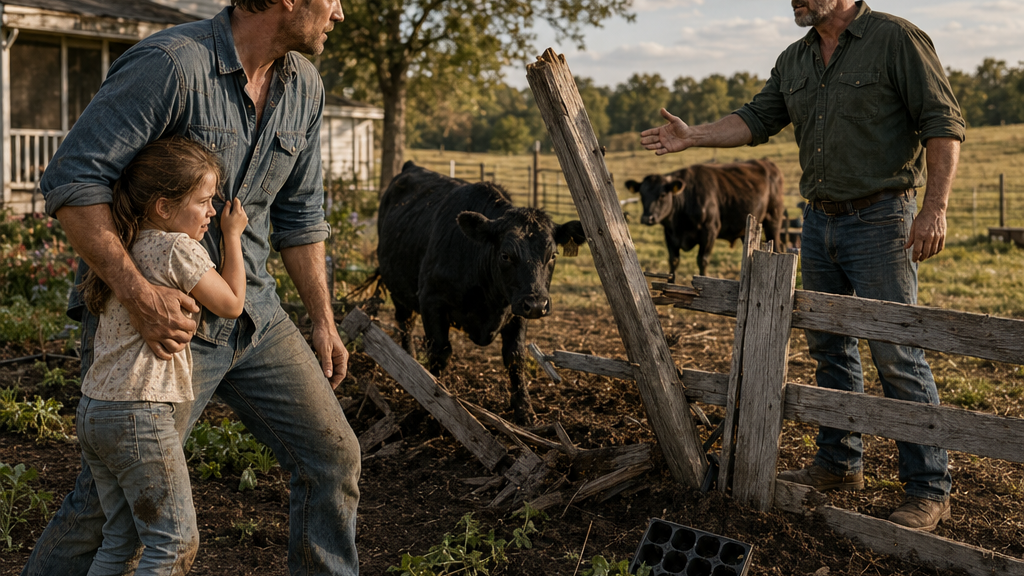
The first board snapped before Samuel saw the cow.
He heard the crack from the shed, a dry, violent sound that did not belong among the ordinary Saturday noises of a farm. Then came Ashley’s scream.
Samuel dropped the wrench in his hand and ran.
A black heifer was halfway through the cedar fence beside the garden, its shoulder driving two gray boards outward as if they were kindling. Another cow crowded behind it. Ashley stood six feet away beside a tray of tomato seedlings, frozen with both hands lifted in front of her.
“Ashley!”
Samuel reached her as the heifer stumbled through.
The animal was not charging. He knew cattle well enough to see that. It was frightened, confused, and suddenly standing somewhere it had never been.
That knowledge did nothing to slow his pulse.
He caught Ashley under the arms and lifted her against his chest. She immediately began crying into his shirt.
The second cow pushed its nose through the gap.
Samuel backed toward the porch, keeping himself between Ashley and the animals. “Inside.”
She clung to him.
“Come on, honey. We’re going inside.”
By the time he shut the kitchen door behind her, the first heifer had stepped through one of the raised garden beds. Damp soil collapsed beneath its hooves. The overturned seedling tray lay beside the broken fence, little squares of potting mix scattered across the grass.
Samuel looked through the window.
The cedar post at the center of the break leaned almost thirty degrees.
He had told Gregory about that post in April.
He had mentioned it again when a calf got its head between two loose boards in May.
Then, three weeks earlier, one of Gregory Walker’s steers had found another weak section farther down and spent half an hour grazing Samuel’s ditch before Gregory got it home.
Samuel had taken no pictures that time.
Gregory had said, “I’ll get to it.”
Samuel had believed him because they had lived beside each other too long for every problem to require paperwork.
Now Ashley was crying at the kitchen table.
Samuel crouched beside her.
“You hurt anywhere?”
She shook her head.
“Did it touch you?”
Another shake.
Her knees were muddy from where she had apparently fallen. There was dirt across one cheek. Samuel checked her arms, hands, legs. Nothing seemed injured.
That should have calmed him.
Instead, when he looked back through the window and saw the heifer standing where Ashley had been kneeling, he felt anger settle into him with unusual clarity.
A pickup came fast along Gregory’s pasture track.
Samuel stepped outside before Gregory reached the fence.
Gregory climbed down wearing work boots, jeans, and an old green shirt. He took in the cattle, the broken boards, and Samuel’s face.
“Everybody all right?”
“Ashley was right there.”
Gregory looked toward the house. “She get hit?”
“No.”
“Thank God.”
He moved toward the heifer.
Samuel caught his arm. “Leave the fence alone.”
Gregory looked at Samuel’s hand, then at him.
“I need to get these cattle back.”
“Get the cattle. Don’t move the post.”
Gregory’s jaw shifted slightly. “Sam, I’m not arguing with you while they’re standing in your yard.”
Neither was Samuel.
He opened the side gate and helped Gregory push the first animal toward the opening. Working together, they got both cattle back through and temporarily blocked the gap with a livestock panel Gregory brought from his truck.
Only when the animals were secure did Gregory stand beside the broken cedar post.
“That thing was rotten clear through.”
“I know.”
“Well.” Gregory nudged a splinter with his boot. “We’ve both known this fence needed replacing.”
Samuel took out his phone.
Gregory watched him photograph the broken boards.
Then the leaning post.
Then the hoofprints pressed deep into the garden soil.
“You taking pictures of me too?”
“No.”
Samuel crouched and photographed one print beside the overturned seedling tray.
Gregory gave a short breath through his nose. “You planning to make this into something?”
“My daughter was standing here.”
“And I said I’m glad she’s okay.”
“That isn’t the same as fixing the problem.”
Gregory’s expression hardened. “Then fix it.”
Samuel stood slowly.
“What?”
“It’s a shared line fence. Half yours, half mine. We replace it, we split it.”
Samuel stared at him.
Gregory pointed along the gray run of cedar stretching toward the pasture. “That fence has been there longer than either of us has owned these places. Your dad maintained parts of it. Mine maintained parts. That’s how it’s always worked.”
“The cattle are yours.”
“The fence is shared.”
“The cattle came through your pasture side and into my daughter’s garden.”
“And if your half of a shared fence is rotten, that matters.”
There it was.
Not apology. Not urgency.
A division of cost.
Samuel almost told him then.
Instead he looked at the post.
For years it had been part of the scenery—a crooked old line everyone understood without discussing. He could remember his father tightening wire to it. Gregory’s father hanging a bucket from another post farther down. Nobody had stood with a survey in hand because nobody had needed to.
Or Samuel had assumed they hadn’t.
He raised the phone again.
Gregory’s voice sharpened. “Sam.”
Samuel photographed the temporary panel, then the gap behind it.
“I’m documenting what happened.”
“You think I’m denying my cattle came through?”
“No.”
“Then what exactly are you proving?”
Samuel slipped the phone into his pocket. “I don’t know yet.”
Gregory frowned.
That was not entirely true.
Two weeks earlier, after the steer had crossed near the ditch, Samuel had called the county records office. Not because he wanted a fight. Because Gregory had said almost the same thing that day: shared fence, shared responsibility.
Samuel had realized he could not remember ever seeing the original survey.
He had ordered a certified copy.
It was supposed to be ready Monday.
Gregory reached for the broken cedar post.
Samuel stepped between them.
“I said leave it.”
“I’m pulling it tonight before it falls.”
“No.”
“It’s rotten.”
“And it stays where it is until I have somebody look at it.”
“Somebody?”
“The surveyor, if necessary.”
Gregory stared at him for a long moment.
Then he gave a humorless laugh. “You’re really doing this.”
“My daughter was six feet from those cattle.”
“They weren’t after her.”
“That doesn’t matter.”
“It matters a little.”
Samuel felt the anger rise again, but Ashley was watching from the kitchen window.
He lowered his voice.
“Don’t move the post.”
Gregory followed his glance toward the house. Some of the resistance went out of his face.
“I’ll leave it tonight,” he said. “But don’t come back Monday acting like some county map means I’m paying for a whole new fence.”
Samuel said nothing.
Gregory climbed into his pickup.
As the truck rolled away, Samuel looked down at the deep hoofprint beside Ashley’s ruined seedlings.
Then he looked at the leaning cedar post.
“The county map,” he said quietly, though Gregory was already too far away to hear, “is already on order.”
Chapter 2: The Line Was Not Where They Remembered
The line on the original plat missed the old fence by nearly six feet.
Samuel checked the scale twice.
The county land-records clerk stood on the other side of the counter while he bent over the large photocopy.
“You seeing what I’m seeing?” he asked.
She leaned closer without touching the document. “I can tell you what’s recorded. I can’t tell you what’s physically on the ground.”
Samuel traced the parcel boundary with one finger.
The recorded line ran almost straight north from an iron monument near the county road. The old cedar fence bowed west before straightening again behind the garden.
If the plat was accurate, the failed section was not sitting on the boundary at all.
It was inside Gregory’s land.
“How old is this?”
“Original subdivision of the two farm parcels? Nineteen seventy-eight.”
“And no later boundary adjustment?”
“Not that I found.”
Samuel had expected clarity to feel better.
Instead he kept staring at the space between the ink line and the drawn fence notation.
Six feet was not much on a farm.
Six feet was also not nothing.
The clerk returned with another file.
“There are older references to access and maintenance between the parcels.”
Samuel looked up.
“What kind of maintenance?”
“Mostly handwritten indexing notes. The actual documents may be elsewhere.”
She set down a photocopied card.
Samuel saw both family names.
Mitchell.
Walker.
Beside them were references to lane access, fencing, and a year from when Samuel had still been in school.
His first thought was that Gregory had been wrong.
His second was that Gregory might not have been entirely wrong.
By late morning, Samuel was standing beside the broken post with a licensed surveyor who had already located the iron monument near the road.
The surveyor sighted along the property line, checked his equipment, then walked slowly toward the garden.
Samuel stayed several paces behind.
“Old fence wandered,” the surveyor said.
“How far?”
“Depends where you measure. Three feet in one section. Nearly seven here.”
“Toward Walker’s side?”
“Yes.”
Samuel looked at the cedar boards.
All these years, the fence had seemed like the boundary because everyone treated it as the boundary.
But a fence and a property line were not necessarily the same thing.
The surveyor stopped beside the leaning post.
“Don’t pull this yet.”
“That’s why I left it.”
“Good.”
He measured from the post to the projected line.
“Five feet, eight inches.”
Samuel let out a slow breath.
“So it’s his fence.”
The surveyor glanced at him.
“I didn’t say that.”
Samuel frowned.
“The line is over there.”
“The line is over there. Ownership of a fence, maintenance responsibility, historic agreements—that’s a separate question.”
Samuel felt his brief rush of vindication flatten.
The surveyor crouched near the post base.
“This was moved at some point.”
“How can you tell?”
“Look at the old wire scar.”
A rust-darkened length of wire disappeared into grass several feet east of the cedar line. Near it, half hidden by soil, was what appeared to be the broken top of an older post.
Samuel stared at it.
The original fence may once have followed the property boundary, then been shifted inward on Gregory’s side.
“Why would somebody move it?”
“Plenty of reasons. Equipment access. Drainage. Trees. Convenience.”
Or an agreement.
Samuel thought of the index card at the records office.
He took pictures of everything.
The iron monument.
The surveyor’s temporary marker.
The old wire.
The leaning cedar post.
By noon, his phone contained more evidence from one morning than he had gathered during years of casual neighbor arrangements.
That should have reassured him.
Instead it bothered him that he had waited until fear forced him to become precise.
He returned to the records office before closing.
The clerk had found a folder in archived rural-road records.
“This isn’t a deed,” she warned. “And it isn’t necessarily enforceable anything. It’s just correspondence that got filed with an old access request.”
Samuel opened it.
The first page concerned seasonal farm access across what was now Gregory’s lane.
The second contained notes about maintenance.
He saw his father’s surname first.
Then Gregory’s father’s.
Then, beside a sentence about keeping the west fence serviceable, a set of initials Samuel knew immediately.
S.M.
Samuel’s father had signed almost everything with those initials, from feed receipts to birthday cards when he was in a hurry.
Samuel read the line again.
Mitchell to maintain west run during continued seasonal access.
His stomach tightened.
He had spent the entire morning imagining the moment he would show Gregory the survey.
He had pictured pointing to the line and saying, calmly, You were wrong.
Now he was holding something that might let Gregory say the same thing back.
“Can I get a copy of this?”
“Of course.”
The clerk began feeding the pages through the copier.
Samuel looked at the original once more.
There was no expiration date.
No formal cancellation.
Nothing saying how long “continued seasonal access” had continued.
Only his father’s initials and a practical arrangement made by two men who probably never imagined their sons would one day examine it under fluorescent county-office lights.
When Samuel returned home, the surveyor’s flags stood in the grass.
The bright markers made the old fence look suddenly dishonest—not because the fence itself had done anything, but because everyone had asked it to mean something nobody had ever written down clearly.
Gregory’s pickup was parked on the far side of the pasture.
Samuel could see him repairing the temporary panel.
For a moment Samuel considered walking over with only the plat.
He could show Gregory the six-foot discrepancy first.
Let him absorb that.
Let him worry.
Then Samuel looked at the copy in his hand.
His father’s initials sat beside the maintenance notation like a quiet objection.
Samuel folded the pages and went inside.
On Tuesday evening, he spread every document across his office desk.
The survey.
The old access file.
Photographs from Saturday.
He arranged them chronologically.
At the bottom of the maintenance page, beneath a faded reference number he had missed at the courthouse, someone had written another notation:
Walker lane—seasonal equipment access.
Beside it were his father’s initials again.
Samuel leaned back.
The survey had answered the first question.
The broken fence was well inside Gregory’s recorded property at the garden.
But it had opened another one Samuel could no longer ignore.
At some point, his father had agreed to maintain at least part of it.
And Samuel had no idea why.
Chapter 3: His Father Had Made a Handshake Deal
Gregory arrived Wednesday morning carrying a notebook Samuel recognized before he even opened the door.
It was brown, cloth-backed, and swollen from years of humidity.
“My dad’s,” Gregory said.
Samuel looked from the notebook to Gregory’s face.
“You found something.”
“I found what you apparently went looking for.”
Samuel stepped aside.
They sat at the farmhouse office table where Samuel already had the survey copies stacked in a folder.
Gregory noticed them immediately.
“So?”
“The fence isn’t on the recorded line.”
“I know.”
Samuel paused.
“You know?”
Gregory rubbed his thumb along the notebook’s worn edge. “I know it isn’t perfectly on it.”
“It’s almost six feet inside your parcel by the garden.”
Gregory’s expression tightened, but he did not look surprised enough.
“That much?”
“The surveyor measured it Monday.”
“And did he tell you why?”
“He told me fences move.”
Gregory opened the notebook.
“My father told me why.”
Several pages held cattle counts, hay yields, fuel purchases, and rough sketches. Gregory turned carefully until he reached a page marked with two parallel lines.
Samuel recognized his father’s handwriting before Gregory pointed to it.
West fence—Mitchell keeps boards/wire. Walker keeps lane open through hay season.
Samuel felt the room go still.
His father’s handwriting slanted hard to the right. Samuel had seen it on thousands of things. There was no mistaking it.
Below the note was a rough sketch showing a lane cutting along the Walker parcel and connecting to a back field Samuel’s family used to hay.
Gregory tapped the page.
“They shifted the fence so your dad could get equipment through easier.”
Samuel studied the sketch.
The story emerged in pieces.
The original line had run close to a narrow drainage dip. Large hay equipment had trouble making the turn from Samuel’s back field to the county road. Gregory’s father had allowed Samuel’s father to use the wider Walker lane seasonally.
In return, Samuel’s father had agreed to maintain the west fence.
Not because it belonged to him.
Because the arrangement benefited him.
Samuel looked up. “You could have shown me this Saturday.”
“You could have asked before ordering a survey.”
“My daughter had cattle in her garden.”
“And I came over and got them out.”
“You also told me half the fence was mine.”
Gregory closed the notebook halfway. “Because as far as I was raised, your family maintained that run.”
“Maintained it in exchange for access.”
“Which your family had.”
Samuel turned the notebook back toward himself.
The handwriting continued across later years. Fence staples. Cedar posts. Wire. Small amounts beside Samuel’s father’s initials.
There was no contract.
No legal language.
Just two farmers keeping track of who did what.
For the first time since Saturday, Samuel understood why Gregory had reacted with irritation instead of embarrassment.
In Gregory’s memory, Samuel was not suddenly asking him to fix his own neglected fence.
Samuel was abandoning an old division of responsibility after something frightening happened.
That did not make Gregory right.
But it made the argument less clean.
“When did this start?” Samuel asked.
“Before I was old enough to drive.”
“When did it end?”
Gregory shrugged. “Who says it ended?”
Samuel looked at him.
“I don’t use your lane.”
“You have.”
“When?”
“You hauled equipment through there.”
“Years ago.”
“That’s still using it.”
“How many years?”
Gregory’s silence lasted just long enough to matter.
Samuel leaned back.
After his father died, Samuel had inherited not only the farm but dozens of practices nobody had thought necessary to explain.
Where to stack winter hay.
Which neighbor could borrow the post driver.
Who got first chance at a cut field if weather threatened.
Which gates stayed unlocked during harvest.
Most of it worked because everybody remembered.
Until they remembered differently.
“I used that lane once after Dad died,” Samuel said.
Gregory shook his head. “More than once.”
“One harvest. The south entrance washed out.”
“You ran three loads.”
“One day, Gregory.”
“That’s access.”
“And I haven’t used it since.”
Gregory’s jaw tightened. “You still benefited from the arrangement.”
Samuel looked at the notebook again.
The worst part was that Gregory had a point.
Not enough of one to excuse putting cattle against rotten boards beside a child’s garden. But enough to ruin the clean argument Samuel had been building in his head.
He had wanted proof.
Now he had too much of it.
The survey proved the fence sat inside Gregory’s land.
The notebook proved Samuel’s father had once accepted maintenance responsibility.
Neither document told him what happened after that arrangement stopped being useful.
Gregory stood.
“I’m not saying I won’t pay anything.”
“You said half.”
“That seems fair.”
“Not if the agreement ended fifteen years ago.”
“You don’t know that it did.”
“Neither do you.”
Gregory picked up the notebook.
“I know nobody from your side ever came over and said it was over.”
Samuel felt something in that sentence catch.
Nobody had said it was over.
That was exactly how old farm arrangements survived long past their purpose.
Not through contracts.
Through silence.
Samuel followed Gregory outside.
They walked toward the pasture lane.
The old cedar fence ran beside them, leaning in places, patched in others. Seen from the survey markers, it no longer looked like one continuous object. It looked like a history of repairs made by different hands.
Gregory stopped where an old gate opening had been wired shut.
“Your dad used to come through here.”
Samuel could picture it.
A tractor pulling a mower conditioner.
A hay wagon behind it.
His father lifting one hand from the wheel as he passed Gregory’s father.
No discussion because the arrangement was already understood.
Samuel touched the rusted hinge still bolted to one cedar post.
“When was the last time this gate opened?”
Gregory frowned.
“I don’t know.”
“Before Dad died?”
“Probably.”
“That’s eleven years.”
Gregory looked toward the lane.
Samuel continued, more to himself than to Gregory. “I used your lane once after that. When the south entrance washed out.”
Gregory did not answer.
Samuel remembered the day clearly now. Heavy rain had cut a rut through his newer entrance. He had called Gregory and asked permission before hauling three loads through.
Asked permission.
That mattered.
If the old arrangement had still been understood as active, he would not have needed to ask.
Samuel turned toward him.
“When I used this lane that day, I called you first.”
Gregory’s face changed slightly.
“You remember.”
“Yes.”
“And you said sure.”
“Yes.”
“You didn’t say, ‘It’s your access anyway.’”
Gregory looked down at the grass.
For the first time, neither man had a ready answer.
Samuel looked past him toward the newer entrance to his own property, visible beyond the hay field.
It had existed before his father died.
He suddenly wanted to know exactly when it had been built.
Because if that entrance had replaced the need for Gregory’s lane, then the old handshake deal might not have faded recently.
It might have ended years before either of them inherited the argument.
Samuel looked back at the rusted gate hinge.
The survey had shown where the legal boundary ran.
The notebook had shown why the fence moved.
Now only one question mattered.
When had the bargain stopped?
Chapter 4: The Old Agreement Had Already Ended
The invoice was dated sixteen years earlier.
Samuel found it in a gray road-association folder the secretary had pulled from a cabinet in the back room of the township office. The paper was thin and slightly curled, but the typed description was clear enough.
NEW SOUTH FARM ENTRANCE — MITCHELL PARCEL.
Below it were charges for gravel, culvert pipe, grading, and two loads of crushed stone.
Samuel read the date again.
Sixteen years.
Five years before his father died.
He sat back in the metal chair.
“So this entrance would’ve been usable that year?”
The road-association secretary looked over the copy.
“If the invoice says final grading, yes. They wouldn’t bill final until the culvert was in.”
Samuel pointed to the parcel notation. “And this is the entrance off the county road?”
“That’s the one.”
The newer entrance he used every day.
The one wide enough for hay equipment.
The one that made Gregory’s lane unnecessary.
Samuel thanked her and drove home with the copy lying on the passenger seat.
At the farm office, he spread it beside Gregory’s father’s notebook photocopy and the county access notation.
The sequence was beginning to form.
First, his father had used the Walker lane.
In exchange, he maintained the west fence.
Then his father had built a separate entrance.
If the arrangement had continued after that, there ought to have been some sign of it.
Samuel opened a box of old farm receipts he had nearly thrown away after settling his father’s estate.
He found fence staples.
Wire.
Cedar posts.
Receipts with his father’s initials written across the top.
For several years they lined up with the old handshake arrangement.
Then, in the same year as the new entrance invoice, they stopped.
Not all fence purchases stopped. Samuel’s father still bought posts for the north pasture and wire for the creek lot.
But nothing marked west run appeared again.
Samuel stared at the gap in the records.
It was not a signed cancellation.
It was not a legal release.
But it was behavior.
And behavior was what the whole arrangement had always been built on.
He carried the papers outside.
The abandoned gate opening was still visible along the cedar fence. Rusted hinges clung to one post, but brush had grown where wagon tires once crossed.
Samuel stood there until Gregory’s truck appeared on the lane.
Gregory slowed when he saw him.
“You find something else?”
Samuel held up the road-association invoice.
“The south entrance was finished sixteen years ago.”
Gregory shut off the truck but stayed behind the wheel.
“So?”
“So Dad didn’t need your lane after that.”
“Doesn’t mean the agreement stopped.”
Samuel handed him the copy.
Gregory looked at the date.
Samuel continued. “His west-fence material purchases stop the same year.”
“You went through his receipts?”
“Yes.”
Gregory looked toward the old gate.
“He still came through sometimes.”
“Maybe.”
“He did.”
“Then why did I call you for permission the one time I used your lane after Dad died?”
Gregory’s expression tightened.
Samuel did not push the question immediately.
That was what he would have done two days earlier—find the weak point and press until Gregory admitted defeat.
Now he waited.
Gregory folded the invoice once, then opened it again.
“You never told me you thought the deal was over.”
“I didn’t know there was a deal until yesterday.”
“Your dad knew.”
“My dad’s been dead eleven years.”
“And mine’s been dead nine. Doesn’t erase what they agreed.”
“No. But agreements built around an exchange stop making sense when one side stops receiving the exchange.”
Gregory climbed out of the truck.
“You’re trying to turn common sense into contract law.”
“I’m trying to figure out what actually happened.”
“You already decided what happened.”
Samuel almost denied it.
Then stopped.
Gregory was right about that much.
On Monday, Samuel had wanted the survey to settle everything. When the plat showed the fence inside Gregory’s parcel, Samuel had felt certain the rest would be easy.
He had not gone searching for history because he wanted Gregory’s side.
He had gone searching because the history had forced itself into the record.
“I decided too early,” Samuel said.
Gregory looked at him, surprised.
Samuel pointed toward the fence.
“But that doesn’t make the boards less rotten.”
“No.”
“It doesn’t make the cattle less yours.”
“No.”
“And it doesn’t change the fact that you knew this section was weak.”
Gregory looked away.
Samuel stepped closer to the old gate hardware.
“This isn’t about proving our fathers never made the arrangement. They did.”
He touched one rusted hinge.
“It’s about whether we get to pretend an arrangement lasts forever just because nobody bothered to say when it ended.”
Gregory’s mouth tightened.
“You never objected to the fence being where it is.”
Samuel nodded. “That’s true.”
“So you accepted it.”
“I accepted a fence standing there. I didn’t accept your cattle coming through it.”
“That’s convenient.”
“So is calling it shared after the exchange ended.”
For a moment they stood facing each other with the old cedar line between them.
Then Gregory kicked lightly at the grass.
“You know what moving that fence to the survey line does?”
Samuel looked toward the pasture.
“It gives you back the strip.”
“No. It changes how I have to run that whole corner.”
Samuel waited.
Gregory pointed north.
“The water trough’s where it is because that fence bends out. The working lane’s narrow behind the shed. If I straighten the whole run, I’ve got to move cattle differently or move the trough.”
“That’s manageable.”
“For you.”
The words came sharper than Gregory probably intended.
Samuel watched him.
Gregory folded the invoice and handed it back.
“Everybody keeps acting like six feet isn’t much.”
“You told me Saturday it wasn’t.”
“I said the cattle weren’t after Ashley.”
“That’s different.”
“Maybe.”
Gregory rubbed a hand over his face.
Samuel noticed something he had missed before. Gregory looked tired. Not Saturday-afternoon tired. Months tired.
“What’s going on?”
“Nothing.”
“Gregory.”
“Nothing you need to make part of your file.”
Samuel glanced at the papers in his hand.
The remark landed.
Gregory walked back toward his truck.
Samuel said, “I’m getting an estimate tomorrow.”
Gregory stopped.
“For what?”
“The failed section first. Maybe the whole run depending on condition.”
“And then you’ll hand me a bill?”
“I’ll hand you numbers.”
Gregory laughed once without humor.
“Numbers.”
He opened the truck door.
Samuel heard himself say, “If the cost is the problem, say that.”
Gregory froze.
For several seconds he faced the inside of the cab.
Then he turned.
“You want me to say I can’t afford a fence?”
“I didn’t say that.”
“You didn’t have to.”
Samuel regretted the sentence immediately, not because it was false, but because of the way he had delivered it.
Gregory looked past him toward Samuel’s newer barn, then toward the south entrance with its broad gravel apron.
“My hay came in forty percent light last year,” he said.
Samuel said nothing.
“I bought feed I wasn’t planning to buy. Vet costs went up. Diesel didn’t get cheaper.”
He looked toward the cattle in the pasture.
“Replacing that whole run right now could mean selling cows I planned to keep.”
Samuel’s anger did not disappear.
But it changed shape.
Gregory climbed into the truck.
Before starting the engine, he looked through the open window.
“You wanted to know why I keep saying half.”
Samuel waited.
Gregory’s hand tightened around the steering wheel.
“Because half I might be able to do.”
Then he drove away.
Chapter 5: What Gregory Could Not Afford to Admit
The first new patch was fifty yards beyond the broken section.
Samuel found it the following evening while walking the fence with the contractor’s preliminary measurements in his pocket.
Fresh galvanized wire looped around an old cedar post.
Twenty yards farther, there was another.
Then a third.
All three had been tightened recently.
Samuel stopped beside the last one and pressed his thumb against a board.
The wood gave slightly.
He withdrew his hand.
Gregory had not repaired one failing spot.
He had been holding together an entire aging run.
Samuel heard a gate latch behind him.
Patricia Walker came across the pasture carrying an empty mineral bucket.
“You looking for Gregory?”
“No.”
Her eyes moved to the patch Samuel had been examining.
“He did those yesterday.”
“I figured.”
“He’s trying.”
Samuel looked toward the old boards.
“That’s part of the problem.”
Patricia set the bucket down.
For a moment neither spoke.
Then she said, “He thinks you’re trying to make him look irresponsible.”
“I’m trying to keep his cattle out of my garden.”
“I know.”
The quickness of her answer made Samuel look at her.
Patricia folded her arms.
“I was there after the steer got out three weeks ago.”
“Gregory said he’d fix it.”
“He meant to.”
“That doesn’t fix anything.”
“No.”
She looked toward the house across the pasture.
“He should’ve replaced that section in spring.”
Samuel waited.
Patricia’s expression changed.
“He knew another one could get through.”
There it was.
Not a survey.
Not an old notebook.
A choice.
Samuel felt the anger return, but without the clean edge it had carried Saturday.
“How long?”
“Since April, probably.”
“And he kept cattle in this pasture.”
“We rotated them out when we could.”
“But not always.”
“No.”
Samuel looked down the line of temporary repairs.
“Why didn’t you tell me?”
Patricia gave him a tired look.
“Because every conversation about this fence became a conversation about money.”
“He told me yesterday.”
“Some of it.”
Samuel said nothing.
Patricia picked up the bucket, then set it down again as though she had changed her mind about leaving.
“We lost part of the hay crop last summer. Then we had two cows go open and one needed surgery. We used the repair money for feed.”
“I’m sorry.”
“I’m not asking you to be sorry.”
“What are you asking?”
“That you understand why he kept saying he’d get to it.”
Samuel looked toward his house beyond the fence.
Ashley was not outside.
She had not wanted to come to the garden since Saturday.
Understanding why Gregory delayed did not make that easier to accept.
“He knew the risk,” Samuel said.
Patricia nodded.
“Yes.”
The answer mattered more because she did not soften it.
Samuel pulled out his phone and photographed the three fresh patches.
Patricia watched.
“You sending those somewhere?”
“I don’t know.”
“You’ve been taking pictures of everything.”
“I should’ve started months ago.”
She gave a small, rueful nod. “Probably.”
The contractor arrived before sunset.
He walked the failed section, tested posts, measured distances, and followed the survey markers.
“This isn’t one fence problem,” he said finally. “It’s several.”
Samuel waited.
“You can replace only the break, but you’ll be back next year somewhere else.”
He pointed toward the patches Samuel had found.
“Maybe sooner.”
“What if we realign it to the surveyed boundary?”
The contractor studied the pasture.
“Actually helps in spots. Straightens the run.”
“What about Gregory’s working lane?”
“Could preserve it if we taper the northern section and move one corner brace.”
“And the trough?”
“Doesn’t have to move.”
Samuel looked across the pasture.
That undercut one of Gregory’s practical objections.
Not all of them.
But one.
The contractor handed Samuel two rough estimates: one for emergency replacement of the failed section and one for rebuilding the longer run.
The larger number was substantial.
Samuel understood why Gregory had flinched.
As the contractor drove away, Samuel’s phone rang.
The livestock insurance representative had returned the message he had left earlier that afternoon.
Samuel explained the incident carefully.
The representative asked whether there had been prior escapes.
Samuel hesitated.
“Two that I know of.”
“Documented?”
“Not formally.”
“Any injuries?”
“No.”
“Property damage?”
“Garden damage and fence failure.”
The representative paused.
“If this is an insured operation and there’s a known containment problem, another documented loss could trigger a review.”
“What kind of review?”
“Depends on the policy. Could require corrective action. Could affect renewal. In some cases, coverage could be restricted if the insured knowingly continues an unsafe condition.”
Samuel looked toward Gregory’s cattle.
“And if I submit what I have now?”
“I can’t tell you what another insured’s carrier would do. But if you’re making a claim, submit all relevant incidents you can accurately support.”
Samuel thanked her and ended the call.
For several seconds he stood with the phone in his hand.
There it was.
Leverage.
Real leverage.
Not the satisfying kind that existed in arguments.
The kind that could cost Gregory more than a fence.
Samuel walked home slowly.
At the kitchen table he laid out the photographs.
Saturday’s hoofprints.
The leaning post.
The temporary panel.
The fresh wire patches.
Beside them he placed the survey and contractor estimate.
Ashley wandered into the room carrying a plastic watering can.
“Garden tomorrow?”
Samuel looked at her.
“You want to go?”
She considered it, then shook her head.
“Cow come?”
“No.”
She stared at the watering can.
Samuel pulled out the chair beside him.
“Not tomorrow unless you want to.”
Ashley climbed onto the chair and leaned against his arm.
Samuel looked at the papers again.
For years he had avoided turning neighbor problems into records because records felt like escalation.
Now the opposite danger had become clear.
Silence had allowed everyone to keep pretending the old system still worked.
But documentation could become its own kind of weapon.
He could file everything.
The prior escapes.
The failed fence.
The photographs.
Patricia’s admission was not written proof, but the patches showed known deterioration.
If Gregory’s insurer reacted strongly, the pressure might force repairs immediately.
It might also push a struggling farm closer to selling cattle.
Samuel thought about Gregory saying, Half I might be able to do.
Then he thought about Ashley asking whether the cow would come back.
Compassion did not erase responsibility.
Responsibility did not require maximum damage.
Samuel opened the insurance incident form on his laptop.
He filled in his name.
Date.
Location.
Description of the Saturday breach.
Then he reached the box asking about previous related incidents.
His cursor blinked.
Once.
Twice.
He had enough information now to make Gregory’s problem much larger.
The only question was whether that was the same thing as making Ashley safe.
Chapter 6: Samuel Chose the Record Over Revenge
Samuel put the insurance incident form on the left side of the kitchen table and the settlement draft on the right.
Between them sat a photograph of the rotten cedar post.
Friday morning light came through the window and caught the creases in the paper.
One packet could force the issue.
The other could solve it.
Neither guaranteed anything.
Samuel had spent half the night building the settlement draft from the chronology he had assembled.
The recorded boundary.
The old seasonal-access arrangement.
His father’s maintenance role.
The new south entrance.
The end of west-fence material purchases.
The years without regular lane access.
The recent cattle escapes.
The contractor’s two estimates.
He included all of it.
Even the parts Gregory could use against him.
Especially those.
At ten, the contractor returned to walk the entire disputed run.
Gregory came too.
For the first several minutes nobody discussed money.
The contractor set temporary stakes along the surveyed line, then pointed out where the new fence could straighten without interfering with Gregory’s working lane.
“This corner brace moves here.”
Gregory frowned. “That cuts my turn.”
“Not if we angle the gate four feet north.”
“And the trough?”
“Stays where it is.”
Gregory walked the turn twice, measuring it with his eyes.
The contractor continued.
“You actually gain usable grass along this section because the old fence bowed inward.”
Samuel watched Gregory register that.
Not a fortune.
Not enough land to transform the farm.
But the realignment was not the loss Gregory had imagined.
The old fence had cost him space for years.
The contractor drove a bright stake beside the leaning cedar post.
For a moment the new marker and old post stood together—the exact line beside the remembered one.
Gregory stared at them.
“My dad moved that post.”
“I know,” Samuel said.
“He said it made the equipment turn easier.”
Samuel nodded.
“And your dad kept the fence up because he used our lane.”
“I know that too.”
Gregory looked at him. “You keep saying that like you’re building to something.”
“I am.”
They went inside.
Samuel placed the settlement draft between them.
Gregory did not touch it.
“What’s that?”
“My proposal.”
“I told you half.”
“And I’m not asking you for all of it.”
That got Gregory’s attention.
Samuel slid the contractor estimate forward.
“I’ll pay for a separate interior fence around the garden. That’s mine. My choice.”
Gregory scanned the page.
Samuel continued.
“For the boundary run, you pay the larger share because it’s on your parcel, contains your cattle, and the old maintenance exchange ended in practice years ago.”
“How much larger?”
“Seventy percent.”
Gregory leaned back.
“No.”
Samuel had expected the answer.
“I’ll pay thirty.”
“No.”
“The contractor says you gain back the strip and we can preserve your lane.”
“That doesn’t create money.”
“No.”
“Then why are we sitting here?”
Samuel put the second packet beside the first.
Gregory glanced at it.
“What’s that?”
“Incident report.”
The room changed.
Gregory’s eyes stayed on the top page.
“You filed it?”
“Not yet.”
“So this is a threat.”
Samuel felt his own jaw tighten.
It would have been easy to say no.
Instead he said, “It’s leverage.”
Gregory looked at him sharply.
Samuel continued before anger could take over.
“And I don’t like that.”
“You expect me to thank you?”
“No.”
“Then what?”
“I expect you to understand what happens if we keep treating this like a disagreement between our fathers.”
Samuel opened the settlement packet.
“I put everything in here.”
He turned to the page about the old lane arrangement.
Gregory stared at it.
“You included that?”
“Yes.”
“That helps me.”
“I know.”
“Why?”
“Because it happened.”
Gregory looked at Samuel for a long time.
Samuel tapped the insurance form.
“If I send this, I send the whole record too. Prior escapes I can support. Photos. Survey. Contractor condition notes. I’m not going to pretend your father moved that fence for no reason, and I’m not going to pretend mine never agreed to maintain it.”
Gregory’s expression shifted from anger to uncertainty.
Samuel realized this was the part Gregory had not expected.
Not mercy.
Completeness.
“I wanted the survey to make you wrong,” Samuel said.
Gregory said nothing.
“It did, partly. Then I found Dad’s agreement and wanted that to be expired enough that I didn’t have to think about it.”
Samuel looked toward the window, where the new survey stakes were visible in the grass.
“But Ashley doesn’t need me to win an old argument. She needs a fence that works.”
Gregory rubbed both hands over his face.
“Seventy percent.”
“Yes.”
“I can’t write that check.”
“Then structure it with the contractor. Deposit now, balance after your next cattle sale. He said he’d discuss it.”
Gregory looked up.
“You already asked?”
“I asked what options existed.”
“And if I say no?”
Samuel looked at the incident packet.
“Tomorrow morning I submit it.”
Gregory stood.
“Still sounds like a threat.”
“It is a deadline.”
“You always did like making things sound cleaner than they are.”
Samuel let that sit.
Gregory was right.
There was nothing clean about using insurance pressure against a neighbor whose finances were already thin.
There was also nothing clean about telling Ashley the cattle probably would not come back while leaving the same rotten fence standing.
Gregory took the settlement draft.
At the door he stopped.
“You know what bothers me?”
Samuel waited.
“You get to be reasonable because you’ve got choices.”
Samuel looked at him.
Gregory held up the packet.
“You can pay for thirty percent and another garden fence and call it restraint. I’m trying to figure out which cows I can sell without wrecking next year.”
Samuel had no answer that would improve the truth.
Finally he said, “I know our positions aren’t equal.”
Gregory nodded once.
“At least you know that.”
He left.
Samuel remained at the table.
For the rest of the day he worked without accomplishing much.
At three, he checked the fence.
At five, he checked his email.
At seven, Ashley sat on the porch steps with the plastic watering can beside her but did not go toward the garden.
When darkness settled, Samuel returned to the kitchen.
The insurance form was still open on his laptop.
He completed every field he could.
Attached the photographs.
Attached the survey.
Added the prior incidents he could honestly describe.
He did not press submit.
At 9:14, a truck passed slowly on Gregory’s lane.
It did not turn in.
Samuel closed the laptop.
The next morning, he decided, he would give Gregory until eight.
After that, the full record would leave his hands.
Chapter 7: They Rebuilt the Boundary Without Pretending
Gregory’s truck came up Samuel’s drive at 6:37 Saturday morning.
Samuel was already awake.
He had been sitting at the kitchen table with the laptop open to the completed insurance form, watching the clock move toward eight.
When the headlights crossed the window, he closed the screen.
Gregory parked near the porch and stayed in the cab for several seconds.
Then he got out carrying the settlement draft.
It was unsigned.
Samuel stepped outside.
Neither man said good morning.
Gregory held up the papers. “Seventy percent is still too much.”
Samuel looked at the packet.
“Then I guess we know where we are.”
“I didn’t say no.”
Samuel waited.
Gregory walked to the porch rail and laid the agreement flat against it.
“I talked to Patricia.”
Samuel said nothing.
“I talked to the contractor too.”
“He called you?”
“I called him.”
Gregory rubbed the back of his neck.
“He’ll let me split the balance after the deposit.”
“That’s what he told me.”
“I can sell two yearlings next month without cutting into the cows I need to keep.”
Samuel heard the words for what they were.
Not surrender.
Calculation.
Gregory pointed to the cost-sharing section.
“I’ll do seventy if the scope stays exactly what’s written. No extras added later and called necessary.”
“Fair.”
“And the new line follows the survey.”
“Yes.”
“You don’t come back next year and say I owe for the interior fence too.”
“I already told you that one is mine.”
Gregory picked up the papers again.
“There’s one more thing.”
Samuel felt the tension return.
“What?”
Gregory looked toward the old cedar fence.
“I want one of the posts.”
Samuel frowned.
“The broken one?”
“No. The one at the old gate.”
The rusted hinge post.
“Why?”
Gregory shifted his weight.
“My dad set it.”
Samuel waited.
“He and your dad argued about where the gate ought to be for half a summer. At least that’s how he told it. Then one morning they put it there and stopped arguing.”
Gregory looked almost embarrassed by the explanation.
“I don’t want it standing in the fence. I know the line has to move. I just want the post.”
Samuel thought of the old notebook.
His father’s handwriting.
The years when two men had solved practical problems with handshakes because neither imagined silence could outlive the understanding behind it.
“Take it,” Samuel said.
Gregory looked at him.
“That easy?”
“It’s a post.”
“No, it isn’t.”
Samuel glanced toward the garden.
“No,” he said. “I guess it isn’t.”
Gregory took a pen from his shirt pocket.
He signed.
Samuel signed beneath him.
For the first time since the cattle came through, the argument became something both men could point to without relying on memory.
The contractor started Monday.
The first thing his crew did was string a bright line between the survey stakes.
Against it, the old cedar fence looked even more crooked than Samuel remembered.
Some sections wandered only a foot.
Near the garden, the gap widened to almost six.
The crew removed boards one at a time.
Several came apart in their hands.
When they reached the post beside the failed section, the bottom was dark and soft enough to crumble under pressure.
Gregory stood nearby.
He stared at it.
“That was holding cattle.”
“Barely,” the contractor said.
Gregory said nothing after that.
Samuel did not need him to.
By Tuesday afternoon, the new posts were set along the surveyed boundary.
Straight.
Deliberate.
The realignment returned a narrow strip of pasture to Gregory and left enough room for his working lane to function.
The trough stayed where it was.
The contractor had been right.
Most of the practical disaster Gregory had imagined existed only because nobody had taken the time to measure first.
The financial problem remained.
Samuel saw that too.
Gregory came over each evening after the crew left and checked the work with the careful attention of a man who knew exactly what every foot cost.
But he stopped arguing about who should have acted sooner.
On Wednesday, the crew reached the old gate.
The hinge post resisted removal.
Its base had been set deep and packed with stone.
One worker wrapped a chain around it.
Gregory stepped forward.
“Easy with that one.”
The worker looked at Samuel.
Samuel nodded.
They worked it loose gradually.
When the post finally came free, dirt clung to the lower half and the rusted hinge remained bolted near the top.
Gregory lifted it with both hands.
For a moment he stood between the old fence and the new line carrying a piece of something his father had considered permanent.
Samuel expected him to say something.
He did not.
He loaded the post into his pickup and closed the tailgate carefully.
That evening, Patricia came with him to look at the finished northern section.
She walked the line once.
“So that’s where it always was supposed to be.”
Samuel said, “According to the survey.”
Patricia smiled faintly. “Careful. You’ve learned what happens when people say ‘always.’”
Gregory gave her a look.
Samuel laughed before he meant to.
It surprised all three of them.
The sound did not repair anything.
But it loosened something.
By Friday, the boundary fence was complete.
Samuel stood beside the garden and looked along the new run.
Pressure-treated posts.
Tight wire on the pasture side.
Solid boards where the line passed nearest the house.
No sagging sections.
No improvised patches.
No assumptions hidden inside rotten cedar.
The contractor handed Gregory the final paperwork.
Gregory looked at the total, exhaled, and folded it.
“I hate this fence.”
The contractor glanced at him.
Gregory added, “Which probably means it’s built right.”
After the contractor left, Samuel walked the garden perimeter with stakes and string.
Gregory watched from the other side.
“You really putting up another one?”
“Smaller.”
“The cattle can’t get through this one.”
“I know.”
“Then why?”
Samuel looked toward the porch.
Ashley sat on the bottom step with her watering can between her shoes.
“Because she doesn’t know that yet.”
Gregory followed his gaze.
He nodded.
Samuel paid for the interior fence himself.
It was simpler than the boundary line: a child-safe enclosure around the garden with a gate that Ashley could see Samuel latch.
No survey issue.
No inherited agreement.
No question of whose responsibility it was.
Samuel chose it because there were some risks he no longer wanted to leave dependent on another person doing the right thing.
The following Tuesday, Ashley came to the garden for the first time since the cattle had broken through.
She stopped at the new gate.
Samuel opened it.
“You want to help?”
She looked toward the pasture.
A cow grazed beyond the new boundary fence.
Ashley immediately moved closer to Samuel.
He did not tell her there was nothing to fear.
He had learned what promises sounded like when people made them too easily.
Instead he crouched.
“See that fence?”
She nodded.
“And this one?”
Another nod.
“The cows stay over there. We stay in here.”
Ashley considered this.
Then she touched the garden gate.
“Close?”
“You want it closed?”
“Yes.”
Samuel closed the gate and latched it.
Ashley watched his hand carefully.
Only then did she pick up her watering can.
They replanted the tomatoes that had been crushed the week before.
Some seedlings were too damaged to save.
Samuel had bought new ones.
Ashley pressed soil around the first plant with both hands, serious about the work.
Across the pasture, Gregory was repairing a mineral feeder.
He looked up once.
Samuel raised a hand.
Gregory returned the gesture.
Nothing about it meant they had forgotten the argument.
The signed agreement was in Samuel’s office.
The insurance incident form remained saved but unsubmitted.
The old gate post now leaned beneath Gregory’s equipment shed, its rusted hinge still attached.
The new boundary stood where the survey said it should.
Everyone knew who maintained it.
Everyone knew what happened if it failed.
For once, there was nothing important left to memory.
Ashley poured too much water around the tomato plant and muddy water ran over the edge of the bed.
Samuel smiled.
“That’s enough.”
She looked at him.
“Cow come?”
Samuel glanced through both fences at the cattle beyond them.
“No,” he said.
This time he was not depending on an old promise.
He was looking at what they had built.
Ashley crouched beside the next plant.
Samuel joined her in the dirt.
The story has ended.