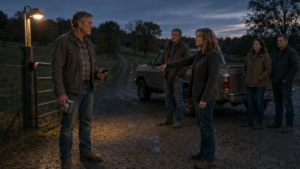
They Fined His Farm for Blocking Their Road—Then He Audited Every Rule They Had Ignored
Chapter 1: The Orange Tag on the Hay Wagon
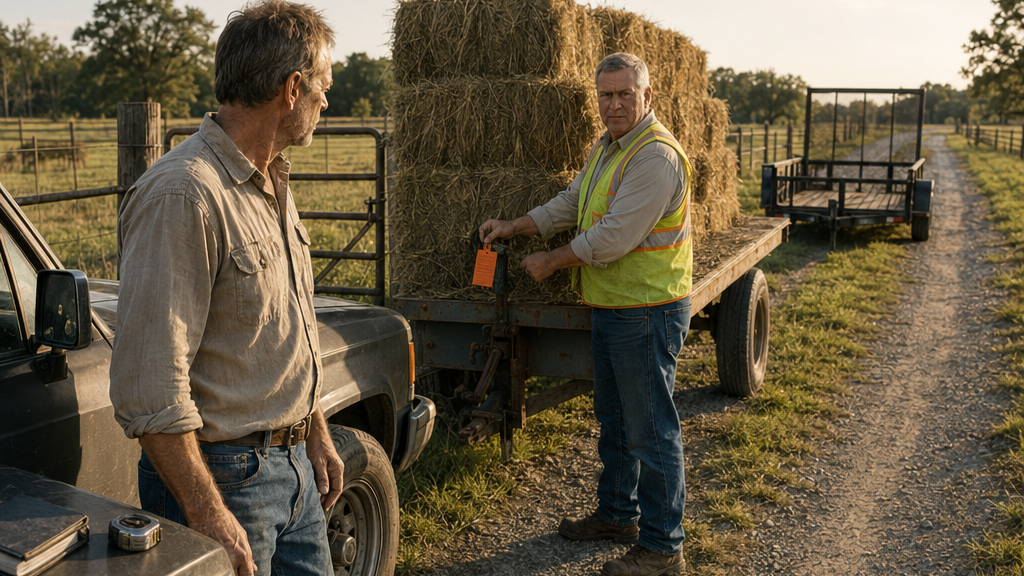
The orange tag was tied to the brake lever of Robert Mitchell’s hay wagon so tightly that he had to cut it loose with his pocketknife.
He stood beside the loaded wagon at the entrance to the shared gravel road, the late-afternoon heat pressing against his shirt, and read the first line twice.
ROAD CLEARANCE VIOLATION.
The wagon carried twenty-four square bales stacked under a faded canvas sheet. Robert had pulled it into the broad turnout beside his gate less than fifteen minutes earlier so the farm-supply truck could come through from the opposite direction. The turnout had been used that way for as long as Robert could remember—feed trucks, cattle trailers, propane deliveries, even the road grader when somebody needed space to pass.
Yet the orange tag carried his name.
A pickup rolled slowly toward him.
Eric Davis stopped beside the gate and lowered his window.
“You got it, then.”
Robert held up the tag. “You put this here?”
“I did.”
“For fifteen minutes?”
Eric killed the engine. “It’s inside the clearance zone.”
Robert looked past him.
Fifty yards farther up the shared road, Eric’s own utility trailer sat half on the grass and half on the gravel shoulder. A string trimmer, two gas cans, and fencing tools were visible through its wire sides.
Robert looked back at Eric.
“So is yours.”
Eric’s jaw tightened slightly. “Mine isn’t blocking through traffic.”
“Neither is this.”
“Your wagon is wider.”
Robert glanced at the road. A full-size pickup could have passed with several feet to spare.
He folded the orange tag once.
“What’s the actual distance?”
Eric opened his door and stepped out. He wore clean work boots and the reflective vest he had begun keeping in his truck since becoming chair of the road association.
“You know what the rule says.”
“I know what people say it says.”
Eric gave him a flat look. “Don’t start that.”
Robert had not intended to.
He had four more fields to check before dark, cattle water to inspect, and a hydraulic leak on the baler that had already cost him half a day. Arguing over a strip of gravel ranked somewhere below repairing a broken gate hinge.
But the tag bothered him in a way the inconvenience did not.
Robert walked to the cab of his truck, opened the door, and took out a worn black notebook.
The road log.
For years he had used it to record the practical things nobody else seemed interested in recording—when he cleared fallen limbs, when the grader came through, how much gravel was delivered, which culvert washed after a hard rain.
He flipped to that day’s page.
“Four twenty-two,” he said.
Eric frowned. “What?”
“That’s when I pulled the wagon over.”
Robert wrote the time.
Then he took a tape measure from behind the truck seat.
Eric crossed his arms.
“You planning to survey the road now?”
“No.”
Robert hooked the tape on the wagon tire and walked toward the center of the gravel lane.
“I’m asking how far inside the clearance zone I am.”
“You’re missing the point.”
“That’s possible.”
Robert measured.
Then he walked up the road toward Eric’s trailer.
Eric followed three steps and stopped.
“Leave mine out of this.”
Robert looked back.
“Why?”
“Because it’s not the same situation.”
“Then the measurement will show that.”
For the first time, Eric’s voice sharpened.
“I said leave it.”
The road went quiet except for flies circling the hay and the distant engine of a tractor working somewhere beyond the tree line.
Robert lowered the tape.
He had known Eric for nearly twenty years. They had pulled each other’s trucks out of spring mud, shared fence tools, helped clear an ice-damaged oak from the road one winter. Eric had always liked rules more than Robert did, but until recently those rules had mostly meant everybody throwing in for gravel and keeping the lane usable.
Something had changed.
Robert held out the tag.
“What’s the fine?”
“Seventy-five dollars.”
Robert almost laughed.
Not because seventy-five dollars meant nothing. Farm bills made even small amounts irritating.
But the number felt absurd beside a wagon that had been sitting there for less time than it took to drink a cup of coffee.
Eric continued.
“And this is being logged as a repeat obstruction.”
The humor vanished.
“Repeat?”
“You were warned last month about the cattle trailer.”
“I was unloading calves.”
“You left it roadside.”
“For twenty minutes.”
“It counts.”
Robert closed the notebook.
Eric seemed to read something in his face and softened his tone.
“Look, this isn’t personal. We’ve had complaints. The road’s busier than it used to be.”
“From who?”
“I’m not getting into individual complaints.”
“Then what exactly am I supposed to fix?”
“Keep your equipment clear.”
Robert pointed toward Eric’s trailer.
Eric didn’t turn around.
“That’s temporary.”
“So is mine.”
“Robert.”
“No. Measure both.”
Eric stared at him.
Robert set the tape measure on top of the notebook, then placed the orange violation tag beside it on the hood of his truck.
Three objects.
A rule.
A measurement.
A record.
Nothing complicated.
Eric looked at them and shook his head.
“I’m not doing this out here.”
“Why not?”
“Because this isn’t a roadside argument. It’s association business.”
“You made it roadside business when you tied that to my wagon.”
Eric took a breath.
“The next one won’t just be a fine.”
Robert waited.
Eric looked toward the farm gate.
“If there’s another documented obstruction, the association can review restrictions on oversized and heavy-vehicle access.”
Robert’s fingers went still on the notebook.
The cattle trailer was heavy-vehicle access.
The hay truck was heavy-vehicle access.
So was feed delivery, fertilizer, gravel, livestock pickup, and almost everything that kept the farm operating.
“You’re saying you can tell me what I can bring down this road?”
“I’m saying the association can review it.”
“This road is how I reach my farm.”
“And it’s how fourteen other properties reach theirs.”
Robert studied him.
For the first time, the orange tag did not feel petty.
It felt like the beginning of something.
Eric returned to his pickup.
“You can appeal Tuesday.”
Robert watched him drive away.
Then he walked to the utility trailer.
He did not touch it.
He measured from the nearest tire to the same reference point he had used on his wagon.
He wrote down the number.
Then he measured his own.
The difference was less than eight inches.
Robert stood between the two measurements for a moment, staring at what he had written.
He added another line beneath them.
Eric trailer — no tag observed.
Then another.
Robert wagon — $75 citation.
He closed the logbook.
A few minutes later, after moving the hay wagon completely through the gate, he looked back toward the road.
Eric’s trailer was still there.
Chapter 2: The Hearing Where Nothing Changed
Robert found his name before he found an empty chair.
It was printed near the top of the packet on the folding table inside the volunteer fire hall.
REPEAT OBSTRUCTION — MITCHELL FARM.
He stopped with one hand on the packet.
Nobody had yet called the meeting to order.
Eric sat at the front beside Linda Carter, the association treasurer. Emily Anderson occupied a chair along the side wall with two other residents.
Robert turned the page.
The seventy-five-dollar fine was listed first.
Below it was a sentence he had not expected.
Heavy-vehicle access review pending.
He carried the packet to the front table.
“You already decided I’m a repeat offender?”
Eric looked up.
“We’re documenting the history.”
“That’s not what this says.”
Linda glanced at the line.
“It’s an agenda description, Robert.”
“It reads like a finding.”
Eric tapped the table.
“Sit down. You’ll get your turn.”
That sentence nearly sent Robert back out the door.
It was exactly why he had stopped attending these meetings.
Two years earlier, he had spent forty minutes listening to residents debate whether a load of crushed stone had been spread too close to somebody’s mailbox. When he suggested they stop talking and move the stone, Eric had told him procedure mattered.
Robert had not returned after that.
Until now.
He sat.
The meeting began with drainage work, a culvert estimate, and a reminder about annual dues.
Then Eric reached Robert’s case.
“The issue is repeated obstruction inside the road-clearance area.”
Robert opened his black logbook.
“The hay wagon was there fourteen minutes.”
Eric looked down at his notes.
“Duration doesn’t eliminate the violation.”
“Your trailer was in the same zone.”
“This appeal is about your wagon.”
“That’s exactly the problem.”
A chair scraped softly behind him.
Linda spoke before Eric could.
“Robert, are you saying you want the fine removed because another violation may have occurred?”
“I’m saying either the clearance rule applies to everything in the clearance zone or it doesn’t.”
Eric leaned back.
“It applies.”
“Then cite both.”
Emily raised her hand slightly.
“I don’t think this is only about the trailer.”
Robert turned.
Emily lived near the far end of the road in a newer house built on land that had once been pasture. He knew her mostly through waves from passing vehicles.
She spoke carefully.
“My mother had an ambulance come out last winter.”
Robert remembered the flashing lights.
“The driver lost time at the lower bend because there was equipment parked on both sides.”
Robert frowned.
“What equipment?”
“I don’t know whose. I’m not accusing you.”
Eric said, “That’s why we’re tightening enforcement.”
Emily nodded.
“The ambulance got through. But not cleanly.”
Robert felt some of the certainty leave his argument.
He had assumed the emergency-access language was cover.
Something broad enough to justify whatever Eric already wanted to do.
But Emily was not performing for the board. Her hands were clasped so tightly in her lap that the knuckles had gone pale.
Robert asked, “Was your mother all right?”
“Yes.”
A pause.
“But I don’t want to wonder whether three minutes matters next time.”
Robert looked down at the logbook.
Three minutes.
He could not dismiss that.
Eric slid two sheets across the table.
“We sent you notices before this citation.”
Robert recognized the envelopes immediately.
One had arrived during calving season.
The second had come while he was repairing storm damage to the equipment shed.
He had opened neither.
He had assumed they were meeting notices.
They were.
But both included language about proposed heavy-vehicle scheduling and roadside clearance.
Robert read them in silence.
“You received those?” Eric asked.
“Yes.”
“And responded?”
“No.”
“Attended the meetings?”
“No.”
There was no satisfaction in Eric’s voice.
That somehow made it worse.
Robert looked at Linda.
She avoided his eyes.
Eric continued.
“We tried to discuss this before enforcement.”
Robert folded the notices.
“You also could’ve called.”
“I did.”
“When?”
“Tuesday afternoon three weeks ago.”
Robert remembered seeing the missed call.
He had been under the baler replacing a bearing.
He had never returned it.
His irritation did not disappear.
Neither did Eric’s trailer.
But the shape of the dispute changed.
Robert had treated the association like background noise until it interfered with him.
Now he was asking why the background had moved without him.
Linda turned to the next page.
“The fine itself is seventy-five dollars. The question before us is whether it was issued under the current clearance provision.”
Robert tapped his notebook.
“What is the current clearance provision?”
Eric pointed to the packet.
“Road policy, section four.”
Robert found it.
The language was brief.
No vehicle, implement, trailer, or stored equipment may obstruct the designated roadside clearance area.
He read it again.
“No exception for temporary equipment?”
“There are practical allowances.”
Robert looked up.
“Where?”
Eric’s expression changed almost imperceptibly.
“In practice.”
Robert closed the packet.
“That sounds useful.”
“Don’t twist it.”
“I’m not.”
He looked toward Emily.
“If the point is keeping the road open, I agree with that.”
Then back to Eric.
“But if a hay wagon counts and a utility trailer doesn’t, I want the rule that explains why.”
Nobody answered immediately.
For the first time that evening, Linda looked uncomfortable.
The board voted.
The fine stood.
Two members voted to uphold it. Linda abstained.
Then Eric read the final motion.
The association would conduct a formal review of oversized and heavy-vehicle access to Mitchell Farm before the next monthly meeting.
Robert felt the words settle harder than the fine.
He gathered the packet, the unopened notices, and his road logbook.
At the door, Emily caught up with him.
“I wasn’t trying to make it worse.”
“You didn’t.”
She studied him as if deciding whether he meant it.
Robert held up the packet.
“I should’ve opened these.”
“Yes,” she said.
There was no judgment in it.
Just fact.
Outside, he sat in his truck without starting it.
He opened the road logbook to the page from Friday.
Beside Eric’s trailer measurement, he wrote:
Check section 4.
Then beneath it:
Find every rule.
The seventy-five dollars no longer mattered much.
The access review did.
Chapter 3: Forty-Two Pages of Road Rules
The phrase was written in pencil beside a meeting entry from six years earlier.
Temporary exceptions permitted.
Robert stared at it under the fluorescent lights of the county records office.
The official minutes themselves said nothing about exceptions.
Only the handwritten margin note did.
He looked at the next page.
Then the one before it.
No resolution.
No vote.
No procedure.
Just the note.
The county road clerk had brought him a box of association filings because older maintenance agreements and amendments had been deposited with the county as supporting records for the shared access road.
“These are copies,” the clerk said. “Not county rules.”
“I understand.”
“Association governs itself unless something conflicts with recorded access rights or state law.”
Robert nodded.
He was not looking for the county to save him.
He wanted to know what everybody had actually agreed to.
He carried the copies home that afternoon and spread forty-two pages across his farmhouse kitchen table.
The road documents were less impressive than Eric had made them sound.
Some sections were formal.
Others had clearly accumulated over years of practical problems: snow removal, gravel assessments, ditch clearing, speed limits, roadside storage.
Robert read each line with a yellow legal pad beside him.
Section Four repeated the clearance rule cited at the hearing.
Section Five dealt with equipment left overnight.
Section Six concerned repeated obstruction.
That one caught his attention.
Each documented occurrence after written warning could carry a separate monetary penalty.
Robert sat back.
That was more severe than he had expected.
Then he read the paragraph again.
Any vehicle, trailer, implement, container, or stored material.
Not farm equipment.
Any.
He wrote the section number into the road logbook beside Friday’s measurements.
Then he kept going.
He reached the provisions governing the association chair.
No enforcement exemption.
The treasurer.
No exemption.
Committee members.
Nothing.
Robert went back to the handwritten note.
Temporary exceptions permitted.
He searched for a form.
None.
A time limit.
None.
A definition.
None.
A procedure for requesting one.
Nothing.
By evening, the kitchen smelled of cold coffee and printer paper.
Robert had filled three pages of notes.
His earlier anger began returning, but in a more disciplined form.
If Eric’s trailer could sit inside the clearance area because it was “temporary,” then the hay wagon could reasonably make the same claim.
If temporary use did not matter, then both were violations.
Either answer was workable.
What was not workable was changing the answer according to whose equipment was there.
Robert pulled the two notices from the fire-hall meeting out of the packet.
He read them completely this time.
The first proposed advance notification for oversized deliveries.
The second repeated it more firmly.
He found the relevant policy after another fifteen minutes.
Oversized agricultural and commercial vehicles expected to occupy or impede shared-road passage for more than ten minutes were supposed to provide advance notice when reasonably practical.
Robert rubbed his forehead.
Ten minutes.
His hay wagon had been there fourteen.
The farm-supply truck had been scheduled.
He could have notified the association.
He had not.
Not because he could not.
Because he had not believed he should have to.
That distinction irritated him more than anything Eric had said.
Robert got up, poured out the cold coffee, and returned to the table.
He drew two columns.
Their violations.
Mine.
Under his own column he wrote:
Ignored two notices.
No delivery notification Friday.
Possible 10-minute rule violation.
He stared at the list.
Then he added the words anyway.
If he wanted the rule applied evenly, he did not get to erase himself from it.
The next morning, Robert returned to the records office.
The clerk helped him locate several years of association meeting minutes.
He searched for citations.
There were plenty.
Trash containers left by the road.
A camper parked along the lower bend.
A construction trailer.
Then something began to bother him.
Robert recognized the property descriptions attached to several warnings.
He also recognized what was missing.
Eric’s utility trailer appeared in no enforcement entry.
Neither did Linda Carter’s livestock trailer, though Robert had seen it parked near her gate dozens of times while she loaded cattle.
A third trailer belonging to another association member had been sitting at a pull-off almost every weekend during hunting season.
No citation.
Robert turned pages faster.
Perhaps they had permits.
Perhaps temporary exceptions had been granted verbally.
Perhaps the minutes were incomplete.
He forced himself to stop assuming.
That was how he had reached the hearing angry and underprepared.
He copied only what the records actually showed.
At home, he opened the road logbook again.
For years, the entries had been simple.
Grader — 7:10 a.m.
Cleared limb north bend.
Two loads gravel, lower culvert.
Now he began adding section numbers.
Section 4 — clearance.
Section 5 — overnight equipment.
Section 6 — repeat occurrence.
Advance notice — agricultural vehicles.
The old book changed in front of him.
It was no longer just a maintenance record.
It was becoming a test.
That afternoon, Robert drove the shared road slowly.
He did not take pictures.
Not yet.
He simply looked.
At Linda’s place, her livestock trailer stood with one wheel in the grassy clearance strip.
Farther down, the other member’s flatbed occupied part of a pull-off.
And near Eric’s equipment shed, the same utility trailer from Friday remained close enough to the lane that Robert could see the tire tracks pressed into the shoulder.
Three trailers.
Three familiar exceptions.
Robert parked at his gate and checked the association citation list one more time.
None appeared.
He looked from the papers to the road logbook.
The question was no longer whether the written rules applied to Eric and the others.
They did.
The question was whether anyone had ever made them live under those rules.
Chapter 4: Eighteen Days in the Logbook
Eric’s utility trailer was still beside the road at six-thirty the next morning.
Robert slowed his pickup without stopping.
The trailer’s left wheel sat deep in the grassy shoulder. Its right side projected toward the gravel lane farther than his hay wagon had on the afternoon he was cited.
He glanced at the clock.
Then at the black logbook resting on the passenger seat.
For several seconds, he did nothing.
Photographing a neighbor’s equipment felt different from recording gravel deliveries or washed-out culverts. He could already imagine how it would sound if Eric saw him.
Robert Mitchell creeping around with a camera because he lost an argument.
He drove on.
At the lower bend, he stopped beside the mailbox cluster and opened the logbook.
Saturday, 6:34 a.m.
Eric utility trailer present in clearance area.
No citation observed.
He closed the book.
That was all.
No opinion.
No accusation.
Over the next eighteen days, Robert made himself follow that rule.
Only what he could see from the shared road.
Only what could be tied to a written provision.
Only times and places he would have been able to defend if somebody asked him directly.
On the third day, Linda Carter’s livestock trailer remained beside her gate through most of the afternoon.
Robert noticed it while hauling mineral tubs to the back pasture.
At five-ten, it was still there.
The next morning, it was gone.
He entered both observations.
On the fifth day, Eric’s utility trailer appeared again near the equipment shed.
On the seventh, the flatbed belonging to one of the other association members occupied the pull-off at the north bend from shortly after noon until dark.
Robert wrote that down too.
He began to dislike the book.
It sat beside him at breakfast.
It rode in the truck.
At night it lay on the kitchen table beside the forty-two pages of road rules.
The entries were building a pattern, but every new line made the shared road feel less like a road and more like an argument waiting to happen.
Once, he nearly stopped.
A delivery driver had left a pallet of fencing supplies near Emily Anderson’s driveway, partly inside the clearance strip.
Robert reached for the notebook.
Then stopped himself.
The pallet had arrived twenty minutes earlier.
Nobody knew whether it would remain.
He drove past.
The next morning it was gone.
No entry.
That mattered to him.
He was not trying to collect everything that could possibly look wrong.
He was trying to find out whether the association actually enforced what it had used against him.
On the tenth day, Linda caught him near her gate.
She had backed the livestock trailer into the roadside area and was fastening the rear door after unloading two calves.
Robert was checking a fence post across the lane when she called out.
“You keeping score now?”
He looked toward her.
Linda smiled, but only a little.
Robert held up the logbook.
“Keeping times.”
“Same difference.”
“Not really.”
She wiped her hands on her jeans.
“My trailer bothering you?”
“No.”
“Then what is it?”
Robert walked closer but stayed on the road side of the ditch.
“I got fined for having mine in the clearance area fourteen minutes.”
Linda looked toward her trailer.
“Yes.”
“Yours has been there close to an hour.”
She frowned.
“I’m unloading.”
“So was I.”
Something shifted in her expression.
Not defensiveness.
Confusion.
“Eric said an hour or two doesn’t count if you’re actively using it.”
Robert went still.
“He said that?”
“More than once.”
“When?”
Linda shrugged.
“Last year. Maybe before that. We’ve always done it that way.”
“We?”
“Everybody.”
Robert looked down at the logbook.
“Not everybody.”
Linda studied him.
“What are you saying?”
“He cited me for fourteen minutes.”
The smile disappeared completely.
“He told me you’d already been warned several times.”
“I had.”
“For leaving equipment overnight?”
“No.”
“For blocking the lane?”
“No.”
“Then what were the warnings for?”
“Advance notice. Heavy traffic. Clearance.”
Linda glanced back toward her trailer.
“I thought you had the same temporary allowance.”
“Who gave it to me?”
She hesitated.
“I assumed Eric did.”
Robert opened the notebook to Friday’s entry and showed her the two measurements.
His wagon.
Eric’s trailer.
Less than eight inches apart.
Linda read them without speaking.
Robert said, “Is there an exception form?”
“Not that I know of.”
“A vote?”
“I don’t remember one.”
“Minutes?”
She shook her head slowly.
“Then what exactly are we doing?”
Linda looked toward her house.
“I don’t know.”
For Robert, that answer was more useful than an argument.
Linda was the treasurer.
If she believed the exceptions were universal, then at least part of the unequal treatment might have grown from assumption rather than a board-wide plan.
That did not make it fair.
It made it messier.
Three days later, the road association sent Robert a preliminary notice reminding him that the heavy-vehicle review remained pending.
The letter cited safety, road wear, and repeated noncompliance.
He placed it beside the logbook.
Then he looked at eighteen days of entries.
Eric’s trailer appeared six times.
Linda’s, four.
The flatbed at the north bend, three.
Two equipment piles had remained long enough to qualify under the overnight provision.
Robert checked the citation records again.
Nothing.
He called Linda that evening.
“Did Eric ever tell you temporary exceptions had to be reported?”
“No.”
“Did you ever put yours in the minutes?”
“No.”
“Did he?”
“I don’t think so.”
“Did anybody?”
A longer silence.
“No.”
Robert thanked her and hung up.
The next morning, he went through every copy of association minutes he had brought home.
He began with the year the clearance rule had been adopted.
Then the year after.
Then every meeting where roadside equipment was mentioned.
Warnings existed.
Fines existed.
One camper owner had been cited twice.
A contractor had been ordered to remove a trailer.
But nowhere did Robert find language offering Mitchell Farm the casual flexibility Linda believed everyone possessed.
Not once.
He turned back to the road logbook.
Years of entries filled the older pages.
Trees cleared.
Snow pushed.
Culverts opened.
Gravel spread.
Work done because somebody had to do it, usually without a meeting and often without a bill.
Robert had always believed that history bought a certain amount of trust.
Maybe that was his mistake.
Trust that was never written down could vanish without anybody formally taking it away.
He opened to a clean page.
At the top, he wrote:
Temporary exceptions.
Beneath it:
Linda believed Mitchell Farm had same allowance.
No record found.
He stared at the sentence.
Until that moment, he had been trying to prove that the rules were being enforced unevenly.
Now a harder question had replaced it.
If everyone else believed Robert had been given the same flexibility, who had decided he had not?
Chapter 5: The Exception Nobody Wrote Down
The road fund had less money in it than Robert expected.
He discovered that before he discovered anything about Eric.
Linda had arranged for him to review the association’s nonconfidential financial records at the fire hall. The first folder contained gravel invoices, culvert work, grading charges, and emergency repairs.
Robert worked through them with a calculator.
Three years earlier, the reserve had been healthy.
Then came two washed-out culverts.
A spring storm.
A steep increase in gravel prices.
A drainage repair at the north bend.
The balance had fallen by more than half.
Robert turned to the latest estimate for resurfacing.
It was worse than he thought.
Linda sat across from him.
“That’s why Eric keeps talking about assessments.”
“He hasn’t talked about assessments.”
“He has at board meetings.”
“I wasn’t there.”
Linda gave him a look.
Robert nodded.
“Fair.”
He returned to the invoice.
Heavy-vehicle wear appeared in a contractor’s note, but no specific farm was named.
“How did this become about my trucks?”
Linda folded her hands.
“You’d have to ask Eric.”
“I am asking what was said in the meetings.”
“He said the road was taking more commercial-type traffic than it used to.”
“My traffic isn’t commercial-type. It’s farm traffic.”
“I know.”
“Did he say Mitchell Farm?”
Linda did not answer immediately.
“At least once.”
Robert set down the calculator.
“What exactly did he say?”
“That your cattle and hay trucks were heavier than most vehicles using the road.”
“That’s true.”
“And that if the association had to reinforce sections for repeated heavy loads, everyone would end up paying.”
“That part’s not proved.”
“No.”
Linda looked tired.
“But people heard the number for resurfacing and got nervous.”
Robert understood that.
A special assessment that meant little to him in principle could mean hundreds or thousands of dollars to somebody living on a fixed income or managing a new mortgage.
Understanding it did not improve what Eric had done.
It only explained why an easy target had been useful.
Robert closed the financial folder.
“Did anybody price the road by actual cause?”
“No.”
“Did anybody count traffic?”
“No.”
“Then my trucks became the answer because they’re the biggest thing people see.”
Linda said nothing.
That afternoon Robert found Eric near the lower culvert, measuring the ditch with a folding rule.
Robert pulled over.
Eric looked up.
“If you’re here about the access review, I don’t have anything new.”
“I looked at the finances.”
Eric folded the rule.
“Linda let you?”
“Yes.”
Eric’s mouth tightened.
“They’re association records.”
“That’s what she said.”
Robert leaned against his pickup.
“The fund’s nearly empty.”
“Not nearly.”
“Close enough.”
“Which is why we have to manage the road.”
“And you think my trucks are the problem.”
“I think they’re part of it.”
“How big a part?”
Eric stared down the road.
“I don’t know.”
“Then why am I the one under access review?”
“Because you ignored notices.”
Robert accepted that without argument.
Eric seemed almost disappointed.
Robert continued.
“And because my equipment is visible.”
“It’s heavy.”
“So is a loaded propane truck.”
“Propane comes a few times a year.”
“Feed trucks come here more.”
“Exactly.”
Robert let the silence sit.
Eric looked older than he had at the gate two weeks earlier. There were dark crescents beneath his eyes.
Robert asked, “Why didn’t you just propose another assessment?”
Eric laughed once without humor.
“You really haven’t been coming to meetings.”
“I know.”
“We raised dues last year. People complained for three months.”
“So?”
“So Emily’s paying medical bills for her mother. One family up the road just had their property tax jump. Another member told me flat-out he’d vote against anything that cost more.”
“That doesn’t make my farm the road fund.”
“I didn’t say it did.”
“You treated it like it did.”
Eric’s expression hardened.
“I treated the biggest recurring load as something we needed to control.”
“And your trailer?”
“That again?”
“Yes.”
Eric looked away.
Robert continued.
“Linda says you told her an hour or two didn’t count.”
“For active loading.”
“Where’s that written?”
“It isn’t.”
“So why did fourteen minutes count for me?”
“Because you’d already been warned.”
“For notice. Not for overnight storage.”
“It all becomes the same problem when you refuse to engage.”
That landed closer than Robert wanted.
He remembered the unopened envelopes.
The missed call.
The meetings he had dismissed as talk.
“I should have answered.”
“Yes.”
Robert nodded.
“But you still don’t get to make a rule flexible for your trailer and rigid for my wagon.”
Eric rubbed the back of his neck.
For a moment, the chairman disappeared and Robert saw the neighbor who had once spent half a Sunday helping him drag a dead tree off the road.
“I was trying to keep this from becoming another assessment,” Eric said.
“By making it an access problem.”
“By reducing wear where I could.”
“You don’t know that my loads caused the repairs.”
“No.”
The admission came quietly.
Robert looked at him.
Eric continued.
“But I knew if I went into another meeting and told fourteen properties we needed more money without changing anything, I’d lose the room.”
“So you changed something people could see.”
Eric did not answer.
That was answer enough.
Robert felt less satisfaction than he had expected.
Eric had not invented an ambulance problem.
He had not fabricated the depleted road fund.
He had simply taken real concerns and managed them in the easiest direction.
Toward the farmer who had stopped showing up.
Robert opened his truck door.
Eric said, “There’s still a way to settle this without dragging it out.”
Robert waited.
“Withdraw the selective-enforcement complaint you gave Linda.”
“And?”
“I’ll recommend postponing the heavy-access review.”
Robert stared at him.
“For how long?”
“We can work that out.”
“And the rule?”
“What about it?”
“Does it apply to your trailer?”
Eric’s face closed again.
“We’re back where we started.”
“No. We’re finally at the part that matters.”
Robert got into the truck.
Eric stepped closer.
“You want to make this a fight, it becomes a fight.”
Robert rested one hand on the steering wheel.
“I don’t.”
“Then don’t send this outside the association.”
That was the first time Eric had said it plainly.
Robert drove home.
At the kitchen table, he opened the road logbook and began assembling copies.
His own missed notices went in.
So did the fourteen-minute hay-wagon entry.
Eric’s trailer measurements.
Linda’s statement about temporary allowances.
The association rules.
Citation histories.
Road-fund invoices.
Robert did not remove anything that made him look careless.
By dusk, the packet was thick enough to need a binder clip.
The state agricultural-access mediation program accepted disputes involving private shared roads when working-farm access and community rules collided. It could not magically erase the association’s authority, but it could conduct a neutral review and recommend corrective terms.
Robert filled out the request.
At the final question—desired outcome—he stopped.
His first impulse was simple.
Cancel every fine.
Stop the access review.
Then he crossed it out.
He wrote:
One written standard applied equally to all properties, with workable agricultural access.
He sealed the packet.
The next morning, instead of leaving it on the kitchen table to think about for another week, Robert drove to town and mailed it.
Chapter 6: When the Same Rule Reached Everyone
The mediator’s first question was not about Eric’s trailer.
It was about Robert’s unopened notices.
They stood beside the shared road near Mitchell Farm’s gate, five people arranged around the hood of the mediator’s state sedan.
Robert had expected the orange violation tag to come first.
Or the measurements.
Instead, the mediator held up copies of the two letters.
“You received both?”
“Yes.”
“You read either before the hearing?”
“No.”
“Why?”
Robert could feel Eric watching him.
“Because I decided I already knew what they said.”
The mediator waited.
Robert added, “That was my mistake.”
Eric shifted his weight.
Linda looked toward the road.
The mediator made a note.
“And the farm-supply delivery on the day of the citation. Was it scheduled?”
“Yes.”
“Could you reasonably have provided advance notice?”
“Yes.”
“Did you?”
“No.”
Another note.
Robert’s stomach tightened, though none of the answers surprised him.
He had included all of it in the packet.
Still, saying it aloud in front of Eric was different.
The mediator closed that folder.
“All right. Now show me the clearance issue.”
Robert retrieved the black logbook.
The original orange tag, flattened beneath clear plastic, marked the page from that Friday.
He showed the wagon measurement first.
Then the entry for Eric’s utility trailer.
Eric interrupted.
“My trailer wasn’t obstructing passage.”
The mediator looked at him.
“That is different from being outside the designated clearance area.”
Eric went quiet.
The mediator took out a tape measure.
They walked to the place where Robert’s wagon had been.
Robert showed the reference point he had used.
The mediator checked the road policy, then measured.
Next they went to the area where Eric regularly left the utility trailer.
Tire depressions were still visible in the shoulder.
The mediator measured from the same designated boundary.
She looked at the numbers.
Then at Eric.
“If Mr. Mitchell’s wagon fell within the restricted area under this interpretation, so does a trailer parked here.”
Eric crossed his arms.
“Mine was temporary.”
“So was his.”
“He had prior warnings.”
“That may support escalating enforcement against him. It does not redefine the clearance line.”
Robert kept his face still.
That sentence was the first clean confirmation he had heard from someone outside the dispute.
It did not erase his own mistake.
It did something more important.
It separated the mistakes.
The mediator returned to the car.
“Now the temporary-exception practice.”
Linda spoke before Eric could.
“I thought everyone had it.”
The mediator looked at her.
“Why?”
“Because that’s how we handled loading. Livestock trailers, utility trailers, deliveries. If someone was actively working and the road could still be used, we didn’t treat an hour or so as storage.”
“Written anywhere?”
“No.”
“Approved by vote?”
“Not that I remember.”
Eric said, “It was practical discretion.”
The mediator turned to him.
“Was Mitchell Farm included in that discretion?”
Eric did not answer immediately.
Robert felt the old urge to fill the silence.
He resisted.
Finally Eric said, “Not after the repeated notices.”
“Was that exclusion communicated to Mr. Mitchell?”
“I told him enforcement was tightening.”
“That isn’t the same question.”
Eric looked toward Robert.
“No.”
The mediator wrote something.
Emily had been invited because her emergency-access complaint formed part of the association’s justification.
She stood near the ditch listening.
The mediator asked her about the ambulance incident.
Emily described it plainly.
Vehicles had been parked near the lower bend.
The ambulance slowed.
Her mother had been inside the house struggling to breathe.
“I don’t know how much time it actually lost,” Emily said. “But standing there waiting, it felt like too much.”
The mediator nodded.
“So you support maintaining the clearance zone.”
“Yes.”
“Even if it restricts association board members?”
Emily looked almost surprised by the question.
“Of course.”
Robert glanced at Eric.
There it was again.
The problem had never been the existence of the rule.
It was deciding whose inconvenience counted.
The mediator spent the next hour reviewing the road fund, the heavy-vehicle provisions, and Robert’s log entries.
She asked why he had recorded Eric and Linda but not every temporary object he had seen.
Robert told her about the fencing pallet near Emily’s driveway.
“It was gone by morning,” he said. “I didn’t know whether it qualified, so I left it out.”
The mediator looked through several pages.
“You also recorded your own fourteen-minute stop.”
“Yes.”
“And your failure to notify?”
“Yes.”
Eric said, “That doesn’t change the road damage issue.”
“No,” the mediator replied. “It doesn’t.”
Robert looked at her.
She turned to him.
“Your documentation supports inconsistent enforcement. It does not mean the association has no authority to regulate oversized access.”
That was the part Robert had once hoped would disappear.
It did not.
The mediator continued.
“The advance-notice requirement appears facially reasonable if it is applied consistently and does not function as a disguised prohibition on agricultural access.”
Eric relaxed slightly.
Then she turned back to him.
“The same is true of the clearance rule. Reasonable rules become difficult to defend when discretionary exceptions are undocumented and enforcement tracks personalities rather than conduct.”
Eric’s expression tightened again.
They returned to the hood of the sedan.
Robert opened the logbook to older pages.
Gravel deliveries.
Snow removal.
Tree clearing.
Culvert work.
The mediator read several entries.
“You did this maintenance?”
“Some of it.”
“Paid?”
“Sometimes for materials. Usually not for labor.”
Eric said quietly, “Nobody asked him to do all of it.”
Robert looked at him.
“No.”
That was true too.
He had done those things because the road needed them.
Then he had expected that contribution to speak for itself forever.
The mediator closed the book.
“I don’t see a basis for simply eliminating road controls.”
Robert nodded.
Eric said, “Then the access review can continue.”
“Not as currently structured.”
The mediator removed a page from her folder.
“My recommendation will require the association to suspend selective penalties arising from undocumented temporary exceptions, review comparable citations, and draft a single written standard.”
Eric frowned.
“For every property?”
“For every property subject to these rules.”
“What about agricultural traffic?”
“It gets its own notice procedure because agricultural access is predictable in some situations and not in others. The procedure must be workable.”
Robert asked, “Meaning?”
“Scheduled deliveries require notice when reasonably practical. Emergencies and unavoidable farm movements need a defined exception. Temporary roadside use needs a time standard or a documented approval process.”
Linda exhaled slowly.
“That’s what we should’ve done in the first place.”
Nobody contradicted her.
The mediator handed Eric the preliminary directive.
“You’ll circulate a draft before the next meeting.”
Eric looked at the paper.
“And if we don’t agree?”
“Then you document the disagreement and continue mediation. What you don’t do is apply one unwritten exception to some properties and deny it to another without notice.”
Eric folded the page once.
Robert expected to feel victorious.
Instead, he thought about the two envelopes he had left unopened on his kitchen counter.
Fairness was going to cost him something too.
Phone calls.
Notices.
Meetings he would rather skip.
The inconvenience of putting agreements into writing before they became problems.
He could live with that.
As the others began leaving, Eric stayed beside the road.
Robert put the logbook back in his truck.
Eric said, “You could’ve answered the first letter.”
Robert shut the door.
“Yes.”
Eric seemed unprepared for the answer.
Robert looked toward the places where both their trailers had stood.
“You could’ve measured both.”
Eric gave a tired nod.
Neither apologized.
Not yet.
The mediator’s sedan pulled away, leaving a thin trail of dust behind it.
Eric remained with the directive in his hand.
For years he had controlled the difficult parts of the road through judgment calls nobody bothered to record.
Now the next rule could not depend on his judgment alone.
Before the week was over, the association had to put one standard on paper and make it apply to every gate on the road.
Chapter 7: A Road Wide Enough for Both
The first thing Robert noticed was that the orange tags were gone.
For nearly a month, one had remained stapled to the bulletin board beside the shared mailbox cluster as an example of the association’s enforcement form. Another had hung from the small notice box near the lower bend.
That morning, both had been removed.
In their place was a single laminated sheet with the new road standard.
Robert stopped his pickup beside the board and read it before continuing to the farm gate.
Temporary roadside loading was allowed for a defined period if through passage remained clear.
Scheduled oversized agricultural deliveries required advance notice when reasonably practical.
Emergency farm movements were exempt from prior notice but had to be logged afterward.
Overnight storage inside the marked clearance area applied equally to every property.
So did the fines.
No board discretion.
No unwritten exceptions.
Robert read the last line twice.
Then he drove home.
A hay delivery was scheduled for ten-thirty.
At nine-fifteen, he sat at the kitchen table with his coffee cooling beside him and looked at the notice form Linda had sent to everyone.
It required a date, estimated arrival time, type of vehicle, and approximate duration.
A month earlier, Robert would have called it unnecessary.
The truck was coming to his farm.
The road existed partly because farms had used it long before most of the houses were built.
Everybody knew hay trucks came through.
But that was exactly how he had thought before.
Everybody knew.
Somebody understood.
Someone would make an allowance.
Those phrases had caused nearly as much trouble as Eric’s selective enforcement.
Robert filled in the form.
Hay delivery.
10:30 a.m.
Estimated road impact: less than ten minutes.
He took a photograph of it for his own records, then placed the original in the new association box.
Eric’s pickup was already parked near the mailboxes.
Robert had not seen him inside.
As Robert closed the box, Eric came around from the far side carrying a small clipboard.
For a moment, neither spoke.
Eric looked at the notice Robert had just filed.
“You didn’t have to do that in person.”
“I was coming through.”
Eric nodded.
The conversation seemed finished.
Then Robert noticed the clipboard.
On it was another form.
“Your trailer?”
Eric followed his glance.
“Bringing fence posts in this afternoon.”
“You filed notice?”
“For the unloading.”
Robert looked toward the shoulder where Eric’s utility trailer had once sat.
“Planning to leave it there?”
“No.”
A faint smile almost appeared on Eric’s face.
“Learned that lesson.”
Robert gave a short nod.
It was not an apology.
Neither was Robert’s notice.
But both were something closer to an agreement than they had managed for months.
At ten twenty-seven, the hay truck appeared at the end of the shared lane.
Robert had already opened his gate and moved his pickup inside.
The truck slowed at the lower bend, cleared the mailbox cluster, and came up the gravel without stopping.
Emily Anderson happened to be pulling out of her driveway.
She waited in the widened turnout until the truck passed.
Robert lifted a hand.
She returned the gesture.
No horns.
No blocked ambulance lane.
No argument.
The truck crossed his gate and disappeared toward the barn.
Eight minutes later, the road was empty again.
Robert wrote the arrival and departure times in his old black logbook.
Then he paused.
The book had become thick with things it had never been meant to hold.
Measurements.
Rules.
Violation dates.
Copies of citations tucked between pages.
Names of trailers.
His own missed notices.
For years it had been a record of work.
Then it became evidence.
Robert wondered if that was what bothered him most about the dispute: a road he had once thought of as something maintained with gravel and labor had become something measured through suspicion.
A pickup stopped outside.
Linda climbed out holding a small wooden box.
“You busy?”
“Not especially.”
She set the box on the hood of Robert’s truck.
It had a hinged lid, a weather seal, and a narrow slot across the front.
“What’s that?”
“The new road log.”
Robert looked at her.
Linda opened it.
Inside was a bound notebook, cleaner and newer than his black one.
“Board approved it last night.”
“Board?”
“Association.”
Robert noticed the correction.
Linda smiled.
“Eric wanted an electronic system.”
“Of course he did.”
“I told him half the people on this road would forget the password.”
Robert ran a thumb along the edge of the box.
“What goes in it?”
“Temporary-use notices. Exceptions. Equipment left overnight. Maintenance work. Anything somebody might later claim was approved verbally.”
“That could get crowded.”
“That would be the point.”
Robert nodded.
Linda leaned against the truck.
“The old fines tied to the undocumented exception issue are being rescinded.”
“All of them?”
“The ones we couldn’t justify consistently.”
Robert looked toward the road.
“And mine?”
“The hay-wagon fine is gone.”
“What about the advance-notice violation?”
“There wasn’t a separate fine for that one.”
Robert had forgotten.
For weeks he had treated all the paperwork as one grievance.
Linda continued.
“The heavy-access review has been closed. Scheduled farm traffic stays protected under the new procedure.”
Robert let out a breath he had not realized he was holding.
The farm would still have rules.
But it would have access.
That was enough.
Linda shut the wooden box.
“You know Eric voted for the final version.”
Robert looked at her.
“I figured he’d abstain.”
“He almost did.”
“What changed?”
“Emily asked him whether he wanted the next chairman making unwritten exceptions too.”
Robert smiled despite himself.
“That’d do it.”
Linda became serious.
“He wasn’t trying to run you off the farm.”
“I know.”
“He handled it badly.”
“I know that too.”
“So did you.”
Robert looked at her.
Linda raised both hands.
“I’m treasurer. I’m required to annoy everyone equally now.”
He laughed.
It was the first time the subject had produced that sound in weeks.
Late that afternoon, Robert carried the new road-log box to the mailbox cluster.
Eric was there mounting a small weatherproof shelf.
They worked without much conversation.
Robert held the level while Eric tightened two screws.
When it was finished, Eric opened the box.
“First entry ought to be yours.”
“Why mine?”
“You had the first delivery under the new rule.”
Robert considered refusing on principle.
Then he took the pen.
He wrote the date.
Mitchell Farm — scheduled hay delivery — notice filed — road clear by 10:38.
He handed the pen to Eric.
Eric looked at him.
“What?”
“Your fence-post trailer.”
Eric stared at the blank line beneath Robert’s.
Then he wrote:
Davis property — utility trailer unloading — 3:10 to 3:42 — removed from clearance area.
Robert read it.
For months, he had wanted Eric’s trailer written down somewhere.
Now it was.
Not as a weapon.
As the same kind of entry as his own.
Eric placed the notebook back inside the box.
“I still think your cattle trucks are hard on the road.”
Robert closed the lid.
“They probably are.”
Eric looked mildly surprised.
Robert continued.
“When we have numbers, we can talk about what they cost.”
“And if they cost more?”
“I’ll pay my share.”
Eric nodded.
“What I won’t do,” Robert said, “is pay for being the easiest person to blame.”
“I understand.”
Robert believed him.
That did not mean everything between them was repaired.
There were years of neighborliness behind them and several months of suspicion layered over it. Those things did not disappear because somebody drafted a better road rule.
Eric picked up his drill.
“Grader’s coming Thursday.”
“I saw the notice.”
“You planning to help with the lower culvert?”
Robert almost answered the way he always had.
Sure.
Then he stopped.
“Put it in the log.”
Eric looked at him.
Robert nodded toward the wooden box.
“If we’re doing this, we’re doing it.”
A small smile crossed Eric’s face.
“I’ll put it in the log.”
They drove away in opposite directions.
At the farm gate, Robert looked back once.
The shared road curved between pasture fence and trees, narrow in places, wider in others, carrying pickups, school buses, cattle trailers, ambulances, feed trucks, and neighbors who did not always agree on what any of them owed one another.
Beside the mailboxes sat the wooden box.
Inside were two entries.
One for Robert.
One for Eric.
The same page.
The same rules.
For the first time in a long while, that felt wide enough.
The story has ended.