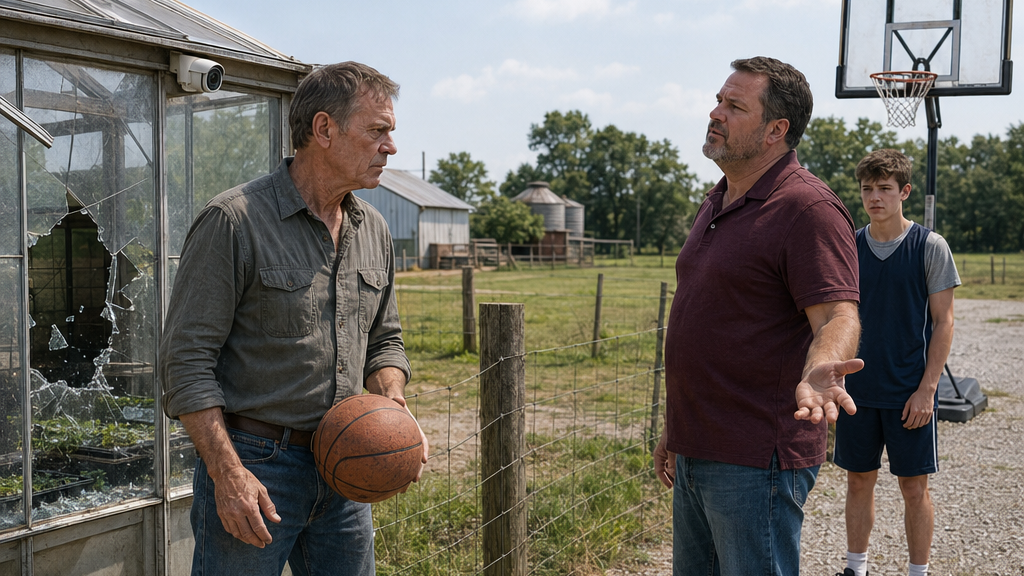
His Neighbor Called the Broken Farm Windows “Just Kids Playing”—Until the Camera Changed What Everyone Knew
Chapter 1: The Ball Came Through the Greenhouse Before Breakfast
The basketball came through the greenhouse before Gary Harris had finished his first cup of coffee.
He heard the impact from the feed room—a sharp crack followed by the brittle rush of glass falling onto concrete—and knew before he reached the greenhouse door that it was not a dropped tray or a loose pane giving way in its frame.
A basketball sat in the center aisle between two rows of seedling benches.
Tiny shards glittered across the damp floor around it.
One corner of a plastic tray had been crushed. Three tomato seedlings leaned sideways, their stems bent under a fan of broken glass. Above them, a jagged opening had appeared in the east wall of the old greenhouse, where one of the rectangular panes had been whole ten minutes earlier.
Gary stopped in the doorway.
For several seconds, he did nothing.
He could hear cattle bawling farther down the property and the steady click of the exhaust fan overhead. Then, from beyond the fence, came the hollow rhythm of another basketball hitting gravel.
Once.
Twice.
Gary stepped carefully around the glass and picked up the ball.
It was dusty, orange, and familiar.
He carried it outside.
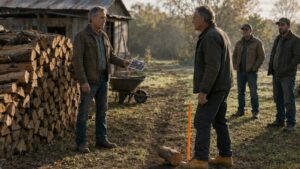
The adjoining Lewis property began less than forty yards from the greenhouse. A narrow strip of grass and woven-wire fence separated Gary’s work yard from a broad gravel turnaround beside the old Lewis farmhouse. Someone had set a portable basketball hoop near the edge of that turnaround.
The backboard faced Gary’s property.
Joshua Lewis stood beneath it.
The seventeen-year-old froze when he saw Gary coming.
Andrew Lewis was farther back beside a pickup, looking at his phone.
Gary held up the ball.
“Morning.”
Andrew glanced over. “Morning.”
“This came through my greenhouse.”
Joshua looked at the ground.
Andrew put his phone in his pocket and walked closer. “He missed one.”
Gary turned and pointed toward the broken pane.
“That’s more than a miss.”
Andrew squinted at the greenhouse as if the distance might change the size of the hole.
“Sorry about that,” he said. “Josh, you hear him? Be more careful.”
Joshua nodded quickly. “Yes, sir.”
Gary waited.
Andrew seemed to think the matter was settled.
Gary lowered the ball. “I’d appreciate it if you moved the hoop.”
Andrew’s expression changed almost too slightly to call it a change.
“Moved it where?”
“Turn it toward your barn. Or farther up the drive.”
“There’s no flat ground up there.”
“You’ve got plenty of room.”
Andrew looked toward the hoop, then back at Gary.
“It was one bad shot.”
Gary could feel irritation pushing against the back of his throat, but he kept his voice level.
“One bad shot put glass over my seedlings.”
“Then I’ll pay for the pane.”
“That isn’t really what I’m asking.”
Andrew gave a short breath that might have been a laugh.
“Gary, he’s seventeen. He plays basketball. Balls get away from kids.”
Gary looked at Joshua.
The boy’s shoulders had drawn inward.
“I understand that,” Gary said. “That’s why I’m asking you to point the hoop somewhere a missed shot doesn’t come through my building.”
Andrew folded his arms.
“This hoop is on my land.”
“I didn’t say it wasn’t.”
“And he’s not shooting at your greenhouse.”
“I didn’t say he was.”
“Then we’re talking about an accident.”
Gary looked past him at the rim. The angle was obvious. A shot long off the back iron, or a ball thrown too hard off the board, had almost nowhere to go except toward the fence and his greenhouse beyond it.
His father would have handled this with fewer words.
Gary could almost hear him: Neighbors have to live with each other after the argument is over.
That rule had carried Gary through stray cattle, broken fence wire, borrowed equipment returned late, and drainage water that crossed lines no survey stake could make it respect.
So he handed the ball to Joshua.
“I’m not trying to make trouble,” Gary said.
“I know,” Andrew replied, though his tone suggested the opposite.
“Just move it enough that we don’t have to have this conversation again.”
Andrew looked at the hoop one more time.
“I’ll make sure he’s more careful.”
It was not an answer.
Gary knew it.
Andrew knew it.
Joshua certainly knew it.
But Gary nodded anyway.
“All right.”
Back inside the greenhouse, Gary swept the glass into a heavy dustpan. The more he cleaned, the more annoyed he became—not at Joshua, exactly, and not even at the broken pane.
It was Andrew’s certainty that bothered him.
One accident. One apology. Finished.
Gary removed the damaged tray, checked the seedlings beneath it, and taped cardboard over the opening until the glass-repair contractor could come out.
He was carrying the broom back toward the wall when he noticed a crescent-shaped indentation in the aluminum frame beneath the broken pane.
He crouched.
The metal had been pushed inward and scraped clean through years of oxidation.
Gary touched it with his thumb.
It was not fresh.
A faint orange scuff still marked the lower edge.
He straightened slowly and looked through the cardboard-covered opening toward the Lewis hoop.
The ball that had come through that morning had not been the first one to reach his greenhouse.
Chapter 2: One Repair Bill Became Two Broken Promises
Susan Carter placed two invoices on top of Gary’s feed ledger and tapped them with one finger.
“You want to tell me why I’m seeing two glass charges in six days?”
Gary kept sorting receipts.
“One is the pane.”
“I can read.”
“The other is the temporary boarding and call-out.”
Susan pulled out the chair opposite him. She handled the farm books two afternoons a week and regarded unnecessary expenses with the same suspicion Gary reserved for a lame steer pretending not to limp.
“How much did Andrew say he was paying?”
“He said he’d cover the pane.”
“Did he?”
“Not yet.”
Susan stared at him.
Gary finally looked up.
“What?”
“You’re doing that thing.”
“I don’t have a thing.”
“You do. You decide being patient means nobody can accuse you of being unreasonable.”
Gary pushed the invoices together.
“The man moved back three months ago. I’m not starting a feud over one window.”
Susan slid the second invoice back toward him.
“Two charges.”
“One window.”
“For now.”
Gary disliked the last two words because he had already thought them himself.
The specialty greenhouse glass had cost more than Andrew expected. The contractor had explained that the old dimensions were no longer standard and the pane needed to be cut to fit. Andrew’s reaction, when Gary mentioned the price, had been disbelief rather than apology.
That afternoon Gary found Joshua near the fence.
The boy had the basketball under one arm but was not shooting.
“Mr. Harris?”
Gary stopped.
Joshua rubbed the toe of one sneaker into the gravel.
“I’m sorry about the glass.”
“I know.”
“I wasn’t trying to hit it.”
“I know that too.”
Joshua glanced toward the farmhouse.
“My dad said he’ll pay.”
“That’s between him and me.”
The boy nodded but did not leave.
Gary waited.
Joshua looked as if he wanted to say more, then seemed to think better of it.
“I’ll watch it,” he said.
Gary studied him.
“Watch what?”
“My shots.”
Gary pointed to the hoop.
“You could also turn that thing.”
Joshua’s mouth tightened.
“I know.”
Before Gary could ask what that meant, Andrew stepped out of the house.
“Everything okay?”
Joshua immediately moved away.
Gary noticed that.
“Fine,” he said.
Andrew came down the steps holding an envelope.
“Here.”
Inside was enough cash to cover the replacement pane, not the contractor’s emergency visit.
Gary counted it once and stopped.
“You didn’t need cash.”
“Cash spends.”
“I meant you didn’t need to come short.”
Andrew frowned.
“I’m paying for the window.”
“The boarding was because of the window.”
“That’s a service charge. That’s between you and your contractor.”
Gary felt the old instinct telling him not to push.
He ignored it for half a second.
“You said you’d cover the damage.”
“I am.”
“Most of it.”
Andrew’s jaw shifted.
“Gary, I’m trying to be decent here.”
“So am I.”
“Then take the money and let’s be done.”
Gary looked at Joshua, who was standing twenty feet away with his back to them.
“You moving the hoop?”
Andrew gave him a tired look.
“We already talked about that.”
“We did. You never answered.”
“I told Josh to be careful.”
“And if he misses?”
“He’ll miss somewhere else.”
Gary almost laughed, but there was nothing funny in it.
Andrew stepped closer, lowering his voice.
“He’s had a rough year. He finally has something he wants to do out here. I’m not taking it away because one shot went wrong.”
“I’m asking you to turn it.”
“It’s staying.”
Gary folded the envelope closed.
For a moment, he considered handing it back.
Instead, he slipped it into his shirt pocket.
“All right.”
Andrew relaxed slightly, hearing surrender where Gary had meant only an end to the conversation.
For two days, nothing happened.
Gary repaired irrigation lines, hauled mineral blocks to the lower pasture, and stopped looking toward the Lewis property every time he heard a basketball strike the backboard.
He told himself the payment had changed things.
He told himself Joshua had understood.
He told himself Andrew’s stubbornness did not matter if the boy was careful.
Late Thursday afternoon, Gary walked from the equipment barn toward his pickup and heard the familiar hollow thump.
Then the sharper clang of metal.
He turned.
A basketball rolled away from the tractor shed door.
Joshua came running from the other side of the fence.
“Sorry!”
Gary walked to the shed.
A fresh shallow dent sat in the lower panel.
It was not serious. It would not stop the door from opening. It might not even be worth repairing.
That almost made it worse.
Joshua stopped at the fence.
“I lost it off the rim.”
Gary stared at the dent.
“Your dad home?”
“No.”
Gary picked up the basketball.
Joshua waited for him to toss it back.
Gary carried it to the fence instead and set it on the top post.
“The window was an accident,” he said.
Joshua said nothing.
“This one was an accident too?”
“Yes, sir.”
Gary looked toward the hoop, then at the dent, then at the greenhouse beyond it.
Two accidents had now followed the same path.
He left the ball on the post.
That evening, instead of calling Andrew, Gary opened his laptop and searched for a small outdoor camera.
Chapter 3: Gary Stopped Arguing and Mounted One Small Camera
The drill bit squealed against the greenhouse eave at seven thirty Saturday morning.
Gary backed the screw out, shifted the camera bracket half an inch, and drove it in again.
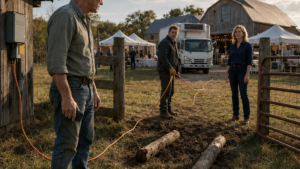
He had chosen a small unit with a wide field of view. From beneath the roofline it covered the greenhouse wall, the fence, part of the gravel turnout, and the basketball hoop beyond it.
He did not aim it at the Lewis house.
He checked twice.
When the camera connected to his phone, the frame showed exactly what he wanted: his own property and the direction from which the balls kept arriving.
By eight fifteen, Andrew was standing at the fence.
“What’s that?”
Gary stayed on the ladder.
“Camera.”
“I can see that.”
Gary tightened the last screw.
Andrew pointed toward the lens.
“That thing recording my son?”
“It’s recording my greenhouse.”
“Don’t play games.”
Gary climbed down.
“I’m not.”
Andrew looked past him at the camera angle.
“You put up a camera because of a basketball?”
“I put up a camera because I’ve got broken glass, a dented shed, and no record of half of it.”
“I paid you.”
“You paid for one pane.”
“I paid what I owed.”
Gary wiped metal dust from his hands.
“That’s what we disagree about.”
Andrew’s face hardened.
“So now you’re watching us.”
“No. I’m documenting what comes onto my property.”
“Same difference.”
“It isn’t.”
Andrew stepped closer to the fence.
“If you’ve got something to say about Josh, say it to me.”
Gary felt the old temptation to explain himself until Andrew approved of the explanation.
He let the silence sit instead.
“I already did,” Gary said.
Then he picked up his drill and walked back toward the greenhouse.
Andrew called after him.
“You’re turning this into something it doesn’t need to be.”
Gary did not answer.
For most of the morning, nothing happened.
He transplanted seedlings, replaced two warped boards on a bench, and tried not to check the camera feed.
At eleven twenty, the first ball crossed the fence.
It bounced once in the grass and rolled against the greenhouse foundation.
Gary watched the clip.
Joshua had taken a shot from several feet left of the hoop. The ball hit the rim and sailed long.
At eleven forty-three, another ball entered the frame.
This one struck the fence and dropped back onto Lewis property.
At noon twelve, a third bounced against the gravel near Gary’s equipment barn.
Gary saved each clip.
None caused damage.
That mattered.
He did not want proof that made Andrew look worse than reality. He wanted a record of what reality actually was.
Shortly after one, Gary heard voices outside.
Andrew had joined Joshua near the hoop.
Gary could not make out every word through the greenhouse wall, but he heard Andrew laugh after a missed shot.
Then he heard the ball strike the rim hard.
The next sound was glass.
Gary closed his eyes once.
When he opened them, a basketball had landed between two seedling trays.
A pane on the side wall had burst inward.
Joshua stood motionless beyond the opening.
Andrew appeared behind him.
“Damn it.”
Gary walked carefully through the broken glass and picked up the ball.
Andrew was already approaching the fence.
“It took a bad bounce.”
Gary said nothing.
“I saw it,” Andrew continued. “Came off the side of the rim.”
Gary stepped outside.
The ball was dusty in his hands. One fine shard of glass clung to a seam in the rubber.
Andrew raised both palms.
“I’m not saying it didn’t happen.”
Gary crossed the grass to the fence and set the ball on the top post.
Then he lifted one hand and pointed toward the camera under the greenhouse eave.
Andrew followed the gesture.
His expression changed.
“Come inside,” Gary said.
“What for?”
“Come see it.”
Joshua remained near the hoop.
Andrew hesitated, then walked around to Gary’s gate.
Inside the farm office, Gary opened the camera application and selected the morning timeline.
He did not start with the broken window.
He played the first clip.
The ball sailed over the fence.
Then the second.
Then the third.
Andrew watched without speaking.
Gary played the final clip.
Joshua took the shot.
The ball hit the rim and flew toward the greenhouse.
Glass exploded inward.
Gary paused the image.
Andrew folded his arms.
“So?”
Gary looked at him.
“So this wasn’t one bad bounce.”
“They’re all bad bounces.”
“They’re all coming the same direction.”
“Because the hoop faces this way.”
Gary waited.
Andrew seemed to hear what he had said only after the words were already out.
“That’s what I’ve been telling you.”
Andrew shook his head.
“No. What you’ve been telling me is where to put things on my property.”
“I’ve been telling you where the misses go.”
“It’s still an accident.”
Gary replayed another clip.
Joshua had moved several feet to one side of the hoop before taking the shot, apparently trying to change the angle. The miss still crossed the boundary.
Then another clip showed him dragging the ball farther around, shooting again.
Andrew leaned toward the screen.
Gary noticed something he had missed earlier.
Joshua was not simply repeating the same careless shot.
He had been adjusting where he stood.
Trying, perhaps, to keep the ball away from the greenhouse without moving the hoop itself.
Andrew straightened.
“I’ll pay for this pane.”
Gary closed the laptop.
“That still doesn’t solve it.”
“I said I’ll pay.”
“And next week?”
“There won’t be a next week.”
“You said that last time.”
Andrew’s cheeks reddened.
“You want me to say you were right?”
“I want the hoop turned.”
“It’s not happening.”
Gary stared at him.
For the first time, Andrew no longer had the excuse that he did not believe the frequency.
He had seen it.
He had watched each ball cross the line.
And he was still refusing the simplest solution.
Andrew left without another word.
Gary went back to the greenhouse.
Joshua was waiting outside the fence.
The basketball remained on the post between them.
Gary started toward the broken pane.
“Mr. Harris?”
He stopped.
Joshua spoke so quietly Gary almost missed it.
“I told him we should move it.”
Gary turned.
Joshua looked toward his house before meeting Gary’s eyes.
“I told him before the first window broke.”
Chapter 4: The Boy Was Not Defending His Father Anymore
Joshua was waiting at the fence the next morning with the basketball tucked under one arm.
He was not dribbling it. He was not shooting. He simply stood beside the top wire, shifting his weight from one foot to the other while Gary carried a bucket of mineral supplement toward the equipment barn.
Gary nearly kept walking.
Then Joshua said, “Mr. Harris?”
Gary stopped.
The basketball looked different held still. For weeks it had appeared in motion—crossing a fence, striking metal, lying among glass. Now it rested against the boy’s ribs like an object neither of them knew what to do with.
“You said yesterday you told your dad to move the hoop.”
Joshua nodded.
“When?”
“Before your first window broke.”
Gary set the bucket down.
“Why?”
Joshua looked toward the Lewis farmhouse.
“Because I knew where the misses were going.”
That answer landed harder than Gary expected.
“You knew.”
“I hit your fence a couple times.”
Gary thought of the old crescent dent in the greenhouse frame.
“A couple?”
Joshua rubbed his palm across the ball.
“I don’t know. Three maybe. One hit the greenhouse before the window. I thought it just hit the metal.”
Gary said nothing.
Joshua rushed to fill the silence.
“I told Dad the hoop should go over by the barn. There’s a concrete pad there, but he said the rim would be too close to the equipment.”
“So he left it facing my greenhouse.”
Joshua winced.
“He said you had plenty of room over here.”
Gary felt anger rise, but it did not settle where he expected.
Not on the boy.
“What did he say after the first window?”
Joshua stared at the gravel.
“That you were making it bigger than it was.”
Gary folded his arms.
“And what did you think?”
“That I broke your window.”
The simplicity of it stopped him.
Joshua continued. “I offered to pay part of it.”
“With what?”
“I work some afternoons at the feed store.”
Gary shook his head. “Your dad told you no?”
“He said it wasn’t my job to let a neighbor tell us what we could do on our own land.”
There it was.
Not an argument about basketball.
Not even an argument about money.
A line had been drawn in Andrew’s head, and moving the hoop had somehow become surrender.
Joshua finally looked up.
“He kept saying you were trying to control us.”
Gary leaned against the barn post.
“I never cared where you played.”
“I know that now.”
“You didn’t before?”
Joshua hesitated.
“Dad said you’d complained about the turnaround before.”
Gary frowned. “I asked him not to block the gate with his trailer.”
“He made it sound like you’d been after him since we moved in.”
Gary remembered that conversation. Andrew’s utility trailer had sat half across Gary’s secondary gate for an afternoon. Gary had asked him to pull it six feet forward.
That had apparently become evidence.
Joshua bounced the ball once before catching it immediately, almost embarrassed by the sound.
“I shouldn’t have kept shooting there.”
“No.”
“I thought if I changed where I stood, I could keep the misses away.”
Gary remembered the camera clips—the boy shifting left, then farther back.
“You were trying.”
“I was also being stupid.”
Gary almost smiled.
“That part I won’t argue with.”
Joshua gave a weak laugh.
Then Gary’s expression settled.
“Trying to compensate for a bad setup doesn’t make the setup good.”
“I know.”
“And apologizing doesn’t replace the glass.”
“I know that too.”
Gary watched him absorb both statements without complaint.
The boy was not asking to be excused.
That mattered.
For weeks Gary had pictured father and son as one unit on the other side of the fence. Andrew dismissing. Joshua continuing. The two of them effectively saying the same thing with different behavior.
But the camera had shown something Gary had missed.
Joshua had been adjusting.
And now the boy was standing here voluntarily, admitting more than Andrew had.
Gary picked up the mineral bucket.
“Go move the hoop.”
Joshua looked toward the house again.
“I can’t.”
“It’s portable.”
“I mean Dad’ll move it back.”
Gary exhaled slowly.
“That’s between you two.”
A truck door slammed.
Andrew was coming across the turnaround.
His pace quickened when he saw Joshua at the fence.
“What’s going on?”
Joshua turned.
“Nothing.”
Andrew looked at Gary. “You talking to my kid about this again?”
“He came to me.”
“That doesn’t mean you need to drag him into an adult dispute.”
Gary stared at him.
“Andrew, he is the one holding the basketball.”
“That doesn’t make this his problem.”
Joshua’s face tightened.
“Dad—”
Andrew raised a hand. “Go inside.”
“I was just telling him—”
“Inside.”
Joshua did not move.
Gary noticed that Andrew noticed.
The silence sharpened.
Finally Joshua lowered the ball.
“I told him I wanted to move the hoop.”
Andrew’s eyes went to him.
“You don’t need to explain yourself.”
“I’m not.”
“Josh.”
“I told you before the window broke.”
Andrew’s jaw tightened.
“Inside.”
Joshua looked at Gary once, then walked toward the house carrying the basketball against his hip.
Andrew waited until he was out of earshot.
“You need to quit putting him in the middle.”
Gary felt something inside him harden.
“I didn’t put him there.”
“You’ve got cameras on him. You’re talking to him at the fence. What do you call that?”
“I call it a boy apologizing for something his father keeps calling nothing.”
Andrew stepped closer.
“You want money? Fine. You want repairs? Fine. But stop telling me how to run my property and stop involving my son.”
Gary studied him.
There was anger in Andrew’s face, but beneath it was something tighter. Fear, perhaps. Or shame.
Gary did not yet know which.
He only knew that pushing harder now would give Andrew another excuse to make the argument about control.
So he nodded once.
“All right.”
Andrew seemed surprised.
Gary picked up the bucket.
“From now on, I’ll deal with you.”
“Good.”
“And anything else you want from me, you can put in writing.”
Andrew’s mouth tightened.
“No,” he said. “Anything else you want from me, you put in writing.”
Gary stopped.
Andrew pointed toward the greenhouse.
“No more fence-line lectures. No more verbal numbers. If you think I owe you something, write it down.”
Then he walked away.
Gary stood beside the barn with the mineral bucket in his hand.
For weeks he had avoided paper because paper felt like escalation.
Now Andrew had demanded it.
Chapter 5: The Numbers Made Silence More Expensive Than Conflict
The farm-insurance adjuster looked at the dent in the tractor-shed door, then at Gary.
“When did this happen?”
“Thursday.”
“And you reported it Saturday.”
“Yes.”
The adjuster wrote something on a tablet.
“What about the first greenhouse impact?”
Gary hesitated.
“The broken pane?”
“No. The earlier strike on the frame.”
Gary looked toward the crescent dent he had found beneath the old glass.
“I don’t know when that happened.”
“Any photograph?”
“No.”
“Witness?”
“No.”
“Camera footage?”
“That was before the camera.”
The adjuster lowered the tablet.
“So you can’t establish when it happened or what caused it.”
Gary disliked the tone, even though the man was only stating what Gary already knew.
“No.”
They moved to the second broken pane. The replacement glass had not arrived yet, and plywood still covered the opening.
“And the first pane?”
“I have the contractor invoice.”
“Photographs from the morning?”
“One on my phone.”
“Before cleanup?”
Gary thought about the shattered glass, the seedling tray, the basketball lying in the aisle.
He had taken the picture after sweeping most of the floor.
“After I’d started cleaning.”
The adjuster nodded.
“Mr. Harris, I’m not saying these things didn’t happen. I’m saying repeated property claims get harder, not easier, when the record starts halfway through.”
Gary looked across the fence.
The hoop still faced his property.
The adjuster continued. “If this turns into recurring damage, your carrier is going to ask what steps were taken to prevent it. They’ll also look at deductibles, frequency, whether pursuing reimbursement makes more sense than repeated claims.”
“So reporting it can cost me too.”
“Potentially.”
Gary almost laughed.
He had spent weeks trying not to make the problem larger. Somehow, by keeping it informal, he had made his own position weaker.
Inside the farm office, Susan was waiting with the ledger open.
She had already heard enough through the screen door to know how the inspection had gone.
“Sit.”
Gary remained standing.
“I’m fine.”
“Sit anyway.”
He sat.
Susan turned the ledger toward him.
The numbers were written in her narrow, exact hand.
Emergency boarding.
Replacement pane.
Custom cutting.
Second temporary cover.
Damaged seedlings.
Contractor mileage.
She had drawn a line under the total.
Gary stared at it.
“That includes the first service call Andrew didn’t pay.”
“Yes.”
“And seedlings?”
“They were product.”
“They were six trays.”
“They were inventory.”
Gary rubbed his forehead.
“I’m not billing him for every tomato plant.”
“I didn’t say you should.”
“Then why put it there?”
“Because you keep talking like the only cost is a square of glass.”
Susan tapped the ledger.
“This is what it cost you.”
Gary looked at the figure again.
“And this,” she added, “doesn’t include your time.”
“I’m not charging my neighbor for sweeping.”
“That isn’t my point.”
“What is?”
“My point is you’ve been deciding what matters based on what keeps Andrew calm.”
Gary looked up sharply.
Susan did not move.
“You didn’t photograph the first damage properly. You didn’t write anything down. You accepted cash without a receipt. You let him decide that paying one pane ended the conversation.”
“I was trying not to turn two farms into a courthouse.”
“You always say that like the only choices are silence or war.”
The sentence stayed in the room.
Gary looked at his father’s old ledger on the shelf above the desk. The leather spine had cracked years ago. His father had settled plenty of disagreements with handshakes, borrowed tractors, replaced fence posts, and conversations held over tailgates.
But Gary remembered something else now.
His father wrote everything down.
Not because he distrusted people.
Because memory changed when money and pride entered the room.
Gary pulled a blank sheet of paper toward him.
“What can I actually prove?”
Susan sat back.
“Now you’re asking the right question.”
They removed the old frame dent.
No date. No proof.
They removed the tractor-shed dent from the financial demand. The damage was visible and recent, but Gary had no repair estimate and had no intention of replacing the door over a shallow depression.
They kept the first broken pane, minus the amount Andrew had already paid.
They kept the second pane and temporary boarding.
They kept only the damaged seedlings visible in Gary’s photograph.
Susan pointed at the remaining total.
“That’s less than the farm actually lost.”
“I know.”
“You comfortable with that?”
Gary considered it.
“Yes.”
Susan nodded.
“Then that’s a claim, not revenge.”
By late afternoon, Gary had drafted one page.
No threats.
No inflated figures.
No accusation that Joshua had acted intentionally.
He listed dates, documented damage, payments received, and the remaining balance. He attached copies of the contractor invoices and still images from the camera.
At the bottom he added one request separate from the money:
Relocate or reorient the basketball hoop so routine misses no longer enter Harris property.
He read the sentence three times.
It seemed almost absurd that this much paper had grown from something so simple.
The next morning Gary walked the envelope across the gravel.
Andrew was beside his pickup.
Gary handed it to him.
“You asked for it in writing.”
Andrew stared at the envelope.
“What is this, some legal notice?”
“It’s the amount I can document.”
Andrew opened it there.
His eyes moved down the page.
Then back up.
“You’re charging me for plants now?”
“Only the trays damaged in the second break.”
“This is ridiculous.”
“I left out the shed.”
Andrew gave a sharp laugh.
“How generous.”
“I left out the old frame dent too.”
“So you’re admitting you don’t know if that was us.”
“I’m admitting I can’t prove it.”
Andrew looked at the attached photographs.
“And these camera shots are supposed to prove what? That a kid misses baskets?”
“They prove where the misses go.”
Andrew folded the papers once.
“This isn’t about the money anymore.”
“No.”
“You’re punishing me because I wouldn’t move the hoop.”
Gary almost answered immediately.
Instead, he looked at Andrew’s face and realized something had changed.
The amount was lower than Andrew had feared.
No speculative damage. No threat. No inflated claim.
Andrew had asked for paper expecting anger converted into numbers.
Gary had given him restraint converted into numbers.
And somehow that seemed to bother him more.
“I’m asking you to pay what’s documented,” Gary said. “And fix the setup that keeps causing it.”
Andrew shoved the papers back into the envelope.
“I’m not paying this.”
“Then don’t.”
Andrew blinked.
Gary continued.
“But I’m not going back to pretending we don’t know what’s happening.”
He turned and walked home.
That evening, Gary made one final change to his copy of the demand.
He crossed out a sentence Susan had suggested about “all resulting losses.”
In its place he wrote:
Only documented, directly attributable repair costs are included.
For the first time since the original pane broke, Gary felt no need to make Andrew agree that he was reasonable.
The paper itself showed it.
Chapter 6: Andrew Finally Said What the Argument Was Really About
Andrew arrived at the shared gravel entrance two mornings later carrying Gary’s demand envelope so neatly folded it looked as if he had never opened it.
Gary was checking the latch on a cattle trailer.
Andrew stopped ten feet away.
“You got a minute?”
Gary closed the latch.
“I’ve got one.”
Andrew held up the envelope.
“I’m not signing anything.”
“There’s nothing to sign.”
“You know what I mean.”
Gary waited.
The portable hoop was visible behind Andrew, exactly where it had always been.
Andrew looked toward it.
Then away.
“You think this is about me refusing to pay you.”
“I think you owe me for documented damage.”
“That’s not what I said.”
Gary leaned against the trailer.
Andrew rubbed the edge of the envelope between his fingers.
“I moved back here because I was trying to fix things.”
“With Joshua?”
Andrew looked at him sharply.
Gary shrugged. “You’ve mentioned he had a rough year.”
For a moment Andrew appeared ready to shut down the conversation.
Instead he looked toward the Lewis house.
“His mother and I separated.”
Gary said nothing.
“I stayed closer to town for work. He stayed with her. Then things got… difficult.”
Andrew paused.
“He stopped talking to me unless he had to. Stopped wanting to come over. Basketball was about the only thing we could do together without turning everything into a conversation neither of us wanted.”
Gary looked at the hoop.
Andrew followed his gaze.
“When I got the family place back into shape enough for us to stay there, I told him we could put a hoop up. Told him he’d have room. Told him things would be different.”
“And then I asked you to move it.”
Andrew’s mouth tightened.
“You didn’t just ask.”
“Yes, I did.”
“You stood there pointing at my land like you knew better.”
“About where basketballs were landing? I did.”
Andrew looked down at the envelope.
“The first time you said move it, all I heard was somebody else telling me I’d made another bad decision for my son.”
The admission came quietly.
Gary felt some of his anger change shape.
Not disappear.
Change.
“So you left it there.”
Andrew nodded once.
“Stupid, maybe.”
“Stubborn.”
“That too.”
Gary glanced at him.
Andrew almost smiled but did not.
“The money’s tight,” Andrew said. “I’m fixing the roof. The well pump went out three weeks after we moved in. I’ve got legal bills from the separation. Then you walk over with a glass bill and tell me the hoop has to move.”
“So you decided I was the problem.”
“I decided I wasn’t going to let one more person tell Joshua his life had to change because adults couldn’t get their act together.”
Gary looked at the gravel between them.
“That sounds good.”
Andrew frowned.
“But?”
“But the glass still broke.”
Andrew’s shoulders lowered slightly.
Gary continued. “Understanding why you did it doesn’t put the panes back.”
“I know.”
It was the first time Andrew had said those words without following them with an excuse.
A pickup slowed on the county road before turning toward the feed store. The driver lifted two fingers from the steering wheel. Gary returned the gesture automatically.
Andrew watched the truck go.
“When people around here hear about this,” he said, “they’re going to make Josh into some spoiled kid breaking things for fun.”
“Who said anybody needs to hear about it?”
“You’ve got camera footage. Insurance. Paperwork.”
“That isn’t the same as putting it around town.”
Andrew studied him.
Then he held out the envelope.
“Put it on him.”
Gary did not take it.
“What?”
“The claim. Say Joshua caused it. He works. He can pay you over time.”
Gary stared at him.
Andrew spoke faster.
“He’s seventeen. He made the shots. Let him learn something from it. You said you wanted accountability.”
The word sounded wrong in his mouth now.
Gary straightened.
“You want me to collect repair money from your son.”
“He caused the damage.”
“And who refused to move the hoop?”
Andrew’s expression closed.
“Don’t do that.”
“Who told him to keep playing there?”
“I never told him to break your windows.”
“No. You told him I was overreacting.”
Andrew looked away.
Gary thought about Joshua standing at the fence, holding the basketball motionless.
The boy had admitted fault before his father had.
He had asked for the solution before either adult had managed to reach it.
“No,” Gary said.
Andrew looked back.
“No what?”
“I’m not making Joshua carry your part because it’s cheaper for you.”
“That isn’t what this is.”
“It’s exactly what this is.”
Andrew’s face reddened.
“You don’t know anything about what I’m trying to do for him.”
“You’re right.”
Gary’s answer stopped him.
“I don’t know what happened in your marriage. I don’t know what promises you made him. I don’t know what it cost you to come back here.”
Gary pointed toward the hoop.
“But I know what happened after I asked you to turn that around.”
Andrew said nothing.
“I should’ve put things in writing sooner,” Gary continued. “I should’ve taken pictures. I kept telling myself being neighborly meant keeping everything informal.”
He shook his head.
“That was my mistake.”
Andrew’s anger softened into uncertainty.
“But your mistake doesn’t become Joshua’s bill.”
The hoop stood behind him, rim facing Gary’s greenhouse.
Gary nodded toward it.
“The boy made bad shots. He should own that. You made the decision to leave the risk in place after everybody knew about it. You own that.”
Andrew lowered the envelope.
Neither man spoke for several seconds.
Then Andrew asked, “What do you want me to do if I can’t pay the whole thing now?”
It was not an agreement.
Not yet.
But it was the first question Andrew had asked that treated the damage as real.
Gary picked up the trailer latch again.
“We’ll talk about what you can pay.”
“And the rest?”
“You move the hoop.”
Andrew looked toward his property.
Gary did not soften the condition.
“The adults will settle what the adults allowed,” he said.
Andrew stood with the envelope at his side, staring past Gary toward the repaired and boarded sections of greenhouse wall.
For once, he had no argument ready.
Chapter 7: The Hoop Moved Before Either Man Called It an Apology
Gary woke to the scrape of metal wheels dragging over gravel.
At first he thought someone was moving a feeder.
Then came another long scrape, followed by the hollow bounce of a basketball.
He pulled on his boots and stepped outside.
Across the fence, Joshua had both hands wrapped around the base of the portable hoop. He was leaning backward, dragging it inch by inch away from the turnaround.
The rim no longer faced Gary’s greenhouse.
Joshua stopped when he noticed him.
For a moment neither spoke.
“You doing that by yourself?” Gary asked.
Joshua wiped his forehead with his sleeve. “Trying to.”
The hoop had barely traveled twenty feet. Its weighted base caught on every patch of loose stone.
Gary looked toward the Lewis farmhouse.
“Your dad know?”
Joshua glanced in the same direction.
“He will.”
That answer told Gary enough.
Joshua bent down and pulled again.
The base jumped forward, then twisted sideways.
The basketball rolled from where Joshua had left it near the fence and came to rest beside Gary’s boots.
Gary picked it up.
“You planning to put that thing by the barn?”
“There’s a slab behind it.”
“The one you mentioned before?”
Joshua nodded.
“It faces the hayfield.”
Gary turned the ball slowly in his hands.
No greenhouse.
No tractor shed.
No neighbor’s windows.
Just open ground.
Joshua took hold of the hoop again.
Before he could pull, the farmhouse door opened.
Andrew stepped outside.
Gary expected his voice before it came.
“Josh.”
Joshua stopped.
Andrew crossed the turnout slowly.
He looked at his son, at the hoop halfway between its old location and the barn, and finally at Gary holding the basketball.
Gary felt the old tension return.
For weeks every conversation had reached this exact point—the moment when Andrew could either solve the problem or defend his pride.
Joshua straightened.
“I’m moving it.”
Andrew’s eyes remained on the hoop.
“I can see that.”
“I should’ve done it before.”
Gary saw Joshua brace himself.
Andrew walked to the weighted base.
He put one boot against it.
Then he bent, grabbed the frame beside Joshua, and said, “Lift your side.”
Joshua stared at him.
“What?”
“Lift it. You’re digging a trench through the gravel.”
Together they raised the front edge.
The wheels rolled.
Neither father nor son looked at Gary as they pulled the hoop toward the barn.
Gary remained beside the fence holding the basketball.
Something in him wanted a sentence.
Not necessarily an apology. Just an acknowledgment that the weeks of broken glass, invoices, arguments, and camera clips had not been some invention of his.
But when Andrew and Joshua reached the concrete slab, Andrew turned the hoop until the backboard faced the open hayfield.
Then he stepped behind it and looked along the shooting line.
Nothing stood there except pasture.
That was enough for the moment.
Gary placed the basketball on the fence post and went to check the cattle.
Later that morning, Andrew found him inside the greenhouse.
The final replacement pane had arrived the day before. The glass-repair contractor was fitting it into the old aluminum frame while Gary cleared trays from the aisle.
Andrew stood in the doorway.
He held an envelope.
Gary looked at it, then at him.
“That the same one?”
“No.”
Andrew stepped inside carefully.
He watched the contractor press the new pane into place.
“I can’t pay the whole balance today.”
Gary set down a tray.
Andrew handed him the envelope.
Inside was cash and a handwritten note listing three future payment dates.
Gary read it once.
“You came up with this?”
Andrew nodded.
“It’s what I can do without missing the mortgage.”
Gary looked at the amounts.
They were reasonable.
No interest. No penalties. No attempt to make the debt larger than the repairs.
Gary folded the note.
“This works.”
Andrew seemed almost suspicious.
“That’s it?”
“That’s what I asked for.”
Andrew rubbed the back of his neck.
“I thought you’d want something official.”
“I want us both to remember what we agreed.”
Gary walked into the farm office and returned with two copies of a single-page agreement.
The language was plain.
Documented repair balance.
Three payments.
The basketball hoop and any similar practice setup would remain oriented away from Harris property.
If future accidental damage occurred, they would notify each other promptly and document it.
Nothing about fault beyond what they had already established.
Nothing about Joshua.
Andrew read both pages.
“You already had this?”
“I drafted it after we talked.”
Andrew looked at Gary.
“A week ago, I’d have called this ridiculous.”
“I know.”
Andrew read the page again.
Then he signed.
Gary signed the second copy.
Each man kept one.
The contractor behind them lifted the replacement glass into position.
For several seconds the only sound in the greenhouse was the faint scrape of rubber gasket against aluminum.
Andrew looked toward the repaired wall.
“I made it worse.”
Gary did not rescue him from the statement.
Andrew continued.
“I kept thinking if I moved that hoop, then you were right about everything.”
“I wasn’t.”
Andrew frowned.
Gary nodded toward the invoices on the office desk.
“I should’ve documented the first damage. I should’ve been clearer sooner instead of acting like being patient would fix it.”
“That’s not the same as what I did.”
“No.”
Gary let that answer remain exactly as it was.
Andrew gave a small nod.
“I kept trying to prove something to Josh.”
Gary waited.
“That coming back here wasn’t another mistake.”
Outside, a basketball struck the new backboard near the barn.
Both men turned instinctively.
A second later came the clean metallic ring of the rim.
Then nothing.
No glass.
Andrew almost smiled.
“He wanted the hoop moved before you ever asked me.”
“I know.”
Andrew looked at him quickly.
Gary did not explain.
Joshua’s confidence had been given privately, and Gary intended to keep it that way.
Andrew seemed to understand.
He looked toward the barn again.
“I should’ve listened to him.”
The contractor called Gary over to inspect the seal.
When Gary turned back, Andrew was already walking toward the door.
“Andrew.”
He stopped.
Gary held up the payment note.
“Saturday after next?”
“I’ll have it.”
“All right.”
Andrew nodded.
No handshake.
No dramatic reconciliation.
Just an agreement between two men who had finally stopped arguing about whether the damage counted.
By early afternoon, the new pane was finished.
Gary removed the last sheet of plywood and carried it to the equipment barn. Sunlight came cleanly through the greenhouse wall again, laying bright rectangles across the concrete floor and the rows of seedlings.
For the first time in weeks, the east side of the greenhouse looked ordinary.
Susan came by near closing time and examined the repair.
“So?”
Gary handed her Andrew’s payment schedule.
She read it.
“He agreed to all this?”
“He did.”
“And the hoop?”
Gary pointed through the glass.
Far across the Lewis property, Joshua was shooting toward the hayfield.
Susan watched one shot hit the rim and fly long.
The ball bounced harmlessly into grass.
“Well,” she said. “That seems obvious.”
“It always was.”
She looked at Gary.
“You planning to say I told you so?”
“To who?”
“Me, for making you write it down.”
Gary gave her a look.
Susan smiled and returned the agreement.
“I’ll put the payments in the ledger.”
“No.”
She raised an eyebrow.
“I’ll do it.”
That surprised both of them.
Gary took the paper back.
There were some things he no longer wanted someone else keeping track of for him.
The final payment came when Andrew said it would.
No reminder was needed.
A week later, Gary found the basketball beside his fence after a hard wind had rolled it from the Lewis side. It had not crossed because of a missed shot. It had simply escaped.
He picked it up.
For a moment he considered leaving it on the fence post the way he had before.
Instead, he walked around through the shared entrance.
Joshua was near the barn adjusting the net.
Gary held out the ball.
“Think this belongs over here now.”
Joshua took it.
“Yes, sir.”
Behind him, Andrew was repairing a loose board on the old barn wall.
He looked over.
Gary gave a small nod.
Andrew returned it.
Joshua bounced the ball once on the concrete.
The sound was the same sound Gary had learned to tense at—the sharp hollow thump that had once meant another possible pane, another argument, another bill.
Joshua took his shot.
The ball struck the backboard, caught the rim, and dropped through the net.
Gary turned toward home before the next one.
The greenhouse stood behind him with every pane intact.
The story has ended.