They Called His Farm Pond Community Property—Then He Found the Agreement Beneath Their Access Road
Chapter 1: The Trailer Was Already Behind His Gate
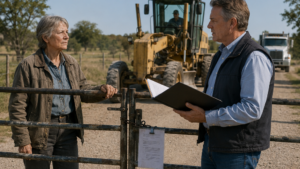
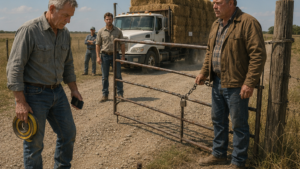
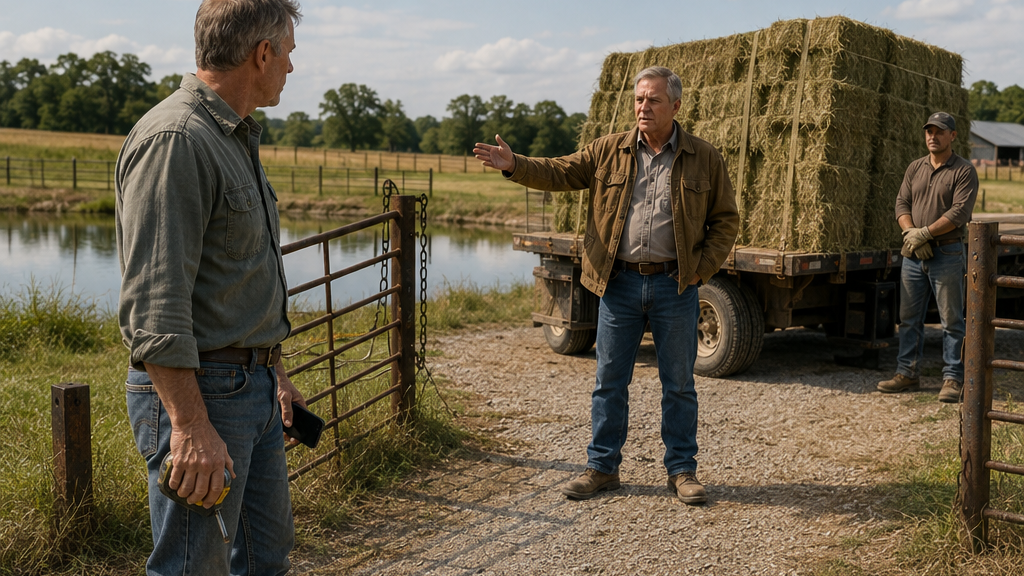
The hay trailer was already inside William Mitchell’s gate when he saw it.
He stopped his pickup halfway down the slope, one hand still on the wheel, and stared past the windshield at forty feet of stacked square bales sitting where nothing but his own equipment was supposed to be.
The old iron gate stood open.
That bothered him almost as much as the trailer.
William had chained it the evening before.
Beyond the turnout, the spring-fed pond lay still beneath the cottonwoods. His cattle were gathered along the far fence, watching the unfamiliar truck and trailer with the dull suspicion cattle reserved for anything that interrupted routine.
Three men stood beside the trailer.
Daniel Clark was one of them.
William shut off the pickup and stepped out.
Daniel saw him coming and raised a hand, not quite a greeting.
“We’ll be out of your way in twenty minutes.”
William looked at the open gate.
“How’d you get in?”
Daniel glanced toward one of the other men. “Gate wasn’t going to stop us from using the association access.”
William’s eyes settled on the chain hanging from the post. It had not been cut. Someone had lifted it over the old iron hook and left it dangling.
“My gate,” William said.
Daniel’s face tightened.
“The access predates your gate.”
William walked past him without answering. The trailer’s right tires had sunk an inch into the soft edge of the gravel turnout. Fresh crushed stone had been kicked toward the pond bank.
One of the other men shifted his weight.
Daniel said, “We’ve been bringing equipment through here for years.”
“Not like this.”
“It’s association access.”
William looked at him.
Daniel was in his early sixties, broad through the shoulders, with the rigid posture of a man accustomed to finishing meetings with the last word. He had chaired the private-road association for six years. William had disagreed with him plenty of times over grading schedules, culvert costs, and whose turn it was to clear storm debris.
They had never stood on opposite sides of an open gate before.
William reached into his pickup and took out his phone.
Daniel frowned. “What are you doing?”
“Taking pictures.”
“Of hay?”
“Of where the hay is.”
William photographed the trailer, the tire tracks, the gate, the disturbed gravel, then the line of the lane leading back toward the road.
The hay contractor looked uncomfortable.
“We were told this was cleared.”
William lowered the phone. “By who?”
The contractor glanced at Daniel.
Daniel said, “By the road association.”
William nodded once.
Then he walked to the gatepost.
Years earlier, when William and his father had reset that gate, they had left a rust-dark survey marker visible beside the lower hinge. Most people never noticed it. Time had buried half of it beneath grass and dirt.
William crouched and cleared the grass with his fingers.
The iron pin was still there.
Daniel watched him.
“What’s that supposed to prove?”
“Nothing yet.”
William went back to the pickup and retrieved a tape measure from behind the seat.
Daniel gave a short, irritated laugh. “You planning to survey it yourself now?”
“No.”
William hooked the tape at the marker and stretched it toward the gravel lane.
“I’m planning to understand what you’re claiming.”
Daniel folded his arms.
William looked up.
“What’s the recorded width of the association access?”
Daniel hesitated.
It was brief, but William saw it.
“The agreement gives agricultural access through here.”
“That wasn’t my question.”
“You know exactly what I mean.”
“I asked how wide it is.”
Daniel’s mouth flattened.
“It’s in the old agreement.”
“What width?”
Daniel looked toward the road as if the answer might be written there.
“William, this was settled decades ago.”
“What year?”
“Nineteen eighty-seven.”
That answer came immediately.
William reeled the tape back in.
“So you know the year.”
“I know the agreement.”
“But not the width.”
Daniel stepped closer.
“You’re making a problem where there hasn’t been one.”
William felt the old urge to end the conversation with a locked gate and no further explanation. It was the same instinct he had carried since his father died: say less, give nothing away, let the property lines speak for themselves.
Instead he pointed at the trailer.
“You made the problem when you brought forty feet of somebody else’s equipment through my gate without asking.”
Daniel’s expression hardened.
“We didn’t need permission.”
The words landed differently than William expected.
Not because Daniel sounded angry.
Because he sounded certain.
William looked from him to the pond, then toward the short lane curling behind the turnout.
“What exactly do you believe belongs to the association?”
“The access lane.”
“Only the lane?”
“The usable access.”
“That means what?”
Daniel gestured broadly. “The lane, the turnout, the approach by the pond. Whatever is reasonably necessary.”
William stared at him.
“The pond approach?”
“It has always been used.”
“Used isn’t the same as owned.”
“Nobody said owned.”
“You just opened my gate and parked behind it.”
Daniel exhaled.
“Rules are rules, William. You don’t get to close a shared access because you’ve decided you don’t like people using it.”
The contractor looked down.
William felt heat move into his face, but he kept his voice even.
“Move the trailer.”
“We’ll move when the hay is unloaded.”
“It isn’t being unloaded here.”
“It’s going through to the lower field.”
“Not through my turnout.”
Daniel stepped nearer.
“If you interfere with association access, we’ll handle it formally.”
William almost laughed.
Instead he photographed Daniel standing beside the trailer.
Then he photographed the open gate again.
“Fine.”
Daniel blinked. “Fine what?”
“Handle it formally.”
William walked back to his pickup.
Behind him, Daniel called, “We’ll be finished in twenty minutes.”
William did not answer.
He drove uphill to the equipment shed, parked where he could see the lower lane, and took out the notebook he still used for machinery repairs.
August 29.
Hay trailer entered lower turnout without permission.
Gate opened by association members.
Daniel Clark claims 1987 agreement includes lane, turnout, pond approach.
He paused.
Then added:
Could not state recorded width.
The trailer remained for thirty-seven minutes.
William timed it.
When it finally rolled away, he walked down and closed the iron gate. He wrapped the chain around the post twice before securing it.
Rebecca arrived shortly after noon.
She saw the tracks immediately.
“What happened?”
William handed her his phone.
She flipped through the photographs, jaw tightening.
“They opened the gate?”
“Yes.”
“And Daniel thinks that’s legal?”
“He says it is.”
Rebecca handed the phone back.
“You going to call the sheriff?”
“No.”
“Why not?”
“Because I don’t know what the agreement says yet.”
She looked surprised.
“You think he could be right?”
William looked toward the gate.
“I think being angry isn’t evidence.”
Rebecca started to answer, then stopped.
That had been his working rule for years as an insurance claims investigator. Photographs before conclusions. Dates before accusations. Records before memory.
It was easier when the property belonged to somebody else.
Late that afternoon, William found a white envelope tucked into his mailbox.
No stamp.
The road association’s name was printed across the top.
He opened it beside the road.
The notice stated that the lower access lane, gravel turnout, and pond approach were subject to longstanding common agricultural access under the association’s original agreement. Any obstruction, including locks, chains, parked equipment, or gates preventing use, could result in association action and recovery of costs.
William read it twice.
At the bottom was Daniel Clark’s signature.
William looked downhill at the iron gate.
Then back at the phrase Daniel had put in writing.
Pond approach.
Until that morning, William had thought they were arguing over a road.
Now Daniel was claiming something much larger.
Chapter 2: The Pond His Father Never Called Shared
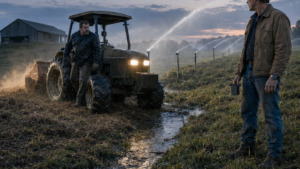
The tire tracks appeared beside the pond before sunrise Monday morning.
William found them while checking the lower pasture.
Two parallel lines cut across the damp edge of the turnout, turned near the water, then climbed back toward the lane. Somebody had driven through after he locked the gate Sunday night.
The chain was still fastened.
They had come from the opposite side.
William stood beside the tracks and felt anger rise again.
He photographed them before following them.
They led across the adjoining agricultural strip to the narrow connecting lane that joined the association road farther east.
Whoever had entered had not needed to open his gate at all.
They had simply treated the entire area as passable ground.
Rebecca arrived twenty minutes later with coffee.
She looked at the marks.
“They’re doing it because you complained.”
“Maybe.”
“You don’t believe that?”
“I don’t know.”
She stared at him. “Dad, somebody drove down here in the middle of the night.”
“Or early morning.”
“That’s your distinction?”
“It matters if I’m going to say what happened.”
Rebecca shook her head.
“You still talk like you’re writing claim reports.”
William looked at the pond.
“That kept me from accusing people of things I couldn’t prove.”
“It also lets people think you’re not mad.”
“I am mad.”
“You could try showing it once.”
He almost smiled.
Almost.
Instead he walked toward the iron gate.
The gate had not always been there.
When William was fourteen, there had been two sagging wooden posts and a strand of wire tied around a nail. Twenty years later, he and his father replaced them with iron posts salvaged from an equipment yard.
Later they rebuilt the pond bank, hauled gravel for the turnout, reset the culvert, and welded the gate together under the equipment shed.
His father had insisted the gate swing inward.
“Never hang one so gravity helps a stranger open it,” he had said.
William could still hear the sentence.
That memory was useful to him emotionally.
It was useless legally.
By nine o’clock, he was at the county recorder’s office.
The clerk listened while he gave the parcel numbers and approximate date.
“Private road agreement?”
“Nineteen eighty-seven.”
“Recorded?”
“According to the association.”
The clerk typed for several minutes.
William waited.
He had spent enough years in records rooms to know not to fill silence.
Finally she said, “There’s an easement agreement attached to three parcels and referenced by several others.”
“Can I see the original image?”
She turned the monitor slightly.
The scanned document was faint but readable.
William leaned forward.
The agreement described a strip reserved for agricultural passage between the county road and several landlocked or partially landlocked farm parcels.
He read the legal description once.
Then again.
“Can you print the exhibits?”
The clerk nodded.
The plat came out on oversized paper.
William carried it to a side table.
The road drawn in 1987 did not look like the road outside his farm today. The present gravel lane had shifted gradually over the years as ditches were cleaned, fences replaced, and machinery got wider.
But one thing was clear.
The recorded strip was narrow.
It crossed the edge of his parcel.
It did not fan outward toward the pond.
It did not include the gravel turnout.
William took out the photographs from Saturday that Rebecca had printed for him.
He placed them beside the plat.
The rust-dark boundary marker at the gate appeared in both.
Not perfectly. The old drawing used bearings and distances from monuments that had since changed or disappeared.
But the geometry was close enough to make his pulse quicken.
The trailer had not merely been using the access strip.
It had been parked well outside it.
He found the paragraph governing use.
Agricultural ingress and egress.
Farm machinery.
Livestock movement.
Reasonable passage.
Nothing about common recreational use.
Nothing describing the pond approach as shared property.
Nothing granting the association control of his turnout.
William felt the first clean edge of vindication.
Then he stopped himself.
One document was not a case.
He knew that better than most people.
“Is this the only filing?”
The clerk looked over.
“For the road?”
“For this agreement.”
She searched again.
“There are references in later deeds.”
“Modifications?”
“I’ll have to check.”
William spent nearly two hours comparing parcel descriptions.
By noon, he had enough to call a surveyor.
The surveyor met him at the farm the next morning.
William showed him the gate marker, the old plat, and the current lane.
The surveyor studied the distances.
“This road moved.”
“How much?”
“Depends where you measure.”
“That bad?”
“Not bad. Common.”
He pointed down the gravel.
“People widen these over thirty years. Somebody grades a little left one year, a little right the next. Then everybody starts calling the traveled surface the easement.”
“Is it?”
“Not necessarily.”
They walked to the turnout.
The surveyor looked toward the pond.
“This part wasn’t in the original strip.”
William felt satisfaction again.
Then the surveyor added, “But I’d want the later filings before I put that in a signed opinion.”
William glanced at him.
“What later filings?”
“Anything recorded after this. Amendments. Boundary agreements. Relocations.”
That afternoon, Rebecca found him in the equipment shed.
An old farm ledger lay open on his workbench.
“What’s that?”
“Maintenance notes.”
His father had kept everything: diesel purchases, fence staples, gravel loads, culvert pipe, pond repairs.
William ran his finger down a page dated almost twenty years earlier.
Lower gate reset.
Three loads gravel, pond turnout.
Weld hinge.
No association reimbursement appeared anywhere.
Rebecca leaned over his shoulder.
“So we paid for all of it.”
“Looks that way.”
“You needed a ledger to know that?”
“No.”
“Then why does it matter?”
“Because knowing something and proving it aren’t the same.”
She looked at him for a moment.
“That’s what this is about for you, isn’t it?”
“What?”
“Proving nobody can take it.”
William closed the ledger.
“I’m making sure I know where we stand.”
It was not an answer, and Rebecca knew it.
She let it go.
The recorder’s office called the next morning.
The same clerk spoke.
“I found another filing tied to that agreement.”
William straightened.
“What kind?”
“Looks like an amendment.”
“What year?”
There was a pause while she checked.
“Two thousand three.”
William looked through the open shed door toward the pond.
“Does it change the access?”
“I haven’t read it closely.”
“Can you pull it?”
“It’s already here.”
William picked up his truck keys.
The original agreement had narrowed Daniel’s claim.
But apparently the original agreement was not the last word.
Chapter 3: The Amendment Daniel Never Mentioned
The 2003 amendment excluded the pond turnout in its first two pages.
William knew that before he reached the signature block.
He stood at the recorder’s counter with the document spread beneath both hands, reading the revised description line by line.
The agricultural access remained.
But its function had been narrowed.
Routine passage for farm machinery and livestock remained permitted within the recorded corridor. Temporary emergency access could be allowed when ordinary routes were obstructed or unsafe.
Nothing in the amendment converted William’s turnout into association property.
Nothing granted general use of the pond approach.
Most importantly, the amended exhibit shifted the defined corridor farther from the water.
William read the language again because he did not trust how badly he wanted it to say what it said.
The clerk watched from behind the counter.
“Good news?”
“Maybe.”
She smiled faintly. “That usually means yes.”
“It means I found another question.”
That was the old investigator in him.
A favorable document always produced another question.
Why had Daniel cited 1987 instead of 2003?
William requested certified copies of both filings.
Before leaving, he searched the grantor and grantee index for every reference connected to the amendment.
There were no dramatic surprises.
No secret transfer.
No hidden ownership claim.
Just a road association trying, twenty-three years earlier, to formalize where agricultural traffic should run.
That made Daniel’s notice harder to explain.
At home, William laid both documents across the farmhouse kitchen table.
Rebecca stood opposite him.
“So he’s wrong.”
“Yes.”
“Completely?”
“About the turnout being common access, it looks that way.”
“And the pond?”
“Not even close.”
Rebecca gave a humorless laugh.
“Then unlock the gate long enough to tell him to come get his notice.”
William shook his head.
“No.”
“Why?”
“Because I want the survey finished.”
“You have the recorded amendment.”
“And a road that doesn’t sit exactly where the recorded line did.”
She folded her arms.
“You’re giving him too much room.”
“I’m making sure he has none.”
By afternoon, the iron gate was locked again.
William moved his own tractor through it to cut the lower field, then chained it behind himself.
He had barely finished the first pass when a pickup stopped on the association side.
Kathleen Hall got out.
William recognized her immediately.
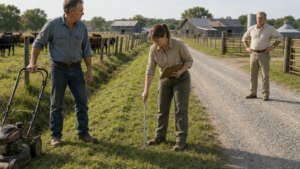
She had owned the small cattle place east of his for longer than Daniel had been chairman. She was well into her seventies now and moved carefully across uneven ground, though she still did most of her own feeding.
William shut down the tractor.
Kathleen rested one hand on the gate.
“You planning to keep this locked?”
“For now.”
“That’s going to cause trouble.”
“It already has.”
She glanced toward the pond.
“Daniel said you were trying to shut the road.”
“I’m trying to shut my turnout.”
“That’s not how folks have used it.”
William wiped dust from his hands.
“How have they used it?”
Kathleen gave him a puzzled look.
“You know how.”
“I want you to tell me.”
“For tractors. Hay. If somebody had a breakdown. Dry years, people came through toward the water.”
“Who told them they could?”
“Your father, half the time.”
William said nothing.
Kathleen seemed surprised that the answer affected him.
“He used to wave us through,” she continued. “If the lower crossing was muddy, he’d tell us to come around this way.”
“Every time?”
“I didn’t keep a tally.”
“Did he say it belonged to the association?”
“No.”
“Did he say everybody had a permanent right to use it?”
Kathleen’s expression changed.
Not defensive.
Uncertain.
“He didn’t talk like that.”
“Then what did he say?”
She looked at the gate.
“Usually something like, ‘Come on through.’”
William felt his certainty shift by a fraction.
Not legally.
Something else.
“How often?”
“Depends on the year. More when the creek crossing washed out.”
“Did you ask?”
“At first.”
“And later?”
Kathleen rubbed the top rail of the gate.
“Later we knew he’d say yes.”
There it was.
Not ownership.
Not necessarily entitlement either.
Habit.
The sort of rural arrangement nobody wrote down because everybody involved assumed everybody remembered what it meant.
William looked toward the pond.
His father had been generous with things William had become protective of after his death.
That did not give Daniel the right to claim them.
But it meant William’s private story—that strangers had simply decided to take what was his—was incomplete.
Kathleen watched him.
“You really didn’t know?”
“I knew he helped people.”
“He helped a lot.”
“That’s different from signing the farm over one favor at a time.”
“I didn’t say it wasn’t.”
Her answer stopped him.
William had expected resistance.
Instead Kathleen seemed almost hurt by the implication that she had knowingly taken something.
She tapped the gate.
“I thought this had always been understood.”
“That’s the problem.”
“What is?”
“Everybody understands something different.”
Kathleen glanced up the lane.
“Daniel says the old agreement covers it.”
“The amendment doesn’t.”
She looked back quickly.
“What amendment?”
“Two thousand three.”
Her brow tightened.
“I remember something being voted on.”
“Did you see it?”
“Probably twenty years ago.”
“It narrows the access.”
Kathleen was quiet.
“To what?”
“Defined agricultural passage. Emergency use under specific conditions. Not the turnout. Not the pond.”
She looked toward the water again.
“That isn’t how Daniel described it.”
“No.”
William expected satisfaction.
Instead he felt the situation getting heavier.
That evening Daniel called.
William let it ring twice before answering.
“Kathleen says you’re going around telling people the association has no access.”
“I’m showing people the recorded documents.”
“You’re reading them your way.”
“They have measurements.”
“Measurements from twenty-three years ago.”
“Exactly.”
Daniel went silent.
William caught the significance.
“You knew there was an amendment.”
“Of course I knew.”
“Then why did your notice cite the 1987 agreement?”
“Because that’s the originating agreement.”
“It’s also the one with the broader language.”
Daniel’s voice cooled.
“You’ve been off the association board a long time, William. You don’t know every problem we’ve had to solve.”
“Then explain this one.”
“People need that route.”
“That isn’t the same as having a right to my turnout.”
“For forty years nobody made that distinction.”
“My father did.”
“You sure about that?”
William’s grip tightened around the phone.
Daniel continued.
“Ask people who were actually here. Your father opened that gate more times than you remember.”
“I remember plenty.”
“Maybe you remember what you need to remember.”
William stood in his kitchen with the certified amendment on the table and felt the remark land where Daniel intended it to.
“You knew the amendment narrowed the corridor.”
“I know that people have relied on that access for decades.”
“That isn’t an answer.”
“It’s the answer that matters out here.”
The line went quiet.
Then Daniel added, “You’re trying to rewrite a practice your own father helped create.”
The call ended a few seconds later.
William remained at the table.
Rebecca had heard enough from the doorway to understand.
“He’s trying to get inside your head.”
“Maybe.”
“You believe him?”
William looked at the old farm ledger on the counter.
He had searched it for gravel loads, gate repairs, and proof of who paid.
He had never searched it for people.
He pulled the ledger toward him.
If Daniel wanted to make the dispute about William’s father, William would investigate that claim exactly the way he had investigated everything else.
Even if he did not like what the record showed.
Chapter 4: Sixty Years of Courtesy Became a Claim
The first name in his father’s ledger had one word written beside it.
Let through.
William sat at the equipment-shed workbench with the book open beneath the fluorescent light and read the entry again.
The page was dated thirty-one years earlier.
A neighbor’s surname appeared beside a note about a broken wagon axle, followed by two words in his father’s square handwriting: let through.
Three pages later came another.
Cattle trailer—let through lower gate.
Then another.
Creek high. Let Hall through.
William stopped.
Hall.
He turned the page back and checked the year.
Kathleen would have been in her forties then.
He kept reading.
The ledger had never been a diary. His father wrote down expenses, work, weather damage, feed deliveries, repair hours—anything that might matter six months later when somebody asked where money or time had gone.
But scattered through the practical notes were these small permissions.
Let through.
Opened gate.
Used lower way.
Water for stock.
William pulled a legal pad toward him and began listing every entry connected to the lower lane.
Rebecca found him there after lunch.
“You’ve been at this all morning?”
He handed her the list.
She read the first few lines.
“So Daniel was telling the truth.”
“Part of it.”
She looked up.
“Dad.”
“My father let people through.”
“That sounds like what Daniel said.”
“No. Daniel said the association has a right.”
Rebecca dropped the paper onto the bench.
“And what’s the difference to everybody who’s been doing it for thirty years?”
William looked at her.
“The difference is whether they could do it when he said no.”
She opened her mouth, then closed it.
William turned the ledger around.
“Look at the wording.”
Rebecca read silently.
“Every entry is permission,” he said. “Not maintenance. Not easement. Not shared road.”
“So?”
“So if this were association access, why would he write that he let somebody through?”
Rebecca leaned against the workbench.
“Because he was Dad’s father and he wrote down everything.”
“Maybe.”
That answer irritated her.
“You know, you could be right without saying maybe every five minutes.”
William closed the ledger.
“That’s how people get themselves in trouble.”
“No. Sometimes that’s how they avoid admitting something they don’t like.”
She walked out before he answered.
William sat alone with the ledger.
He disliked the remark because it was accurate enough to stay with him.
That afternoon he drove to Kathleen Hall’s place.
She was carrying a mineral bucket toward a small group of cows when he pulled in. She set it down beside the fence.
“You found something.”
William held up a photocopy.
“My father’s notes.”
Kathleen wiped her hands on her jeans.
“About me?”
“Some.”
She read the entry he pointed to.
Creek high. Let Hall through.
A faint smile crossed her face.
“I remember that year.”
“What happened?”
“The lower crossing washed out twice. My husband was laid up after surgery. Your father told me to quit fooling with the creek and use your lane until it dried.”
“Did he say until it dried?”
Kathleen looked at him.
“I believe so.”
“Not forever?”
“No.”
She gave the paper back.
William produced another page.
“Did anyone pay him for maintaining the turnout?”
“Not that I know.”
“Gravel?”
“No.”
“Pond work?”
“No.”
“Gate repairs?”
Kathleen shook her head.
“William, are you trying to prove your father was generous or prove we took advantage of him?”
The question stopped him.
“I’m trying to understand what people thought they had.”
“Well, I thought we had neighbors.”
“That isn’t a property right.”
“I know that now.”
There was no anger in her voice.
That made his own harder to hold.
Kathleen rested her arms on the top fence board.
“When your father said yes enough times, people stopped treating every trip like a special favor. I’m not saying that was smart. I’m saying that’s what happened.”
“And Daniel turned that into association property.”
Kathleen looked toward the distant tree line.
“Daniel turned it into something easier to manage.”
“That’s a polite way to say it.”
“Maybe. But you ought to ask why.”
William studied her.
“You know?”
“I know the north route is bad.”
“How bad?”
Kathleen hesitated.
“Bad enough I wouldn’t pull a loaded stock trailer through it.”
William knew the alternate road. It ran behind several parcels, crossed a shallow drainage, and joined the county road farther north.
It was the route the association was supposed to maintain for heavy access.
“When did that happen?”
“Didn’t happen all at once.”
“Last time it was graded?”
“I couldn’t tell you.”
“Last time you used it?”
Kathleen gave him a tired look.
“That I can. Two years ago.”
William felt the shape of the problem change.
The next morning he drove north.
The alternate access looked acceptable from the county road.
Fifty yards in, it narrowed.
Grass grew through the center strip. Farther down, runoff had eaten one shoulder away. At the drainage crossing, the gravel had washed into two deep ruts.
William stopped his pickup and walked.
A loaded hay truck might make it through dry.
A livestock trailer might not.
An emergency vehicle would have to slow almost to a crawl.
He crouched beside the washed-out edge.
Someone had placed chunks of broken concrete into the rut as a temporary patch.
Not a repair.
A postponement.
Back at the farm, William pulled old road-association packets from a filing cabinet.
He had stopped attending regularly years earlier after deciding the meetings consumed two hours to settle twenty-minute problems.
Now he read every page.
Budget requests.
Grading estimates.
Culvert proposals.
A contractor invoice marked deferred.
Then another.
Daniel’s name appeared in meeting minutes beside motions to postpone work on the north route.
William read carefully.
The reasons were not ridiculous.
Material costs had risen.
Several owners were behind on assessments.
A culvert replacement had consumed part of the road reserve.
But the pattern was unmistakable.
Repair north drainage—defer to spring.
Regrade north section—hold pending funds.
Contractor estimate—table.
William reached the most recent packet.
Inside was an invoice from the grading contractor for an inspection and temporary patch.
Across the top, someone had written by hand:
Too expensive this year. Continue lower access as needed.
William knew the handwriting.
Daniel’s.
Rebecca came into the kitchen while he was arranging copies.
“What now?”
He slid the invoice toward her.
She read it.
“So that’s why.”
“Looks like it.”
“He didn’t want to fix their road.”
“Couldn’t afford to, maybe.”
“He could afford to claim ours.”
William looked toward the lower field.
That sentence was sharper than anything he would have said.
But he could not dismiss it.
Daniel had inherited a real problem.
He had also chosen a solution that transferred the cost and burden onto William’s land without asking him.
The distinction mattered.
So did something else.
For the first time, William understood why the association had become dependent on his father’s old courtesy.
The north route had been allowed to fail because another path was easier.
His path.
His pond turnout.
His gate.
He gathered the invoices into chronological order.
At the bottom of the stack lay the most recent meeting note.
Daniel had moved to defer repairs again only four months before sending William the access notice.
William read the line twice.
Then he circled it.
The dispute was no longer about whether Daniel misunderstood an old agreement.
The question now was whether Daniel had expanded that agreement because admitting the truth would expose what the association had failed to maintain.
Chapter 5: The Road They Stopped Maintaining
The surveyor’s maintenance truck made it sixty yards down the north road before its right rear wheel dropped into the washed-out shoulder.
The driver stopped immediately.
William, walking behind with the surveyor, heard gravel slide into the ditch.
“That’s enough,” the surveyor called.
The driver eased forward, but the truck leaned farther.
He stopped again.
Nobody needed to say what all three men could see.
The road was not dependable.
The surveyor walked to the rut and looked at William.
“You wanted to know whether this is a practical alternate route.”
“Yes.”
“There’s your answer.”
“Could it be repaired?”
“Of course.”
“How much?”
The surveyor glanced along the drainage.
“Depends whether they want another patch or an actual road.”
William almost smiled.
“That sounds familiar.”
They backed the truck out slowly.
An hour later, the surveyor drove stakes along the recorded agricultural corridor near William’s pond. The current traveled lane overlapped portions of it, but the turnout spread well beyond the legal strip.
The gate itself stood outside the defined corridor.
The surveyor drove the final temporary stake near the pond.
“There.”
William looked at the orange flag snapping above it.
“So Daniel’s trailer?”
“Most of it was outside.”
“And the pond approach?”
“Outside.”
William nodded.
It should have felt like the end of the argument.
Instead he looked north, toward the road that could barely carry the survey truck.
“What happens if somebody needs to get through in an emergency?”
“That’s not a survey question.”
“No.”
It was becoming William’s question.
Later that week, he attended the road association’s regular meeting for the first time in nearly three years.
Daniel sat at the front table with two board members.
Kathleen was there, along with eight other landowners.
Daniel looked at William’s folder before he looked at William.
“You planning to make a presentation tonight?”
“Not tonight.”
Daniel leaned back.
“Then what are you here for?”
“To listen.”
One board member shifted uncomfortably.
The meeting moved through routine business before reaching road maintenance.
Daniel summarized available funds.
“We’ve got enough for grading the south stretch and gravel at the county entrance. North work will probably need to wait.”
William said nothing.
Kathleen did.
“How long?”
Daniel looked at her.
“Until the reserve comes back up.”
“That road’s barely usable now.”
“We’re aware.”
“Then why are we spending on the south road?”
“Because it serves more daily traffic.”
Kathleen glanced at William.
Daniel noticed.
“The lower agricultural access remains available for necessary use.”
William finally spoke.
“According to what?”
The room went quiet.
Daniel set down his pen.
“We’re not doing this again.”
“We haven’t done it once in this room.”
“William—”
“You just told everybody my property is the backup for a road you aren’t repairing.”
Daniel’s jaw tightened.
“I said the established lower access remains available.”
“Established under which recorded description?”
One board member rubbed his forehead.
Daniel said, “This is exactly the kind of legalistic argument that makes simple road management impossible.”
William opened his folder.
He did not raise his voice.
“I worked claims for twenty-six years. Whenever somebody called a detail legalistic, it usually meant the detail cost them money.”
A few people shifted in their chairs.
No one laughed.
William slid copies of the 1987 agreement and 2003 amendment onto the table.
Daniel did not touch them.
“You know what those say.”
“Yes.”
“So do I.”
“Then why did your notice claim my turnout?”
Daniel glanced around the room.
“This isn’t the place.”
“It became the place when you described it as association access.”
Kathleen spoke quietly.
“I’d like to hear the answer.”
Daniel looked at her with something close to betrayal.
Then he exhaled.
“The original agreement has been used in conjunction with longstanding practice.”
“That isn’t what the amendment says,” William replied.
Daniel’s patience cracked.
“The amendment doesn’t erase forty years of people relying on that route.”
“No. But it does tell you what the association can claim.”
“And while you’re proving your point, what happens when somebody can’t get a trailer through the north road?”
William looked at him.
There it was.
Not ownership.
Need.
Daniel continued.
“We have older residents. We have livestock operations. We have emergency water concerns. The north crossing needs major work, and everybody in this room knows assessments are already high.”
His voice had lost its edge.
For the first time, William heard the pressure beneath it.
Daniel was not trying to acquire a pond for pleasure.
He had a failing road, limited money, and neighbors who expected him to keep access working.
Then Daniel made the choice that kept William from sympathizing too far.
“You locking that gate creates a safety problem for everybody.”
William’s expression hardened.
“No.”
“It does.”
“The failed north road creates the safety problem.”
Daniel looked away.
William saw it.
He opened another part of the folder.
“I found the maintenance minutes.”
Daniel’s face changed.
One of the board members looked toward him.
William placed three pages on the table.
“North drainage repair deferred last fall. Regrading deferred in March. Contractor estimate tabled in April.”
Daniel said nothing.
William put down the handwritten invoice.
“Continue lower access as needed.”
The board member picked it up.
“You wrote this?”
Daniel’s voice was flat. “Yes.”
“When?”
“After the contractor inspection.”
William leaned forward.
“So four months before you sent me a notice claiming my turnout was common property, you knew the north route needed repairs and decided to keep using mine instead.”
“That isn’t what that says.”
“It says you knew the problem existed.”
Daniel’s hands tightened around the pen.
“We didn’t have the money.”
William believed him.
That was the worst part.
Because now he understood exactly how the mistake had grown.
A temporary convenience became practice.
Practice became expectation.
Expectation became something Daniel was willing to call a right because the alternative was telling the membership their legitimate road had been neglected.
William gathered his papers.
“I’m not asking you to solve this tonight.”
Daniel looked at him suspiciously.
“What are you asking?”
“Nothing.”
He stood.
Kathleen said, “William.”
He stopped.
She looked older under the meeting-room lights than she had at her fence.
“My sister’s place is past the north crossing.”
William waited.
“If something happened during harvest,” she said, “an ambulance could get through your lower way faster.”
Daniel watched him.
William felt the trap, though Kathleen had not set one.
He could be legally right and practically cruel at the same time.
His locked gate had made the boundary clear.
It had also removed an emergency option people had come to depend upon, however carelessly.
“I understand,” he said.
Kathleen nodded.
William drove home with Daniel’s notice on the passenger seat.
Rebecca was waiting in the kitchen.
“Well?”
“He knew.”
She straightened.
“Knew the amendment?”
“Knew the north road was failing. Knew they were relying on us because they weren’t repairing it.”
“So we have him.”
William looked at her.
“This isn’t a claim file.”
“What does that mean?”
“It means there are people in the middle.”
“He put us in the middle.”
“Yes.”
Rebecca studied him.
“You’re going to let them use it.”
“I didn’t say that.”
“You’re thinking about it.”
William looked toward the dark window above the sink.
For years he had believed the dangerous thing was letting exceptions become expectations.
Now he could see the other danger.
A boundary could become a wall simply because drawing one felt safer than explaining it.
The following morning he called Daniel.
“The survey is finished.”
Daniel was quiet.
“And?”
“The turnout is mine. The gate is mine. The pond approach is mine. Your recorded corridor doesn’t include them.”
“I figured that’s what you’d say.”
“It’s what the survey says.”
“What do you want?”
William looked at the iron gate from his porch.
“A full association meeting.”
“We just had one.”
“A meeting where the access issue is on the agenda and everyone gets the documents beforehand.”
Daniel hesitated.
“You planning to demand damages?”
“I’m planning to correct the record.”
“And then?”
“That depends on what everyone is willing to admit.”
Daniel was silent long enough for William to hear machinery running somewhere on his end of the call.
Finally he said, “Next Thursday.”
“I’ll be there.”
William ended the call.
He had spent two weeks trying to prove where the association’s rights stopped.
At the next meeting, he would have to decide what, if anything, should begin on the other side of that line.
Chapter 6: The Meeting Where Custom Met the Map
Daniel opened the meeting by calling William’s locked gate a safety hazard.
No greeting.
No preliminary business.
The association room was fuller than William had ever seen it. Folding chairs filled two rows behind the long front table. Nearly every landowner affected by the road system had come.
Daniel stood beside a projected photograph of William’s lower entrance.
The image showed the iron gate, the gravel turnout, and the orange survey stake near the pond.
“This is the current condition,” Daniel said. “Whatever disagreements exist about recorded boundaries, closing this route has created a practical emergency-access problem.”
William sat in the front row with a folder across his knees.
Rebecca sat beside him.
She whispered, “He’s starting with blame.”
William kept his eyes on Daniel.
“He’s starting with the strongest thing he has.”
Daniel continued.
“For decades, residents have used the lower route when weather, equipment failures, or conditions made other access difficult.”
Kathleen shifted in her chair.
William waited until Daniel finished.
Then he stood.
“You’re right.”
The room changed.
Even Daniel looked surprised.
William walked to the front.
“The safety problem is real.”
Rebecca stared at him.
William placed a copy of the north-road photographs on the table.
“But the locked gate didn’t create it.”
He handed Daniel the first photograph.
It showed the washed-out shoulder.
Then the second.
The deep drainage rut.
Then the third, showing the surveyor’s maintenance truck stopped before the crossing.
“The association’s alternate route is failing.”
Daniel said, “We’ve already discussed the budget.”
“Yes.”
William faced the room.
“That matters. Gravel costs money. Drainage work costs money. I’m not pretending otherwise.”
He placed the meeting minutes beside the photographs.
“What also matters is that the board knew the route was deteriorating.”
One of the board members lowered his eyes.
William did not press him.
He turned on the projector.
The next image was the 1987 plat.
A narrow corridor crossed the Mitchell parcel.
“This is the original agricultural access.”
Then the 2003 amendment appeared.
“This narrowed and clarified it.”
Finally William projected the current survey.
The recorded corridor was marked clearly against the present lane and turnout.
“My gate is outside it. The pond turnout is outside it. The pond approach is outside it.”
A neighbor in the second row raised a hand.
“So we never had the right to use that part?”
“Not under these documents.”
Another voice asked, “Then why did everybody use it?”
William looked toward Kathleen.
She stood without being asked.
“Because his father let us.”
The room went quiet.
Kathleen looked around.
“I used it myself. Plenty of times. When the creek was high. When we had equipment trouble. Once when my husband was sick and I didn’t want to risk the north crossing.”
She looked at William.
“He said yes.”
Daniel leaned forward.
“That’s the longstanding practice I’ve been talking about.”
Kathleen turned toward him.
“No.”
The single word landed harder than William expected.
Daniel frowned.
Kathleen continued.
“He let me through. That doesn’t mean he gave me his gate.”
Several people shifted.
One older landowner nodded slowly.
Kathleen said, “I think some of us forgot the difference.”
William felt something inside him loosen.
Not victory.
Recognition.
Daniel looked at the projected survey.
“Custom still matters.”
“It does,” William said.
Daniel turned on him.
“Then stop pretending paper is the only thing that counts.”
William met his eyes.
“I’m not.”
That silenced the room again.
William took out the old ledger.
“My father wrote down when he opened the lower way for people.”
He showed photocopies rather than passing the fragile book around.
“Let through. Opened gate. Water for stock.”
He pointed to the repeated wording.
“He treated access as permission.”
Daniel said, “He also gave that permission over and over.”
“Yes.”
“Which people relied on.”
“Yes.”
Daniel spread his hands.
“Then what exactly are we arguing about?”
William looked at him.
“Whether kindness becomes ownership when the person who gave it dies.”
Nobody spoke.
William let the silence stand.
Then he put Daniel’s original notice on the table.
“This says the turnout and pond approach are common association access.”
Daniel stared at it.
“That statement is wrong.”
Daniel’s face reddened.
“You’ve made that point.”
“No. I’ve proved that point. There’s a difference.”
One of the board members cleared his throat.
“We should withdraw the notice.”
Daniel looked at him.
The second board member nodded.
“And correct the property description.”
Daniel sat back.
For several seconds, he seemed less angry than tired.
William had seen that expression in claim meetings when somebody realized the argument they had defended for weeks was no longer supportable.
Daniel said, “Fine.”
Rebecca shifted beside the wall.
William did not move.
Daniel looked directly at him.
“Happy?”
“No.”
That answer seemed to irritate Daniel more than triumph would have.
“What else do you want?”
“The truth about why you did it.”
Daniel’s eyes narrowed.
William placed the deferred maintenance invoice on the table.
“You knew the north road needed major work. You knew the lower turnout wasn’t within the amended corridor. Instead of telling people the association had a maintenance problem, you called my property common access.”
Daniel glanced around the room.
His status was suddenly visible in a way it had not been before.
Not authority.
Exposure.
“We were trying to keep farms accessible.”
William nodded.
“I believe you.”
Daniel looked up sharply.
That was not the attack he expected.
William continued.
“I also believe you knew the legal claim was weak.”
Daniel said nothing.
“That’s the part you own.”
For a moment, Daniel seemed ready to deny it.
Then his shoulders dropped slightly.
“If I’d told everybody we needed a special assessment for the north road,” he said, “half this room would’ve fought it.”
Nobody contradicted him.
“The reserve was already low. Two owners were behind. The culvert ate what we had.”
His gaze moved toward Kathleen.
“And I had people calling me asking whether they could get equipment through before harvest.”
Kathleen said quietly, “So you used William’s place instead.”
“I used a route people had been using for decades.”
“After he told you not to.”
Daniel looked at the table.
That was the choice he could not explain away.
William closed the folder.
“The association withdraws the claim.”
One board member nodded.
“Yes.”
“You reimburse the survey cost and repair the gravel your traffic pushed toward the pond bank.”
Another nod.
“Reasonable.”
“And you repair the north route.”
Daniel looked up.
“With what money?”
“With association money.”
“That means an assessment.”
“Then tell people what it costs.”
Daniel gave a bitter half laugh.
“Easy for you to say.”
“No. It isn’t.”
William reached into the folder one final time.
He placed a two-page proposal on the table.
Rebecca stared at it.
Daniel did too.
William said, “I’m not leaving the lower route open.”
Daniel’s expression hardened again.
“Then what is that?”
“Emergency access terms.”
Nobody moved.
William tapped the page.
“Named emergency conditions. No routine equipment traffic. No parking. No pond use. No turnout use except what’s necessary to pass safely. Access controlled through the gate. Every use logged. It ends if the association stops maintaining its own road again.”
Kathleen was the first to speak.
“You’d allow that?”
William looked at the projected image of the gate.
For two weeks he had treated every opening as a loss.
Now he understood what his father had apparently understood without ever writing it as a principle.
A gate could belong to you and still open.
The important thing was knowing who decided.
“Yes,” William said.
Daniel picked up the proposal.
“You already had this drafted?”
“Since yesterday.”
Rebecca leaned toward her father.
“You didn’t tell me.”
“I wasn’t sure I’d use it.”
Daniel read the first page.
“This admits there’s a need.”
“There is.”
“And confirms you own the route outside the recorded corridor.”
“Yes.”
Daniel turned the page.
“So if we sign this, we’re admitting the notice was wrong.”
“Yes.”
Daniel looked around the room.
No one rescued him from the choice.
William had expected that moment to feel satisfying.
Instead it felt heavy and clean.
Daniel placed the pages flat on the table.
“I’ll have the board review it.”
“No,” Kathleen said.
Daniel looked at her.
“We’ve reviewed things long enough.”
A few voices murmured agreement.
One landowner said, “Fix the north road.”
Another added, “And stop calling somebody else’s pond ours.”
There was no applause.
William was grateful for that.
Daniel looked once more at the corrected survey, the photographs, and William’s proposal.
Then he slowly pulled the emergency-access agreement toward the center of the table.
For the first time since the hay trailer appeared behind William’s gate, the argument was no longer about whether the boundary existed.
It was about whether the association was willing to live with what came after acknowledging it.
Chapter 7: The Gate Stayed, but the Rules Changed
The first thing the workers removed was the gravel that should never have been there.
A skid-steer backed carefully away from William’s pond turnout, its bucket carrying the gray stone that association traffic had pushed beyond the proper lane. Another worker raked the disturbed shoulder by hand, pulling loose rock away from the grass and reshaping the edge where the hay trailer tires had sunk weeks earlier.
William stood beside the iron gate and watched without giving instructions.
For once, nobody needed him to explain where the boundary was.
Orange survey stakes still marked the recorded agricultural corridor. The repaired turnout ended cleanly outside it.
Rebecca came down from the barn carrying two coffees.
“They’re actually putting it back.”
William took one.
“That was the agreement.”
“I know.”
She watched the skid-steer turn.
“I just didn’t expect Daniel to follow it without another fight.”
William looked north.
Beyond the tree line, trucks had been working on the association’s neglected route for most of the week. They had replaced the damaged drainage pipe, rebuilt the washed-out shoulder, and laid fresh stone over the worst section.
It was not finished yet.
But it was a road again.
The association had approved a special assessment after the meeting. Nobody liked paying it. Several owners complained. One demanded a payment schedule.
But the vote passed.
The board also withdrew the notice claiming William’s turnout and pond approach as common access. The reimbursement check for his survey costs arrived three days later.
None of it felt dramatic.
William preferred that.
The skid-steer operator finished the last pass and climbed down.
“That should do it.”
William inspected the edge.
“It does.”
The worker nodded toward the gate.
“Still want that lock installed today?”
“Yes.”
The new hardware was simple: a weatherproof emergency lock attached beside William’s own chain, accessible only under the written procedure the association had adopted.
No general key.
No standing permission for equipment traffic.
No parking.
No pond use.
If the north road was passable, the lower route remained closed.
Rebecca rubbed her thumb across the paper cup.
“Granddad would’ve laughed at all this paperwork.”
“Probably.”
“He would’ve just opened the gate.”
William looked at the iron bars.
“That’s what got us here.”
Rebecca gave him a sideways glance.
“Not exactly.”
He knew what she meant.
His father’s kindness had created habit.
Daniel’s overreach had turned habit into a claim.
William’s own silence had helped turn a boundary dispute into something sharper than it needed to be.
None of those facts canceled the others.
A pickup came down the association road around noon.
Daniel was driving.
He parked outside the gate and stepped out carrying a document tube.
William did not move toward him.
Daniel walked over and rested the tube against the hood of the pickup.
“Final corrected map.”
William opened it.
The survey showed the agricultural corridor, the Mitchell turnout, the pond approach, and the emergency-access section in separate markings.
At the bottom were signature lines.
Daniel had already signed for the association.
No argument.
No handwritten qualification.
William studied the map longer than necessary.
Daniel said, “The north-road contractor says another two days.”
“I saw.”
“We’ll keep emergency access listed until they certify the crossing.”
“That’s what the agreement says.”
Daniel nodded.
The old irritation was still there between them, but it had changed shape.
Daniel glanced toward the pond.
“I should’ve handled it differently.”
William looked at him.
Daniel seemed uncomfortable with the sentence.
He continued before William could answer.
“I was trying to keep people moving. Doesn’t make the notice right.”
“No.”
Daniel’s jaw tightened slightly.
“You could make this easier.”
William almost smiled.
“You already got your one apology.”
Daniel gave a short breath that might have been a laugh.
Then he handed William a pen.
William signed the corrected map.
Daniel rolled it carefully and returned it to the tube.
“That’s it, then.”
“For the map.”
Daniel nodded once.
Neither man offered a handshake.
William was not offended.
Some things took longer than documents.
Two weeks later, Kathleen called just after four in the afternoon.
William was replacing a hydraulic hose when his phone rang.
“My sister fell in the barn,” Kathleen said.
Her voice was controlled but strained.
“The north route’s blocked by a gravel truck. Ambulance is coming from the county road.”
William looked toward the gate.
“I’ll open the lower way.”
“I can meet them there.”
“No. Stay with her.”
He hung up.
Rebecca was already moving toward the pickup.
“I heard.”
William took the emergency key from the locked box in the equipment shed.
They drove down together.
For the first time since the dispute began, William approached the gate knowing someone else needed it open.
He unlocked the emergency hardware and swung the iron gate inward.
Ten minutes later, the ambulance passed through without slowing, following the cleared lane beyond the turnout.
Kathleen’s pickup came behind it.
She stopped beside William long enough to lower her window.
“Thank you.”
William nodded.
“Call when they’re clear.”
She looked at the gate, then back at him.
“I will.”
That was all.
No assumption.
No argument.
Permission asked, permission given, use recorded.
Exactly what the old ledger had meant all those years.
By evening, the ambulance had gone back out.
Kathleen returned alone.
She stopped outside the gate this time.
William walked over.
“She’s all right,” Kathleen said. “Broken wrist. Bruised pride.”
“Good.”
Kathleen glanced at the new lock.
“Your father would’ve opened it too.”
William rested a hand on the iron rail.
“Yes.”
“But he would’ve expected us to remember whose gate it was.”
William looked at her.
Kathleen smiled faintly.
“I think that’s the part we forgot.”
She drove away.
William stood there until the dust settled.
Then he swung the gate shut.
The latch met the post with the same solid metal sound he had heard thousands of times since he and his father installed it.
Only now it meant something different.
Not exclusion.
Not surrender.
A boundary.
And a choice.
William wrapped his own chain around the post, secured the emergency lock beside it, and stepped back.
The gate stayed.
The neighbors still had a way through when it truly mattered.
And for the first time in years, everyone understood that those two things could both be true.
The story has ended.