She Fined His Farm Supper, So He Found the Acre Her Rules Could Never Reach
Chapter 1: The Supper That Became a Violation
Margaret Hall laid the violation notice on Jonathan Carter’s folding table before the plates had gone cold.
A smear of gravy still marked one corner of the paper when she pushed it toward him.
Jonathan looked at the notice, then at the six people still seated around the machinery shed. Kathleen Moore had a coffee mug between both hands. One of the neighboring farmers was halfway through wrapping leftover cornbread in foil. Nobody spoke.
Margaret remained standing.
“This is the third Friday,” she said. “That makes it recurring.”
Jonathan glanced toward the open shed doors. Beyond them, pickup trucks sat along the gravel shoulder beneath the security light. His cattle were quiet in the dark pasture. Somewhere behind the equipment bay, the old refrigerator clicked on.
“You drove down here during supper to tell me supper is recurring?”
Margaret’s expression did not change.
“I came because the association received complaints.”
“From who?”
“I’m not required to identify them.”
Jonathan read the top line again.
ROAD USE VIOLATION.
Below it was a charge of three hundred dollars.
He looked up slowly. “For six people eating roast beef?”
“For organized non-agricultural use involving repeated vehicle traffic.”
Kathleen put her mug down.
“We’re neighbors,” she said.
Margaret turned toward her. “That doesn’t change the road agreement.”
Jonathan felt heat rise behind his collar. He did not like being corrected at his own table. He liked it less with people watching.
The Friday suppers had started without anybody calling them suppers. One week Kathleen had brought beans because she had cooked too many. A neighboring farmer arrived with biscuits. Jonathan put on coffee. Then someone came the next Friday, and someone else after that.
No invitations. No club. No dues.
Just people who had begun finding reasons not to eat alone.
He could have said that.
Instead he folded the notice once.
“You finished?”
Margaret tightened her mouth.
“This is exactly the problem, Jonathan. You treat every rule like it’s personal.”
“You brought a fine to my dinner table.”
“I brought it where I knew I could find you.”
That got a small movement from Kathleen, not quite a flinch.
Jonathan stood.
Margaret was shorter than he was, but she had the peculiar confidence of someone carrying paperwork she believed settled the matter before the conversation started. She opened a thick black binder and turned to a marked page.
“Recurring assemblies,” she said. “Commercial or organized activities. Non-agricultural traffic. Those are all addressed.”
“There’s no commercial activity here.”
“I didn’t say there was.”
“You put it on the notice.”
“I said the provision covers it.”
Jonathan looked at the binder.
He had lived on that road for thirty-seven years. He had helped spread gravel on it with his own tractor when there were only four houses beyond the county pavement. Now there were nine properties, three absentee owners, and an association with annual meetings and printed rules.
He had never once thought of Kathleen’s pie as organized traffic.
Margaret closed the binder.
“This isn’t about pie. It’s about use.”
She left before anybody offered her coffee.
For a moment, nobody moved.
Then Kathleen said, “Well.”
Jonathan placed the folded notice beside the salt shaker.
One neighbor muttered that Margaret had been looking for something to enforce since taking over the road committee. Another said they ought to ignore her.
Jonathan began stacking plates.
“Eat your dessert,” he said.
Kathleen watched him.
“You going to pay it?”
“No.”
“You going to appeal it?”
“No.”
“That leaves what?”
Jonathan carried the dishes to the utility sink.
“I haven’t decided.”
He had.
By Monday morning, the first notice had company.
The second envelope was clipped to the livestock gate where the private gravel lane met his farm entrance.
Jonathan tore it open with one thumb.
Two hundred dollars.
Vehicles associated with a recurring non-agricultural gathering had parked partially on the maintained shoulder, creating what the notice called an obstruction and potential maintenance burden.
He looked down the lane.
Friday’s rain had softened the edge. Tire tracks showed where two pickups had eased off the gravel to let another vehicle pass.
The ruts were shallow.
Not imaginary.
Jonathan crouched and pressed a finger into the damp shoulder.
When he straightened, Margaret’s SUV was coming toward him.
She stopped beside the gate and lowered her window.
“You got the second notice.”
“I see that.”
“The board discussed it Sunday.”
“Did the board discuss calling me?”
“We’re past informal warnings.”
Jonathan held up the paper.
“You never gave me an informal warning.”
Margaret exhaled through her nose.
“You know the traffic has increased.”
“It increased for two hours on Friday.”
“Repeatedly.”
“There’s that word again.”
“Because repeated use matters.”
She climbed out and went to the rear of her SUV.
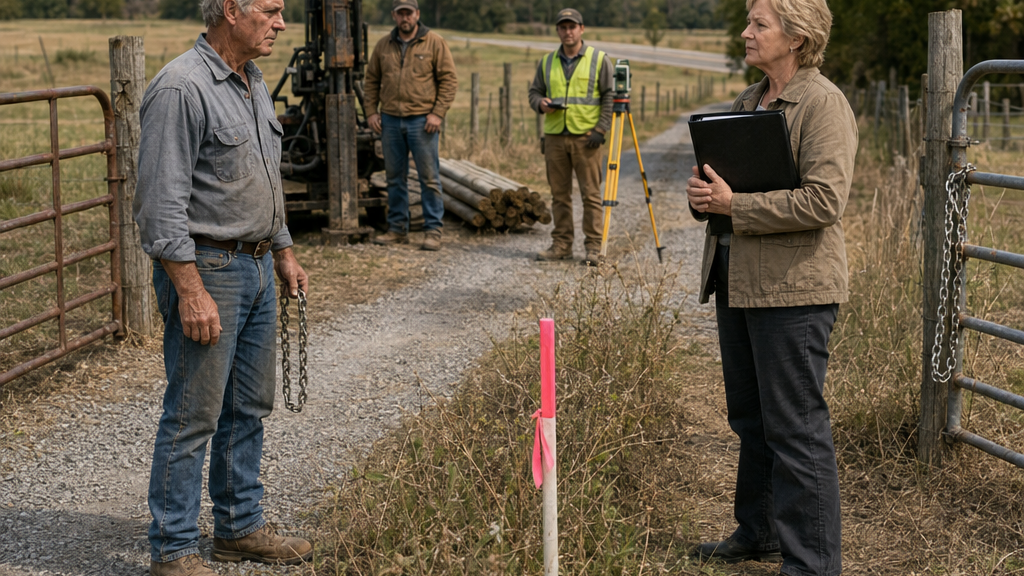
Jonathan watched her remove a galvanized chain.
His own livestock gate already had a chain looped loosely through the latch, mostly to keep cattle from nosing it open. Margaret carried hers to the larger association gate beside it, the one controlling the shared lane when maintenance work required closure.
She threaded it through the steel bars.
The sound of the links against the gate was sharper than Jonathan expected.
“What are you doing?”
“Making the access-control point clear.”
She attached a padlock but did not close it.
Jonathan stared at her.
“That gate has never been locked against residents.”
“It has been locked for maintenance.”
“That’s not what you just said.”
Margaret faced him.
“I said if the unauthorized recurring traffic continues, the association can restrict that traffic.”
“Through my entrance.”
“Through the association road.”
He looked from her to the chain.
His anger changed shape.
Until then, the fines had felt insulting.
The chain felt different.
It made the dispute physical.
His cattle trailers came through that lane. Hay equipment came through it. Feed deliveries. Veterinarians. Fuel.
Margaret seemed to read something in his face and softened her voice slightly.
“I’m not trying to keep you from farming.”
“You’re standing at my farm gate with a chain.”
“I’m trying to keep this from becoming something bigger.”
Jonathan folded the second notice and put it in his shirt pocket.
“It already did.”
Margaret picked up the binder from her passenger seat.
“The next supper needs to be canceled.”
Jonathan looked at her.
“No.”
Her shoulders stiffened.
“Then you need to understand what happens next.”
“I understand fine.”
“No, Jonathan. You don’t.” She tapped the binder against her palm. “Unauthorized recurring traffic can be denied access under the agreement.”
Jonathan’s eyes moved to the galvanized links hanging against the gate.
For the first time, he wondered whether she could actually do it.
Chapter 2: The Rule Nobody Had Read Twice
The recorded road agreement was eleven years older than the version in Margaret’s binder.
Jonathan discovered that before breakfast on Tuesday.
He had pulled his own closing papers from a metal file cabinet in the spare bedroom, spreading yellowed copies across the kitchen table until he found the easement reference attached to his deed.
Margaret’s association binder cited a revised operating policy from 1997.
That alone proved nothing.
But it was enough to make him stop being angry long enough to become curious.
By ten that morning, he was standing at the county records counter with his reading glasses low on his nose while a clerk brought up scanned plats and recorded instruments.
The habit returned faster than he expected.
Parcel number first. Recording book. Easement language. Amendments. Signatures. Exhibits.
For twelve years, before farming full-time, Jonathan had worked as an agricultural-land appraiser for the county. He had spent days driving fence lines, checking soil classes, reading deeds that contradicted what families swore their grandfathers had owned.
He had not done professional land work in more than twenty years.
Still, property descriptions had a rhythm.
So did mistakes.
He found the original private-road maintenance agreement just before noon.
The first pages were ordinary: shared grading costs, drainage obligations, snow removal, access for agricultural purposes, responsibility for damage caused by unusual loads.
Then he reached the section Margaret had quoted.
He read it twice.
Recurring organized use involving non-resident traffic could be restricted when such use caused measurable maintenance burdens, unsafe obstruction, or costs beyond normal residential and agricultural access.
Jonathan leaned back.
That was not what he had wanted to read.
There was no blanket ban on people gathering.
But Margaret had not invented the traffic provision either.
The distinction mattered.
He asked the clerk for a copy and drove home with it on the passenger seat.
At the association gate, the chain remained looped through the bars.
Unlocked.
Visible.
Jonathan parked and walked the last fifty yards of lane instead of driving through.
The ruts along the shoulder looked worse in daylight.
He paced them out.
Nearly eighty feet.
Friday’s rain had been heavier than he remembered. Where vehicles had edged off to pass one another, the shoulder had pushed outward toward the drainage swale. One tire had cut deep enough to leave standing water.
Jonathan crouched.
He knew roadbeds.
Not as an engineer, but as a man who had paid for enough gravel to understand what happened when water got under it.
He could hear Margaret saying, You know the traffic has increased.
He hated that she had been partly right.
At the farmhouse, he put the agreement beside both notices.
Kathleen came by that afternoon carrying an empty casserole dish she claimed Jonathan had forgotten to return.
He knew perfectly well the dish had been sitting in his kitchen for two days because she had seen it there Sunday.
She looked at the papers.
“You found something?”
“Depends what you mean.”
“Something good.”
“Then no.”
She sat across from him.
Jonathan turned the agreement around and tapped the relevant paragraph.
Kathleen read it.
“So she can stop us?”
“Not exactly.”
“That sounds like exactly.”
“It says they can restrict unusual recurring traffic if it creates measurable road burden. It doesn’t say they can prohibit people from visiting my farm.”
Kathleen considered that.
“But those tire marks are ours.”
“Some.”
“Jonathan.”
He leaned back.
“I said some.”
She gave him the look his wife used to give him when a distinction was technically accurate and practically useless.
“What?”
“Nothing.”
“That look means something.”
“It means you wanted Margaret to be completely wrong.”
“She is wrong.”
Kathleen slid the paper toward him.
“She can be wrong about the supper and right about mud.”
Jonathan looked toward the window.
Through the leafless lower branches of the maples, he could see the beginning of the gravel lane.
“She didn’t have to fine me.”
“No.”
“She could have called.”
“Yes.”
“She threatened my access.”
“Yes.”
Kathleen stood.
“And you still have mud.”
After she left, Jonathan found a tape measure in the shop.
He walked down to the association gate with the old agreement, his deed sketch, and the county copy of the subdivision plat.
At first he was only trying to determine where the association’s maintained width ended.
The gateposts were not where the plat suggested they should be.
That was common enough. Gates got moved. Fences followed convenience. Gravel wandered over decades.
He hooked the tape against one post and measured toward his fence.
Then again.
He looked at the plat.
The road easement bent slightly before meeting the county right-of-way.
The physical lane did not.
Jonathan frowned.
He took three steps into the weeds beside his boundary fence.
There was nothing there but broom sedge, blackberry canes, and an old cedar stump.
He returned to the plat.
A narrow parcel sat between his western fence and the county road, shaped like a wedge with a wider back section.
He had seen it before.
Years ago.
Not as a farmer.
As an appraiser.
Jonathan went back to the house and pulled another county map.
The parcel carried its own number.
It was not part of his farm.
More interestingly, it was not included among the parcels listed in the private-road agreement.
He circled it with a pencil.
Half an acre, roughly.
Maybe a little more.
The kind of leftover land created when somebody split a farm and aligned new lots around an old road.
He studied the frontage.
According to the recorded plat, the strange wedge touched the county road directly.
Jonathan sat still.
Then he smiled for the first time since Margaret had put the violation notice beside his supper plate.
Not because he had solved anything.
Not yet.
He had only found a question Margaret’s binder had never asked.
Who owned the half acre beside his fence?
Chapter 3: The Half Acre Beside the Fence
Jonathan found the old boundary pin under six inches of dead grass and forty years of assumptions.
The metal detector borrowed from the surveyor gave a sharp tone near the county ditch. Jonathan pushed aside the weeds with his boot while the surveyor knelt and scraped at the soil.
A rust-darkened iron rod appeared.
The surveyor set a bright flag beside it.
Jonathan looked toward the association gate.
The flag stood barely three feet from where generations of drivers had treated the gravel entrance as one continuous piece of ground.
“That’s the recorded corner?” Jonathan asked.
The surveyor checked his instrument.
“That’s what the evidence says.”
Margaret’s galvanized chain was visible through the weeds.
For decades, everybody had behaved as though the gate, shoulder, ditch, fence, and scrubby ground beside them belonged to one shared entrance.
The plat said otherwise.
The forgotten parcel ran behind the ditch, widened along Jonathan’s fence, then reached the county road on its own narrow frontage.
The surveyor pointed.
“You could theoretically access there.”
“Theoretically?”
“County controls the road connection. Drainage, sight distance, permit. I’m telling you where the dirt is, not what they’ll let you do with it.”
Jonathan nodded.
He appreciated professionals who knew the edge of their answer.
He wished Margaret did.
By afternoon he had the owner’s name.
Edward Green.
Jonathan remembered him as a younger man whose family had owned acreage north of the county road. Edward had inherited several odd remnants when his father died and sold most of the usable ground years later.
The half acre had remained.
Two days after the survey, Jonathan drove to Edward’s workshop.
Edward listened without interrupting while Jonathan described the parcel, the independent frontage, and his interest in leasing it.
Then he asked one question.
“Why?”
Jonathan had prepared numbers.
He had prepared a proposed annual payment.
He had prepared liability insurance requirements and maintenance terms.
He had not prepared for why.
“I need another access point.”
“For cattle?”
“Not primarily.”
“Equipment?”
“No.”
Edward leaned against his desk.
Jonathan disliked being made to explain himself.
“There’s a disagreement over the private road.”
“What kind?”
“Association enforcement.”
Edward waited.
Jonathan continued.
“I’ve been having supper in my shed Friday nights. Neighbors come over. Hall decided it qualifies as recurring non-agricultural traffic.”
Edward’s mouth twitched.
“That Margaret Hall?”
“Yes.”
“How much did she fine you?”
“Five hundred so far.”
Edward whistled softly.
“And you want to lease my parcel to get around her gate.”
“To establish independent access.”
“That is the respectable way to say exactly what I just said.”
Jonathan’s jaw tightened.
Edward looked at the map again.
“No.”
Jonathan had expected negotiation.
He had not expected that.
“You haven’t heard the offer.”
“I heard the reason.”
“The reason doesn’t affect the value.”
“It affects whether I spend the next ten years getting phone calls because two neighbors hate each other.”
“This isn’t a neighbor feud.”
Edward looked up.
“What would you call driving twenty minutes to lease a half acre so you can prove somebody’s gate doesn’t matter?”
Jonathan said nothing.
Edward folded the map.
“I like money, Jonathan. I don’t like money enough for that.”
Jonathan drove home angry at Edward for saying aloud what Jonathan had carefully avoided admitting to himself.
At the machinery shed, the folding tables were stacked against the wall.
Friday supper had been canceled for the first time in months.
Jonathan told everybody it was temporary.
He had not explained why seeing the empty tables bothered him.
He stood there for several minutes before returning to the kitchen.
The next morning, he called Edward again.
“I was wrong about the proposal.”
Edward paused.
“That happen often?”
“No.”
“Then I should probably listen.”
Jonathan ignored that.
“I don’t just need an access point.”
“What do you need?”
Jonathan looked through the window toward his equipment shed.
“A place people can use without putting extra traffic on the private lane.”
“That sounds like the same thing with nicer wording.”
“Maybe. But I’m thinking a small produce shed. Farm-table sales in season. Covered area behind it. Friday supper there if people want it.”
“Commercial?”
“Limited farm-market use, depending on county approval.”
Edward was quiet.
Jonathan continued.
“The parcel would carry its own access, parking, insurance. No connection through your remaining land. I pay for survey, permits, drainage work. You get a long lease and no operating responsibility.”
“That sounds more expensive than being mad at Margaret.”
“It is.”
“Good.”
They met again that afternoon.
This time Edward brought his own list.
The annual lease payment was higher than Jonathan wanted. The initial term was ten years. Jonathan would carry liability insurance naming Edward as an additional insured. Any county-required entrance improvements came out of Jonathan’s pocket. If permits failed, Edward kept the first payment.
Jonathan read every line.
“You planning to make me regret asking?”
“I’m planning to make sure your argument stays yours.”
Jonathan nearly objected, then stopped himself.
Edward tapped the final page.
“And there’s one more condition.”
“What?”
“No signs about the road association. No slogans. No little joke painted on a barn board about Margaret Hall.”
“I wasn’t planning one.”
Edward stared at him.
Jonathan sighed.
“Fine.”
“Then maybe this is a land lease instead of a grudge with property taxes.”
Before signing, Jonathan took the proposed site plan to the county.
The planner did not promise anything.
The parcel had frontage, but a new entrance required drainage review. A produce shed might qualify under one set of uses while a regular public gathering area could trigger parking and occupancy requirements.
Jonathan listened, took notes, and did not argue.
That surprised him.
For years he had thought the professional part of his life was over. Yet sitting across from a planner with a pencil in his hand, he felt an old precision returning.
Not certainty.
Method.
He hired the surveyor for a full boundary survey.
A week later, bright stakes appeared through the weeds.
One stood near the old association gate, close enough that Margaret’s chain could be seen behind it.
Jonathan unlocked his livestock gate and stepped onto his side of the fence.
The surveyor pointed toward the county road.
“Your leased parcel runs out there. No overlap with the private-road tract.”
“So traffic from that entrance never touches association ground.”
“If the county approves the entrance where we marked it, correct.”
Jonathan looked at the stake.
For one sharp moment, all he could imagine was Margaret standing there with her binder while he explained exactly where her authority ended.
The thought pleased him more than it should have.
He signed Edward’s lease the following morning.
The first year’s payment left his account immediately.
Permitting, insurance, surveying, drainage work, and construction would cost far more.
Edward handed him a copy.
“You can’t cheaply change your mind now.”
Jonathan slid the lease into his folder.
“I know.”
Driving home, he passed the chained association gate and saw the bright survey stake beyond it.
He had wanted a way around Margaret.
Now he owned ten years of responsibility for whatever he chose to put on the other side.
Chapter 4: A Legal Victory With Mud on It
The repair estimate was lying on Jonathan’s kitchen table when he realized Margaret had not been exaggerating about everything.
He had gone to the association office expecting to find numbers padded by irritation and a board eager to justify the fines. Instead, the packet showed washouts, drainage failures, and a resurfacing estimate large enough to make him read the total twice.
The lower section of the shared lane needed new stone.
One culvert had begun to collapse at the shoulder.
Another stretch needed reshaping before winter.
Jonathan turned to the invoices attached behind the estimate.
Some were old. Some were not.
The newest carried photographs.
In one of them, he recognized the tire marks near his gate.
Margaret sat across the table with the black binder beside her.
“I told you the traffic mattered.”
Jonathan kept looking at the picture.
“You told me six people eating supper were an organized use problem.”
“I told you their vehicles were using the road differently.”
“You fined me before you showed me any of this.”
“I shouldn’t have to prove the road is wearing out every time someone ignores the agreement.”
He looked up.
“That’s exactly when you should prove it.”
Margaret’s jaw tightened.
For a few seconds, neither of them spoke.
Then she pushed the repair estimate toward him.
“The association doesn’t have enough in reserve to do all of it this year.”
Jonathan scanned the contribution schedule.
“That’s not my fault.”
“No.”
The answer came too quickly for him.
Margaret folded her hands.
“But neither is it mine.”
That stopped him.
He had expected another argument. Instead, she looked tired.
The road association had changed chairs twice in five years. Previous boards had delayed drainage work, deferred gravel purchases, and kept annual dues low because nobody wanted to be the person demanding more money from neighbors already paying for fuel, fencing, taxes, and equipment repairs.
Margaret had inherited the backlog.
That did not excuse the way she had handled him.
But it explained something.
She tapped the estimate.
“If I let one recurring use slide and the road gets worse, everyone asks why they’re paying for somebody else’s traffic.”
Jonathan closed the packet.
“You could have told me that before you put a fine beside my dinner plate.”
“You could have asked before turning your shed into a weekly gathering place.”
His temper rose.
“It’s six neighbors.”
“Then why are you leasing land to build another entrance?”
Jonathan stared at her.
Margaret held his gaze.
So she knew.
He had not told the board.
The survey stakes had done that for him.
“What I do on land outside the association isn’t your concern.”
“That depends what connects to this road.”
“It won’t.”
“You don’t know that yet.”
“I know where the property line is.”
“I’m talking about use, not lines.”
Jonathan stood.
“That’s becoming your favorite distinction.”
He left before anger gave him something worse to say.
At home, he walked the shared lane on foot.
He had driven it nearly every day for decades, but walking changed the scale.
Water had carved a shallow groove beside the culvert.
The gravel crown flattened near the bend.
At the soft shoulder, his guests’ tire tracks overlapped older ruts from delivery trucks and farm trailers.
Nobody had caused the damage alone.
That was the uncomfortable part.
Kathleen found him there late that afternoon.
She parked at the county road and walked in.
“You avoiding the gate now?”
“Until the county decides what it wants for the new entrance.”
She looked down the lane.
“I heard about the repair estimate.”
“Of course you did.”
“Margaret called two people before lunch.”
Jonathan gave her a look.
Kathleen shrugged.
“She’s not wrong that the road needs work.”
“You too?”
“I didn’t say she was right about the fines.”
“Sounds close.”
Kathleen studied him.
“What are you building on Edward’s parcel?”
“A produce shed.”
“That all?”
“Covered table area.”
“For the suppers.”
“If people want.”
She nodded slowly.
“And where will the front of it face?”
Jonathan said nothing.
Kathleen looked toward the association gate.
Then back at him.
“Oh.”
“What?”
“You’re going to put it where Margaret can see it.”
“That happens to be where the land works.”
“No, Jonathan.”
“It does.”
“You’re enjoying this.”
He shoved his hands into his jacket pockets.
“She threatened to lock people out of my farm.”
“I know.”
“She fined me for feeding neighbors.”
“I know.”
“She stood in my shed like I’d opened a dance hall.”
Kathleen’s voice stayed level.
“And now you’re spending money to build something where she has to look at it.”
Jonathan stared down the road.
Kathleen stepped closer.
“You want the supper back, or you want her beaten?”
“That’s the same thing right now.”
“No.”
Her answer landed harder than Margaret’s binder ever had.
Kathleen walked back toward her truck.
Jonathan called after her.
“You coming Friday if we eat at the house?”
She paused.
“If it’s supper.”
Then she kept walking.
The next morning, Jonathan mailed a check to the association for his assessed portion of the scheduled drainage repair.
Not the fines.
Not the penalties.
His share of the road work.
He attached a short note saying exactly that.
Margaret called before noon.
“So you’re admitting the gathering caused damage.”
“No.”
“You paid.”
“I paid my normal share of a road I use.”
“After reviewing the traffic provision.”
“Don’t rewrite my check.”
“You can call it whatever you want.”
Jonathan gripped the receiver.
“I just did.”
He hung up first.
Two days later, a written response arrived stating that his payment had been credited toward maintenance obligations while the gathering-related penalties remained outstanding.
Margaret had not won anything.
But she had turned his attempt at fairness into a record that could be interpreted against him.
Jonathan stood in the machinery shed with the letter in one hand.
The tables were still folded against the wall.
For a moment, he imagined tearing the notice in half.
Instead, he placed it with the lease documents.
Outside, an engine rumbled.
A contractor’s pickup rolled past the association entrance and stopped on the county shoulder beside Edward’s parcel.
A second truck followed carrying posts, marking paint, and a compact auger.
Jonathan stepped outside.
The contractor raised a hand.
“County access line is where the surveyor marked it?”
Jonathan looked toward the bright stakes beside the weeds.
“Yes.”
The men unloaded their equipment.
At last, the argument was about to become visible.
Chapter 5: Where Margaret’s Authority Actually Ended
Margaret parked her SUV across the contractor’s intended entrance before the first post went into the ground.
Jonathan saw her from halfway across the pasture.
By the time he reached the roadside, the contractor had shut off the auger and was standing beside his truck with both hands resting on his belt.
Margaret had the black binder tucked under one arm.
“This work needs to stop,” she said.
The contractor looked at Jonathan.
“You the leaseholder?”
“Yes.”
“Then I’m taking direction from you unless county staff tells me otherwise.”
Margaret opened the binder.
“This entrance affects association-controlled access.”
Jonathan looked at the survey stake three feet from her shoes.
“No, it doesn’t.”
“It sits beside the association entrance.”
“Beside isn’t inside.”
She pointed toward the gravel lane.
“Any traffic generated here will use that road.”
Jonathan shook his head.
“The proposed entrance goes directly to the county road.”
“You cannot create a second access point just because you dislike the association rules.”
“The county approved the preliminary access location.”
“Preliminary.”
“Yes.”
“That isn’t final.”
“No.”
Margaret seemed to take strength from the admission.
“Then construction stops until it is.”
Jonathan could have told the contractor to start the auger.
He wanted to.
Instead, he looked at the surveyor, who had arrived to verify the post locations.
“Would you show us the corner?”
Margaret’s face changed slightly.
“Jonathan—”
“Just the corner.”
The surveyor lifted his instrument and walked toward the bright stake.
Everyone followed.
Traffic passed on the county road twenty yards away.
The surveyor checked his reading, then pointed to the iron rod beneath the flag.
“This is the recorded corner between the private-road tract and the Green parcel.”
Margaret stepped closer.
“You’re saying the association property stops here?”
“The recorded tract does.”
“And the gate?”
The surveyor looked toward the old steel gate and galvanized chain.
“The gate is inside the association tract.”
Jonathan walked to his livestock gate.
He removed his own loose chain from the latch and swung the gate inward.
Then he left Margaret’s association chain exactly where it hung.
The two openings sat only yards apart.
One belonged to the system Margaret controlled.
The other did not.
Jonathan returned to the stake.
“Which side is Edward Green’s parcel?”
The surveyor pointed toward the weeds and county frontage.
“That side.”
“And does the proposed driveway cross association ground?”
“Not according to this layout.”
Margaret closed the binder.
Her voice became quieter.
“The road agreement regulates recurring traffic.”
“On the association road,” Jonathan said.
“This project was created specifically to avoid the agreement.”
“Yes.”
The directness of his answer seemed to irritate her more than an argument would have.
“You admit that?”
“I’m not hiding it.”
“You could have worked with the board.”
“You fined me before asking me to work with anybody.”
“And you responded by leasing land.”
“I responded by reading the same records you should have read before threatening my access.”
The contractor looked away, suddenly interested in his truck.
Jonathan heard the opening for humiliation.
He could have pointed to the chain.
He could have said something about where Margaret’s authority ended.
He could have made sure every person standing there remembered the line.
Instead, he looked at the contractor.
“Don’t set anything until we confirm what work the county allows before final inspection.”
Margaret blinked.
“You’re stopping?”
“I’m following the permit process.”
“That’s what I asked.”
“No. You told him you had authority to stop work here.”
She said nothing.
Jonathan pointed toward the stake.
“You don’t.”
The surveyor packed away his equipment.
Margaret opened the binder again, but this time the gesture looked less like certainty and more like habit.
“What use did you apply for?”
“Produce sales and a covered gathering area.”
“How many people?”
“Depends what the county allows.”
“How many vehicles?”
“Same answer.”
“Hours?”
“Not finalized.”
Margaret shook her head.
“So you don’t even know what you’re building.”
“I know enough to apply before pretending I have permission.”
The words came out sharper than Jonathan intended.
Margaret’s face hardened.
“Fine.”
She walked back to her SUV.
Jonathan thought that was the end of it.
Then she stopped with one hand on the door.
“I’m requesting formal county review.”
“You can.”
“I will challenge any access plan that affects drainage into the association ditch.”
“That’s your right.”
She looked almost disappointed by the answer.
“And if they determine this development increases burden on our road—”
“Then we deal with what they determine.”
Margaret held his gaze for a moment, then got in her vehicle and drove away.
The contractor let out a low breath.
“She always like that?”
Jonathan looked at him.
“Doesn’t matter.”
The contractor smiled faintly.
“That means yes.”
They spent the rest of the morning marking, not digging.
The county-approved preliminary entrance was staked in paint. The contractor measured the culvert length that might be required and marked the proposed parking area.
Jonathan watched the shape emerge from weeds.
For weeks he had imagined this moment as victory.
Instead, he felt something smaller and more complicated.
Margaret had been wrong about the boundary.
But her drainage concern was not automatically foolish just because she was the one making it.
The parcel sloped gently toward the county ditch. A poorly placed entrance could move water toward the shared road.
Jonathan crouched near the proposed culvert line.
The contractor joined him.
“We can pitch the apron away from their side.”
“Do it if county approves.”
“It’ll cost more.”
“I figured.”
The contractor glanced at him.
“You planning for a lot of traffic?”
Jonathan looked at the stakes.
“Not as much as I was.”
That afternoon, the county planner called.
Margaret had formally submitted an objection.
Because her complaint raised drainage and circulation questions, the county would conduct a site inspection before final approval.
Jonathan listened without interrupting.
“When?”
“Thursday morning.”
“Anything wrong with my application?”
“Nothing denied. We need to verify conditions on the ground.”
Jonathan thanked the planner and hung up.
He stood alone in the machinery shed.
On the workbench sat the old galvanized chain he used for his livestock gate, coiled beside a wrench.
For the first time since this started, he understood that finding the boundary had not ended anything.
It had only forced everyone to stand on the correct side of the next question.
Thursday morning, county staff were coming to decide whether Jonathan had missed something Margaret had not.
Chapter 6: The Reason the Table Mattered
Kathleen stood in the doorway of the empty machinery shed and told Jonathan she would not attend another supper if the new pavilion was built to humiliate Margaret.
Jonathan was holding a box of permit papers.
He set it down.
“That’s not what it’s for.”
Kathleen looked toward the folded tables.
“Then why is the front facing her gate?”
“We went over this.”
“You gave me an answer. That isn’t the same thing.”
The county inspection was two days away.
Jonathan had spent the morning reviewing drainage sketches, parking estimates, and revised site plans. He did not have patience left for another examination of his motives.
“I’m trying to keep people off the shared road.”
“Good.”
“I’m building a place where we can meet without the association deciding whether six trucks count as an event.”
“Good.”
“So what exactly are you objecting to?”
“The part you don’t say.”
Jonathan waited.
Kathleen stepped farther into the shed.
“You light up every time you talk about Margaret seeing that building.”
“I do not.”
“You do.”
“That’s ridiculous.”
“Jonathan, I’ve known you twenty-six years.”
He picked up the permit box again.
Kathleen did not move.
“If the point is a table,” she said, “build a table. If the point is making her look stupid, do it without me.”
Jonathan stared at her.
“You were the one who told me not to pay the first fine.”
“I told you not to roll over.”
“Same difference.”
“No.”
The word was quiet.
That made it worse.
Kathleen looked around the shed.
“Why did we start eating here?”
Jonathan frowned.
“What does that have to do with anything?”
“Answer me.”
“You brought beans.”
“Why?”
“You cooked too many.”
“I said I cooked too many.”
Jonathan said nothing.
Kathleen walked to one of the folded tables and rested her hand on the edge.
“My husband had been gone six months. I was tired of eating at a kitchen table set for two.”
Jonathan looked away.
She continued.
“One of the neighbors had stopped cooking anything that didn’t come out of a can. Another was driving into town twice a week just to sit at the feed store because he didn’t want to go home yet.”
Jonathan’s throat tightened.
“That still doesn’t—”
“And you.”
He looked back at her.
Kathleen waited.
Jonathan picked at a split in the cardboard box.
“My situation isn’t relevant.”
“Of course it is.”
His wife had been gone nearly three years.
He rarely said her name now because people either became too gentle or changed the subject.
The first winter alone, Jonathan had eaten most meals standing at the counter.
It seemed pointless to set a table.
Then Kathleen had brought beans one Friday.
They ate in the machinery shed because Jonathan had been replacing bearings on a hay rake and did not want grease in the kitchen.
The next week somebody brought chicken.
By the fourth week, Jonathan had unfolded two tables.
He had never called it loneliness.
He called it supper.
Kathleen watched him.
Finally, he said, “I liked having people here.”
“I know.”
“More than I expected.”
“I know that too.”
He sat on the edge of the workbench.
The old livestock chain lay beside him, coiled and unused.
“I thought if I gave Margaret exactly what she was afraid of—a real permitted use outside her road—then she’d understand.”
“Understand what?”
“That she couldn’t keep pushing.”
Kathleen gave him a tired half-smile.
“That isn’t understanding. That’s winning.”
Jonathan looked at the chain.
He had spent weeks telling himself the same story: Margaret had pushed too far, so he had found a lawful route around her.
All true.
But somewhere between the plat map and Edward’s lease, the plan had started requiring Margaret’s audience.
That part was harder to defend.
The county inspection came Thursday morning.
Jonathan met the planner, the county road representative, and the contractor at the parcel.
Margaret arrived five minutes later with her binder.
Nobody objected to her presence.
The county road representative examined sight distance first, then the ditch.
The planner reviewed the proposed shed dimensions and parking area.
Jonathan answered questions.
When they reached circulation, the planner pointed to the site plan.
“You show twelve parking spaces.”
“I want eight.”
Margaret looked at him.
The planner did too.
“You applied for twelve.”
“I’m revising it.”
“Why?”
“Less traffic. Less runoff area.”
Jonathan pointed to the proposed covered section.
“No amplified events. No late-night use. Produce sales during daylight hours. Supper gathering Friday evenings, small capacity.”
Margaret spoke.
“So now you agree traffic matters.”
Jonathan looked at her.
“Yes.”
Her expression shifted.
He continued before she could mistake the answer for surrender.
“It matters whether it’s your road or mine. It matters whether water leaves this property and damages somebody else’s. It matters whether people can get in and out safely.”
He pointed toward the association gate.
“What doesn’t change is where your authority stops.”
The planner looked between them.
Jonathan turned back to the site plan.
“I’ll add a condition that delivery vehicles over a specified weight use the county entrance only and that the leased parcel has no vehicular connection to the private lane.”
The contractor rubbed his chin.
“That’ll change the rear grading.”
“Then change it.”
Margaret said nothing.
The planner made notes.
By the end of the inspection, nobody had given Jonathan final approval.
But nobody had identified a fatal problem either.
That evening, he unfolded one table in the machinery shed.
Kathleen arrived with a covered casserole.
Only four people came.
Jonathan poured coffee.
Nobody mentioned Margaret for the first twenty minutes.
That felt like progress.
After supper, Jonathan showed Kathleen the revised sketch.
The words “farm-table pavilion” had replaced the larger event-area designation.
The parking footprint was smaller.
The produce shed remained.
“You changed it,” she said.
“I corrected it.”
Kathleen smiled.
“Whatever helps.”
Three days later, the county called.
The entrance was approved subject to the drainage design, reduced parking layout, daylight commercial hours, and the traffic limitations Jonathan had proposed.
He wrote each condition down.
When he finished, he remained at the kitchen table with the phone in his hand.
Outside the window, the association gate stood closed but unlocked.
For months, Jonathan had wanted somebody official to tell Margaret she had lost.
Instead, the county had told him something more useful.
He could build.
But what he built would now have to prove that his argument had been about access, not domination.
Chapter 7: The Gate He Chose to Leave Open
Jonathan found Margaret standing outside the new gate forty minutes before the first supper was supposed to begin.
She had parked on the county shoulder rather than use the association lane.
That detail registered before anything else.
The pavilion behind him was finished but still looked new enough to feel borrowed. The posts were pale. The gravel parking area had not yet settled. A small produce shed stood near the entrance with empty shelves waiting for spring vegetables.
Jonathan had left the gate swung open.
No chain crossed it.
Margaret held a manila folder against her coat.
“If you’re here about permits,” Jonathan said, “the final inspection passed Tuesday.”
“I know.”
“Drainage?”
“County signed off.”
“I know that too.”
He waited.
Margaret looked past him toward the pavilion.
Eight parking spaces. No connection to the private lane. A shallow grassed channel carried runoff toward the county ditch instead of the association culvert. The changes had cost Jonathan more than he had originally intended to spend.
He had stopped keeping a separate mental total for the price of being right.
Margaret held out the folder.
“The board adopted this last night.”
Jonathan did not take it immediately.
“What is it?”
“Revised road-use language.”
That surprised him enough that he accepted the folder.
Inside was a clean copy of the association agreement amendments.
Jonathan read standing at the open gate.
The revisions separated ordinary residential and agricultural access from recurring organized uses. They established a process for documenting measurable road damage before extra assessments could be charged. Temporary traffic controls required written notice except during emergencies.
And there, midway down the second page, was a sentence that had not existed before:
Association authority applies only to the recorded private-road tract and easements expressly subject to this agreement.
Jonathan read it twice.
“You wrote this?”
“The board did.”
“That wasn’t my question.”
Margaret looked toward the county road.
“I drafted most of it.”
Jonathan closed the folder.
For months he had imagined an apology.
In some versions, Margaret admitted every fine had been unreasonable. In others, she stood beside the survey stake while somebody official corrected her in front of everyone.
Now that she was actually there, those imagined scenes felt childish.
“The penalties?” he asked.
“The board removed the access-threat language from your record.”
“That isn’t what I asked.”
“No.”
She met his eyes.
“The gathering fines were rescinded.”
Jonathan said nothing.
“The shoulder charge remains under review because there was actual damage.”
“That seems fair.”
Margaret’s expression changed almost imperceptibly.
Perhaps she had expected resistance simply because the conclusion came from her.
Jonathan opened the folder again.
“What made the board change this?”
“The county planner asked for the recorded easement.”
“And?”
“And I realized our operating copy had been written as though the maintained road and everything around the entrance were the same property.”
“They’re not.”
“I’m aware.”
There was no softness in the answer.
But there was no binder in her hands either.
Jonathan looked toward the old association gate.
Its galvanized chain still hung through the steel bars, neatly looped to one side because the gate was open today.
Two gates.
Two roads.
Two kinds of authority.
The difference no longer needed to be shouted.
Margaret nodded toward the pavilion.
“So this is what you built.”
“This is it.”
“Smaller than the first plan.”
“Yes.”
“No commercial events after dark?”
“No.”
“Produce sales in season?”
“Yes.”
“And Friday supper.”
“If people show.”
Margaret looked at him.
“They’ll show.”
Jonathan almost smiled.
He folded the revised agreement and slid it back into the folder.
“You want coffee?”
“No.”
“That was fast.”
“I didn’t come for supper.”
“I didn’t ask about supper.”
Margaret gave him the first almost-smile he had seen from her since the whole thing began.
It disappeared quickly.
“I should go.”
Jonathan nodded.
She took two steps toward her SUV.
Then he said, “Margaret.”
She stopped.
He had a chance to say what he had rehearsed for months.
Your authority ends there.
The county agreed with me.
You should have read the plat before threatening people.
All of it was true.
None of it seemed useful now.
Instead he lifted the folder slightly.
“This is better.”
Margaret looked at the revised agreement.
“It should have been better before.”
That was as close to an apology as she came.
Jonathan accepted it for what it was.
“Seven o’clock,” he said.
“For what?”
“Supper.”
“I said I’m not staying.”
“I heard you.”
She opened the SUV door.
“I’m still telling you the time.”
Margaret shook her head and drove away.
By seven, every parking space was full except one.
Kathleen arrived first with beans.
She saw the empty space and looked at Jonathan.
“You saving that?”
“No.”
“You are a terrible liar.”
“Park your truck.”
She carried the pot toward the pavilion.
The table arrangement was deliberately ordinary.
No sign announcing victory.
No plaque about property rights.
No joke about road associations.
Just two long tables, mismatched chairs, coffee, roast beef, cornbread, vegetables, and pie.
The produce shelves along the front wall held only jars and a few bags of late winter potatoes.
By seven-fifteen, conversation had filled the pavilion.
Jonathan stood near the serving table with a coffee cup and watched people settle into the same pattern they had once made in his machinery shed.
Someone complained about hay prices.
Someone else argued about a tractor part.
Kathleen told a story she had clearly told before and nobody interrupted her.
For months, Jonathan had described the project as access.
Standing there, he understood that access had never been the whole thing.
The important part was what happened after people came through the gate.
One of the neighboring farmers stepped beside him.
“You going to lock this at night?”
Jonathan looked toward the entrance.
“Probably.”
“You get yourself one of those association chains?”
Jonathan laughed once.
“I’ve already got enough chains.”
The old livestock chain was hanging on a nail inside the produce shed.
He had brought it over during construction because he assumed he would use it on the new gate.
He never had.
Kathleen came up beside him.
“You left the gate open.”
“People are still arriving.”
“They’re all here.”
Jonathan counted vehicles.
She was right.
He looked at the gate anyway.
“I know.”
Kathleen glanced toward the empty parking space.
“She coming?”
“No.”
“You invited her?”
“Yes.”
“That must have hurt.”
“More than the lease payment.”
Kathleen smiled.
Jonathan drank his coffee.
He had expected disappointment when Margaret declined.
Instead he felt relief.
Not because he wanted her excluded.
Because the supper did not need her presence to prove anything.
That was new.
A truck passed on the county road without slowing.
Conversation continued.
Someone cut the first pie.
The evening moved forward.
Later, when the plates were mostly empty and the light over the pavilion had come on, Jonathan noticed movement near the entrance.
Margaret’s SUV had stopped on the shoulder.
She did not pull into the parking area.
Jonathan watched through the open side of the pavilion.
Margaret got out carrying something covered in a blue dish towel.
Kathleen followed his gaze but did not say anything.
Margaret walked through the open gate.
The conversation at the tables softened for half a second, then resumed.
Nobody applauded.
Nobody confronted her.
Jonathan was grateful for both.
Margaret reached the serving table and set down a casserole dish.
“What’s that?” Jonathan asked.
“Food.”
“I gathered.”
“It was already made.”
“Of course.”
She adjusted the towel.
Jonathan could see that she wanted to leave before anyone turned the moment into something larger than she could tolerate.
“You want a plate?”
“No.”
“Coffee?”
“No.”
“You keep coming to places where you refuse everything.”
Margaret looked at him.
This time the smile stayed a little longer.
“I said I wasn’t staying.”
“I remember.”
Kathleen approached with an empty serving spoon in her hand.
Margaret nodded to her.
Kathleen nodded back.
Nothing was repaired in that exchange.
But nothing broke either.
Margaret turned toward the gate.
Before she reached it, Jonathan called after her.
“You can use the parking space next time.”
She stopped.
She did not turn around.
“We’ll see.”
Then she walked back to her SUV.
Jonathan stood beside the table until her taillights disappeared down the county road.
Kathleen lifted the towel from the casserole.
“Potatoes.”
Jonathan looked.
“They any good?”
“There’s one way to find out.”
She spooned some onto his plate.
Jonathan carried it to the end of the table and sat down.
From there he could see both entrances.
The association gate stood farther down, managed by rules that were clearer now than when the trouble began.
His own gate remained open beneath the pavilion light.
The old chain stayed on its nail.
Jonathan looked around at the people eating, talking, lingering because none of them seemed ready to go home yet.
For months, he had fought to prove where somebody else’s authority ended.
Only now did he understand what he wanted to do with the ground beyond it.
He left the gate open until the last neighbor drove away.
The story has ended.