They Locked His Cattle Farm Behind Their New Gate—Then the Old Access Records Changed Everything
Chapter 1: The New Gate Across Raymond’s Farm Lane
Raymond Clark saw the stone columns before he saw his mailbox.
He slowed his pickup so sharply that the empty stock trailer behind him rattled against the hitch.
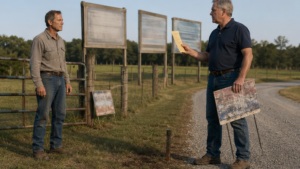
Two square columns now stood on either side of the gravel entrance to his farm, each nearly shoulder-wide and faced with gray stone that had not been there when he left Friday morning. Between them, workers were fastening a black steel gate to heavy hinges. A trench crossed one side of the lane where electrical conduit disappeared beneath fresh gravel.
Raymond stopped in the road.
For a few seconds he thought he had turned into the wrong drive.
Then he saw his lower pasture beyond the fence, the red roof of his equipment shed, and the old maple beside the lane.
He pulled onto the shoulder and got out.
A contractor in a reflective vest stepped away from the gate.
“Need you to stay clear of the footing,” he said.
Raymond looked at him. “The footing is in my driveway.”
The contractor glanced toward the stonework. “This is the road association entrance.”
“No. The road association road starts beyond my line.”
The man’s expression changed only slightly. He had the look of somebody who had already been warned there might be trouble but had been told it was somebody else’s problem.
Raymond walked past him.
The western post stood close to where he remembered the boundary crossing the grass shoulder. The eastern post bothered him more. Its concrete footing spread toward the inside of his turn radius, exactly where he swung livestock trailers wide before straightening onto the lane.
A worker had stacked bags of mortar where Raymond usually put his right trailer tires.
“Who approved this?” Raymond asked.
“Association.”
“Who?”
The contractor wiped his hands on his trousers. “Frank Nelson’s the contact.”
Raymond stared at the gate frame.
He and Frank had disagreed before—ditch mowing, snowplowing, whose gravel washed where after heavy rain—but none of it had ever amounted to this.
Raymond stepped into the grass beside the eastern column.
Years earlier, when a surveyor had marked the parcel after Raymond refinanced the farm, an iron pin had been found near the entrance. Raymond remembered it because his father had laughed when the surveyor uncovered it.
Been there longer than either of us, his father had said.
Now the ground was torn up.
Raymond crouched and pushed aside loose dirt with his fingers.
“Sir,” the contractor said, “I really need you outside the work area.”
Raymond ignored him.
He found a strip of flattened grass, then a small depression packed with wet soil. He grabbed a screwdriver from his truck and worked carefully around it.
Metal scraped metal.
He stopped.
The top of the old iron pin appeared beneath the dirt.
Raymond cleared another inch.
The new stone column stood several feet inside it.
His anger sharpened into something quieter.
“Come look at this.”
The contractor hesitated, then walked over.
Raymond pointed. “That’s my survey monument.”
The man looked from the pin to the post.
“You sure?”
“I paid to have it located.”
The contractor bent slightly but did not touch it.
Raymond stood. “Your footing is inside my property.”
“We built to the site plan we were given.”
“Then the site plan is wrong.”
The contractor walked to a folding table near the work truck and picked up a laminated drawing. Raymond followed.
A thick line marked the proposed gate. Another line showed the gravel lane. The drawing looked polished, but Raymond saw no survey bearings, no monument references, no parcel corners.
“Where did these property lines come from?” he asked.
“I don’t know.”
“You poured concrete without knowing?”
“We pour where the owner tells us.”
Raymond looked at him. “Who did you think the owner was?”
The contractor did not answer immediately.
“The association is paying us.”
“That isn’t what I asked.”
The man folded the plan closed.
Raymond took out his phone and photographed the pin, the column, the footing, the trench, and the gate frame. He stepped back and photographed the entire entrance with his mailbox and pasture fence visible.
The contractor watched him.
“We can stop for tonight,” he said finally. “You’ll need to take the boundary issue up with Frank.”
Raymond nodded once.
He drove the short distance to Frank Nelson’s property without calling first.
Frank was beside his machine shed loading brush into a utility trailer. He was in his early sixties, broad through the shoulders, with gray hair cut close and a manner that could make ordinary statements sound like decisions already made.
Raymond got out holding his phone.
“You put a gate across my entrance.”
Frank set down the branch he was carrying. “Across the association road.”
“One post is inside my survey monument.”
Frank exhaled.
“So that’s what this is.”
“What did you think it would be?”
“We’ve been working on that entrance for six months.”
“No one asked me.”
“The road serves everybody back there.”
“My driveway serves my farm.”
Frank wiped his palms together.
“We’ve had dumping twice this year. Four-wheelers came through Laura’s place. Somebody cut a chain down by the creek. People wanted controlled access.”
“Then put controlled access on association property.”
Frank’s jaw tightened. “That entrance has been used by everybody longer than either of us has owned what we own.”
“Use isn’t ownership.”
“I didn’t say it was.”
“You poured a column on my ground.”
Frank looked toward the road as if he could see the construction from there.
“We have approvals.”
“From who?”
“The association.”
“That still doesn’t make you the owner.”
Frank’s face hardened, but his voice stayed even.
“Bring me your survey tomorrow.”
Raymond had expected an argument. The request slowed him.
“I will.”
“Good.”
“And nothing else gets built until you see it.”
Frank picked up the branch again.
“I can’t promise that.”
Raymond stared at him.
“You’ve got a contractor sitting on my property.”
“And I’m telling you we have a basis for what we’re doing.”
“What basis?”
Frank lifted the branch into the trailer.
“Bring the survey.”
Raymond remained there another moment.
Frank finally looked back at him.
“The crew starts at seven.”
Chapter 2: The Survey Frank Refused to Accept
At six forty the next morning, Raymond spread his stamped survey across the hood of his pickup beside the unfinished gate.
The contractor’s laminated plan lay next to it.
They did not match.
Raymond held the corners down with two sockets from his toolbox while the contractor studied the pages. The survey showed bearings, distances, parcel corners and the iron monument Raymond had uncovered. The association plan showed a neat entrance centered over the gravel lane, as if the lane itself were the boundary.
Raymond tapped the eastern post location.
“Your drawing puts that here.”
The contractor nodded.
Raymond moved his finger to the survey.
“But the monument puts my line out here.”
Another worker arrived carrying a level. He stopped when he saw them.
The contractor said, “I’m not a surveyor.”
“You don’t need to be one to see those two lines aren’t the same.”
“No.”
“Then don’t pour anything else.”
The contractor rubbed his chin.
“I need Frank to authorize a stop.”
Raymond folded the survey.
“Then we’ll go see Frank.”
Frank was already outside when Raymond arrived. He had apparently been expecting him.
Raymond handed over the survey without introduction.
Frank took it to the tailgate of his truck and studied it carefully. That bothered Raymond more than if he had brushed it aside. Frank was not pretending not to understand.
“This was done when?” he asked.
“Four years ago.”
“After your father transferred the last acreage?”
“Yes.”
Frank traced one boundary line with his finger.
“And you think this settles the entrance.”
“I think the iron pin settles where my ground starts.”
Frank looked toward Raymond.
“The road has never been treated that way.”
“By who?”
“By anybody.”
“That doesn’t move a property line.”
“No. But a property line isn’t the only thing that matters when people have used an access for decades.”
Raymond felt the first flicker of uncertainty.
“Used it for what?”
“Maintenance. Deliveries. Farm access. Snow removal.”
“Not control.”
Frank handed the survey back.
“You’re interpreting this like there’s never been an arrangement.”
“What arrangement?”
Frank’s mouth tightened.
“We’ll get to that.”
Raymond stared at him.
“Stop the job.”
“I’m not stopping a project the members approved because you showed me one survey.”
“One survey stamped by a licensed surveyor.”
“And historical use matters too.”
Raymond slid the paper back into its tube.
“Then show me whatever you think gives you the right.”
Frank did not answer.
By noon, the contractor had resumed work.
Raymond watched from the edge of the lane as the gate frame was lifted onto its hinges. He wanted to pull his tractor across the entrance and end the discussion physically. The thought lasted long enough for him to picture Frank calling the sheriff, neighbors arriving, and Raymond becoming exactly what people already thought he was when he refused association meetings.
Difficult.
Stubborn.
Impossible to deal with.
Instead he went inside.
His farm office occupied one end of an old enclosed porch. He opened the file cabinet where he kept deeds, tax records, insurance papers, feed contracts, and the stack of letters the road association had sent over the years.
He found one from three years earlier.
The association had invited him to join formally and contribute annual dues beyond the road-maintenance share some neighboring properties paid.
Raymond had replied that his parcel was not part of the association and that he would continue handling his own lane maintenance.
He found his copy.
Then he found the association’s response acknowledging that membership was voluntary for his parcel.
He photographed both.
That afternoon he attended the association meeting for the first time in nearly two years.
Seven folding chairs faced a long table in the fire hall annex. Frank sat at the center with the treasurer. Laura Wright sat along one wall, arms folded.
Raymond placed copies of his survey and the old membership correspondence on the table.
“I’m asking for one thing,” he said. “Stop construction until a surveyor verifies the entrance.”
Frank looked toward the other members.
“We have a project already under contract.”
“You also have written notice that the post is on my land.”
One neighbor leaned forward. “Can the gate be shifted?”
The treasurer shook his head. “That changes electrical, footing, everything.”
Raymond said, “That sounds cheaper than building it twice.”
Frank gave him a flat look.
Laura spoke for the first time. “Is the gate blocking you right now?”
“Not yet.”
“Then maybe we verify before assuming the worst.”
Frank turned toward her.
“We already verified the roadway.”
“Not his boundary.”
Silence settled around the table.
Frank tapped Raymond’s survey.
“This line does not erase historical access.”
Raymond felt that phrase again.
Historical access.
“What historical access?”
Frank looked at the board members rather than at him.
“For as long as anyone here remembers, that entrance has served the properties beyond it.”
“My father let trucks through.”
“Exactly.”
“He let them. That isn’t the same as giving them the land.”
“No one is claiming your land.”
Raymond pointed toward the window, in the direction of the gate.
“Then move the post off it.”
The treasurer cleared his throat.
The vote was called.
Five favored finishing the project. Two opposed continuing without boundary verification.
Laura was one of the two.
Raymond gathered his papers slowly.
He had come believing the survey would end the argument. Instead, the board had looked at the same line he saw and decided it was not the only line that mattered.
Frank followed him toward the door.
“Raymond.”
He turned.
Frank lowered his voice.
“You should look through your father’s records before you spend money fighting this.”
“Why?”
“Because this didn’t start with me.”
Raymond waited.
Frank opened the door for him.
“There was an old access arrangement on that lane.”
Raymond stood still.
“What arrangement?”
Frank met his eyes.
“One everybody seems to have forgotten except when it’s convenient.”
Chapter 3: Locked Outside With Cattle Behind Him
The first calf bawled just as Raymond hit the brakes.
The stock trailer pushed against the pickup for half a second before the rig settled on the gravel.
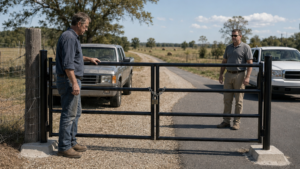
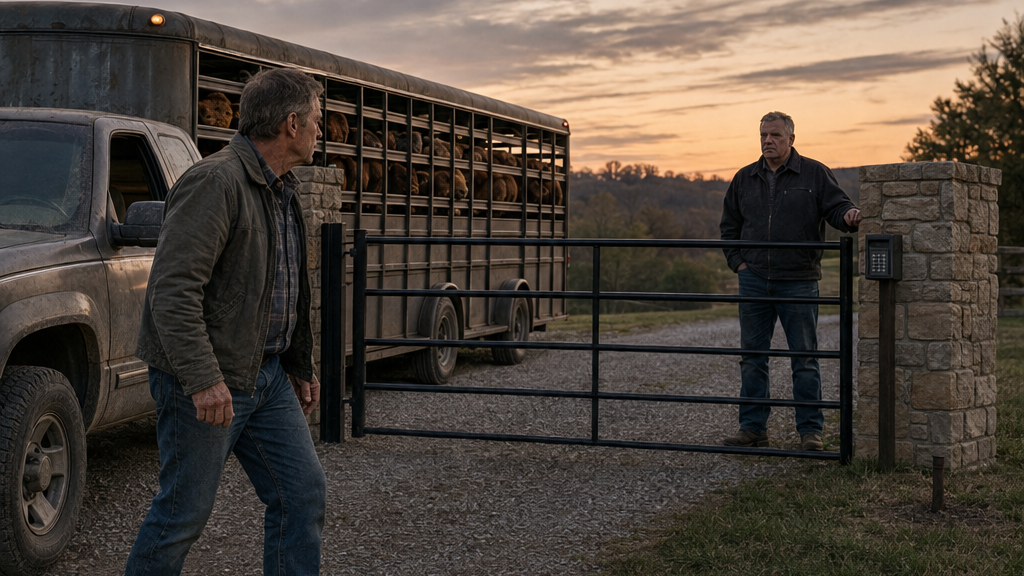
Twenty feet ahead, the new black gate was closed.
Locked.
Raymond sat behind the wheel staring through the windshield while six recently purchased feeder calves shifted in the trailer behind him. He had left before dawn to collect them and had been on the road most of the day. The gate had been open when he departed.
Now a keypad glowed beside the stone column.
He got out.
A small metal sign instructed association members to enter their assigned access code.
Raymond read it twice.
Then he walked to the gate and pulled.
The latch held.
“You have got to be kidding me.”
One of the calves kicked the trailer wall.
Raymond looked back at the rig. The animals had already been hauled long enough. His normal unloading pen was another quarter mile up the lane.
He took out his phone and called Frank.
No answer.
He called again.
Then he heard an engine on the other side of the gate.
Frank’s utility vehicle appeared around the bend with two workers following in a pickup. Frank stopped and climbed out.
Raymond stood in the center of the lane.
“Open it.”
Frank approached the keypad.
“You’ll get access.”
“I have access. It’s my driveway.”
“Association members have individual codes.”
Raymond stared at him.
“I am not an association member.”
Frank’s expression did not change.
“That’s part of what we need to work out.”
“No. What you need to work out is why I’m standing outside my farm with cattle behind me.”
Frank glanced toward the trailer.
“The gate is a safety improvement, Raymond.”
“For who?”
“For everyone along this road.”
“You put a lock on my entrance.”
“We’ve had trespassing, dumping, vehicles coming through after midnight. You know that.”
“I know you put one of your columns inside my property line after I told you not to.”
“The road agreement gives us access.”
There it was again.
Raymond stepped closer.
“What road agreement?”
“The old one.”
“Show it to me.”
“I don’t carry forty-year-old records around in my pocket.”
“But you’re willing to lock a forty-year-old claim across my driveway.”
One of the workers shifted uncomfortably.
Frank lowered his voice. “You want to do this here with cattle in that trailer?”
“I want you to open the gate.”
“I can give you a temporary code.”
Raymond’s anger rose so quickly he felt heat along his neck.
“A code to enter my own farm?”
“You’re making the wording the issue.”
“The lock is the issue.”
“No. Control of traffic is the issue.”
Raymond took one step toward the keypad.
Then he stopped.
The afternoon light caught a rust-colored point in the grass beside the stone column.
The iron survey pin.
It was still visible.
Raymond looked at the column, then at the pin, then back at Frank.
Something in him settled.
He pulled out his phone.
Frank frowned. “What are you doing?”
Raymond photographed the gate.
Then the keypad.
Then the eastern column with the survey pin in the same frame.
He backed toward his truck and photographed the pickup and livestock trailer stopped outside the gate. He took another picture showing the lane beyond it.
“Raymond.”
He ignored Frank and photographed the workers’ vehicle.
Then he opened the video function.
“For the record,” he said, keeping the camera pointed at the closed gate, “this is my farm entrance. I gave written notice that I disputed this structure before completion.”
Frank stiffened.
Raymond lowered the phone enough to look at him directly.
“Are you keeping this gate locked after receiving my objection?”
Frank’s eyes flicked toward the workers.
“You have a way to access the property.”
“That isn’t my question.”
“The association has a right to manage the access corridor.”
“Are you keeping it locked?”
Frank paused.
“Yes. Until this is resolved.”
Raymond stopped recording.
That answer changed something.
He no longer needed Frank to agree with him beside the road.
He needed Frank to keep being precise.
“Open it now so I can unload.”
Frank entered numbers on the keypad. The motor engaged and the steel gate swung inward.
Raymond watched the clearance.
The stone posts narrowed the turn enough that he would have to angle the trailer carefully.
He climbed into the pickup but did not drive forward.
Instead he reversed.
Frank lifted both hands. “What are you doing?”
“Not putting cattle through that opening until I know I can clear it without clipping your post.”
“It’s wide enough.”
“My trailer. My decision.”
Raymond backed down the road until he reached the old field entrance near the lower pasture. It was narrow, muddy, and never intended for a stock trailer, but he could make it work.
It took forty minutes.
He had to remove one section of temporary electric fence, ease the trailer over a shallow ditch, then back almost a hundred yards across uneven ground to the portable pen.
By the time the calves were unloaded, Raymond’s shirt was soaked through and one trailer tire was caked with mud.
He stood against the fence watching the cattle settle.
The humiliation had not disappeared.
It had become useful.
Inside the farmhouse, he spread every relevant document across the kitchen table.
Survey.
Deed.
Tax map.
Association letters.
His certified objection and delivery receipt.
Photographs from construction.
Photographs from that evening.
He called David Adams before he ate.
David listened without interrupting.
When Raymond finished, the attorney asked, “Did Frank actually say there’s an old road agreement?”
“Yes.”
“Have you seen it?”
“No.”
“Did your father ever mention one?”
“No.”
“Did association crews ever come onto that first section of lane?”
Raymond leaned back.
“Sure. To grade the shoulder sometimes.”
“With permission?”
“Nobody asked every time.”
“How long?”
Raymond looked toward the dark kitchen window.
“Years.”
David was quiet.
“Snowplow?”
“Sometimes.”
“Delivery trucks for neighboring properties?”
“If they needed to turn around.”
“Did you ever object?”
“No. Why would I? They weren’t trying to own anything.”
David let that sit.
Raymond understood before the attorney said it.
His silence, which had always seemed like simple neighborliness, was now part of Frank’s argument.
David finally spoke.
“Your survey matters. The physical encroachment matters. Locking you out matters a lot. But don’t make the mistake of assuming the old agreement is meaningless because Frank is using it too broadly.”
Raymond looked down at the photographs of the gate.
“So what do we do?”
“First, we find it.”
“And if it gives them access?”
“Then we find out what kind.”
Raymond touched the edge of the certified-mail receipt.
David continued.
“Access to maintain a road is one thing. Access to control your entrance may be another. But until we read the language, neither you nor Frank gets to decide what that old agreement means.”
Raymond looked toward the mud on his boots, tracked across the kitchen floor from the field entrance.
For the first time since finding the stone posts, he could see a possibility he did not like.
Frank might be wrong about the gate.
But he might not have invented everything.
Chapter 4: The Agreement Everyone Remembered Differently
The county records clerk slid a single yellowed page across the counter and said, “This is the only one I found under that parcel description.”
Raymond did not touch it at first.
He had spent most of the morning moving between index books, microfilm scans, and deed references with David beside him, following every mention of the lane back through transfers that predated Raymond’s ownership. He had expected either nothing or something formal—a recorded easement with bearings and legal language.
Instead, the page looked almost ordinary.
A typewritten agreement, dated decades earlier, signed by several landowners.
David leaned closer.
“Read the first paragraph.”
Raymond did.
The agreement permitted neighboring owners and their designated contractors to enter the first portion of the Clark lane “for purposes reasonably necessary to grading, drainage maintenance, snow removal, and preservation of the common road approach.”
Raymond read it again.
Then a third time.
His father’s signature appeared near the bottom.
Raymond felt a slow pressure behind his ribs.
“So Frank wasn’t making it up.”
David shook his head.
“No.”
Raymond looked toward the clerk.
“Is this recorded against my parcel?”
“It was indexed with the old deed book reference,” she said. “Whether it runs with the land the way they’re claiming is a legal question. I just find the paper.”
David gave her a brief nod.
“And you found the paper.”
Outside, Raymond stood on the courthouse steps holding the copy while trucks passed through the square.
He wanted to be relieved that the agreement was narrow.
Instead he kept looking at his father’s signature.
David tapped the page.
“Don’t skip what helps you.”
“I’m not.”
“You are.”
Raymond looked at him.
David pointed to the language.
“Maintenance. Drainage. Snow removal. Preservation of the common approach. That is not the same thing as a right to construct whatever they want.”
“But they had access.”
“For specific purposes.”
“And I let them keep doing it.”
“Yes.”
Raymond folded the copy carefully.
For years, the association grader had shaved washboard out of the entrance after storms. A snowplow had sometimes pushed through the first stretch before Raymond cleared his own drive. Once, during a wet spring, an association crew had opened the ditch and reset a culvert while Raymond was spreading fertilizer.
He had never objected.
He had not considered those things permission because they had been so ordinary.
That was the problem.
He had believed everyone understood the difference between being helpful and giving something away.
David said, “We need facts about how this was actually used.”
Raymond already knew where to start.
Laura Wright was repairing a latch when he found her that afternoon.
She had one boot braced against a wooden pasture gate while she drove a new bolt through the hinge plate. Several cows stood in the shade behind her.
She looked at the folded records in Raymond’s hand.
“You found something.”
“You knew about the old agreement?”
Laura stopped tightening the nut.
“I knew there was something.”
“That isn’t what I asked.”
She gave him a tired look.
“My father talked about it. Frank talked about it. I never read it.”
Raymond handed her the copy.
Laura wiped her hand on her jeans before taking it.
She read in silence.
When she reached the signatures, she exhaled.
“That’s your dad.”
“I noticed.”
She handed it back.
“My dad used to say your father let the grader come through whenever the road washed out.”
“He did.”
“And the plow.”
“Yes.”
“So that’s what people remember.”
Raymond folded the paper again.
“What else do they remember?”
Laura rested one arm on the gate.
“That nobody stopped anybody from using that first stretch if there was a practical reason.”
“Practical reason according to who?”
“Raymond.”
“No, I’m serious.”
“So am I.”
He waited.
Laura looked toward the lane.
“The feed truck would turn around there if somebody was blocked farther up. The gravel company staged there once. Your father let the ditch crew pile stone by the entrance. Nobody treated it like some sacred line.”
“It still had a line.”
“I know that.”
“Frank doesn’t seem to.”
Laura’s expression shifted.
“You think Frank believes he owns it?”
“I think he believes he can lock it.”
“That’s not the same thing.”
“It feels fairly similar from the wrong side of the gate.”
Laura looked down.
Raymond heard one of the cows pull grass against the fence.
After a moment she said, “Your father was easier about that road than you are.”
Raymond almost answered immediately.
Then he stopped.
There it was.
Not accusation exactly.
Comparison.
His father had said yes to things Raymond had never even been asked about because the habits were already established by the time the farm became his.
Raymond said, “I never told anyone they couldn’t maintain the shoulder.”
“No.”
“I never told anyone they could install a gate either.”
“No.”
“Those are different.”
“They are.”
Her agreement took some of the fight out of him.
Back at the kitchen table that evening, Raymond spread the old agreement beside his survey.
He marked every action the document actually permitted.
Grading.
Drainage.
Snow removal.
Maintenance.
Nothing about security.
Nothing about fencing.
Nothing about gates.
Nothing about keypads.
Nothing about restricting the landowner.
David arrived after six with copies of two older deeds.
They worked through the language line by line.
At one point David asked, “Did you ever give the association a key to anything?”
“No.”
“Written permission for controlled access?”
“No.”
“Sign meeting minutes approving a gate?”
“I barely attended the meetings.”
“That may help on consent, but don’t be proud of it.”
Raymond looked up.
David continued.
“You let a system operate around you and assumed everybody shared your understanding of the limits.”
“The limits are on the deed.”
“People live by habits long before they hire lawyers to read deeds.”
Raymond pushed his chair back.
“So this is my fault now?”
“I didn’t say that.”
“Sounds close.”
“I said you left space for an argument. Frank chose what to do with that space.”
The words irritated Raymond because they landed too neatly.
He stood and went to the sink.
Outside the window, the farm lane disappeared behind the barn. Beyond that, the new gate stood at the road, its black frame visible through the trees.
David tapped the agreement.
“This document explains why reasonable people might think there was shared access.”
Raymond turned.
“And?”
“It also creates a problem for Frank.”
Raymond came back to the table.
David pointed to one sentence near the end.
Nothing in the agreement, it said, transferred ownership or created rights beyond the listed maintenance purposes.
Raymond read it slowly.
Then he looked toward the photocopy of the gate plan.
“So where does the lock come from?”
David shook his head.
“Not from this.”
“The posts?”
“Not from this.”
“Control over who enters?”
“Not from this.”
For the first time all day, Raymond felt something settle.
Not victory.
Shape.
Frank had not invented the history.
He had enlarged it.
The question now was whether he had done that because he genuinely believed decades of custom gave him room—or because he knew the written agreement was too narrow and hoped nobody would look closely enough to challenge him.
Raymond folded the copy along its old crease.
At the bottom of the page, his father’s signature remained perfectly legible.
Above it, the agreement granted maintenance access.
Nowhere did it grant a gate.
Chapter 5: Why Laura Voted for the Gate
Laura did not start by defending Frank.
She started by showing Raymond the fence.
“This post was split clean through,” she said.
They stood at the far end of her pasture where the land dipped toward a narrow creek. One new pressure-treated post stood between two older weathered ones. The wire beside it had been spliced and tightened.
Raymond touched the fresh wood.
“When?”
“April.”
He looked at her.
That had been before the gate project became public.
Laura stepped over a patch of flattened grass.
“Someone came through after dark. Probably four-wheelers. They opened the lower gate and didn’t latch it.”
Raymond looked across the pasture.
“How many got out?”
“Seven.”
He turned back.
Laura’s face had gone flat in the way people’s faces did when the frightening part had happened months ago but the memory had not worn down.
“I found tracks on the road at one in the morning,” she said. “Spent until daylight getting them back.”
Raymond said nothing.
“One heifer made it almost to the county road.”
He could picture that too easily.
Headlights.
Black cattle against black pavement.
A driver rounding the bend too fast.
Laura pushed the repaired gate shut and tested the latch twice.
“That’s why I voted for controlled access.”
Raymond looked toward her house in the distance.
“You thought a keypad would stop it.”
“I thought something might.”
“And that was worth putting the gate on my land?”
“I didn’t know it was on your land.”
“You saw my survey at the meeting.”
“After most of us had already been told the entrance had been checked.”
“By Frank.”
“Yes.”
Raymond looked away.
The answer annoyed him because it sounded honest.
Laura continued.
“He told us the design would not interfere with your farm.”
“When?”
“Before the vote.”
“Those words?”
“Close enough.”
Raymond faced her again.
“He knew I used that turn for stock trailers.”
“Everybody knows.”
“And he still said it wouldn’t interfere.”
Laura nodded.
For a moment neither of them spoke.
The livestock gate between them creaked in the wind.
Raymond had spent days thinking of the association as a group of people trying to take something because it was easier than asking. Standing beside the repaired fence, that explanation became harder to hold.
Laura had not wanted his ground.
She had wanted to stop waking up at midnight wondering whether somebody had opened another gate.
That did not make the stone post legal.
It did make the conflict less clean.
“What did Frank tell you the old agreement said?” Raymond asked.
“That the association had long-standing access rights.”
“Did he say maintenance?”
“No.”
“Did he show it to you?”
“No.”
Laura frowned.
“Is that all it says?”
“Maintenance. Drainage. Snow removal. Things like that.”
Her expression tightened.
“No security?”
“No.”
“No gate?”
“No.”
She looked back toward the road.
“He made it sound broader.”
Raymond studied her.
“Maybe he thinks it is broader.”
“Maybe.”
Neither of them sounded convinced.
That evening the association met again.
This time Raymond came with a proposal instead of only an objection.
He placed one sheet in front of Frank.
“Until the boundary issue is resolved, leave the gate open during normal farm operating hours. Emergency services get whatever code they need. Nobody loses access.”
Frank read the first lines.
“No.”
“You haven’t finished.”
“I don’t need to.”
Laura sat two chairs down from him.
“Why not?”
Frank turned toward her.
“Because the purpose of controlled access is that it remains controlled.”
Raymond leaned forward.
“I’m not asking you to remove it tonight. I’m asking you to stop locking me out.”
“We offered you a code.”
“A code you control.”
“That’s how electronic gates work.”
“Then move the gate off my parcel first.”
Frank set the proposal down.
“We are not dismantling a completed project every time somebody changes their interpretation of an old agreement.”
Raymond felt the old anger return.
“My interpretation didn’t pour concrete.”
Frank’s voice sharpened.
“And your father’s interpretation allowed shared use for thirty years.”
“My father allowed maintenance.”
“He allowed people through.”
“Yes. Because they asked or because there was a reason.”
“Most of the time nobody asked.”
Raymond stopped.
Frank had him there.
Not legally, maybe.
But factually.
Raymond had watched graders, snowplows, delivery trucks and neighboring equipment use the approach. He had waved them through. Sometimes he had not even stepped outside.
Silence had been easy when nobody claimed authority.
Frank looked around the table.
“This is exactly why the gate was needed. Everybody wants safety until safety requires a rule.”
Laura said, “A rule still has to fit the property.”
Frank’s eyes moved toward her.
“You voted for it.”
“I did.”
“And now?”
“Now I’ve seen the agreement.”
Frank sat back.
The room changed slightly.
Raymond noticed it before anyone spoke.
Frank had expected resistance from him.
Not from Laura.
The treasurer cleared his throat.
“Could we leave it open temporarily?”
Frank shook his head.
“If we do that now, before the legal issue is settled, we undermine the association’s position.”
There it was.
Not safety.
Position.
Raymond looked at him.
“You mean you don’t want to look like you backed down.”
Frank’s jaw tightened.
“I mean decisions have consequences.”
“So does locking a man off his own farm.”
“You were not locked off your farm. You had alternate access.”
“The field entrance?”
“You used it.”
“With cattle in a stock trailer.”
“And they were unloaded.”
Raymond nearly stood.
Then Laura spoke.
“Frank.”
Something in her tone stopped him.
She had gone very still.
“When did you get Raymond’s certified letter?”
Frank looked at her.
“You know when.”
“I want you to say it.”
“This isn’t a trial.”
“When?”
Frank did not answer.
Laura turned to Raymond.
“I was at the office when the treasurer brought the mail in.”
Raymond watched her.
“The letter was there before the keypad was installed,” she said.
Frank’s chair scraped softly.
Laura continued.
“Before the final electrical work. Before the gate was commissioned.”
Raymond looked toward Frank.
Frank did not deny it.
The room seemed suddenly smaller.
Raymond had assumed Frank had pushed forward because he believed the historical arrangement gave the association authority.
That might still have been true.
But Frank had also known Raymond formally objected before the gate became operational.
He had known the boundary was disputed.
He had known Raymond was not an association member.
He had known the structure might interfere with livestock access.
And he had chosen to lock it anyway.
Raymond gathered his copy of the temporary proposal.
Frank said, “Raymond, don’t turn this into something it isn’t.”
Raymond looked at him.
“I’m trying to figure out exactly what it is.”
Laura answered before Frank could.
“He had your objection before he turned the lock on.”
Chapter 6: The Record Frank Could Not Stretch Further
The association attorney used the phrase “shared access corridor” three times before Raymond was asked a single question.
Raymond sat beside David at the county courtroom counsel table and listened while the attorney described decades of road use, coordinated maintenance, snow removal, agricultural deliveries, and emergency concerns. None of it was invented.
That was what made it effective.
Across the aisle, Frank sat with his hands clasped.
The photograph Raymond had taken at dusk rested inside David’s folder: the black gate closed across the lane, Raymond’s truck and livestock trailer visible beyond the stone post.
The judge looked down at the old agreement.
“You’re not asserting ownership of Mr. Clark’s parcel?”
“No, Your Honor,” the association attorney said.
“An express easement?”
“Not in the conventional modern form.”
David wrote two words on his legal pad and slid it toward Raymond.
Here it comes.
The attorney continued.
“The association’s position is that the written maintenance agreement, combined with longstanding open and continuous use, established broader access rights necessary to preserve the function of the road.”
The judge looked up.
“Broader how?”
“In a manner consistent with present safety needs.”
“Such as a locked gate?”
“Yes.”
Raymond felt David shift beside him.
The judge turned a page.
“Show me where the written agreement authorizes the installation of a gate.”
The association attorney paused.
“The agreement predates electronic gates.”
“That was not my question.”
Silence settled.
The attorney pointed to a paragraph concerning preservation of the common approach.
The judge read it.
“This permits grading, drainage maintenance, snow removal, and related preservation work.”
“Yes, Your Honor.”
“Where does it permit exclusion of the parcel owner?”
“It does not say exclusion.”
“But the gate excluded him.”
“Temporarily, until access credentials could be arranged.”
Raymond’s jaw tightened.
David touched one finger to the table.
Wait.
The judge said, “The owner was required to obtain credentials from an association to which he does not belong?”
“The association manages the access system.”
“Under what authority?”
The attorney returned to historical use.
This time it sounded thinner.
When David stood, he did not argue that no shared use had ever existed.
Raymond had expected him to at first.
Instead David conceded what the records supported.
“Yes, neighboring owners and maintenance contractors historically entered the first portion of the Clark lane. Mr. Clark does not dispute that. His father permitted it. Mr. Clark himself tolerated the same practices.”
The association attorney looked almost pleased.
Then David placed the gate photograph beside the old agreement.
“But this case is not about whether a snowplow could pass.”
He pointed to the photograph.
“It is about whether permission to grade a shoulder became authority to build this.”
The judge looked at the image.
David continued.
“The association crossed a surveyed boundary, installed permanent structural footings, placed a controlled locking system across Mr. Clark’s principal agricultural entrance, and continued after receiving written objection.”
Frank’s face remained expressionless.
David handed up Raymond’s survey and certified-mail receipt.
The judge compared them with the old agreement.
“What evidence establishes the location of the structure?”
“The licensed survey and field monument,” David said.
“Has the association produced a contrary survey?”
“No.”
The judge looked toward the other table.
“Do you have one?”
The association attorney glanced at Frank.
“No, Your Honor.”
“A recorded easement authorizing a gate?”
“No.”
“A recorded right to regulate Mr. Clark’s entry?”
“No.”
“A written modification expanding this maintenance agreement?”
“No.”
Each answer landed more quietly than Raymond had imagined.
There was no dramatic collapse.
No raised voice.
Just less and less underneath Frank’s position.
The association attorney tried one more direction.
“The practical concern remains that unrestricted access has created safety problems. Trespass, dumping, livestock incidents—”
“I understand the concern,” the judge said. “Concern does not write property rights into a document.”
Raymond looked down.
That sentence should have felt like complete vindication.
Instead he thought of Laura’s repaired fence.
Seven cattle loose in the night.
A heifer near the county road.
The judge continued.
“I am prepared to order immediate unrestricted access restored to Mr. Clark and to require removal of any structural component shown to encroach upon his parcel.”
Frank’s shoulders lowered a fraction.
Raymond felt something release inside him.
The gate could not stay as it was.
The post could not remain where it stood.
The lock could not be used against him.
The judge looked at David.
“Is your client seeking complete prohibition of all association access to the approach?”
Raymond turned slightly.
David did not answer for him.
Instead he said, “My client can address that.”
The judge looked at Raymond.
Raymond had not expected to speak yet.
He stood.
“No, Your Honor.”
Across the aisle, Frank looked up.
The judge waited.
Raymond chose his words carefully.
“I’m not trying to stop a grader from fixing a washout. I’m not trying to stop a plow. If there’s a fire or an ambulance needs through, I don’t want somebody standing there reading a deed.”
The judge nodded.
“But?”
“But I don’t want what happened here to happen again.”
“What does that mean to you?”
Raymond glanced at the photograph.
“It means permission needs limits.”
The courtroom stayed quiet.
For years he had believed the limits were obvious.
That belief had helped create the problem.
He continued.
“If they need maintenance access, write down maintenance access. If emergency services need access, write down emergency access. But no permanent structure on my property. No association lock controlling my farm. No turning permission into ownership later.”
The judge looked toward both attorneys.
“That sounds like something the parties should be capable of putting into an agreement.”
The association attorney began to speak.
Frank touched his arm.
The attorney stopped.
For the first time since the dispute began, Raymond saw something other than certainty in Frank’s face.
Not defeat exactly.
Calculation, then fatigue.
The judge issued temporary relief from the bench: the gate could not remain locked against Raymond, and the encroaching post would have to be removed unless the parties reached another arrangement consistent with the surveyed boundary.
The larger claims regarding historical access would be narrowed to what the written agreement and applicable law actually supported.
Outside the courtroom, Frank caught up with Raymond near the stairwell.
“You got what you wanted.”
Raymond turned.
“Not yet.”
“The post comes out. You control your entrance.”
“That’s part of it.”
Frank gave a short, humorless laugh.
“What else?”
Raymond thought about answering with every grievance he had carried into court.
Instead he said, “Something nobody has to remember differently in twenty years.”
Frank looked at him for a long moment.
David stepped out of the courtroom behind them carrying the file.
Frank said, “So now you want a new agreement.”
“I want a clear one.”
“And if I say no?”
Raymond looked through the courthouse doors toward the street.
“Then the order stands, the post comes down, and the association gets exactly what the old paper gives it. Nothing more.”
Frank’s mouth tightened.
David said, “That’s accurate.”
Frank ignored him.
“What about emergency access?”
Raymond looked back.
“That depends on whether you’re asking for emergency access or control.”
For the first time, Frank had no quick answer.
The court had given Raymond enough leverage to demand complete separation if he chose.
What remained was harder.
He had to decide how much of that leverage he actually wanted to use.
Chapter 7: Taking Down the Post Without Closing the Road
The demolition saw bit into the concrete less than a foot from the old iron survey pin.
Raymond stood behind the temporary barrier with his hands in his jacket pockets while gray dust rolled across the gravel. The eastern stone post, the one that had started the whole fight, had already been stripped of its facing. Bare block and conduit showed beneath it.
The gate hung open.
It had remained open since the court hearing.
Frank stood on the opposite shoulder beside the contractor, saying little.
When the saw stopped, the sudden quiet made the place feel unfamiliar.
The contractor pointed toward the iron pin.
“We’ll stay clear of that.”
“You better,” Raymond said.
The man nodded without offense.
A month earlier Raymond might have watched every cut as if supervising an enemy retreat. Now the removal felt less satisfying than he had expected.
Necessary, yes.
Satisfying, not exactly.
The stone post came apart in sections. Workers lifted broken pieces into a skid-steer bucket. Beneath them, the footing remained—a thick block of concrete extending well inside Raymond’s boundary.
Frank walked over while the machine repositioned.
“You’re getting the whole thing removed.”
“That’s what the order says.”
“I know what the order says.”
Raymond looked at him.
Frank glanced toward the gate.
“What are you going to do with the entrance?”
“My entrance?”
“The access.”
There was still a challenge in the way Frank said it, but less confidence behind it.
Raymond said, “David’s drafting something.”
Frank gave a short nod.
“I assumed.”
“You sound disappointed.”
“I assumed you’d shut everybody out.”
Raymond studied him.
“Why?”
Frank looked toward the road.
“Because you can.”
There it was.
Raymond understood then that Frank had built an ending in his own head.
The court would side with Raymond. Raymond would retaliate. The association would lose every informal privilege it had relied on for decades. Then, whatever happened during the next snowstorm or washout, Frank could say this was what came from one man insisting on absolute control.
Raymond said, “That what you would do?”
Frank’s expression tightened.
“That isn’t the point.”
“It might be.”
The skid-steer cracked another section of concrete loose.
Frank watched it for a while.
Then he said, “You think I did all this because I wanted your ground.”
“I think you knew I objected and locked the gate anyway.”
“That isn’t an answer.”
“No. It’s the part you keep avoiding.”
Frank looked at him.
Raymond continued.
“You had my survey. You had my letter. Laura says you knew there was a problem before the keypad went live.”
Frank’s jaw moved slightly.
“We had people screaming about trespassers, dumping, kids on four-wheelers. We’d spent months getting bids. The contractor was already paid in part. Half the board thought if I stopped because you complained, the project would die.”
“So you kept going.”
“Yes.”
The directness surprised Raymond.
Frank rubbed a hand over his mouth.
“I thought the old agreement gave us enough room. Maybe not forever. Enough to manage the entrance until the legal part got sorted.”
“You thought locking me out would help sort it?”
“I thought giving you a code would solve the practical problem.”
Raymond almost laughed.
“That’s still the part you don’t understand.”
Frank’s eyes hardened.
“I understand it now.”
The contractor called Raymond over.
The footing had been exposed.
Fresh earth surrounded the old iron pin, but the monument itself remained untouched.
Raymond crouched beside it.
The metal was rust-dark and unimpressive, barely taller than the grass when the ground was intact. Yet a structure weighing thousands of pounds had been moved because of where that small piece of iron stood.
He brushed dust from the top with two fingers.
That afternoon he met David at the attorney’s office.
The draft agreement was only three pages.
Raymond read every line.
It allowed association contractors to enter a defined portion of the lane for grading, drainage repair, snow removal, and specified maintenance. Emergency vehicles could use the approach without prior permission. The association could maintain a gate on its own property beyond Raymond’s surveyed line, provided Raymond retained unrestricted passage.
No general public-access right.
No right to store materials.
No permanent construction on Raymond’s parcel.
No authority to issue, suspend, or condition Raymond’s access credentials.
Most important, one paragraph stated that every permitted use was a license limited to the listed purposes and created no ownership interest, general easement, or expanded right through continued use.
Raymond read that paragraph twice.
David watched him.
“That’s the sentence you wanted.”
“That’s the sentence I should’ve had twenty years ago.”
“You didn’t own the whole place twenty years ago.”
“You know what I mean.”
David leaned back.
“What are you uncomfortable with?”
Raymond pointed to the emergency section.
“Who gets the override?”
“Volunteer fire company and emergency dispatch.”
“Not the association?”
“Not unless you choose to give them one.”
Raymond nodded.
“And maintenance?”
“Notice when practical. Immediate access if there’s an active washout affecting the shared approach.”
Raymond looked toward the window.
“What if Frank says it’s too narrow?”
“Then he doesn’t sign.”
“And we fall back to the court order.”
“Yes.”
Raymond folded his hands.
He had spent weeks wanting exactly that leverage.
Now that he had it, he was surprised by how little he wanted to use it for punishment.
“What about the new gate?” he asked.
“If it’s re-hung entirely outside your parcel and doesn’t restrict your travel, the court has no reason to care.”
“I might.”
“That’s your choice.”
Raymond looked back at the draft.
“Keep it.”
David raised an eyebrow.
“The gate?”
“If they want it on their ground, keep it.”
Two days later they met in the fire hall annex.
Frank came with the association treasurer and the association attorney. Laura sat along the wall but did not speak at first.
David placed copies of the draft around the table.
Frank read more slowly than Raymond expected.
When he reached the paragraph denying any creation of broader rights, he stopped.
“This is pretty absolute.”
“That’s the idea,” Raymond said.
“It says long-term use doesn’t expand the license.”
“Yes.”
“So thirty years from now, if everybody is still using the approach—”
“They’ll still be using it for what’s written there.”
Frank looked toward David.
“Can you even do that?”
David said, “You can state the parties’ intent very clearly.”
Frank flipped another page.
“And if the association changes?”
“The agreement stays.”
“If Raymond sells?”
“It stays.”
Frank looked at Raymond again.
“So nobody gets to reinterpret it.”
Raymond slid the stamped survey onto the table between them.
“That’s what got us here.”
Frank’s eyes dropped to the boundary line.
For several seconds he said nothing.
Laura finally spoke.
“Sign it.”
Frank looked toward her.
She shrugged.
“You wanted certainty.”
“This isn’t what I meant.”
“No,” she said. “It’s probably better.”
Frank leaned back.
Raymond could see the resistance in him—not to maintenance access, not to emergency access, but to the idea that he no longer controlled the language.
Raymond knew that feeling.
He had spent years believing ownership made explanation unnecessary.
Frank had spent months believing responsibility gave him authority.
Both assumptions had survived because nobody had been forced to state the limits out loud.
Frank picked up the pen.
Before signing, he said, “I still think the entrance needed fixing.”
Raymond nodded.
“You may be right.”
Frank looked surprised.
Raymond added, “You were wrong about whose permission you needed.”
Frank held his gaze for a moment.
Then he signed.
Raymond signed after him.
He did not offer his hand.
Frank did not offer his.
When Raymond returned to the farm, the demolished footing had been filled with compacted gravel. The iron pin stood exposed at the edge of the repaired shoulder.
Beyond it, workers had begun setting a new hinge post several feet farther down the association side.
The gate would remain.
But it would stand where the authority to build it actually began.
Chapter 8: The Gate That Finally Marked the Right Boundary
The feed truck slowed at the entrance, and Raymond felt his shoulders tighten before he could stop them.
The driver rolled down the window.
“Clark farm?”
Raymond nodded from beside the fence.
The truck turned through the entrance without touching the shoulder where the old stone post had stood.
There was room now.
Enough room for the rear axle to clear the ditch.
Enough room for a livestock trailer to swing wide.
Enough room that Raymond no longer watched every turn expecting steel and stone to interfere.
The new association gate stood farther back from the county road, entirely beyond the iron survey pin. It was simpler than the first version. The heavy stone columns had been replaced by square steel posts. The keypad remained on the association side.
Raymond had no code.
He did not need one.
His lane remained open.
Three months had passed since the agreement was recorded.
Harvest had come and gone.
The grader had entered twice, both times after Raymond received a short notice. A drainage crew had cleared a blocked culvert after a hard rain. Nobody asked for more than the agreement allowed.
At first, each message made Raymond suspicious.
Association maintenance Tuesday, 8 a.m.
He would read it twice, then walk down to the entrance as if expecting to find another foundation being poured.
Nothing happened.
The grader came.
It worked.
It left.
That ordinary pattern turned out to be harder to trust than Raymond had expected.
One afternoon Laura pulled up beside him while he was replacing an insulator on the pasture fence.
“You still check every truck?” she asked.
Raymond looked at her.
“I check trucks.”
“That’s not what I asked.”
He pushed the new insulator onto the post.
“Most of them.”
Laura smiled slightly.
“You’ll wear yourself out.”
“I’ve been told that before.”
She rested an arm on the open window.
“How are the feeders?”
“Growing.”
“That’s usually what they do.”
“Usually.”
They had not returned to the easy neighborliness they had once had, but neither of them avoided the other now.
That was enough.
Frank was different.
Raymond saw him at the entrance sometimes, usually checking the gate mechanism or talking with a contractor. They nodded when they were close enough that not doing so would feel deliberate.
They did not stop to talk.
Raymond was not sure whether that counted as peace.
He had decided it did not need a name.
The first real test came on a cold morning in late November.
Raymond was in the equipment shed when his phone rang.
Laura.
“There’s an ambulance coming up.”
He straightened.
“What happened?”
“One of the neighbors fell off a ladder. Dispatch called me because they saw the gate note.”
Raymond was already walking.
“Do they need my side?”
“Maybe for the turnaround.”
“I’ll open the lower fence.”
“I’m heading there.”
By the time Raymond reached the entrance, the volunteer fire company had already used its emergency override. The association gate stood open.
No call to Frank.
No request for permission.
No delay while someone searched for an individual code.
The ambulance came through behind a volunteer fire vehicle.
Raymond waved them toward the wider portion of his lane, then opened the lower field entrance so the larger vehicle would have space to turn without backing toward the cattle fence.
Laura arrived a minute later.
For fifteen minutes neither of them discussed property.
They moved a portable feeder out of the way. Raymond held a gate. Laura directed the fire vehicle back toward the road.
When the ambulance finally left, the association gate closed automatically behind it.
Laura stood beside Raymond in the gravel.
“Well,” she said.
“Well.”
“That worked.”
“It did.”
She looked at the gate.
“This is what I thought we were voting for.”
Raymond followed her gaze.
“I know.”
The admission surprised both of them.
Laura looked toward him.
“You could’ve shut it all down.”
“Yes.”
“You thought about it?”
“Yes.”
“How long?”
Raymond considered lying.
“Long enough.”
Laura laughed once.
“Fair.”
He put his hands in his jacket pockets.
“I kept thinking about that night you were chasing cattle.”
Her expression changed.
“You didn’t owe me access because of that.”
“No.”
“That’s important.”
“I know.”
Raymond looked toward the iron pin.
The grass had grown back around it, but he kept a small circle cleared so it remained visible.
“I just didn’t want the lesson to be that nobody helps anybody anymore.”
Laura followed his gaze.
“What was the lesson?”
Raymond took a moment.
“That helping isn’t the same as handing something over.”
Laura nodded slowly.
“And asking isn’t the same as taking.”
“No.”
She glanced toward the association gate.
“Frank might need a few more years for that one.”
Raymond almost smiled.
In December, the feed supplier called ahead before sending a larger truck than usual.
Raymond met it at the road.
The driver studied the entrance.
“Plenty tight through there?”
“Used to be.”
The truck eased forward.
Its front wheels crossed the gravel where the demolished footing had once been. The rear end swung wide, exactly through the space Raymond had tried to explain at the first meeting.
Nothing blocked it now.
The driver straightened the truck and continued toward the barn.
Raymond remained beside the entrance.
Across the road, Frank’s pickup approached.
It slowed.
Frank lowered his window.
“Big truck.”
“Three tons of feed.”
Frank looked toward the new gate, then toward the clear lane.
“Turn okay?”
“Fine.”
Frank nodded.
He could have driven on.
Instead he said, “Emergency call worked last month.”
“It did.”
“Fire company wants the override checked every spring.”
“Fine with me.”
“I’ll send notice before they test it.”
Raymond looked at him.
“All right.”
Another silence.
Then Frank said, “I should’ve stopped the contractor when your letter came.”
Raymond had imagined hearing something like that often enough that he had built several answers for it.
None of them seemed useful now.
“Yes,” he said.
Frank nodded once.
No apology followed.
No explanation.
He drove away.
Raymond watched the pickup disappear around the bend.
It was not reconciliation.
But it was the first time Frank had named his own choice without hiding it behind the board, the agreement, or the word safety.
Raymond found that sufficient.
By early spring the entrance looked ordinary again.
Grass covered the disturbed soil. The replacement gate had weathered enough that it no longer seemed new. Trucks came and went. Snowplows crossed when needed. Nobody treated the iron pin as particularly important except Raymond.
He noticed it every time.
One afternoon, after a feed delivery, he walked down to close the pasture gate.
The driver raised two fingers in thanks and headed toward the county road.
Raymond swung the wooden gate shut behind the truck and dropped the chain into its slot.
The motion was familiar.
His father had done it.
Raymond had done it thousands of times.
A gate was not ownership.
A gate was not authority.
It was simply a boundary made visible, and a boundary meant little unless the people on both sides understood who had the right to open it.
He walked toward the lane.
Near the shoulder, the old iron survey pin caught the late light.
Beyond it stood the association gate, firmly on the other side.
Raymond looked at both for a moment, then turned back toward his cattle.
The story has ended.