The HOA Blocked His Own Driveway for Their Service Trucks—Then He Found the Easement Had Expired Years Ago
Chapter 1: The Trucks Were Waiting in His Driveway
Samuel King knew something was wrong before he reached the garage.
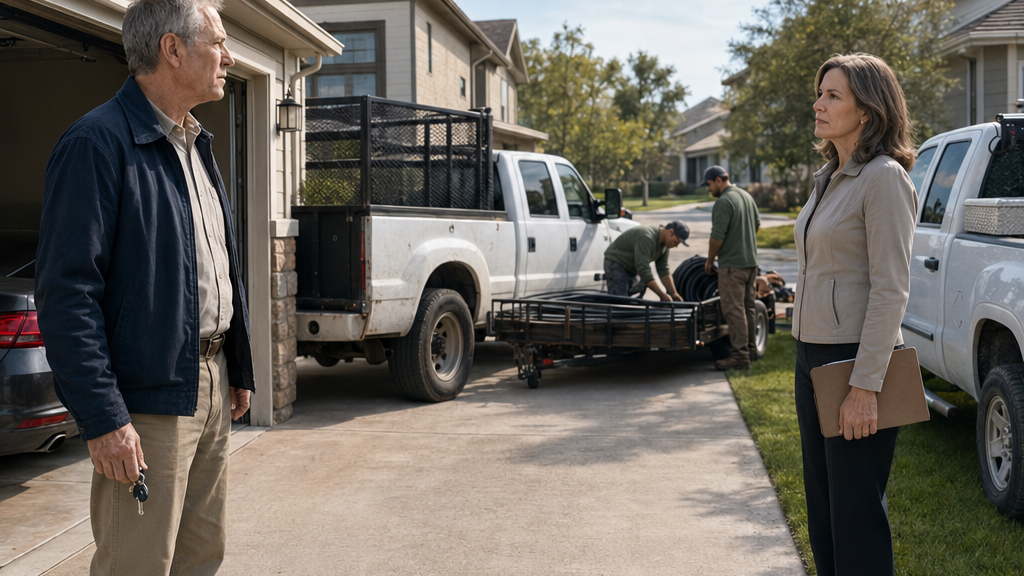
A white landscaping truck sat sideways across the lower half of his driveway, its trailer angled behind it like a gate. Beyond that, a second contractor pickup had backed onto the narrow strip of ground beside Samuel’s garage. Two men in work shirts were unloading coils of irrigation tubing.
Samuel stopped on the front step with his keys in his hand.
His sedan was inside the garage.
There was no way out.
He walked down the driveway slowly, expecting one of the workers to notice him and move. Instead, a third vehicle rolled through the opening beside the house and continued toward the HOA’s maintenance area behind the row of homes.
Samuel stepped aside as it passed.
The strip was barely wide enough for a truck. Eighteen feet, according to the survey he remembered receiving when he bought the house. Grass on one side, garage wall on the other, then a shallow turn behind his property.
For years, maintenance crews had occasionally used it.
Occasionally.
A mower when the rear gate was muddy. A utility cart after a storm. Once, a tree-service truck when a fallen limb blocked the association’s usual entrance.
Samuel had never objected.
He had also never imagined waking up to find it operating like a private road.
“Morning,” he called.
One of the workers looked over.
“I need to get my car out.”
The man glanced toward the driveway entrance.
“We were told to stage here.”
“By who?”
“The association.”
Samuel looked at the truck blocking his garage.
“Then the association needs to unstage it.”
The worker shifted his gloves from one hand to the other. “You’ll probably want to talk to the board president.”
That answer irritated Samuel more than an argument would have.
He pulled out his phone, took three photographs, then called the property manager. He got voicemail.
Before he could try again, Emily Hall came around the corner from the sidewalk.
She wore running shoes and a light jacket, but she was carrying a clipboard under one arm. That told Samuel she had not simply happened upon the scene.
“Samuel,” she said. “I was coming over.”
He looked past her at the blocked driveway.
“Good. Who authorized this?”
“I did.”
The directness surprised him.
“You authorized trucks to block my garage?”
“For the irrigation project. They’re replacing the failed section behind the common area.”
“That wasn’t my question.”
Emily’s expression tightened slightly.
“The crew needs access through the service corridor. They should be finished unloading shortly.”
Samuel looked toward the narrow strip.
“Service corridor?”
“Yes.”
“That’s my side yard.”
“It’s an access easement.”
Samuel stared at her.
Emily lowered the clipboard against her leg. “The association has used that route for years.”
“I’ve allowed people through there when there was a reason.”
“It isn’t just informal permission.”
“Then why has nobody ever called it an easement to me?”
She gave a small exhale, the kind people used when they believed a conversation had become unnecessarily difficult.
“Samuel, this predates both of us being on the board.”
“I’ve never been on the board.”
“You know what I mean.”
He did, but he let the silence stand.
A worker rolled a heavy spool off the trailer. It struck the pavement with a hollow thud.
Samuel pointed toward the driveway.
“I have an appointment in forty minutes.”
“We can get the truck moved.”
“Then do that first.”
Emily turned and asked the driver to pull forward. The truck moved six feet, then ten. It was enough for Samuel to back his car out if he angled carefully.
That should have ended the immediate problem.
Instead, Emily said, “But the crew will still need the corridor today.”
Samuel looked at her again.
“So you moved the truck, but you’re still saying they’re driving across my property.”
“They’re using the easement.”
“You keep saying that like it settles something.”
“Because legally, it does.”
There was no triumph in her voice. That bothered him almost more. She sounded certain in the way people sounded when they were repeating something long accepted.
Samuel had lived there sixteen years.
He had helped neighbors drag branches after storms. He had allowed contractors through the side strip because the association’s rear entrance was inconvenient. When the old mower broke down years ago, he had even unlocked his side gate for the landscaping crew without being asked.
He had considered those things favors.
Apparently someone else had been keeping a different kind of record.
“When was this easement created?” he asked.
“I don’t know the exact year.”
“Who owns it?”
“The association has the access right.”
“What are the boundaries?”
Emily paused.
“It’s the existing corridor.”
“That isn’t a legal description.”
“No, Samuel, it’s obviously not the legal description.”
“Then what is?”
Her restraint thinned.
“You’re turning a maintenance issue into a property dispute when nobody is trying to take anything from you.”
Samuel felt the answer settle in his chest.
Nobody is trying to take anything from you.
The workers were unloading equipment on land she had just told him the association had a legal right to use.
“I’m not accusing anyone of taking the land,” he said. “I’m asking what right you have to be on it.”
“And I answered you.”
“You gave me a word.”
Emily’s eyes narrowed.
“Fine. There is a recorded easement. It covers the access strip from the street toward the common maintenance parcel. The association has relied on it for decades.”
Samuel looked toward the grass.
Fresh tire tracks pressed two dark lines through the damp surface.
“Decades?”
“Yes.”
“And you’re sure it applies now?”
“Yes.”
The certainty came too quickly.
Samuel noticed it.
He also noticed his own impulse to push harder.
That was the part of himself he distrusted. He could tolerate something for years, say nothing, then reach a point where every sentence came out sharper than he intended.
So he stopped.
“All right.”
Emily seemed surprised.
“All right?”
“I’ll check it.”
She shifted the clipboard.
“You’re welcome to.”
Samuel nodded toward the contractors.
“Today, keep the driveway clear.”
“We will.”
“And don’t assume silence means agreement.”
For the first time, Emily looked genuinely annoyed.
“Samuel, no one has been hiding this from you.”
“Maybe not.”
He opened his garage.
Behind him, another utility vehicle turned toward the narrow strip.
Samuel watched it slow beside the corner of his house.
Emily stepped away to guide it through.
She knew exactly where the vehicle was supposed to go.
That bothered him.
Not because it proved she was wrong.
Because it suggested she might be completely right.
Before Samuel got into his car, Emily called after him.
“County records should have the original instrument if you want the paperwork.”
He turned.
She tapped the clipboard lightly against her leg.
“You should read the recorded easement yourself.”
Chapter 2: The Easement Looked Real Enough
The document appeared on the county terminal under Samuel’s parcel number.
He found it at 2:17 that afternoon.
For several seconds he simply stared at the screen.
ACCESS AND MAINTENANCE EASEMENT.
There it was.
Not a board memo. Not an internal HOA map. Not something drafted last month to justify what had happened that morning.
A recorded property instrument.
Samuel leaned closer.
The county records office was quiet except for the clicking of another computer and the distant scrape of paper at the clerk’s counter. He had arrived expecting to discover that Emily was exaggerating.
Instead, the first page seemed to confirm almost everything she had said.
The document had been recorded decades earlier, before his house was built in its current form.
It named the parcel that later became part of the association’s common property.
It described access for maintenance vehicles.
It referenced a strip of land along the western side of the lot Samuel now owned.
Samuel sat back.
“Well,” he whispered.
A county records clerk glanced over.
He shook his head. “Nothing.”
He printed the document.
Then the attached exhibit.
The map came out on two pages.
Samuel carried them to a side table and aligned the edges.
There was his lot.
There was the street.
There was the narrow strip beside what was now his garage.
The measurements were close enough to make his stomach sink.
Eighteen feet wide.
Approximately two hundred ten feet long.
The same passage the trucks had been using that morning.
He ran one finger along the shaded section.
For years he had told himself that he was helping the HOA because the strip happened to be convenient.
According to the map, convenience had been designed into the property before he ever owned it.
He felt foolish.
Not defeated exactly.
But embarrassed by how quickly he had challenged Emily.
He remembered telling her she had given him only a word.
Now the word had six recorded pages behind it.
At home, he spread everything across his dining table.
From the window he could see the grass beside the garage.
The contractors were gone, but the tire tracks remained.
They looked different now.
In the morning they had looked like trespass.
By late afternoon they looked like evidence of something Samuel had failed to understand.
He read the document from the beginning.
The language was dense but not impossible.
Grantor. Grantee. Successors and assigns. Access for installation, inspection, repair, and maintenance.
He underlined phrases with a pencil.
The HOA itself had not existed in exactly the same form when the document was created, but the common property had passed into association control later. Samuel could follow enough of the chain to see why the board believed the right belonged to it.
He called the property manager.
This time she answered.
“I found it,” Samuel said.
“The easement?”
“Yes.”
There was a brief pause.
“Good.”
That single word irritated him.
Not because she had done anything wrong.
Because he could hear relief in it.
As if the case had been closed.
“Did the association give me a copy when I bought the house?”
“That would normally be part of the title documents.”
“Normally?”
“I can’t speak to what your closing company provided sixteen years ago.”
Samuel rubbed his forehead.
“Do you have a current site plan?”
“Yes.”
“Does it show the strip?”
“It does.”
“As association access?”
Another pause.
“As a service access corridor.”
Samuel looked at the old exhibit.
“Based on this easement?”
“As far as I know.”
He thanked her and ended the call.
For the next hour, he searched through a file cabinet in the spare room.
Closing documents. Tax assessments. Insurance papers. An old survey folded into quarters.
The survey showed the strip.
A thin dashed line ran beside the garage.
Samuel found a note pointing to a recorded instrument number.
The same number.
He sat on the floor with the survey across his knees.
He had owned the proof all along.
That realization stung more than Emily’s certainty had.
He had been so determined not to become the neighborhood crank that he had never asked what exactly everyone believed they were entitled to.
He had assumed favors remained favors simply because nobody had said otherwise.
But the documents suggested a different history.
Samuel called Emily shortly before six.
“I found the easement.”
“I thought you would.”
“You were right about the location.”
“I wasn’t trying to win an argument.”
“I know.”
He said it reluctantly, then realized it was true.
Emily had been defensive, but she had not lied to him about the document.
“At least now we’re looking at the same thing,” she said.
Samuel looked down at the papers.
“Seems that way.”
“The irrigation work should be finished by Thursday.”
He almost told her that was fine.
The words were already forming.
Then his eyes stopped on a paragraph near the bottom of page four.
It had a heading.
TERMINATION.
Samuel frowned.
“Emily?”
“Yes?”
“Give me a second.”
He read the first line once.
Then again.
The paragraph referred to a date.
There were conditions after it, cross-references, language he did not fully understand.
But the year was unmistakable.
Samuel sat forward.
“What?” Emily asked.
“I’m still reading.”
He moved his finger slowly beneath the sentence.
The easement shall terminate…
Then language concerning a designated access facility.
Then another clause.
Samuel’s pulse changed.
It might mean nothing.
It might refer only to part of the agreement.
It might be legal wording he was interpreting completely backward.
He had learned enough that day not to trust his first reaction.
“I’ll call you later,” he said.
“Is something wrong?”
“I don’t know yet.”
After the call, Samuel photographed the paragraph and sent it to a real-estate attorney whose card had been in his closing file for years.
Kathleen Baker.
He added one sentence.
Can you tell me whether this easement is still in force?
Five minutes later, he looked again through the dining-room window.
The narrow strip beside his garage was empty.
Nothing about it had changed.
But for the first time all day, Samuel was no longer wondering whether an easement existed.
He was wondering why a document everyone treated as permanent contained a date from seventeen years ago.
Chapter 3: One Date Changed the Entire Corridor
Kathleen Baker did not begin by telling Samuel he had won.
She placed the easement on her desk, turned it toward him, and said, “Why is anyone still using an agreement that appears to have expired in 2009?”
Samuel stared at her.
“Appears?”
Kathleen tapped the page.
“That word matters.”
Her office was small and orderly, with two shelves of property codes and a framed survey map on one wall. Samuel had arrived ten minutes early and spent all ten trying not to imagine what he wanted her to say.
Now that she had nearly said it, caution bothered him.
“So it expired.”
“Under this termination provision, yes, assuming the conditions referenced here were satisfied.”
“What conditions?”
Kathleen turned to the attached exhibit.
“The easement was created as temporary service access until the planned permanent association access was constructed and accepted.”
Samuel leaned over the desk.
She pointed to a paragraph he had read three times the previous night without understanding.
“This is tied to a future access facility. The temporary easement terminates when that facility is completed, or no later than the date specified here.”
“Which is 2009.”
“Yes.”
“And that date passed.”
“Seventeen years ago.”
Samuel let out a breath.
Kathleen did not smile.
“You need to hear the rest.”
His relief stopped almost immediately.
“What rest?”
“The document is strong evidence that this specific recorded easement is no longer active. That does not mean I’m telling you to put a barricade across the strip this afternoon.”
“Why not?”
“Because property disputes are rarely improved by people acting faster than the facts.”
Samuel sat back.
“They blocked my driveway yesterday.”
“I understand.”
“They’re driving trucks across my property under an expired agreement.”
“Possibly.”
“There’s that word again.”
Kathleen folded her hands.
“You called me because you wanted the accurate answer, not the satisfying one.”
Samuel looked away.
That landed harder than he wanted it to.
She continued.
“How often have you allowed association vehicles through there?”
“I don’t know.”
“Once a year?”
“More.”
“Once a month?”
“Not usually.”
“Have you ever told them in writing they needed permission?”
“No.”
“Ever posted the strip?”
“No.”
“Ever refused access?”
Samuel hesitated.
“Not that I remember.”
Kathleen nodded.
“That matters practically.”
“Are you saying they own it because I was being neighborly?”
“No. I’m saying your conduct is part of the history now.”
“That’s ridiculous.”
“It may feel ridiculous. It still matters.”
Samuel stood and walked to the window.
He could feel himself getting angry for reasons that were not entirely about the HOA.
He remembered the tree crew eight years earlier.
The manager had called because the rear entrance was blocked.
Samuel had said, Sure, come through my side.
Then there had been the drainage inspection.
The broken sprinkler main.
A delivery of replacement benches.
Each time, Samuel had treated the decision as too small to document.
Because people who documented every favor were difficult people.
At least that was what he had always believed.
Kathleen spoke more quietly.
“You created a pattern.”
Samuel turned.
“I created permission.”
“Yes.”
“Permission isn’t ownership.”
“No.”
“Permission isn’t an easement.”
“Not automatically.”
He crossed his arms.
“Then why does it sound like you’re defending them?”
“I’m defending you from turning a good argument into a bad situation.”
That stopped him.
Kathleen slid a legal pad toward herself.
“If the board genuinely believed the recorded easement was valid, yesterday’s conduct looks different than if they knew it had expired and used your property anyway.”
Samuel sat down again.
“So first we tell them.”
“First we establish the record. Then you clearly withdraw any informal permission going forward, if that’s what you want.”
“It is.”
Kathleen watched him.
“Are you sure?”
Samuel almost laughed.
“They blocked my garage.”
“That isn’t what I asked.”
He frowned.
She continued.
“You’ve allowed access for years because you wanted to be cooperative. If you shut it down completely, there may be consequences for people who had nothing to do with yesterday. Landscapers. Repairs. Maybe emergency work. Neighbors may be inconvenienced.”
“So I should keep allowing it.”
“I didn’t say that either.”
Samuel understood what she was doing, and he disliked her for it briefly.
She was making him choose instead of simply telling him he had been wronged.
“What would you do?” he asked.
“I would stop using unwritten assumptions.”
Samuel looked at the easement again.
That answer stayed with him.
Kathleen made copies of the relevant pages and marked the termination language.
“Do you have a current survey?”
“One from when I bought the house.”
“Get a new one before you install anything permanent.”
“I haven’t said I’m installing anything.”
“You’re thinking about it.”
Samuel said nothing.
She smiled faintly.
“That’s why I’m telling you now.”
His phone vibrated on the desk.
He almost ignored it.
Then he saw the HOA property manager’s name.
Samuel answered.
“Mr. King, I wanted to give you advance notice about Friday.”
“What happens Friday?”
“A materials delivery for the pool equipment project.”
Samuel looked at Kathleen.
“How much material?”
“Two trucks, possibly three. They’ll need temporary access through the service corridor.”
Samuel’s jaw tightened.
“Who approved that?”
“The board approved the project last month.”
“That’s not what I asked.”
A pause.
“Emily confirmed the access plan.”
Samuel looked at the easement lying open between him and Kathleen.
The termination date was circled in pencil.
“Has Emily seen the termination clause in the easement?”
“I’m not sure what you mean.”
“I mean the recorded easement you keep calling the basis for the service corridor.”
Another pause.
“I’d need to ask her.”
“Please do.”
“The delivery is already scheduled.”
Samuel heard the warning hidden inside the ordinary sentence.
Trucks had been booked.
Workers had been arranged.
Someone had built a plan around the assumption that his property would remain available.
Exactly as it had yesterday.
Exactly as it had for years.
He looked at Kathleen.
She did not tell him what to say.
That, he realized, was the point.
Samuel tightened his grip on the phone.
“Tell Emily I need to speak with her before Friday.”
“About the delivery?”
“About whether there is still a corridor.”
He ended the call.
For a few seconds the office was silent.
Kathleen closed the file.
“You wanted to know if the old easement gives them an automatic right to keep using your property.”
Samuel waited.
She placed one finger on the circled date.
“Based on what I’m seeing, I would not treat this document as giving them that right today.”
Relief came, but it was smaller than Samuel had expected.
Because now he could no longer blame an old document for everything.
The easement had expired.
But the trucks were still scheduled.
And before Friday morning, Samuel was going to have to decide whether sixteen years of courtesy ended with a conversation—or with a boundary no one could pretend not to see.
Chapter 4: Courtesy Had Quietly Become a Rule
“Our access has been used that way for years.”
Emily Hall said it before Samuel had even finished laying the photocopied easement on the clubhouse table.
Samuel kept one hand on the document.
“Our access?”
Emily looked at the other board members, then back at him. “The service access. You know what I mean.”
“I know exactly what you mean. That’s why I’m asking you to stop saying it.”
The Thursday evening meeting had been added to the board calendar with less than a day’s notice. Samuel had expected a quiet discussion with Emily and the property manager. Instead, six folding tables had been pushed into a rectangle, two residents had stayed after an architectural committee meeting, and Larry Miller sat across from Samuel with a calculator beside a stack of budget sheets.
The room smelled faintly of coffee and floor cleaner.
Samuel had brought only three things: the recorded easement, Kathleen’s marked copy, and the old survey.
Emily had brought the HOA site plan.
That difference became important almost immediately.
She spread the plan across the table.
“The association has relied on this access point since before I was president.”
Samuel looked down.
A shaded line ran along the western edge of his property.
SERVICE ACCESS.
No expiration date. No note explaining that the underlying easement had once been temporary.
Just a line.
“What year is that plan from?” Samuel asked.
The property manager leaned closer to the title block. “It was updated in 2018.”
“And where did this label come from?”
“I’d have to check the original files.”
Samuel tapped the recorded easement.
“This one ended in 2009.”
Emily’s jaw tightened.
“We understand your interpretation.”
“It isn’t only mine.”
He slid Kathleen’s marked copy toward her.
Emily did not touch it.
“An attorney’s opinion isn’t a court order.”
“No. But neither is your site plan.”
For several seconds nobody spoke.
Larry finally leaned back in his chair.
“Can we get practical for a minute?”
Samuel looked at him.
Larry turned the calculator around, though there was nothing on the display Samuel could read from across the table.
“If we stop using the side access tomorrow, the pool equipment delivery has to come through the east maintenance entrance.”
“So use it.”
“It isn’t that simple.”
“Why?”
Larry glanced at Emily before answering.
“The east entrance was never finished for full-size service traffic.”
Samuel frowned.
“There’s a gate.”
“There’s a gate, yes. But the turn radius is bad, the surface is narrow, and the drainage edge won’t support heavier vehicles without improvements.”
Samuel looked at Emily.
“The easement was temporary until permanent access was built.”
“That was the original development plan,” Emily said.
“So where is it?”
Nobody answered immediately.
Samuel felt something shift.
Not victory.
Something less satisfying and more important.
The old easement had not simply been forgotten.
The thing it was supposed to replace had never been properly completed.
Larry pulled one of the budget sheets free.
“We got a preliminary estimate last year for widening that entrance, replacing the gate, and reinforcing the surface.”
Samuel looked at him.
“How much?”
“Depending on drainage work? Thirty-five to forty-five thousand.”
One of the residents at the end of the table let out a quiet breath.
Samuel stared at Larry.
The number explained more than any argument Emily had made.
The association had reserves, but Samuel knew enough from annual disclosures to understand they were not comfortable. Roof work at the clubhouse had run over budget. The pool pump had failed early. Two sections of perimeter fence were scheduled for replacement.
Forty thousand dollars was not impossible.
It was painful.
Emily folded her hands.
“We have been trying to manage competing priorities.”
Samuel looked at the site plan again.
“And the cheapest solution was to keep using my property.”
“That is not how I would characterize it.”
“How would you?”
“As continued use of an established access route.”
“Established by an agreement that expired.”
“Samuel, you allowed it.”
The words landed harder because they were true.
He looked at her.
“Yes.”
Emily’s expression softened slightly, as if she believed they had finally reached common ground.
“You never objected.”
“I didn’t.”
“You opened the gate for crews.”
“Yes.”
“You knew the association depended on the route.”
“No.”
That stopped her.
Samuel sat back.
“I knew you used it sometimes. I didn’t know your permanent entrance had never been finished. I didn’t know the board had built its maintenance planning around my willingness to say yes.”
Emily shook her head.
“You’re making ordinary neighborhood cooperation sound calculated.”
“No. I think I’m finally understanding how something becomes a rule without anybody voting on it.”
Larry looked down at his budget sheet.
The property manager shifted in her chair.
Samuel continued.
“I said yes because I thought somebody was asking me.”
Emily’s voice lowered.
“And now?”
“Now trucks are scheduled whether I say yes or not.”
“That’s because the board believed we had access rights.”
“Believed?”
Emily hesitated.
It was brief.
Samuel noticed anyway.
“We have relied on the recorded easement and the existing site plans.”
“That wasn’t my question.”
Larry interrupted.
“Let’s not turn this into a trial.”
Samuel looked at him.
“I’m not.”
“Then what do you want?”
The question was cleaner than anything Emily had asked.
Samuel looked through the clubhouse window toward the darkened parking lot.
What did he want?
On Tuesday morning, he would have said he wanted the trucks gone.
By Wednesday afternoon, he wanted proof Emily was wrong.
Now he had both the proof and an explanation for why the board had resisted the problem.
Forty thousand dollars.
Years of habit.
Successive boards inheriting a line on a site plan.
A route that worked because Samuel had never forced anyone to build another one.
He felt less angry.
That did not make him more willing to continue.
“I want the board to stop treating permission as ownership.”
Larry nodded once.
Emily did not.
“The delivery is tomorrow morning,” she said.
“Cancel it or reroute it.”
“We can’t cancel without a penalty.”
“That isn’t my responsibility.”
“It affects every homeowner.”
Samuel felt the old pressure immediately.
Not legal pressure.
Social pressure.
The possibility that twenty or thirty households would hear some version of Samuel King stopped the pool work because he suddenly decided to object to a road everyone had used for years.
He had spent sixteen years avoiding exactly that reputation.
Emily seemed to know it.
“We need time,” she said.
“How much?”
“Until we can get updated legal guidance and an engineering estimate.”
“Meanwhile?”
“We continue existing operations.”
Samuel stared at her.
There it was.
The same assumption, now dressed in caution.
“You’re asking me to accept the thing we’re disputing until you decide whether I have a right to dispute it.”
“I’m asking you not to create an operational crisis overnight.”
Samuel almost raised his voice.
Instead, he opened his folder.
Kathleen had prepared a one-page notice.
Simple language.
No threats.
No demand for money.
No claim that the HOA had acted maliciously.
Just a statement that Samuel withdrew any prior informal permission for association vehicles, contractors, employees, or vendors to use the strip without his specific written consent.
He had hoped not to use it.
That was the flaw Kathleen had seen before he did.
Samuel kept waiting for people to understand his limits without forcing him to state them.
Then, when they failed, he resented them for crossing a line he had never clearly marked.
He pushed the page toward Emily.
“What is this?” she asked.
“The clear answer I should’ve given years ago.”
Emily read the first paragraph.
Her face changed.
“Samuel.”
“I’m not fencing anything tonight. I’m not blocking emergency access. I’m giving you written notice.”
“You realize what this does to tomorrow’s delivery?”
“Yes.”
“You’re putting the board in an impossible position.”
“No. I’m ending the assumption that my property is the easiest solution.”
Larry picked up the second copy.
The property manager read over his shoulder.
Samuel stood.
His hands were steadier than he expected.
“I should’ve written something down the first time I opened that gate for a crew. I didn’t. That part is mine.”
Emily looked up at him.
“And if the board disagrees with your attorney?”
“Then your attorney can contact mine.”
The room went quiet.
Samuel gathered his old survey but left the revocation notice on the table.
As he reached the door, Emily spoke behind him.
“The delivery is already loaded.”
Samuel stopped.
He did not turn around.
For years, that sentence would have been enough.
Someone had already made arrangements. Someone would be inconvenienced. Someone would think he was difficult.
This time, he opened the door.
“Then somebody needs to change the route.”
Chapter 5: The Board Used the Lane Anyway
The tire tracks appeared before sunrise.
Samuel saw them from his kitchen window while the coffee maker was still running.
Two dark bands cut across the narrow strip beside his garage, fresh enough that damp soil clung to the grass in ridges. One orange utility marker near the rear corner had been flattened completely.
For several seconds he stood motionless.
Then he set down his mug.
The written revocation had been delivered three days earlier.
Not discussed.
Not implied.
Delivered.
Samuel went outside in slippers and an old sweatshirt.
The air was cool against his face. He followed the tracks toward the rear of the property.
Near the turn behind his garage, the impressions deepened. A heavy vehicle had come through slowly, probably a contractor truck carrying equipment.
The gate at the back stood partly open.
Samuel had not opened it.
He took photographs.
Close-ups of the tire marks.
The flattened marker.
The gate latch.
Then he called the property manager.
She answered on the fourth ring.
“Mr. King?”
“Who came through my property this morning?”
A pause.
“I’m not sure.”
“Find out.”
“I’ll check the contractor schedule.”
“You received my written notice.”
“Yes.”
“So did the board.”
“Yes.”
Samuel looked down at the crushed marker.
“Then I need to know who authorized access.”
“I’ll call you back.”
This time Samuel did not argue.
He ended the call and walked the length of the strip.
By eight-thirty, he had placed temporary marking flags along the grass, using measurements from the old survey only as a rough guide. Bright orange tabs stood every fifteen or twenty feet.
They were not a legal boundary.
He knew that.
But for the first time, the invisible corridor looked like part of somebody’s lot rather than an open lane.
One neighbor slowed while walking a dog.
“What’s all that?”
“Getting a survey done.”
“Because of the trucks?”
Samuel nodded.
The neighbor looked toward the HOA maintenance area.
“They’ve always gone through there.”
Samuel almost answered too sharply.
He caught himself.
“I know.”
The neighbor waited for more.
Samuel offered none.
By noon, Larry Miller was at Samuel’s front door.
He had no calculator this time.
“Can we talk?”
Samuel stepped onto the porch but did not invite him inside.
“Did you authorize the truck?”
“No.”
“Did Emily?”
Larry rubbed one hand over the back of his neck.
“I don’t know exactly what happened this morning.”
“That’s not why you’re here.”
Larry looked toward the side yard.
“No.”
Samuel waited.
Larry lowered his voice.
“You asked at the meeting whether anybody knew the easement might be a problem.”
Samuel’s attention sharpened.
“Yes.”
Larry looked uncomfortable.
“Emily asked the property manager about it months ago.”
Samuel said nothing.
“She didn’t say it was expired,” Larry added quickly. “She asked whether the old access agreement had ever been updated.”
“When?”
“Late winter.”
“Why?”
“We were reviewing the service entrance issue.”
“The forty-thousand-dollar issue.”
Larry nodded.
Samuel felt anger rise slowly rather than suddenly.
That made it worse.
“And what did management tell her?”
“That the site plan still showed the corridor.”
“That isn’t what she asked.”
“I know.”
“Did anyone pull the recorded easement?”
Larry hesitated.
“I don’t think so.”
“You don’t think so?”
“She asked whether we needed legal review. We were dealing with the clubhouse roof overrun, and the pool pump had just gone out.”
Samuel stared at him.
“So it got postponed.”
Larry nodded.
“And while it was postponed, the HOA kept sending trucks through.”
“We all thought the access existed.”
“Even after she wondered whether it did?”
Larry frowned.
“That’s not the same as knowing it didn’t.”
“No.”
Samuel looked past him toward the flags.
“It’s just the point where ignorance stops being completely accidental.”
Larry’s mouth tightened.
“That’s fair.”
The answer surprised Samuel.
He had expected defense.
Instead, Larry looked tired.
“We should have checked,” he said.
Samuel studied him.
“Why are you telling me this?”
“Because the board meeting Monday is going to be ugly if everybody walks in believing somebody else acted in bad faith.”
“And you think telling me Emily had doubts will make it less ugly?”
“No.”
Larry glanced toward the narrow strip.
“But you deserve the whole context.”
Samuel crossed his arms.
“What do you want me to do?”
“Give us a week before you build anything.”
“I haven’t decided what I’m building.”
“You’ve got a surveyor coming.”
Samuel’s eyes narrowed.
“How do you know?”
“The property manager mentioned it.”
That irritated him, but he let it go.
“Yes. Tomorrow.”
Larry nodded.
“If the survey confirms what your attorney says—”
“The expiration isn’t a survey question.”
“I know. I mean the property line.”
Samuel waited.
Larry continued.
“If that whole strip is yours, I’ll support funding the east entrance.”
“Why didn’t you before?”
“Because forty thousand dollars feels different when you think the cheaper route is legally available.”
There was no moral transformation in his voice.
Just arithmetic.
Samuel almost respected that.
“Did you authorize the truck this morning?”
“No.”
“Find out who did.”
Larry nodded.
After he left, Samuel walked the side strip again.
The orange flags moved slightly in the breeze.
They looked flimsy.
Temporary.
Easy to step over.
That seemed appropriate.
The problem had never been that no boundary existed.
The problem was that no one had been forced to see it.
The licensed surveyor arrived the next morning with a tripod, electronic equipment, and a roll of bright marking ribbon.
Samuel stayed mostly out of the way.
He watched from the driveway as measurements were taken from the street corner, then from monuments farther down the property line.
At one point the surveyor disappeared behind the garage and returned carrying a shovel.
“Your old rear marker is buried.”
“Still there?”
“Looks like it.”
Samuel followed at a distance.
A few inches below the soil, the surveyor exposed the top of an old iron pin.
Samuel crouched.
He had walked past that spot hundreds of times.
The marker had been there beneath the grass while trucks crossed over the property year after year.
By midafternoon, new stakes stood at the front and rear corners.
The surveyor stretched a line between reference points and checked it twice.
Samuel looked at the narrow strip.
“Any surprises?”
The surveyor removed his cap and wiped his forehead.
“One.”
Samuel’s stomach tightened.
“What?”
“The line is actually a little farther toward the association side than your old sketch suggested.”
Samuel blinked.
“How much?”
“Varies. Several inches in places.”
Samuel looked toward the maintenance area.
“So the strip?”
“Entirely inside your parcel.”
“All eighteen feet?”
The surveyor nodded.
“And the turn behind the garage?”
“Yours too.”
Samuel let out a slow breath.
The surveyor pointed toward the rear.
“I’ll send the stamped drawing once it’s finished, but the corners are established.”
Samuel looked down the corridor.
Orange flags now stood beside professional stakes capped with bright ribbon.
For years, nothing had visually separated his courtesy from the HOA’s assumption.
Now there was a line.
Not metaphorical.
Not argumentative.
Measured.
Recorded.
Samuel took out his phone and called the fence contractor whose estimate he had requested the previous afternoon.
“When can you start?”
Chapter 6: The Stakes Made the Boundary Visible
The first service truck stopped ten feet before Samuel’s new stakes.
The driver leaned forward over the steering wheel, stared at the ribboned markers, then looked toward the row of fresh post holes beside the garage.
Samuel stood near the fence contractor while a hydraulic auger turned slowly into the soil.
Behind the first truck waited another pickup and a box van.
For the first time in years, the HOA service convoy had reached the narrow strip and found that habit was no longer enough to enter.
The driver lowered his window.
“Are we supposed to go through here?”
Samuel walked closer.
“Not anymore.”
The driver pointed toward the maintenance area behind the houses.
“They told us this was the service entrance.”
“It was being used as one.”
“So where do we go?”
Samuel pointed back toward the street.
“East entrance.”
The driver stared at him.
“They said that gate was too tight.”
“It is.”
The contractor beside Samuel shut off the auger.
Suddenly the morning became very quiet.
The driver picked up his phone.
Samuel stepped away.
He had promised himself he would not enjoy this part.
He mostly succeeded.
The permanent plan was straightforward: a boundary fence along the side parcel with a controlled gate positioned for Samuel’s own maintenance needs. The permit had cleared. The survey was stamped. Kathleen had reviewed the placement before the contractor began.
Nothing was being built out of spite.
Still, Samuel understood exactly what the scene looked like.
Three service vehicles stopped.
Bright survey stakes.
Fresh holes.
A homeowner standing beside them saying no.
Within twenty minutes, two neighbors had appeared near the sidewalk.
Emily arrived five minutes after that.
She came quickly, carrying no clipboard this time.
“Samuel.”
He turned.
“We need to talk.”
“The crew’s working.”
“I can see that.”
She looked at the fence contractor.
“How much of this is going up today?”
“Most of the side run,” Samuel said.
“You couldn’t wait until Monday?”
“I waited sixteen years.”
Emily closed her eyes briefly.
“That’s not fair.”
“No?”
“You didn’t object for sixteen years.”
Samuel felt the temptation to throw the sentence back at her.
Instead, he nodded.
“You’re right.”
That took some of the force out of her.
“I didn’t object. That was my mistake.”
Emily looked toward the waiting vehicles.
“The east entrance cannot handle that van.”
“Then it shouldn’t have been booked without a route.”
“We booked it weeks ago.”
“Before or after you wondered whether the easement was still valid?”
Emily went still.
Samuel saw the answer before she spoke.
“Larry talked to you.”
“He told me you raised the issue months ago.”
Her face hardened.
“He had no business discussing a preliminary board concern outside a meeting.”
“Was it true?”
Emily looked past him toward the survey stakes.
“Yes.”
The admission was quiet.
One of the neighbors shifted closer, trying not to look as though he was listening.
Samuel lowered his voice.
“You asked whether the agreement had been updated.”
“Yes.”
“Why?”
“Because the east entrance estimate forced us to look at every access option.”
“And then?”
“The property manager said the current site plan showed this route.”
“So you stopped checking.”
Emily’s expression sharpened.
“We postponed legal review.”
“While continuing to use my property.”
“We believed the existing use was defensible.”
“Even after I revoked permission?”
“That morning was not supposed to happen.”
Samuel stared at her.
“What does that mean?”
Emily rubbed her forehead.
“The contractor had an old work order. Management failed to update the access instructions.”
“Did you tell management the route was closed?”
“I told them the issue was under review.”
“That’s different.”
“Yes.”
The word seemed difficult for her.
Samuel looked at the stopped convoy.
“So this is what under review looks like.”
Emily followed his gaze.
The first driver had backed halfway into the street to turn around.
The box van behind him was beginning a careful three-point maneuver.
A neighbor across the way stood near a mailbox with folded arms.
“This is going to create complaints,” Emily said.
“It already has.”
“No, I mean actual service delays.”
“Then fix the east entrance.”
“With what money?”
Samuel looked at her.
“That’s the real conversation, isn’t it?”
Emily did not answer.
The convoy finally turned away.
Samuel watched the vehicles disappear toward the eastern side of the development.
A few minutes later, the sound of reversing alarms carried faintly across the common area.
The route was inconvenient.
It was not impossible.
By noon, that distinction mattered.
The box van reached the maintenance area through the east gate after two workers temporarily moved a section of decorative edging. The landscaping truck came through next. Nothing was damaged.
The pool equipment was delivered.
The neighborhood did not stop functioning.
It merely functioned less conveniently.
Samuel expected that to settle something.
Instead, the complaints began.
One resident caught him near his mailbox.
“My landscaper said the HOA access got blocked.”
“Your landscaper?”
“The common-area crew.”
Samuel nodded.
“They have another entrance.”
“It took them twenty minutes to get through.”
“I heard.”
The resident frowned.
“You know we all pay when this stuff gets more expensive.”
Samuel felt his patience tighten.
“I know.”
“You couldn’t have worked something out?”
“I tried.”
The resident gave him a doubtful look and walked away.
Later, another neighbor was less careful.
“Seems like a lot over a strip nobody cared about until now.”
Samuel looked at the fresh fence posts.
“I cared about it.”
“You let everyone use it.”
There it was again.
Samuel almost answered defensively.
Then he realized the neighbor was not entirely wrong.
“I did,” he said.
The man seemed surprised.
Samuel continued.
“That’s why I’m fixing it clearly now.”
By late afternoon, the posts stood in a straight line along the corridor.
The visual effect startled Samuel.
The property looked narrower.
More divided.
For a moment he wondered whether he had gone too far.
Not legally.
Emotionally.
He had spent years thinking good neighbors left gates open.
Now there was a row of posts where trucks had passed freely.
The fence contractor noticed him staring.
“Want the gate swung inward or outward?”
“Inward.”
“Good. Keeps it off the common side.”
Samuel nodded.
That small detail mattered to him more than it should have.
He did not want to claim an inch that was not his.
That was the entire point.
Near five, Emily returned alone.
The contractors were packing tools.
The first section of fencing was complete.
She stopped beside the front stake.
“I saw the delivery made it through the east entrance.”
Samuel looked at her.
“Yes.”
“Barely.”
“But it did.”
She gave a tired laugh without humor.
“You really needed that sentence to be true, didn’t you?”
Samuel considered it.
“Yes.”
Emily nodded slowly.
“So did I.”
He waited.
She looked down the new fence line.
“We have a board vote Monday night.”
“On the entrance?”
“On several things now.”
Samuel said nothing.
Emily touched the top of the front post, then removed her hand.
“The engineering estimate may be lower if we phase the work.”
“That sounds useful.”
“It doesn’t solve everything.”
“No.”
She looked at him.
For the first time since Tuesday morning, she did not speak like a board president defending a position.
“Can you meet me here tomorrow before the meeting packet goes out?”
Samuel glanced toward the completed section of fence.
“What about?”
Emily hesitated.
“The part I should have told you before this got this far.”
Then she walked back toward the sidewalk, leaving Samuel beside the new boundary and a question that no survey could answer.
Chapter 7: The New Route Cost Less Than Pride
“The easement expired seventeen years ago.”
Emily Hall said it without qualification.
She and Samuel stood beside the new fence the next morning, before most of the neighborhood was awake. The contractor had not yet installed the gate, so the opening remained framed by two posts and bright survey ribbon.
Samuel waited.
Emily looked down the straight line of fencing.
“I should have said that sooner.”
“That isn’t what you told me Tuesday.”
“No.”
“You told me the association had a legal right.”
“I believed we probably did.”
“Probably?”
She accepted the correction with a small nod.
“That’s the part I need to explain.”
Samuel folded his arms.
Emily had brought a thin folder, but she kept it closed.
“When we got the first estimate for fixing the east entrance, I started asking why we had never finished it properly.”
“The forty-thousand-dollar estimate.”
“Thirty-eight thousand at the time.”
Samuel almost smiled at the distinction.
Emily did not.
“The property manager pulled the current site plan. It showed the corridor here. I remembered there was an older easement, so I asked whether anyone had confirmed it was permanent.”
“And nobody had.”
“No.”
“Then why didn’t you check?”
Emily looked toward the clubhouse beyond the neighboring roofs.
“Because the roof project was already twelve thousand over budget. Then the pool pump failed. We were getting complaints about dues before we even discussed another increase.”
Samuel said nothing.
“I told myself the easement question could wait,” she continued. “The route had been used for years. Nobody had challenged it. You had allowed crews through. The site plan showed it. Every practical thing around me said the access was established.”
“Except the document.”
“Except the document I didn’t pull.”
There was no defense in the sentence.
Samuel found that harder to answer than he expected.
Emily finally opened the folder.
Inside was a new engineering estimate.
“The east entrance can be fixed in phases. Reinforce the turn first, widen the gate later. We don’t need forty thousand all at once.”
Samuel scanned the first page.
The number for the initial work was less than half the original estimate.
“So the crisis wasn’t quite the crisis.”
“It was still money we didn’t want to spend.”
“That’s different.”
“Yes.”
Emily closed the folder again.
“And embarrassment.”
Samuel looked at her.
She took a moment before continuing.
“If I had pulled the easement and found what you found, I would’ve had to tell the board we’d been building maintenance plans around a right we might not have. And I would’ve had to explain why nobody caught it earlier.”
“That wouldn’t all have been your fault.”
“No. But I’m president now.”
Samuel understood that more than he wanted to.
Emily had not invented the old mistake.
She had simply inherited it, recognized enough uncertainty to become uncomfortable, and then chosen the path that required no immediate admission.
That did not excuse Tuesday morning.
But it made the mistake human.
“You still authorized the trucks after I challenged it,” Samuel said.
Emily nodded.
“That part is mine.”
The sentence stayed between them.
No apology large enough to erase what happened.
No excuse either.
Samuel looked at the gate opening.
“I don’t want HOA trucks using this as normal access again.”
“I know.”
“I also don’t want an ambulance or fire crew losing time because somebody is afraid to cross my property.”
Emily looked at him carefully.
“What are you proposing?”
“Emergency access only. Written terms. Actual emergencies, not landscaping schedules or pool deliveries.”
“And you’d keep a gate?”
“Yes. Controlled by me, with whatever emergency-access arrangement is appropriate.”
Emily seemed surprised.
“You’d agree to that after all this?”
Samuel looked along the fence.
A week earlier, he might have said no simply because he finally had the power to say it.
That thought embarrassed him.
He had spent years afraid that boundaries would make him difficult.
Then, once forced to establish one, he had nearly begun treating firmness as proof that cooperation itself had been a mistake.
It had not been.
Unwritten cooperation had been the mistake.
“I’m not trying to make the neighborhood harder to live in,” he said. “I’m trying to stop pretending nobody needs to ask.”
Emily nodded slowly.
“That seems fair.”
“Put it in writing.”
This time she almost smiled.
“I assumed you’d say that.”
Two weeks later, the clubhouse tables were arranged for the regular board meeting.
Samuel sat in the back rather than at the table.
The new fence was finished. The gate stood closed beside his garage, its line following the professional survey stakes that had once looked temporary and confrontational.
Now they simply looked accurate.
Larry presented the east-access proposal.
The first phase would reinforce the surface and improve the turning area. The second would widen the gate during the next budget cycle.
There were questions.
Some residents complained about cost.
One asked why the association could not simply negotiate continued use of Samuel’s lane.
Emily answered before Samuel could.
“Because it is not association property, and the recorded easement that once permitted regular access expired in 2009.”
The room became quieter.
She did not soften it.
She did not say disputed.
She did not say according to Samuel’s attorney.
Expired.
Larry moved to approve the first phase of the permanent entrance work.
Another board member seconded.
The vote passed.
Then Emily introduced a second motion.
All association site plans, contractor instructions, and maintenance documents would be revised to remove Samuel’s parcel as a routine service route.
Any future access across private property would require a current recorded right or written permission from the owner.
That vote passed too.
Samuel had expected satisfaction.
Instead he felt something quieter.
A correction.
Nothing more dramatic than people finally naming things properly.
After the meeting, Larry caught him near the door.
“Looks like the first phase may come in under estimate.”
Samuel nodded.
“Good.”
Larry smiled.
“Turns out the cheaper route wasn’t cheaper.”
Samuel glanced toward Emily, who was collecting papers.
“No,” he said. “It was just being paid for by somebody else.”
Outside, Samuel walked home beneath the streetlights.
At the corner of his property, he stopped.
The old corridor was still there physically: eighteen feet of ground beside his garage, two hundred ten feet toward the rear.
But it no longer looked like a road.
The grass had begun recovering where truck tires had pressed it flat.
The new fence followed the surveyed line.
At the front, the gate waited inside Samuel’s property.
Emily approached from the sidewalk carrying her meeting folder.
“They’ll update the contractor map tomorrow,” she said.
Samuel nodded.
“And Kathleen sent over the emergency-access draft?”
“This afternoon.”
“We’ll have association counsel review it.”
“Good.”
Emily looked at the gate.
“I suppose this could have been handled years ago.”
Samuel considered that.
“Maybe.”
“You could’ve asked sooner.”
He looked at her.
There was no accusation in her voice.
Samuel nodded.
“I could have.”
“And we could’ve checked.”
“Yes.”
For a moment they stood beside the boundary neither of them needed to argue about anymore.
Then Emily continued toward her house.
Samuel opened the gate, stepped through, and closed it behind him.
The latch made one clean metallic click.
Not a warning.
Not a victory.
Just a boundary that now meant exactly what everyone understood it to mean.
The story has ended.