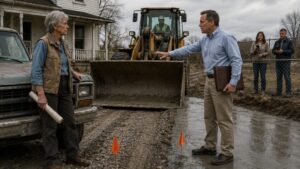
The HOA Towed His RV From a Strip They Never Owned—Then the Old Plat Changed Everything
Chapter 1: The Tow Truck Was Already Under His RV
The first sound Ronald Miller heard when he opened his garage Tuesday morning was not an engine.
It was the metallic ratcheting of a winch.
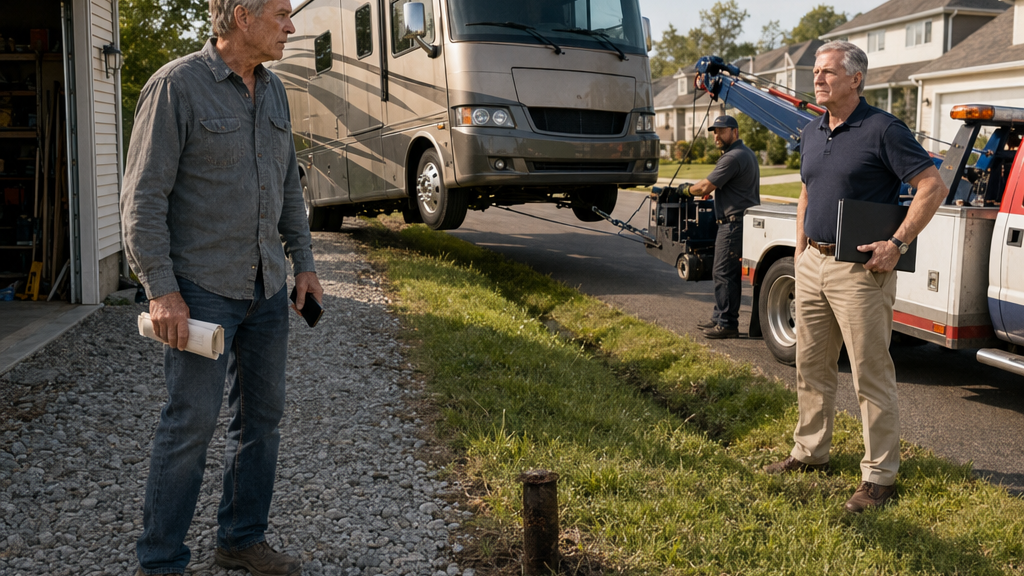
He stepped past the nose of his pickup and saw the cable stretched tight across the narrow strip beside his house. Forty feet away, his Class A RV sat at an unnatural angle, its front tires already lifting from the gravel.
For several seconds Ronald simply stared.
Then he saw Patrick Clark standing near the tow truck with a folder tucked beneath one arm.
“Stop,” Ronald called.
The tow-truck driver looked over but did not touch the controls.
Patrick did.
Not literally. He only raised one hand, palm out, with the calm expression of a man asking somebody else to be reasonable.
“Ronald,” he said. “This has already been authorized.”
Ronald walked toward them.
He was sixty-two and had spent most of his working life maintaining utility-company fleet vehicles. Machines made sense to him. A bad bearing announced itself. A hydraulic leak left evidence. A transmission either engaged or it did not.
People could take a simple thing and bury it under language.
The RV’s suspension creaked as the winch took another inch.
“Authorized by who?”
“The board.”
“This is my land.”
Patrick glanced toward the grassy drainage swale running along the development’s western edge. The narrow parcel beside Ronald’s lot looked like part of it if a person did not know where to look. Same cut grass. Same shallow ditch. Same scattered utility markers.
“The board’s records show this as association frontage.”
Ronald looked at the driver. “Don’t move that vehicle until somebody verifies where it’s sitting.”
The driver rubbed the side of his jaw.
“I’ve got a signed tow authorization.”
“From him?”
“From the association.”
Ronald turned back to Patrick.
“You called a tow company without calling me?”
“We sent notice.”
“You sent a certified letter Friday afternoon.”
“You received it.”
“Yesterday.”
Patrick’s mouth tightened. “The vehicle violates the community appearance standards. We gave you until eight this morning.”
Ronald looked at his watch.
Eight sixteen.
The speed of it landed harder than the argument. Somewhere between breakfast and opening the garage, a disagreement about a letter had become a thirty-two-foot motor home hanging from somebody else’s cable.
He pulled out his phone.
Patrick noticed. “Recording this won’t change anything.”
“I’m taking pictures.”
Ronald photographed the rear tires, the gravel pad, the tow truck, and the angle from his driveway. Then he walked twenty feet toward the drainage ditch and crouched beside a rust-dark metal cap almost buried in grass.
He had known the marker was there since 2019.
The surveyor had pointed it out when Ronald bought the strip from the estate of the original developer. Sixty feet of awkward ground, too narrow for a house, too detached to mean much to anybody else.
Ronald photographed the marker with the RV visible behind it.
“What’s that supposed to prove?” Patrick asked.
“That you never asked where the line was.”
Patrick gave a tired sigh. “Ronald, we have maps.”
“So do I.”
He went back into the garage and pulled open a metal filing cabinet. The deed was not where it should have been. For one brief, humiliating moment he imagined Patrick watching him search through folders while the RV disappeared.
Then he found the envelope beneath an insurance binder.
When he returned, the front wheels of the RV were fully off the ground.
Ronald held out the first page.
“Parcel number’s right there.”
Patrick did not take it.
The driver leaned closer instead.
Ronald read the number aloud.
“That parcel is separate from my house lot,” he said. “Separate tax bill. Separate deed.”
Patrick finally looked at the paper.
“That doesn’t mean it isn’t subject to the association.”
Ronald stopped.
It was not the answer he had expected.
He had expected Patrick to argue that the strip was common ground. He had expected to point at the deed and watch the argument collapse.
Instead Patrick had shifted the question.
“Then show me where,” Ronald said.
“We have an association map.”
“I’m asking for the document that gives you authority over this parcel.”
Patrick’s expression changed slightly. Not uncertainty. Irritation.
“We are not going to litigate governing documents in the street.”
“You’re towing my RV in the street.”
“No. We’re towing it from association-controlled property.”
Ronald looked at the gravel beneath the RV. For three years he had parked there. Before that he had stored a utility trailer there for months at a time. Nobody had cited him. Nobody had asked permission to cross it.
The tow driver cleared his throat.
“I need to finish this job.”
Ronald felt heat rise through his chest.
He could stand in front of the truck.
He could take the keys out of the RV if they had not already been removed.
He could make the driver call the police and force Patrick to explain everything in front of a deputy.
For one sharp second, all of those options felt better than letting the RV leave.
Then he looked again at the rusted marker.
Evidence first.
He stepped back.
“I’m not consenting to the tow,” he told the driver.
The driver nodded once. “Understood.”
“I want the authorization number, your company name, and the storage address.”
The driver gave them to him.
Patrick said, “This doesn’t need to become something bigger.”
Ronald almost laughed.
The RV rolled forward.
Its rear wheels crossed the edge of the gravel pad and onto the street. Ronald photographed that too.
Two neighbors had appeared on a porch across the road. Neither waved.
The worst part was not losing possession of the RV. It was standing there while something he owned was removed in public beneath the authority of people he had known for years.
Patrick stayed behind after the truck turned the corner.
“I told you last week that we’ve had complaints.”
“One complaint.”
“That isn’t the point.”
“What is?”
“Consistency.”
Patrick looked down the street toward rows of tidy driveways.
“We had three owners challenge trailer rules last year. One said we were targeting him because somebody else had a boat visible from the road. Another threatened to stop paying dues. If we make exceptions every time somebody gives us a different interpretation, the rules mean nothing.”
Ronald folded his deed.
“This isn’t an exception.”
“That’s your position.”
“It’s my property.”
“And the association records say otherwise.”
Patrick walked away.
Ronald stood beside the empty gravel pad until the tow truck’s engine could no longer be heard.
Back inside, he opened the certified envelope again.
The violation notice referred to an unauthorized recreational vehicle located on “association common property adjacent to Lot 47.”
Ronald read the phrase twice.
Then a third time.
His house was Lot 47.
The strip beside it was not.
And somebody had put the wrong description into an official towing order as if the distinction had never existed.
Chapter 2: The Strip Beside Lot Forty-Seven
By noon, Ronald had his county tax record open on one computer screen and a photograph of his RV behind a chain-link fence on the other.
The tow-yard manager had texted the picture after Ronald called.
“We can’t release it unless the party who authorized the tow clears it,” the manager had said.
“I own it.”
“I understand.”
“No, I mean the RV and the land it was taken from.”
There had been a pause.
“I can only tell you what our paperwork says.”
Ronald had heard versions of that sentence during thirty-five years around service departments.
The paperwork says.
As if paper had written itself.
The county website loaded slowly. He entered the parcel number from his deed.
His name appeared at the top.
RONALD MILLER.
Underneath was the abbreviated legal description of the narrow tract he had purchased in 2019.
He printed it.
Then he printed the tax bill.
Then the recorded deed.
By one o’clock he had a stack thick enough to make him feel foolish for ever having worried.
He called Patrick.
No answer.
He left a message.
“I’ve confirmed the parcel is independently deeded and taxed to me. Call the tow yard and authorize release today.”
Patrick replied by text twenty minutes later.
Ownership does not necessarily exempt property from recorded restrictions. Board reviewing.
Ronald stared at the message.
That phrase again.
Not necessarily.
He drove to the tow yard carrying the deed folder.
His RV sat behind the fence between a repossessed pickup and an old travel trailer with a missing window. A yellow tag hung from one mirror.
The manager met him at the gate.
Ronald held up the deed.
“This is where it was parked.”
The manager glanced at the page without taking it.
“I’m not disputing you.”
“Then release it.”
“I can’t.”
“You have my property.”
“We received a lawful-looking authorization from the association responsible for that development.”
“Lawful-looking?”
The manager leaned against the gate.
“Mr. Miller, if I decide the HOA is wrong and release this against their instructions, that becomes my problem. If they clear it, I’ll hand you the keys.”
“How much?”
“Storage starts today.”
Ronald’s jaw tightened.
He left before he said something useless.
On the way home, he called Jennifer Lee.
He had used her once, years earlier, for a commercial lease connected to a small repair bay he had rented after leaving the utility company.
She remembered him.
When he explained the tow, she was quiet longer than he liked.
“Email me the deed, tax record, HOA declaration, any amendments, the violation notice, and whatever map the association is relying on.”
“The deed proves I own it.”
“It proves title.”
“That’s what we’re arguing about.”
“Maybe.”
Ronald stopped at a red light.
“What does ‘maybe’ mean?”
“It means ownership and covenant coverage aren’t always the same question.”
He gripped the steering wheel.
“If they don’t own it, how do they control it?”
“Recorded restrictions can bind privately owned property. Your house is privately owned too.”
Ronald said nothing.
Jennifer continued.
“I’m not saying they’re right. I’m saying don’t jump from separate deed to zero association authority until we read the documents.”
It irritated him because it was sensible.
At home he logged into the HOA portal.
The governing-documents folder contained more files than he remembered: declaration, bylaws, amendments, design standards, rules, maps, reserve studies.
He opened the newest community exhibit.
Lot lines appeared in black. Common areas were shaded pale green.
He zoomed toward the western edge.
The strip beside his house was green.
Ronald leaned closer.
His tax map showed a narrow independent parcel.
The HOA map visually absorbed the same ground into the drainage corridor.
He printed both and placed them side by side on the kitchen table.
For the first time that day, his confidence slipped.
The deed was real.
So was the HOA map.
He called Jennifer again.
“I found what Patrick’s looking at.”
He sent it.
Five minutes later she called back.
“That helps explain their position.”
“It’s wrong.”
“Maybe.”
He hated the word now.
She said, “Do you know who prepared this map?”
“No.”
“Surveyor’s seal?”
“Not that I can see.”
“Recording information?”
“No.”
“Then it may be an internal exhibit.”
“So it means nothing?”
“I didn’t say that. It means we need the source.”
Ronald looked through his kitchen window toward the empty strip.
The HOA’s landscaping crew had mowed the outer edge for years.
He had never asked them to.
He had never stopped them either.
Sometimes they cleared leaves from the drainage channel after storms. Once they had replaced a section of corrugated pipe under the shallow swale.
He had considered it neighborly efficiency.
The realization bothered him enough that he pushed it aside.
“My deed was recorded in 2019.”
Jennifer said, “And the association declaration?”
“Older. Early 2000s, I think.”
“I want the original recorded copy. Not a scan uploaded by the board last year. And I want every recorded annexation or amendment affecting the western boundary.”
“You think they added the strip later?”
“I think we don’t know.”
Ronald picked up the tax map.
A small rectangle labeled with the separate parcel number sat beside Lot 47 like an afterthought.
“What exactly are we looking for?”
Jennifer answered without hesitation.
“The moment, if there was one, when that tract became subject to the association.”
“And if there wasn’t?”
“Then Patrick has a very different problem.”
Ronald looked again at the HOA exhibit.
One map said the strip was his.
Another map colored it like everybody’s.
Between those two pieces of paper sat his RV behind a locked fence.
Jennifer said, “Tomorrow morning, get the original declaration from county records.”
Chapter 3: The Map Everyone Had Trusted for Years
Susan Green placed the binder on the HOA conference table and said, “Before you decide Patrick made this up, you should see this.”
Ronald remained standing.
It was Wednesday morning, and he had expected ten minutes in the HOA office to collect whatever map Patrick had cited.
Instead Susan had arrived carrying a three-inch black binder from her years as board secretary.
Patrick was not there.
Ronald was glad.
Susan opened to a plastic sleeve containing a faded site plan.
“This is from at least twelve years ago.”
The western drainage corridor was highlighted in yellow.
So was Ronald’s strip.
Not legally described. Not separately labeled. Just colored as part of one continuous maintenance area.
Ronald leaned over it.
“Who prepared this?”
“I don’t know.”
“That matters.”
“I agree now.”
“Now?”
Susan gave him a patient look.
“Ronald, when I was secretary, this was the map the landscaping contractor used. Nobody sat around comparing it to deeds.”
“That’s the problem.”
“Yes.”
Her lack of defensiveness took some force out of his anger.
She flipped several pages.
Invoices.
Drainage clearing.
Seasonal mowing.
Brush removal.
One entry mentioned work “west of Lot 47.”
Another listed replacement of a damaged drainage pipe.
Ronald recognized the year.
He remembered the crew.
He had stood in his driveway drinking coffee while two workers dug near the strip. One of them had waved. Ronald had waved back.
Susan tapped the invoice.
“You never objected.”
“They weren’t taking ownership.”
“I didn’t say they were.”
“You’re making it sound like permission.”
“I’m telling you why people believed what they believed.”
Ronald looked away.
Through the office window, he could see the small community entrance sign and the line of crepe myrtles maintained by the same contractor.
Susan lowered her voice.
“Patrick has been getting hammered over selective enforcement.”
“I know what he told me.”
“Last year there was the boat issue. Before that, two utility trailers. People take pictures of each other’s driveways and email the board. If one person gets a warning and another doesn’t, we hear about that too.”
“So towing mine solves it?”
“No.”
She closed the binder halfway.
“But I don’t think he woke up Tuesday deciding to steal your RV.”
Ronald sat down.
It was easier when Patrick was simply wrong.
Wrong could be confronted.
This was messier.
Susan reopened the binder and pulled out a maintenance summary.
“Every board after mine inherited the same map. The management company uses it. The landscaper uses it. Patrick probably assumed somebody had verified it years ago.”
“Did you?”
Susan hesitated.
“No.”
It was the first answer all morning that Ronald fully trusted.
His phone buzzed.
A message from the tow yard showed a new daily storage charge.
Susan saw his expression.
“How much?”
“Enough.”
“I’m sorry.”
Ronald folded his arms.
“Sorry doesn’t move the RV.”
“No.”
She pushed the binder toward him.
“Take pictures of anything you need.”
Ronald photographed the maintenance map and the invoices.
One invoice stopped him.
It covered debris clearing after a heavy storm four years earlier.
He remembered that too.
A branch had clogged the shallow channel. Water had spread toward the corner of his gravel pad. Ronald had planned to deal with it after work.
The HOA crew arrived first.
He had let them.
Not merely let them.
He had thanked them.
That memory felt different now.
Not because it transferred ownership. Ronald knew better than that.
But because he had spent the last day insisting the association had no reason to think the land concerned them.
They did have a reason.
Maybe not a legal one.
But a reason.
Susan watched him.
“You remember that storm?”
“Yes.”
“I was still on the board. We approved emergency drainage work across the whole western edge.”
“You could have asked me.”
“We probably should have.”
“I could have told you where the boundary was.”
“You probably should have.”
Ronald looked up sharply.
Susan did not flinch.
After a moment, he almost smiled.
Almost.
At county records, the clerk asked him whether he wanted the subdivision declaration, amendments, plats, or all recorded instruments tied to the development.
“All of it.”
“That can be a lot.”
“That’s what I’m afraid of.”
She gave him a terminal number and showed him how to search the subdivision name.
Ronald began with the declaration.
The index returned the original filing, followed by years of amendments.
Architectural changes.
Voting provisions.
Assessment language.
A supplemental tract on the opposite side of the development.
He wrote down recording numbers.
Then he searched the parcel number for his strip.
His deed appeared.
The prior developer’s estate transfer appeared.
A utility easement appeared.
No HOA reference appeared on the first page of results.
He knew enough now not to celebrate.
Jennifer had warned him.
Absence from one search did not prove absence from every controlling instrument.
The clerk returned carrying a thin folder.
“You asked about annexations?”
“Yes.”
“There’s a separate index for additions to the subdivision declaration.”
Ronald followed her to another terminal.
She entered the development name, then opened a chronological list.
Three supplemental declarations appeared.
One added twelve lots east of the original subdivision.
Another covered a clubhouse parcel.
A third corrected a legal description.
Ronald copied the numbers.
“Is that everything?”
“For instruments indexed as annexations or supplements under this association name, yes.”
“What about my parcel?”
She searched the number.
Nothing.
Ronald felt the first clean surge of satisfaction he had experienced since Tuesday morning.
Then the clerk clicked back to the original filing.
“You’ll still want to read the declaration itself,” she said.
“I plan to.”
“Sometimes the original has expansion language that matters.”
The satisfaction narrowed into attention.
She opened the scanned document.
Pages of dense legal language filled the screen.
Jennifer had told him not to skim for words he wanted to see.
Ronald printed the declaration and the annexation index.
As the printer worked, he looked at the first page.
The development name appeared at the top.
Below it was the legal description.
He traced the lines with one finger.
The original subdivision lots were identified numerically.
He had not yet reached the ending.
His phone rang.
Patrick.
Ronald considered letting it go to voicemail, then answered.
“I understand you’ve been requesting association records,” Patrick said.
“I’m requesting county records.”
There was a pause.
“We’ve sent our map to counsel.”
“Good.”
“The board still considers the tow valid.”
Ronald looked at the pages emerging from the printer.
“Did your counsel ever compare that map to the recorded declaration?”
“I’m not discussing legal advice with you.”
“That wasn’t what I asked.”
Patrick’s voice hardened.
“We relied on records that have been used for years.”
Ronald looked at the maintenance invoices saved on his phone.
For once, he did not have an immediate answer.
Patrick mistook the silence for retreat.
“We’re willing to discuss the matter at the next board meeting.”
“My RV is accumulating storage charges today.”
“The board meets Monday.”
Ronald ended the call.
The clerk placed the final printed sheet on top of the stack.
“Here’s the annexation index.”
Ronald took it.
The original declaration sat underneath, waiting to be read line by line.
Somewhere in those pages was the answer neither his deed nor Patrick’s map had been able to provide.
Whether the narrow strip had ever legally crossed the line from Ronald’s property into the HOA’s authority.
Chapter 4: The Declaration Stopped One Number Too Soon
The legal description ended at Lot 46.
Ronald read the line twice, then slid his finger back across the page as if the missing number might appear if he approached it from another direction.
Lots 1 through 46.
That was the language in the recorded declaration.
His house was Lot 47.
The narrow strip beside it was not even part of that numbered sequence.
He looked at the annexation index beside the declaration.
Three supplemental filings.
None named his parcel.
The county clerk had moved on to another customer, leaving Ronald at the terminal with a stack of papers and the strange sensation that something enormous had just happened without making a sound.
He called Jennifer from the hallway.
“I found it.”
“You found what?”
“The declaration. It stops at forty-six.”
There was a pause.
“Don’t leave yet.”
“I printed everything.”
“Good. Search the legal description of your strip by grantor, grantee, parcel number, and any prior parcel designation. I want to rule out a supplemental declaration filed under something other than the HOA name.”
Ronald leaned against the wall.
“You think there’s another one?”
“I think I’d rather be disappointed now than surprised later.”
Twenty minutes later, he had searched every variation the clerk suggested.
Deeds appeared.
Utility easements appeared.
The estate transfer appeared.
No declaration.
No supplemental covenant.
No annexation instrument.
By early afternoon he was sitting across from Jennifer with the documents spread across her conference table.
She did not react the way he wanted.
There was no smile. No declaration that Patrick was finished.
Instead she aligned the pages into three neat piles.
“Title,” she said, touching the first.
“Association declaration,” touching the second.
“Association internal records,” touching the third.
Ronald pointed at the recorded declaration.
“It stops at forty-six.”
“Yes.”
“And there’s nothing adding the strip.”
“So far, yes.”
“So they had no authority.”
Jennifer looked at him.
“We have a strong argument they lacked covenant authority over that parcel.”
“That’s what I said.”
“No. You said they had no authority. I’m being narrower.”
Ronald leaned back.
“This is why people hate lawyers.”
“This is why people hire us after somebody tows a forty-thousand-pound motor home.”
Despite himself, Ronald gave a short laugh.
Jennifer turned the declaration toward him.
“The important part isn’t just the lot numbers. The legal description attached to the declaration does not appear to encompass your tract. The later supplemental filings we found don’t add it. That matters.”
She tapped the HOA maintenance map.
“This also matters, but differently.”
“It’s wrong.”
“It may be wrong as a representation of covenant jurisdiction. It may still help explain why the board believed what it believed.”
“I’m not suing them for believing something.”
“You may be claiming damages arising from what they did because of that belief.”
She let the distinction sit between them.
Ronald looked at the tow photograph on his phone.
The RV’s front wheels hung above the narrow gravel pad. Behind them, near the edge of the frame, the survey marker was visible.
Jennifer held out her hand.
“Send me the original file.”
He did.
She enlarged the image.
“Good.”
“For what?”
“For location.”
“I already told you where it was.”
“I believe you. A claim isn’t built on what I believe.”
She pointed to the marker.
“If the tow company later says the vehicle was partly on the common drainage corridor, we need more than your memory. We need the survey, measurements, photographs, maybe their own tow photographs.”
Ronald’s satisfaction thinned into irritation again.
“So even after finding this, I still have to prove where the tires were?”
“You have to prove every part that matters.”
She wrote a short list on a legal pad.
Tow authorization.
Driver photographs.
Storage invoices.
Certified-letter delivery date.
Board correspondence.
Ronald’s pre-tow communications.
Survey or reliable boundary evidence.
“Then we demand release?”
“Immediately.”
Jennifer drafted the letter while he sat across from her.
The language was restrained enough to disappoint him.
It stated that county records showed Ronald’s ownership of the tract and that their review had located no recorded instrument subjecting it to the association declaration. It demanded that the HOA immediately authorize release of the RV and preserve all records relating to the tow.
No accusations of theft.
No threats of criminal charges.
No paragraph describing Patrick as reckless.
Ronald read it.
“That’s it?”
“That’s enough for today.”
“You’re not mentioning trespass?”
“Not yet.”
“Conversion?”
“Not yet.”
He looked at her.
“You think I’m wrong?”
“I think you want the strongest words before we have the strongest record.”
Ronald folded his arms.
“And Patrick had the strongest action before he had any record.”
“Yes.”
That answer settled him more than reassurance would have.
Jennifer sent the demand by email to the management company, Patrick, and the association’s listed counsel.
A response came less than an hour later.
Patrick had copied the entire board.
The association had relied on maps previously reviewed during legal and management consultations, he wrote. Until counsel completed its review, the board would not concede that the tow was unauthorized.
Ronald read the message aloud.
“Would not concede.”
Jennifer’s eyes narrowed slightly.
“Interesting phrase.”
“He’s not releasing it.”
“Not yet.”
“He’s keeping my RV locked up because he doesn’t want to admit he was wrong.”
“Maybe.”
Ronald stood.
“There’s that word again.”
Jennifer remained seated.
“You’ve learned one important thing today. Don’t ruin it by assuming you’ve learned everything.”
He paced once around the table.
The narrow strip had felt completely different that morning. For years it had been leftover land. A place to park the RV. A drainage edge. Ground the landscapers crossed because Ronald could not be bothered to argue about who cut which three feet of grass.
Now the strip was measurable.
Recorded.
Bounded.
The line mattered because Patrick had acted as though it did not.
Jennifer closed the declaration.
“I’m sending a second request directly to the tow yard for preservation of photographs and dispatch records.”
“And tomorrow?”
“We document damages.”
“My damages are obvious.”
“No. Your anger is obvious. Damages get receipts.”
Ronald looked at the email from Patrick one more time.
The board still would not authorize release.
But Patrick’s position had shifted.
Tuesday morning, he had said the association controlled the strip.
Now he was saying the board had relied on maps and needed counsel to confirm whether that was true.
It was the first movement Ronald had seen.
Not retreat.
But no longer certainty.
Then another email arrived.
Patrick again.
This one was shorter.
The board would maintain its position pending legal review because its existing maps had been “attorney approved.”
Jennifer read the line over Ronald’s shoulder.
“Then tomorrow,” she said, “we find out exactly what they approved.”
Chapter 5: The Cost of Refusing to Check
The tow yard charged Ronald again at 8:03 Thursday morning.
He knew the exact time because the automated receipt arrived while he was pouring coffee.
Another day.
Another fee.
His RV remained behind chain-link fencing while the HOA scheduled its discussion for the following week.
Ronald forwarded the receipt to Jennifer with three words.
Add this too.
Her reply came almost immediately.
Already did.
By nine thirty they were at the tow yard.
The manager met them in the small office beside the gate. A security monitor showed rows of stored vehicles in gray rectangles.
Jennifer placed a preservation letter on the counter.
“We’re asking you not to destroy or overwrite any photographs, intake notes, dispatch records, location information, or authorization documents associated with Mr. Miller’s tow.”
The manager read the first page.
“We don’t destroy anything that fast.”
“Good.”
Ronald looked through the office window toward his RV.
“Did the driver take pictures before moving it?”
“Yes.”
“How many?”
“I’d have to check.”
“Can we see them?”
The manager hesitated.
Jennifer spoke before Ronald could.
“We’re not asking you to decide whose property it was. We’re asking you to preserve evidence.”
That seemed to help.
The manager turned to his computer.
After several minutes, he found the file.
Four photographs.
The first showed the RV from the street.
The second showed the front wheels and tow equipment.
The third showed the driver’s view down the side of the vehicle.
The fourth showed the rear tires.
Ronald leaned toward the screen.
There it was.
The rusted survey marker.
And beyond it, the drainage swale.
The RV sat fully on the gravel strip.
Jennifer did not celebrate.
“Please preserve the originals with metadata.”
The manager nodded.
“Can you tell me who gave the driver the location?”
He opened the dispatch record.
“Association president. Mr. Clark.”
Ronald’s jaw tightened.
“Personally?”
“That’s what it says.”
Outside, Jennifer stopped him before he reached his truck.
“Don’t call Patrick.”
“I wasn’t going to.”
“You were reaching for your phone.”
“I was checking the time.”
She gave him a look.
Ronald put the phone away.
At the HOA office that afternoon, the meeting was smaller than Ronald expected. Patrick sat at one end of the table with two board members and the management representative. Jennifer sat beside Ronald.
Susan was present as a former secretary because Patrick had asked her to explain older maintenance records.
Patrick looked tired.
Not frightened.
Not defeated.
Just older than he had on Tuesday morning.
Jennifer began with the recorded declaration.
She spoke plainly.
“We have found no recorded instrument that places Mr. Miller’s separate tract within the declaration’s legal description.”
One board member shifted in his chair.
Patrick said, “Our maps have consistently treated that area as association-maintained property.”
“Maintained is not the same as owned or covenant-controlled.”
“We never claimed ownership.”
Ronald looked at him.
“The tow authorization says common property.”
Patrick’s eyes moved toward the management representative.
“That terminology may have been imprecise.”
Ronald almost answered.
Jennifer touched his wrist lightly beneath the table.
Not yet.
She produced the tow-yard photographs.
“These images also appear to show the RV entirely within Mr. Miller’s tract.”
Patrick studied them.
Susan leaned closer.
The rusted marker was plainly visible.
One board member asked, “Where did the tow company get the boundary?”
Nobody answered immediately.
Patrick finally said, “They were instructed to remove the vehicle from the area shown on our enforcement map.”
Jennifer slid the current HOA exhibit across the table.
“And who verified that this map reflected the recorded declaration?”
Patrick’s face hardened.
“This map has been used for years.”
“That wasn’t my question.”
Ronald recognized the phrase.
It was almost exactly what he had said at county records.
Patrick looked toward the management representative.
The representative said, “The map was included in prior counsel review packets.”
“Included,” Jennifer said. “Was this specific parcel ever reviewed for covenant status?”
“I’d have to check.”
The power in the room changed so quietly that Ronald almost missed it.
Nobody had proved Patrick acted maliciously.
Nobody needed to.
The question had become simpler.
Who checked?
Jennifer opened another document.
“And before the tow, Mr. Miller emailed the parcel number to the association.”
Patrick looked up.
Ronald did too.
Jennifer turned the page toward the board.
The timestamp was Monday afternoon, less than a day before the tow.
Ronald remembered sending it through the HOA portal after receiving the certified letter. He had attached a photograph of the tax map and written that the RV was on his separately owned parcel.
He had almost forgotten because Patrick never answered.
One board member stared at Patrick.
“You saw this?”
Patrick was silent for a second too long.
“I saw his objection.”
“With the parcel number?”
“Yes.”
“And you still authorized the tow Tuesday morning?”
Patrick looked at Ronald, then at Jennifer.
“We had an existing enforcement determination and an established map. Mr. Miller had been warned.”
Ronald felt the old anger surge.
Jennifer spoke first.
“The issue is not whether you had an enforcement policy. The issue is whether you paused to verify jurisdiction after receiving specific information that your map might be wrong.”
Patrick pushed back from the table.
“You’re describing this as though there was no reason to rely on our records. There had been years of maintenance. The area had always been shown the same way. We’ve had residents accusing this board of selective enforcement for two years.”
Susan spoke quietly.
“Patrick.”
He turned.
She had the old binder open in front of her.
“The maintenance map was never a boundary survey.”
“I know that.”
“Did you know it Monday?”
The room went still.
Patrick looked down.
Ronald expected denial.
Instead Patrick said, “I believed it had been vetted.”
That was different.
Not enough.
But different.
Jennifer gathered the documents.
“We want immediate release, reimbursement of storage charges, and preservation of all association communications regarding the tow.”
One board member asked, “Are you filing suit?”
“We’re giving the association an opportunity to correct the immediate harm first.”
Patrick looked at Ronald.
For the first time since Tuesday, there was no board-president tone in his voice.
“If we release it today, are you done?”
Ronald thought of the empty strip. The neighbors watching. The storage receipts. Patrick refusing to verify the parcel after being given the number.
“No.”
Patrick nodded slowly, as though he had expected that.
Back at Jennifer’s office, the tow-yard manager called.
He would continue preserving the file.
The association, however, had still not issued a release authorization.
“They’re talking to counsel,” Jennifer said.
“While I pay.”
“Document it.”
Ronald looked at the stack of receipts.
He no longer wanted Patrick embarrassed at a meeting.
He wanted an answer to a narrower question.
How much harm could somebody cause simply by refusing to check one number?
Late that afternoon, Jennifer’s email chimed.
The sender was the association’s liability insurer.
It requested the declaration, annexation records, tow authorization, Patrick’s communications, Ronald’s pre-tow email, maintenance maps, and every photograph showing the vehicle’s location.
The final paragraph instructed the board and management company to suspend direct substantive communications with Ronald while the claim was reviewed.
Ronald read it twice.
Patrick had begun the week as the person deciding what happened next.
Now somebody else was asking him for the record of how he had made that decision.
Chapter 6: He Had Let Them Cross the Line Before
Patrick’s lawyer placed three printed emails on the settlement table the following week.
Ronald recognized the dates before he read the messages.
One was four years old.
One was three years old.
One was from the previous spring.
All three concerned landscaping or drainage work along the western strip.
All three had been sent to Ronald.
He had answered none of them.
Patrick sat across the table without speaking.
Jennifer read the first email.
The association had notified Ronald that contractors would clear debris along the drainage corridor beside Lot 47.
The second mentioned mowing.
The third referenced access for inspection after heavy rain.
Patrick’s lawyer asked, “You received these?”
Ronald looked at Jennifer.
She did not rescue him.
“Yes.”
“You objected?”
“No.”
“You told the association the strip was separately owned?”
“No.”
Patrick shifted slightly in his chair.
Ronald disliked how much that small movement bothered him.
The morning before the conference, Ronald had walked the strip with a survey copy in hand.
For the first time in years he had deliberately located both corners.
One pin was easy to find.
The other sat under six inches of grass and packed soil.
He had marked each with a temporary stake.
Standing between them, he had seen how the mistake happened.
The association mower had always followed the drainage swale in one smooth pass. The grass did not change color at the property line. Water did not respect deeds. To anybody looking from the street, the strip belonged visually to the same system.
That did not make the tow lawful.
But it made Ronald’s years of silence harder to dismiss as meaningless.
At the conference table, Patrick finally spoke.
“We maintained it because we thought we were responsible for it.”
“You never asked me.”
“You never told us not to.”
Ronald’s first answer came automatically.
“I shouldn’t have to tell you not to treat my property like yours.”
Jennifer looked at him.
Not a warning.
A question.
Ronald stopped.
He remembered the storm debris.
The mowing.
The mornings he had watched crews work and been glad he did not have to do it himself.
He rubbed one thumb against the edge of the table.
“That’s not the whole truth.”
Patrick’s expression changed.
Ronald continued.
“I knew they were mowing part of it.”
Nobody interrupted.
“I knew about the drainage work. I figured if the association wanted to clear the ditch, fine. It helped me too.”
Patrick’s lawyer said, “So you allowed the association to maintain the property.”
“I allowed maintenance.”
“You never distinguished the boundary.”
“No.”
Patrick leaned forward.
“That’s the point.”
Ronald met his eyes.
“No. It’s part of the point.”
Patrick opened his mouth, then stopped.
Ronald looked at the three emails.
“I was lazy about the line because the arrangement was convenient. That doesn’t mean I gave you the parcel. And it doesn’t mean you could tow something off it after I sent you the deed number.”
Jennifer spoke then.
“Mr. Miller’s silence may explain the board’s misunderstanding. It does not create a recorded annexation.”
Patrick’s lawyer nodded.
“We’re not asserting adverse ownership.”
“Good.”
“But it affects reasonableness.”
“Up to Monday afternoon,” Jennifer said. “Then the board received specific contrary information.”
Patrick looked at Ronald.
“You sent a parcel number and demanded we cancel an enforcement action that had already been approved. I had two board members asking why we were backing down when we’d cited other residents for trailers.”
“You could have checked.”
“I should have checked.”
The words were so plain Ronald almost missed them.
Patrick looked away.
“But you could have told us years ago that our maps were wrong.”
Ronald felt the impulse to reject that too.
Instead he said, “Yes.”
Jennifer let the silence remain.
It was the first moment in the dispute when neither man was trying to prove the other entirely responsible.
The proposed settlement came out after lunch.
The insurer would fund release of the RV, storage charges, and a portion of Ronald’s documented loss of use. The association would revise its enforcement map.
Ronald read the third page and stopped.
The draft described the western strip as property “subject to association maintenance and control.”
He pushed the document away.
“No.”
Patrick’s lawyer said, “That language preserves existing operations.”
“It preserves the same problem.”
“It would let the association maintain the drainage corridor.”
“Then write that.”
Jennifer took the agreement and read the paragraph.
Ronald continued.
“You can have limited access for drainage maintenance if we define it. You cannot put ‘control’ into a settlement and use it five years from now to tell somebody the HOA owns rights nobody recorded.”
Patrick rubbed his forehead.
“If we don’t maintain it, water from that strip can affect the lots downhill.”
“I understand.”
“Do you?”
Ronald looked at him.
This time the question did not feel insulting.
“Yes.”
He thought of the branch-clogged ditch.
“If I own it, I own that problem too.”
Jennifer glanced toward him.
There was the real cost hidden underneath the victory.
For years Ronald had wanted the benefits of clarity without the inconvenience of drawing the line. The HOA had wanted the convenience of treating the land as part of its system without verifying what authority came with that treatment.
Both arrangements had worked until somebody hooked a tow cable to the RV.
Ronald took a clean sheet of paper.
“Here’s what I’ll agree to.”
He wrote as he spoke.
Immediate release.
Reimbursement of storage charges.
Documented loss of use.
A corrected association map.
Written acknowledgment that the parcel was not shown to be subject to the declaration.
Defined permission for drainage access, with notice except for emergencies.
Future mowing responsibility assigned clearly.
No admission that past maintenance created ownership or covenant authority.
Patrick read the list.
“You want the board to adopt a rule requiring title verification too.”
Ronald looked up.
“Yes.”
“For every enforcement action?”
“For towing from land where ownership or association jurisdiction is disputed.”
Patrick considered it.
“That would have stopped this.”
“That’s the idea.”
The meeting ended without signatures.
Outside, Ronald drove home alone.
He parked beside the empty gravel pad and walked the strip again.
The two temporary stakes stood several dozen feet apart.
For years the space between them had been something he barely saw.
Now every foot carried responsibility.
Mowing.
Drainage.
Access.
Taxes.
And the right to tell somebody else where their authority ended.
His phone rang.
Jennifer.
“The insurer wants your revised terms in writing.”
“Good.”
“They’re not agreeing yet.”
“I didn’t expect them to.”
Ronald looked toward the western ditch.
A thin line of dried grass marked where the HOA mower usually turned.
“I want one more thing in there.”
“What?”
“No language calling it common property. Anywhere.”
Jennifer was quiet for a moment.
“That’s reasonable.”
Ronald watched the two stakes.
“Then send it.”
For the first time since the RV disappeared, he was not asking someone else to acknowledge a boundary he had kept only in his own head.
He was putting it where everyone could see it.
Chapter 7: The Boundary They Finally Put in Writing
The RV came back on a flatbed three weeks later.
Ronald heard the diesel engine before he saw it turn into the subdivision, and for one instant the sound pulled him back to Tuesday morning—the winch, the raised front wheels, Patrick standing beside the tow truck with a folder under his arm.
This time, nobody was waiting with an authorization form.
Two fresh survey stakes stood at the corners of the narrow strip.
The driver stopped at the curb and climbed down.
“You want it exactly where it was?”
Ronald looked across the gravel pad.
Not exactly.
The old position had been legal, as far as the settlement now recognized, but the survey had shown the rear of the RV had sat closer to the drainage-access line than Ronald remembered.
“Two feet farther in,” he said.
The driver nodded.
Ronald guided him slowly.
When the RV finally settled onto the gravel, all four tires rested clearly inside the newly marked boundary.
The sight should have felt triumphant.
Instead it felt precise.
That surprised him.
He had imagined this moment often while the RV sat behind the tow-yard fence. In those versions, Patrick watched from across the street. Somebody apologized. Somebody admitted Ronald had been right from the beginning.
None of that happened.
The driver handed him the keys.
“Glad you got it back.”
“Me too.”
The flatbed left.
Ronald stood alone beside the RV, holding the keys in one hand and a copy of the settlement in the other.
The agreement did not call Patrick reckless.
It did not call Ronald blameless.
It did something more useful.
The association reimbursed the storage charges, towing-related costs, and the portion of lost use Ronald could document. The revised map identified the strip as Ronald’s separate parcel. The HOA disclaimed any ownership claim and acknowledged that the records reviewed did not establish that the tract had been annexed into the declaration.
The drainage language took almost two pages.
Emergency access.
Advance notice for routine work.
Restoration after entry.
No landscaping beyond the defined drainage area unless Ronald separately agreed.
And one sentence Jennifer had insisted remain untouched:
Past maintenance shall not be construed as creating ownership, covenant jurisdiction, or permanent control.
Ronald folded the settlement and slid it into the RV’s side compartment.
Across the street, a neighbor slowed while walking a dog.
“Looks good back there.”
Ronald nodded.
“Thanks.”
No questions.
No congratulations.
He was grateful for that.
The board meeting that evening was different.
Not because the room was full.
It was not.
About a dozen homeowners sat in folding chairs. Susan Green was in the second row with the old black binder on her lap. Patrick sat at the board table beside the management representative and two board members.
Ronald took a seat near the aisle.
He was not there to demand an apology.
Jennifer had offered to attend, but Ronald told her he could handle this part himself.
The agenda item came midway through the meeting.
“Enforcement procedure revision,” Patrick said.
He did not look at Ronald at first.
The management representative summarized the proposed policy: before authorizing towing from any disputed tract, side parcel, easement area, or other location where ownership or association jurisdiction was unclear, management would verify the parcel against county records and the association’s recorded governing documents.
One board member asked, “Every time?”
“When there’s a legitimate boundary dispute,” the representative said.
“What counts as legitimate?”
Patrick answered.
“A specific parcel number. A deed. A survey. Something more than somebody saying they disagree.”
Ronald noticed the wording.
It was careful.
Practical.
Probably drafted with the insurer’s involvement.
Susan raised her hand.
The board recognized her.
“We should also review the maps we currently use,” she said. “Not just future disputes.”
Patrick nodded.
“That’s part of the motion.”
Susan looked down at the binder.
“Some of those maps were never intended to prove ownership.”
Patrick was quiet for a moment.
Then he said, “That’s correct.”
Ronald looked at him.
Patrick finally met his eyes.
The room did not become dramatic.
Nobody leaned forward.
Nobody pulled out a phone.
Patrick rested both hands on the table.
“The tow involving Mr. Miller’s RV was authorized before the ownership issue was adequately verified.”
The words were formal.
Still, Ronald felt them land.
Patrick continued.
“The board relied on maps and maintenance practices that had been used for years. That reliance did not replace the need to verify the recorded property status once a specific dispute was raised.”
One homeowner near the back said, “So the tow was wrong?”
Patrick looked toward him.
“The process was wrong.”
It was not the sentence Ronald might have chosen.
But Patrick was not hiding behind “attorney approved” anymore.
The board voted.
The new verification procedure passed without opposition.
Then came the part Ronald had almost forgotten.
The management representative turned to him.
“Mr. Miller, because the association will no longer perform routine mowing on the private portion of the tract, responsibility for that area will remain with you except for the drainage access described in the agreement.”
Ronald nodded.
“I understand.”
A board member said, “And if vegetation blocks the drainage flow?”
“I handle it.”
“If you don’t?”
“Then notify me.”
The board member studied him for a moment, as though expecting resistance.
Ronald had none.
The line worked both ways.
That was what he had taken longest to understand.
After the meeting, Susan caught up with him near the door.
“You got what you wanted.”
“Mostly.”
She smiled.
“What didn’t you get?”
Ronald glanced toward Patrick, who was packing papers into a folder.
“A simpler story.”
Susan understood immediately.
She held up the old binder.
“I’m turning this over to management for review. Half these maps need labels explaining what they actually are.”
“You keeping a copy?”
“Absolutely.”
Ronald laughed.
Patrick approached before Susan left.
For several seconds, none of them spoke.
Then Patrick said, “Your reimbursement should clear Friday.”
“I saw the notice.”
“And the corrected map will go out with the next association packet.”
“Good.”
Patrick looked toward the parking lot.
“I should have stopped the tow when you sent the parcel number.”
Ronald could have said yes.
Instead he waited.
Patrick continued.
“I thought stopping it would look like another exception. We’d been dealing with people saying the board only enforced rules against whoever complained least.”
“So you decided not to look weak.”
Patrick gave a slight, tired smile.
“That’s one way to put it.”
“It’s the way I’d put it.”
Patrick nodded.
Then he said, “You could have corrected that map years ago.”
Ronald looked at him.
A month earlier, the sentence would have felt like an excuse.
Now it felt like the other half of an unpleasant truth.
“I could have.”
Neither man apologized again.
They did not shake hands.
Patrick went back inside.
Ronald walked home.
Two days later he met the surveyor at the strip.
The temporary stakes were replaced with low, permanent markers that would not interfere with mowing. Ronald added a small gravel edge along the private side, not as a barrier but as something visible enough that nobody would confuse the transition again.
Then he spent Saturday morning clearing the drainage channel himself.
It was harder work than he remembered.
Mud packed beneath the grass. A handful of leaves had gathered against the culvert. By noon his back hurt and one glove was soaked through.
He stood upright and looked at the RV.
The vehicle sat behind the markers, unmistakably on his side.
Beyond the markers, the association-maintained drainage corridor continued toward the neighboring lots.
Nothing magical had happened to the ground.
Only the understanding around it had changed.
That afternoon, Susan stopped by.
She carried a copy of the revised association map.
The private strip was no longer shaded green.
A narrow line separated it from the common drainage corridor.
“Thought you might want one before they mail them,” she said.
Ronald studied it.
For years he had treated maps as paperwork for people who enjoyed meetings.
Now one line on one page carried weeks of argument, invoices, legal fees, and a tow truck.
“Looks boring,” Susan said.
“That’s the best thing about it.”
She laughed.
Before leaving, she hesitated.
“There’s something else.”
Ronald waited.
“Some people are talking about running a different slate for the board next year.”
He knew where this was going.
“They want to use the tow as the example.”
“Probably.”
“And they want me involved?”
“They think you’d be effective.”
Ronald looked toward the RV.
A month earlier, he might have enjoyed the idea of standing in front of a room while Patrick listened to the story told from beginning to end.
The thought now felt strangely small.
“I’m not interested.”
Susan raised an eyebrow.
“Not even a little?”
“Not even enough to sit through the meetings.”
“That sounds more like you.”
Ronald smiled.
Then he became serious.
“They fixed the procedure. They fixed the map. Patrick said publicly what went wrong.”
“He did.”
“I don’t need the mistake to become his permanent job title.”
Susan folded her copy.
“That might disappoint some people.”
“They’ll survive.”
On Monday morning, Ronald drove to the county recorder’s office with the final survey and boundary acknowledgment.
The clerk stamped the recording cover and slid the documents beneath the glass.
Ronald watched the timestamp appear.
It was a small sound.
Just the machine pressing down.
Nothing like a winch.
Nothing like an RV being pulled away.
The clerk returned his copy.
“You’re all set.”
Ronald thanked her and stepped outside.
He had spent years believing that because he knew where the line was, that should have been enough.
Patrick had spent years believing that because everybody treated the line one way, that made it official.
Both assumptions had been convenient.
Neither survived contact with the record.
When Ronald returned home, he placed the stamped copy in the metal filing cabinet in his garage.
This time he did not bury it beneath insurance papers.
He put it in the front folder.
Then he closed the drawer and walked outside.
The RV sat where it belonged.
The drainage channel was clear.
The survey markers caught the afternoon light at either end of the strip.
For the first time, the boundary did not feel like a weapon.
It felt like an agreement about where responsibility began.
The story has ended.