He Lent His Smart Tools for a Farm Project—Then Found Them Building Someone Else’s Private Fence
Chapter 1: The Tools Were Supposed to Fix the Road
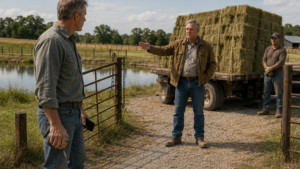
By the time Catherine Hall pulled into David Carter’s yard Monday morning, muddy water was already cutting a new channel across the shared gravel road.
David could see it from the open doors of his equipment barn. Brown runoff slid out of the roadside ditch, crossed the wheel tracks, and disappeared beneath the fence grass on the low side. Every few seconds another ribbon of loose gravel shifted with it.
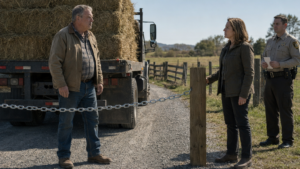
Catherine parked beside his hay wagon and climbed out before shutting the truck door.
“You seen the corner?”
“I’m looking at it.”
“That’s worse than yesterday.”
David wiped his hands on a shop rag and followed her gaze. The road served four properties beyond his place. It was not county-maintained, and everyone who used it had learned the same lesson: small problems became expensive ones if ignored.
A livestock trailer had already cut deep ruts through the soft shoulder.
Catherine folded her arms. “Contractor can come today. If we get the ditch opened, put new boards along that soft section, and brace the edge before the next rain, we might keep the road from washing into my field.”
“Boards?”
“Temporary retaining work. Whatever he needs.”
David glanced at her.
Catherine was the volunteer treasurer for the road association, which mostly meant she collected checks, kept invoices, and called people when gravel needed ordering. She had also become the person who spoke as though every practical problem required an answer before the conversation ended.
“What are you short on?”
“Drivers. Circular saw. Maybe your rotary hammer.”
“That’s not a maybe-small list.”
She smiled without much humor. “Neither is the ditch.”
David walked back into the barn.
His tool wall occupied nearly half of one side: battery tools locked into steel racks, chargers labeled, blades stored by size, cases stacked according to use. He had spent years replacing the battered collection his father had treated as communal property for anyone who happened to stand in the doorway.
David still loaned tools. He simply preferred knowing where they were.
Catherine stopped behind him.
“You’ve got enough here to build another barn.”
“That’s why I still have enough here.”
She ignored the remark.
He pulled down two impact drivers and a heavy cordless drill. “These should handle screws and anchors. Take the reciprocating saw if they hit old roots.”
“Circular saw?”
He pointed to one on the lower rack.
She reached for the larger case beside it.
David frowned. “That’s the table saw.”
“I know.”
“For ditch work?”
“The contractor said there may be rails to cut.”
“What kind of rails?”
“For the road edge.”
David kept his hand on the case.
The saw was portable only in the technical sense. It had a folding stand and wheels, but it was still one of the most expensive tools he owned. He used it for barn trim, gates, fencing panels, and repair work where straight cuts mattered.
Catherine noticed his hesitation.
“I’m not asking to keep it.”
“That helps.”
“We’re trying to get the road fixed, David.”
He looked past her through the barn opening. From there he could see the washout. The muddy scar was real. So were the ruts.
He released the handle.
“Fine. But keep the saw dry.”
“I will.”
“And don’t leave the batteries sitting in mud.”
“I know how batteries work.”
He almost said, Bring it back tonight.
Instead he began loading cases into the bed of her truck.
It was an old habit, the part of him that disliked attaching conditions to a favor. His father had attached conditions to everything—fence wire, diesel, tractor hours, even borrowed ladders. By the end of his life, he had a notebook full of tiny debts and almost nobody who wanted to ask him for anything.
David had promised himself he would not become that man.
Catherine pointed toward a black key fob hanging on a hook beside the tool rack.
“What’s that for?”
“Access tag.”
“To what?”
“The smart equipment.”
She raised an eyebrow.
David picked it up. “Some of the newer tools are registered through the manufacturer. Location history, inventory status, lock controls.”
“You can lock a saw?”
“If somebody steals it.”
Catherine gave him a sideways look. “Planning on me stealing your saw?”
“No.”
“Then I guess we’re safe.”
He handed her the fob.
That small gesture bothered him almost immediately, though he could not have explained why without sounding foolish.
They drove separately to the damaged corner.
The contractor had already marked the ditch with orange flags. One laborer was clearing clogged vegetation while another shoveled loose stone away from a collapsed culvert edge. Catherine walked directly into the work area, asking questions about drainage and delivery timing.
David crouched near the washed-out shoulder.
The soil beneath the gravel had softened enough that his thumb sank into it.
This was not an invented emergency. Another hard rain could take several feet of shoulder with it.
Ruth Wilson’s place lay beyond the bend, and she hauled cattle through here twice a month. An ambulance would have to use the same road.
“Needs doing,” David said.
Catherine looked relieved, as if she had been waiting for him to admit it.
“Told you.”
He stood. “That doesn’t mean build half the county.”
“We’re not.”
For the next hour, David helped move stone and showed the laborers where old drainage tile crossed the field edge. By the time he returned to his own place, Catherine’s truck was still parked near the work.
He told himself the unease had been unnecessary.
Then, late that afternoon, he heard another truck near the barn.
Catherine had returned for a few smaller items.
David stepped outside as she closed the tailgate.
“Forgot something?”
“Contractor needs clamps.”
“What kind?”
“Fence clamps. Just for holding boards.”
She walked back toward the barn before he answered.
David followed.
She chose four heavy clamps from a shelf beside his welding bench.
Those were not ditch tools.
They were the clamps he used to hold rails square while building gates and fence sections.
He watched her place them beside the saw case.
“You putting up permanent boards along the road?”
Catherine did not look at him.
“Whatever keeps that edge from washing.”
“That wasn’t my question.”
She finally faced him.
“The contractor knows what he’s doing.”
David let the silence sit between them.
He could have asked exactly where every tool was going. He could have written the location on a piece of cardboard. He could have taken back the key fob until she explained.
Instead he stepped aside.
“Bring them back when the road work’s done.”
Catherine nodded once.
“Of course.”
She drove away with the clamps visible through the rear window.
David remained beside the barn until the truck disappeared around the bend.
The road needed fixing.
He had seen that himself.
But he had spent enough years building fences to know what four clamps and a table saw usually meant.
And they did not mean a ditch.
Chapter 2: Three Days Later the Saw Was Still Gone
On Thursday afternoon, David opened the equipment app expecting to see his table saw near the washed-out bend.
The blue location marker appeared nearly six hundred yards away.
He stared at it for several seconds before zooming in.
Catherine Hall’s property.
The impact driver showed the same location.
So did the heavy drill.
David checked the timestamp.
Updated eight minutes earlier.
He set his phone on the workbench and looked at the empty spaces on his tool rack.
Monday had become Tuesday without a word. By Wednesday, he had assumed the contractor was simply finishing the drainage work. Catherine handled the association bills, and the road had stayed passable, so David had avoided chasing her down over every borrowed item.
Now it was Thursday.
He opened the app again.
Still Catherine’s place.
David drove the tractor out to check the south pasture before deciding what to do. He repaired one loose strand of wire, inspected a mineral feeder, then spent five minutes pretending he had forgotten about the tools.
It did not work.
By three o’clock, he was walking down the shared lane.
The damaged corner looked better.
Fresh gravel had been packed along the shoulder. The ditch had been deepened, and the water line beneath the road had been cleared of debris. A line of timber reinforcement protected the weakest edge.
David stopped.
The improvement was obvious.
Whatever Catherine had arranged, at least part of it had been necessary.
Then he heard his table saw.
The high, steady whine came from beyond the trees bordering Catherine’s front pasture.
David followed the sound.
Her driveway curved behind a machinery shed and opened into a wide gravel apron beside the field. He saw the saw before he saw Catherine.
It stood on its folding base beside a stack of new lumber.
Not road timbers.
Fence boards.
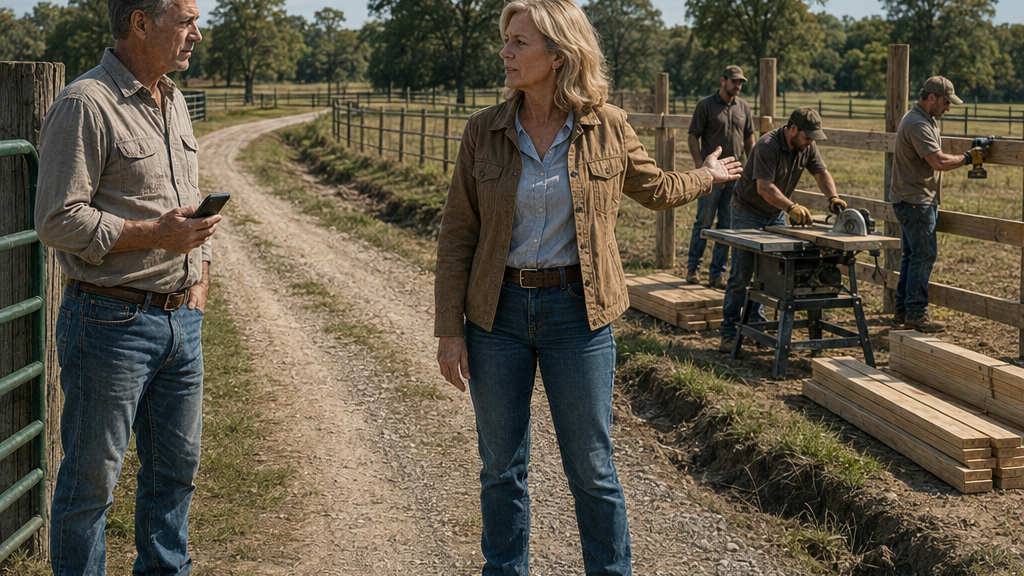
Fresh posts ran in a straight line along the edge of Catherine’s property, their tops pale where they had just been cut. One laborer held a board while another drove screws with David’s impact driver.
A wheelbarrow sat beside several bags of concrete.
David stopped at the edge of the gravel.
The contractor spotted him first.
“Afternoon.”
David nodded toward the saw.
“That mine?”
The contractor glanced at the tool, then at him.
“Catherine said association equipment.”
David said nothing.
The contractor’s expression changed.
“She told us it was available for the project.”
“What project?”
The man looked toward the fence line.
“Drainage and fencing.”
David walked closer.
The new fence ran from Catherine’s barn lot toward the shared road. For the first hundred feet, it followed her property edge. Near the road, however, the line curved beside the same drainage ditch the contractor had repaired.
That gave Catherine just enough truth to make the scene harder to read.
“What does the fence have to do with drainage?”
The contractor set down his measuring tape.
“She wanted the bank protected before we finished grading. Then she asked us to continue the same fence up to the paddock.”
“How much of it is road-association work?”
“That’s something you’ll have to ask her.”
David looked at the lumber.
A dozen boards had already been cut.
The edge was clean.
His blade.
His batteries.
His clamps held a section square near the gate opening.
The first rush of anger was not dramatic. It settled behind his ribs with the cold weight of something confirmed.
He had not misunderstood the tools she took.
She had needed fence equipment because she intended to build a fence.
A screen door shut behind him.
Catherine crossed the porch carrying a folder.
“I thought that was your truck down the road.”
“I walked.”
She glanced at the workers, then at David.
“Something wrong?”
“My tools are still here.”
“We’re still using them.”
“For your fence.”
“For the improvement work.”
David pointed at the stretch running toward the paddock. “That does not improve the road.”
“It protects the drainage edge.”
“That section might.”
He pointed farther uphill.
“That one doesn’t.”
Catherine exhaled.
“The contractor was already here. The posts needed doing. We’re trying to finish everything in one mobilization instead of paying him to come back twice.”
“We?”
“The association. Me. Everybody who uses the road.”
“That fence keeps your cattle in your field.”
“It also keeps them off a drainage bank we just paid to repair.”
David looked at her.
There it was again: enough practical sense to blur what should have been a simple line.
“How long were you planning to keep my saw?”
“Until the work is finished.”
“You could have called.”
“You were the one who said to use what we needed.”
“For the road.”
“This is connected to the road.”
“The gate by your paddock is connected to your paddock.”
Catherine’s mouth tightened.
One laborer slowed his work. The contractor made a point of studying his tape measure.
David lowered his voice.
“I want the tools back.”
“When?”
“Today.”
“That’s not practical.”
“They’re mine.”
“I know whose name is on them, David.”
“That ought to make this easier.”
Catherine stepped closer.
“We have one contractor, two laborers, rented equipment arriving tomorrow, and rain coming next week. If we stop now, we lose time and probably money.”
“Then use the contractor’s tools.”
“He didn’t bring everything because you volunteered yours.”
The word landed harder than he expected.
Volunteered.
As though he had placed the entire tool wall at the association’s disposal.
David took out his phone.
Catherine noticed.
“What are you doing?”
“Checking what’s still here.”
Her expression sharpened.
“You tracking us?”
“I’m tracking my equipment.”
“That seems a little excessive.”
“So does finding my table saw building somebody else’s fence three days after I loaned it for road repair.”
“It isn’t somebody else’s fence. It’s part of the whole project.”
“It’s your fence.”
Neither spoke for several seconds.
David could hear the driver turning screws again.
He looked toward the repaired ditch.
That was the complication he could not dismiss. Catherine had not invented the washout. The road work had happened. Some of the boards near the edge might even be defensible.
But the line running toward her paddock was private.
He knew it.
The contractor knew it.
Catherine knew it.
“Bring everything back by tonight,” he said.
She shook her head.
“No.”
The answer was calm.
Almost administrative.
David studied her face.
“You’re refusing to return my tools?”
“I’m saying we’re not tearing down an active job because you’ve decided the boundaries of your favor changed after the fact.”
“My favor didn’t change.”
“You never gave me a list of restrictions.”
“I said road work.”
“You said, ‘Use what you need.’”
“For the road.”
“That’s your interpretation.”
David felt his jaw tighten.
Catherine shifted the folder under her arm.
“You said we could use what we needed.”
For the first time since Monday, David had no immediate answer.
Because she was wrong about what he meant.
But she was not wrong about what he had failed to say.
Chapter 3: Nothing in Writing Cut Both Ways
“There was never a return date.”
Catherine said it from her porch Thursday evening with the same tone she used when reading numbers from an association ledger.
David stood below the steps, hands empty.
He had returned because he wanted one last conversation without workers listening.
“That doesn’t turn a loan into ownership.”
“I didn’t say it did.”
“Then give the tools back.”
“They’ll be finished tomorrow.”
“With your fence?”
“With the project.”
David looked past her toward the dark line of new boards.
The workers had stopped for the day. His table saw was covered with a tarp near Catherine’s machinery shed.
“You keep using that word.”
“Because that’s what it is.”
“The road was the project.”
“The road, the drainage edge, the safety fencing—”
“Your paddock gate?”
Catherine’s eyes narrowed.
“You want to fight over every board, we can do that at the next association meeting.”
“I don’t want a fight.”
“No, you want me to stop work halfway through and send everybody home because you changed your mind.”
David felt the old instinct rise in him—the instinct to walk away rather than turn a disagreement into something permanent.
It was the same instinct that had kept him from naming a return time Monday.
He forced himself to stay.
“I want my property back.”
“You’ll get it.”
“When?”
“Tomorrow.”
“What time?”
She hesitated.
That was enough.
“Nine in the morning,” David said. “Everything.”
Catherine gave a short laugh.
“You can’t just invent terms four days later.”
“I can ask for my tools back.”
“And I can tell you the work isn’t finished.”
David’s voice stayed level.
“Then we understand each other.”
Catherine shifted her weight.
“You have nothing in writing saying the saw was limited to the ditch.”
He looked at her.
She continued, quieter now.
“You don’t have a checkout sheet. You don’t have a return date. You handed me the access fob and told me to use what we needed.”
David waited.
The confidence in her argument depended on something she knew about him: he hated making favors formal.
His father had made every favor formal.
David had spent half his adult life going the other direction.
He finally nodded.
“You’re right about one thing.”
Catherine’s shoulders relaxed slightly.
“I didn’t write it down.”
He turned and walked home.
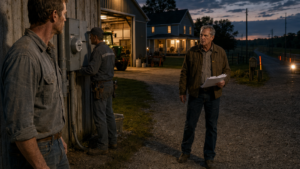
The equipment barn was dark except for the light above his workbench.
David sat on the stool and opened the manufacturer’s app.
The registered devices appeared one by one.
Table saw.
Impact driver.
Heavy drill.
Rotary hammer.
Each entry showed a serial number, last location, account owner, and control status.
He had used the app mostly for inventory. Once, after leaving an impact driver in a hayfield, he had found it through the last-seen location. He had never remotely disabled a tool.
He opened the saw’s settings.
A control appeared beneath the device information.
REMOTE LOCK.
David frowned.
He tapped the help icon instead.
The language was dry and technical. Registered account owners could restrict operation of individual connected devices. Lock commands would take effect once the tool communicated with the network or paired hub.
Another menu showed location history.
Monday: shared road.
Tuesday morning: shared road.
Tuesday afternoon: Catherine’s property.
Wednesday: Catherine’s property.
Thursday: Catherine’s property.
David scrolled farther.
The impact driver had followed nearly the same pattern.
That answered one question.
Not the larger one.
He could prove where his tools had been.
He still could not prove where community work ended and Catherine’s private job began.
His phone rang.
Richard Allen.
David answered.
“You talk to Catherine?” Richard asked.
“Twice.”
“I figured.”
“How?”
“She called me.”
David leaned back against the bench.
“What did she tell you?”
“That you’re threatening to shut down road work.”
“I asked for my tools.”
“She says they’re part of the contractor setup.”
“They’re building her fence.”
Richard was quiet for a moment.
“I know about the fence.”
David sat forward.
“You approved that?”
“I approved drainage protection along the road edge.”
“That’s not what I asked.”
“I didn’t approve a private paddock fence.”
“Then why is association work paying the contractor while he builds it?”
“I don’t know that it is.”
David looked at the location history on his screen.
“Richard.”
“I’m being straight with you.”
“Are association funds tied to what they’re doing tomorrow?”
Another pause.
“Yes.”
“How much?”
“I’d have to check Catherine’s invoices.”
“What work?”
“Finish grading the ditch. Set the last timber section. Put stone around the outlet.”
“With my tools?”
“I don’t know whose tools they planned to use.”
David rubbed his forehead.
Richard continued.
“I’m not saying Catherine handled this right. I’m saying if you stop everything tomorrow morning, you may be stopping work the association actually authorized.”
That was exactly what David did not want to hear.
He had spent the afternoon building a clean case in his head.
Borrowed tools.
Private fence.
Refusal to return them.
Simple.
Now the ditch was back inside the argument.
“When’s the rain supposed to come?” David asked.
“Early next week.”
“And the road really needs that outlet finished?”
“Yes.”
David looked at the lock control.
“So what are you asking me to do?”
“I’m asking you not to turn a tool dispute into a road failure.”
“That sounds a lot like asking me to let her keep using them.”
“I’m asking you two to settle it.”
“I tried.”
“I know.”
Richard sounded tired.
“That’s why I’m calling you instead of her.”
David almost laughed.
“That doesn’t make much sense.”
“It does to me.”
After the call ended, David remained at the bench.
He opened each registered device and reviewed the controls.
The system allowed him to lock them separately.
Not everything.
Not Catherine’s contractor equipment.
Not rented machinery.
Only what belonged to him.
That distinction mattered.
So did the fact that he did not yet know which tool was being used for which part of the work.
He printed the location history.
Then he printed the device registrations.
The pages slid onto the tray one after another, black lines and timestamps replacing the vague irritation he had carried all week.
At eight thirty, Catherine called.
David let it ring twice before answering.
“Richard talked to you?” she asked.
“Yes.”
“Good. Then you know tomorrow isn’t just my fence.”
“I know association work is scheduled.”
“So we can stop making this harder than it needs to be.”
David looked at the tarp-covered shapes he could imagine at her place.
“I want the tools returned by nine.”
Silence.
“David.”
“Nine.”
“You know the crew starts at seven.”
“Then they have two hours to finish whatever they’re doing with my equipment.”
“That’s ridiculous.”
“No. It’s specific.”
Catherine lowered her voice.
“You’re going to create a mess over a favor you volunteered.”
“No.”
He stared at the printed device log.
“I created the mess when I made the favor vague.”
She did not answer.
David continued.
“Nine tomorrow morning. If my tools are still being used after that, I’ll stop their use myself.”
“You can’t stop a contractor from working.”
“I’m not planning to.”
“What does that mean?”
“It means exactly what I said.”
Catherine was quiet long enough that he wondered whether she remembered the conversation about the smart equipment.
Then she said, “If you interfere with authorized road work, that’s on you.”
“And if you use my tools after I’ve asked for them back, that’s on you.”
He ended the call before either of them could add another sentence.
The barn seemed unusually still.
David gathered the printed records into a folder and set his phone beside them.
On the screen, the table saw remained active at Catherine’s property.
The remote-lock control waited beneath its serial number.
For the first time all week, David knew exactly where his boundary was.
At nine o’clock Friday morning, he intended to find out whether Catherine believed him.
Chapter 4: Friday Morning Every Motor Went Quiet
At 8:57 Friday morning, David could hear his table saw running from across the field.
He stood beside his own gate with the phone in one hand and the printed equipment list folded beneath the other.
The sound came in bursts—blade rising, dropping, rising again—as the crew cut boards at Catherine’s fence line. Through the gap between two sycamores, David could see movement around the new posts. One laborer carried a board from the stack. Another leaned over the impact driver.
Three minutes.
David checked the app.
Table saw: active.
Impact driver: active.
Heavy drill: active.
The location markers all sat inside Catherine’s property boundary.
He could have walked down there.
Part of him wanted to.
Walking over would have made the dispute visible in the ordinary way: two neighbors standing ten feet apart, saying the same things they had already said, only louder because other people were watching.
Instead, he stayed where he was.
At 8:59, his phone rang.
Catherine.
He answered.
“You coming down?” she asked.
“No.”
“We’re finishing the road section first.”
“With my saw?”
“With the equipment we already have set up.”
David looked at the time.
“You have one minute.”
Silence.
Then Catherine said, “You cannot be serious.”
“I was serious last night.”
“There’s authorized work happening.”
“I know.”
“You shut anything down and Richard’s going to hear exactly what happened.”
“He should.”
The line went quiet again.
David heard the saw start.
Nine o’clock.
He ended the call.
The first thing he did was open the table saw registration.
He checked the serial number against the printed sheet.
Same number.
He did the same with the impact driver.
Same.
Heavy drill.
Same.
He had told himself all morning that verification mattered. It was not enough to see his tools in the app. He wanted no possibility that he was disabling something he had forgotten he had sold, replaced, or registered twice.
The numbers matched.
He opened the saw controls.
REMOTE LOCK.
His thumb hovered over the button.
He thought of Richard’s warning.
If you stop everything tomorrow morning, you may be stopping work the association actually authorized.
Then he thought of Catherine saying there was nothing in writing.
He pressed the button.
A confirmation box appeared.
Lock this device?
David pressed confirm.
For several seconds, nothing happened.
The saw continued whining in the distance.
Then the pitch changed.
The blade wound down.
David watched the small shape of the laborer step back from the machine.
The silence that followed carried farther than the saw had.
One of the workers bent over the controls.
David opened the impact driver registration.
Confirm.
Across the field, the laborer holding it squeezed the trigger.
A short mechanical click.
Nothing else.
He tried again.
Click.
The man turned the battery over in his hand.
David locked the heavy drill next.
Then he stopped.
He did not lock the rotary hammer.
According to the location log, it was sitting closer to the drainage ditch than the fence build, and he could not see who was using it or for what.
He was not trying to shut down the whole job.
He was enforcing the boundary he could prove.
That distinction did not make him feel as satisfied as he had expected.
The workers gathered near the table saw.
The contractor walked toward Catherine’s house.
Less than two minutes later, David’s phone rang.
He let it ring.
It stopped.
Thirty seconds later, it rang again.
He ignored it.
The third call came while one of the laborers carried a dead drill toward the truck.
The fourth came five minutes after that.
By the fifth call, David was back inside the equipment barn.
He answered.
“What did you do?” Catherine said.
Her voice had lost the flat administrative calm she had carried all week.
“I locked my tools.”
“You disabled them in the middle of active work.”
“I asked for them back.”
“We are at the ditch.”
“You’re also at your fence.”
“The same crew is working both.”
“That doesn’t make the same job.”
Catherine took a breath hard enough that he heard it over the phone.
“The contractor says the saw won’t reset.”
“It won’t until I unlock it.”
“Then unlock it.”
“No.”
“David.”
“I verified every serial number before I touched anything.”
“That is not the point.”
“It’s exactly the point.”
“No, the point is you have interfered with work the association is paying for.”
David looked at the printed location history.
“Then the association can show me which part of that work required my table saw at your paddock yesterday.”
Catherine did not answer immediately.
When she spoke again, her voice was lower.
“You are making this bigger than it is.”
“I tried making it smaller yesterday.”
“You gave us the tools.”
“I loaned them.”
“With no restrictions.”
“I asked for them back.”
“After the job was underway.”
“And you kept using them.”
There was a pause.
Then Catherine said, “Richard is calling a meeting this afternoon.”
“That’s fine.”
“You may not think so once the invoices are on the table.”
David’s eyes shifted to the app.
The rotary hammer marker moved.
It was now closer to the repaired ditch.
That made his stomach tighten.
“What invoices?”
“The ones showing this is association work.”
“All of it?”
“I didn’t say all of it.”
That answer was different from every answer she had given before.
David said nothing.
Catherine continued.
“You want to make a distinction between road work and private work? Fine. We’ll make it with the records in front of everyone.”
“That’s what I’ve been asking for.”
“No. You’ve been acting like I stole a truckload of tools.”
“You refused to return them.”
“Because we were using them.”
“For both jobs.”
Again, silence.
David understood then that the argument had changed.
Catherine was no longer insisting there was no distinction.
She was insisting the distinction did not matter enough to justify what he had done.
“Three o’clock,” she said. “Community hall.”
“I’ll be there.”
“And bring your logs.”
“I planned to.”
She hung up.
David stood alone beside the workbench.
The locked device icons were still visible on the screen.
For three days he had imagined this moment as the clean turn in the story: his tools stop, Catherine loses control, facts replace entitlement.
But through the open barn door, he could see the low section of the shared road.
A delivery truck slowed almost to a crawl where the fresh gravel met the unfinished drainage work.
Its rear wheels dropped into the soft edge before climbing out.
David watched it continue toward Ruth Wilson’s place.
The road problem was still real.
So were his tools.
And somewhere between those two facts was the question the afternoon meeting would have to answer.
At 2:41, Richard sent him a photograph of the meeting table.
Three contractor invoices were already spread across it.
Chapter 5: The Fence Was Private but the Ditch Was Not
Ruth Wilson did not wait for the meeting to begin.
The moment David entered the small community hall, she pointed toward the invoices and said, “Before anybody turns this into a neighbor fight, that corner nearly stopped an ambulance last winter.”
David had not even taken off his cap.
Catherine sat at the far end of the folding table with a legal pad in front of her. Richard was beside her. Three other road-association members occupied metal chairs along the wall.
David placed his folder on the table.
“I’m not saying the road didn’t need work.”
Ruth leaned back.
“Good. Because it did.”
Her voice was sharper than usual.
“My cattle trailer dragged the shoulder twice this spring. And when my husband went down last winter, the ambulance driver asked whether there was another way in.”
There was no other way in.
David knew that.
He also knew Ruth was not defending Catherine’s fence. She was defending the road because she had reasons not to let anyone minimize it.
Richard tapped the table.
“Let’s separate the issues.”
“That’s what I want,” David said.
Catherine looked at him.
“Now.”
David ignored the word.
Richard pulled the first invoice toward the center.
The contractor had listed ditch excavation, culvert clearing, gravel placement, timber reinforcement, labor, and equipment mobilization.
The second invoice included additional labor, fence-post setting, board installation, and drainage-bank protection.
David read the line twice.
“Fence-post setting.”
Catherine said, “Some posts protect the repaired bank.”
“Some.”
“Yes.”
“And the rest?”
“The contractor was already mobilized.”
David looked up.
“That is not an answer.”
“It is an explanation.”
Richard raised a hand.
“Keep going.”
The room settled.
David opened his folder and placed the printed location history beside the invoice.
Monday morning, his table saw had been near the road.
Tuesday afternoon, the location shifted to Catherine’s property.
Wednesday, it remained there.
Thursday, same.
He aligned the timestamps with the contractor’s work dates.
The comparison made one thing clear.
The tools had served both locations.
It did not make clear which hours belonged to which purpose.
Ruth leaned over the papers.
“So she did use them for the road first.”
“Yes,” David said.
The admission came easily enough.
What followed did not.
“And Friday morning?”
Richard asked.
David opened the app on his phone and showed the device history.
“At nine, the table saw and two drivers were at Catherine’s fence line.”
Catherine answered immediately.
“Which is beside the drainage project.”
“The paddock section isn’t.”
“But the crew moved back and forth.”
David nodded.
“That’s the problem.”
One of the association members asked, “What exactly stopped when you locked the tools?”
David looked at Richard.
“I don’t know all of it.”
Catherine gave a small, humorless laugh.
“There.”
David continued.
“I know which tools I locked. I don’t know what each worker planned to do with them five minutes later.”
“The table saw was cutting road-edge boards,” Catherine said.
The contractor, seated near the door, shifted in his chair.
Richard noticed.
“You were there. Was it?”
The contractor rubbed his jaw.
“At that moment?”
“Yes.”
“One of the boards on the saw was for the fence.”
Catherine turned toward him.
“But the next cuts were for the lower rail by the drainage bank.”
“That’s possible.”
“Not possible. Planned.”
The contractor looked uncomfortable.
“We had both stacks together.”
David felt something in his certainty loosen.
He had stopped a private cut.
He had also stopped a tool that was about to be used on authorized work.
Both could be true.
Richard picked up the second invoice.
“This is exactly why we need to separate billing.”
Catherine’s face tightened.
“We were trying to save mobilization costs.”
“That may be true,” Richard said. “But combined billing makes it impossible to tell what the association owes.”
Ruth pointed at a line.
“What is this labor block?”
The contractor leaned forward.
“Eight hours, two men.”
“For what?”
“Fence and drainage.”
“Together?”
“Yes.”
Ruth sat back.
“Well, that’s useless.”
No one laughed.
David looked at Catherine.
For the first time all week, she seemed less certain than tired.
Not guilty exactly.
Cornered by the consequences of a shortcut she had believed she could explain later.
Richard separated the invoice from the others.
“This gets revised.”
Catherine said, “That’s going to delay payment.”
“Then payment gets delayed.”
“The contractor already did the work.”
“And he can tell us which part was ours.”
The contractor nodded cautiously.
“I can reconstruct most of it.”
David folded his hands on the table.
He should have felt vindicated.
Instead, Ruth’s ambulance story remained in his mind.
“If the tools hadn’t shut down this morning,” he asked, “would the drainage section be finished?”
The contractor considered it.
“Probably the timber and rail work. Stone still depended on the delivery.”
“So I delayed legitimate work.”
Catherine looked at him.
“Yes.”
Richard spoke before she could continue.
“You delayed work because your property was being used without a clear agreement.”
“That doesn’t make the delay disappear.”
“No.”
The answer came from Ruth.
David looked at her.
She tapped the location printout.
“You can be right about your tools and still have made the road harder for half a day.”
David leaned back.
That was the sentence he had not wanted anybody to say because it was the sentence he knew was true.
The room moved on to the records.
Richard requested purchase approvals.
Catherine produced emails, notes, and a summary of expected expenses.
The drainage work had been discussed.
The timber reinforcement had been discussed.
Fence work had been mentioned only where it touched the roadside bank.
Nothing in the records authorized the paddock run.
That gave David his first clean piece of ground.
Richard looked at Catherine.
“The upper fence is private.”
“Yes.”
“You charged any part of that labor to the association?”
Catherine hesitated.
“The contractor hasn’t separated it yet.”
“That wasn’t my question.”
She looked down at the invoice.
“It’s included in this bill.”
The room went still.
David did not say anything.
He did not need to.
Richard pulled another invoice from beneath the stack.
“This one came by email this morning.”
He slid it across the table.
David read the description.
Grading support. Shared access improvement. Community-provided machinery.
His eyes stopped there.
“What machinery?”
Catherine said nothing.
Richard pointed to a notation beneath the line.
“Portable saw. Drills. Drivers.”
David looked at Catherine.
The phrase had the strange effect of making his anger colder.
Not because it changed ownership.
Because it showed how Catherine had described his property to someone else.
“Community-provided?”
Catherine straightened.
“You provided it for community work.”
“I provided it to you.”
“On behalf of the association.”
“No.”
“You knew why I was borrowing it.”
“For the road.”
“Yes.”
“Then you moved it onto your fence.”
“To keep one crew on site.”
David tapped the invoice.
“And somewhere along the way my tools became association machinery?”
“That’s bookkeeping language.”
“It’s ownership language.”
“It doesn’t transfer title.”
“That’s not the point.”
Richard picked up the page.
“Who told the contractor to write this?”
The contractor answered before Catherine could.
“She did.”
Every face at the table turned toward Catherine.
Her expression did not collapse. She did not apologize.
She simply looked at the invoice as though the wording had become more serious now that other people were reading it.
David understood the next question before Richard asked it.
“Catherine,” he said, “who authorized you to classify David’s private equipment as community-provided machinery?”
This time, she had no answer ready.
Chapter 6: Catherine Had Been Counting on His Silence
“I never asked whether the fence part was covered.”
Catherine said it Saturday morning before David had finished sitting down.
Her farm office occupied one end of an old converted milk room behind the barn. A metal desk faced a window overlooking the shared road. Three revised invoices lay in separate piles.
David looked at her.
“That would’ve been useful on Monday.”
“I know.”
The answer was so direct that it took some of the force out of what he had prepared to say.
Catherine slid the key fob across the desk.
It stopped halfway between them.
David did not pick it up.
“All the tools are back?”
“In your barn. Contractor dropped them off at seven.”
“I saw them.”
“Any damage?”
“Normal use.”
She nodded.
For several seconds, neither spoke.
Without the association members around them, the argument felt smaller and somehow more difficult.
Catherine touched one of the revised invoices.
“The contractor separated the drainage labor from the private fence labor.”
David looked at the figures.
The distinction was not perfect, but it was better. Hours had been divided by task. Material costs were separated. The road-association portion was noticeably smaller than the original bill.
“You’re covering this column?” he asked.
“Yes.”
“Personally?”
“Yes.”
David studied her face.
“Then why didn’t you do that from the start?”
Catherine looked toward the window.
“Because I was trying to get all of it done at once.”
“That doesn’t answer the question.”
“It does if you know what the contractor wanted to charge to come back.”
“How much?”
She named the amount.
David understood the temptation immediately.
Not enough to justify what she had done.
Enough to explain why she had done it.
Catherine continued.
“The ditch needed excavating. The lower fence needed moving away from the bank. My paddock fence needed replacing anyway. Same crew, same lumber delivery, same auger setup. I thought if we did everything while they were there, I could sort out the numbers afterward.”
“You also thought my tools were part of that arrangement.”
“I thought you would be annoyed.”
David gave her a long look.
“That’s different from permission.”
“I know.”
“Did you know Thursday?”
Catherine pressed her lips together.
“Yes.”
There it was.
Not confusion.
Not administrative sloppiness.
A choice.
David rested his forearms on his knees.
“Then why tell me I volunteered?”
“Because you did.”
“For road work.”
“Yes.”
“And you knew the fence was different.”
“Yes.”
Her voice was quieter now.
David waited.
Catherine finally said, “I thought you’d let it go.”
That landed harder than any argument she had made earlier.
“Why?”
“Because you usually do.”
He sat back.
Catherine immediately looked as if she regretted saying it, but she did not withdraw it.
David thought of gates he had welded for neighbors who never offered payment. Tractors he had pulled from mud. Sunday repairs. Emergency hay hauling. Tools returned late enough that he had forgotten who borrowed them.
He had always called that being useful.
Apparently other people had learned a different lesson from it.
Catherine folded her hands.
“You don’t like making a thing out of favors.”
“No.”
“I knew that.”
“So you counted on it.”
She looked at the desk.
“Yes.”
David picked up the key fob.
The plastic was warm from the room.
On Monday, he had handed it over because asking Catherine to sign anything would have felt petty.
Now it felt like something else entirely.
Not trust.
Permission without edges.
He set it down again.
“What was the rush?”
Catherine frowned.
“The road?”
“All of it.”
She opened a folder and pulled out a printed forecast.
“Rain was supposed to move in Tuesday. Now they’re saying Monday night.”
David glanced at the page.
Heavy accumulation.
“The ditch would’ve held another week.”
“Maybe.”
“Richard thought so.”
“Richard doesn’t live below that corner.”
“You do.”
“Yes.”
Her tone sharpened for the first time that morning.
“When that shoulder washes, it drops water into my lower field. When the fence is down, my cattle push toward the soft bank. When people complain, they call me because I’m the treasurer. When I ask for decisions, everybody wants another meeting.”
David said nothing.
Catherine continued.
“So I made one.”
“That part I noticed.”
“I wasn’t trying to steal your tools.”
“I know.”
She looked surprised.
David stood.
“Come walk the road.”
Outside, the repaired ditch ran clean along the gravel edge. Fresh stone protected the outlet. The lower timber rail had been completed Friday afternoon with the contractor’s own equipment after David’s lockout.
Farther up, Catherine’s private fence stretched toward the paddock.
Seeing both in the same line made the entire dispute visible.
One section protected shared access.
One protected Catherine’s cattle.
The mistake had been treating proximity as sameness.
Catherine stopped beside the drainage bank.
“If we had waited for another meeting, this might not have been finished before the rain.”
“Maybe.”
“You think that matters?”
“Yes.”
She looked at him.
David nudged loose gravel back from the road with his boot.
“It matters. It doesn’t make the rest yours to decide.”
Catherine folded her arms.
“Fair.”
He glanced at her.
“That’s the first time you’ve said that.”
“I’m trying something new.”
Despite himself, David almost smiled.
They walked another twenty yards.
Catherine said, “I’ll pay for the fence labor. I’ll cover whatever equipment charge you think is fair. Fuel, blade wear, batteries.”
David stopped.
“That’s not enough.”
Her expression hardened again.
“I’m offering to make you whole.”
“I don’t want a blade fee.”
“What do you want?”
He looked back toward the road.
For most of the week, the answer had been simple.
His tools.
Then acknowledgment.
Then proof.
Now all three were already in front of him.
If he demanded money and walked away, nothing would stop the same ambiguity from happening the next time someone borrowed a post driver, trailer, pump, or tractor.
Worse, he knew he had helped build the ambiguity himself.
He had been so determined not to resemble his father that he had made clarity feel like hostility.
“I should’ve told you exactly what you could take,” David said.
Catherine stared at him.
“And when it came back.”
“That doesn’t excuse what I did.”
“No.”
“But you’re saying you made part of the problem.”
“I’m saying I left the door open and then got mad when you walked farther through it than I expected.”
Catherine looked down at the gravel.
“That’s more generous than I deserve.”
“It isn’t generosity.”
David’s voice stayed calm.
“It’s accuracy.”
They reached the bend where the road widened near Ruth’s property.
Catherine asked, “So what do you want?”
David looked at the repaired ditch, then at the key fob in his hand.
“I want this to be the last time anybody in the association can say they thought private equipment belonged to everybody because somebody was too polite to write down the terms.”
Catherine exhaled.
“You want a borrowing policy.”
“I want more than fuel money.”
“Fine.”
“And the invoices corrected before the association pays them.”
“They will be.”
“And private work stays private on the books.”
“Yes.”
She waited.
“Anything else?”
David thought about Friday morning—the dead saw, the repeated calls, the satisfaction that had disappeared the moment Ruth talked about the ambulance.
“Yes.”
“What?”
“We stop pretending the only person who handled this badly was you.”
Catherine looked at him for a long moment.
Then she nodded.
At the farm office door, she tried once more.
“I can still reimburse the batteries and blade wear.”
David handed her the revised invoice instead.
“No.”
“You’re refusing repayment?”
“I’m refusing to let repayment be the whole answer.”
Catherine’s brow tightened.
“Then what exactly are you going to ask for Monday?”
David slipped the key fob into his pocket.
“Something neither of us has been very good at.”
“What’s that?”
He opened the door.
“Terms everybody can read before they say yes.”
Chapter 7: The New Rule Was Written Before Anyone Borrowed Again
David put the one-page equipment policy in the middle of the table before anyone had finished sitting down.
Richard Allen picked it up first.
Catherine Hall did not.
The Monday evening road-association meeting was held in the same community hall where the invoices had been spread across the table three days earlier, but the room felt different now. The revised contractor bills were clipped into separate packets. One stack was marked for shared-road work. Another contained Catherine’s private fence charges.
David had brought neither the remote-lock logs nor the photographs.
He had already proved what needed proving.
This meeting was supposed to decide what happened next.
Richard read the page silently.
Ruth Wilson leaned toward him.
“Well?”
Richard looked over the top of the sheet.
“This is stricter than anything we’ve ever had.”
“That’s the idea,” David said.
Catherine finally reached for a copy.
The rules were plain.
Privately owned equipment remained private regardless of whether it was borrowed for association work.
Every borrowed item had to be listed.
The intended work location had to be identified.
Any private use required separate permission.
A return date and time had to be written down.
If the equipment was connected, tracked, remotely controlled, or registered to an owner account, the owner retained full control of those systems.
No one could describe privately owned equipment on an invoice as association-owned or community-provided without the owner’s written approval.
Ruth read the last sentence twice.
“That one seems aimed at somebody.”
Catherine kept her eyes on the page.
“It is.”
David looked at her.
She did not sound offended.
That was new.
One of the association members near the wall cleared his throat.
“I still think we’re making this complicated because Catherine took advantage of a favor.”
Catherine’s jaw tightened.
Richard set down the policy.
“We are making it clear because the old way was not clear.”
“The old way worked until last week.”
“No,” David said. “The old way depended on everybody interpreting a favor the same way.”
The member looked at him.
“And most people do.”
“Until they don’t.”
David did not raise his voice.
That mattered to him more than it would have a week earlier.
He had spent too much time thinking the only alternatives were silence or a feud. The paper in front of him was proof there was something between them.
Richard opened the revised invoices.
“Before we vote on the equipment policy, we need to close the billing issue.”
He slid the first invoice toward the center.
The contractor had separated the ditch excavation, culvert clearing, road-edge timber, outlet stone, and drainage-bank protection.
Those charges belonged to the association.
The second page contained fence-post labor, upper paddock rails, private gate work, and the hours Catherine had asked the crew to combine while they were already on site.
Those charges belonged to Catherine.
The difference was large enough that nobody could call the original combination harmless bookkeeping.
Catherine spoke before Richard asked.
“I’ll cover the private portion.”
One member looked surprised.
“All of it?”
“Yes.”
“Even the additional equipment time?”
“Yes.”
David watched her.
There was no argument in her voice.
No attempt to shave away responsibility one line at a time.
Richard nodded.
“And the contractor has removed the phrase ‘community-provided machinery’ from the association invoice.”
Catherine said, “I asked him to.”
Richard glanced at David.
“That resolve your ownership issue?”
“The invoice issue, yes.”
“Any reimbursement claim?”
David shook his head.
Catherine looked at him.
“You’re still not charging for the tools?”
“No.”
A member at the end of the table frowned.
“Why not?”
David considered the question.
A week earlier, he might have answered because he was not petty.
Now he knew that answer would have been another version of the same pride that caused the problem.
“Because the road did use some of them,” he said. “And because I loaned them without terms. Catherine crossed the line. I left the line unmarked.”
Catherine looked down.
Ruth tapped her copy of the policy.
“So now we mark it.”
“Yes.”
The room was quiet for a moment.
Then one of the members said, “I think Catherine should step down as treasurer.”
Catherine’s head lifted.
Richard leaned back.
“On what grounds?”
“She mixed private work with association billing.”
“That happened,” Richard said.
“She labeled David’s equipment like it belonged to us.”
“That happened too.”
“Then why is she still handling money?”
Catherine did not defend herself.
David noticed that first.
Three days ago she would have answered before the sentence ended.
Now she folded her hands and waited.
The member continued.
“If we don’t remove her, what are we saying?”
David looked at the revised invoices.
He had not expected to be the person who answered.
“We’re saying she corrects what she did.”
The man turned toward him.
“You’re defending her?”
“No.”
“That sounds like it.”
David shook his head.
“I’m saying the remedy should fit the damage.”
“She used your property.”
“Yes.”
“She put private work on a shared bill.”
“Yes.”
“And you want her to stay?”
“I want controls that don’t depend on whether Catherine stays.”
The room went still.
David looked at Catherine.
“If we fix this by removing one person and leave everything informal, then the next problem belongs to whoever comes after her.”
Richard nodded slowly.
David continued.
“She pays the private charges. The invoice is corrected. Nobody calls privately owned equipment association property again. We vote on written borrowing rules. And for any project that mixes private and shared work, somebody besides the treasurer approves the split before the contractor starts.”
Ruth smiled faintly.
“That last part might save us all some trouble.”
The member who had proposed removing Catherine looked dissatisfied.
“She still made the decision.”
“She did,” David said.
Catherine finally spoke.
“And I knew I hadn’t asked him about the private fence.”
No one moved.
She looked directly at the member.
“I thought the savings justified sorting it out later. They didn’t.”
It was not an apology shaped for sympathy.
That made it stronger.
Richard asked, “Are you willing to work under the new approval rules?”
“Yes.”
“And recuse yourself from approving any invoice involving your own property?”
“Yes.”
The member looked toward David.
“You trust that?”
David glanced at the key fob lying beside his copy of the policy.
“I trust rules more than assumptions.”
Richard called the vote.
The reimbursement split passed.
The dual-approval requirement passed.
The equipment policy passed without objection.
The motion to remove Catherine did not.
When the meeting ended, people gathered their papers without celebration. No one applauded. No one shook David’s hand as though he had won something.
Ruth stopped beside him on the way out.
“Road held through last night’s rain.”
“I saw.”
“Water stayed in the ditch.”
“Good.”
She nodded toward Catherine, who was speaking quietly with Richard.
“She was wrong.”
“I know.”
“So were you, a little.”
David gave her a look.
Ruth smiled.
“That’s why I like you better today.”
Then she left.
David remained long enough to help fold the chairs.
Catherine approached while he was carrying the last two against the wall.
“You didn’t have to stop that motion.”
“I didn’t.”
“You know what I mean.”
David set the chairs down.
“I didn’t want your job.”
“That isn’t what I meant either.”
He waited.
Catherine folded the policy and slipped it into her folder.
“I thought you’d want me embarrassed.”
“I wanted my tools back.”
“You got them.”
“I wanted the bills fixed.”
“They are.”
“And I wanted this not to happen again.”
She looked at the page in her hand.
“That part might take longer.”
“Probably.”
Outside, the repaired road was dark from the previous night’s rain but intact. Water moved through the cleaned ditch without spilling across the gravel.
They stood beside the parking area for a moment.
Catherine said, “I was wrong about one thing.”
“Only one?”
She ignored that.
“I thought if you didn’t put a boundary in writing, it meant you didn’t care much about it.”
David looked toward the road.
“I thought if I put boundaries in writing, it meant I didn’t trust anybody.”
“And?”
“And both ideas were expensive.”
That earned a quiet laugh from her.
Not much.
Enough.
The following Thursday, David was in his equipment barn replacing a worn blade on a mower when Catherine appeared in the doorway.
She did not enter.
That was the first thing he noticed.
The second was the sheet of paper in her hand.
“I need to borrow your post driver.”
David leaned against the workbench.
“For what?”
“Lower drainage fence. Two posts beside the road. Association work only.”
“When?”
“Tomorrow morning.”
“Return?”
“By noon.”
“Who’s using it?”
“The contractor.”
“Where?”
“Same damaged corner. Road side of the ditch.”
David stared at her long enough that she shifted the paper.
“I wrote it down.”
“I can see that.”
She placed the sheet on the bench.
At the bottom was a blank line for his signature.
Beside it lay the black access fob.
For a moment David saw the same object as he had seen it Monday morning: something easy to hand over because neighbors were supposed to trust each other.
Then he remembered the dead saw blade coasting to a stop, the invoice calling his property community machinery, Ruth talking about the ambulance, Catherine admitting she had counted on his silence.
The fob had not changed.
What it meant had.
David read the sheet.
Two posts.
Road drainage fence.
Contractor use.
Return by noon.
He picked up a pen.
Catherine watched him.
“You going to make me initial the serial number too?”
“Yes.”
She sighed.
“You really did become your father.”
David stopped before signing.
For years, that sentence would have irritated him.
Instead he looked at the single page, then at the organized wall of tools behind him.
“No,” he said.
Catherine raised an eyebrow.
“My father kept a notebook so he could remember what people owed him.”
David signed the form and slid it toward her.
“I’m writing this down so neither of us has to owe the other an argument.”
Catherine read the line, then added her initials beside the serial number.
David handed her the key fob.
This time neither of them pretended the gesture meant unlimited trust.
It meant something better.
It meant they both knew where the line was.
The story has ended.