He Kept Moving My Farm Bins Across the Property Line—Then I Learned Why He Needed Them There
Chapter 1: The Containers Were Gone Before the Truck Arrived
Scott Harris heard the collection truck before he saw what was wrong.
Its diesel engine climbed the county road in a low mechanical growl, followed by the sharp hiss of brakes at the farm entrance. Scott was halfway across the equipment shed with a grease rag in one hand when the truck stopped.
Then, almost immediately, it moved again.
“No.”
He dropped the rag and walked quickly outside.
The two large wheeled farm-service containers were supposed to be sitting on the gravel turnout beside his field gate. Scott had rolled them there himself after supper the night before.
The turnout was empty.
The truck continued east, its rear lights shrinking between the rows of roadside trees.
Scott stood for a moment with his hands on his hips. Then he looked across the wire fence toward the neighboring property.
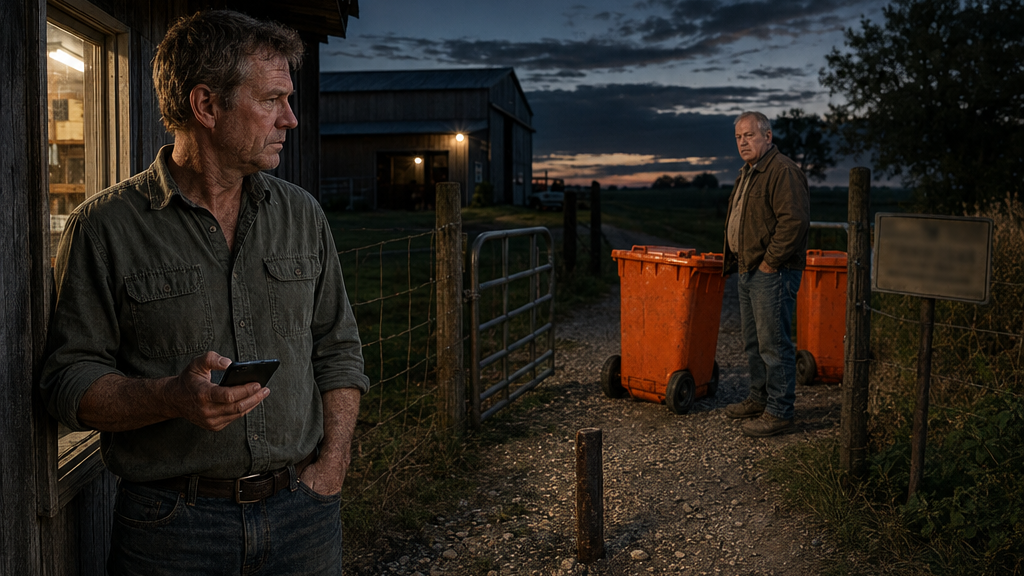
Both containers were beside Gary Wright’s entrance.
Again.
One leaned slightly against Gary’s weathered gatepost. The other stood near the drainage ditch, twenty or thirty yards from where Scott had left it.
Scott crossed the grass.
There was a rust-dark survey pin near the edge of his turnout, low enough that most people would step over it without noticing. Scott knew exactly where it was. His father had pointed it out to him years ago.
The containers were well beyond it.
He grabbed one handle and pulled.
The plastic wheels rattled over loose gravel.
Seven months earlier, Scott had assumed the first incident was a mistake.
Gary had moved one container farther down the road, and Scott had simply dragged it back. They had lived beside each other too long to turn every inconvenience into an argument.
The next week both containers had moved.
Then it happened again.
Not every Tuesday, but often enough that Scott had begun checking them before bed.
He had mentioned it once when he saw Gary near the fence.
“Those cans keep ending up down your way.”
Gary had shrugged.
“Wind catches stuff.”
They were heavy containers.
Scott had let the answer pass.
That was what bothered him now.
Not Gary’s explanation.
His own willingness to accept it.
By the time Scott pulled the second container back across the property line, Kathleen was standing at the equipment shed door.
“Truck already came?”
Scott nodded.
She looked at the empty road, then toward Gary’s entrance.
“He moved them.”
“I don’t know that.”
Kathleen gave him a tired look.
“You left them here last night.”
“I did.”
“And they walked over there?”
Scott gripped the container handle harder than he needed to.
“I’m going to call the service office.”
“You said that last time.”
“I know.”
Behind the shed, the August heat had already begun warming the metal siding. Inside one of the containers were spoiled feed sacks, veterinary packaging, baling twine and household refuse from the farmhouse. Nothing dangerous. Nothing dramatic.
But missing another collection mattered.
Two weeks earlier, the truck had passed while the containers were on Gary’s side. Scott had missed that pickup too.
The waste had sat for another seven days.
By the fourth day the smell had moved from the containers into the shed.
By the sixth, flies gathered whenever Scott lifted a lid.
He had spent Sunday morning double-bagging spoiled scraps because Kathleen refused to let him keep them near the feed room.
Now it was happening again.
Scott rolled the containers into the shade and flipped open the first lid.
A sour wave of heat rose from inside.
He shut it immediately.
Kathleen had followed him.
“We can haul this ourselves.”
“Forty minutes each way.”
“Still better than keeping it another week.”
Scott looked down the road.
“He knows pickup is Wednesday.”
Kathleen said nothing.
That bothered him more than if she had agreed.
Scott crouched beside the first container.
Molded into the plastic near the lid hinge was a sequence of numbers. He had noticed them before but never paid much attention.
The second container had a different sequence.
He took out his phone.
“What are you doing?” Kathleen asked.
“Something I should’ve done months ago.”
He wiped dust from the first number with his thumb and photographed it.
Then the second.
He stepped back and took pictures of both containers beside his gate, the gravel turnout, the fence and the survey pin.
Kathleen watched him.
“This isn’t about garbage anymore.”
Scott straightened.
“It should still be about garbage.”
“That’s not what I said.”
He understood her.
The containers were worth little compared with a tractor tire or a ton of hay. If somebody had stolen a wrench from the shed, Scott might have replaced it rather than start trouble.
But the containers were not disappearing.
They were being moved.
Repeatedly.
Always before collection.
Always across the same line.
That gave the act a purpose Scott did not understand.
“I’ll talk to Gary,” he said.
Kathleen folded her arms.
“You’ve been talking around Gary for half a year.”
“I’m not calling a deputy over two plastic containers.”
“I didn’t tell you to.”
Scott looked at her.
“I’m just asking you to stop pretending keeping quiet is the same thing as solving it.”
The words landed harder than Scott expected.
His father had believed in settling problems at the fence.
Not in offices.
Not through county forms.
Certainly not through lawyers.
A man who needed the county to explain how to live beside his neighbor, his father used to say, had waited too long to speak plainly.
Scott had always believed that.
Yet somehow he had spent seven months saying almost nothing.
By late morning he had loaded the worst bags into the pickup for the trip to the transfer station.
Before leaving, he wrote the two molded identification numbers on the back of a feed receipt and folded it into his shirt pocket.
Gary’s pickup was parked beside his house.
Scott could have driven past.
For several seconds, he considered doing exactly that.
Then he shut off the engine.
The silence after the diesel stopped felt deliberate.
Scott unfolded the receipt, checked the numbers once more and started walking toward Gary Wright’s front porch.
Chapter 2: Gary Said the Numbers Proved Nothing
Gary opened the door before Scott had reached the top porch step.
“You here about those containers?”
The question stopped Scott.
He had expected denial.
Instead, Gary stood behind the screen door in work jeans and a faded shirt, one hand still on the latch.
“Yes.”
Gary pushed the door open.
“What about them?”
Scott removed the folded receipt from his pocket.
“You moved them last night.”
Gary’s expression barely changed.
“Sure.”
The blunt admission threw Scott off balance more than an argument would have.
“Why?”
Gary glanced toward the road.
“They belong at the turnout.”
“My turnout.”
“The turnout.”
Scott unfolded the paper.
“They were beside my gate when I went inside.”
“I know where they were.”
“And you moved them across the line.”
Gary leaned one shoulder against the doorframe.
“You keep saying ‘the line’ like that settles something.”
Scott held up the receipt.
“These numbers are molded into the lids. I took pictures this morning. They’re my containers.”
Gary looked at the paper but made no effort to read it.
“Numbers don’t tell you where pickup is.”
“They tell me which containers I’m paying service on.”
“You sure about that?”
Scott felt heat rise into his face.
“I’ve been using those same two for years.”
Gary nodded once.
“That’s different from what I asked.”
Scott had known Gary for nearly fifteen years. They had traded equipment when one of them broke down. Gary had helped pull Scott’s hay wagon out of mud once. Scott had loaned him a post-hole auger the spring after Gary bought the place.
This version of him—calm, almost legalistic—felt unfamiliar.
“The truck passed me again this morning,” Scott said.
Gary shrugged.
“Then you ought to put the containers where the driver expects them.”
“They were where the driver has picked them up for three years.”
“That’s not how this place used to work.”
Scott paused.
“What does that mean?”
Gary looked toward the road again.
“It means you don’t know how that turnout was set up.”
Scott heard Kathleen’s voice in his head: This isn’t about garbage anymore.
“What turnout?”
Gary gave him an impatient look.
“The old collection point.”
“On my side?”
“It wasn’t treated like anybody’s side when your dad was alive.”
That landed differently.
Scott lowered the paper.
“My father?”
Gary seemed to realize he had said more than intended.
He straightened from the doorframe.
“Both places used that spot.”
“When?”
“For years.”
“How many?”
“I don’t keep a diary.”
Scott stepped closer, not aggressively, but enough that Gary’s eyes came back to him.
“Did you move my containers because you think you have some right to that turnout?”
“I moved containers to the collection point.”
“You moved my property.”
“You keep making this about the cans.”
“They are my cans.”
Gary’s jaw tightened.
“You can stamp whatever numbers you want on plastic. That doesn’t rewrite how access worked.”
“They aren’t numbers I stamped.”
“Then call whoever stamped them.”
Scott stared at him.
“Maybe I will.”
Gary pulled the screen door toward himself.
“You do that.”
“Gary.”
The door stopped.
“Leave them where I put them next Tuesday.”
For the first time, Gary looked openly irritated.
“Put them where they’re supposed to go.”
Then the door closed.
Scott stood on the porch long enough to hear the inside latch settle.
On the walk back, the old turnout bothered him more than Gary’s admission.
Scott remembered pieces of his childhood: a truck at the roadside, barrels near the gate, his father complaining about muddy tires.
But memory was unreliable when it came to ordinary things.
He could not remember which family had used what.
At the farmhouse, Kathleen had cleared one side of the kitchen table for invoices.
She looked up when Scott entered.
“He admit it?”
“Yes.”
Her eyebrows rose.
“That was easy.”
“No.”
Scott sat across from her.
“He says they’re supposed to be over there.”
Kathleen stopped sorting papers.
“Over where?”
“Gary’s entrance. Or the old turnout. He says Dad used to let both places stage collection there.”
Kathleen thought for a moment.
“That sounds possible.”
Scott looked at her.
“You remember it?”
“No. But your dad let half the county use something if they asked nicely.”
Scott almost smiled.
It was true.
His father had treated formal boundaries as things best remembered but not constantly invoked.
Scott unfolded the receipt with the container numbers.
“Even if there was some old arrangement, these are registered to us.”
“Are they?”
“They should be.”
Kathleen slid her laptop closer.
“Should be isn’t a record.”
They searched the county website first.
The solid-waste page listed schedules, transfer-station hours and replacement-container fees, but there was no public lookup for container numbers.
Scott called the number at the bottom of the page.
An automated message told him the office had closed fifteen minutes earlier.
He hung up.
Kathleen continued opening folders.
“What are you looking for?”
“Old service bills.”
“Why?”
“Because you keep everything.”
“I keep what keeps us out of trouble.”
“That’s why I married you.”
“No, you married me because your bookkeeping was criminal.”
Scott let out a short laugh.
The pressure eased for perhaps thirty seconds.
Then Kathleen pulled a yellowing invoice from a folder marked Farm Services.
“Here.”
Scott leaned across the table.
The invoice was eight years old. Most of it concerned collection fees and an old replacement charge.
At the bottom was a printed service account number.
Beside it, in his father’s handwriting, was a note:
Call county before moving road pickup.
Scott read it twice.
Kathleen tapped the account number.
“Tomorrow morning.”
Scott folded the invoice carefully.
Until that moment, he had believed the next question was simple: could he prove the containers were his?
Now he understood that Gary was asking a different question.
And somewhere in the county’s files might be the reason.
Chapter 3: The County Records Solved Only Half the Problem
Jessica Carter turned her computer monitor slightly toward Scott.
“Container one,” she said. “Registered to Harris Farm service account.”
Scott looked at the screen.
There was the number from the lid.
He checked the photograph on his phone anyway.
Exact match.
Jessica entered the second number.
A moment later she nodded.
“Same account. Same service address.”
Scott sat back.
“So they’re mine.”
“The county record says they’re assigned to your service account.”
“That sounds like mine.”
Jessica smiled faintly.
“For the containers? Yes.”
Kathleen had stayed at the farm because a feed delivery was due. Scott had driven to the county service office alone with the old invoice, his photographs and the folded paper containing both identification numbers.
He had expected the meeting to take ten minutes.
It had already lasted twenty-five.
Jessica clicked through another screen.
“When were these issued?”
Scott asked.
“Just over three years ago.”
“That matches.”
“You purchased replacement capacity after storm damage?”
“Tree limb cracked the old pair.”
Jessica nodded and opened the archived payment record.
“Paid in full.”
Scott felt a small, almost embarrassing rush of satisfaction.
For months he had allowed Gary’s confidence to make him question something obvious.
The bins were his.
The records proved it.
“Can you print that?”
“I can print the assignment record.”
“Please.”
Jessica clicked the printer icon.
Scott took out the photographs.
“My neighbor keeps moving them to his side before pickup.”
“So this is a placement dispute.”
“It became one.”
Jessica waited.
Scott explained the Tuesday pattern, the missed collections and the conversation on Gary’s porch.
When he mentioned Gary Wright’s name, Jessica’s expression changed slightly.
Not alarm.
Recognition.
“You have his service address?”
Scott gave it to her.
Jessica typed.
For several seconds, neither spoke.
Then she frowned.
“What?”
“His current account is active.”
“That doesn’t surprise me.”
“No. But his original containers aren’t.”
Scott leaned forward.
Jessica opened another record.
“Two containers assigned to the Wright account were reported missing.”
“When?”
She read the date.
Scott went still.
“Fourteen months ago?”
“Yes.”
He counted backward.
The first time he clearly remembered one of his own containers appearing beside Gary’s gate had been a little over a year earlier.
At first it had happened occasionally.
Then more often.
“That’s about when this started.”
Jessica looked at him.
“I’m not saying those things are connected.”
“I am.”
“You can suspect it. The records only tell us his containers were reported missing and yours belong to your service account.”
Scott stared at the date.
Gary had not sounded like a man confused about which containers were his.
He had sounded like a man who believed ownership did not matter.
“Did he ever get replacements?”
Jessica checked.
“Not through our office.”
“How is he getting collection?”
“His account stayed active.”
“With what containers?”
Jessica leaned back.
“That’s exactly the kind of question that becomes messy when rural routes operate on old arrangements.”
Scott’s satisfaction thinned.
“What does that mean?”
“It means the driver collects what’s at the designated service point. We track containers, but placement can depend on route history, road safety and access.”
“My containers don’t become his because he moves them to a different spot.”
“No.”
“Then we’re done.”
“On ownership, yes.”
Jessica’s tone made Scott wait.
“On the turnout, maybe not.”
She searched the account again.
An older database screen opened, plainer than the first.
Jessica scrolled.
Then stopped.
“There’s a note.”
“What kind?”
She read silently before turning the monitor.
The entry was more than a decade old.
Shared turnout access—Harris/Wright parcels. Roadside service staging approved pending safe-access conditions.
Scott read it twice.
“That doesn’t say he owns anything.”
“No.”
“It doesn’t say he can move my containers.”
“No.”
“Then what does it say?”
“That at one point the county recognized one roadside collection location serving both parcels.”
Scott looked toward the office window.
Outside, pickups moved through the courthouse parking lot. Someone pushed a handcart loaded with archive boxes across the sidewalk.
He had come expecting a clean answer.
He had one.
Just not to the whole problem.
“My father probably agreed to it,” he said.
“Could be.”
“Would that still apply?”
Jessica shook her head slightly.
“I need more than this note.”
“More what?”
“Old route maps. Road access records. Maybe service correspondence if any survived digitization.”
“How long?”
“I can request the archived file.”
Scott slid the printed registration records toward himself.
“Gary told me I didn’t know how that turnout was set up.”
Jessica studied him.
“He may know some of the history.”
“That doesn’t make what he’s doing right.”
“I didn’t say it did.”
Scott gathered his photographs.
Before he stood, Jessica held up a hand.
“One more thing.”
She opened the Wright account again.
“The report for his missing containers says they disappeared from roadside staging.”
“Which roadside staging?”
“It doesn’t specify.”
Scott thought of his two containers standing beside Gary’s gate.
For the first time, he wondered whether Gary believed he had been taking something back rather than taking something away.
Two days later, an envelope from the county arrived at the farmhouse.
Kathleen opened it beside Scott at the kitchen table.
Inside was a photocopied route sketch, its lines faint from age.
Their road ran through the center. Two parcel outlines sat beside it.
Only one collection turnout was marked.
It straddled the space Scott now thought of as his entrance.
Near the bottom, beside an arrow drawn toward the road, someone had written a note by hand.
Scott recognized the handwriting immediately.
His father’s.
Kathleen looked from the page to him.
“You know what that means?”
Scott ran his thumb above the faded words without touching them.
“Yes.”
It meant Gary had not invented the old shared turnout.
And Scott now had to find out whether something his father allowed decades ago had ever actually ended.
Chapter 4: The Old Shared Turnout Changed What Scott Thought He Knew
Scott knew his father’s handwriting before he finished reading the first word.
The letters leaned slightly forward, pressed hard enough into the old photocopy that even the faded reproduction carried the shape of them.
Use east shoulder for both places until county says otherwise.
Scott kept staring.
Kathleen stood across the kitchen table with one hand resting on the back of a chair.
“That’s his.”
“I know.”
“So Gary wasn’t making it up.”
Scott folded his arms.
“I didn’t say he was.”
“You thought it.”
He looked at her.
She did not soften the point.
On the route sketch, the old collection mark sat near the gravel turnout Scott now used alone. The property line was faint but visible. The collection point lay almost on top of it, slightly toward the Harris side.
Scott remembered barrels there when he was a boy.
Not plastic containers. Metal drums, sometimes feed sacks piled beside them. He remembered his father complaining after rain because the collection truck had cut a rut in the shoulder.
What he did not remember was ever hearing the arrangement described as permanent.
The next morning Scott took the sketch to the farm entrance.
The rust-dark survey pin was half hidden under grass.
He scraped around it with the heel of his boot until the top showed clearly.
From there he looked toward Gary’s gate, then back toward his own gravel.
The old route sketch suddenly made physical sense.
Years ago, before Scott widened his entrance and added fresh stone, a truck could have stopped once and reached waste from either property without crossing much ground. Gary’s newer gate had not existed then. Neither had the drainage cut running beside it.
“You figuring out where your property went?”
Scott turned.
Gary stood on his side of the fence carrying a pair of work gloves.
“My property didn’t go anywhere.”
Gary nodded toward the paper in Scott’s hand.
“Found the old map?”
“Yes.”
“Then you know.”
“I know Dad let both places use this turnout.”
Gary’s mouth tightened.
“Wasn’t just your dad letting me.”
“What was it?”
“Arrangement.”
“With who?”
“County knew about it.”
“That doesn’t answer the question.”
Gary slipped one glove onto his hand.
“You keep trying to turn everything into ownership.”
Scott almost laughed.
“You keep moving things I own.”
“Because you changed where you put them.”
“For three years.”
“And?”
“And you didn’t say a word for most of those three years.”
Gary looked away.
That silence mattered.
Scott stepped closer to the fence.
“When did this suddenly become important?”
“It was always important.”
“No. It became important fourteen months ago.”
Gary’s eyes returned to him.
Scott saw the reaction before Gary controlled it.
Small.
But there.
“That’s about when your original containers went missing,” Scott said.
Gary pulled on the second glove.
“You’ve been digging.”
“I checked records.”
“Good for you.”
“You report those containers missing from this turnout?”
Gary did not answer.
Scott waited.
Finally Gary said, “You ought to worry about your own service.”
Then he walked toward his equipment shed.
Scott watched him go.
The conversation should have made him feel stronger.
Instead it made the whole thing less clean.
At the county road office that afternoon, a road employee pulled up older access records. The employee could confirm the turnout had long been used as a roadside staging area. He could not find an easement granting Gary any ownership interest in Scott’s land.
“Shared service use and property rights are different things,” he said.
“So does Gary have a right to use it?”
“I can tell you what the road records show. I can’t give you a legal opinion.”
“What do they show?”
“That both addresses were serviced from approximately the same roadside location for a long time.”
“Still?”
The employee scrolled.
“Your entrance was updated three years ago.”
“I paid for gravel and widening.”
“That’s here.”
“And Gary?”
“His roadside service point was never separately rebuilt.”
Scott leaned back.
There it was again.
An answer that opened another question.
That evening Kathleen spread the records across the kitchen table.
Scott stood at the counter instead of sitting.
“He’s exploiting it,” he said.
“Maybe.”
“You saw the dates.”
“I did.”
“His bins disappear. Mine start moving. Now suddenly an old arrangement matters.”
Kathleen looked at the route sketch.
“You knew both farms used that spot when you were young.”
“I knew there were barrels there.”
“You knew enough that Gary mentioning it shouldn’t have sounded impossible.”
Scott said nothing.
That was the point she was making, and he disliked it because she was right.
He had not deliberately hidden the old arrangement.
He had simply never thought about it.
When he rebuilt the turnout, he had treated the change as obvious. His farm. His entrance. His service account. New gravel.
Gary had never objected.
Scott had assumed silence meant agreement.
The realization felt uncomfortably familiar.
He had spent seven months expecting Gary to understand a boundary Scott himself had never formally stated.
Kathleen tapped the papers.
“You both let silence do too much work.”
“That doesn’t give him the right to move my containers.”
“No.”
Her answer came quickly.
“That part is still his choice.”
The distinction mattered.
Scott sat down.
The next day he called the non-emergency line.
He hated doing it.
A county deputy met him at the entrance near dusk.
Scott showed him the container registrations, photographs and route sketch. Gary came outside after seeing the vehicle.
For twenty minutes, the three men stood beside the road discussing plastic containers, old access, service placement and a property line none of them could point to without looking down at the survey pin.
The deputy listened more than he spoke.
Finally he said, “The containers appear registered to Mr. Harris.”
Gary folded his arms.
“I never said they weren’t.”
Scott looked at him.
The deputy continued.
“But the use of this turnout sounds like a civil issue. I’m not settling access rights standing on the shoulder.”
“So what happens when he moves them again?” Scott asked.
The deputy looked at Gary.
“Don’t move property that isn’t yours.”
Gary’s face hardened.
“I’m trying to maintain an established service point.”
“Then handle that through the county or through counsel. Not by taking somebody else’s containers.”
Gary gave a short nod.
Scott felt tension leave his shoulders.
For the first time, there had been a clear instruction from someone other than him.
It felt almost like an ending.
Two mornings later, an envelope arrived by certified mail.
Kathleen signed for it.
She waited until Scott came inside from checking cattle before opening it.
The letter was from an attorney representing Gary Wright.
Scott read the first paragraph standing at the kitchen counter.
Then the second.
By the third, he sat down.
The letter described the turnout as an “established shared service access point” and accused Scott of interfering with a long-standing use by unilaterally relocating containers and attempting to terminate access without agreement.
Near the end was a demand that he stop obstructing the established service arrangement.
Kathleen watched him finish.
“Well?”
Scott placed the letter beside his father’s old route sketch.
The two documents contradicted each other less than he wanted them to.
One proved history.
The other was trying to turn history into a present right.
Scott read the attorney’s phrase again.
Established service access.
Then he looked out the kitchen window toward the road.
For the first time, he understood the real question was no longer whether Gary was lying.
It was how much truth Gary needed in order to keep doing something wrong.
Chapter 5: Scott Painted the Argument Bright Orange
The first fluorescent-orange container looked ridiculous in daylight.
Scott rolled it out of the equipment shed and stopped beside the open door.
The color was so bright it seemed almost separate from the rest of the farm—orange against gray gravel, weathered wood and late-summer grass.
Kathleen came around the corner carrying a box of invoices.
She stopped.
“Oh, that’s awful.”
“That’s the idea.”
“You could see that from the highway.”
“Also the idea.”
Scott had spent most of Saturday cleaning the containers, masking the wheel assemblies and spraying them outside the shed. Across the broad front and both sides, he had painted the Harris farm number in oversized block figures.
Not decorative.
Not subtle.
Impossible to mistake.
He had followed the paint with a clear outdoor coating after it dried.
Kathleen set the invoice box down.
“You planning to start a roadside attraction?”
“I’m planning to stop hearing ‘maybe I thought they were mine.’”
“Gary hasn’t said that.”
“He won’t be able to.”
That was the point.
The attorney letter had irritated Scott in a way Gary’s porch argument had not.
It took the old shared turnout—something real—and stretched it across the present like a tarp over every other fact.
Scott could not change the history.
But he could separate history from deliberate behavior.
On Monday he rolled both orange containers to his usual collection position beside the field gate.
He measured from the survey pin.
He photographed the placement.
Then he drove a short metal marker into the gravel edge on his side, not as a new boundary marker but as a fixed visual reference for the camera.
Kathleen watched from the porch.
“You sure about the camera?”
“It’s aimed at our entrance.”
“That’s not what I asked.”
Scott tightened the mounting bracket on a weathered fence post.
The small solar-powered unit faced the containers, survey pin and a slice of the adjoining roadside.
“I’m tired of arguing about what happened.”
Kathleen stepped closer.
“And after you prove it?”
Scott looked at her.
She had asked the question he had been avoiding.
“I take it to the county.”
“And then?”
“I don’t know.”
She nodded once.
“At least that’s true.”
Scott finished the installation.
Tuesday afternoon, Gary drove past slowly on his tractor.
He looked at the orange containers.
Then at Scott.
He did not stop.
By supper, Scott had checked the camera feed three times.
At eight-thirty he checked again.
Nothing.
At nine-fifteen Kathleen took his phone out of his hand.
“If you’re going to sit there watching the road, just go sit in the barn.”
“I’m not watching the road.”
“You’ve refreshed that screen six times.”
“Four.”
“Go.”
Scott took the phone back.
The equipment shed had a small office partition near the feed room, with a window facing the entrance. At ten, Scott turned off the main shed lights and sat there with only the desk lamp behind him.
The orange containers glowed faintly under the yard light.
At ten forty-two, headlights came from Gary’s drive.
Scott straightened.
Gary’s pickup stopped near his gate.
The driver’s door opened.
Gary walked into the road shoulder.
He did not look toward Scott’s house.
He did not hesitate at the containers.
He crossed directly to them.
Scott felt his hand tighten around the phone.
This was the moment he had imagined for days.
Part of him wanted to step outside.
He could have reached the entrance in less than a minute.
He could have said Gary’s name once and ended the ambiguity face-to-face.
Instead he stayed in the chair.
Gary gripped the first container and tilted it back onto its wheels.
The orange plastic caught the yard light.
The enormous Harris farm number faced Scott like a sign.
Gary pulled it across the gravel.
Its wheels bumped over the edge.
Then past the metal reference marker.
Then past the rust-dark survey pin.
Scott opened the camera application.
The live view showed exactly what he could see through the window, only colder and flatter.
Gary returned for the second container.
For a few seconds he stood beside it.
Scott thought he might stop.
Gary ran a hand over the lid.
Then moved that one too.
Scott checked the time.
10:46 p.m.
He typed it into a note.
No confrontation.
No shouting.
No chance to claim later that Scott had moved anything after the fact.
Gary wheeled both containers beyond his gate.
But he did not leave them where Scott expected.
Instead he positioned them near a small roadside placard Scott had barely noticed before, mounted beside Gary’s entrance on a temporary metal stake.
Scott zoomed the camera image.
The placard carried a county inspection emblem.
The printed details were unreadable from that distance.
Gary adjusted the first container until it stood close to the placard.
Then he stepped back.
That was the strange part.
He looked at the arrangement.
Not casually.
Deliberately.
As if checking that the containers and marker belonged in the same picture.
Scott’s satisfaction disappeared.
Gary walked back to his truck and drove toward the house.
Scott remained in the dark office.
He replayed the clip.
Gary crossing the line.
Gary moving the first container.
The giant orange numbers.
The second container.
The placard.
Scott had exactly what he wanted: proof no reasonable person could call accidental.
Yet the footage raised a larger question immediately.
Why put them there?
Kathleen found him twenty minutes later.
“He did it?”
Scott handed her the phone.
She watched without speaking.
When the clip ended, she replayed the final ten seconds.
“What’s that sign?”
“I don’t know.”
“County?”
“Looks like it.”
Kathleen enlarged the still image.
The resolution broke apart before the smaller words became readable.
She handed the phone back.
“He wanted those cans beside it.”
Scott nodded.
“That’s what it looks like.”
“So this isn’t about pickup.”
“Maybe not just pickup.”
At sunrise Scott walked to the road.
He photographed everything before touching anything.
The orange containers stood beside Gary’s entrance, vivid enough to be seen from a quarter mile away.
The inspection placard was less than six feet from them.
Scott crouched to read it.
County service access review.
There was a file number beneath the heading and an inspection date from the previous week.
He took another photograph.
A neighboring farmer slowed his pickup while passing.
His window came down.
“Lose something, Scott?”
Scott looked at the orange containers.
“Apparently.”
The farmer stared at the markings, then at Gary’s house.
He did not ask another question.
Scott dragged the containers back across the survey pin.
This time the movement felt different.
Until that morning, the pin had marked where Scott believed Gary should stop.
Now it marked the point at which the story had become something else.
Back at the farmhouse, he emailed Jessica Carter the photographs and video stills.
He attached the county placard image last.
Five minutes later he called.
Jessica answered on the third ring.
“I just sent you something.”
“I’m opening it now.”
Scott waited.
He heard her keyboard.
Then silence.
“Jessica?”
“Yes.”
“You recognize that placard?”
Another pause.
“I recognize the file type.”
“What is it?”
“It’s not something I want to explain before I look at the underlying record.”
Scott looked out the window.
The orange containers stood beside his gate again.
“What does the file type mean?”
Jessica exhaled slowly.
“It means Gary’s turnout isn’t just an old collection point anymore.”
Chapter 6: The Real Dispute Was Never About the Containers
Jessica placed one of Scott’s photographs on the desk between them.
In the image, the two fluorescent-orange containers stood beside Gary’s county placard like oversized evidence markers.
She tapped the nearest container.
“These are registered to your farm.”
“Yes.”
Then she tapped the placard.
“And this is tied to Gary’s service-access review.”
Scott leaned forward.
“So why did he need my containers next to it?”
Jessica turned her monitor toward him.
“Because the review asks whether the property has an active roadside service point that can be safely reached without creating a new entrance.”
Scott read the screen.
The county form included fields for roadside staging, drainage clearance, collection access and existing service use.
“What review?”
“Gary filed to maintain rural collection access while making improvements on the property.”
“What improvements?”
“That part isn’t my department. But the service component came through us.”
“When?”
Jessica gave him the date.
Several months earlier.
Scott looked again at the photograph.
“After his own containers disappeared.”
“Yes.”
“And he represented that turnout as active?”
Jessica hesitated.
“He represented that his property continued to use the historical shared service location.”
Scott sat back.
There it was.
Not theft for the sake of two plastic containers.
Not even habit.
Proof of use.
Gary needed objects at the old turnout because an empty turnout looked abandoned.
Scott’s containers made it look active.
“Does the county inspect without warning?”
“Sometimes the window is broad. Sometimes follow-up photographs are requested.”
Scott remembered Gary stepping back after positioning the containers.
Checking the arrangement.
“Was last Tuesday inside an inspection window?”
Jessica looked at the file.
“Yes.”
Scott gave a short humorless laugh.
“So he moved my registered containers beside his inspection sign.”
“That appears to be what your video shows.”
“Is that enough?”
“For what?”
“To end this.”
Jessica folded her hands.
“That depends what you mean by end.”
Scott disliked the answer.
He wanted a clean sentence.
Gary was wrong.
Scott was right.
Fix it.
Instead Jessica opened another document.
“If the county determines Gary no longer has a compliant service point through the historical turnout, he’ll need a separate one.”
“Good.”
“It may require grading.”
Scott said nothing.
“Possibly a culvert or drainage correction. The shoulder on his side isn’t configured the same as yours.”
“How much?”
“I can’t estimate construction.”
“But not nothing.”
“No.”
Scott looked toward the office door.
The anger was still there.
It had simply acquired a price tag.
That afternoon he stopped his pickup near Gary’s gate.
Gary was repairing a section of wire fence.
He saw Scott and kept working.
Scott got out.
“I talked to the county.”
Gary twisted wire around a post.
“I figured.”
“I know what the inspection marker is for.”
Gary pulled the wire tight.
“Congratulations.”
Scott held his temper.
“You used my containers to make that turnout look active.”
Gary finally looked at him.
“The turnout is active.”
“With my equipment.”
“With containers that have been staged there for years.”
“Not yours.”
“That’s your favorite part of this.”
“It’s a fairly important part.”
Gary dropped the fencing pliers into the grass.
“You want to know what happens if they close that point?”
Scott waited.
Gary wiped his hands on his jeans.
“They make me build another entrance suitable for service.”
“Then build one.”
“With what?”
The question came sharp enough to stop Scott.
Gary looked toward the ditch.
“That side needs grading. County wants drainage kept open. Might need pipe. Might need stone. Might need more than that if road office doesn’t like the angle.”
Scott said nothing.
Gary laughed once, without humor.
“Easy to say ‘build one’ from the side that already has one.”
“You could’ve told me.”
“And said what?”
“That you needed the old arrangement.”
“I did.”
“No. You told me my containers belonged over here.”
Gary’s mouth tightened.
Scott stepped closer to the fence.
“You never said you were using them to prove the turnout was still active.”
Gary looked away.
That was answer enough.
“Why?”
Gary picked up the pliers again but did not use them.
“Because once everybody starts putting things on paper, paper wins.”
Scott nearly told him that was exactly what should happen.
Then Gary continued.
“I’ve been trying to keep that place workable. Taxes don’t get cheaper. Equipment doesn’t get cheaper. Every little county requirement turns into another contractor.”
“You sent me an attorney letter.”
“I needed you to stop changing the service point.”
“You needed me to lie about what was happening.”
“I needed you to acknowledge what your father already acknowledged.”
“My father shared a turnout.”
“Yes.”
“He didn’t promise you my containers forever.”
Gary’s face hardened.
“Nobody said forever.”
“You’ve been acting like it.”
For several seconds neither man spoke.
A feed truck passed on the road, forcing Scott to step closer to the fence as dust lifted from the shoulder.
When the noise faded, Gary’s voice was lower.
“I lost the old containers.”
“You reported them missing.”
“They disappeared.”
“From where?”
Gary hesitated.
“The turnout.”
Scott remembered Jessica saying the report did not specify.
“Which side?”
Gary looked at him.
“That matter now?”
“Yes.”
“They were near the old staging point.”
“You don’t know who took them?”
“No.”
“And after that, you started moving mine.”
Gary did not deny it.
Scott felt something shift inside him.
Not sympathy exactly.
Recognition.
Gary had experienced a loss, then responded by taking control of the shared routine without ever admitting he was doing it.
He had built one bad decision on top of an old ambiguity until backing away became expensive.
Scott knew something about letting silence grow into a structure.
But Gary had crossed lines Scott had not.
He had moved property after being confronted.
He had used legal pressure.
He had staged Scott’s containers beside an inspection marker.
Understanding the fear did not erase those choices.
Gary picked up the fencing pliers.
“If the county kills that turnout, I’m looking at thousands.”
“That’s not my fault.”
“No.”
The answer surprised Scott.
Gary looked tired suddenly.
Not defeated.
Just tired.
“I know.”
Scott studied him.
It was the first direct admission Gary had made that did not come wrapped in an argument.
Then Gary said, “Tell them the old arrangement is still in effect.”
Scott’s sympathy stopped there.
“You want me to confirm something that isn’t true.”
“It was true.”
“Was.”
Gary’s jaw tightened.
“Your dad wouldn’t have made this into a county case.”
The words landed exactly where Gary intended.
Scott stared at him.
For years Scott had carried that same standard around himself.
His father would have handled it at the fence.
His father would not have needed paperwork.
His father would not have dragged a neighbor into an office.
But his father had also written notes on county route maps.
He had called about service changes.
He had made agreements clear enough that decades later, his handwriting still mattered.
Maybe Scott had remembered only the part of his father’s ethic that allowed him to avoid confrontation.
“You’re right about one thing,” Scott said.
Gary waited.
“I should’ve dealt with this sooner.”
Gary’s shoulders eased slightly.
Scott continued.
“That doesn’t mean I’m going to make your story true for you.”
The ease disappeared.
Scott drove back to the county office before closing.
Jessica was standing near the copier when he entered.
“You back already?”
“I don’t want you to file the final complaint yet.”
She looked surprised.
Scott put both hands on the counter.
“I want the county to inspect both entrances.”
“Both?”
“Mine and Gary’s. Road access, drainage, service placement. Everything relevant.”
Jessica studied him.
“You understand that could still result in his turnout being rejected.”
“Yes.”
“And your footage would remain part of the record.”
“Yes.”
“Why wait?”
Scott thought of Gary saying thousands.
Then of the orange containers crossing the survey pin.
“Because I want the fix to be about what works now, not about making him pay for being wrong.”
Jessica looked at him for a moment, then nodded.
“I can request a joint access review.”
“Do it.”
She turned toward her computer.
Scott stopped at the door.
“And Jessica?”
“Yes?”
“If there’s a legal, separate service point on his side, I want to know what it takes to make it happen.”
Outside, Scott looked down the road toward the two neighboring farms.
For the first time in months, he had enough evidence to hurt Gary.
What he did not yet know was whether he had enough sense to solve the problem instead.
Chapter 7: A New Turnout Cost Less Than Another Year of Resentment
The county flags appeared on Gary’s side of the road on a Monday morning.
Scott saw them from the tractor before he understood what they meant: three bright stakes running from the shoulder toward the shallow ditch, then another pair farther back where Gary’s gravel drive widened toward the barn.
He shut down the tractor at his own gate and walked over.
One flag marked the edge of proposed grading. Another stood where a drainage pipe would have to pass beneath a new service approach.
Gary was already there.
He stood with his hands in his jacket pockets while a county road employee measured the slope.
Neither man greeted the other.
Jessica Carter arrived ten minutes later with a folder tucked beneath one arm.
She looked first at Scott’s entrance, then Gary’s.
“This is workable,” she said.
Gary’s head came up.
“Workable how?”
The road employee pointed with the end of his measuring rod.
“Grade this shoulder back, keep the ditch open, install a properly sized pipe if you extend across it, then cap the approach with compacted stone.”
Gary looked at the flagged area.
“How much stone?”
“That depends how far you build.”
“And the pipe?”
The employee gave him a dimension.
Gary rubbed a hand over his mouth.
Scott could almost see the numbers adding themselves behind his eyes.
Jessica opened her folder.
“If the approach passes inspection, rural collection can designate this as a separate service point for your account.”
“And the old turnout?”
“It remains with the Harris service location.”
Gary looked toward Scott.
There was no anger in the look at first.
Only disbelief.
Then it hardened.
“So that’s it.”
Scott said nothing.
Gary turned to Jessica.
“A line on a new form erases thirty years?”
“No,” she said. “It clarifies what service arrangement applies now.”
“My place has used that turnout longer than she’s probably worked for the county.”
Jessica did not react.
“The historical record is still part of the file.”
“Then use it.”
“We did.”
Gary gave a short laugh.
Scott recognized the tone. It was the same one Gary had used when he told him the numbers proved nothing.
But the confidence behind it was thinner now.
The road employee packed away his measuring tools.
“From a road standpoint, you have an option here.”
Gary stared at the flags.
“An option I have to pay for.”
“Yes.”
After they left, Scott remained beside the road.
Gary did too.
For several moments the only sound was a loose piece of fence wire tapping against a post.
Finally Gary said, “Happy?”
Scott looked at him.
“No.”
Gary seemed almost offended by the answer.
“You got what you wanted.”
“I wanted my containers left alone.”
“You got your own turnout.”
“I already had one.”
Gary looked down at the flagged ditch.
Scott could have stopped there.
Instead he said, “I should’ve dealt with the old arrangement when I rebuilt my entrance.”
Gary glanced up.
“I assumed everybody understood it was done.”
“That your apology?”
“No.”
“Sounds close.”
Scott shook his head.
“It’s me saying I helped create the confusion. Not what came after.”
Gary’s face closed again.
There it was—the line neither man could cross for the other.
Scott could admit that silence had been a mistake.
Gary still wanted that mistake to excuse everything he had done with it.
Two days later Jessica brought the access acknowledgment forms to the Harris farmhouse.
Kathleen read every line before Scott signed.
The document did not accuse Gary of theft. It did not use the word fraud. It simply established that the historical shared collection staging was superseded by two separate service locations once Gary’s new approach passed inspection.
Kathleen tapped the signature line reserved for Gary.
“He signed?”
“Not yet,” Jessica said.
Scott looked up.
Jessica closed the folder.
“He says signing it could be interpreted as giving up rights he believes existed before.”
“What rights?”
“He hasn’t specified beyond the historical access language.”
Kathleen leaned back.
“So we’re still doing this.”
Scott felt the old anger return.
Not hot.
Heavy.
“What happens if he doesn’t sign?”
“The county can still make a service determination,” Jessica said. “But his attorney has indicated he may challenge it.”
“And my complaint?”
“Still open.”
Scott looked toward the kitchen window.
The orange containers stood outside the gate.
Since the joint inspection, Gary had not touched them.
That mattered.
But not enough.
“What exactly is he asking for?”
Jessica hesitated.
“For you to withdraw the documentation of the repeated container movement and state that the prior shared arrangement remained mutually recognized until this dispute.”
Kathleen gave a quiet, incredulous laugh.
Scott did not.
“He wants me to clean up the record for him.”
“I’m telling you what was communicated.”
“He gets the new turnout anyway?”
“If he builds it to specification.”
“Then why does he need my statement?”
Jessica met his eyes.
“You’d have to ask him.”
Scott already knew.
Because paper won.
Gary had said so himself.
And now Gary wanted the paper to show a softer version of what had happened.
That evening Scott walked to Gary’s place carrying the unsigned acknowledgment.
Gary was under the lean-to beside his barn, sorting hardware into coffee cans.
Scott held out the form.
“You going to sign this?”
Gary did not take it.
“I’m reading through it.”
“You’ve had it two days.”
“My attorney’s reading it.”
Scott lowered the paper.
“The county gave you a way out.”
“A way out of something I shouldn’t have been pushed into.”
Scott felt his patience narrow.
“No. This is where we stop changing the words.”
Gary looked at him.
Scott continued.
“My father let both properties use one turnout. I rebuilt mine. I should’ve put the change in writing. That’s on me.”
Gary said nothing.
“But you moved my containers after I asked you not to. You did it after the county confirmed they were mine. You did it after a deputy told you not to. And you used them beside an inspection marker.”
Gary’s jaw shifted.
“I was preserving an existing use.”
“You were trying to make an old arrangement look current.”
“You think those are different because you say them differently.”
“No. I think they’re different because one is true.”
Gary turned away.
Scott placed the acknowledgment on a workbench.
“I’m not asking the county to punish you beyond fixing the access.”
Gary looked back.
“That supposed to make me grateful?”
“No.”
Scott surprised himself with how easily the answer came.
“I don’t need grateful.”
“What do you need?”
“A line that stays where we put it.”
Gary’s eyes moved toward the road.
Scott thought of his father’s handwritten note. For years he had treated that generation’s informality as a kind of moral strength.
But his father had left a record.
Not because he distrusted his neighbors.
Because memory changed.
People changed.
Properties changed hands.
An arrangement that lived only in somebody’s recollection eventually became whatever the loudest person said it was.
Scott picked up the document again.
“If you don’t sign, I leave every photograph, every date and the video in the complaint file. I don’t withdraw any of it.”
Gary stared at him.
“That a threat?”
“No.”
“What would you call it?”
“A boundary.”
The word sat between them.
Gary looked down at the coffee cans.
For a long time, he said nothing.
Then he reached for the paper.
“You got a pen?”
Scott gave him one.
Gary read the final page once more.
His expression changed when he reached the sentence stating that neither parcel would rely upon the other parcel’s containers, staging area or access point for routine collection.
He looked at Scott.
“Your dad wouldn’t have liked this.”
Scott felt the old reflex—a need to defend himself against a dead man’s imagined judgment.
This time he let it pass.
“Maybe not.”
Gary waited.
Scott said, “But he isn’t the one who has to live next door now.”
Gary signed.
No apology came with it.
No handshake either.
He pushed the paper back across the bench, put Scott’s pen beside it and returned to sorting hardware.
Scott folded the document carefully.
At the edge of the lean-to, he stopped.
Behind him, Gary said, “I’ll start the grading Saturday.”
Scott turned.
Gary was looking down at the coffee cans.
“I saw the flags,” Scott said.
“That ditch holds more water than it looks like.”
“I know.”
Another pause.
“I’ve got extra stone after you get the pipe in,” Scott said. “If you need it.”
Gary finally looked at him.
Neither man smiled.
“I’ll let you know.”
Scott walked home with the signed acknowledgment in his shirt pocket.
It was not forgiveness.
It was not victory.
But for the first time in months, both of them knew exactly where the other man was supposed to stop.
Chapter 8: The Bright Orange Containers Finally Stayed Where They Belonged
The collection truck stopped at Scott’s gate at 7:18 on Wednesday morning.
Scott was already outside.
He had not planned to wait for it.
That was what he told himself, anyway.
The fluorescent-orange containers stood beside his gravel turnout exactly where he had left them Tuesday evening.
The truck’s lifting arm caught the first one, raised it, emptied it and set it back down.
Then the second.
Nothing had moved overnight.
No wheels had crossed the survey pin.
No camera notification had appeared on Scott’s phone.
The truck continued down the road.
Scott stood beside the empty containers and listened to the diesel fade.
Kathleen came out carrying two mugs of coffee.
“You watched it happen.”
“I happened to be here.”
“At seven-eighteen.”
“I get up early.”
She handed him a mug.
The orange paint was already losing some of its violence after several weeks of sun. Dust dulled the sides. One corner had been scraped against the truck’s lifting mechanism.
They looked less like a warning now.
More like equipment again.
Across the property line, Gary’s new turnout was finished.
The shoulder had been graded. A drainage pipe disappeared beneath a compacted gravel approach, and water moved cleanly through the ditch after rain instead of pooling against the road.
Two county-issued replacement containers stood near Gary’s gate.
On his side.
Scott noticed them every time he drove past.
He also noticed that Gary had never asked for the extra stone.
A contractor had delivered his own.
That was fine.
The signed acknowledgment sat in Kathleen’s filing cabinet with the service records, inspection approval and Scott’s photographs.
The camera remained on the fence post, although Scott had stopped checking it every night.
The attorney sent no further letter.
The deputy never returned.
The county closed the service-placement issue after Gary’s new approach passed inspection.
Life did not transform.
Gary did not suddenly become friendly.
When the men passed on tractors, one might raise a hand and the other might answer.
Sometimes neither did.
That was enough.
Scott had once imagined that proving Gary wrong would feel larger.
He had pictured the moment the county records became undeniable. Gary having to admit it. Maybe a sentence Scott could carry away and repeat later.
Instead the real satisfaction was embarrassingly ordinary.
His waste disappeared on schedule.
The ditch stayed clear.
Nobody touched his equipment.
For nearly a month, that was all.
Then one Saturday morning, Scott found something leaning against the fence post.
At first he thought it was scrap plastic.
He walked closer.
It was an old container lid.
Faded dark gray, cracked near one hinge.
A molded identification number remained visible along the edge.
Scott picked it up.
The number was not his.
He carried the lid into the farmhouse.
Kathleen was at the kitchen table entering receipts.
“What did you break?”
“Not mine.”
He set the lid in front of her.
She turned it around.
“Where’d you get this?”
“Fence post.”
Her eyes narrowed.
Scott pulled out his phone and found the photograph he had taken months earlier of Jessica’s screen.
Gary Wright’s original missing-container record listed two identification numbers.
The first matched the lid.
Kathleen looked at Scott.
“Well.”
That was all she said.
He ran a thumb over the cracked hinge.
Gary’s old containers really had existed.
At least one had been damaged badly enough to leave part of itself somewhere.
Scott thought back to the county record: reported missing from roadside staging.
Maybe somebody had taken them.
Maybe one had blown or rolled into a ditch during bad weather and Gary had never found the rest.
Maybe Gary knew exactly what had happened.
The lid did not answer everything.
What it did answer was smaller and more important.
Gary had not invented the beginning of his grievance.
Something had happened to his property at that old shared turnout.
Then, instead of facing the uncertainty or cost that followed, he had decided Scott’s containers could fill the absence.
One wrong did not need to be imaginary for the next one to remain wrong.
“Think he left it?” Kathleen asked.
Scott looked toward the window.
Gary’s pickup was parked beside his barn.
“Who else?”
“You going over?”
Scott picked up the lid.
For a moment, he considered it.
Months ago he would have carried it straight across the line because an object like this demanded a conversation.
An admission.
Maybe an apology.
Now he understood it did not demand anything.
Gary had placed it where Scott would find it.
That was his sentence.
Incomplete, awkward and late.
But deliberate.
“No,” Scott said.
Kathleen studied him.
“You sure?”
“Yes.”
He carried the lid out to the equipment shed.
For a few days, it rested on a shelf.
Then Scott put it with the old farm records.
Early autumn brought cooler mornings and shorter evenings.
The fluorescent orange faded further.
Scott considered repainting the containers, then decided against it.
They did not need to announce themselves anymore.
One afternoon he brought the new access agreement into the kitchen office.
Kathleen was balancing the farm account.
“Need the county folder?”
“Dad’s old one.”
She pointed to the lower drawer.
Scott found the decades-old route sketch inside.
The photocopy had begun curling at the corners.
His father’s handwriting still crossed the bottom:
Use east shoulder for both places until county says otherwise.
Until.
Scott had read the note dozens of times during the dispute.
Only now did that final word seem important.
His father had never written forever.
Scott placed the new acknowledgment behind the old sketch.
Two separate service locations.
Two separate access points.
No reliance on the neighboring parcel for routine collection.
He closed the folder.
Kathleen watched him.
“You filing things now?”
“Apparently.”
“Should I be worried?”
“Probably.”
She smiled and went back to the accounts.
Outside, a tractor started on Gary’s side.
Scott looked through the window.
Gary was moving hay equipment toward his barn.
As he passed the new turnout, he slowed to clear the gravel edge.
The orange containers stood on Scott’s side near the gate.
Gary did not look at them.
Scott realized he no longer needed him to.
He had spent months wanting proof because proof seemed like the only thing strong enough to stop someone who refused to listen.
In the end, proof had stopped the behavior.
But it had not solved the deeper problem.
That had required something Scott had avoided almost as much as Gary had: admitting where an old understanding ended, writing down what came next, and accepting that a boundary did not become hostile simply because someone could finally see it.
The following Wednesday Scott rolled the containers out before supper.
He stopped them beside the gravel turnout.
One wheel settled into a shallow groove.
He nudged it straight.
The rust-dark survey pin showed through the thinning grass a few feet away.
For months it had looked like evidence.
Now it looked like what it had always been.
A marker.
Scott gave the second container a final push, then walked back toward the farmhouse without checking Gary’s gate.
In the morning, the truck would come.
And the containers would be where Scott had left them.
The story has ended.