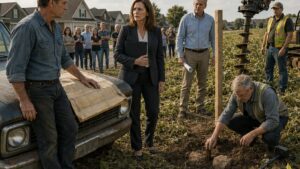
The HOA Fined His Old Ranch Every Day—Then Their Perfect Lawns Started Turning Brown
Chapter 1: The Notice Waiting on the Ranch Gate
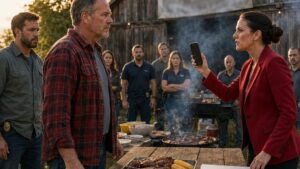
The laminated notice was already zip-tied to Paul Mitchell’s gate when he came out before sunrise.
He saw the white rectangle from twenty yards away, bright against the weathered cedar post, and knew before he reached it that it had come from Silverstone.
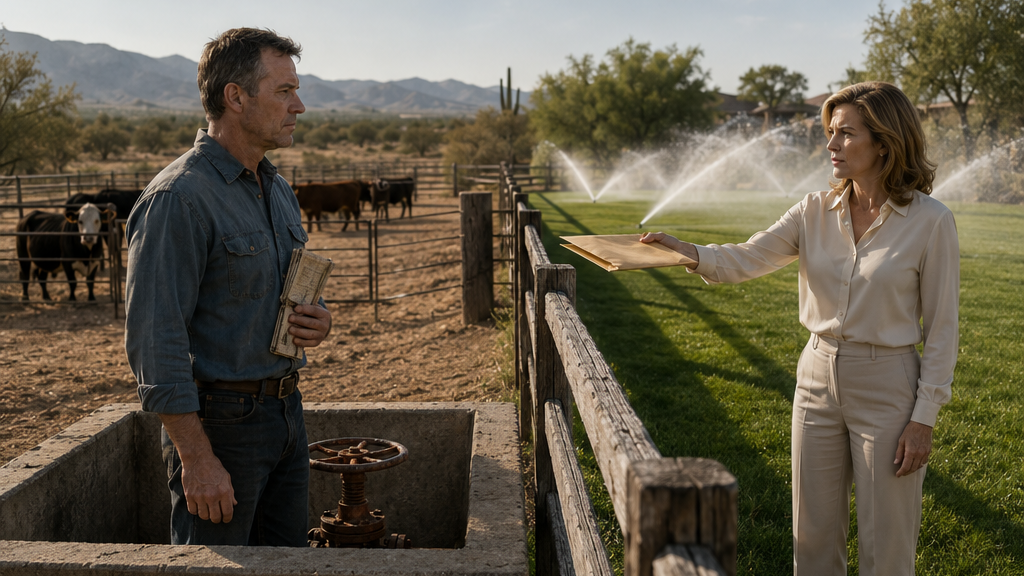
His cattle were moving toward the eastern trough behind him. Across the fence, automatic sprinklers lifted silver arcs over Silverstone Estates’ common lawn, throwing water high enough for the breeze to carry a fine mist across the property line.
Paul cut the zip tie with his pocketknife.
NOTICE OF CONTINUING VIOLATION.
The letter listed livestock odor, visible agricultural equipment, deteriorated fencing, and “incompatible commercial activity.” Below that, in bold type, was a demand that he move cattle and machinery away from the development boundary.
Paul read it twice.
Then he folded it once and slid it into his shirt pocket.
A white SUV rolled slowly down Silverstone’s perimeter road and stopped opposite him.
Cynthia White stepped out.
She wore sunglasses despite the weak morning light and carried a leather folder against one hip. Paul had met her twice at county meetings and once when she had come to complain about a feed truck blocking part of the shared approach.
She stopped on the Silverstone side of the fence.
“You received it.”
“I found it.”
“The board wanted proof of delivery.”
Paul looked at the zip tie dangling from his fingers. “You’ve got proof.”
Cynthia glanced past him toward a stock trailer parked near the barn.
“We’ve tried informal requests.”
“You sent me letters.”
“Those were requests.”
“They looked like letters.”
Her jaw tightened slightly.
Behind her, a sprinkler head clicked and changed direction. Water swept across immaculate grass, stopped inches from the gravel maintenance path, then began its slow return.
Cynthia opened the folder.
“The complaints have increased. Especially from the homes along the west boundary.”
“The ranch has been here longer than those homes.”
“That doesn’t eliminate nuisance impacts.”
Paul looked toward the cattle.
Nothing about the morning was unusual. Dust near the trough. Hay stacked under corrugated roofing. A tractor beside the equipment shed. The same smells that had been there when Silverstone’s first grading crews arrived.
“What exactly do you want?” he asked.
“I want you to create a buffer. Move livestock farther east. Relocate the trailer and visible equipment. Repair or screen the fence line.”
“My east pasture doesn’t have enough shade for the herd this time of year.”
“That isn’t something the homeowners can solve.”
Paul almost laughed.
Instead he asked, “Who says I’m under your rules?”
Cynthia’s expression changed—not surprise, exactly, but readiness.
“The HOA has authority to address continuing impacts affecting member property.”
“That isn’t what I asked.”
“We’ve had counsel review it.”
“Your counsel?”
“I am counsel.”
Paul nodded once.
That was Cynthia’s way. She answered questions with qualifications until the qualification sounded like authority.
His grandfather John had hated that kind of talk. John preferred dates, fence lines, measurements. If somebody said a road was public, he wanted the plat. If somebody said a pipe belonged to the county, he wanted the easement.
Paul had always thought the old man kept too much paper.
Cynthia removed another sheet.
“Beginning after the compliance period, the board intends to assess one thousand dollars per day.”
Paul’s eyes lifted from the paper.
“One thousand.”
“Until the violations are corrected.”
“You think you can fine land that isn’t in your subdivision?”
“I think this is more complicated than you want it to be.”
For the first time that morning, irritation gave way to something colder.
Paul had ignored the first two letters because they seemed ridiculous. He had left the third unopened for nearly a week. In his mind, answering them meant accepting that Silverstone had standing to question what happened on Mitchell land.
Now Cynthia had converted his silence into momentum.
“How long?” he asked.
“Seventy-two hours.”
She offered him the sheet.
Paul did not take it.
A gust pushed sprinkler mist through the fence. Droplets darkened the dust near his boot.
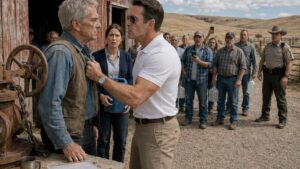
At the base of the boundary, half hidden behind rabbitbrush, sat a low concrete utility enclosure he had passed thousands of times. Its lid was stained green-gray with age. A rusted steel wheel was visible through a broken section of screening.
Paul remembered turning that wheel as a boy while John stood over him.
Not hard. Slow.
He had no idea what it controlled now.
Cynthia followed his gaze but seemed to see only the weeds.
“Paul, nobody wants this to become ugly.”
“It already has a daily price on it.”
“I have homeowners who bought houses here expecting certain standards.”
“And I had cattle here before anybody drew your streets.”
“I understand that.”
“No,” Paul said. “You understand that it’s inconvenient.”
Her face hardened.
For a moment neither spoke.
The sprinklers continued their steady rhythm behind her.
Cynthia closed the folder. “You can make this easier.”
Paul looked at the ranch behind him—the barn his grandfather had repaired more times than Paul could count, the cottonwoods planted along the wash, the faded gate John had welded himself.
He had promised after the funeral that he would never be the Mitchell who sold because holding the place had become difficult.
Maybe that promise had made him stubborn.
Maybe stubborn was what the place required.
“I’ll read your notice,” he said.
Cynthia gave him a long look. “Please do more than read it.”
She returned to the SUV.
Paul stayed beside the gate until the vehicle disappeared between Silverstone’s stone pillars.
An hour later, the certified-mail carrier pulled into the ranch drive.
Paul signed on the handheld screen and accepted another envelope.
This one was heavier.
Inside was the formal assessment schedule, a summary of alleged violations, and a line that made his stomach tighten:
FAILURE TO CURE WITHIN 72 HOURS WILL RESULT IN ACCRUING DAILY PENALTIES.
Paul laid the packet on the hood of his truck.
Across the fence, the sprinklers turned again, bright water falling over bright grass.
For the first time, he stopped asking whether Cynthia was bluffing.
He started wondering whether she could make the bluff expensive enough to work.
Chapter 2: The Rule Cynthia Would Not Explain
The county clerk searched the parcel number three times before turning the monitor toward Paul.
“I don’t see it.”
Paul leaned closer.
“What don’t you see?”
“Your parcel in the Silverstone covenant map.”
The answer should have relieved him. Instead, it made him irritated all over again.
He had driven into town before the records office opened, carrying Cynthia’s certified packet in a manila envelope. By nine-thirty he had a stack of plats, amendments, annexation pages, and a headache behind his right eye.
The clerk enlarged an old map.
Silverstone Estates appeared as a patchwork of numbered lots bordered in clean black lines. Mitchell land sat to the west as a much larger irregular parcel.
The HOA boundary stopped at Paul’s fence.
“So they can’t fine me.”
The clerk raised both hands slightly.
“I can tell you what’s recorded. I can’t give you legal advice.”
“Is my ranch part of the HOA?”
“Not according to this.”
Paul stared at the map.
A small, sharp satisfaction moved through him.
He imagined Cynthia at his fence again, delivering her thousand-dollar figure with that controlled certainty.
Then the clerk added, “That doesn’t mean you can’t have some other issue.”
Paul looked up.
“What other issue?”
“Nuisance. Easements. Shared infrastructure. County restrictions. Depends what they’re claiming.”
There it was again: complication.
Paul disliked complication when a straight boundary seemed available.
He tapped the map.
“My property ends here. Their property starts there.”
“Yes.”
“That seems pretty uncomplicated.”
The clerk smiled without agreeing.
She opened another scanned record.
“This is older.”
A utility drawing appeared, faint enough that some lines had nearly disappeared.
The subdivision name was different. The land Silverstone now occupied had once been divided among larger residential tracts.
A thin line crossed from Mitchell property toward those tracts.
Paul bent closer.
“What’s that?”
“Utility corridor, maybe.”
The clerk zoomed in.
Near the Mitchell boundary was a handwritten reference tied to a recording number.
Paul wrote it down.
“Can you pull that document?”
She searched.
“No scan attached.”
“Meaning?”
“Meaning it may only exist in the older books, or the reference was carried forward from something else.”
Paul sat back.
The little burst of triumph he had felt five minutes earlier was gone.
He drove home with copies on the passenger seat and the windows down because the truck’s air-conditioning had stopped working properly in July.
By noon the heat had settled hard over the ranch.
He went straight to the small office beside the tack room and spread the maps across John’s old metal desk.
The ranch was clearly outside Silverstone.
That part was real.
But Cynthia’s letter avoided saying he was a member.
It talked about “impacts,” “affected owners,” “continuing interference,” and “available enforcement remedies.”
Paul read the wording more carefully than he had before.
That bothered him.
If the HOA had an easy contractual right to fine him, Cynthia should have said so.
Instead, she had written around the question.
His phone rang.
Cynthia.
He let it ring twice before answering.
“Paul.”
“Have you reviewed the compliance packet?”
“I’m working on it.”
“I’d like to avoid unnecessary escalation.”
“You keep saying that while escalating.”
A pause.
Then Cynthia said, “Have you decided whether you’ll move the livestock?”
“No.”
“The board meets tomorrow.”
“Then tell them my land isn’t in Silverstone.”
Silence.
Not long. Barely two seconds.
But Paul heard it.
Cynthia replied, “Membership status does not eliminate responsibility for nuisance impacts.”
“You knew.”
“I knew what?”
“That I’m outside the covenants.”
“I never said otherwise.”
“You sent HOA violation notices.”
“We sent notices regarding conditions affecting HOA members.”
Paul looked at the county map.
“You made them look like you had direct authority over my ranch.”
“I’m not responsible for assumptions you make instead of asking questions.”
That hit harder than he expected because there was truth inside it.
Paul could have answered the first letter.
Could have gone to the county weeks ago.
Could have called an attorney.
Instead he had thrown the letters on his desk and waited for Silverstone to get tired.
Cynthia had not gotten tired.
“You still haven’t explained where the thousand-dollar fine comes from,” he said.
“We’ll discuss that if enforcement becomes necessary.”
“So you won’t explain it.”
“I’m not litigating this with you over the phone.”
She ended the call.
Paul set the phone down more carefully than he felt.
By late afternoon he had separated the county copies into two piles: useful and confusing.
The useful pile said Silverstone’s covenants ended at his property line.
The confusing pile was everything else.
He returned to the old utility drawing.
The thin line from Mitchell land bothered him.
He walked outside with the copy folded in his hand.
Near the fence, Silverstone’s sprinklers were running again. The grass on their side looked almost fluorescent against the dry pasture.
Paul found the old concrete enclosure beneath the rabbitbrush.
He kicked dirt away from its edge.
A corroded metal plate was fixed to the side. Most of its lettering had worn smooth.
The rusted wheel inside was larger than he remembered.
A pipe disappeared underground toward Silverstone.
Paul crouched beside it.
He could hear water moving.
Not loudly. Just a faint vibration through metal.
He unfolded the utility sketch and aligned himself with the fence.
The old line matched.
That evening, Paul went through the filing cabinets in the barn office.
John had labeled everything in block letters.
TAX.
CATTLE.
WELLS.
FENCE.
ROAD.
Paul found nothing under WATER except pump receipts and well service invoices.
He almost stopped.
Then he remembered that John stored agreements separately because, as he used to say, invoices told you what something cost, agreements told you who could make you pay.
Paul pulled open the bottom drawer.
Empty.
He checked the shelf above the desk.
Nothing.
Then he noticed an old ledger wedged behind a box of branding records.
Inside the back cover, in John Mitchell’s narrow handwriting, were five words followed by a date and recording number.
Water agreement — keep original.
Paul stared at the line.
Then he looked toward the darkening doorway of the barn.
He knew exactly where John had kept the papers he considered too important for a filing cabinet.
Chapter 3: The Contract Beneath Fifty Years of Dust
The lockbox resisted the key until Paul struck the lid twice with the heel of his hand.
Rust cracked loose along the seam.
The metal box had sat on the highest shelf in the barn’s enclosed storage room since John’s death, behind veterinary ledgers, an old branding iron, and a coffee tin filled with bolts nobody had needed in twenty years.
When the latch finally lifted, dust rolled off the lid.
Inside were folded deeds, insurance papers, two yellowed photographs, and an envelope marked in John Mitchell’s handwriting.
WATER ACCESS.
Paul carried it to the workbench beneath the only good light.
The document inside had been folded into quarters so long that the creases felt close to tearing. A notary stamp was still visible near the bottom.
The date was 1963.
Paul read the first page slowly.
John Mitchell had granted an easement across a defined strip of ranch property to serve several residential parcels east of the ranch. The language described installation, maintenance access, and continuing use of a water line.
Paul’s heartbeat quickened.
He turned the page.
The grant was narrower than he expected.
Domestic supply.
Household use.
Then a clause that made him stop.
The water provided under the agreement was not to be expanded for commercial or common-area irrigation beyond specifically described residential needs without written consent from the Mitchell property owner.
Paul read it again.
Then once more.
Outside the barn, something hissed rhythmically.
He carried the agreement into the yard.
Beyond the fence, Silverstone’s sprinklers were running.
One head turned in a slow half-circle, throwing hundreds of gallons across the common lawn beside the entrance road. Farther back, another system watered ornamental trees around a stone fountain.
Paul looked down at the paper.
Domestic supply.
He looked back at the sprinklers.
For the first time since Cynthia had delivered the notice, he felt the balance shift.
Not victory.
Something more dangerous than that.
Possibility.
He spent the next hour comparing the agreement with the county drawing. The recording number matched John’s ledger note. The utility corridor matched the old line.
And the line ran through the concrete enclosure by the fence.
Paul drove there just before sunset with a flashlight and the agreement folded inside his shirt pocket.
Water murmured beneath the ground.
He cleared weeds from the old enclosure and lifted the loose cover.
The wheel sat inside under a layer of red dust and insect husks.
He remembered John’s hands around his when he was maybe nine.
Slow, Paul.
You never force a valve you haven’t had to repair yourself.
At the time, Paul had thought it was another one of John’s unnecessary lessons.
John had been full of them.
Never lend equipment without writing down the date.
Photograph fence posts before road crews arrive.
Keep original signatures.
Know where the water goes.
Paul had called it paranoia when he was twenty.
Standing over the valve at forty-eight, he had another word for it.
Memory.
A vehicle approached on Silverstone’s perimeter road.
Cynthia’s SUV stopped near the fence.
She stepped out carrying another envelope.
Paul stayed beside the open valve enclosure.
“You’ve been busy,” she said.
“So have you.”
She looked toward the paper in his hand.
“The board meets at eight tomorrow morning. I came to make sure you understood that the compliance period is almost over.”
“Let me ask you something.”
Cynthia waited.
Paul pointed toward the sprinklers.
“What does Silverstone believe that water line is authorized to supply?”
Her gaze shifted briefly toward the grass.
“What line?”
“The one under us.”
“I don’t manage utility infrastructure.”
“You’re president of the association.”
“I’m not the irrigation contractor.”
Paul unfolded the agreement.
Cynthia’s posture changed.
Only slightly.
“What is that?”
“Recorded easement. Nineteen sixty-three.”
She did not reach for it.
Paul read the relevant sentence aloud, then stopped before the next paragraph.
Cynthia looked past him toward the valve enclosure.
The sprinklers clicked behind her.
“Domestic use,” Paul said. “No expanded common irrigation without owner consent.”
“You need to have that reviewed before you make assumptions.”
“I plan to.”
“Good.”
“But you knew there was a line through my property.”
“I knew there was historic infrastructure.”
“That isn’t the same answer.”
“I’m not going to interpret a sixty-year-old agreement standing beside a fence.”
Paul folded the document.
“Funny. You were willing to interpret my responsibilities standing beside one.”
Her mouth tightened.
“That agreement does not erase nuisance law.”
“No. And your nuisance claim doesn’t rewrite this.”
For several seconds the only sound was the irrigation.
Cynthia looked at the valve again.
Paul saw the question arrive in her face before she hid it.
Could he shut it?
The same question had been in his head for hours.
He did not know.
That mattered.
The easement gave him leverage, but the modern system might not resemble the one John had signed around. Household connections could share the same branch. Fire-service storage could be involved. Later amendments might exist.
Turning the wheel tonight would feel satisfying.
That was precisely why he did not touch it.
Cynthia extended the envelope.
“This is the board’s final notice.”
Paul took it.
“Tomorrow at noon,” she said, “the first assessment is entered if you haven’t started compliance.”
“One thousand dollars.”
“Per day.”
“You still think you can impose that.”
“I think you should stop assuming that finding one old document makes everything else disappear.”
Paul glanced toward Silverstone’s immaculate grass.
“No,” he said. “It just makes me wonder what else nobody bothered to read.”
Cynthia returned to her SUV without answering.
Paul waited until she drove away.
Then he opened the envelope.
The language was more formal than before. It cited complaints, economic impact on neighboring homeowners, administrative costs, and continuing failure to cooperate.
Near the bottom was the deadline.
NOON, WEDNESDAY.
Paul checked his watch.
Less than seventeen hours.
He went back to the barn, placed the original agreement inside a clear sleeve, and photographed every page.
Then he called a water-rights attorney whose number the county clerk had written on a scrap of paper.
The office was closed.
Paul left a message.
Afterward, he stood alone at John’s old desk, looking at the lockbox.
For years he had thought his grandfather saved paper because he distrusted change.
Now Paul wondered whether John had understood something Paul had not.
The agreement was not merely proof of what the Mitchell family could stop.
It was also proof of something John had once agreed to let continue.
Outside, the sprinklers ran well into the night.
By noon the next day, Cynthia intended to start charging him a thousand dollars every twenty-four hours.
And Paul still did not know whether the rusted wheel at the fence was his strongest defense—or the quickest way to make a much bigger mistake.
Chapter 4: The Water Right Was Not a Weapon
“You can stop something,” the attorney said, “but not everything.”
Paul sat across from him with John Mitchell’s 1963 agreement spread flat between them.
The words hit harder than Paul expected.
For most of the drive into town, he had pictured the old valve at the boundary. He had pictured Cynthia’s expression when the sprinklers stopped. He had pictured the daily fines becoming irrelevant the moment Silverstone understood what it depended on.
Now the attorney tapped one paragraph with the end of a pen.
“This easement is restrictive. That helps you. But it doesn’t make you the water department.”
Paul leaned back.
“What does it make me?”
“The owner of land burdened by an easement with conditions.”
“That sounds close enough.”
“It isn’t.”
The attorney slid a modern utility map beside the old agreement. He had obtained it that morning from county records and a service filing attached to Silverstone’s development documents.
Two branches appeared after the line crossed Mitchell land.
One continued toward the residential distribution system.
The other split toward common-area storage tanks, irrigation controls, fountains, and landscaped medians.
Paul stared at the page.
“They’re separate.”
“Now they are.”
“Meaning I can close the irrigation branch.”
“Potentially.”
Paul frowned.
The attorney pointed again.
“Your grandfather’s agreement anticipated household use. It specifically restricts expansion into common or commercial irrigation without consent. That gives you a serious argument. But you don’t touch residential supply. You don’t touch anything tied to health, fire protection, or domestic use.”
“I wasn’t planning to poison anybody.”
“I know. I’m telling you because anger makes people turn one valve when the law only lets them turn half of one.”
Paul looked toward the office window.
He had come in wanting permission.
Instead, he was getting boundaries.
Some part of him resented that.
Another part knew exactly why he needed them.
The attorney opened a second folder.
“There’s more.”
Inside were usage reports from Silverstone.
Paul scanned the first page.
The numbers meant little until the attorney circled a column.
“This is common-area consumption.”
Paul followed the yearly totals.
“They doubled.”
“More than doubled over four years.”
“For grass?”
“Grass, fountains, ornamental trees, pool makeup, entrance landscaping. Anything on the association’s common meter.”
Paul looked at the most recent summer figures.
“That much?”
“They’ve been compensating for rising heat and tighter municipal restrictions by drawing more through the easement line.”
Paul sat still.
The attorney added, “Your agreement doesn’t automatically erase their access. But it does make that expansion difficult to defend.”
For the first time, Paul understood what Cynthia might already know.
Silverstone had not merely inherited an old water connection.
It had leaned on it.
Hard.
The attorney turned to another page.
“Here’s the part I don’t like.”
A board authorization, several years old, approved a “landscape supply optimization project.”
Paul read the signature block.
Cynthia’s name was not on it. She had not been president then.
But the association had formally approved expansion of the common irrigation network.
“Could she know about this?”
“She should.”
“That isn’t what I asked.”
The attorney considered him.
“If she reviewed the property documents as thoroughly as she says she reviewed your nuisance issue, then yes. She should know there’s an easement problem.”
Paul felt the old anger return.
Not hot.
Dense.
He pictured Cynthia at the fence telling him that his cattle were affecting investment expectations while her association ran water through rights granted by his grandfather.
“What do I do?”
“First, you notify them in writing that you dispute the expanded irrigation use.”
“And the fines?”
“Separate problem.”
“You said my parcel isn’t in their covenants.”
“That helps. It doesn’t end a nuisance dispute. But the HOA imposing contractual penalties on a nonmember parcel is something I’d want them to explain very carefully.”
Paul exhaled through his nose.
“I should’ve called you when the first letter showed up.”
“Yes.”
The bluntness irritated him because it was deserved.
“I thought answering made it real.”
“Not answering made them comfortable.”
Paul looked down at the agreement.
That was his mistake in plain language.
He had mistaken silence for strength.
The attorney drafted a notice while Paul waited.
It demanded immediate suspension of disputed common-area irrigation, clarification of the HOA’s authority to assess penalties against Mitchell land, and preservation of all records related to the water line.
Then the attorney added a sentence Paul read twice:
Any physical restriction by the easement owner will be limited to non-domestic common-area irrigation confirmed to fall outside the recorded grant.
Paul tapped it.
“So if they ignore this?”
“You confirm the branch. You document everything. You give them a final opportunity.”
“And then?”
The attorney closed his pen.
“Then you make a decision you can defend after you’re no longer angry.”
By midafternoon, Paul was back at the ranch with the irrigation contractor.
They opened an access panel fifty yards from the old valve enclosure and traced the branch.
The contractor crouched beside a cluster of newer pipes.
“This one feeds residential pressure.”
He tapped a second line.
“This one goes to common storage and irrigation.”
“You’re sure?”
“I can isolate it without touching houses.”
Paul looked toward Silverstone.
The sprinklers were running in broad shimmering arcs.
The answer he had wanted was finally in front of him.
He could stop the grass without stopping somebody’s kitchen faucet.
He could make the HOA feel consequences without making ordinary homeowners collateral damage.
That should have satisfied him.
Instead, it made the choice heavier.
The rusted wheel no longer looked like a weapon.
It looked like responsibility.
As the contractor packed his tools, Paul’s phone buzzed.
A message from an unfamiliar number.
Margaret Lee.
HOA treasurer.
I need to speak with you before you send anything final. Please. Not at the clubhouse.
A second message followed.
There are things Cynthia hasn’t told the residents.
Paul read it twice.
Then he looked across the fence at Silverstone’s green lawn, all that water glinting in the late light.
For the first time, he wondered whether the line under his land was only half the secret.
Chapter 5: The Reason Silverstone Needed His Ranch
“Cynthia didn’t invent the complaints,” Margaret Lee said. “She weaponized them.”
Paul stood beside his truck in a gravel turnout half a mile from Silverstone’s main gate.
Margaret had chosen the spot because it could not be seen from the clubhouse windows.
That alone made Paul distrust the meeting.
She was in her sixties, dressed plainly, with a folder pressed against her ribs. Nothing about her looked dramatic, which made the first sentence feel more serious.
“What does that mean?” Paul asked.
“It means people really complained.”
“About cattle.”
“Odor. Equipment. Flies. The fence. Yes.”
Paul folded his arms.
“My ranch didn’t appear last month.”
“I know.”
“Do they?”
“Some do. Some don’t care.”
At least she did not pretend otherwise.
Margaret glanced toward Silverstone.
“There are homeowners who spent most of their savings buying there. Cynthia hears from them every time a listing sits longer than expected.”
“So she decided my cows were the problem.”
“She decided visible action was easier than explaining the real problem.”
Margaret opened the folder.
Inside were budget summaries.
Paul had seen enough ranch accounts to recognize bad numbers even when they wore clean formatting.
Landscape maintenance had increased.
Water costs had increased faster.
Reserve contributions had been reduced to cover operations.
Special assessments had been discussed twice and delayed twice.
Paul looked up.
“This is why you wanted me out here?”
“It’s part of it.”
She showed him another sheet.
A proposal to acquire a strip of Mitchell property along the western boundary.
Paul read the figure.
It was well below what he would have considered.
“They wanted to buy this?”
“Some board members did.”
“For what?”
“Buffer space. Utility control. Future access.”
Paul gave a short, humorless laugh.
“So the odor problem came with an offer.”
“Not officially.”
“Convenient.”
Margaret flinched.
“I told you Cynthia didn’t invent the complaints.”
“But she knew what they could be used for.”
Margaret looked down at the folder.
“Yes.”
The single word changed something.
Until then, Paul had been able to imagine Cynthia as simply overconfident.
Now the shape was clearer.
The complaints had given her pressure.
The pressure could make the ranch harder to operate.
A ranch that became expensive enough might become sellable.
“Did she know my parcel wasn’t in the HOA?”
Margaret did not answer immediately.
Paul felt his jaw tighten.
“She knew?”
“We discussed it.”
“When?”
“Before the first formal notice.”
Paul stared at her.
“And she still sent HOA violation letters.”
“She believed nuisance remedies gave the association enough leverage to force negotiations.”
“Leverage.”
Margaret’s voice sharpened.
“I’m not defending that.”
“You sat on the board.”
“I’m the treasurer.”
“That sounds like sitting on the board.”
“I thought she was trying to get you to address legitimate complaints.”
“And when did you stop thinking that?”
“When the proposed fines became a thousand dollars a day.”
Paul looked away.
Silverstone’s stone entrance rose in the distance beyond a line of ornamental trees.
Margaret continued.
“The association has a problem we haven’t told the residents clearly.”
“The landscaping.”
“The whole operating budget.”
She explained without dramatics.
Silverstone had been marketed around lush common areas, fountains, shade trees, green medians, and a pool complex that looked expensive because it was expensive.
Drought restrictions and municipal rate increases had changed the math.
The board could reduce landscaping.
Or raise dues.
Or admit that the old appearance could not be maintained at the old price.
Cynthia had resisted all three.
“She thinks if the community starts looking different, values fall faster,” Margaret said.
“So she keeps pumping water.”
“She keeps maintaining what people were promised.”
“Through my grandfather’s easement.”
Margaret nodded.
There it was.
Not greed exactly.
Fear disguised as policy.
Paul hated that it made Cynthia easier to understand.
He wanted the problem clean.
He wanted her wrong and himself right.
Instead, Silverstone contained hundreds of people who had no idea what their board had done and might wake tomorrow to dead landscaping because of a fight they had never voted to start.
Margaret seemed to read his expression.
“If you shut the irrigation off in this heat, they’ll blame you.”
“Would they be wrong?”
“They won’t care about the distinction.”
“I do.”
“That’s why I came.”
Paul looked at her.
She said, “Give us time.”
“How much?”
“A week.”
He almost smiled.
“Cynthia gave me seventy-two hours.”
“I know.”
“She starts charging me at noon.”
“I know.”
“And you want seven days.”
Margaret closed the folder.
“I’m asking because once the lawns start browning, nobody will listen to the history.”
Paul thought of John’s agreement.
Domestic use.
Limited rights.
A compromise made when the neighboring properties were not luxury homes behind stone gates, just families needing water.
John had not signed it to gain power.
He had signed it to solve a problem.
Paul had spent most of the morning imagining the valve as proof that the Mitchells could not be pushed around.
Now he wondered whether that was the wrong lesson.
“I sent Cynthia a standstill proposal,” he said. “Suspend the fines. Suspend the disputed irrigation. We verify the documents together.”
Margaret’s eyebrows lifted.
“When?”
“An hour ago.”
“She hasn’t told us.”
“That doesn’t surprise me.”
They parted without an agreement.
At dusk, Paul drove past the boundary enclosure and stopped.
The wheel sat under its dust exactly where it had always been.
He could have reached down and turned it.
He did not.
That choice gave him less satisfaction than he expected.
Back at the ranch office, an email waited.
From Cynthia.
Paul opened it.
The message was brief.
The board rejected the proposed standstill.
The nuisance enforcement would continue.
The first assessment had been entered against him at noon.
One thousand dollars.
Tomorrow, another thousand.
Attached was the formal notice.
Paul printed it.
For a long moment he stood beside John’s desk with the page in one hand and the old easement in the other.
Margaret had asked him not to become the man Silverstone expected him to be.
Cynthia had just made restraint more expensive.
Paul folded both papers.
Then he called the irrigation contractor.
“Tomorrow morning,” he said. “I want the branch confirmed one more time.”
He looked through the office window toward the dark outline of the boundary.
“And bring tags. I want everything documented.”
Chapter 6: Twelve Turns on the Old Valve
At eight the next morning, Silverstone’s sprinklers were still running.
Paul stood beside the old concrete enclosure with the contractor’s verification sheet clipped to a board under his arm.
The final written notice had been delivered the night before.
No reply.
No suspension.
No request for another meeting.
Just the first thousand-dollar assessment sitting on Paul’s desk.
The contractor finished checking the isolation point and wiped his hands on a rag.
“Residential stays open.”
“Fire storage?”
“Open.”
“Pool buildings?”
“Domestic branch stays live. Their common refill system on this side doesn’t.”
Paul looked at him.
“So fountains and landscaping stop.”
“Yes.”
“Houses don’t.”
“Yes.”
Paul signed the verification sheet.
The contractor handed him a numbered tag.
“You want me to do it?”
Paul looked at the wheel.
“No.”
He had spent half the night deciding that.
If the valve turned, it would turn because he chose it.
Not because an attorney told him he could.
Not because Margaret asked him not to.
Not because Cynthia had finally pushed far enough.
Because the boundary meant something.
Paul removed the enclosure cover.
The wheel was stiff under his palm.
Rust stained his fingers.
Across the fence, a sprinkler swept toward him, paused, and returned.
Paul thought of John’s voice.
Slow.
Never force a valve you haven’t had to repair yourself.
He put both hands on the wheel.
The first turn resisted.
The second moved easier.
By the fourth, he could hear the change in the pipe.
A low shudder.
Then a narrowing rush.
Five.
Six.
Seven.
A white SUV appeared on Silverstone’s perimeter road.
Paul kept turning.
Eight.
The SUV stopped hard beside the fence.
Cynthia stepped out.
“What are you doing?”
Paul looked at her once.
“Nine.”
She crossed toward the boundary.
“Paul.”
“Ten.”
“You cannot shut off residential water.”
“I’m not.”
She stopped.
For the first time since the dispute began, Cynthia looked uncertain rather than controlled.
Paul nodded toward the contractor.
“Residential line is confirmed separate.”
“By whom?”
“Licensed contractor. My attorney has the records.”
The sprinklers behind her began to weaken.
Eleven.
Water arcs shortened.
One sprinkler head rattled.
Cynthia turned toward it.
“Paul, stop.”
He rested both hands on the wheel.
“This is the disputed irrigation branch.”
“You don’t understand what you’re doing to that community.”
Paul looked at her.
“I understand exactly what I’m not doing.”
He turned the wheel once more.
Twelve.
The pipe quieted.
Behind Cynthia, the nearest sprinkler threw one final uneven stream, coughed twice, and fell silent.
Farther down the road, another lost pressure.
Then another.
The green lawn remained green.
Nothing dramatic changed in that first minute.
No instant brown grass.
No cracked fountain.
Just silence where water had been.
Paul secured the valve with the numbered tag and documented the position.
Cynthia stared at him.
“You planned this.”
“I notified you.”
“You threatened essential service.”
“No. I told you to stop using a restricted easement for common irrigation.”
“You are interpreting a decades-old document to suit yourself.”
“My attorney sent you the interpretation.”
“And ours disagrees.”
“Then we can sort that out without charging my ranch a thousand dollars a day.”
Cynthia stepped closer to the fence.
“You think this makes you look reasonable?”
Paul almost answered too quickly.
That was the old impulse.
Win the sentence.
Instead, he said, “I think keeping water on in every house is reasonable.”
Her face shifted.
She had expected something else.
Maybe anger.
Maybe revenge.
Maybe the total shutoff Margaret had warned about.
Cynthia looked toward the entrance fountain.
Its pumps were still moving stored water for the moment.
“You’re going to have residents furious at you.”
“I know.”
“People who never sent you a letter.”
“I know.”
“You could have given us more time.”
Paul looked at her for several seconds.
“You gave me seventy-two hours.”
That landed.
Cynthia glanced away.
By ten that morning, residents had begun gathering near the clubhouse.
Paul could see vehicles moving along the perimeter road.
His phone rang constantly.
He answered none of the unknown numbers.
At eleven, the contractor called.
“House pressure is normal.”
Paul released a breath he had not realized he was holding.
“Common irrigation?”
“Zero flow from your branch.”
“Good.”
“You sound disappointed.”
“I’m not.”
But he was not triumphant either.
That surprised him.
For days, he had imagined the shutoff as an ending.
It was only another beginning.
By early afternoon, Silverstone’s fountain pumps had been switched off to protect them from running dry.
The pool complex remained open, but staff had stopped nonessential refill cycles.
The lawns still looked perfect.
They would not for long.
Paul was checking cattle near the south fence when Cynthia’s SUV returned.
This time she came alone.
No folder.
No envelope.
She stood on the other side of the fence and waited until Paul walked over.
“You got what you wanted,” she said.
“No.”
Her expression tightened.
“The irrigation is off.”
“That wasn’t what I wanted.”
“What did you want?”
Paul looked toward Silverstone.
He could hear residents arguing near the clubhouse.
He knew some of them would curse his name by dinner.
He knew Cynthia’s board might sue.
He knew his own attorney would prefer he say nothing without counsel present.
But Cynthia was not asking as an attorney now.
She was asking as someone who had finally lost control of the sequence.
Paul said, “I wanted you to stop pretending your board owned my side of the fence.”
Cynthia looked down briefly.
Then she said something Paul had never heard from her before.
“What will it take to turn the irrigation back on?”
Paul studied her face.
The easiest answer would have been money.
Withdraw the fines.
Pay his attorney.
Apologize.
Maybe buy water properly.
All of those things had crossed his mind.
But standing beside the valve, Paul understood that whatever he demanded next would define what the wheel meant.
Power could protect a boundary.
Or it could become another way to make somebody kneel.
“I’ll tell you,” he said, “after the board hears the truth about why you needed that water in the first place.”
Chapter 7: What Paul Chose to Turn Back On
Three days after Paul closed the irrigation branch, Silverstone’s entrance fountain stood dry.
The shallow basin still held a dark ring where the waterline had been. A few curled leaves collected against the drain. The grass along the western median had lost its polished color, not dead yet, but dulling under the heat.
Paul saw all of it through the clubhouse windows as he walked into the HOA meeting.
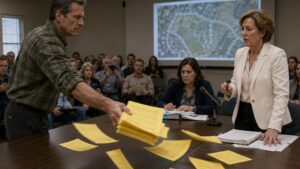
Every chair was taken.
Residents stood along the walls. Some watched him with open hostility. Others looked toward Cynthia White as though they had not yet decided who had brought them there.
Margaret Lee sat at the end of the board table with a thick stack of papers in front of her.
Cynthia had left the center chair empty for Paul.
He did not take it.
“I’ll stand.”
A man near the back said, “Easy for him. His grass isn’t dying.”
Another voice answered, “His grass was never supposed to look like a golf course.”
Several people began speaking at once.
Cynthia struck the table once with the flat of her hand.
“Enough.”
The room quieted gradually.
She looked different without the folder she usually carried. Tired, Paul thought. Not defeated.
That mattered.
Defeated people looked for somebody to blame.
Tired people sometimes listened.
Cynthia said, “Mr. Mitchell has agreed to explain his conditions for restoring common-area irrigation.”
Paul glanced at her.
“I agreed to explain what has to change.”
A few heads turned.
Cynthia’s expression tightened, but she nodded.
Paul placed copies of the 1963 easement on the table.
Then the county parcel map.
Then the contractor’s verification showing that residential service remained untouched.
He did not make a speech.
He simply said, “My ranch is not part of Silverstone. The association knew that before it started sending violation assessments. The water agreement allows domestic service through Mitchell land. It does not give unlimited rights for common landscaping.”
A resident raised a hand without waiting to be recognized.
“So you shut off our water.”
“No,” Paul said. “I shut off one irrigation branch.”
“My front lawn is brown.”
“Your kitchen faucet works.”
That did not satisfy the man, but it stopped the argument from becoming something else.
Margaret opened her own folder.
“There is another issue the membership needs to understand.”
Cynthia turned toward her.
“Margaret.”
“No.”
The word was quiet.
It carried farther than shouting would have.
Margaret began distributing budget summaries.
Paul watched residents scan the pages.
The first murmurs came from the back.
Then the middle.
Someone asked, “Why are reserve contributions down?”
Another said, “What is landscape supply optimization?”
Margaret answered that one.
“It was a decision by the association to expand use of the older water connection because municipal costs were increasing.”
A woman near the aisle looked at Cynthia.
“You knew we were doing this?”
Cynthia remained still.
“I knew the association depended on the line.”
“That’s not what she asked,” Paul said.
Cynthia looked at him sharply.
For a moment, he regretted it.
It was the same habit he had been trying to break—the urge to win the sentence instead of solving the problem.
So he stepped back.
Margaret continued.
“The board has delayed a landscaping reduction plan for two years. We also delayed discussing a dues increase because we were concerned about property values.”
“Concerned?” somebody said. “Or hiding it?”
Nobody answered immediately.
Cynthia finally stood.
“I made decisions I believed would protect this community.”
A few residents scoffed.
She looked toward them.
“Three homes along the west boundary sat unsold much longer than comparable properties. Complaints about odor, equipment, and appearance were real. Owners wanted action.”
Paul said nothing.
Cynthia continued.
“I believed pressure on the ranch would bring Mr. Mitchell into negotiations over a buffer or possible land sale.”
There it was.
No polished wording.
No legal mist.
A resident said, “So you fined somebody who isn’t even in our HOA?”
Cynthia’s voice lowered.
“I authorized assessments I believed could be defended as part of a broader nuisance enforcement strategy.”
Margaret looked down.
Paul could see how hard the admission cost Cynthia.
It did not erase what she had done.
But it stripped away the easiest version of her—the one Paul had preferred, where she was simply arrogant and he was simply right.
She had been afraid.
Afraid of admitting the budget was failing.
Afraid of home values slipping.
Afraid that changing Silverstone’s appearance would look like failure under her leadership.
Then she had chosen Paul’s ranch as the easier problem to move.
That choice still belonged to her.
Paul unfolded a single page.
“These are my terms.”
The room settled again.
“The fines against my ranch are withdrawn. Permanently.”
No one objected.
“The association records that Mitchell land is outside Silverstone’s covenants.”
Margaret nodded.
“Agreed.”
“Any future nuisance complaint comes through normal county or civil channels. No HOA violation notices pretending otherwise.”
Cynthia’s jaw moved once.
“Agreed.”
Paul placed his hand on the last page.
“The irrigation line gets independently metered. Common use stays within a written limit. If Silverstone wants more water in the future, we negotiate it openly.”
A resident asked, “And the fountain?”
Paul looked toward the dry basin outside.
“That’s up to you.”
The man frowned.
Paul explained.
“The existing budget can’t maintain everything the way it was. You can spend more, or landscape less. That isn’t my decision.”
The room filled with quieter conversation.
Not outrage now.
Arithmetic.
Margaret said the revised budget would reduce turf near the entrance, replace several decorative areas with lower-water landscaping, and keep irrigation concentrated around shared shade trees and essential common spaces.
Some residents hated the idea.
One called it a downgrade.
Another said they had bought precisely because Silverstone looked green.
A woman near the window said, “Then we pay for green honestly.”
That ended more arguments than Paul expected.
After the meeting, Cynthia caught him near the side door.
“There’s another option.”
She handed him a folded sheet.
Paul opened it.
A purchase proposal.
Higher than the earlier figure Margaret had shown him.
Not insulting this time.
Cynthia said, “The association could still acquire the western strip. It would resolve the boundary problem permanently.”
Paul looked through the glass toward his ranch beyond the dry median.
For years, he had assumed every offer was an attempt to take something.
This one was fair enough to consider.
That made refusing it easier.
“No.”
Cynthia studied him.
“You didn’t even calculate it.”
“I don’t need to.”
“You could put that money back into the ranch.”
“I could.”
“Then why not?”
Paul folded the offer and handed it back.
“Because the problem wasn’t that we share a boundary.”
He looked at her.
“It was that you thought the boundary only mattered when it protected you.”
Cynthia accepted the paper.
This time she did not argue.
Late that afternoon, Paul met the irrigation contractor, Margaret, and two board members at the old valve enclosure.
The new temporary meter had been installed downstream.
A written operating limit was signed and waiting for permanent recording.
The fines were withdrawn.
The parcel acknowledgment was signed.
Paul crouched beside the rusted wheel.
For three days, he had imagined this moment as victory.
It felt nothing like victory.
The wheel was simply metal again.
Old, stubborn, useful.
He removed the numbered tag.
Margaret asked, “How far?”
Paul checked the contractor’s mark.
“Only to the agreed flow.”
He turned slowly.
One rotation.
Two.
The pipe began to murmur.
By the time he reached the marked position, water was moving toward Silverstone again.
Not as much as before.
Enough.
In the distance, one of the entrance sprinklers rose from the ground and released a narrow arc over the remaining strip of grass.
The fountain stayed dry.
For now, Silverstone had chosen trees before decoration.
Paul secured the valve at the new setting.
That evening, he carried the key back to the barn.
The old lockbox sat open on John Mitchell’s workbench.
Paul placed the key inside beside the 1963 agreement.
For years he had thought John saved papers because he distrusted people.
Now he understood the old man had done something harder.
He had trusted people enough to share something valuable, then written down the boundary so generosity would not become surrender.
Paul closed the lid.
Outside, cattle moved quietly along the fence.
Beyond them, Silverstone was still there.
Some lawns would brown.
Some residents would remain angry.
Cynthia would still have meetings to survive, budgets to explain, and trust to rebuild.
Paul would still hear complaints when the wind carried ranch smells east.
Nothing had become perfect.
But the ranch remained a ranch.
The homes still had water.
And the old valve no longer marked the place where one side had defeated the other.
It marked the place where both sides finally learned what the boundary was for.
The story has ended.