They Locked His Farm Road Over Unpaid Fees—Then the County Found the Gate Was Standing on Public Land
Chapter 1: The New Road Bill Arrived Before Harvest
Patrick Hall knew something was wrong before he reached the bottom of the page.
The envelope had been clipped to the screen door with a black binder clip, as if whoever delivered it wanted to be certain the August wind could not carry it away. Across the kitchen table, beside a feed-store receipt and a list of cattle scheduled for shipment in two weeks, Patrick unfolded the notice and read the number again.
Seven hundred sixty dollars.
Last year the road assessment had been five hundred.
Below the new amount, a second sheet warned that unpaid balances could incur monthly penalties and loss of association access privileges.
Patrick read that line twice.
Outside the farmhouse window, the gravel road ran past the equipment shed, crossed the narrow drainage dip, and continued north toward three other farms. Near Patrick’s entrance stood an old iron gate that had been there longer than anyone seemed to remember. Its paint had worn down to dull gray over rust, and one hinge sagged enough that the gate scraped gravel when opened.
For years Patrick had treated it as scenery.
Now he looked at it differently.
Michael Wright came through the back door carrying two empty vaccine coolers.
“You see the bill?”
Patrick slid the paper toward him.
Michael whistled softly. “That’s a jump.”
“They call it repaving.”
“Gravel isn’t pavement.”
“They call a lot of things whatever they need to call them.”
Michael leaned against the counter. “Still cheaper than getting into a fight with Steven.”
Patrick folded the notice along its original crease.
That was exactly the kind of sentence that usually made him stubborn.
The farm-road association had existed informally for decades before anybody incorporated it or printed letterhead. Four farms and two rural homes used some portion of the same route. Everybody contributed to gravel, culvert work, grading, and snow clearing when the county trucks did not come far enough.
Patrick had paid without much complaint.
But he remembered the closing documents from when he had taken full title to the home place. One phrase in particular had surfaced in his mind the moment he saw “association access privileges.”
Public right-of-way.
That evening, he pulled a dented metal file box from the bottom shelf of a bedroom closet. The papers smelled faintly of dust and old cardboard. He found the deed, the title commitment, then a copy of an easement description attached behind them.
He stood at the dining table with one finger beneath the typed legal description.
The road along his southern boundary was described as lying within a public right-of-way.
Not “private access.”
Not “association road.”
Public.
Patrick looked through the window again.
The iron gate stood almost directly in line with the ditch.
He did not yet know what that meant. A deed description could be incomplete. Roads changed jurisdiction. Right-of-way language sometimes survived long after maintenance agreements changed.
But Steven’s notice had not said the association maintained part of the route.
It said the association controlled it.
The distinction bothered Patrick enough that he drove to the meeting two nights later with the document folded inside his shirt pocket.
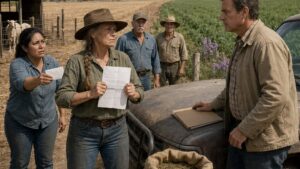
The association met in a back room of a farm-supply cooperative six miles from Patrick’s place. Folding chairs faced two pushed-together tables. Steven Campbell sat at the front with Sarah Mitchell, the treasurer, and three other landowners.
Steven had the thick hands and permanent shoulder stoop of a man who had spent most of his life climbing machinery. He was not polished, but he liked meetings run in order.
He tapped a pencil against the proposed budget.
“Gravel went up. Diesel went up. The north culvert is washing again. We either fix the road before harvest traffic or we pay twice as much after.”
Nobody argued with that.
Patrick waited until Steven asked for questions.
“Which road are we charging for?”
Steven looked up. “The same road we’ve always charged for.”
“That isn’t what I asked.”
A couple of chairs shifted.
Steven set his pencil down.
“The association road from the county blacktop through the farm corridor.”
Patrick took the folded document from his pocket.
“According to this, at least some of that corridor is public right-of-way.”
Steven gave the paper only a glance.
“Patrick, we’ve maintained that road since before either of us had gray hair.”
“Maintenance isn’t ownership.”
Sarah looked from one man to the other.
Steven exhaled through his nose. “Nobody said ownership.”
“Your notice says you can suspend access.”
“Association access privileges.”
“To what?”
That produced a silence.
Patrick knew he should have explained more. He could have said that road jurisdiction depended on recorded acceptance, width, dedication language, maintenance history, and several things no one in the room had checked.
Instead he folded the paper again.
Old habits.
During fourteen years in county transportation work, he had learned that explaining technical facts to people who had already chosen a conclusion could turn into an argument about tone instead of evidence. When he finally left that job, he promised himself he was finished carrying other people’s land disputes home at night.
So he said only, “You might want to confirm the boundary before you threaten somebody’s access.”
Steven’s face tightened.
To everyone else, Patrick’s restraint looked like evasiveness.
One landowner near the wall muttered, “We all use the road.”
“I know.”
“We all pay.”
“I’ve paid too.”
“Then what’s the problem?”
Patrick looked at Steven. “The problem is charging for something you may not control.”
Steven leaned back.
“The bill is seven-sixty. Same formula for everyone based on use. If you don’t pay, we follow the rules.”
“What rules?”
“The association rules.”
“Rules don’t move a county line.”
That was the moment Patrick lost the room.
Not because anyone proved him wrong. Because he sounded as though he knew something he refused to share.
Sarah rubbed the edge of the budget sheet with her thumb. Michael, sitting two chairs behind Patrick, stared at the floor.
Steven picked up the pencil again.
“Then bring us something official. Until then, the assessment stands.”
Patrick rose.
“Fine.”
Steven stopped him before he reached the door.
“And Patrick?”
He turned.
“Starting ten days from the due date, unpaid balances carry a two-hundred-dollar monthly penalty.”
Patrick looked at him for a long moment.
Then he glanced through the narrow window beside the exit. Across the cooperative lot, beyond parked pickups and seed pallets, the county road disappeared between cornfields.
He could still see the wording on his deed in his mind.
Public right-of-way.
“Put that in writing too,” he said.
Chapter 2: Steven Chained the Gate Across Patrick’s Hay Delivery
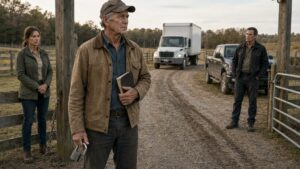
The hay truck hit its brakes twenty yards from Patrick’s entrance.
Patrick heard the air brakes release from inside the machine shed and stepped out expecting to find cattle loose or a trailer tire gone bad.
Instead, the driver was staring through the windshield at a chain stretched across the road.
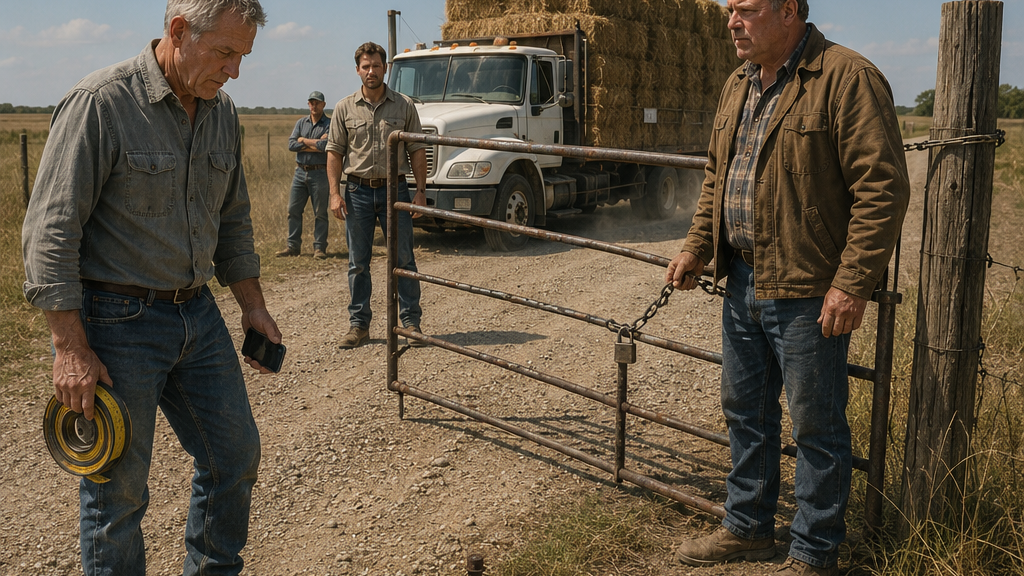
The old iron gate was closed.
A new padlock hung from its latch.
Patrick stopped walking.
Three days earlier the gate had been standing open against the fence, as it had nearly every working day for years.
Now a laminated notice had been zip-tied to the middle rail.
ASSOCIATION ACCESS RESTRICTED.
Patrick did not need to read the rest.
Michael came around the shed carrying a fencing tool.
“You’ve got to be kidding me.”
The hay truck idled heavily, loaded high with round bales Patrick needed before the cattle shipment. Dust drifted around its tires.
Michael raised the fencing tool. “That chain won’t take thirty seconds.”
Patrick held out a hand.
“No.”
“He can’t lock our own entrance.”
“That’s why we don’t cut it.”
The driver climbed down. “Want me to back out?”
“Not yet.”
Patrick walked toward the gate.
By the time he reached it, a pickup was approaching from the north. Steven stopped on the other side of the chain.
He got out slowly.
“Morning.”
Patrick pointed at the lock. “Yours?”
“Association’s.”
“You put it there?”
“We voted to enforce delinquent-access rules.”
“My bill isn’t even due.”
“You gave us notice you aren’t paying.”
“I questioned the charge.”
Steven looked toward the hay truck. “Same effect if everybody does it.”
Michael stepped closer. “Move the gate.”
Patrick did not look at him.
Steven said, “Soon as the account’s current.”
Patrick stared at the left gatepost.
Something about its position had bothered him since the meeting.
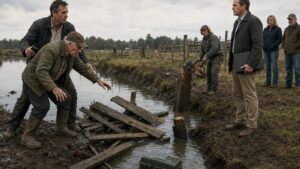
The gravel road at the gate was wider than it appeared because grass had crept inward along both shoulders. The ditch line sat several yards farther south. On the north side, a woven-wire fence angled away from the roadway rather than following it.
Patrick walked into the grass.
“What are you doing?” Steven asked.
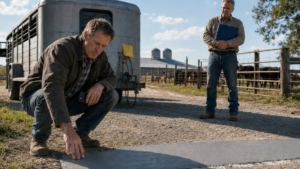
Patrick crouched and pushed aside dead stems with both hands.
He found the top of the pin after less than a minute.
Rust-dark steel, driven nearly flush with the ground.
Michael stopped talking.
Patrick scraped dirt from around it with the heel of his boot.
Steven remained beside the gate.
“That doesn’t change the bill.”
Patrick stood and looked from the pin to the opposite ditch.
“No. But it might change your gate.”
He went back to the shed and returned with a hundred-foot fiberglass tape.
By then two neighboring pickups had stopped. Nobody had been invited. In farm country, a hay truck blocked in the middle of a shared road did its own advertising.
Patrick hooked the tape near the survey pin and walked it across the gravel.
Steven’s expression changed slightly.
Not fear.
Recognition that this was no longer an argument about seven hundred sixty dollars.
“What exactly are you measuring?” Sarah asked after arriving in another pickup.
Patrick read the tape.
“Road width.”
“From an old pin?”
“If it’s the pin I think it is.”
Steven crossed his arms. “And if it isn’t?”
“Then the county can tell us.”
One of the neighbors shook his head. “Patrick, everybody’s trying to keep this road usable. We just put stone on it last spring.”
Patrick reeled several feet of tape back through his hand.
“I didn’t say nobody should pay for anything.”
“Sounds like it.”
That landed harder than Patrick wanted it to.
He had paid into the road fund for years because he knew exactly what heavy farm traffic did to gravel and drainage. His cattle trailers used the same culvert as everybody else’s combines and grain trucks.
But once he started explaining that, he would also have to explain why the gate bothered him, why the deed language mattered, and why his eye kept returning to the ditch and the old pin.
He disliked offering half an argument.
So again he offered almost none.
“I said the association shouldn’t charge for what isn’t theirs.”
The neighbor gave a humorless laugh.
“Convenient.”
Patrick’s jaw tightened.
Michael heard it too.
For the first time, Patrick wondered whether silence was serving him or simply making everyone else fill in the missing pieces with the worst explanation.
He measured from the pin to the centerline, then from centerline toward the opposite shoulder.
The numbers were familiar.
Too familiar.
Patrick walked directly to the gatepost and photographed its base with his phone. Then he photographed the pin, the tape reading, the road centerline, and the chain.
Steven stepped forward.
“You planning to sue us?”
“No.”
“Then what is this?”
“Documentation.”
“Of what?”
Patrick finally faced him.
“Who authorized you to place an obstruction inside the county right-of-way?”
The road went quiet except for the hay truck’s diesel engine.
Steven’s gaze flicked toward the survey pin.
There it was.
A hesitation.
Small enough that Patrick might have missed it twenty years earlier.
Sarah noticed too.
Steven recovered. “This road has been association-maintained for decades.”
“That’s not an answer.”
“We control the gate.”
“Maybe.”
Steven’s face reddened. “You think because you’ve got an old pin and a tape measure you can declare county jurisdiction?”
“No.”
Patrick unclipped the tape and let it rewind.
“I think the county can.”
The hay driver checked his watch.
Patrick walked back to him. “You’ll have to take the west route.”
“Adds almost forty minutes.”
“I know. Put the extra mileage on my bill.”
Michael stared at him. “You’re letting Steven win this?”
Patrick looked at the locked gate.
“No.”
He turned toward the farmhouse.
“I’m making sure he only gets to do it once.”
That evening, after the hay finally arrived by the longer route, Michael found Patrick at the kitchen table transferring measurements onto a yellow legal pad.
Beside him sat the closing papers.
“You knew what that pin was,” Michael said.
Patrick kept writing.
“I had an idea.”
“You knew the road width too.”
Patrick stopped.
Michael pulled out a chair.
“How?”
For several seconds Patrick said nothing.
Then he pushed back from the table.
“In the office closet, top shelf, there’s a gray steel box.”
Michael frowned. “What’s in it?”
“A combination lock.”
“What’s the combination?”
Patrick gave him four numbers.
Michael stood.
“And what am I bringing you?”
Patrick looked toward the dark window over the sink. The gate could not be seen from there, but he could picture the chain perfectly.
“My old county field notebooks.”
Chapter 3: Fourteen Years of Road Maps Changed the Argument
Michael set the steel box on the kitchen table hard enough to rattle the coffee cups.
He had already opened it.
On top lay a faded field notebook stamped with the county transportation department seal.
Michael looked at Patrick.
“You worked right-of-way?”
Patrick sat down across from him.
“For fourteen years.”
“You told me you worked roads.”
“I did.”
“That’s not the same thing.”
Patrick opened the notebook.
Inside were pencil sketches of ditch lines, section corners, fence offsets, culverts, drive approaches, and survey references. His handwriting was narrower then.
Michael lifted another book.
“How many property disputes did you handle?”
“Enough.”
“And you didn’t think this was worth mentioning at the meeting?”
“I wasn’t going to argue from memory.”
“You let everybody think you were trying to duck a bill.”
Patrick looked at him.
“They were free to ask why.”
Michael laughed once, without humor.
“You make people drag every sentence out of you and then get irritated when they don’t understand.”
Patrick closed the notebook.
That was close enough to the truth to annoy him.
He walked to the counter and poured coffee neither of them needed.
“I’ve watched right-of-way arguments ruin neighbors,” he said. “One person remembers a fence. Another remembers where a grader ran in 1978. Somebody’s uncle swears the road was promised to somebody’s grandfather. By the end, everybody is certain.”
“And?”
“And certainty isn’t a record.”
Michael’s anger softened slightly.
Patrick brought the coffee back.
“When I left the county, I decided I was done being the man in the middle.”
Michael tapped the notebook.
“Looks like the middle came to your driveway.”
The next morning Patrick went to the recorder’s office.
The clerk at the counter searched the parcel index while Patrick stood beneath fluorescent lights that made everything look older than it was. He gave her the road name, his parcel number, and the legal description from his deed.
She returned first with a subdivision plat recorded in 1992.
Patrick spread it beneath the reading lamp.
The line work was faint but clear enough.
His finger followed the road north from the county blacktop. A labeled width ran alongside it.
Sixty feet.
Patrick took out the measurements from the gate.
The iron post fell inside that width.
He felt a brief, sharp satisfaction.
Then he followed the plat farther north.
The road changed.
Beyond a particular section line, the wide public corridor narrowed into a separately drawn access strip serving the upper farms.
Private easement.
Patrick sat back.
Michael, who had come with him, leaned over the map.
“So Dad was right.”
“Partly.”
“You said the gate’s in the public section.”
“It appears to be.”
“Then that’s it.”
“No.”
Patrick pointed north.
“This isn’t county.”
Michael studied the map.
“The association road?”
“Could be.”
The clean victory Patrick had imagined the night before immediately became messier.
If the old plat was still controlling, Steven had overstated the association’s authority at Patrick’s gate—but he had not invented the existence of private shared infrastructure.
Patrick looked at the map again.
The public road and private spur had been treated as one thing for so long that even he had done it in conversation.
“Can we get the acceptance record?” Patrick asked.
The clerk checked an index.
“If the county formally accepted the dedicated section, there should be a resolution.”
She disappeared into the back room.
Michael folded his arms.
“So what now?”
“Now we find out whether the dedication was accepted.”
“And if it was?”
“Then Steven can’t control the lower road.”
“And if it wasn’t?”
Patrick looked at the plat.
“Then I owe him an apology.”
Michael gave him a sideways look. “You’d actually do that?”
Patrick ignored him.
The clerk returned carrying a thin folder.
“No resolution in this volume,” she said, “but the plat references a road petition. Different index.”
Patrick’s pulse changed.
He knew that system.
Older counties often recorded the plat in one series and the actual acceptance action somewhere else: commissioners’ proceedings, highway resolutions, road petitions.
“Can you search by year?”
“What year?”
“Start with 1993.”
While she worked, Patrick requested the current GIS road layer at a public terminal. The digital map showed the county-maintained route running farther north than Steven’s association map suggested, nearly to the same point where the 1992 plat changed into private easement.
Not proof.
But alignment.
Patrick printed the screen.
Michael looked between the printout and the old plat.
“That’s three things saying almost the same thing.”
“Two things and a hint.”
“You always like this?”
“Unfortunately.”
Michael smiled despite himself.
Patrick laid the gate measurements beside the plat. The old iron gate, by his calculation, stood well south of the private spur.
That answered one question.
It opened another.
Why had the association been collecting one undivided road assessment if the road itself had two different legal statuses?
Patrick thought of Sarah’s annual statements. Gravel. Grading. Culvert. Snow. Drainage.
All combined.
If county maintenance already covered part of the route, where exactly had the association money gone?
He disliked the direction of that thought. Steven could be domineering, but Patrick had never considered him dishonest.
The clerk returned carrying an index card.
“I found the petition reference.”
Patrick stood.
She pointed to a handwritten entry.
“County board proceedings. September 1993.”
“Acceptance?”
“Looks like it references an acceptance resolution, yes.”
Patrick felt Michael watching him.
For the first time since the bill arrived, Patrick’s suspicion had something beneath it firmer than memory.
He copied the book and page numbers.
The clerk said, “The actual resolution is archived downstairs. I can have it pulled.”
“Today?”
“Probably.”
Patrick nodded.
Then she added, “You might want the attachments too.”
He looked up.
“Why?”
“Because the resolution description says ‘accepted portion.'”
Patrick glanced back at the 1992 plat, where the broad roadway narrowed into private access.
Not the whole road.
A portion.
The distinction he had accused Steven of ignoring might also be the distinction Patrick himself had nearly ignored.
“Pull everything,” he said.
The clerk wrote the request.
At the bottom of the slip, beside the archive number, she underlined the year:
Chapter 4: The Records Proved Both Men Partly Wrong
The acceptance resolution contained exactly the language Patrick had hoped to find.
That was what made the attachment behind it so troublesome.
He stood at the recorder’s counter with the 1993 county board proceedings open beneath his hands. The resolution formally accepted the lower stretch of the farm road into the county highway system. Its description matched the width shown on the 1992 plat and ran north past Patrick’s entrance.
Past the iron gate.
Patrick read the legal description again anyway.
Michael leaned over his shoulder. “So Steven had no right to lock it.”
“Not there.”
“That sounds pretty final.”
Patrick turned the page.
Stapled behind the resolution was a survey exhibit showing the accepted road ending farther north, at the same point where the broad corridor narrowed into the private easement.
Patrick tapped the line.
“This part isn’t county.”
Michael followed his finger. “But we use it.”
“So do Steven and the others.”
“For what?”
“Depends where the trucks are going.”
Patrick requested copies of everything.
By the time they returned to the farm, the satisfaction he had felt in the recorder’s office had thinned into something less comfortable.
The iron gate was still locked.
The notice was still tied to it.
Those facts had not changed.
But neither had the private spur beyond the accepted county road. Patrick’s cattle trailers sometimes crossed the upper drainage structure when pasture rotation required access from the north side. He could no longer tell himself that every road dollar he had paid was automatically illegitimate.
He spread the copies across the desk in the small farm office.
The county resolution.
The 1992 plat.
The GIS printout.
The association map from the last annual statement.
On the association version, one thick line ran from the blacktop all the way through the farm corridor. No break. No jurisdiction change.
Patrick set the county plat beside it.
Two maps.
Two versions of the same road.
Michael stood in the doorway.
“You going to Steven?”
“Not yet.”
“Why?”
“Because I know where the road changes. I don’t know what they charged us for.”
“That seems like their problem.”
Patrick looked at him.
“No. If I’m accusing somebody of billing wrong, I need to know what the bills paid.”
Michael gave a small shrug. “You’re being nicer than they were.”
“That’s not the standard.”
Patrick called Sarah.
She was quiet when he told her what he had found.
Finally she said, “You have the county resolution?”
“In front of me.”
“And it actually says accepted?”
“Yes.”
A longer pause.
“Come over.”
Sarah kept the association records in two plastic file totes beneath a table in her kitchen. When Patrick arrived, she had already cleared a space between a sewing basket and a stack of farm magazines.
She did not offer coffee.
That told him how uneasy she was.
“I’ve been treasurer six years,” she said. “The categories were already set up when I took it over.”
Patrick opened the first ledger.
“Road maintenance.”
“That’s what we’ve always called it.”
Inside that single category were invoices for limestone, grading, snowplowing, ditch work, pipe, diesel reimbursements, culvert installation, and equipment rental.
Patrick worked through the entries one year at a time.
Some invoices identified locations.
Many did not.
Sarah sat across from him with her hands wrapped around an empty mug.
“Are you trying to prove we stole from people?”
Patrick looked up sharply.
“No.”
“Because that’s what Steven thinks.”
“I haven’t accused anybody of stealing.”
“You said we were charging for a road we don’t control.”
“I said you might be.”
Sarah pushed one invoice toward him.
“Last spring. Twenty-two tons of limestone.”
Patrick read the delivery notation.
North spur.
Private section.
The next invoice was for grading along the same stretch.
Then a culvert replacement near the northern drainage crossing.
Legitimate shared expenses, at least in principle.
Patrick moved them into a separate pile.
Then he found a snow-removal invoice describing work from the county blacktop all the way north.
“County should’ve handled the lower stretch.”
Sarah frowned. “They don’t always get out here quickly.”
“That’s different from owning responsibility for it.”
Another bill covered shoulder repair near Patrick’s entrance.
County section.
Another charged for gravel placed well north of it.
Private section.
Year after year, the two had been blended together.
Sarah began making her own two piles.
By the fourth ledger, neither of them spoke much.
Patrick found an invoice for work on the drainage crossing used by his own cattle trailers.
He stared at it longer than the others.
Sarah noticed.
“You use that crossing.”
“Yes.”
“Quite a bit.”
“Enough.”
It was not what he had wanted to discover.
He had entered her kitchen ready to establish that the association had collected money without authority. Instead he was finding a harder truth: they had collected money badly, across the wrong boundaries, for some work that should have been county responsibility and some work that absolutely benefited him.
Patrick rubbed a thumb along the invoice edge.
Sarah said, “So what does this mean?”
“It means the accounting needs to be separated.”
“And the gate?”
“Still wrong.”
“And the assessment?”
“Part of it may be wrong.”
Sarah sat back.
“You came in thinking all of it was wrong.”
Patrick did not answer.
She gave him a tired look.
“That means yes.”
He almost defended himself.
Instead he said, “I did.”
The admission felt strangely heavier than proving Steven wrong.
Sarah turned toward another tote.
“There are older records.”
“How old?”
“Before I was treasurer.”
She pulled out a binder with cracked vinyl along the spine. Inside were meeting notes, handwritten cost splits, and copies of checks dating back more than a decade.
Patrick found the same pattern almost immediately.
One road.
One account.
One assessment.
Somewhere along the years, the county section and private section had stopped being treated separately.
Not because anyone had formally decided to combine them.
Because everybody had forgotten there was a difference.
Sarah turned a page slowly.
“Here.”
Patrick looked.
A meeting note from three years earlier contained one line beside Steven’s initials:
Confirm county maintenance endpoint before next gravel contract.
Patrick read it twice.
Sarah’s face changed.
“I forgot about that.”
“Did he confirm it?”
“I don’t know.”
“Was it discussed again?”
She shook her head.
Patrick continued through the following pages.
Nothing.
No survey.
No county letter.
No updated map.
Just another annual assessment.
Sarah stared at the note.
“He asked me once if I knew where the county stopped.”
“When?”
“Around then, I guess.”
“What did you tell him?”
“That I assumed it stopped at the blacktop.”
Patrick looked toward the window over her sink. From Sarah’s place, the road curved behind a row of cottonwoods before continuing toward Steven’s grain bins.
“He knew there was a question.”
Sarah stiffened. “A question isn’t the same as knowing he was wrong.”
“No.”
Patrick closed the binder.
“But he had the question before he locked the gate.”
Chapter 5: Steven Finally Explained Why He Would Not Ask
Steven did not deny it.
Patrick had barely placed the copied meeting note on the workbench before Steven looked down and said, “Yeah. I asked.”
They stood inside Steven’s equipment shed beside a grain drill with one wheel removed. Through the open doors, two steel bins rose against the afternoon sky, and an auger motor ticked as it cooled.
Patrick had expected an argument.
The absence of one unsettled him more.
“You asked where the county maintenance ended.”
“Yes.”
“And then?”
Steven picked up a shop rag and wiped grease from his fingers.
“And then I had a contractor wanting payment, a culvert washing out, and six people telling me they wanted the road fixed before harvest.”
“That doesn’t answer me.”
Steven tossed the rag onto the bench.
“I called the county.”
Patrick waited.
“They sent me to highways. Highways sent me to records. Records said they’d need the original acceptance documents. I didn’t have time to spend three days chasing paper.”
“So you guessed.”
“I used the line we’d always used.”
“The association map.”
“The road we’ve maintained for thirty years.”
Patrick kept his voice level.
“Then you threatened me with penalties based on that guess.”
Steven’s jaw moved.
“I threatened you based on the same rules everybody else follows.”
“You locked a gate.”
“You told us you weren’t paying.”
“I told you your authority was questionable.”
“And if I’d backed off because you said the word right-of-way, what do you think would’ve happened?”
Patrick said nothing.
Steven pointed toward the open shed door.
“Everybody would’ve stopped paying until I proved every inch of road history. You know what account balance we had when we set that assessment?”
“No.”
“Forty-three hundred dollars.”
He walked to a metal cabinet and pulled out a folder.
Inside was an unpaid contractor invoice.
Steven placed it in front of Patrick.
The amount was more than eight thousand dollars.
“Upper culvert,” Steven said. “Half the pipe bed washed after those spring rains. Contractor agreed to finish before harvest if we paid him in two installments.”
Patrick read the invoice.
The location matched the private spur.
“That’s legitimate association work.”
“I know.”
“Then bill it that way.”
“With what money? Sarah’s books don’t separate thirty years of expenses clean enough to make everybody happy. We needed the road usable now.”
Patrick looked at him.
“So you decided uncertainty gave you more authority, not less.”
Steven’s eyes hardened.
“I decided somebody had to make a decision.”
There it was.
Not greed.
Not a secret account.
Something Patrick understood more than he wanted to.
The pressure to keep machinery moving.
The fear that asking one technical question would open ten others.
The temptation to treat an old practice as settled because the alternative was expensive and inconvenient.
Patrick had seen public officials do exactly that during his county years.
Sometimes they were even right about the practical need.
That never made the paperwork disappear.
Steven sat on the edge of the workbench.
“My grain prices are down. I’ve got payments on the combine. If that contractor walks, the crossing gets worse. If the crossing goes, the north farms are hauling equipment five extra miles around.”
“That’s still not my gate.”
“No.”
The word came quietly.
Patrick looked at him.
Steven reached into a drawer and took out a brass key.
The spare padlock key.
He set it on the bench between them.
For a moment Patrick thought Steven was giving it to him.
Instead Steven rested two fingers over it.
“I shouldn’t have locked it that fast.”
“That fast?”
Steven’s expression tightened.
Patrick said, “The problem isn’t timing.”
“You knew what I meant.”
“I know what you want me to hear.”
“And what’s that?”
“That you were under pressure.”
“I was.”
“I believe you.”
Steven looked surprised.
Patrick continued, “It doesn’t make the gate legal.”
The auger motor outside gave a metallic pop as it cooled.
Steven turned the brass key beneath his fingertips.
“You know what I think?”
Patrick waited.
“I think you enjoyed walking into that meeting knowing more than everybody else.”
Patrick felt the hit because it was not entirely wrong.
Steven leaned forward.
“You could’ve said you’d worked right-of-way. You could’ve shown us exactly what bothered you. Instead you gave me three sentences and looked at me like I was too stupid to understand the fourth.”
Patrick’s first instinct was to reject it.
Then he remembered Michael’s accusation at the kitchen table.
You make people drag every sentence out of you.
“I should’ve explained more,” Patrick said.
Steven studied him.
“But you should’ve checked before using the gate.”
Neither man moved.
Finally Steven lifted his fingers from the key.
“I’ll tell you what. Bring me an official county determination and I’ll move it.”
“You have the same resolution I have.”
“It’s thirty-three years old.”
“It didn’t expire because you stopped reading it.”
“I want the county to stand here and tell me where their road ends.”
Patrick looked at the key.
“You’re leaving the gate locked?”
“Until they do.”
“Even now?”
“Yes.”
That was Steven’s choice.
Not an inherited bookkeeping mistake. Not a misunderstood map.
A choice made after he knew the evidence.
Patrick picked up his copies.
Steven said, “If you turn this into a legal fight, you’re going to blow up the whole association.”
Patrick stopped at the doorway.
“No. If the association only works when nobody checks what it controls, it was already broken.”
He drove directly to the county administration building.
The form for a formal right-of-way determination was six pages long.
Twenty years earlier, filling it out would have felt routine.
Now each box pulled him back toward the kind of work he had sworn to leave behind: parcel numbers, recorded instruments, jurisdiction claims, photographs, survey references, applicant statements.
He nearly stopped at the signature line.
Michael’s voice came back to him.
The middle came to your driveway.
Patrick attached the gate photographs.
The 1992 plat.
The 1993 acceptance reference.
The association notice.
His measurements from the rust-dark pin.
Then he added one sentence explaining that the private agricultural spur beyond the county segment was not being disputed.
That sentence mattered to him.
He was not asking the county to erase a neighbor’s responsibility.
Only to establish where one responsibility ended and another began.
At the filing counter, the clerk stamped the first page and slid a copy back.
“Engineering usually assigns field review after records verifies the petition.”
“How long?”
“Depends on workload.”
Patrick looked at the stamped date.
“Fine.”
When he returned home, the gate was still chained.
He did not touch it.
He put the county-stamped copy on the kitchen table where Michael could see it.
At the top, in block letters, was the request type:
RIGHT-OF-WAY DETERMINATION.
Chapter 6: The County Truck Stopped Beside the Iron Gate
Eighteen days after Patrick filed the request, a white county road truck turned onto the gravel lane while Steven Campbell was standing beside the locked iron gate.
Patrick saw it from the cattle lot.
The timing was almost too perfect.
Steven had come down to check the chain after someone reported that the laminated association notice had torn loose in the wind. He was holding a replacement zip tie when the county truck slowed behind him.
Patrick wiped his hands on his jeans and walked toward the road.
Two neighboring landowners appeared within minutes. Sarah arrived soon after, carrying the binder of association records against her chest.
Nobody had called a meeting.
The truck had created one.
The county road inspector stepped out wearing a reflective vest and carrying a tablet, a measuring wheel, and a short bundle of marking flags.
“Patrick Hall?”
Patrick raised a hand.
The inspector looked at Steven.
“And you’re the association representative?”
“Chairman.”
“Good. I’d rather everybody be here.”
Steven glanced toward Patrick.
Patrick gave him nothing.
The inspector began with the documents.
He compared the acceptance resolution to the plat, then checked the county GIS layer against older road records already loaded onto his tablet.
Steven pointed north.
“We’ve maintained this whole corridor for decades.”
“I understand,” the inspector said.
“So doesn’t that count for something?”
“For maintenance history, yes.”
“For jurisdiction?”
“Not by itself.”
Steven’s mouth flattened.
Patrick felt the old reflex returning—the desire to explain the distinction, to say exactly what records controlled and why.
He kept quiet.
This was no longer his determination to make.
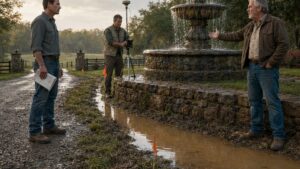
The inspector walked the road.
He measured from the apparent centerline, checked ditch features, then asked about original monumentation.
Patrick pointed toward the grass.
“There was a pin near the north shoulder.”
Steven looked at him.
The inspector followed Patrick to the spot.
Grass had nearly covered it again.
Patrick crouched, separated the stems, and exposed the rust-dark top.
The inspector cleaned around it, checked the plat, then entered a reading into his tablet.
Michael stood near the hay shed watching.
This was the same pin Patrick had found while the truck sat blocked three weeks earlier.
The same point neighbors had treated as an old piece of steel in the weeds.
Now the county inspector placed a bright marking flag beside it.
Patrick felt satisfaction rise.
He let it pass without speaking.
The inspector crossed the road.
Measured again.
Returned to the gatepost.
Then measured once more.
Steven finally asked, “Well?”
The inspector looked at his tablet.
“This gatepost is inside the accepted county right-of-way.”
“How far?”
The inspector gave the measurement.
It was not inches.
The post stood several feet inside the corridor.
Sarah closed her eyes briefly.
One of the neighbors muttered, “You’ve got to be kidding.”
Steven stared at the post as if its position might change now that somebody had said the number aloud.
“What about the road north of here?”
“Different issue.”
The inspector pulled up the historic plat.
“County acceptance continues beyond this gate, then terminates at the recorded point near the upper junction. North of that is private access under the easement shown here.”
Patrick stepped closer.
The inspector was tracing exactly the distinction Patrick had discovered.
Public below.
Private above.
The association had not imagined the private road.
It had simply allowed that private authority to creep south over the years until the old iron gate made the mistake look permanent.
Steven said, “So we’re responsible for the upper section.”
“That’s a private matter among the easement users.”
“And the lower?”
“County right-of-way.”
“We’ve put gravel on it.”
“You can voluntarily perform certain work subject to county rules. That doesn’t give you authority to obstruct it.”
The word hung in the air.
Obstruct.
Steven looked toward the chain.
The inspector photographed the gate from several angles, then returned to the truck and took out an official notice sleeve.
Patrick had seen hundreds like it during his working years.
He had never imagined one being fastened to a gate ten minutes from his kitchen.
The inspector secured the notice to the iron rail.
Steven stepped forward.
“What does that require?”
“Removal of the obstruction.”
“How soon?”
“Seventy-two hours.”
Sarah looked at Patrick.
Michael did too.
No one smiled.
There was no applause, no triumphant exchange, only the metallic click of the inspector fastening the notice to the same rail where Steven had attached the access warning.
The association’s paper was gone.
The county’s paper remained.
Steven read it silently.
His face had gone pale beneath the sunburn along his cheeks.
Patrick could have said something.
He could have reminded Steven of the meeting, the penalty, the hay truck, the demand for official proof.
Instead he asked the inspector, “Can you mark the county endpoint north of here while you’re out?”
Steven turned toward him.
The inspector nodded. “That’s part of the determination.”
They drove and walked the remaining corridor.
At the upper junction, the inspector located additional references matching the recorded transition. The private spur began where Patrick’s newer copies said it did.
The association really did have responsibilities there.
That mattered.
By afternoon, the county engineer’s preliminary determination confirmed the lower-road jurisdiction and required the gate removed or relocated outside the public corridor.
The penalty notice against Patrick had no authority over county access.
But the inspector said nothing about the private-spur invoices.
He could not.
Those belonged to the landowners.
When the county truck finally left, the neighbors drifted away more slowly than they had arrived.
Sarah remained.
Steven stood beside the gate with the official notice fluttering faintly against the metal.
“You got what you wanted,” he said.
Patrick looked north toward the private spur.
“No.”
Steven gave him a tired laugh. “County just told me to tear down the gate.”
“Move it.”
“Same difference.”
“No, it isn’t.”
Patrick pointed toward the upper junction.
“That’s where your authority starts.”
Steven stared at him.
“What are you going to do about the assessments?”
“Separate them.”
“And the money people paid for county-road work?”
“Account for it.”
Steven’s shoulders dropped.
“So you want six years of refunds.”
Sarah shifted the binder against her chest.
Patrick knew what everyone expected him to say.
Three weeks earlier, he would probably have said yes.
Then he had seen the culvert invoice.
The private gravel bills.
The drainage crossing his own trucks used.
He looked at Steven.
“I want every dollar put where it belonged.”
Steven frowned.
Patrick continued.
“If money was charged for work the county was responsible for, credit it back. If money paid for private work we actually used, show it honestly and split it honestly.”
“You’re saying you’d still pay?”
“For something I owe.”
Steven looked at him for a long moment.
The old gate stood between them, now carrying an official order defining exactly what it could no longer mean.
Patrick touched the top rail.
“But I’m not paying for the right to drive down a county road.”
For the first time since the dispute began, Steven had no argument ready.
Chapter 7: They Moved the Gate Instead of Ending the Road
The old iron gate lay across two sawhorses when Patrick arrived at the junction.
For the first time in as long as he could remember, there was nothing spanning the road.
No chain.
No padlock.
No faded association notice.
No county order fluttering against the rails.
Just open gravel running north until it narrowed near the private spur.
Steven stood beside the gate with a tape measure clipped to his belt. A posthole auger rested behind his pickup, and two new steel posts lay in the grass.
Patrick parked and walked over.
Steven did not say good morning.
He pointed toward a bright survey flag near the edge of the private easement.
“County says the gate can go here.”
Patrick looked at the flag, then at the copy of the county determination Steven had folded on the hood of his truck.
“That’s the beginning of the private section.”
“I know.”
The words carried no argument this time.
Steven pulled the tape measure free.
“You want to check it?”
Patrick almost said no.
Then he took the end of the tape.
They measured from the recorded reference point together.
Michael arrived in the farm pickup while they were marking the first posthole. He slowed when he saw Patrick holding one end of the tape and Steven holding the other.
He climbed out.
“Never thought I’d see that.”
Steven looked at him. “Don’t get sentimental.”
Michael smiled.
Patrick did not.
But the corner of his mouth moved.
The county had required the old gate removed from the public right-of-way within seventy-two hours. Steven had complied the next morning.
The harder work had taken weeks.
Sarah had gone through six years of association records line by line. Patrick helped her classify expenses by location. Gravel delivered north of the public-road endpoint went into one column. Private culvert work went into another. Work performed on the county section went into a third.
Some entries could not be reconstructed cleanly.
Those were marked uncertain rather than quietly assigned where they were most convenient.
That change alone had taken three meetings.
The first meeting nearly fell apart.
One landowner wanted every road payment from the previous six years refunded.
Another argued that nobody should get anything because everyone had benefited somehow.
Steven sat at the end of the table looking older than he had a month earlier.
Patrick listened until both sides had repeated themselves.
Then he placed Sarah’s revised ledger on the table.
“We don’t need to pretend every dollar was wrong,” he said.
The room quieted.
He pointed to the first column.
“These are documented private-spur expenses. Gravel. Grading. Culvert repair. Drainage work.”
Then the second.
“These were charged against the group even though they were performed on county right-of-way.”
Someone across the room said, “So refund those.”
“Credit or refund them, yes.”
Steven looked up.
Patrick continued.
“But this crossing here—”
He tapped the private drainage line.
“—my cattle trucks use it. So do Michael’s. I’m paying my share.”
Michael, sitting against the wall, straightened.
One of the neighbors frowned. “After all this, you’re still paying?”
“For something we used.”
The man looked confused.
Patrick understood why.
For weeks, the dispute had been treated as though one side had to be entirely right and the other entirely wrong.
But a boundary could do more than divide land.
It could divide responsibility.
Patrick had spent years understanding that professionally and nearly forgotten it personally.
Sarah slid a revised calculation toward him.
His credit for improperly assessed lower-road work exceeded the new private-road contribution by a modest amount.
Patrick read it once.
“This drainage percentage is based on traffic?”
“And access benefit,” Sarah said. “Same formula for everyone using that spur.”
He looked at Steven.
Steven nodded.
Patrick signed the new agreement.
Michael watched him.
Outside afterward, he said, “I figured you’d walk away from the association.”
“So did I.”
“What changed?”
Patrick looked down the road.
“Found out the road wasn’t the only thing I was treating as all-or-nothing.”
Michael leaned against the pickup.
“You mean Steven?”
Patrick gave him a look.
“I mean me.”
The answer seemed to satisfy Michael more than any explanation Patrick had given since the bill arrived.
Not everything repaired itself as easily as the bookkeeping.
Steven had offered to resign as chairman.
No one accepted.
Not because the neighbors had forgotten what he had done. The locked gate remained too recent for that.
But Steven knew the contractor agreements, the outstanding culvert balance, and every supplier the association owed. Replacing him immediately would have created another practical mess.
So the members voted to keep him temporarily, with Sarah handling all assessments and any future access restrictions requiring written verification of authority.
Steven had stared at that last provision.
Then he voted for it too.
Now, beside the relocated gate, Patrick watched him guide the auger into the first marked hole.
The machine bit into dry soil.
This time the post was going where the records said private authority actually began.
When the hole was deep enough, they set the first steel post.
The old gate itself would stay.
Patrick had expected Steven to replace it.
Instead Steven said, “Nothing wrong with the gate. Just where we put it.”
Patrick ran a hand over the weathered top rail.
There were pale rectangles where the association notice and county order had shielded the metal from sun.
The marks would probably remain for years.
He did not mind that.
By noon, the gate hung from its new hinges.
Steven opened it once.
Closed it.
The lower corner scraped lightly across the gravel.
Patrick heard the familiar sound and shook his head.
“You moved it half a mile and still hung it crooked.”
Steven looked at the hinge.
“It was crooked before.”
“That doesn’t make it correct.”
For half a second, neither man spoke.
Then Steven laughed.
It was the first easy sound between them in weeks.
“Fine,” he said. “Get the wrench.”
They adjusted the hinge until the gate cleared the ground.
Later that afternoon, Patrick’s cattle truck came down from the northern pasture route.
The driver slowed at the new gate.
Patrick was already there.
He unlatched it and swung it wide.
The truck rolled across the private drainage crossing—the one Patrick had agreed to help maintain—then passed the new posts and entered the county road.
Michael followed in the pickup.
He stopped beside Patrick after the truck cleared.
“Want me to close it?”
Patrick looked at the gate.
A month earlier it had been a threat across his own entrance.
Then it had become evidence.
Now it stood farther north, neither enemy nor trophy.
Simply a gate in the place where a gate belonged.
“I’ll do it.”
Michael drove on.
Patrick waited until the cattle truck disappeared toward the blacktop.
Then he swung the iron gate shut across the private spur.
The latch settled into place without scraping.
Steven was farther up the road near his grain bins. He lifted one hand.
Patrick returned the gesture.
Nothing between them was exactly as it had been.
That was probably for the best.
Patrick rested his hand on the top rail for a moment, then stepped back onto the county gravel.
For years, everyone had treated the road as one continuous thing because that was easier than asking where responsibility changed.
Now the boundary was visible.
County road on one side.
Shared private road on the other.
And Patrick had finally learned that defending the first did not require abandoning the second.
He closed the gate only after his cattle truck was safely beyond it.
This time, it was exactly where it belonged.
The story has ended.