They Ordered Him to Move His Hay Trailer—Then the County Map Showed What His Farm Entrance Was Actually Zoned For
Chapter 1: The Notice Nailed Beside the Hay Gate
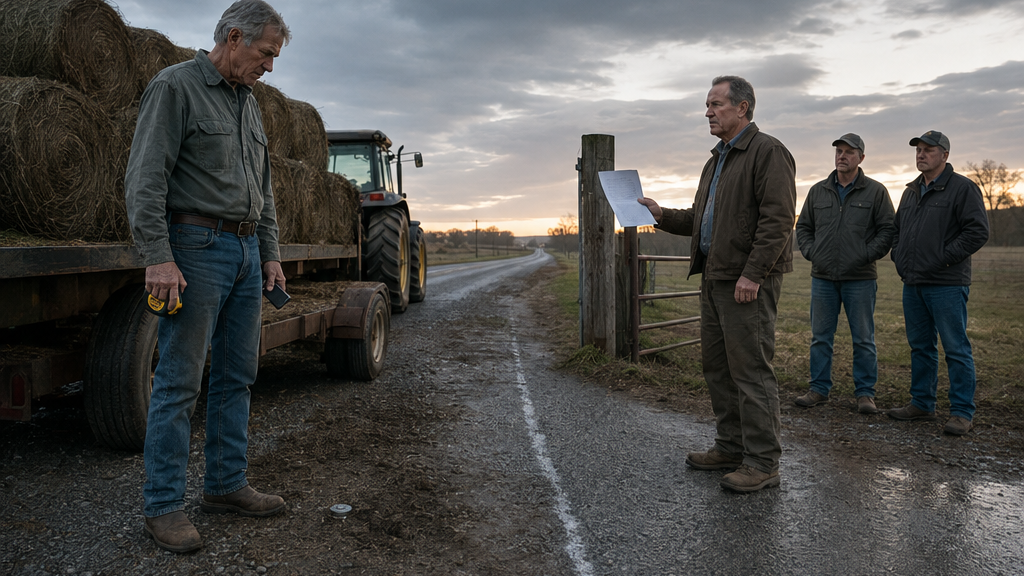
The notice was already nailed to Nicholas Wright’s gate when he came down the lane before sunrise.
He saw the white sheet before he saw the men.
It flapped against the weathered oak post beside the cattle gate, held by two bright roofing nails that caught the tractor headlights. Twenty yards beyond it, Nicholas’s hay trailer sat exactly where he had left it the night before: loaded, tarped, and backed onto the faded gravel strip that widened beside the entrance.
Jeffrey Nelson stood beside the trailer with two road-association board members.
Nicholas killed the tractor.
“What’s this?”
Jeffrey held up another copy of the notice. “You need to move the trailer.”
Nicholas looked past him toward the gravel road.
“It is moved. It’s off the road.”
“It’s inside the association margin.”
Nicholas climbed down slowly. His knees objected before his pride did.
For more than twenty years, hay wagons, feed deliveries, seed trucks, cattle trailers, and machinery had used that strip. Nicholas’s father had spread the first gravel there when Nicholas was still young enough to shovel without thinking about his back.
Nobody had ever called it a road margin.
Jeffrey pointed toward a line of faded orange paint near the weeds.
“We measured from the centerline last week. Anything inside that line has to stay clear.”
Nicholas looked at the paint.
Then at Jeffrey.
“When did that become the rule?”
“The rule’s been there.”
“That isn’t what I asked.”
One of the board members shifted his weight.
Jeffrey’s voice stayed controlled. “We’ve got more traffic now. More deliveries. More families using the road. The board voted to enforce the clearance provision consistently.”
Nicholas looked at the folded paper nailed to his gate.
“Consistently starting with me.”
“Starting with everybody who has something in the margin.”
The feed truck was due in fifteen minutes.
Nicholas could already picture it coming around the bend beyond the sycamores, driver expecting the entrance clear enough to turn into the farm. His loaded hay trailer was supposed to leave first. He had a delivery across the county before nine.
He did not have time for a committee argument.
Jeffrey seemed to know that.
“The trailer needs to go now,” he said.
Nicholas walked past him toward the road edge.
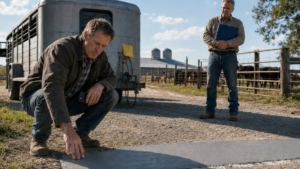
The previous evening’s rain had washed a shallow groove through the dirt. Near the rear tire of the trailer, something dark showed beneath the mud.
Nicholas stopped.
He crouched and scraped at it with two fingers.
A metal cap appeared.
Old. Mud-stained. Almost buried.
He knew what it was before he exposed enough to see the stamped surface.
A survey marker.
Nicholas stood and looked from the cap to the orange paint.
The two did not line up.
Jeffrey noticed where he was looking.
“That marker doesn’t change the road agreement.”
“Maybe not.”
Nicholas went to the tractor cab and took out the tape measure he kept behind the seat.
Jeffrey exhaled. “Nick.”
Nicholas hooked the tape to the edge of the traveled gravel and walked it toward the marker.
He did not say anything.
That seemed to irritate Jeffrey more than an argument would have.
“What exactly are you trying to prove?”
“Nothing yet.”
Nicholas measured again.
Then he took his phone out and photographed the marker, the tape, the painted line, and the trailer tire in the same frame.
The orange line sat several feet beyond the metal cap.
One of the board members leaned slightly to see.
Jeffrey said, “The association measured the maintained width. That’s what the rule covers.”
Nicholas folded the violation notice once.
Then again.
“I’ll move the trailer if the recorded boundary says it’s in your corridor.”
Jeffrey’s jaw tightened. “The board has already made that determination.”
Nicholas looked at him.
“With what?”
“The road map.”
“What road map?”
“The one we’ve used for maintenance.”
Nicholas let that sit.
A diesel engine sounded from around the bend.
The feed truck.
Nicholas turned toward the noise.
The driver slowed when he saw the men gathered at the entrance.
That settled the immediate question.
Nicholas climbed back onto his tractor, pulled forward, and moved the hay trailer away from the gravel strip and deeper into the farmyard so the truck could make its turn.
Jeffrey watched him do it.
“Thank you,” he said.
Nicholas did not answer.
The feed truck rumbled through the gate. Dust rose around the posts and settled slowly over the orange paint.
By seven-thirty, the board members were gone.
By eight, Nicholas had missed the first delivery window.
He spent the rest of the morning loading hay onto a different trailer and said almost nothing to anyone.
That afternoon, he returned to the entrance with a short-handled shovel.
The gravel strip looked strangely empty without the trailer.
He knelt beside the survey marker and dug around it carefully, cutting through wet soil and packed stone. The cap widened into a metal pin driven deep into the ground.
He brushed the mud away with his glove.
The stamp was old but readable enough to confirm it belonged to a recorded corner from a prior survey.
Nicholas stood.
He paced from the pin to the orange line.
Then back again.
Several feet.
Not inches.
Several feet of ground Jeffrey’s new enforcement line treated as association-controlled space.
Nicholas looked toward the road, then toward the barn.
For years, he had believed the distinction did not matter because everybody knew what the strip was for.
That morning, somebody had nailed a notice to his gate saying otherwise.
He went inside the house, washed the dirt from his hands, and wrote one sentence on the back of the folded violation notice:
Find the map.
Chapter 2: The Price of Keeping the Peace
Three weeks later, Nicholas was unlocking a chain-link gate at a commercial equipment yard forty minutes before dawn.
His hay trailer waited in the third row between a contractor’s dump trailer and an old camper with a blue tarp tied over its roof.
The yard manager handed him a clipboard.
“Sign at the bottom.”
Nicholas signed.
The monthly charge had seemed irritating when he first paid it.
Now it felt stupid.
Storage for the hay trailer, room for the disc mower during busy weeks, and the extra trips back and forth were costing enough that Nicholas had started keeping the receipts in a separate envelope.
He told himself it was temporary.
He had been telling himself that for twenty-two days.
The first week, he had moved the trailer because harvest mattered more than arguing with Jeffrey.
The second week, he had kept it off the strip because he did not want another notice.
By the third, the absence had started dictating his work.
That morning, Nicholas needed the trailer for a delivery scheduled at seven.
By the time he drove from the yard back to the farm, hooked the tractor, checked the load, and reached the county road, he was already behind.
His phone rang before he had gone five miles.
The delivery driver on the other end had been waiting to pick up a separate load of wrapped hay from Nicholas’s barn.
“I can sit another fifteen,” the man said. “After that I’ve got another stop.”
Nicholas looked at the clock.
“Give me twenty.”
“That’s what you said ten minutes ago.”
The call ended.
Nicholas gripped the steering wheel.
None of this was catastrophic.
That was almost what made it worse.
No single storage bill would break him. No single missed delivery would ruin the farm. No single extra trip mattered enough to sound dramatic when described aloud.
But the small costs accumulated like gravel in a boot.
That afternoon, Nicholas found Jason Campbell leaning against the fence near the shared road, watching cattle in the adjoining pasture.
Jason nodded toward the empty strip.
“Looks different.”
Nicholas shut the gate behind him.
“Apparently cleaner.”
Jason gave him a sideways glance.
“You still sore about it?”
“No.”
Jason smiled faintly. “That means yes.”
Nicholas started toward the barn.
Jason followed a few steps.
“For what it’s worth, I don’t remember the old board ever calling that strip part of the shoulder.”
Nicholas stopped.
“What did they call it?”
“Nothing. It was just where you staged equipment.”
“You voted for Jeffrey’s enforcement rule.”
Jason looked toward the road.
“I voted for keeping the road clear.”
“That isn’t the same thing.”
“I thought it was.”
Nicholas studied him.
Jason shrugged. “You moved the trailer without fighting it. Figured you knew where the line was.”
There it was.
Not accusation.
Assumption.
Nicholas had said almost nothing at the meeting after the first notice. He had been busy. Angry. Unwilling to sit in a folding chair and explain a farm entrance to people who had driven past it for years.
He had mistaken silence for refusal to participate.
Everybody else had mistaken it for agreement.
Two days later, a large envelope arrived from the road association.
Inside was a printed enforcement standard with a simple map.
The shared road ran in a gray band through the center. A wider shaded strip extended along both sides. Nicholas’s entrance lay inside it.
A thick orange line marked the supposed clearance boundary.
It matched the paint Jeffrey had put beside the road.
Nicholas held the page against the kitchen light.
At the bottom, in smaller print, it identified the source as an association maintenance sketch.
Not a county survey.
Not a recorded plat.
A maintenance sketch.
Nicholas folded it and put it beside the growing stack of storage receipts.
That night, after supper, he opened the lower cabinet in the room his father had once used as an office.
The folders inside smelled of paper dust and machine oil.
Tax statements.
Seed invoices.
Equipment titles.
Old cattle records.
Near the back was a manila folder labeled simply FARM.
Nicholas carried it to the kitchen table.
Inside were copies of documents his father had collected whenever the county widened a road, replaced a culvert, or changed a tax classification.
Halfway down the stack, Nicholas found a parcel sketch.
The lines were faint, made before digital maps and clean computer labels.
But the entrance was there.
So was the gravel strip.
Nicholas unfolded Jeffrey’s enforcement map beside it.
The association line cut across the staging area.
The old parcel sketch did not.
Nicholas moved the pages until the road centerlines matched.
He checked again.
Then a third time.
The difference was too large to dismiss as printing error.
His father had always kept papers long after Nicholas thought they were useful.
“Ground doesn’t explain itself,” the older man used to say.
Nicholas had laughed at that.
Now he sat alone at the table with two maps describing the same piece of earth in two different ways.
He pulled the envelope of storage receipts closer.
For the first time since Jeffrey nailed the notice to the gate, Nicholas stopped thinking about how much the rule was costing him.
He started wondering whether the association had any right to apply it there at all.
Chapter 3: Two Maps for the Same Ground
Amanda Roberts placed the two maps side by side on the county counter and looked at Nicholas.
“Which one did the association give you?”
Nicholas tapped the newer sheet.
“The shaded one.”
Amanda adjusted her glasses and leaned closer.
The planning office had just opened. Behind her, fluorescent lights hummed over rows of map drawers and filing cabinets. Nicholas had arrived carrying the association printout, his father’s parcel sketch, photographs of the survey marker, and a suspicion he no longer trusted himself to interpret.
Amanda traced the thick orange line with one finger.
“Where did they get this boundary?”
“Says maintenance sketch.”
“That isn’t what I asked.”
Nicholas looked at her.
She almost smiled.
He understood the point.
“I don’t know.”
Amanda turned to her computer.
“Parcel number?”
He gave it to her.
She typed for several seconds, then pulled up a digital map.
The screen showed Nicholas’s land divided into fields, structures, tax parcels, drainage features, and a narrow road corridor.
Amanda zoomed in on the entrance.
Nicholas leaned forward.
The county line did not match Jeffrey’s.
It matched the old survey marker.
Amanda clicked through several layers.
“This section here,” she said, pointing to the faded gravel strip, “is within your parcel.”
“So it’s mine.”
“That isn’t the same as saying the association has no rights over it.”
Nicholas leaned back.
The answer annoyed him, though he knew she was being careful.
“What rights?”
“I haven’t looked at the private-road documents.”
“You have the county map.”
“The county map tells me ownership and land classification. It doesn’t necessarily tell me every easement attached to the property.”
Nicholas folded his arms.
Amanda noticed.
“You came here because somebody gave you an answer you don’t trust,” she said. “Don’t get mad because I won’t give you another one before I check it.”
Nicholas uncrossed his arms.
“Fair enough.”
She opened another record.
The parcel classification included agricultural use across most of the property. Near the entrance was a narrower designation Nicholas had never paid attention to.
Amanda enlarged the text.
“Agricultural service area.”
“What does that mean?”
“It means the county recognizes that portion as supporting farm operations. Access, loading, temporary equipment staging, things of that kind, depending on setbacks and any easements.”
Nicholas stared at the screen.
For three weeks he had been paying to keep a hay trailer in a commercial yard because the road association said the gravel strip beside his own gate was restricted shoulder.
County records called it part of the farm’s service area.
“So I can park there.”
Amanda shook her head immediately.
“I did not say that.”
Nicholas exhaled.
She continued.
“County land use appears compatible with what you’ve been doing. That is useful. But if the road association has a recorded easement covering that ground, they may still regulate obstruction inside the easement.”
“Even if I own it.”
“Yes.”
Nicholas looked again at the digital map.
The small victory shrank, but it did not disappear.
“Where did their map come from?”
Amanda opened a document index and searched the association name.
Several filings appeared.
Maintenance agreements.
Drainage work.
A culvert replacement.
An old road sketch.
She opened the sketch.
Nicholas recognized it immediately.
It was the same general drawing Jeffrey had used.
But without the orange line.
Without the shaded enforcement band.
Amanda zoomed in.
“This isn’t a boundary survey.”
“What is it?”
“Looks like a maintenance reference. Probably used to show ditch locations, culverts, grading limits.”
“So they turned it into a property line.”
“I can’t tell you what they intended.”
“It isn’t recorded as a boundary.”
“No.”
That single word gave Nicholas more satisfaction than it should have.
Amanda printed the county parcel map.
When the page came out, Nicholas picked it up carefully.
The line through the entrance was thin and unremarkable.
Yet for the first time since the notice appeared, he held something official that agreed with the metal pin in the ground.
Amanda circled the agricultural-service notation.
“This supports you on land use.”
Nicholas folded the page along its existing margins.
“What do I do with it?”
“You can show it to the association.”
“That won’t end it.”
“No.”
She said it too quickly for politeness.
Nicholas almost smiled.
Amanda turned back to the document list.
“There’s another issue.”
He waited.
“The road association predates some of these digital parcel layers. If they have a recorded access easement, its description matters more than either of these drawings for the question you’re actually asking.”
“Which is?”
“How much ground they have the right to keep clear.”
Nicholas looked at the county map in his hand.
All morning he had expected to find one correct map and one wrong map.
Instead he had found something more irritating.
The association map was not authoritative.
The county map favored him.
And neither one, by itself, answered the dispute.
Amanda wrote a recording reference number on a yellow slip.
“Ask archives for the original road easement and any amendments.”
Nicholas took the slip.
“How old?”
“Forty-three years.”
His father would have known about it.
That thought landed harder than Nicholas expected.
His father had known where water lines crossed, where fence corners belonged, who had permission to turn around in which field, and which neighbor had once agreed to maintain which ditch.
Nicholas had inherited the farm and most of the habits.
He had not inherited all the explanations.
At the door, Amanda called after him.
“Mr. Wright.”
He turned.
She tapped the association map.
“If you want to know whether they can make you move that trailer, stop looking at the zoning map.”
Nicholas waited.
“Find the easement.”
He folded the county parcel map and slipped it into his jacket.
For the first time, it no longer felt like proof.
It felt like the beginning of the argument.
Chapter 4: The Easement Was Narrower Than the Paint
The original easement was narrower than Nicholas expected.
He stood at the county archives counter with one hand pressed flat against a photocopy while the clerk pointed to a legal description written in dense type four decades old.
“Twenty-four feet,” the clerk said.
Nicholas read it again.
The road association’s orange enforcement line treated nearly thirty-two feet as controlled corridor near his entrance.
“That’s measured how?”
“From the described centerline. Twelve feet each side, subject to drainage and maintenance access.”
Nicholas looked at the page.
“And the ditch?”
“Separate language.”
The clerk turned the copy.
The easement allowed maintenance of the traveled surface, culverts, and drainage necessary to keep the road passable. It did not say the association owned the land. It did not describe the broad strip on Jeffrey’s maintenance sketch. It did not give the board unrestricted authority over every piece of gravel beside the road.
Nicholas felt the satisfaction rise before he could stop it.
He had been right.
Or close enough to right that the difference suddenly mattered.
He paid for certified copies and drove directly to the farm.
At the entrance, he unfolded the county parcel map across the hood of his pickup and held the easement description beside it.
The old survey marker sat where the map said it should.
The orange paint sat several feet farther into the gravel strip.
Nicholas measured from the road centerline twice.
Then once more from the marker.
The trailer had never been sitting in the traveled lane.
It had never blocked the drainage ditch.
Most of the place Jeffrey had called association margin lay outside the recorded easement.
Nicholas took photographs until he had the line, the marker, the gatepost, and the empty staging strip documented from every useful angle.
By late afternoon he was sitting across from Sandra King.
She read the documents without offering him the satisfaction he wanted.
Finally Nicholas said, “Well?”
Sandra placed the easement on her desk.
“Well what?”
“They’re wrong.”
“On the width, probably.”
“Probably?”
“They appear to be applying their maintenance sketch beyond the recorded easement.”
Nicholas leaned back. “That sounds like wrong.”
Sandra gave him a level look.
“You came here because you want this fixed or because you want somebody to tell you Jeffrey Nelson is a fool?”
Nicholas said nothing.
“That silence usually means the second one.”
He looked toward the window.
Sandra slid the parcel map closer.
“The useful part is that your staging strip appears to sit largely outside their access easement. The county also recognizes agricultural service use there. Those are good facts.”
“So I bring the trailer home.”
“No.”
Nicholas looked at her.
“Why not?”
“Because good facts aren’t the same as finished facts.”
She pointed to a county notation.
“You’ve used the strip for years. But where is the formal record identifying it as an equipment-staging area?”
Nicholas frowned. “The county map says agricultural service.”
“That supports the type of use. It doesn’t necessarily document the specific configuration you’re relying on.”
“My father put gravel there before Jeffrey even lived on that road.”
“And?”
Nicholas’s jaw tightened.
Sandra waited.
He knew what she was forcing him to say.
“And we never filed anything.”
Sandra nodded.
“There it is.”
Nicholas looked down at his hands.
For years, the strip had simply existed. Trucks used it. Trailers waited there. Hay sat there for an hour or overnight. Nobody needed a diagram because everybody nearby understood what a working farm entrance looked like.
His father had kept documents about everything that crossed the property.
Nicholas had not bothered formalizing something he considered obvious.
“You’re saying I caused this.”
“I’m saying you left room for somebody else to define it.”
That landed harder.
Nicholas stood and walked to the office window.
Beyond the parking lot, cars moved steadily along the state highway.
“You know what bothers me?”
Sandra waited.
“I moved everything because I didn’t want the fight. And now everybody acts like that means Jeffrey was right.”
“You trained them to think silence meant agreement.”
Nicholas turned.
“I was working.”
“I know.”
“I didn’t have time to attend meetings about a patch of gravel.”
“And now you’re spending more time fixing it than you would’ve spent documenting it ten years ago.”
Nicholas almost argued.
Instead he looked back at the easement.
His father’s old saying came to him again.
Ground doesn’t explain itself.
Nicholas had always thought that was about deeds and fences.
Maybe it had also been about people.
Sandra opened a county application form.
“If the agricultural-service classification supports equipment staging, you can ask planning to formally recognize the area and its setbacks. Then we deal separately with the road easement.”
“How long?”
“Depends on whether they require review.”
“And if Jeffrey sends another notice while I’m waiting?”
“Then you keep the trailer off the strip.”
Nicholas stared at her.
“That’s what he wants.”
“No. What he wants is for you to accept his boundary.”
She tapped the application.
“This is you refusing without being reckless.”
Nicholas took the form.
On the way home he stopped beside the farm entrance.
The empty gravel strip was pale under the evening light.
For decades it had been nothing more complicated than useful ground.
Now it contained three different ideas at once: what Nicholas owned, what the county permitted, and what the association could legally reach.
He walked to the old survey marker and crouched beside it.
The orange paint was still visible farther out.
He could have brought the trailer home that night.
Part of him wanted to.
Instead, Nicholas stood, folded the application, and put it back in his pocket.
The next morning he would go to the county planning office.
This time, before he moved a single piece of equipment, he intended to put the purpose of that gravel strip into the record.
Chapter 5: The Filing That Changed the Argument
The filing fee was seventy-five dollars.
Nicholas looked at the number on the county form, then at the storage receipt he had brought in his jacket pocket.
One month at the commercial yard cost more.
Amanda Roberts watched him compare the two.
“That expression usually means either good news or very bad news.”
Nicholas handed over the application.
“It means I should’ve done this years ago.”
Amanda read the first page.
He had described the strip as an agricultural equipment staging area used for temporary positioning of hay trailers, feed deliveries, and farm machinery during loading and access.
No permanent structure.
No storage extending into the road easement.
No interference with drainage.
Amanda glanced up.
“You talked to somebody.”
“Attorney.”
“I could tell.”
“Too many commas?”
“Too few opinions.”
She turned to the site sketch.
Nicholas had measured everything himself: distance from the survey marker, road centerline, ditch, gate, gravel edge.
Amanda studied it.
“This is better.”
“Meaning?”
“Meaning I can tell what you’re asking us to recognize.”
Nicholas resisted the urge to ask when he could bring the trailer home.
Instead he said, “What happens next?”
“Setback review. We’ll verify the marker. Planning checks that the use fits the agricultural classification and doesn’t interfere with drainage or access.”
“Hearing?”
“Probably not if the records agree.”
Probably.
Nicholas had learned to distrust that word.
Six days later, a county survey technician arrived.
Nicholas met him at the gate.
The technician found the marker Nicholas had uncovered, cleaned the cap, set up his equipment, and worked without much conversation.
Nicholas stayed nearby pretending to repair a hinge that did not need repairing.
Eventually the technician called him over.
“This the line the association painted?”
Nicholas nodded.
The technician looked from the orange mark to his instrument.
“That isn’t the parcel line.”
“How far off?”
The technician gave him a measurement.
Almost exactly what Nicholas had found with his tape.
Nicholas felt something loosen in his chest.
Not victory.
Confirmation.
The technician checked the drainage area next.
The usable staging strip was smaller than Nicholas had informally treated it for years. One edge had to remain clear to protect the ditch and culvert flow.
Nicholas stared at the marked dimensions.
“So I lose some of it.”
“You never had all of it available for this use if you wanted to stay outside the drainage setback.”
That answer irritated him for perhaps three seconds.
Then Nicholas laughed once.
The technician looked at him.
“Something funny?”
“No. Just getting expensive, finding out where my own ground is.”
The formal approval arrived in early November.
No hearing.
No confrontation.
No grand language.
A county envelope containing two pages and a stamped site plan.
The agricultural-service area was recognized for temporary equipment staging subject to the confirmed easement and drainage setbacks.
Nicholas read it at the kitchen table.
Then he read it again.
He drove to the commercial yard that afternoon and canceled the next month’s storage.
The manager pointed toward the trailer.
“You taking it now?”
Nicholas looked at the faded red frame, the tires gray with dust.
“Yes.”
He brought it home before sunset.
For the first time in weeks, he backed the trailer through his gate and turned deliberately onto the gravel strip.
Not where he used to put it.
Where the county plan said it belonged.
The new usable area was narrower, pulled farther from the road and slightly closer to the fence. Nicholas had added fresh gravel inside the approved limits and left the drainage edge untouched.
He shut off the tractor.
The trailer sat squarely behind the verified line.
Nothing dramatic happened.
No one came running.
No truck was blocked.
No ditch disappeared.
It simply looked as though the trailer belonged there.
Nicholas stood beside it for a long moment.
He had expected satisfaction.
Instead he felt something closer to relief.
The following morning, he found another envelope attached to the gate.
ROAD ASSOCIATION NOTICE OF CONTINUING VIOLATION.
Nicholas did not open it immediately.
He stared at the association logo.
Then at the county approval sitting inside his pickup.
He laughed without humor.
By noon, Jeffrey’s truck appeared.
Nicholas was repairing a hydraulic line beside the barn when Jeffrey walked over.
“I assume you got the notice.”
Nicholas wiped his hands on a rag.
“I did.”
“You brought the trailer back.”
“Yes.”
“You know the board didn’t approve that.”
Nicholas looked at him.
“The county did.”
“The county doesn’t govern the road agreement.”
Nicholas walked to the pickup, retrieved the stamped plan, and handed it over.
Jeffrey read it.
His expression changed only slightly.
Nicholas noticed anyway.
“The staging area is outside the recorded easement,” Nicholas said. “Survey confirmed it.”
Jeffrey gave the paper back.
“The board’s clearance policy is broader than the easement.”
“Based on what authority?”
“We’re responsible for keeping the road safe.”
“That wasn’t my question.”
Jeffrey looked toward the entrance.
The trailer was plainly visible from where they stood.
It was also plainly off the traveled road.
Nicholas waited.
He had expected Jeffrey to repeat the rule.
Instead Jeffrey lowered his voice.
“You think this is only about your trailer.”
“What else would it be about?”
“If I say your county filing overrides the board’s clearance line, every person on this road with a shed, camper, pile of firewood, or trailer is going to claim the same thing.”
“Not if their property is different.”
“You know how these meetings go.”
“That doesn’t make my ground theirs.”
Jeffrey rubbed one hand over his jaw.
For the first time, Nicholas saw something other than certainty.
Not guilt.
Fear.
Jeffrey looked back at the road.
“If I give you this,” he said, “I lose the whole road.”
Then he walked back toward his truck.
Nicholas remained beside the barn holding the county approval.
He had spent weeks trying to discover why Jeffrey would not admit the map was wrong.
Now Nicholas understood the answer was larger than a map.
He just did not yet know what had made Jeffrey so afraid of losing control.
Chapter 6: Why Jeffrey Would Not Back Down
Jeffrey opened the road-association meeting with photographs.
Not of Nicholas’s hay trailer.
The first image showed the blind curve a quarter mile beyond Nicholas’s farm.
The second showed a feed truck angled halfway across the gravel road.
The third caught the blurred shape of a child’s bicycle near the ditch.
Nicholas stopped arranging the papers in front of him.
Jeffrey stood at the end of the folding tables.
“This was June.”
Nobody interrupted.
“A feed truck came around the curve while a child was riding downhill from the upper houses. There was equipment parked along the shoulder on the outside of the bend.”
He changed photographs.
The truck’s front tire was buried in soft ground beyond the ditch.
“The driver left the road to avoid the bicycle.”
Nicholas looked at Jason Campbell.
Jason did not meet his eyes.
Jeffrey continued.
“Nobody was hurt. That does not mean nothing happened.”
His voice had none of the sharpness Nicholas expected.
That made the room quieter.
“The board received complaints afterward. Delivery traffic has increased. We have more houses. More children. More contractors. We adopted a uniform clearance standard because I do not intend to wait until somebody gets injured before deciding the road is too narrow.”
Nicholas looked again at the photograph.
He knew that curve.
He also knew the equipment shown at its edge was nowhere near his farm entrance.
When Jeffrey finished, Nicholas unfolded the certified easement.
“I don’t disagree that the road needs to be clear.”
Jeffrey looked at him.
“My trailer isn’t in the road.”
“The standard covers more than the traveled surface.”
“Your standard does. The recorded easement doesn’t.”
One of the board members shifted in his chair.
Nicholas placed the county site plan beside the easement.
“The survey marker was confirmed. The county recognized the staging area. The trailer is outside the easement and outside the drainage setback.”
Jeffrey crossed his arms.
“And you think that means the board has no safety interest beyond twelve feet.”
“I think a safety interest doesn’t create property rights.”
The room tightened.
Nicholas heard the sentence after he said it and knew it sounded more combative than he intended.
Jeffrey’s face hardened.
“There it is.”
“What?”
“You still think this is about taking something from you.”
“You painted a line across my land and fined me for using the other side of it.”
“I painted a clearance line.”
“Without surveying it.”
Jeffrey started to answer.
Jason spoke first.
“I told him to enforce it.”
Nicholas turned.
Jason kept his eyes on the table.
“Not your place specifically. The whole road.”
Nicholas said nothing.
Jason continued.
“After that truck went off the bend, everybody was mad. Jeffrey said exceptions would make the rule useless.”
“So you decided my entrance was the same as a blind curve?”
“I figured you agreed.”
Nicholas stared at him.
Jason finally looked up.
“You moved the trailer. You didn’t appeal. Didn’t come to the next meeting. Didn’t send anything in.”
“I was harvesting.”
“I know that now.”
The sentence struck Nicholas harder than he expected.
Jason rubbed his thumb along the edge of the table.
“I thought you knew the line and didn’t like it. That’s different from saying the line was wrong.”
Nicholas sat back.
For weeks he had carried the story one way: Jeffrey had taken an old rule, drawn an oversized line, and forced Nicholas to comply because the board enjoyed authority.
The photographs did not excuse the false boundary.
But they changed the shape of the motive.
Jeffrey had seen a truck in a ditch and a child a few feet from disaster.
Then he had tried to remove uncertainty from every roadside at once.
Nicholas understood the impulse.
He did not accept the result.
Sandra King sat two chairs away, silent as promised.
She had told Nicholas before the meeting, “I’ll answer legal questions if they ask me. You need to answer the land question yourself.”
Jeffrey pushed a paper toward Nicholas.
“We can end this tonight.”
Nicholas read it.
The board would withdraw the violation and waive the accumulated penalty.
In exchange, Nicholas would agree not to stage trailers or equipment anywhere between his fence and the traveled road.
He looked at Jeffrey.
“That includes the county-approved area.”
“Yes.”
“So I get the fine withdrawn if I surrender the ground.”
“You get certainty.”
Nicholas almost laughed.
Months earlier, he might have signed simply to end the problem.
That was how he had entered the mess: move the trailer, keep working, let the irritation pass.
Now he looked at the photographs again.
The child on the bicycle deserved a clear road.
The feed driver deserved room.
Jeffrey deserved to be taken seriously about that.
None of them needed Nicholas’s entire gravel strip to accomplish it.
He slid the agreement back.
“No.”
Jeffrey’s shoulders dropped slightly.
Nicholas continued before the meeting could turn into another argument.
“But I’ll agree to a clear zone.”
Jeffrey frowned.
Nicholas unfolded the survey technician’s sketch.
“Measure from the actual travel corridor. Keep the easement clear. Keep the drainage setback clear. Add sight-distance clearance at the blind curve if that’s what safety requires.”
He put one finger on the marked agricultural strip.
“But stop pretending this line is the same everywhere.”
One board member leaned over the plan.
Jason did too.
Jeffrey stayed standing.
Nicholas looked at him.
“You wanted one rule because one rule is easier to enforce.”
“Yes.”
“It’s also wrong if the ground changes.”
Jeffrey’s gaze moved to the photographs, then back to the survey plan.
“What happens when the next person says their situation is special?”
“We measure theirs.”
Silence.
Nicholas felt Sandra glance toward him.
For years he would have hated that answer.
Measure it. Record it. Explain it.
Too much paperwork for facts neighbors already ought to understand.
Yet it was the only answer that protected both things in front of them: a working farm entrance and a road safe enough for a child on a bicycle.
Nicholas gathered his papers but left the survey sketch on the table.
“Mark the real clear zone,” he said. “I’ll live inside it.”
Jeffrey looked down at the map.
Accepting Nicholas’s proposal would solve the safety issue.
It would also require the board to admit that the orange line it had been enforcing was never a surveyed boundary at all.
Chapter 7: The Line They Finally Agreed to Measure
Nicholas parked the loaded hay trailer before anyone arrived.
Not where he had kept it for years.
Not where Jeffrey’s orange paint said it could not be.
He backed it carefully onto the newly graveled strip until the rear tire stopped six inches inside the survey technician’s stake. Then he shut off the tractor, climbed down, and walked toward the road with his tape measure.
By eight-thirty, Jeffrey Nelson’s truck was coming down the gravel road.
Jason Campbell followed in his pickup. One of the other board members arrived behind him.
Sandra King came last.
Nicholas had asked the county survey technician to return only long enough to verify the reference points. The man was already setting his instrument near the ditch when Jeffrey stepped out.
Jeffrey looked first at the trailer.
Then at Nicholas.
“You decided not to wait.”
“I decided to put it where the survey says it belongs.”
Jeffrey glanced toward the technician.
“I thought we were discussing this before anything became permanent.”
“Nothing’s permanent. Gravel moves.”
Nicholas handed him a copy of the proposed clear-zone sketch.
Jeffrey did not take it immediately.
The morning was cold enough that their breath showed between them.
Finally Jeffrey accepted the paper.
Nicholas pointed toward the road.
“Start with what everybody agrees on. The traveled surface stays open.”
“Yes.”
“The drainage ditch stays open.”
“Yes.”
“The culvert stays open.”
Jeffrey nodded.
Nicholas pointed toward the blind curve farther up the road.
“And if the sight distance needs more clearance there, mark more clearance there.”
Jeffrey studied him.
“But not here.”
“Not beyond what’s needed here.”
That was the argument reduced to its smallest form.
Not whether safety mattered.
Not whether rules mattered.
Whether a rule could ignore the ground beneath it.
The survey technician called them over.
He had placed two temporary flags: one at the recorded edge of the access easement and another marking the drainage setback.
The usable strip between them and Nicholas’s fence was narrower than it had been under the old informal arrangement.
Nicholas saw that immediately.
Years ago, he had occasionally let the hay trailer angle farther toward the ditch when the farmyard was crowded.
Under the corrected layout, he could not.
Jeffrey noticed too.
“So you’re losing space.”
Nicholas looked at the flags.
“Yes.”
Jeffrey’s expression shifted slightly, as though he had expected Nicholas to dispute that part.
The technician stretched a tape from the road centerline.
“Recorded access is here,” he said.
He pointed to the first flag.
Jeffrey looked toward the old orange paint.
The difference was obvious even without measuring.
The painted line stood several feet deeper onto Nicholas’s parcel.
One board member asked, “Where exactly did our line come from?”
Nobody answered at first.
Jeffrey looked down at the gravel.
Then he said, “The maintenance sketch.”
“That sketch wasn’t surveyed,” Nicholas said.
Jeffrey remained quiet.
Jason walked from the paint to the survey flag and paced the distance himself.
“You knew that?”
Jeffrey’s eyes stayed on the ground.
“I knew it was a maintenance reference.”
“That’s not what I asked.”
Nicholas recognized the sentence.
He had used nearly the same words at the gate months earlier.
Jeffrey finally looked up.
“No. The orange line was never formally surveyed.”
The admission was small.
No one applauded.
No one raised a voice.
The road continued behind them, gray and ordinary.
But Nicholas felt the conflict change.
Until that moment, Jeffrey had defended the line as though admitting uncertainty would collapse everything built around it.
Now the uncertainty was standing in the open where everyone could measure it.
Jason took the proposed clear-zone sketch from Jeffrey.
“This still gives trucks the full road width?”
“Yes,” Nicholas said.
“And the ditch?”
“Protected.”
“What about sight distance from his entrance?”
The technician answered that one. “Trailer placement shown here doesn’t interfere with the measured approach.”
Jason studied the paper another moment.
“Then I can live with this.”
Jeffrey turned toward him.
Jason shrugged.
“I wanted the road safe. I didn’t vote to take four extra feet from Nick because somebody colored it orange.”
The board member beside him nodded slowly.
Jeffrey walked toward Nicholas’s trailer.
He stood behind it and looked down the road from the driver’s-eye height of an approaching vehicle.
Nicholas waited.
He wanted to say something.
That impulse surprised him.
Months earlier he would have said nothing and called the silence restraint.
Now he understood silence could leave too much empty space for other people to fill.
“My old setup wasn’t perfect either,” Nicholas said.
Jeffrey turned.
“I used more of this strip than the drainage setback really allowed.”
Sandra looked at Nicholas but said nothing.
Nicholas continued.
“I should’ve had it marked before this became a fight.”
Jeffrey seemed unsure what to do with the concession.
“You’re saying the board was right?”
“No.”
Jason gave a short laugh.
Nicholas almost did too.
“I’m saying I was treating custom like documentation. That worked until it didn’t.”
Jeffrey looked toward the survey flags.
“And I treated the maintenance sketch like a survey.”
“Yes.”
They stood there a moment.
Neither statement canceled the other.
That afternoon, the board reconvened in the small association meeting room.
The corrected proposal was plain enough to fit on one page.
The recorded easement would define the baseline road corridor.
Drainage areas would remain clear.
Additional sight-distance restrictions could be established where actual conditions required them.
Property outside those limits would not automatically be treated as association-controlled shoulder.
Nicholas’s accumulated violation would be withdrawn.
The orange painted line would be removed from the association map.
Jeffrey read the proposal twice.
One of the board members asked, “Does this mean we have to survey every complaint now?”
Sandra answered only after Jeffrey looked toward her.
“No. It means you should know what authority you’re relying on before penalizing somebody.”
Jeffrey rubbed the corner of the page with his thumb.
“That sounds easier in this room than it will be on the road.”
Nicholas said, “Probably.”
Jeffrey looked at him.
Nicholas continued.
“Still better than pretending every piece of ground is the same.”
Jason made the motion to adopt the revised standard.
The second came from the other board member.
Jeffrey did not immediately call the vote.
He looked through the window toward the gravel road outside.
Nicholas wondered whether the photograph of the child and the feed truck was still somewhere in his mind.
Probably.
Nicholas hoped it stayed there.
Fear had not made Jeffrey wrong about everything.
It had made him demand certainty where none existed.
Finally Jeffrey called the vote.
It passed.
Afterward, Jeffrey handed Nicholas the original violation notice.
The first one.
The paper was creased and soft at the folds.
“Found it in the association file,” he said.
Nicholas looked at the two nail holes near the top.
“You saving souvenirs now?”
“I thought you might want it.”
Nicholas considered throwing it into the trash beside the door.
Instead he folded it once and slipped it into his coat.
Jeffrey hesitated.
“The trailer looks fine where it is.”
Nicholas nodded.
“It is.”
Neither man apologized.
It would have felt false if they had.
Two days later, Nicholas repainted the approved boundary markers at the farm entrance.
Not orange.
Just small white reference marks beside the gravel where he could see them from the tractor seat.
The usable staging strip was narrower now.
He had to square the trailer more carefully.
He could not leave equipment angled toward the ditch the way he sometimes had before.
But feed trucks turned easily through the gate.
The drainage stayed open.
The road remained clear.
And the hay trailer remained on Nicholas’s land.
Later that afternoon, he took the folded county parcel map into the barn.
The old violation notice was in his other hand.
For a moment he stood beside the trash barrel.
Then he dropped the violation notice inside.
He kept the map.
Nicholas found an empty nail above the workbench where his father had once hung grease-stained calendars and equipment receipts.
He unfolded the county map carefully.
The creases were worn now from weeks of being carried between offices, meetings, trucks, and kitchen tables.
He pinned it flat against the wall.
From the barn door he could see the gravel staging strip beyond the gate.
The trailer sat inside the marked line.
For years Nicholas had believed the land itself was enough—that fences, ruts, gravel, habit, and memory told anyone who mattered how a place worked.
His father had known better.
Ground did not explain itself.
Sometimes a man had to.
Nicholas turned back to the workbench, leaving the county map hanging where he could find it the next time somebody asked what the line meant.
The story has ended.