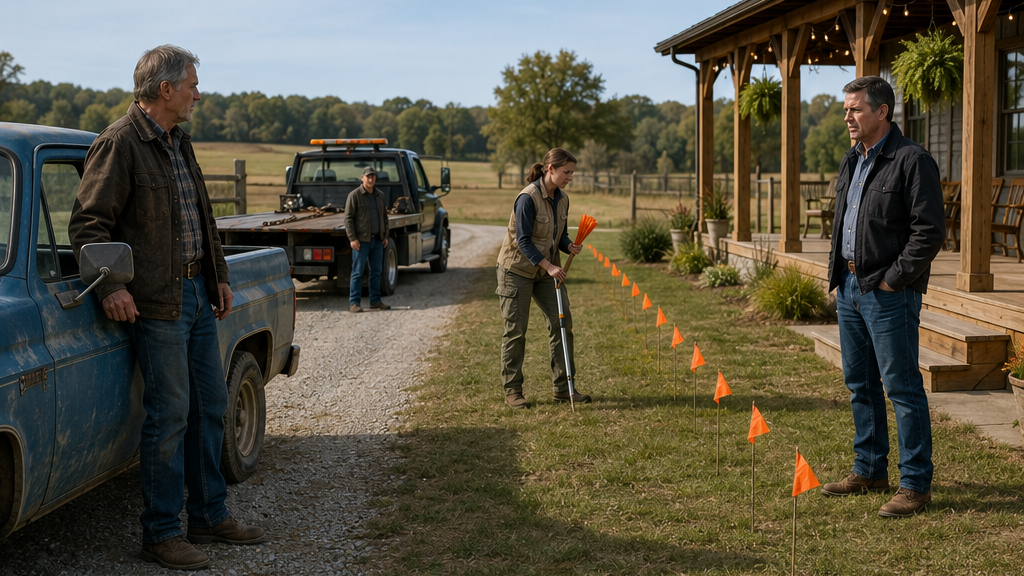
They Threatened to Tow His Farm Truck—Then the Survey Flags Crossed the Chairman’s New Porch
Chapter 1: The Tow Notice Waiting on Benjamin’s Windshield
The orange tag snapped against the windshield of Benjamin Hill’s blue pickup every time another car rolled past the farm entrance.
He noticed it from halfway across the hay lot.
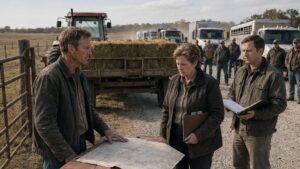
Three SUVs were creeping down the shared gravel road toward Gregory Roberts’s event barn, polished enough to throw back the afternoon sun. Their tires pushed pale dust into the ditch grass. A fourth vehicle slowed near Benjamin’s gate while its driver looked from the old pickup to the cedar-sided barn farther up the road.
Benjamin set down the fence pliers he was carrying and walked toward the truck.
The tag was tucked beneath the driver-side wiper.
PRIVATE ROAD ASSOCIATION — VEHICLE REMOVAL NOTICE.
Below that, in heavier type, was a deadline: forty-eight hours.
Benjamin read it twice.
His pickup was fourteen years old, faded around the hood, with a rust bloom above one rear wheel and a dark stain beneath the transmission. It was not pretty. It was also parked where it had been parked most afternoons for seven years, on packed gravel beside his own cattle gate.
Gregory stood across the road near the entrance to his event property.
He wore clean work boots and a pale button-down shirt with the sleeves rolled precisely to his forearms. Behind him, strings of small bulbs hung beneath the roofline of the renovated barn. Two workers were carrying folding tables through an open side door.
Benjamin held up the notice.
“You put this here?”
Gregory crossed the road without hurry.
“The association did.”
“You’re the chairman.”
“I’m the one who signed it.”
Benjamin looked down at the gravel beneath his boots.
The traveled portion of the shared road was easy to see. Fresh tire tracks ran through the center. His truck sat well beyond them, nose pointed toward his pasture.
“What exactly am I blocking?”
“It isn’t only about blocking.”
“Then what is it about?”
Gregory glanced toward the event barn as another SUV turned in.
“We’ve had complaints about congestion at the entrance. My insurer did a site walk last week. They want the approach kept clean and predictable.”
Benjamin looked at his truck.
“Predictable.”
“You know what I mean.”
“No. I don’t.”
Gregory’s jaw tightened slightly. “Vehicles stored near the entrance. Equipment. Oil staining. Sight lines. We have guests pulling in who don’t know the road.”
“This is a farm road.”
“It’s also shared access.”
“And that truck is on my side of it.”
Gregory folded his arms. “That’s what you believe.”
Benjamin almost laughed, but something in Gregory’s tone stopped him.
For years, Benjamin had dealt with road questions the way his neighbors did: somebody’s culvert washed out, they fixed it; a limb fell, whoever found it brought a saw; gravel got thin, they argued about invoices and eventually paid their shares.
He hated meetings. He hated bylaws more.
His father had loved both whenever land was involved.
Benjamin could still picture stacks of yellow legal pads across the kitchen table, property descriptions copied by hand, fence measurements, names of surveyors, dates of county filings. The last decade of his father’s life seemed to contain a dispute for every corner post.
Benjamin had promised himself he would never live like that.
He pulled the notice from under the wiper.
“I’ll move it when I need to use it.”
“That isn’t what the notice says.”
“Then the notice can be wrong.”
Gregory exhaled through his nose. “Benjamin, I’m not trying to turn this into something.”
“You put a tow notice on my truck.”
“Because you ignored the written warning last week.”
Benjamin remembered the envelope he had left unopened on the counter for three days, then skimmed while eating breakfast. He had assumed it was another road-maintenance notice and dropped it into the drawer beside feed receipts.
Gregory continued, quieter now.
“We have a wedding tomorrow and another event Sunday. Monday morning, the entrance has to be clear.”
Benjamin looked up.
“Monday?”
“The tow company is already scheduled.”
The words landed differently than the orange tag had.
“You already called a tow truck?”
“I scheduled one in case you refused.”
“You scheduled somebody to come onto my frontage and take my truck?”
Gregory’s expression changed—not uncertainty exactly, but caution.
“If it is on association-controlled access, yes.”
Benjamin stepped away from him and walked toward the edge of the road.
The ditch began several feet beyond the truck. He paced from the centerline to the pickup, then from the pickup to the old wire fence behind it. There was room for a hay wagon to pass. There was room for two pickups to squeeze by each other if they had to.
Gregory watched.
“You can measure with your boots all afternoon,” he said. “That won’t establish the legal corridor.”
Benjamin stopped.
For the first time, irritation gave way to something colder.
“Legal corridor?”
“The association maintains a defined access area.”
“Since when?”
“Since before either of us was on the board.”
“I’ve never been on the board.”
“That’s part of the problem.”
Benjamin turned to face him.
“No. That’s part of why my afternoons aren’t wasted.”
Gregory almost smiled, but didn’t.
A pickup approached slowly from down the county road. Edward Campbell was driving, one hand high on the wheel. At seventy-eight, Edward moved carefully everywhere except behind an old truck, where he still drove as though gravel belonged under the tires.
He pulled onto the shoulder and lowered his window.
“What’s all this?”
“Road business,” Gregory said.
Edward’s eyes settled on the orange tag in Benjamin’s hand.
“What kind?”
Benjamin passed it over.
Edward read without speaking.
Gregory checked his phone. “I’ve got people waiting. Benjamin, Monday morning. I’d rather not have it get ugly.”
He walked back toward the event barn.
Benjamin watched him go.
Edward handed back the notice.
“Did the treasurer sign off on this?”
“Gregory says the association did.”
Edward grunted.
Benjamin called the road-association treasurer before going back to the hay lot.
The answer did not improve his mood.
“Yes,” the treasurer said after a pause. “It’s official. Gregory brought the road rules to me Wednesday. Said the insurer wanted action. I told him I didn’t like towing anybody’s property, but the notice went out.”
“You know where my truck sits.”
“I know where it looks like it sits.”
Benjamin said nothing.
The treasurer added, “That’s the trouble. Nobody’s had that stretch properly marked in years.”
When the call ended, Benjamin found Edward standing beside the roadside fence.
The old man was looking past the pickup toward Gregory’s porch, a broad timber structure built onto the event barn’s office wing two summers earlier.
Edward tapped his cane once against the gravel.
“You remember where the fence used to come through here?”
Benjamin frowned. “Fence has been where it is since I took over.”
“That fence, yes.”
Edward pointed several feet away, toward a shallow dip in the grass where nothing stood now.
“I mean the one before it.”
Benjamin looked at him.
Edward’s face had lost its usual teasing expression.
“Before you move that truck,” he said, “find where the old line really was.”
Chapter 2: The Old Fence Line Nobody Wanted Discussed
Edward Campbell pointed his cane into empty grass as though a fence still stood there.
“Right through that dip,” he said.
Benjamin followed the line with his eyes.
It began near the county-road ditch, crossed the frontage at a slight angle, then seemed to disappear toward Gregory’s property. Nothing about the ground announced a boundary. The grass had been mowed evenly. Gregory’s landscaping crew had planted ornamental grasses farther up the slope. Beyond them stood the long timber porch, clean and new against the renovated barn.
“You sure?” Benjamin asked.
Edward gave him a look.
“I’m old. I’m not blind.”
“I didn’t say you were.”
“You were thinking it loud enough.”
Benjamin crouched near the ditch. At first he saw nothing except clover and gravel kicked out from the road. Then, beneath a tangle of dead grass, he found the top of a weathered wooden post cut nearly flush with the soil.
A small strip of faded plastic ribbon clung beneath an old staple.
Once, it might have been orange.
Benjamin rubbed dirt from it with his thumb.
“Survey ribbon?”
“Could be.”
“Could be baler twine.”
“Could be,” Edward said. “That’s why you don’t build a case out of an old man’s memory and a piece of plastic.”
Benjamin stood.
“Then why tell me?”
Edward looked toward the porch.
“Because your father and mine spent twenty years disagreeing about what that strip was for.”
Benjamin felt the familiar resistance rise in him.
“There it is.”
“What?”
“My father.”
“You asked.”
“I didn’t.”
“You were about to.”
Benjamin turned toward the farmhouse.
He had spent years refusing to inherit arguments that belonged to dead men. His father could turn a bent fence staple into a three-hour lecture about easements. He kept plats inside feed catalogs and copies of deeds in a metal box beneath his desk. When Benjamin suggested simply asking a neighbor what they needed, his father would answer, A handshake is for after you know what you’re shaking on.
At the time Benjamin had thought it was a miserable way to live.
Sometimes he still did.
Edward followed him as far as the gate.
“Your dad knew that road wasn’t the line,” he said.
Benjamin stopped.
“What does that mean?”
“Means the gravel moved.”
“When?”
“More than once.”
Edward pointed toward a low spot where the modern lane curved gently uphill. “It used to run straighter. Then the lower section washed bad. Folks shifted it. Later they widened it.”
“And the boundary?”
“Ground doesn’t move because gravel does.”
Benjamin looked back toward his pickup.
If Edward was right, Gregory’s whole argument about an association-controlled corridor depended on a line nobody could currently see.
That evening Benjamin ate standing at the kitchen counter.
The orange tow notice lay beside his plate.
For ten minutes he ignored it.
Then he opened the drawer where he had thrown Gregory’s first letter.
The earlier notice was less aggressive. It cited “stored vehicles and equipment within the maintained entrance area” and asked owners to remove anything affecting visibility or appearance before the weekend event schedule.
Benjamin read it properly for the first time.
He had not answered.
That bothered him more than he wanted it to.
Gregory had overreached, but Benjamin had made it easy by treating the first warning as beneath his attention.
He folded both notices together and went to the small room off the kitchen that had once been his father’s office.
Most of the old files were still there.
Benjamin had cleaned out tax returns, bank statements, machinery warranties. The property boxes he had barely touched.
One was marked ROAD / EAST FRONTAGE.
He stared at it for a long moment before pulling it down.
Inside were maps, receipts for gravel, road-association letters from before there had formally been an association, and several pages in his father’s square handwriting.
Benjamin found the note halfway through a yellow legal pad.
Road line is not ownership line.
Below it were three measurements from an iron pin near the county road.
He sat back.
There was no explanation, only a date from almost twenty years earlier and a rough sketch showing a fence angled differently from the present one.
Benjamin carried the sketch outside with a flashlight.
Night insects rattled in the ditch grass.
He measured as best he could from the approximate location of the old road pin to the pickup. Even allowing for his rough starting point, the truck appeared well inside the frontage shown on his father’s sketch.
That was the first good news he had received all day.
Then he extended the imagined line uphill.
His flashlight beam crossed Gregory’s mowed grass.
Then the flower bed.
Then the outer edge of the new porch.
Benjamin lowered the light.
“No,” he said quietly.
Saturday morning, he showed the sketch to Edward.
Edward studied it on the hood of the blue pickup.
“That looks like his notes.”
“You knew about this?”
“I knew there was an old access strip.”
“That isn’t the same answer.”
Edward handed the paper back.
“Your father thought every old disagreement improved with age. I didn’t.”
Benjamin waited.
Edward finally said, “My father was involved when the access was formalized. Early seventies. People needed a reliable way from the back farms to the county road.”
“Who owned what?”
“That’s where memory gets dangerous.”
“You remembered the fence.”
“I remember fence posts. I remember tractors. I remember men arguing over where to put gravel. I’m not going to tell you a legal boundary from something I saw fifty years ago.”
Benjamin could not fault him for that.
“What happened to the papers?”
“County should have them.”
“Should?”
Edward smiled without humor. “Now you sound like your father.”
Benjamin folded the sketch.
By noon, he had called three survey companies. One could come in two weeks. Another never answered.
Michelle Adams returned his message shortly after one.
Benjamin explained the tow deadline, expecting her to say Monday was impossible.
Instead she asked for the parcel numbers.
He read them from his tax statement.
There was a pause while she typed.
“I have a crew cancellation Monday morning,” she said. “I can do preliminary fieldwork if I pull the records beforehand.”
“How early?”
“Seven-thirty.”
Benjamin looked through the window toward the truck.
Gregory’s notice gave him until eight.
“The tow company’s supposed to be here Monday morning.”
“Then tell them not to disturb any monuments or stakes.”
“I don’t have any stakes.”
“You might by then.”
After the call, Benjamin stood in the kitchen with his father’s legal pad open under one hand.
For years those pages had represented everything he did not want to become.
Now one sentence on yellow paper had done something Gregory’s official notice had not.
It had made Benjamin curious enough to check.
Outside, the blue pickup sat where it always had.
Monday morning, a surveyor and a tow truck were both coming to decide what that patch of gravel really was.
Chapter 3: Orange Flags Ran Straight Beneath the New Porch
The tow truck arrived while Michelle Adams was driving her first orange flag into the ground.
Benjamin heard the chains before he saw the truck.
Metal clattered against the flatbed as it came off the county road and stopped partly on the shoulder. The driver climbed out, looked at Benjamin’s blue pickup, then at Michelle’s tripod and measuring equipment.
“This the vehicle?”
“Depends who you ask,” Benjamin said.
The driver frowned.
Gregory came down from the event-barn porch before Benjamin could say more.
He was dressed for work, not events this time—jeans, boots, dark jacket. He carried a folder under one arm.
“You got the notice,” he said.
“I did.”
“Deadline passed at eight.”
Benjamin checked his watch. “It’s eight-oh-three.”
Gregory looked toward Michelle.
“And this?”
“Survey.”
“You ordered a survey over a parking notice?”
“I ordered one because you said you knew where the legal corridor was.”
Gregory’s mouth tightened.
Michelle lifted her head from the instrument.
“If everyone can stay clear of the line I’m running, I’ll be faster.”
Gregory walked toward her. “Are you establishing the road easement?”
“I’m recovering boundary evidence and mapping relevant features.”
“That wasn’t my question.”
“It’s the answer I can give before I finish.”
Benjamin almost smiled.
He didn’t.
Michelle placed another flag.
The first stood near the county-road frontage. The second appeared several yards uphill. A third went into the grass behind Benjamin’s pickup.
Gregory watched closely.
“So the truck is inside the access strip.”
Michelle adjusted the prism pole.
“I haven’t said that.”
“You just marked behind it.”
“I marked a recovered line.”
Benjamin stepped nearer.
“Which line?”
Michelle pointed. “Preliminary boundary alignment based on the monuments and record description I’m working from.”
The tow driver folded his arms against the flatbed.
“Anybody going to tell me if I’m loading that pickup?”
Gregory answered first. “Yes.”
Benjamin said, “No.”
The driver stared at both of them.
“I get paid either way. I just prefer not to get sued either way.”
Michelle continued working.
She planted another orange flag past the truck.
Then another.
Benjamin felt some of the tightness in his chest ease.
The line was not cutting beneath his tires. It was not even close.
His pickup sat fully on his side of the preliminary boundary.
Gregory noticed it too.
“This isn’t about the parcel boundary,” he said. “The association controls access beyond the traveled road.”
“How far beyond?” Benjamin asked.
“The recorded corridor.”
“Show me.”
Gregory opened his folder and produced a photocopy of an association map.
It showed the modern gravel lane with a shaded band along both sides.
Benjamin looked at the date.
The map was twelve years old.
“That’s not a deed.”
“It reflects the easement.”
“Does it?”
Gregory’s face hardened.
For one dangerous second Benjamin wanted to push.
He wanted to ask loudly enough for the tow driver and the workers near the barn to hear whether Gregory had ever actually read the easement he kept invoking.
Instead he folded the copy once and handed it back.
“Let her finish.”
Gregory stared at him, then moved away.
Michelle planted the next flag.
It landed near the edge of Gregory’s manicured frontage.
The orange line had not stopped at Benjamin’s property entrance.
That changed the atmosphere.
Even the tow driver stopped checking his phone.
Michelle worked uphill, occasionally returning to the instrument, then pacing forward with the prism.
One flag appeared beside Gregory’s ornamental grass.
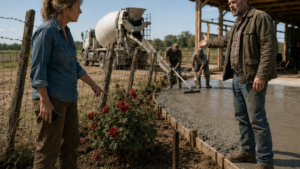
The next went just outside the flower bed.
Gregory stepped forward.
“Why are you continuing onto my side?”
Michelle glanced at him.
“Because the line continues.”
“You’ve already established his frontage.”
“I was hired to identify the relevant boundary.”
“What relevant boundary?”
Michelle did not answer until she had taken another measurement.
Then she walked toward the porch.
Benjamin’s first reaction was that something must be wrong.
Gregory’s porch had been built two summers earlier as part of the event-barn expansion. Heavy timber posts supported a broad roof. The railings were stained dark brown, and the outer corner looked square to the modern road.
Michelle drove an orange flag into the lawn less than two feet from the first porch post.
Gregory laughed once.
Not because it was funny.
“You’re off.”
Michelle ignored him.
She moved several feet farther.
Another flag.
This one went beneath the porch overhang.
Benjamin stared.
Michelle repositioned her equipment and checked again.
The next orange flag appeared on the other side of a timber post.
The line was running through the porch area.
Gregory stepped down from the boards.
“Stop.”
Michelle looked up.
“Excuse me?”
“You need to stop until we figure out what reference you’re using.”
“I know what reference I’m using.”
“That structure was permitted.”
“I don’t issue permits.”
“The county approved it.”
“That may be.”
Gregory’s voice rose. “Then your line can’t be right.”
Michelle’s expression remained flat.
“A permit doesn’t move a property line.”
Silence settled over the frontage.
Benjamin looked from the blue truck to the flags.
The same line Gregory had expected to prove Benjamin’s violation now ran in a bright orange procession past the truck, across the grass, and under the clean timber geometry of Gregory’s showpiece porch.
Michelle pulled out a tape.
She measured from the marked alignment to the outer edge of the structure.
“Approximately eleven feet at the widest point,” she said.
Gregory’s face went still.
Benjamin felt a burst of vindication so sharp it almost embarrassed him.
Eleven feet.
Gregory had threatened to tow a truck over a disputed strip of gravel while his own porch apparently crossed the line by eleven feet.
The tow driver let out a low whistle.
Gregory turned on him.
“Don’t.”
The driver raised both hands. “Didn’t say anything.”
Gregory faced Benjamin.
“You think this means you own my porch?”
“I didn’t say anything either.”
“You don’t have to.”
Benjamin looked at the flags.
For years he had imagined moments like this whenever somebody tried to tell him what he could do with his land: the clean proof, the other person finally forced to admit they were wrong.
It did not feel as clean as he had expected.
Michelle walked back toward them carrying her field tablet.
“The pickup is not crossing the parcel boundary I recovered,” she said. “That much I’m comfortable saying from today’s work.”
The tow driver nodded.
“That’s enough for me.”
Gregory turned sharply. “The association notice concerns the access easement, not just parcel ownership.”
“And that,” Michelle said, “is where this gets less simple.”
Gregory seized on the words.
“Exactly.”
He opened his folder again.
“There’s an old access easement through this frontage. The road association has rights across it. That’s what I’ve been telling him.”
Benjamin looked at Michelle.
“Does that easement cover my truck?”
“I haven’t completed the record review.”
Gregory pointed toward his porch.
“And if the easement is what I think it is, that structure could be within land I have use rights over.”
Benjamin frowned.
“You just said the association uses it for access.”
“Access rights can be broad.”
Michelle shook her head.
“Everybody needs to slow down.”
Gregory looked at her.
“You marked a line through my building.”
“I marked a boundary based on the monuments and legal description available to me. I did not tell either of you what every historical easement permits.”
The distinction drained some of the satisfaction from Benjamin.
The tow driver climbed back into his cab.
“I’m not touching the pickup,” he said through the window. “Call me when you people know whose gravel is whose.”
The flatbed backed toward the county road.
Gregory watched it leave.
Then he looked at the orange flags beneath his porch.
For the first time since Benjamin had known him, Gregory Roberts appeared to have nothing ready to say.
Michelle packed one piece of equipment, leaving the flags in place.
Benjamin asked, “So what happens now?”
“We pull the full recorded history.”
“You can’t tell us whether the porch has to come out?”
“No.”
Gregory exhaled.
Benjamin said, “Can you tell us whether he’s right about the easement?”
“Not yet.”
Michelle pointed toward the oldest section of the road.
“A survey tells you where things are. It does not automatically tell you every right attached to them.”
She looked at Benjamin, then Gregory.
“You’ve got a modern road, an older parcel line, and at least one recorded access instrument. Until we know how those fit together, neither of you should pretend the flags settle the whole argument.”
Benjamin glanced again at the line disappearing beneath Gregory’s porch.
The truck was safe.
That answer had taken less than an hour.
The larger question was now standing eleven feet wide in front of them.
Michelle closed her field case.
“The record reference I found starts in 1971.”
Edward had said his father was involved.
Benjamin looked toward the county road.
“What exactly happened in 1971?”
Michelle shook her head.
“That’s what we find out next.”
Chapter 4: The 1971 Access Strip Changed Both Men’s Story
The oldest deed described a road that no longer existed.
Benjamin Hill stood at the county recorder’s counter Monday afternoon with a photocopy spread beneath both hands, reading a property description that sent the old access route nearly straight across ground where the modern gravel lane now curved.
He read it again.
“Twenty feet in width, for purposes of ingress and egress…”
Then bearings. Distances. An iron pin. A walnut tree that had probably been gone for forty years.
Michelle Adams stood beside him with her field sketch open on a tablet.
“The language matches the reference I found this morning,” she said.
Benjamin traced the old route with one finger.
“That would put the road over here.”
“Back then, yes.”
“That’s not where the gravel is now.”
“No.”
“So Gregory’s map is wrong.”
Michelle looked at him.
“Don’t get ahead of it.”
The county recorder clerk returned carrying a second folder.
“This is everything indexed under that grantor name between 1971 and 1990.”
Benjamin recognized Edward Campbell’s family name on the oldest instrument.
Edward had been right about one thing: his father had been involved.
The 1971 document granted access across a narrow strip connecting several back parcels to the county road. It was written for practical farm use—tractors, livestock trucks, whatever people needed to move when the surrounding ground still belonged to fewer families.
The road itself was not the land.
It was a right to pass across it.
Benjamin felt the old sentence from his father’s legal pad return.
Road line is not ownership line.
For a moment, the answer seemed almost embarrassingly simple.
Gregory’s association map had treated the present gravel corridor as though the shaded strip surrounding it belonged to the association. It didn’t. At least not according to the 1971 language.
Benjamin leaned back.
“So he had no right to tow the truck.”
Michelle closed one file and opened another.
“Probably not under this instrument.”
“Probably?”
“The easement gives passage rights. It doesn’t automatically give the association authority over everything inside or beside it.”
“That sounds like no.”
“It sounds like somebody needs to read the association documents and the later property instruments together.”
Benjamin disliked answers that refused to finish themselves.
His father had been the opposite. The old man could find certainty in a coffee stain on a courthouse copy.
The clerk slid another instrument toward them.
“This one may matter.”
It was recorded seventeen years later.
By then, several parcels had changed hands and the road had been shifted uphill after repeated washouts. The later agreement narrowed the practical access corridor around the newer alignment and assigned maintenance obligations to the owners who used it.
Benjamin read slowly.
“What does ‘modified for purposes of maintenance and travel’ mean?”
Michelle answered carefully. “It means exactly what it says. The access arrangement was modified.”
“But the boundary?”
“Not here.”
She placed her field sketch beside the old plat.
The modern gravel lane curved. The old parcel line did not.
The orange flags she had placed that morning followed the parcel geometry recovered from monuments and descriptions. The later road agreement followed the traveled lane more closely.
Two different things.
Benjamin stared at them.
“So Gregory can’t claim that whole strip as his yard.”
“No.”
A small satisfaction returned.
Then Michelle touched the porch outline on her sketch.
“But you can’t claim this document alone means the whole porch has to come down either.”
The satisfaction disappeared.
Benjamin looked at her.
“Eleven feet crossed the line.”
“Across the parcel boundary, yes.”
“You measured it.”
“I did.”
“Then what am I missing?”
“Rights can overlap ownership. Easements can survive changes. Improvements can sometimes be treated differently depending on the instrument, later agreements, permits, setbacks, and how the property was conveyed.”
“That sounds like ten ways to avoid saying somebody built in the wrong place.”
Michelle gave him a tired look.
“I’m a surveyor. My job is to tell you where the line is. I’m trying very hard not to become your attorney.”
The recorder clerk pretended not to hear.
Benjamin folded his arms.
He had spent the entire morning imagining Gregory’s porch reduced to a simple fact: eleven feet over.
Now the paper had complicated it.
That irritated him more than Gregory’s confidence had.
By Tuesday morning, Benjamin had copies of four instruments spread across his kitchen table.
The orange flags were still visible through the window beyond the pasture entrance.
They looked different now.
On Monday they had seemed like verdicts.
Now they looked like questions.
Edward arrived shortly after breakfast.
Benjamin handed him the 1971 copy.
Edward read the first page and nodded.
“My father signed that.”
“You knew.”
“I knew there was an agreement.”
“You didn’t think that was worth mentioning before Monday?”
“I did mention it.”
“You said there was an old access strip.”
“That’s what this is.”
Benjamin pushed back from the table.
“You could have told me your father signed the thing.”
Edward set the paper down.
“And then what? You’d have treated my memory like a deed?”
Benjamin had no answer.
Edward pointed to the later modification.
“This is why I kept my mouth from doing too much work. People remember the first arrangement. They forget the second.”
“You knew about this one too?”
“I knew the road shifted.”
“That’s not the same.”
“No.”
Edward’s eyes narrowed.
“And you had your father’s notes twenty yards from your kitchen all these years.”
That landed harder than Benjamin expected.
He looked at the metal file box on the floor.
The truth was inconvenient.
Gregory had assumed too much.
So had Benjamin.
Gregory had trusted association practice and a modern map. Benjamin had trusted dislike—his dislike of committees, old disputes, and anything his father had considered important enough to label in block letters.
Neither had checked until someone threatened a tow.
A pickup came up the shared road and slowed near the orange flags.
Benjamin watched it pass.
“What happens now?” Edward asked.
“We find out why the county approved Gregory’s porch.”
Edward’s expression changed.
“You know it was approved?”
“Gregory said it was.”
Benjamin gathered the papers.
“That’s one thing I’m willing to verify.”
The county building file was thinner than Benjamin expected.
The clerk at the permitting counter found the porch application, the site sketch, inspection notes, and final permit card.
At first everything appeared ordinary.
The construction had been reviewed.
Footings inspected.
Framing inspected.
Final inspection signed.
Benjamin felt his case shrinking into administrative fog.
Then the clerk turned over the original site-plan attachment.
A yellow note had been clipped to it.
BOUNDARY CONFIRMATION REQUIRED PRIOR TO FINAL STRUCTURAL APPROVAL.
Benjamin read the words twice.
Michelle leaned closer.
“Is there a survey attached?”
The clerk searched the folder.
“No.”
“Boundary letter?”
“No.”
“Recorded waiver?”
The clerk shook her head.
Benjamin looked at the final approval date.
Then at the yellow note.
Gregory’s porch had passed inspection.
But somewhere between “boundary confirmation required” and “final approved,” the confirmation itself had disappeared.
Benjamin placed one finger beside the handwritten requirement.
“Was this ever completed?”
The clerk looked through the file once more.
“If it was,” she said, “it isn’t here.”
Chapter 5: Gregory Had Been Warned Before the Porch Was Finished
Gregory Roberts was waiting outside Benjamin’s gate Tuesday evening with the contractor’s email already printed in his hand.
Benjamin had planned the confrontation differently.
He had imagined laying the permit file on Gregory’s desk, pointing to the missing boundary confirmation, and watching the man explain himself.
Instead Gregory held out two pages before Benjamin could speak.
“You were going to find this.”
Benjamin did not take them immediately.
“Find what?”
“The reason the boundary letter isn’t in the county file.”
The orange survey flags glowed against the evening grass behind him.
Gregory looked toward them, then back at Benjamin.
“Read it.”
Benjamin took the pages.
The email was from Gregory’s event-barn contractor, dated three months before the porch had been completed.
The first paragraph concerned lumber delivery.
The second concerned the property line.
Existing record information appears inconsistent with visible road alignment. Recommend licensed boundary verification before porch posts are finalized.
Benjamin read that sentence again.
“You knew.”
Gregory’s expression tightened.
“I knew there was a question.”
“You knew enough that your contractor told you to get a survey.”
“I knew the old road records were messy.”
“And you built it anyway.”
Gregory looked past Benjamin toward the farmhouse.
“Come up to the office.”
“I’m fine here.”
“I’m not discussing six months of construction beside the road.”
Benjamin almost refused because Gregory had asked.
Then he recognized the impulse for what it was.
He followed him uphill.
Inside the event-barn office, the room smelled faintly of coffee and new wood. A calendar on the wall was crowded with weekend bookings. Gregory set another folder on the desk.
“I didn’t hide the email.”
“You didn’t give it to the county.”
“The contractor copied the project file. The county already had the note requiring confirmation.”
“Which never happened.”
Gregory rubbed a hand across his jaw.
“The survey company I called couldn’t get out for six weeks.”
“So you waited.”
“No.”
Benjamin said nothing.
Gregory looked through the window toward the porch.
“We had fourteen booked events.”
“That’s why?”
“It was part of why.”
“Fourteen weddings make a boundary move?”
Gregory turned.
“Don’t do that.”
“Do what?”
“Make this sound easier than it was.”
Benjamin folded the email.
“It was easy enough when my truck was the problem.”
Gregory absorbed that without arguing.
Then he sat.
“The barn renovation ran four months late. The lender had already extended the construction note. The insurance carrier wanted the guest entrance finished before they renewed the event coverage. If we lost that season, I was carrying the loan another year without the revenue we built the whole project around.”
Benjamin glanced at the booking calendar.
“That doesn’t explain why you skipped the survey.”
“No. It explains why I wanted to believe I didn’t need it.”
The admission changed the room.
Benjamin had expected denial.
Gregory continued.
“The contractor said the visible road didn’t match one of the old descriptions. I had the association map. I had the later maintenance agreement. The porch was outside the traveled lane and outside what everybody had treated as the access area for years.”
“So you decided that was good enough.”
“Yes.”
Gregory looked directly at him.
“I decided it was good enough.”
There it was.
Not theft.
Not ignorance.
A choice.
Benjamin hated that the difference mattered.
Gregory had not built eleven feet across a line because he meant to take Benjamin’s land. He had seen uncertainty and chosen the interpretation that preserved his schedule.
Then, two years later, he had treated uncertainty about Benjamin’s truck as though it did not exist.
Benjamin laid the email on the desk.
“You see the problem.”
“Yes.”
“Do you?”
Gregory stood again.
“I see it.”
Outside, voices carried from the road.
Two neighboring landowners had stopped beside the flags. One pointed toward the porch.
Gregory saw them through the window.
“They know?”
“It’s a road with six properties on it. Of course they know.”
“One of them called me this afternoon and asked when I was resigning.”
Benjamin turned back.
“And?”
“And I told him there hadn’t been a meeting.”
“You put a tow notice on my truck without a meeting.”
“The board authorized enforcement.”
“The board let you handle enforcement.”
Gregory’s face hardened.
“That distinction is going to become very popular this week.”
For the first time Benjamin understood the broader problem.
For years the association had worked because nobody wanted to spend Wednesday evenings debating culverts and gravel invoices. Gregory handled things. The treasurer signed checks. Residents complained when costs rose and otherwise stayed away.
Convenience had slowly become authority.
Now the same informality threatened to tear the arrangement apart.
One neighbor wanted Gregory gone.
Another had already asked whether past assessments could be challenged.
The treasurer had left Benjamin a message asking him to attend an emergency meeting Wednesday.
Benjamin had wanted his truck left alone.
He had accidentally opened the governance of the entire road.
Gregory walked onto the porch.
Benjamin followed.
The orange flags ran beneath them.
One stood between two timber posts, its plastic ribbon barely moving.
Gregory gripped the railing.
“I told the landscapers not to touch those.”
“Good.”
Gregory gave him a sideways look.
“That surprise you?”
“A little.”
They stood without speaking.
Benjamin could see where the porch crossed the recovered parcel line now that he knew where to look. There was nothing visible in the woodwork itself. No crooked board. No obvious trespass.
Only flags.
Gregory said, “County called me.”
Benjamin turned.
“They’re reviewing the permit.”
“What did they say?”
“That they need the survey and the old instruments before they decide what correction is required.”
“Correction.”
“That’s their word.”
Gregory stared over the railing.
“They said full removal is unlikely unless access clearance can’t be restored another way.”
Benjamin felt an unexpected disappointment and was ashamed of it almost immediately.
For a day, he had pictured the entire porch coming down.
The thought had been satisfying in exactly the way his father’s old arguments used to be satisfying to his father.
Winning made visible.
Gregory seemed to read something in his face.
“You wanted them to tear it all out.”
Benjamin did not answer.
“Wouldn’t blame you,” Gregory said.
“That supposed to help?”
“No.”
Gregory released the railing.
“I was wrong about the truck.”
“You were.”
“I was wrong to issue the tow notice before confirming the corridor.”
“Yes.”
“I’m still not wrong that the entrance has become a problem.”
Benjamin looked toward the gravel road.
A delivery van slowed to pass a tractor coming the other direction.
Gregory said, “That’s what keeps getting lost. Guests miss the turn. Trucks stop. Cars stack at the county road. My insurer wasn’t inventing it.”
“You made my pickup stand in for the whole problem.”
“I did.”
Benjamin appreciated the plainness of the answer more than he wanted to.
Gregory turned toward him.
“Tomorrow night, they’re going to want my head and your blessing.”
“I’m not giving anybody anything.”
“You’ll have to.”
“No.”
“You will if the county says that porch crosses your boundary.”
Benjamin looked down at the nearest flag.
Gregory’s voice dropped.
“If they require alteration, what are you asking for?”
Benjamin looked up.
“Why are you asking me now?”
“Because everybody else is going to ask tomorrow.”
He nodded toward the porch around them.
“Full removal? Eleven feet cut off? New access? Money? What?”
Benjamin opened his mouth.
Nothing came.
All week he had been fighting for a line.
Now Gregory was asking what he intended to do once he had it.
Chapter 6: Benjamin Refused the Victory Everyone Expected Him to Take
The tow notice lay in the middle of the association table Wednesday evening, directly beneath a single orange survey flag Benjamin had carried in from the road.
Nobody had planned the arrangement.
Benjamin had set the flag down because he did not want to hold it.
The treasurer placed the tow notice beside it five minutes later.
Now twelve people sat in Gregory’s event barn staring at both.
Gregory occupied a chair near the end instead of his usual place at the center.
One neighboring landowner spoke first.
“I think we can save ourselves an hour. Gregory resigns, porch comes down, and we hire somebody to rewrite the road rules.”
Another neighbor shook his head.
“You can’t order a porch demolished because you’re mad about a truck.”
“It’s eleven feet over.”
“Over what?”
“The property line.”
“The access strip complicates that.”
“That’s what Gregory keeps hiding behind.”
Gregory’s chair scraped.
“I’m sitting right here.”
The room sharpened immediately.
The treasurer raised both hands.
“We’re not doing this by shouting.”
Benjamin almost laughed.
For years the association had avoided formal procedure because everyone considered it unnecessary. Now, with the chairman’s authority under question, they suddenly wanted parliamentary discipline.
A county review letter rested in front of the treasurer.
She tapped it.
“This came this afternoon. The county has reviewed Michelle Adams’s preliminary survey and the recorded access instruments. They’re requiring the historic access clearance to remain unobstructed.”
Gregory nodded once.
“Which means?”
“Some portion of the porch and landscaping will have to be altered. They have not ordered total removal.”
The first neighbor leaned back, dissatisfied.
“So he gets to keep most of it.”
“This isn’t punishment,” the treasurer said. “It’s compliance.”
Benjamin looked at the orange flag.
The distinction sounded important.
It also sounded suspiciously like something his father would have argued with for three hours.
The discussion moved to the tow notice.
The treasurer opened the association rules.
“We have authority to maintain the shared road, assess owners for maintenance, and address obstructions affecting travel.”
She looked at Gregory.
“I do not see explicit authority to remove a privately owned vehicle from deeded frontage without additional process.”
Gregory’s mouth tightened.
“We’ve removed equipment before.”
“With permission.”
“We told owners to move it.”
“Which they did.”
“So the practical authority existed.”
Benjamin finally spoke.
“Practical authority isn’t the same as written authority.”
The room went quiet.
The words sounded enough like his father that Benjamin nearly regretted them.
Gregory looked at him.
“You’ve had that sentence waiting all day?”
“No.”
“It was good.”
A few people shifted, unsure whether Gregory was joking.
Benjamin looked down at the original warning letter.
“I should’ve answered this.”
The treasurer blinked.
Benjamin tapped the first notice.
“I got it. I skimmed it. Then I stuck it in a drawer because I figured Gregory was making himself important.”
Gregory said nothing.
Benjamin continued.
“If I’d called, maybe this stays a parking argument. Maybe we still end up surveying. I don’t know. But pretending the letter didn’t deserve an answer didn’t help.”
The first neighbor frowned.
“You’re not the one who threatened a tow.”
“No.”
Benjamin looked at Gregory.
“He did that.”
Gregory met his eyes.
“And that was wrong.”
No one seemed prepared for the agreement.
The treasurer drew a line through a paragraph on her notes.
“Then I’m proposing the association formally withdraw the tow directive and suspend any claimed towing authority until written procedures are adopted.”
There was no applause.
Only several nods and the scratching of pens.
The tow notice had gone from threat to evidence.
Benjamin felt a quiet relief that was almost disappointing in its size.
His truck would stay.
That was what he had wanted on Friday.
It no longer felt like the whole question.
One of the neighbors pointed toward Gregory.
“And the chairmanship?”
Gregory leaned forward.
“I’ll step aside from enforcement matters while this is resolved.”
“That isn’t resigning.”
“No.”
“You think you should still run this board?”
Gregory’s expression changed.
“I think this road still needs gravel invoices paid, culverts scheduled, and insurance reviewed while everybody decides what example they want to make of me.”
The neighbor started to answer, but Benjamin spoke first.
“He’s right about one thing.”
Heads turned toward him.
Benjamin hated that.
“The entrance has problems.”
The neighbor stared.
“After what he did to you?”
“That doesn’t make the sight-line problem disappear.”
Gregory looked at Benjamin but said nothing.
Benjamin picked up the orange flag.
“When Michelle put this line in the ground Monday, I thought it settled everything.”
He rolled the thin wire stem between his fingers.
“It didn’t.”
Nobody interrupted.
He nodded toward Gregory.
“He treated the road map like it answered every question because that was convenient. I treated my father’s property boxes like they answered nothing because that was convenient for me.”
The admission tightened something behind his ribs.
He had avoided those boxes for years and called the avoidance wisdom.
His father had been difficult.
That did not make every measurement the old man saved meaningless.
Benjamin placed the flag back beside the tow notice.
“If we’re going to have rules, they need to say what authority the association actually has. Where the maintained corridor is. What happens when something blocks it. And it needs to apply the same whether it’s my pickup, somebody’s hay wagon, or Gregory’s porch.”
The room stayed still.
The treasurer said, “That’s reasonable.”
The first neighbor looked disappointed.
“Reasonable isn’t the point.”
Benjamin turned to him.
“It’s exactly the point.”
The neighbor leaned back.
“So you don’t want the porch removed?”
“I want the access protected.”
“You own the ground under part of it.”
“Some of it. With recorded rights crossing it. Which is why I’m done pretending one sentence explains the whole thing.”
Gregory lowered his eyes.
The county letter specified minimum clearance around the historic access area. Michelle’s corrected drawing showed that Gregory could preserve most of the porch if the outer section were cut back and one support line relocated.
The solution would be expensive.
It would also leave the building standing.
The treasurer asked Benjamin, “You’re willing to accept that?”
Benjamin looked toward the barn doors.
Outside, twilight had flattened the pasture into dark shapes. Somewhere down the road, his blue pickup sat exactly where it had been on Friday.
“I’m willing to accept the same line I expect everybody else to accept.”
Gregory looked up.
The first neighbor shook his head.
“If that were my land—”
“It isn’t.”
Benjamin did not say it sharply.
That seemed to end the argument better than anger would have.
The meeting moved through motions.
The towing directive was withdrawn.
A committee would draft written enforcement limits.
Michelle’s final survey would be incorporated into the association’s road records.
Gregory would step aside from enforcement decisions and from any vote concerning his own construction.
Near the end, the treasurer asked whether anyone had anything else.
Gregory raised his hand.
Everyone looked at him.
He faced Benjamin rather than the table.
“County wants my correction proposal Friday.”
Benjamin waited.
Gregory continued.
“The contractor can redesign the porch edge. Move the outer posts. Pull the landscaping back.”
“That sounds like what they asked for.”
“It is.”
Gregory paused.
“But I want the condition clear.”
Benjamin frowned.
“What condition?”
“Yours.”
The room became silent again.
Gregory nodded toward the survey flag.
“You said the same line binds everybody. Fine. What do you require from me?”
Benjamin looked at the flag, then at the man who had put a tow notice on his windshield five days earlier.
He could ask for more.
Part of him still wanted to.
Instead he said, “Redesign the encroaching section so the surveyed access line stays permanently clear. Put the correction in the county file. Put the final survey in the association records.”
Gregory waited.
“That’s it?”
“No.”
Benjamin leaned forward.
“Next time you’re not sure where your authority stops, you check before you use it.”
Gregory’s face gave nothing away for several seconds.
Then he nodded.
“I can live with that.”
Benjamin picked up the orange flag.
Whether Gregory could live with the rebuilt porch was something Friday’s plans would show.
Chapter 7: The New Porch Stopped Where the Orange Flags Had Stood
The circular saw bit into Gregory Roberts’s porch at eight-thirteen on a Monday morning while Benjamin Hill’s blue pickup remained parked exactly where the tow notice had once hung from its windshield.
Benjamin heard the saw from the cattle lot.
He stopped with one hand on the gate chain and looked toward the event barn.
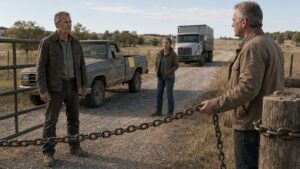
For three weeks, the orange survey flags had stood in the frontage grass like temporary punctuation marks. Now most were gone. Michelle Adams had replaced the important points with permanent markers, and Gregory’s contractor had stretched a taut line between them before cutting the first section of railing loose.
The old porch did not collapse.
There was no dramatic tearing apart of the building, no machinery ripping through the roof as some of the neighbors had half expected.
A worker removed one railing section.
Another braced a timber post.
Then the saw started again.
Benjamin finished chaining the cattle gate before walking uphill.
Gregory was standing beside a stack of salvaged boards.
He no longer carried the association folder everywhere.
“Morning,” he said.
“Morning.”
Benjamin looked at the exposed porch framing.
The correction was substantial enough to notice. The outer edge would move back, one support line would be relocated, and the landscaping nearest the old access strip had already been removed.
But most of the porch remained.
Gregory followed his gaze.
“Contractor says two more days if nothing unexpected shows up.”
“Something unexpected always shows up.”
“That’s what he said.”
For a moment neither man spoke.
A few weeks earlier, silence between them had felt like unfinished argument.
Now it simply felt cautious.
Gregory pointed toward a small wooden stake near the new corner.
“Michelle’s supposed to check that before they set the final post.”
“She coming today?”
“At ten.”
Benjamin nodded.
Gregory hesitated.
“I stepped down as chairman Friday.”
Benjamin looked at him.
“You said you were stepping aside from enforcement.”
“I decided that wasn’t enough.”
There was no self-pity in the words.
Gregory picked up a short piece of cut railing and moved it onto the scrap pile.
“The treasurer’s handling meetings until they elect somebody.”
“You running again?”
“No.”
Benjamin had expected to enjoy hearing that more.
Instead he looked toward the barn doors, where workers were setting tables for an event later in the week.
“You’ll survive.”
Gregory gave him a brief smile.
“That sounded almost friendly.”
“Don’t get ambitious.”
The smile stayed for another second.
The road association had changed too.
Its new enforcement rules were three pages long instead of three vague paragraphs. They distinguished the traveled road, maintenance corridor, deeded property, and recorded access rights. No private vehicle could be removed without written notice, a defined obstruction, and authorization beyond one officer’s decision.
Benjamin had read every line.
That fact alone would have amused his father.
He had even suggested two revisions.
That amused Benjamin less.
At ten minutes after ten, Michelle’s truck pulled into the frontage.
She stepped out carrying a field tablet and measuring pole.
“You two manage not to move the earth while I was gone?”
Gregory said, “We considered it.”
Michelle walked directly to the new porch corner.
The contractor showed her the post location.
She checked the permanent marker, took a measurement, then looked toward Benjamin.
“Want to verify where this finishes?”
Benjamin frowned.
“Me?”
Gregory leaned against the remaining railing.
“It touches your side of the access question. I’d rather you see it before they pour anything.”
Three weeks earlier Gregory would have told him what the line meant.
Now he was asking him to witness it.
Benjamin walked over.
Michelle indicated the new structural edge.
“This stays behind the parcel boundary and preserves the required access clearance.”
Benjamin studied the distance.
The new porch stopped cleanly before the marked line.
“No argument from me.”
Gregory called to the contractor.
“Go ahead.”
The contractor nodded and returned to work.
Benjamin started back toward his pickup when Michelle said, “There is one other thing.”
He turned.
She brought up the final survey.
“The association asked me to mark the full corrected access corridor, not just Gregory’s portion.”
Benjamin looked at the screen.
“So?”
Michelle enlarged the section near his cattle entrance.
His planned new gate—something he had mentioned casually during the association meeting—was sketched across the frontage.
The post location on the north side sat inside the clearance area.
Benjamin stared at it.
“That’s where the old post was.”
“The old post predates the corrected record work.”
“It’s been there forty years.”
“And if you replace the gate in the same configuration, the new post would reduce the required width.”
Gregory said nothing.
Benjamin looked at him anyway.
There was an opportunity sitting plainly between them.
Gregory could have smiled.
He could have said something about rules applying equally.
He could have reminded Benjamin of every sentence spoken at the meeting.
Instead he waited.
Benjamin looked back at Michelle.
“How far do I move it?”
“Thirty-two inches would clear it comfortably.”
“That puts the hinge into harder ground.”
“Yes.”
Benjamin exhaled.
“Of course it does.”
Michelle almost smiled.
“I don’t design farms.”
“No. You just make them inconvenient.”
“I mark where the inconveniences already are.”
Benjamin looked at the permanent boundary marker.
Three weeks earlier, he would have argued that a gate standing in roughly the same place for decades ought to count for something.
His father certainly would have.
There would have been old photographs, recollections, measurements, perhaps an afternoon spent proving why thirty-two inches represented an insult to history.
Benjamin rubbed his thumb along the folded survey copy.
“Move it thirty-two.”
Gregory looked at him.
“That easy?”
Benjamin glanced toward the shortened porch.
“No.”
Then he added, “Still moving it.”
Something changed in Gregory’s expression.
Not gratitude.
Recognition, maybe.
The same line that had embarrassed Gregory was now costing Benjamin something too.
Less money, certainly.
Less public consequence.
But the principle had finally become inconvenient in both directions.
That mattered.
By late afternoon, the new porch corner was standing.
The railing ended behind the surveyed clearance instead of crossing it. Fresh-cut timber showed pale against the older stained boards, making the correction obvious for now.
Benjamin suspected that after one season of weather it would all look ordinary.
That seemed right.
He did not need Gregory’s mistake preserved as a monument.
On his way home, Edward Campbell was parked beside Benjamin’s gate.
The old man looked uphill at the construction.
“Well?”
“Porch is shorter.”
Edward nodded toward the pickup.
“Truck still ugly?”
“Very.”
“Good.”
Benjamin opened the gate.
Edward’s gaze moved to the new permanent marker near the roadside.
“Your dad would’ve enjoyed this.”
Benjamin groaned.
“Don’t ruin it.”
“I didn’t say he’d have handled it well.”
Benjamin stopped.
Edward rested both hands on the top of his cane.
“He would’ve proved himself right and made sure nobody forgot it.”
“That sounds about right.”
“You did something different.”
Benjamin looked toward the farmhouse.
“I ignored the records for fifteen years because I didn’t want to be him.”
Edward nodded.
“That’s one way of letting a dead man keep running things.”
Benjamin looked back at him.
Edward shrugged.
“Old people occasionally earn one good sentence.”
Then he climbed into his truck.
That evening Benjamin went into the workshop carrying the last temporary orange flag.
Michelle had pulled it from the frontage after setting the permanent markers and handed it to him without explanation.
The plastic was faded along one edge from weeks of sun.
Benjamin stood beside the workbench.
Above it hung a ring of his father’s old farm keys: machinery keys, padlock keys, two that no longer fit anything Benjamin owned.
For years he had considered taking them down.
He never had.
He found an empty nail beside them and hung the orange flag there.
Not because his father had been right about everything.
He hadn’t been.
Not because Gregory had been wrong about everything either.
He hadn’t.
The flag stayed because it marked the point where Benjamin had finally learned the difference between defending a boundary and living for one.
Outside, his blue pickup waited beside the gate.
Tomorrow he would use it to haul feed.
Later that month he would move the new gatepost thirty-two inches.
Up the road, Gregory’s porch ended where the surveyed line said it should.
The boundary asked the same thing of both men now.
Benjamin switched off the workshop light and left the faded orange flag hanging beside his father’s keys.
The story has ended.