The Name He Couldn’t Say
Part I — The Room Where He Arrived Too Late
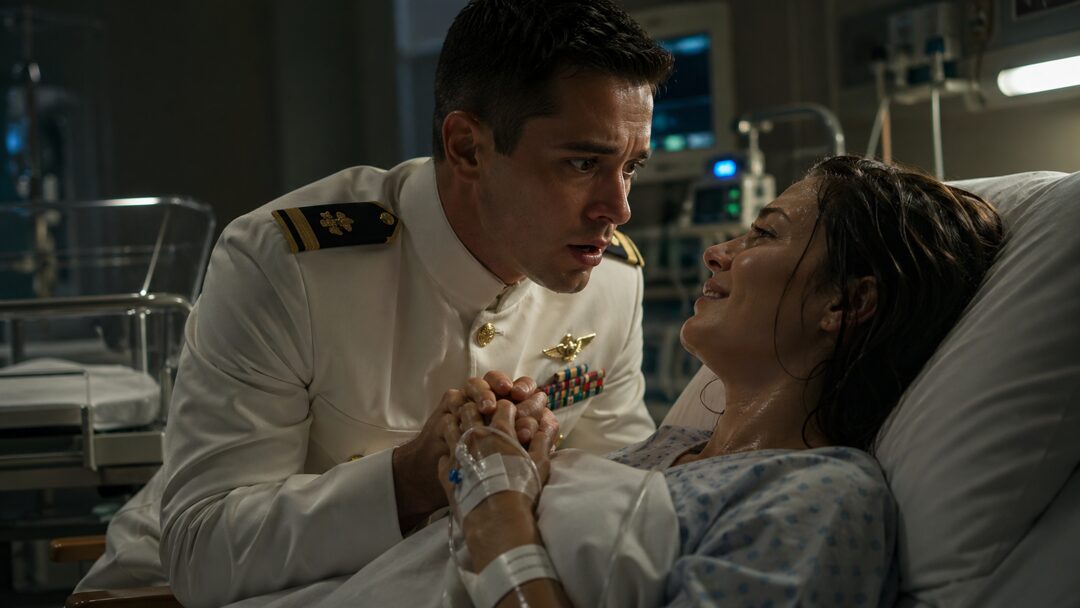
Lieutenant Aaron Hale entered the hospital room in dress whites and medals, looking more terrified than he had ever looked under fire.
The door struck the rubber stopper behind him. A nurse turned, startled. Somewhere down the hall, a monitor chirped in steady little notes that sounded too calm for the way his heart was behaving.
Lena was in the bed.
Alive.
Pale, damp-haired, propped against pillows with a hospital sheet pulled to her chest. Her lips were dry. Her eyes were tired in a way he had never seen before, not even after the last deployment, not even during the nights when she had stopped asking when he would be home because neither of them trusted the answer.
But she smiled when she saw him.
That was what broke him first.
Not the IV line taped to her hand. Not the blood pressure cuff. Not the empty bassinet beside the bed.
Her smile.
Aaron crossed the room too fast. His white shoes squeaked against the polished floor. He reached for her hands as if she might vanish before he touched her.
“Lena.”
She gripped him back with surprising strength.
“Don’t look so scared,” she whispered. “She waited for you.”
Aaron’s throat closed.
For ten hours, his phone had been a dead object in a locked compartment while he stood under flags and fluorescent lights, accepting applause he did not want. For ten hours, commanders had clapped his shoulder. Cameras had flashed. Someone had read his citation into a microphone.
Then an aide had pushed through the side aisle with a face like bad news.
Your wife is at Walter Reed. Emergency labor. Complications.
He had left the ceremony mid-speech. He had not changed. He had not removed the medals. He had run through hallways, onto transport, through security, past people who saw the uniform and made way as if the uniform meant he knew where he was going.
He had known nothing.
Only this room.
Only her.
Only the empty bassinet.
“Where is she?” he asked.
Lena’s smile trembled.
“NICU. Observation. She’s small, but she’s fighting.”
Aaron turned toward the door at once.
Lena tightened her fingers around his.
“Wait.”
It was one word, but it stopped him better than any order ever had.
He looked back at her. “I need to see her.”
“You will.”
“Is she breathing on her own?”
“Mostly.”
“Mostly?”
“Aaron.”
The way she said his name made him look down at their hands. His were too clean. His cuffs were too white. His medals sat bright and stupid on his chest, polished for a room that smelled like antiseptic and fear.
He hated them then.
“What happened?” he asked.
“You weren’t reachable.”
“I know.”
“I kept asking.”
“I know.”
“No,” she said softly. “You don’t.”
The nurse by the monitor pretended not to hear. She adjusted a line, checked the screen, and disappeared into the hall with the kind of mercy professionals learned to practice without calling it mercy.
Aaron sank into the chair beside the bed. He did not release Lena’s hands.
“I’m here now,” he said.
Lena looked at him for a long moment. Her thumb moved over his knuckles.
“I know.”
That should have comforted him.
It did not.
Because there was still an empty bassinet beside the bed.
Because Lena was smiling with something behind the smile.
Because she had said, She waited for you, and he did not know if she meant their daughter or someone else.
Aaron swallowed hard. “What did you name her?”
Lena’s face changed.
Not much. Just enough.
Her eyes filled. Her smile stayed. Her fingers held him harder.
“Mara,” she said.
The room went silent inside him.
Outside, the hospital continued. Footsteps. Wheels. A distant page over an intercom. A newborn crying somewhere that was not this room.
Inside Aaron, there was only dust.
Heat.
A medic bag with faded tape across the strap.
A woman’s voice saying, Fear is only proof something matters.
His hand loosened around Lena’s.
“No,” he said.
Lena blinked.
Aaron stood so quickly the chair knocked backward against the wall.
“No.”
“Aaron—”
“We can’t name her that.”
The words came out low, controlled, and severe. Not anger. Worse than anger. Command.
Lena’s smile disappeared.
She looked suddenly younger. Smaller. Not weak, but wounded in a place the IV could not reach.
“You wrote it,” she said.
Aaron shook his head.
“You wrote it to me.”
“I shouldn’t have.”
“You said if we ever had a daughter—”
“I know what I said.”
“You said she was the bravest person you ever knew.”
Aaron looked at the empty bassinet because he could not look at his wife.
“She wasn’t supposed to be brave.”
Lena stared at him.
The room seemed to narrow around the two of them.
Aaron could feel the medals on his chest. They felt nailed there.
Part II — The Name That Entered Before the Baby
Lena closed her eyes for a second, and Aaron immediately hated himself.
He had seen men go pale from blood loss and still try to stand. He had seen Marines bite leather rather than scream. But nothing in him knew what to do with his wife lying in a hospital bed after giving birth alone while he refused their daughter’s name.
He bent to pick up the chair.
The movement was useless. Polite. Cowardly.
“I didn’t mean—”
“Yes, you did,” Lena said.
Her voice was quiet, but it cut through the little room.
Aaron stayed half-bent, one hand on the chair back.
“You meant it exactly,” she said. “That’s what scares me.”
A knock came at the door before he could answer.
A nurse entered carrying a clipboard and a plastic folder. She was young, maybe twenty-five, with careful eyes that moved between Aaron’s uniform and Lena’s face and understood too much too quickly.
“Mrs. Hale? I’m sorry to interrupt. We need a signature for temporary NICU authorization. Baby Hale is stable, but Dr. Warren wants to keep the oxygen support available.”
Aaron straightened.
“Stable?” he asked.
The nurse looked at him. “Yes, sir.”
“Then why oxygen support?”
“Precautionary.”
“That doesn’t answer the question.”
“Aaron,” Lena said.
The nurse adjusted the folder against her chest. “She had some breathing irregularities after delivery. Dr. Warren will explain.”
“I want to see my daughter.”
“You can, sir, but Dr. Warren asked for a few minutes. They’re finishing an assessment.”
“Then bring me the doctor.”
Lena’s hand moved over the sheet, searching for his. He did not take it quickly enough.
The nurse placed the paperwork on the rolling tray.
“Mrs. Hale, when you’re ready.”
Then she left.
The door sighed shut.
Aaron stared at the forms. There were blank lines waiting for signatures, initials, decisions. He knew how to handle paper. Orders. Reports. Casualty summaries. Authorization blocks. The world became bearable when it fit inside boxes.
Lena watched him.
“You’re doing it again,” she said.
“Doing what?”
“Trying to turn fear into paperwork.”
He exhaled sharply. “Our daughter is in NICU.”
“Yes.”
“You nearly died.”
“I didn’t.”
“I wasn’t here.”
“No.”
The word landed without accusation.
That made it worse.
Aaron rubbed both hands over his face. His sleeve brushed his cheek. The fabric was starched. Ceremony-clean.
“I tried,” he said. “As soon as they told me—”
“I know.”
“It was locked down.”
“I know.”
“I didn’t choose the ceremony over you.”
“I know that too.”
“Then why does it feel like you’re punishing me?”
Lena looked at him. Her eyes shone, but her voice stayed steady.
“Because I asked you to share something, and you treated it like an attack.”
Aaron looked away.
The old letter came back to him in pieces.
A cot. A generator whining. His hands shaking too badly to sleep. Sand inside the crease of the paper. Lena’s name at the top because writing it was the only thing that reminded him there was a world where people bought groceries and argued about paint colors and touched without checking for wounds.
He had written too much that night.
That was the problem with surviving. Sometimes the truth leaked out before discipline could seal it.
Lena shifted, wincing. Aaron moved toward her instinctively.
“Don’t,” she said.
He stopped.
The word hurt more than he deserved.
Lena drew a slow breath. “You told me about her after you came home the second time. Not everything. Just enough. You said she saved you and three others. You said she laughed when everyone else froze. You said she had a cracked watch she refused to replace because it still told the truth twice a day.”
Aaron’s jaw tightened.
“You said,” Lena continued, “‘If we ever have a daughter, I hope she gets even half of Mara’s courage.’”
“That was before.”
“Before what?”
Before I remembered it correctly, he almost said.
But that was not true.
He had always remembered it correctly. That was why he had stopped sleeping.
Lena reached toward the drawer beside the bed. Her hand shook.
Aaron stepped forward despite her warning.
“What do you need?”
“The letter.”
His body went still.
“What?”
“In my bag.”
“Lena.”
“I brought it.”
“Why would you bring that here?”
“Because I knew you’d run from it.”
He opened his mouth.
Nothing came.
Lena’s hospital bag sat on the chair by the window. He had not noticed it before. Blue canvas. The one she used for weekend trips when they still believed weekends belonged to them.
He unzipped it and found a folded envelope tucked inside a paperback book.
His handwriting.
Lena.
He held it like something live.
“Read the last part,” she said.
“I know what it says.”
“Then remember who wrote it.”
Aaron did not open it.
His fingers pressed into the paper until the edge bent.
“I was not myself when I wrote this.”
Lena looked at the medals on his chest.
“No,” she said. “I think maybe you were more yourself than you are right now.”
That line struck clean.
Aaron looked down.
For a second, the room was not a hospital room. It was a forward aid station with torn canvas snapping in hot wind. It was Mara Velez sitting on an ammo crate, sleeves rolled, watch cracked, smiling like the world had insulted her and she was considering whether to laugh.
“You’re scared, Lieutenant?” she had asked him once.
“No.”
“Liar.”
“I’m responsible.”
“Same thing with better posture.”
He had almost laughed.
Almost.
Then the mortars started again.
Aaron folded the letter back without reading it.
“We are not naming our daughter after a ghost,” he said.
Lena’s face hardened then.
Not loudly. Not dramatically.
Just enough for him to recognize the woman who had survived every deployment beside him without wearing rank.
“She wasn’t a ghost when I needed her,” she said.
Part III — The Sentence That Kept Her Breathing
Aaron did not understand at first.
Then Lena looked toward the door, toward the hallway that led to the neonatal unit, and her face changed again.
The anger thinned.
Underneath it was fear.
Real fear. The kind she had hidden from him because he had arrived already drowning in his own.
“What do you mean?” he asked.
Lena’s fingers moved over the blanket, twisting the hospital sheet.
“When labor got bad, they couldn’t find her heartbeat for a minute.”
Aaron stopped breathing.
“They found it again,” she said quickly. “They found it. But then my blood pressure dropped, and everyone started moving fast. Too fast. I kept asking for you.”
His hand went to the bed rail.
“I’m sorry.”
“I know. But apologies don’t hold your hand when you think you’re leaving your child motherless.”
Aaron flinched.
Lena saw it and softened, but she did not take the words back.
“I was scared,” she said. “Not worried. Not nervous. Scared. The kind where your body stops feeling like your own.”
Aaron sat down again because his knees had become unreliable.
“And then I remembered the letter.”
His hand closed around the envelope.
“Not the whole thing,” she said. “Just one line. The one you said Mara told you.”
Aaron knew before she said it.
Lena’s voice dropped.
“Fear is only proof something matters.”
The room shifted.
A monitor beeped.
Somewhere in the hall, someone laughed too loudly, then hushed themselves.
Aaron stared at the envelope in his hand.
“She said that before an extraction,” he said.
Lena nodded. “I kept saying it in my head. Over and over. I thought if a woman could say that in a war zone, I could say it in a hospital bed.”
“Lena.”
“It helped.”
He looked up.
Her eyes were wet now.
“That’s what you don’t understand. You think I chose the name because I wanted to decorate our daughter with your pain. I chose it because when you weren’t there, something you gave me was.”
Aaron’s mouth opened. No words came out.
Lena gave a small, exhausted laugh that was almost a sob.
“I hated you for five minutes,” she said. “Maybe ten. I hated the Navy. I hated locked phones and classified rooms and every person who got to hear your speech while I was trying not to pass out.”
He closed his eyes.
“But then I heard that line,” she said. “Your line. Her line. And I breathed.”
Aaron shook his head slowly. “You don’t know what happened.”
“I know she saved you.”
“That’s not all.”
“Then tell me.”
He stood.
He could not help it. His body chose distance before he did.
Lena watched him move toward the window. Outside, evening had settled over the hospital complex. The glass reflected him back: white uniform, rigid shoulders, face too pale beneath the military haircut.
A man built for public composure.
A man who could not say one dead woman’s name without wanting to tear the medals off his chest.
“She disobeyed me,” he said.
Lena did not answer.
Aaron kept looking at his reflection.
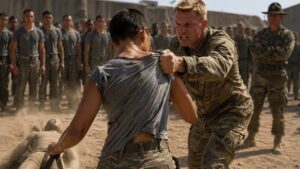
“We were pinned down near a collapsed school. Local militia had been moving through the district all week. Our extraction window was closing. We had one route left. I gave the order to hold cover.”
His voice was flat now. Report-like.
That was the only way through.
“There was a child in the street,” he said. “Maybe seven. Maybe younger. I don’t know. He was hit when the wall came down.”
Lena’s hand went to her mouth.
“Mara saw him,” Aaron said. “I told her no.”
He saw it again.
Mara’s head turning.
Her eyes finding his.
The impossible calm in her face.
“Lieutenant, he’s moving.”
“Hold position.”
“He’s moving.”
“That is an order.”
“And she looked at me,” Aaron said, “like I had asked her to stop being herself.”
Lena was crying silently now.
Aaron continued because if he stopped, he would not start again.
“She crossed anyway. Smoke everywhere. Rounds hitting the wall behind her. She got to the boy. Dragged him back. He was alive when she handed him off.”
His hand closed over the window ledge.
“Then I was hit.”
Lena whispered, “Aaron.”
“I don’t remember falling. I remember looking up and seeing her come back for me. I remember trying to tell her to stay down. I remember blood on her gloves.”
He turned from the window.
“She died because I lost control of the scene.”
Lena shook her head. “No.”
“Yes.”
“She died saving people.”
“She died after disobeying an order I gave for a reason.”
“And if she had obeyed?”
Aaron’s face tightened.
Lena’s voice was gentle, but it did not let him hide.
“If she had obeyed, would the child have lived?”
Aaron said nothing.
“If she had obeyed,” Lena asked, “would you?”
The question landed in the space between them.
Aaron looked at his wife in the hospital bed, alive because doctors moved fast, because machines worked, because strangers made decisions he had not been there to make.
“She should have lived,” he said.
It was the smallest his voice had sounded all day.
Lena reached for him again.
This time, he went.
He sat beside her and let her take his hand.
“Maybe,” she said. “But she did live long enough to save you. And you lived long enough to come here.”
Aaron shut his eyes.
“That doesn’t make it fair.”
“No,” Lena said. “It makes it ours to carry.”
He bowed his head over their joined hands.
For a moment, neither of them spoke.
Then Lena said, “There’s something else.”
Aaron opened his eyes.
He almost laughed, but there was no humor left in him.
“Of course there is.”
Lena managed a fragile smile.
“It’s in the side pocket of my bag.”
“What is?”
“A package.”
He looked toward the blue canvas bag.
His body had already begun to reject whatever waited there.
“Lena.”
“I wrote to her sister.”
The room dropped out from beneath him.
“You what?”
“I wrote to Mara’s sister.”
Aaron released her hand.
“Why would you do that?”
“Because you wouldn’t.”
The sentence was not cruel.
That made it worse.
Part IV — Useful
Aaron stared at Lena as if she had opened a door in a wall he had spent years reinforcing.
“You had no right,” he said.
Lena absorbed it. Her face tightened, but she did not look away.
“I know why it feels that way.”
“No. You don’t.”
“I was pregnant,” she said. “You were gone again. I kept reading that letter, and I realized I knew more about how Mara died than whether anyone had told her family what she gave us.”
Aaron shook his head. “That was handled.”
“By the Navy?”
“Yes.”
“By a letter with formal regret and authorized language?”
His silence answered her.
Lena’s eyes did not leave his.
“I didn’t write as your wife,” she said. “I wrote as someone whose child might exist because her sister crossed a street.”
Aaron looked away first.
The bag sat by the window.
Harmless. Blue canvas. A thing packed with socks, a phone charger, a going-home outfit too small to believe.
And now, apparently, the dead.
He went to it because not going would have been worse.
The side pocket held a small brown parcel, already opened and carefully retaped. His name was not on it.
Lena had written to Mara’s sister. Mara’s family had answered Lena, not him.
That detail cut deeper than he expected.
Inside the package was a folded note and a clear plastic sleeve.
Aaron saw the bracelet before he touched it.
Old hospital plastic. White once, now yellowed at the edges. Faded black print. VELEZ, MARA. A date from years before the deployment. A stateside hospital in San Diego.
His fingers went cold.
“She broke her wrist during training,” Lena said quietly. “Her sister said Mara kept the bracelet because she thought it was funny that the hospital spelled ‘laceration’ wrong on the discharge form.”
Aaron did not smile.
He read the note.
Only three lines mattered.
Mara hated being called brave.
She said brave made people sound finished.
She preferred useful.
Aaron sat down hard in the chair.
The bracelet lay in his palm.
It weighed almost nothing.
That was the cruelty of objects. They carried entire people without becoming heavy enough to explain themselves.
He remembered Mara taping her watchband with medical tape because the buckle had snapped. He remembered her saying, “Useful beats pretty.” He remembered the last time he saw her clearly: one knee in the dirt, hair stuck to her cheek, hands red, shouting at him to keep his eyes open.
He had turned her into a monument because monuments were easier than people.
Monuments did not laugh.
Monuments did not disobey.
Monuments did not make choices that saved you and ruined you at the same time.
“She had a sister named Isabel,” Lena said. “She wrote that Mara talked about her unit like they were all idiots she was personally responsible for keeping alive.”
Aaron let out one breath that nearly became a laugh.
“That sounds right.”
Lena watched him carefully.
“She also wrote that if Mara knew a baby was named after her, she’d pretend to hate it.”
This time something almost broke through his face.
“She would,” he said.
The room held them differently now.
Not easier.
Different.
The old bracelet sat between Aaron’s fingers. He could see the ghost of Mara’s wrist inside it. Not battlefield Mara. Not dying Mara. Just a younger woman with a broken wrist, probably irritated by paperwork, probably stealing extra pudding from a hospital tray.
Useful.
Not brave.
The word undid something in him.
Brave was what they put in citations.
Useful was what she had chosen.
A sharp knock came at the door.
Dr. Elise Warren entered before either of them answered. She was in her forties, gray-streaked hair pinned back, white coat over blue scrubs, expression measured in the way of people who had learned not to spend panic carelessly.
“Mrs. Hale,” she said, then turned to Aaron. “Lieutenant.”
Aaron stood automatically.
“Doctor.”
Lena gripped the sheet. “Is she okay?”
Dr. Warren’s face softened by a degree.
“She’s stable. But her oxygen saturation dipped again. We adjusted support, and she responded.”
Aaron’s fingers closed around Mara’s bracelet.
“I want to see her.”
“I expected that,” Dr. Warren said. “Only one parent for a few minutes. Mrs. Hale can’t be moved yet.”
Lena looked at Aaron.
He looked back.
The room seemed to understand before he did.
He would have to go alone.
He would have to stand over a child he had not yet seen and decide whether the name in his hand was a wound or a gift.
Dr. Warren glanced at the bracelet, then away. She had the grace not to ask.
“There’s one more thing,” she said. “We need the baby’s full name for the temporary chart update. It can be changed later, but NICU needs a record now.”
Later.
Aaron hated the word.
It was the word people used when they wanted mercy from the present.
Lena said nothing.
She did not plead. She did not push.
She only looked at him.
The same way Mara had looked at him across smoke and dust when he ordered her not to cross.
Not defiant.
Certain.
Aaron placed the old bracelet carefully on Lena’s blanket.
“I’ll go,” he said.
His voice was steady enough to fool anyone who did not love him.
Lena reached out and touched his cuff.
The white fabric was still impossibly clean.
“Don’t go in there as a lieutenant,” she said.
Aaron looked down at her hand.
“Then what am I?”
Her thumb brushed the edge of his sleeve.
“Her father.”
Part V — The Blank Line
The neonatal unit was warmer than the rest of the hospital and quieter in a way that felt enforced.
Machines breathed softly. Clear bassinets stood beneath muted lights. Nurses moved with careful hands and low voices, tending to lives so small they seemed not yet fully convinced of the world.
Aaron followed Dr. Warren through the doors.
His uniform drew glances.
He wished he had changed. He wished he could strip away the medals, the polished shoes, the stiff collar, every visible sign that other people had decided what his survival meant.
But there was no time.
Dr. Warren stopped beside a bassinet near the far wall.
“There she is,” she said.
Aaron did not move.
For one second, he was back outside a collapsed school, unable to cross the distance between an order and a human being.
Then the baby made a sound.
Small.
Offended.
Alive.
Aaron stepped forward.
His daughter lay under a clear cover, wrapped in a blanket with wires taped carefully to her tiny chest. A thin tube rested near her nose. Her face was red and wrinkled, her mouth moving as if she was arguing with the air.
He had expected to feel joy.
He had expected terror.
He had not expected recognition.
Not of features. Not of family resemblance. She was too new for that.
Recognition of need.
Here was someone who did not care about medals, classifications, failures, citations, commands, or the carefully managed language of reports.
She needed breath.
She needed warmth.
She needed a name.
Aaron placed one hand on the side of the bassinet. His fingers trembled against the plastic.
“Hi,” he said.
His daughter kicked once beneath the blanket.
A nurse approached with a tablet.
“Lieutenant Hale?”
Aaron looked up.
“We just need the full name entered for the temporary chart,” she said gently. “No rush.”
But there was a rush.
Not from her. Not from the machines.
From everything he had spent years refusing to say.
Aaron looked down at the blank line on the tablet.
Baby Girl Hale.
That was what she was without the past.
A safe little blank.
He could choose something else. Something clean. Something without blood under it. Something that did not wake him at 0300. Something that would not make him think of cracked watches and dust and a woman crossing open ground because usefulness mattered more to her than obedience.
He could protect his daughter from the name.
Or he could protect himself.
The difference had never been clearer.
The baby’s fingers opened and closed.
Aaron thought of Lena alone in labor, repeating a sentence from a dead medic to stay alive.
Fear is only proof something matters.
He thought of Mara’s sister writing back to a woman she had never met.
She preferred useful.
He thought of the old bracelet on Lena’s blanket, and the new bracelet waiting here, printed and plastic and temporary, because every life began with someone willing to write it down.
The nurse waited.
Aaron swallowed.
“Mara,” he said.
The nurse’s fingers moved over the tablet.
“Middle name?”
He closed his eyes once.
Not to hide.
To steady.
“Lena.”
The nurse looked up, maybe because his voice had changed.
Aaron kept his hand on the bassinet.
“Mara Lena Hale.”
The nurse entered it.
Just like that, the name existed outside him.
Not trapped in memory. Not sealed in a letter. Not buried under ceremony. Not reduced to guilt.
Spoken.
Given.
Carried forward.
The baby shifted, mouth opening in a tiny silent complaint before she found a breath.
Aaron leaned closer.
“You waited,” he whispered.
He did not know who he was saying it to.
His daughter.
His wife.
The dead woman who had crossed the street.
Maybe all of them.
Dr. Warren stood a few feet away, giving him the mercy of pretending to review the chart.
After a moment, the nurse printed the temporary identification card. She handed it to him.
MARA LENA HALE.
The letters were plain and black.
No ceremony.
No citation.
No polished language.
Just a name.
Aaron held the card with both hands.
Something inside him loosened, but it did not vanish. The grief stayed. The guilt stayed. The memory stayed.
Only the silence moved.
Part VI — Two Bracelets
When Aaron returned to Lena’s room, she was awake, though barely.
Her eyes went first to his face.
Then to the card in his hand.
He did not speak.
He crossed the room and placed the temporary ID card on the blanket beside Mara Velez’s old bracelet.
Lena looked down.
MARA LENA HALE.
Her hand went to her mouth.
Aaron waited for tears, for relief, for the thing people did when a battle ended.
But Lena only closed her eyes and breathed once, deep and shaking.
Then she reached for him.
This time, he took her hand before she had to search.
“I saw her,” he said.
Lena’s eyes opened.
“She’s very angry,” he said.
A laugh escaped her. It broke halfway into a sob.
“Good,” she whispered.
Aaron looked at the two objects on the blanket.
One old bracelet, yellowed with years.
One new card, warm from the printer.
Two names.
Two hospital records.
One life gone, one life beginning, and him standing between them in a uniform that no longer knew whether it belonged to war, ceremony, or fatherhood.
“I’m sorry,” he said.
Lena shook her head. “For what?”
He had too many answers.
For not being there.
For refusing the name.
For writing the letter and then resenting her for remembering it.
For surviving.
For turning Mara into a wound and calling that respect.
“For making you carry it alone,” he said.
Lena’s fingers tightened around his.
“That’s the part I was angry about.”
“I know.”
“No,” she said softly. “You’re learning.”
He gave a small, broken smile.
“That sounds worse.”
“It is.”
For a while, they sat with the sounds of the hospital around them. The monitor. The hallway. The distant roll of wheels. Life continuing in rooms where people were being born, repaired, lost, saved.
Aaron reached for Mara Velez’s bracelet.
He held it carefully, then placed it beside the baby’s printed card, aligning them without quite knowing why.
Lena watched him.
“She shouldn’t have had to die for this,” he said.
“No.”
“Our daughter shouldn’t have to carry that.”
“She won’t carry her death,” Lena said. “She’ll carry her name.”
Aaron looked at her.
Lena’s face was exhausted, but her eyes were clear.
“There’s a difference.”
He wanted to believe her.
Not completely. Not easily.
But enough to stay.
Enough to let the sentence enter him without fighting it.
A nurse came in later to check Lena’s vitals. She smiled at the card on the blanket and said, “That’s a beautiful name.”
Aaron almost corrected her.
Almost said, You don’t know what it costs.
But he stopped.
Not because she was wrong.
Because she was right too.
After the nurse left, Lena began to drift. Her grip loosened, then tightened again as if even sleep did not fully trust him not to disappear.
“I’m here,” he said.
Her eyes remained closed.
“For how long?”
The question was barely audible.
It was not accusation.
It was marriage.
Aaron looked at the medals on his chest. At the uniform he had worn into rooms where men stood straight and applauded. At the white sleeves now creased from hospital chairs, Lena’s fingers, and the edge of a bassinet in the NICU.
“As long as they let me,” he said.
Lena opened her eyes.
He knew it was not enough.
He knew the Navy would call again. Orders would come. Phones would lock. Doors would close. The world that had taken him before would not apologize for taking him again.
So he added the truer thing.
“And when I can’t be, I won’t make you carry the silence too.”
Lena looked at him for a long moment.
Then she nodded.
Not forgiveness exactly.
Not completion.
Something sturdier than both.
Near dawn, Dr. Warren returned and told them Mara Lena Hale was holding her oxygen better. Not perfect. Better.
Aaron accepted the word like a ration.
Better was not safe.
Better was not healed.
Better was enough for the next breath.
When they finally wheeled Lena toward the NICU, Aaron walked beside her, one hand on the rail, the other holding the old bracelet in his palm.
He did not pin it to anything.
He did not display it.
He simply carried it.
At the bassinet, Lena saw their daughter for the first time since delivery and cried without making a sound. Aaron stood behind her, one hand on her shoulder.
The baby slept under the soft machinery, mouth open, fist curled near her cheek as if she had arrived already prepared to argue with the world.
Lena reached through the opening and touched one tiny foot.
“Hi, Mara,” she whispered.
Aaron felt the name move through him.
It hurt.
It also lived.
He placed Mara Velez’s old bracelet on the shelf beneath the bassinet, beside the hospital supplies and the printed chart label bearing his daughter’s name.
Not as an offering.
Not as proof.
Just near.
Lena leaned back against him.
Aaron bent his head until his cheek touched her hair.
No one in the room said brave.
No one said sacrifice.
No one tried to make the dead useful to the living with a speech.
Their daughter breathed.
The monitor counted.
Lena’s hand found Aaron’s again, and this time when she held on, he did not look stunned by what love had asked him to feel.
He looked afraid.
He looked grateful.
He looked present.
And in the warm, guarded quiet of the neonatal unit, between one bracelet yellowed by time and another still clean around a newborn wrist, Aaron Hale finally understood that some promises were not kept by surviving.
Some promises were kept by naming what survival had cost, then loving anyway.