The Desert Highway Standoff: The Scarred Outlaw Who Shielded A Runaway Child
CHAPTER 1: THE HIGHWAY DRAW
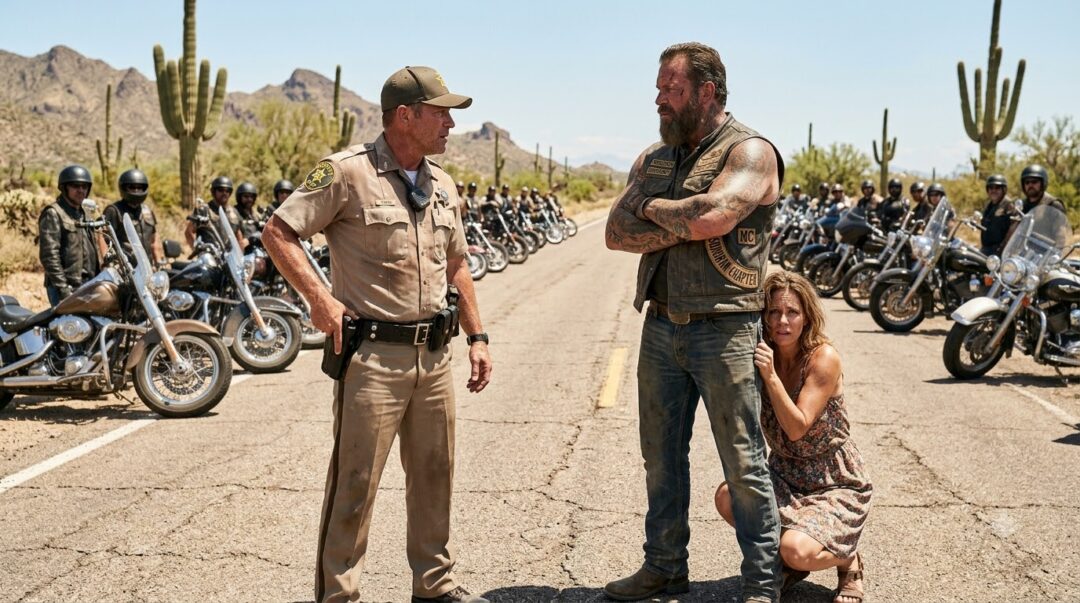
The blistering June sun over the Sonoran Desert in Pima County, Arizona, hammered down upon Interstate 8 like a hammer striking an anvil of raw iron. At two in the afternoon, forty miles west of Gila Bend, the thermometer pushed past one hundred and twelve degrees. The black ribbon of two-lane asphalt was a shimmering, liquid mirage of heat waves, flanked on both sides by endless forests of giant saguaro cacti, dry creosote scrub, and the bleached skeletons of desert ironwood trees baking in the furnace wind.
Parked in an unbroken, double-flanked echelon formation across both lanes of the empty highway were thirty custom motorcycles of the Desert Phantoms Motorcycle Club. Their massive chrome exhaust pipes, brushed aluminum oil tanks, and black steel frames radiated waves of intense heat that blurred the horizon.
At the front of the formation, standing on the cracked center line with his heavy combat boots planted wide, was Colton “Iron” Stone.
At forty-eight, Colton was six-foot-three of scarred bone, combat muscle, and immovable moral authority. A decorated former federal border ranger who had spent ten years leading tactical interdiction teams along the Mexican border before founding the Phantoms, his weathered face bore a distinct, pale scar tracking from his left temple down across his cheekbone. Across his heavy black steerhide cut was an embroidered silver rocker that read simply: PRESIDENT.
Standing directly behind Colton’s heavy leather boots, her small, trembling hands clutching the thick steerhide fringes of his vest with white-knuckled desperation, was nine-year-old Maya Ruiz.
She was tiny, her floral-print cotton dress torn at the hem and caked in yellow desert dust, her bare legs covered in fresh scratches from jumping through barbed-wire cattle fences. A dark purple bruise was swelling beneath her left eye, and her small face was streaked with dried tears and sweat. But despite her terror, her dark, intelligent eyes looked out from behind Colton’s leather hip with a fierce, burning will to live.
Ten yards down the shimmering asphalt, standing beside an idling, marked Pima County Sheriff four-wheel-drive patrol Tahoe, stood Sheriff Wade Sterling.
At fifty-four, Sterling was a burly, thick-necked lawman whose tan uniform shirt was soaked through with dark circles of sweat beneath his body armor. His campaign hat was pulled low over bloodshot, panic-stricken eyes, his mouth twitching with a nervous, frantic aggression.
In his right hand, leveled squarely at Colton’s chest, was a six-inch stainless-steel Smith & Wesson .357 Magnum revolver. The heavy hammer of the weapon was cocked back, its hair-trigger set, the polished steel barrel trembling with the lawman’s erratic breathing.
“Step away from the girl, Colton!” Sheriff Sterling’s voice cracked through the furnace heat, hoarse and shrill with desperate authority. “She’s an escaped juvenile ward of the county under state protective detention! You are harboring a fugitive and obstructing an officer in the performance of his sworn duty! Step aside right now or I will empty this cylinder into your chest!”
Behind Colton, nine-year-old Maya whimpered, burying her tear-stained face deeper into the steerhide between his shoulder blades.
“Don’t let him take me, mister…” Maya wept, her small voice vibrating through Colton’s spine. “Please don’t let him take me back to the cattle ranch. He was the one who locked the iron doors. He was the one who watched them put my mother in the ground.”
Colton didn’t raise his hands. He didn’t step back an inch.
He stood motionless under the blinding white desert sun, his amber eyes locking onto the trembling sheriff with a cold, terrifying calm that seemed to drop the ambient temperature on the highway to zero.
“Wade,” Colton said, his deep baritone rumbling across the cracked blacktop like low thunder. “You’ve been on the county payroll for twenty years. You know the law, and you know me. You know that if you pull that trigger, you better kill every single one of the twenty-nine combat veterans standing behind my back.”
Sheriff Sterling swallowed hard, his Adam’s apple bobbing in his throat. He looked past Colton’s towering frame at the thirty motorcycles lined across the highway.
Thirty hardened outlaw bikers sat on their machines in absolute, stone-faced silence. Their arms were crossed over their cuts, their eyes shielded behind dark aviator glasses, their boots resting lightly on their floorboards.
“This is county jurisdiction, Stone!” Sterling screamed, stepping forward two paces, the .357 Magnum shaking wildly in his fist. “The state governor declared an emergency border enforcement protocol! I have full statutory authority to use lethal force on anyone interfering with federal interdiction!”
“You’re not doing federal interdiction, Wade,” Colton replied, his voice dropping into a deadly, rhythmic gravel that resonated through the heat waves. “You’re running cleanup for the Alvarez cartel. That child didn’t escape from a foster home. She escaped from the underground shipping bunkers at the Rancho Del Sol cattle feedlot.”
Sterling’s face turned the color of dry salt. The nervous smirk on his lips dissolved into sheer, unadulterated horror as his pupils dilated into black pinpricks under the blinding desert sun.
Behind Colton, the synchronized sound of thirty heavy steel kickstands dropping into the asphalt echoed across the highway like a volley of rifle fire.
Thirty leather-clad riders dismounted simultaneously, their boots hitting the gravel in a unified cadence, hands resting on the grips of heavy sidearms concealed beneath their cuts.
Colton took one deliberate step toward the drawn revolver, closing the distance to nine feet, his eyes pinning the sweating sheriff like two iron spikes.
“Lower the hammer, Sheriff,” Colton commanded softly. “Or I’ll take that revolver, break your wrist in three places, and leave you in the dirt for the coyotes.”
CHAPTER 2: THE GIRL’S CONFESSION
Sheriff Wade Sterling stood stranded on the center line of Interstate 8, his uniform drenched in cold sweat, his trembling hand still leveling the heavy .357 Magnum at Colton’s chest. But facing thirty battle-hardened combat veterans who had deployed in an unbroken, interlocking crescent across both lanes of the highway, the lawman looked like a lone wolf cornered by an entire pack of mountain lions.
“You’re making a catastrophic mistake, Stone,” Sterling whispered, his voice trembling with high-strung panic. “The cartel has three armed surveillance drones in the air along this corridor right now. If I don’t check in with the girl’s tracking bracelet in ten minutes, they’re deploying two gunships from the Sonoyta airfield.”
Colton didn’t blink. He closed the nine-foot gap between them in a single, explosive stride.
His left hand shot out like an iron piston, clamping around the cylinder of the .357 Magnum, his thumb wedged firmly between the falling hammer and the firing pin. With a brutal downward twist of his wrist, Colton rotated the heavy weapon against Sterling’s trigger finger.
A sharp snap of dislocating bone echoed across the asphalt. Sterling screamed in agony as the revolver was ripped from his paralyzed fingers, clattering onto the highway.
Before Sterling could draw a breath, Colton drove his right palm heel into the sheriff’s sternum, driving the breath from the lawman’s lungs with a hollow thud that slammed Sterling back against the hot metal hood of his patrol Tahoe. Colton leaned over him, his scarred face inches from Sterling’s sweating brow.
“Your radio is broadcasting on frequency 154.8,” Colton growled, plucking the sheriff’s shoulder microphone from his epaulette. “Tell your cartel handlers that the girl is dead. Tell them her body was burned in a brush fire at the forty-mile marker.”
Sterling coughed, blood bubbling from his split lip, shaking his head in sheer terror. “I… I can’t, Colton! Salazar will execute my wife in Tucson!”
“Then you better start praying, Wade,” Colton said coldly.
Colton pulled the keys from the patrol Tahoe’s ignition, hurled them fifty yards into the dense cholla cactus along the shoulder, and reached to his belt to produce a pair of heavy tactical zip-ties, binding Sterling’s wrists firmly around the Tahoe’s steel push-bumper.
The furnace-like heat radiating from the cracked asphalt of Interstate 8 was suffocating, burning through the heavy soles of Colton’s combat boots, but the veteran stood like an unmoving monolith of leather and iron. Behind his broad shoulders, the thirty riders of the Desert Phantoms held their defensive line across the empty highway with the quiet, deadly discipline of an infantry platoon holding an isolated perimeter. Every man in the club had seen the devastating human wreckage caused by cartel trafficking networks along the Arizona border; they had buried friends, assisted stranded migrant families in the badlands, and fought off armed smuggling crews in the washes. To see a nine-year-old child marked for execution by her own county sheriff was an atrocity that demanded immediate, total retribution.
He turned on his heel, walking back to where nine-year-old Maya stood waiting beside his custom Road Glide.
Road Captain Dutch and Preacher moved forward, flanking the child with protective reverence, handing her a chilled stainless-steel canteen of clean spring water.
Maya drank with desperate, frantic gulps, water spilling over her chin and onto her dusty dress.
“Easy, little bird,” Colton murmured softly, kneeling on the hot asphalt so his eyes were level with hers. “You’re safe now. Nobody is taking you back to that ranch.”
Maya wiped her face with the back of her small hand, her breathing slowing as she looked into Colton’s calm, steady amber eyes.
She reached beneath the collar of her floral dress, pulling out an antique silver filigree locket hanging from a tarnished silver chain. With small, trembling fingers, she pressed a hidden catch on the locket’s rim.
The silver locket sprang open.
Inside, nestled in a bed of red velvet, was an ultra-high-density 512-gigabyte SanDisk Extreme micro-SD card, sealed in transparent waterproof silicone.
“My mother was an investigator for the Department of Homeland Security,” Maya said, her voice dropping into a fierce, heartbreaking whisper that silenced every biker on the road. “She went undercover at the Rancho Del Sol three months ago. When they discovered she was transmitting coordinates to the federal grand jury in Tucson, Hector Salazar had her and my father shot behind the tractor barn.”
Maya looked down at the tiny chip in her palm.
“Before she died, she put this card in my locket and hid me inside the irrigation intake pipe,” Maya choked, tears welling in her dark eyes. “This card has forty-eight hours of high-definition video of the underground holding pens. There are twenty-two children locked in the basement beneath the feedlot, Colton. And Salazar is moving them across the border into Sonora at midnight tonight.”
A collective, subterranean growl of pure, murderous fury rippled through the thirty Desert Phantoms.
Dutch looked at Colton, his jaw set like iron. “The federal courthouse in Tucson is seventy miles east, Anvil. But if we take Interstate 8, we’re riding straight through Salazar’s primary surveillance corridor.”
Colton stood up to his full, towering height, his amber eyes scanning the pale blue desert sky.
Three miles to the south, hovering low above the jagged volcanic peaks of the Sand Tank Mountains, two dark silhouettes emerged from the heat haze—twin-engine Bell 412 helicopters flying in tactical combat formation without navigation lights, their nose-mounted thermal cameras tracking the highway.
“Salazar’s air support,” Colton said, his voice dropping into that quiet, deadly register of an old border ranger. “They’re not waiting for Sterling’s check-in. Mount up, Phantoms! We take the dry arroyo trails through the Crater Range!”
CHAPTER 3: THE ARROYO EVASIVE
The twin-engine cartel gunships descended over the desert like black locusts, the heavy thumping of their rotor blades beating against the hot air with a rhythmic, mechanical roar that rattled the loose stones on the highway.
“SCATTER INTO THE WASH!” Colton roared through his helmet microphone, slamming his throttle wide open.
The thirty custom motorcycles of the Desert Phantoms plunged off the paved asphalt of Interstate 8 simultaneously, dropping four feet down the loose caliche embankment into the broad, dry gravel bed of the Tenmile Wash.
The arroyo was a hundred-foot-wide desert trench carved by centuries of flash floods, its sandy floor flanked by twenty-foot vertical walls of red clay and tangled mesquite roots that provided natural overhead cover against high-altitude radar.
Colton rode point, his knobby dual-sport tires biting into the deep gravel at seventy miles an hour, his Road Glide fishtailing through the turns with magnificent, controlled power.
Behind him on the touring passenger saddle, Maya leaned tight against his back, her small arms locked around his leather cut, her goggles pulled low over her eyes against the stinging rooster-tails of sand thrown by the front tire.
Above the canyon rim, the lead helicopter banked violently, its five-hundred-pound nose-mounted searchlight snapping on with the blinding intensity of a miniature sun, sweeping the sandy floor of the wash.
CHUG-CHUG-CHUG-CHUG.
A three-second burst of 7.62mm minigun fire tore through the upper canyon wall, pulverizing two hundred feet of dried clay into a blinding cloud of red dust, sending baseball-sized volcanic boulders tumbling into the arroyo floor fifty yards behind Colton’s machine.
“They’re walking their fire down the center track!” Dutch yelled over the radio headset, leaning his chopper hard into an S-curve to avoid a collapsing wall of gravel.
“Hold the left bank!” Colton commanded. “The old Southern Pacific railway culvert is half a mile ahead! If we reach the concrete arches, their thermal imaging can’t penetrate the rail ballast!”
Ahead, crossing the arroyo at an oblique angle, was a sixty-foot-high earthen railway embankment carrying the transcontinental freight tracks. Piercing the base of the embankment were three massive, ten-foot-tall poured-concrete culvert arches, originally constructed in the 1920s to drain desert cloudbursts beneath the railroad bed.
Colton dropped two gears, the 124-cubic-inch engine screaming at six thousand RPM, shooting through the center concrete arch into the cool, echo-filled darkness of the tunnel just as a second rocket-assisted incendiary grenade struck the upper embankment with a deafening, concussive roar.
The three-hundred-foot railway culvert shuddered under the detonation, dust and dried mortar raining down onto their helmets, but the reinforced concrete structure held firm.
Colton slid his motorcycle to a halt in the center of the dark tunnel, killing his ignition.
The ancient concrete culvert smelled of alkaline dust, dried silt, and eighty years of desert flash floods, the cool gloom providing a momentary sanctuary from the blinding white glare of the Sonoran sun. Maya sat against the curved concrete wall, her small chest rising and falling in shallow, exhausted gasps as she held the silver locket against her collarbone. Dutch knelt beside her, checking the girl’s scratched arms and bruised knees with surprising, fatherly gentleness, cleaning the cuts with an antiseptic wipe from his road kit. There was no fear left in the young girl’s eyes; she looked up at the scarred outlaws surrounding her with a deep, calm certainty, knowing that the men of the Desert Phantoms would tear the desert apart before they allowed any predator to touch her.
The twenty-nine Phantoms roared in behind him, packing the concrete tube in an unbroken line of chrome and leather, their heavy engines ticking as they cooled in the shaded sanctuary.
Maya lowered her goggles, panting in the damp gloom, her dark eyes looking up at the high arched ceiling. “They’re circling above the tracks… I can hear the rotors.”
Colton dismounted, lifting Maya down to the dry gravel, then climbed a rusted iron inspection ladder set into the culvert wall to peer through an overhead drainage vent.
Through the iron grating, he watched the two cartel helicopters hovering fifty feet above the railway tracks, their searchlights scanning the surrounding sagebrush flats in futile, frustrated circles.
Suddenly, a loud, two-tone electronic chime sounded from Preacher’s field telemetry terminal mounted to his handlebars.
“Anvil!” Preacher called out, his face pale in the blue screen light. “I just intercepted an unencrypted microwave transmission from the Rancho Del Sol feedlot, six miles north.”
Colton scrambled down the ladder. “What’s the message, Preacher?”
“Salazar’s ground commanders realized Maya escaped with the DHS evidence,” Preacher said, his voice trembling with dark fury. “They’re executing Operation Clean Sweep. They’ve loaded the twenty-two captive children into two livestock haulers, and they’ve wired four commercial fuel tanks around the underground bunkers to detonate at sunset. If we ride straight to the federal courthouse in Tucson, those kids will be incinerated before the marshals can scramble a tactical team.”
The silence inside the concrete tunnel was suffocating, broken only by the steady drip of mineral water and the distant, muffled chop of the circling helicopters.
Maya looked up at Colton, her small, bruised hands reaching out to clasp his scarred wrists, tears streaming freely down her cheeks.
“My mother told me that if a soldier sees an innocent person in a trap, he doesn’t run to the police station,” Maya whispered, her voice rich with an unshakeable, heartbreaking courage. “He attacks the trap. Colton… please save the other kids. Please don’t let them burn.”
Colton looked down at the nine-year-old orphan, feeling the heavy silver locket resting against her small chest.
He slowly drew his Kimber .45 pistol, checked the seven-round magazine with a crisp metallic snap, and looked at the twenty-nine men of the Desert Phantoms.
“Turn the bikes around, brothers,” Colton said, his voice dropping into that terrifying, immovable mountain gravel. “We’re not running for Tucson. We’re raiding the feedlot.”
CHAPTER 4: THE CATTLE RANCH INFILTRATION
The Rancho Del Sol feedlot was a sprawling, sixty-acre industrial compound nestled in an arid volcanic bowl ten miles north of the Mexican border. From the air, it appeared to be a standard commercial cattle facility: towering metal grain silos, massive outdoor pens holding three thousand head of beef cattle, and a fleet of commercial livestock tractor-trailers idling by the main processing barn.
Beneath the commercial slaughterhouse, however, lay Hector Salazar’s subterranean fortress: an unmapped three-story network of reinforced concrete bunkers, refrigerated storage vaults, and human trafficking holding pens equipped with heavy steel blast doors.
It was five-forty-five in the evening. The desert sun was descending behind the jagged obsidian peaks of the Growler Range, casting long, blood-red shadows across the dusty feedlot.
Standing on the elevated catwalk of the main loading ramp was Hector Salazar himself.
At fifty, the cartel kingpin wore a bespoke linen Western shirt and hand-tooled caiman-skin boots, a gold-plated medallion of Santa Muerte gleaming against his throat, holding a heavy tactical satellite radio in his manicured hand.
“Load the last six children into Hauler Two!” Salazar barked to four armed enforcers in greasy coveralls. “The border crossing patrol team in Sonoyta has cleared the secondary gate for nine o’clock! Where is the demolition team?”
From the sub-basement freight elevator, two cartel mechanics emerged carrying four five-gallon metal drums of commercial aviation kerosene and three blocks of industrial quarry explosives, stacking them against the primary ventilation shafts of the underground bunker.
“The timer is set for six-thirty, boss,” the lead mechanic reported. “Once the charges blow, the underground foundation will collapse under three thousand tons of burning grain. The county coroner won’t find a single bone.”
Salazar checked his diamond watch, nodding with cold, ruthless satisfaction. “Good. Terminate the power generators and pull the perimeter guards into the trucks.”
Before the mechanic could turn toward the elevator, a low, tectonic vibration began to rumble through the concrete deck of the slaughterhouse ramp.
It wasn’t the hum of the grain augers. It was the terrifying, earth-shaking roar of thirty high-displacement American V-twins charging out of the dense mesquite thickets along the southern perimeter fence.
CRASH.
The eight-foot heavy steel commercial chain-link gate was blown completely off its concrete pilings as Colton Stone’s black Road Glide slammed through the padlocked iron barrier in a blinding shower of sparks and sheared aluminum.
Flanking Colton in a screaming, high-speed wedge came the thirty riders of the Desert Phantoms, their high-beam halogen spotlights pinning the catwalk in an incandescent wall of white light.
“ATTACK! BIKERS IN THE FEEDLOT!” the sniper in the grain silo shrieked, raising his tactical rifle, but Dutch swung his heavy cruiser beneath the silo’s steel ladder, firing a three-pound magnesium flare directly through the observation window.
The blinding, four-thousand-degree white chemical flame erupted inside the sniper’s booth, scorching his night optics and forcing the shooter to leap for his life onto a mountain of cattle feed thirty feet below.
On the loading ramp, four cartel enforcers drew automatic submachine guns, opening fire with wild, desperate bursts that chewed into the dirt driveway.
Colton didn’t flinch. He brought the heavy Road Glide to a screeching, forty-foot highside slide across the gravel apron, dismounting before the machine stopped moving.
In his left hand, Colton carried a heavy twelve-pound steel railroad sledgehammer from his tool kit; in his right, he leveled his Kimber .45 pistol.
Colton fired three precision double-taps, neutralizing the two lead enforcers on the ramp before they could shoulder their weapons. He leaped onto the concrete catwalk, swinging the twelve-pound sledgehammer with the full rotation of his broad torso.
CRACK.
The heavy steel hammer struck the padlock of the sub-basement blast door with concussive, bone-shattering force. The three-inch hardened steel hasp sheared off the iron frame, and Colton kicked the heavy blast door wide open.
“PREACHER! SECURE THE CHILDREN!” Colton roared into the dark stairway.
Preacher and four veteran Phantoms bounded down the concrete steps into the subterranean bunker. Within sixty seconds, the five bikers re-emerged into the fading twilight, carrying twenty-two terrified, weeping children—ranging from five to fourteen years old—guiding them safely into the armored steel beds of two club chase trucks parked behind the silo.
Hector Salazar, seeing his operation pulverized and his captives liberated, drew a nickel-plated .45 automatic from his holster, sprinting frantically toward an idling black armored Suburban parked by the grain elevators.
Colton closed the thirty-foot distance across the loading deck in four massive, terrifying strides.
Colton’s heavy combat boot struck Salazar’s right shoulder with a sickening crunch, knocking the cartel kingpin off the catwalk into a five-foot deep manure pit below.
Salazar landed on his back with a breathless gasp, his bespoke shirt ruined, his gun flying ten feet into the mud.
Colton dropped from the catwalk, landing on the gravel beside the pit, his Kimber .45 leveled directly between Salazar’s terrified eyes.
“The timer is ticking on those fuel tanks, Salazar,” Colton growled, his voice carrying the cold, unyielding weight of an executioner. “Give me the defusal code.”
Salazar choked, coughing through broken teeth, his face pale as damp chalk as he pointed trembling fingers toward the main electrical control box on the silo wall. “The blue toggle… cut the blue toggle! Don’t shoot! I surrender!”
Dutch sprinted to the control box, severing the blue wire with his tactical knife just as the digital LED display on the quarry explosive froze at 00:14.
Colton hauled Salazar out of the pit by the collar of his ruined Western shirt, slamming him face-down onto the tailgate of the chase truck, ratcheting heavy steel handcuffs over the kingpin’s wrists.
From the northern highway, the sirens of arriving law enforcement began to echo across the desert.
Colton turned to his thirty riders. “Mount up, Phantoms! We have twenty-two children and one cartel boss to deliver to the federal judge in Tucson!”
CHAPTER 5: THE SONORAN GAUNTLET
The desert twilight deepened into a bruised, star-strewn canopy of indigo and cold purple as the thirty-motorcycle convoy of the Desert Phantoms surged out of the Rancho Del Sol feedlot onto rural Highway 86, heading east toward Tucson.
At the center of the formation rode the two heavy, enclosed steel chase trucks carrying the twenty-two liberated children, wrapped in clean club blankets and sipping sweet water from canteens, their small faces peering through the rear safety glass with wide, awe-struck eyes at the thirty leather-clad outlaws riding flank.
In the passenger seat of the lead chase truck sat nine-year-old Maya Ruiz, clutching her mother’s silver locket against her chest, her dark eyes shining with proud, unyielding courage.
Colton Stone rode point on his custom Road Glide, his high-beam halogen light cutting through the desert darkness at eighty-five miles an hour, his tactical radio headset buzzing with encrypted telemetry from Preacher monitoring federal frequencies.
“Anvil,” Preacher called out over the radio channel. “Sheriff Wade Sterling broke his zip-ties using a spare razor blade from his duty boot twenty minutes ago. He flagged down two corrupt county patrol units at Gila Bend, and they’ve coordinated with Salazar’s remaining hit squad in Tucson.”
“Where are they staging the roadblock?” Colton asked, leaning his heavy machine into a sweeping turn through the saguaro forests of the Tohono O’odham reservation.
“Snyder’s Pass,” Preacher reported, his voice grim. “Ten miles west of the Tucson city limits. The highway narrows into a two-lane cut between four-hundred-foot volcanic granite bluffs. Sterling has two heavy municipal tow trucks jackknifed across the road, backed by eight patrol cruisers and three armored cartel Suburbans. They’ve deployed twelve-gauge spike strips across both lanes.”
Dutch brought his chopper parallel to Colton’s rear wheel, his scarred face illuminated by the amber dashboard glow. “We can’t ram two commercial tow trucks with motorcycles, Anvil. Not with twenty-two children in the chase beds.”
Colton didn’t hesitate. He checked his wrist GPS, his mind pulling up forty years of tactical border terrain knowledge.
“We don’t ram the trucks,” Colton said, his voice dropping into that quiet, deadly battle register. “Two miles before Snyder’s Pass, the old 1915 mining flume road branches north toward the Silverbell copper mine. It runs along the high northern ridge three hundred feet above the highway gorge, bypassing the road cut entirely and descending into the Tucson federal district through Speedway Boulevard.”
“The Silverbell flume trail is a six-foot-wide shelf road on raw granite, Anvil!” Dutch warned. “It hasn’t been maintained since nineteen-seventy! One blown tire means rolling three hundred feet into the canyon!”
“Our tires won’t blow,” Colton said. “And our brothers don’t miss their lines. Signal the convoy. We take the high ridge.”
The cold mountain wind sweeping down from the jagged volcanic peaks of the Crater Range was a welcome relief from the furnace heat of the desert floor, chilling the sweat on Colton’s forehead as he guided the heavy Road Glide along the narrow shelf road. Below their vibrating knobby tires, the sheer three-hundred-foot drop into the darkened gorge was a terrifying reminder that the line between survival and catastrophe was less than six inches of crumbling red granite. But Colton rode with the absolute, flawless precision of a master border scout, his weight shifting fluidly from peg to peg, feeling the powerful pulse of the 124-cubic-inch engine vibrating through the steel chassis. In the chase truck behind him, the twenty-two liberated children held each other’s hands in the dark, their small voices singing soft Spanish nursery songs to keep away the terror of the night, while the thirty Phantoms rode as their iron angels through the mountain wilderness. Every twist of the throttle was a promise that no child would be left behind in the hands of border predators.
Two miles down the highway, Colton executed a sudden, flawless ninety-degree right turn off the asphalt, leading the thirty motorcycles and the two heavy chase trucks onto a narrow, rutted shelf trail of loose red granite that climbed aggressively into the volcanic hills.
Below them, through the darkness of the gorge, the blinding blue and red strobe arrays of Sheriff Sterling’s roadblock appeared—eight patrol cars and two massive flatbed wreckers blocking the highway in an impenetrable fortress of steel and halogen light.
Standing on the highway blacktop below, holding a night-vision monocular to his eyes, was Sheriff Wade Sterling.
The sheriff scanned the empty road ahead, expecting the roar of approaching motorcycles down the pavement.
Suddenly, a sound echoed from the high granite cliffs three hundred feet directly above his head—a deep, subterranean, multi-cylinder roar that shook the volcanic canyon walls like an oncoming landslide.
Sterling lowered his night-vision goggles in utter, disbelieving horror.
Racing along the narrow cliffside shelf trail three hundred feet above his barricade, illuminated by the cold white light of the desert moon, was the entire convoy of the Desert Phantoms: thirty heavy chrome choppers and two roaring chase trucks, their exhaust notes rolling down the canyon like artillery thunder as they swept past the ambush without touching a single inch of the blocked highway.
“THEY’RE ON THE RIDGE!” Sterling shrieked into his radio microphone, his voice cracking with hysterical, humiliated fury. “GET TO THE CARS! GET TO THE INTERSTATE! INTERCEPT THEM BEFORE THEY REACH THE FEDERAL PLAZA!”
Sterling threw himself into his backup patrol vehicle, tires screaming against the asphalt as the eight police cruisers spun in frantic U-turns, beginning a desperate, eighty-mile-an-hour pursuit toward the glittering lights of Tucson.
CHAPTER 6: THE TUCSON EXPRESSWAY BREACH
The midnight skyline of Tucson rose out of the desert darkness like a glittering constellation of emerald and gold, framed against the towering black silhouettes of the Santa Catalina Mountains.
The thirty motorcycles of the Desert Phantoms roared off the Silverbell mountain trail onto the smooth, four-lane concrete expanse of West Speedway Boulevard at ninety miles an hour, their high-output engines singing with raw, uninhibited American horsepower.
The boulevard was deserted, illuminated by overhead sodium vapor lights that cast long, amber reflections across the clean pavement.
Behind them, two miles back, the flashing blue and red pursuit strobes of Sheriff Sterling’s eight interceptor cruisers came screaming down the Interstate 10 connector, their V8 engines running at redline, closing the distance with desperate, reckless speed.
“They’re coming fast, Anvil!” Dutch shouted through the radio headset. “Sterling has authorized PIT maneuvers on the chase trucks! He’s trying to flip the children’s vehicles before we cross the federal perimeter!”
Colton checked his mirror. The lead patrol cruiser, driven by Sterling himself, had surged ahead of the pack, its heavy steel push-bumper looming less than six feet from the rear bumper of the second chase truck holding Maya and the children.
The wide, illuminated lanes of West Speedway Boulevard seemed to stretch toward the Tucson skyline like a runway of white concrete, the streetlights casting long, amber reflections across the clean asphalt. Colton kept his machine locked on an intercept vector with the screaming police cruisers, his mind operating with the razor-sharp tactical detachment of a combat veteran who had executed high-speed vehicle interdictions along the Rio Grande. He knew that Sheriff Sterling was no longer acting as a law enforcement officer; the man was a desperate, homicidal cornered animal who would gladly sacrifice his own deputies and plow into civilian traffic if it meant destroying the evidence that would send him to a federal penitentiary for life. Colton’s scarred hands tightened on the throttle, his breath slow and deliberate as he prepared to deliver the final, decisive blow against the cartel’s desert monopoly.
Sterling leaned out of his driver’s window with a heavy twelve-gauge shotgun, leveling the barrel toward the truck’s rear tires.
Colton didn’t hesitate.
He dropped three gears, his 124-cubic-inch engine screaming as he threw his heavy Road Glide into an aggressive, diagonal sweep across two lanes, placing his massive motorcycle directly between Sterling’s cruiser and the children’s truck.
“Preacher, take the children straight to the granite portico of the James E. Walsh Federal Courthouse on Congress Street!” Colton roared into his helmet radio. “Dutch, form defensive diamond! We break their line right now!”
The two chase trucks accelerated down the center lanes toward the courthouse plaza, while Colton and six veteran Phantoms formed an iron wall across the intersection of Speedway and Stone Avenue.
Sterling’s cruiser bore down on Colton at seventy miles an hour, the sheriff’s face twisted in homicidal, psychotic rage as he floored the accelerator, intending to crush the outlaw leader against the pavement.
Colton didn’t swerve.
He waited until the cruiser’s steel bumper was ten feet from his front tire.
In a single, heart-stopping fraction of a second, Colton locked his rear brake, dropped his left boot into the asphalt, and kicked the Road Glide into a violent, controlled forty-five-degree highside slide.
The heavy motorcycle’s steel crash bars dug into the asphalt in a massive, sixty-foot fan of blinding orange sparks, sliding directly beneath the cruiser’s front cross-member.
CRUNCH.
The motorcycle’s three-inch structural chromoly frame caught the police cruiser’s front steering assembly, severing the tie-rods and puncturing the transmission pan with an ear-splitting shriek of sheared metal.
The police cruiser’s front tires shredded instantly, the two-ton vehicle lifting two feet into the air before sliding sideways across the intersection on its aluminum rims in a shower of boiling coolant, shattered glass, and screaming metal, grinding to a halt against a concrete utility pole.
Colton rolled clear of the slide with the instinctual, gymnastic agility of a combat ranger, tumbling three times across the pavement before springing to his feet, his Kimber .45 drawn and leveled before the smoke had cleared.
Sterling kicked open the dented driver’s door of his wrecked cruiser, stumbling onto the asphalt, covered in glass and radiator steam, clutching a short-barreled shotgun with his uninjured left hand.
“I’ll kill you, Stone!” Sterling screamed, raising the weapon.
BOOM.
Colton fired a single, precision .45-caliber round through the shotgun’s wooden stock, shattering the walnut grip into splinters and knocking the weapon from Sterling’s hand.
Colton closed the ten-foot gap in two strides, his heavy combat boot striking Sterling’s chest, pinning the corrupt sheriff flat against the hot asphalt of the street.
Colton looked down at the ruined lawman, his amber eyes cold and unyielding.
“Your jurisdiction is canceled, Wade,” Colton said.
From the southern boulevard, the sirens of thirty arriving United States Marshals and Arizona Department of Public Safety tactical vehicles filled the night air with deafening, legal authority.
Preacher’s two chase trucks pulled onto the illuminated granite plaza of the federal courthouse two blocks away, where Chief Federal Judge Margaret Caldwell and fifty federal marshals stood waiting on the portico to receive the twenty-two children.
Colton stepped off Sterling’s chest, holstered his weapon, and raised his hand toward his arriving club brothers.
The brotherhood of the Desert Phantoms had drawn their line in the desert sand, and they would hold it to the last drop of fuel. The long desert war was over.
CHAPTER 7: THE FINAL SANCTUARY
The dawn sun over Tucson broke across the Santa Catalina Mountains in a magnificent, brilliant blaze of rose and liquid gold, washing the neoclassical granite facade of the James E. Walsh United States Courthouse in warm, radiant light.
The broad plaza on Congress Street was filled with hundreds of cheering citizens, federal agents, and medical personnel who had gathered upon hearing the extraordinary news:
Twenty-two captive children had been liberated from the Rancho Del Sol feedlot, Hector Salazar’s fifty-million-dollar cartel human trafficking pipeline had been completely dismantled, and Sheriff Wade Sterling, along with twelve corrupt county deputies, was in federal custody facing life imprisonment without parole.
Standing on the top landing of the courthouse portico, flanked by two armed federal marshals, was United States District Judge Margaret Caldwell.
Beside her stood nine-year-old Maya Ruiz, dressed in a clean denim jacket provided by the Red Cross, her dark hair brushed, her small face radiant with an unshakeable, triumphant peace. In her hands, she held the open silver filigree locket containing her mother’s micro-SD card.
Standing at the foot of the granite steps were Colton “Iron” Stone and thirty battle-hardened riders of the Desert Phantoms, their leather cuts glistening in the morning light, their motorcycles parked in an unbroken, ceremonial line along the boulevard.
Judge Caldwell stepped to the microphone on the ceremonial podium, her voice carrying through the public address speakers across the entire city plaza.
“In thirty-five years on the federal bench,” Judge Caldwell announced, her voice rich with deep, judicial emotion, “I have rarely witnessed courage so noble, nor civic vigilance so pure. When the legal institutions of this county were compromised by corruption, an outlaw motorcycle club stood as the living embodiment of American justice, placing their lives between twenty-two innocent children and the predators who hunted them.”
Judge Caldwell presented Maya with an official, gold-sealed certificate of federal wardship, then turned her gaze to Colton Stone.
“Colton Stone,” the judge continued, a rare, motherly smile touching her lips. “Before her execution, Special Agent Elena Ruiz filed an emergency legal testament with the federal clerk, naming Colton Stone as her designated legal guardian for her daughter in the event of her death. This court has verified the authenticity of that testament, and today, it is my profound honor to formally grant full, permanent legal adoption of Maya Ruiz to Colton Stone.”
The crowd on the plaza erupted into an earth-shaking, thunderous cheer, hundreds of citizens, marshals, and state troopers applauding and throwing their hats into the morning air.
Maya looked down from the portico, her dark eyes brimming with tears of pure, overwhelming joy.
She ran down the twenty granite steps, throwing her small arms around Colton’s massive leather-clad neck, burying her face against the steerhide of his cut.
“Daddy…” she whispered softly, her small voice carrying a lifetime of relief and love. “You came back for me.”
Colton knelt on the concrete, his massive, scarred arms wrapping around the nine-year-old girl, holding her tight against his heart, a tear cutting a clean path through the road dust on his weathered cheek.
“I will never leave you, Maya,” Colton murmured softly, his voice thick with an emotion that silenced thirty years of battle scars. “Never again.”
Dutch and Preacher stepped forward, presenting Maya with a miniature, hand-stitched black leather cut bearing the silver raven insignia of the Desert Phantoms, with an embroidered rocker over the front pocket that read: LITTLE SISTER.
Maya slipped her arms through the vest, beaming with immense, radiant pride as she touched the silver raven on her chest.
Colton stood to his full, towering height, lifting Maya onto his broad shoulders so she sat high above the cheering crowd, looking out over the mountains under the brilliant Arizona sky.
The morning air over downtown Tucson was fresh and sweet, blowing off the pine-covered slopes of Mount Lemmon to wash through the city streets with the fragrance of desert rain and wild sage. The crowd of citizens who packed Congress Street—local shopkeepers, municipal workers, university students, and Hispanic families from South Tucson—cheered and wept with an overwhelming, collective catharsis that echoed off the granite walls of the federal courthouse. For five long years, the dark shadow of Hector Salazar’s trafficking syndicate had terrorized the border communities, tearing children from their homes and leaving a trail of anonymous bodies in the desert washes; today, looking at the thirty scarred outlaw bikers who had brought the children home without losing a single soul, the entire city knew that true justice had returned to the desert.
Dutch and Preacher stood beside the idling motorcycles, their arms crossed over their patched cuts, their weathered faces relaxed into broad, triumphant smiles as they watched Colton hold his new daughter high above the cheering crowd. The heavy burden of thirty years of solitary desert warfare had been lifted from Colton’s shoulders, replaced by the sacred, eternal joy of fatherhood and family.
Thirty heavy American V-twin engines roared to life in an earth-shaking, triumphant symphony of raw horsepower and open exhaust pipes. The sound rolled down Congress Street, booming across the desert valleys toward the sacred mountains like victorious battle thunder, as the iron brothers rode into the golden sunrise, carrying a child home to freedom and peace forever. The open road was their home, their sanctuary, and their creed, an unbroken ribbon of freedom that stretched to the horizon.