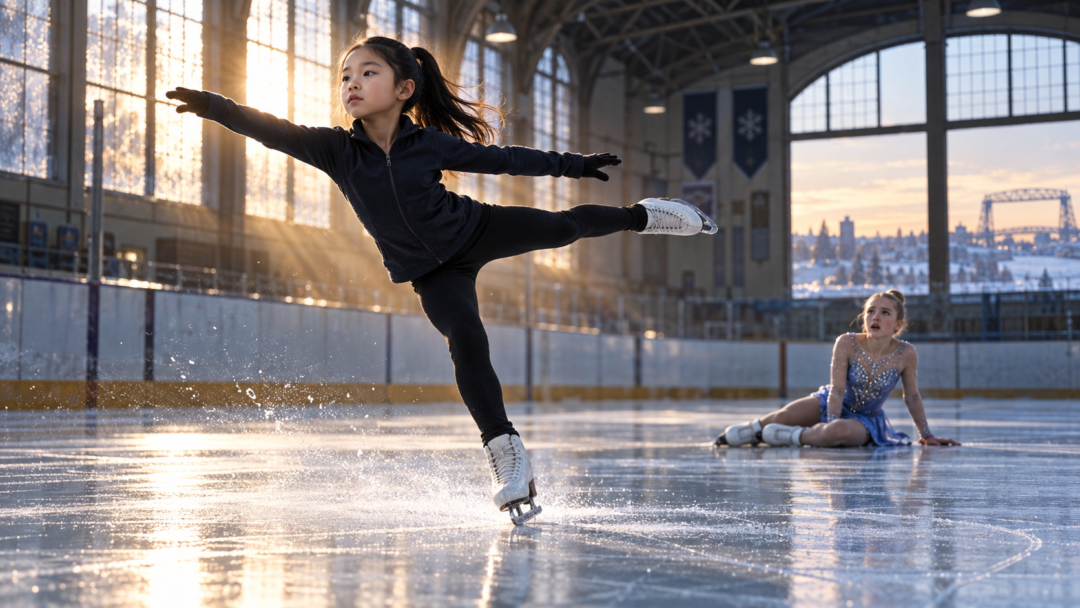
The Perfect Double Axel On The Cold Ice Shattered Her Pride
CHAPTER 1: THE FROST ON THE DASHER BOARDS
The sub-zero November wind howling off Lake Superior rattled the frosted clerestory windows of the Duluth Municipal Arena, sending thin ribbons of powdered snow swirling across the upper concrete bleachers. Inside, the massive 1930s arena was cold enough to see one’s breath in thick, pale plumes. High overhead, the exposed timber rafters groaned beneath the weight of accumulated rooftop drifts, while down on the freshly cut sheet of ice, the rhythmic hiss of steel blades echoed against the wooden dasher boards like sharpened razors carving glass.
At six-fifteen on a Thursday morning, the ice belonged exclusively to seventeen-year-old Raven Cross.
Raven was the crown jewel of the private North Shore Elite Skating Academy—or at least that was what the brass plaques in the arena lobby proclaimed. Dressed in a custom-tailored, obsidian-black Lycra practice dress trimmed in imported Austrian crystals, Raven skated with a desperate, frantic velocity. Her bleached-blonde hair was pulled into a high, immaculate ponytail, her jaw clenched with white-knuckled intensity. For the past forty minutes, she had been drilling the entry edge for her signature element: the double axel.
The jump was her ticket to the Midwest Sectional Championships, and it had become her living nightmare.
Raven gathered speed on a deep backward outside edge, stroking aggressively across the blue line. She checked her shoulders, snapped forward onto her left forward outside takeoff edge, and launched her body into the freezing air with an explosive, guttural grunt.
Her rotational axis collapsed almost instantly.
In mid-air, her right hip dropped three inches out of alignment. Her arms flailed wide, fighting against the centrifugal force, and she completed only one and a half rotations before gravity violently dragged her back to the ice.
Her right pick dug prematurely into the frosted surface. With a sickening, hollow thud that reverberated through the empty arena, Raven slammed sideways onto the frozen concrete sheet. She skidded twenty feet across the neutral zone, her designer tights ripping against the shaved ice, her crystal-encrusted hip bruising deep against the unforgiving substrate.
From behind the red dasher boards near the maintenance gate, ten-year-old Mina Lin watched in absolute silence.
Mina stood barely four feet six inches tall, wrapped in an oversized, faded maroon fleece jacket that had seen five harsh Minnesota winters. Her dark hair was tied back with a simple black elastic band, and her dark, observant eyes possessed the stillness of deep winter water. Under her arm, she carried a worn canvas skate bag. She had arrived on foot through the snowdrifts an hour before dawn, waiting quietly on a wooden folding chair for the open public session scheduled for seven o’clock.
Raven pushed herself up from the ice, her face flushed crimson with rage, embarrassment, and searing pain. She caught Mina’s calm, unblinking gaze through the glass boards.
“What are you staring at, you little rat?” Raven snarled, her voice cutting through the hollow arena like a cracked whip. She glided aggressively toward the boards, stopping with a violent spray of white shaving ice that dusted the dasher cap. “Who gave you permission to stand there watching me? This is private academy ice. My mother pays three hundred dollars an hour for this sheet.”
Mina did not flinch. Her hands remained resting quietly on her canvas bag. “Your right hip dropped before your takeoff pick left the surface,” Mina said softly. Her voice was remarkably steady, carrying a calm, matter-of-fact cadence. “You are leaning two degrees to the inside on your entrance edge. That is why your rotational axis tilts sideways before your shoulders snap.”
Raven’s eyes widened in sheer disbelief, her mouth parting in venomous indignation.
“Excuse me?” Raven scoffed, letting out a harsh, mocking laugh that bounced off the wooden rafters. “You’re a ten-year-old nobody in a thrift-store jacket. You skate on thirty-dollar rental blades during free public sessions with toddlers on plastic buckets. How dare you critique a senior national competitor?”
Raven pointed a gloved finger toward the exit doors. “Get out of here. Pack your garbage bag and sit in the freezing vestibule until the Zamboni clears the ice for the peasants at seven. You don’t even know what a clean double axel feels like.”
Mina looked at the vast, gleaming sheet of open ice stretching between the blue lines. Then, without answering, she reached into her bag.
She pulled out a pair of vintage, hand-stitched white Harlick leather boots fitted with John Wilson Sheffield steel blades. The leather was scuffed and softened by years of careful oiling, but the carbon-steel edges caught the overhead arena floodlights with a razor-sharp, mirror-bright sheen. Mina sat on the maintenance bench, laced her boots with swift, practiced precision, and tied the double knots without looking down.
She stood up, slipped off her white rubber blade guards, and pushed open the dasher gate.
“Hey!” Raven shouted, gliding forward to intercept her. “I told you to get off my ice! If you step onto this sheet before seven, my mother will have you banned from Duluth parks for life!”
Mina did not hurry, nor did she look at Raven. She stepped onto the ice with a silent, frictionless glide that seemed to defy the physical weight of her body.
With two effortless cross-strokes, Mina accelerated across the neutral zone, building immense kinetic energy from pure, textbook blade geometry. Her posture was straight as a plumb line, her chin lifted, her breathing deep and even. Approaching the center circle, she carved a deep, whispering backward outside curve, stepped forward onto a razor-sharp left forward outside edge, and bent her knee into a deep, spring-loaded compression.
Then, she launched.
There was no strain, no wild flailing, no desperate heave of the shoulders. Mina rose into the freezing air like a falcon caught in an updraft. Her body snapped into an airtight, pencil-straight rotational cylinder. Two complete, blindingly fast rotations whipped through the cold air—one, two—with her arms locked tight against her chest and her ankles crossed like locked needles.
She checked out of the rotation with immaculate, breathtaking elegance.
Her right outside back edge struck the ice with a crisp, musical chime. She rode out the landing curve on a single, flowing crescent of steel, her arms extending like swan wings, gliding twenty feet backward on a deep, shimmering arc that left a clean, razor-thin groove in the frost.
The entire arena went dead silent.
Raven stood frozen twenty feet away, her breath caught in her throat, her face draining of all color. Her knees trembled beneath her designer dress as she stared at the delicate, perfect circular tracing left on the ice by Mina’s blade.
From the darkened shadows behind the players’ bench, a gruff, gravelly voice broke the freezing stillness.
“She didn’t just guess your hip dropped, Raven,” Coach Nikolai Vance said, stepping slowly into the light beneath the dasher glass. “She’s been sitting up in the dark rafters watching you fail that exact jump for six weeks.”
CHAPTER 2: THE BLADE IN THE LEATHER GUARD
Coach Nikolai Vance stepped onto the rubber runner beside the players’ bench, his heavy wool overcoat dusted with dry snow and his breath rising in steady, white plumes. At sixty-eight, Vance was a legend in northern Minnesota figure skating circles—a former Olympic technical specialist who had guided world medalists before retreating into quiet retirement following the commercial takeover of the Duluth arena. His craggy, weathered face was lined with decades of sub-zero mornings, but his grey eyes were as sharp and unforgiving as freshly ground Sheffield steel.
He leaned both gloved hands against the dasher board, his gaze fixed not on Raven, but on the small girl gliding in slow, effortless backward crossovers across the center circle.
“Nikolai,” Raven stammered, her voice shaking as she tried to pull her posture upright and mask the humiliation burning behind her eyes. “She… she trespassed on my ice. I was in the middle of my sectional program run-through. She interrupted my ice time.”
“Your ice time ended five minutes ago when your hip hit the concrete substrate, Raven,” Vance said without turning his head. His voice was low, measured, and dry. “And what you were doing was not a double axel. You were throwing your torso over your right shoulder and praying the ice would catch you before your neck snapped. You have been doing that since August.”
Vance raised a hand, gesturing toward Mina. “Come here, child.”
Mina glided over to the boards, stopping on a clean two-foot snowplow that did not throw a single grain of ice over the dasher lip. She looked up at the veteran coach with calm, respectful eyes.
Vance did not look at her face first. He looked straight down at her feet.
His eyes widened slightly as he took in the distinctive, vintage John Wilson Sheffield blades mounted to her hand-stitched Harlick boots. The parabolic rocker profile was uniquely custom-cut, ground with an eight-foot radius and an aggressive cross-cut toe pick pattern that had not been manufactured in England since the late 1990s.
“Where did you get those blades, Mina?” Vance asked, his voice suddenly softer, tinged with an emotion Raven had never heard from the stern old coach.
“They were my mother’s,” Mina replied quietly. “She told me that steel remembers the edge of whoever loved it first.”
Raven let out an exasperated snort, crossing her crystal-clad arms. “Her mother was probably some rink-rat who bought second-hand junk at a garage sale. Look at her boots, Coach Vance. The leather is twenty years old! The academy dress code explicitly forbids antiquated gear on competition sheets.”
Vance’s gaze shifted to Raven, cold enough to freeze water. “Those blades,” he said with deliberate, chilling emphasis, “won silver in Nagano in 1998. They were ground by Arthur Wilson himself for Elena Lin.”
Raven blinked, the name striking her like a physical slap. “Elena… Elena Lin?”
“The same Elena Lin whose bronze silhouette hangs in the entrance rotunda,” Vance continued, pointing a gloved thumb over his shoulder toward the arena lobby. “The woman who funded the refrigeration compressors under this very floor. The skater your mother has spent the last three years trying to erase from the Duluth sports commission archives.”
Before Raven could formulate an answer, the heavy double doors at the far end of the arena concourse banged open against the concrete wall.
The sharp, rhythmic clack of Italian leather heels echoed across the cavernous building.
Victoria Cross marched down the concrete runway like an empress entering an occupied territory. At forty-eight, Victoria was a master of intimidation: wrapped in an ankle-length white cashmere coat, wearing oversized designer sunglasses despite the dim arena lighting, and flanked by Donald Henderson, the arena’s chief facility administrator. Behind them trailed two private security guards in navy-blue parkas.
“What is the meaning of this delay?” Victoria’s voice rang out, sharp, brassy, and dripping with manicured authority. She stopped at the dasher gate, her sunglasses sliding down her thin, aristocratic nose. “Raven, why are you standing at the boards? Your choreography specialist is arriving from Minneapolis at eight. Every minute of this private ice was billed to my corporate account.”
Victoria’s gaze snapped down to Mina, her thin lips curling into a sneer of pure revulsion. “And why is this stray child standing on academy ice? Henderson, I thought we made it abundantly clear that open public sessions do not begin until our academy skaters have cleared the building.”
Henderson, a nervous man in his fifties clutching a leather-bound ice scheduling ledger, shifted uncomfortably from foot to foot. “Mrs. Cross, the schedule board shows public ice at seven o’clock sharp. Young Mina paid her five-dollar youth admission at the front window—”
“I don’t give a damn about five dollars!” Victoria snapped, turning on the administrator with theatrical fury. “Look at her! Look at her ragged clothes and uncertified equipment. She is a liability risk to the North Shore Academy. If Raven trips over an errant rut left by that child, this city will face a seven-figure negligence lawsuit.”
Victoria stepped toward the dasher gate, pointing a manicured, emerald-ringed finger directly at Mina’s face. “Take off those skates immediately, little girl. Hand them to security. Henderson, pull the ledger. Erase her name from the public register. As President of the North Shore Academy Board, I am declaring Mina Lin permanently banned from the Duluth Municipal Arena for gross safety violations.”
The two security guards stepped forward, their heavy boots thumping against the dasher threshold.
Raven watched with a smug, vindictive smirk returning to her lips, pleased to see her mother’s crushing apparatus deployed so swiftly.
Mina did not retreat toward the center of the sheet. She simply stood her ground on the ice, her chin lifted, her hands steady at her sides.
“You cannot ban her, Victoria,” Coach Vance said, stepping squarely between the security guards and the open dasher gate. His voice was heavy, unyielding, and absolute.
Victoria let out a theatrical gasp of mock amusement. “And who is going to stop me, Nikolai? You? You’re a pensioned relic who hasn’t held a valid board seat since Elena Lin died. I run this arena now.”
Vance pulled a folded, official municipal document from the inner pocket of his heavy overcoat. “You might run the private academy board, Victoria. But you do not own the municipal trust. And if you lay a finger on that child’s skates, you will answer to the district attorney for felony theft of municipal property.”
CHAPTER 3: THE TABLET IN THE RAFTERS
The concrete hallway beneath the arena’s northern bleachers smelled of damp wool, industrial floor wax, and the bitter sulfur tang of the Zamboni’s propane exhaust. Outside the administrative offices, Coach Nikolai Vance led Mina into his personal workshop—a cramped, wood-paneled room lined with vintage skate-sharpening jigs, heavy stone grinding wheels, and dozens of black-and-white framed photographs of Duluth figure skaters from eras long before corporate sponsorships took over the ice.
Vance closed the heavy oak door, shutting out the muffled shouting of Victoria Cross and Henderson arguing in the lobby concourse.
He turned on the brass desk lamp, casting a warm pool of amber light across a workbench covered in micro-calipers, sharpening stones, and technical skating manuals. He pulled up a wooden stool for Mina and took a seat behind his scarred oak desk.
“Sit down, Mina,” Vance said gently. He pointed to her canvas skate bag. “Now tell me what you’ve really been doing up in the catwalks before dawn.”
Mina sat quietly on the stool. Her small hands carefully unzipped the side pocket of her worn canvas bag. Instead of extra laces or blade guards, she pulled out a battered, first-generation Apple iPad enclosed in a thick, cracked rubber shock case. The screen was heavily scratched, but the battery indicator glowed steady green.
She unlocked the screen and slid the tablet across the oak desk toward the veteran coach.
“I didn’t guess Raven’s hip dropped, Coach Vance,” Mina said in her soft, deliberate voice. “I calculated it.”
Vance frowned, adjusting his reading glasses as he peered down at the display.
What he saw made his breath catch in his throat.
The tablet was loaded with an open-source biomechanical motion-tracking application. On the screen was high-definition slow-motion video footage of Raven Cross executing her double axel takeoff, captured from an elevated forty-five-degree angle directly above the northern blue line. Overlaid across Raven’s moving silhouette were digital vector lines: red lines tracing the tilt of her pelvis, yellow arcs measuring the angular velocity of her free leg, and green crosshairs marking the center of mass relative to the blade rocker.
Mina reached over and tapped the screen, advancing the video frame by frame.
“Look at frame one hundred and forty-two,” Mina explained, her small finger tracing the red vector line. “When Raven steps from her left back inside edge to her left forward outside takeoff, her trailing shoulder drops four point five degrees. That creates rotational torque in the wrong plane. To compensate, she kicks her right leg out instead of snapping it straight through the axis. By the time she reaches peak apex at zero point six seconds, her moment of inertia is thirty percent too wide. She can never complete the second rotation.”
Vance stared at the ten-year-old girl in stunned amazement. The depth of technical analysis, the precision of the angular velocity calculations, and the clarity of the kinematic breakdown were on par with Olympic training centers in Colorado Springs.
“Who taught you how to chart angular momentum like this?” Vance asked, looking up from the screen.
“My mother left four leather notebooks in our closet,” Mina answered simply. “She wrote down the mathematical formulas for every jump in the competitive handbook. She said that figure skating isn’t about wishing or pretending to be pretty. She said it is physics and music agreeing to tell the truth at the same second.”
Mina tapped the folder icon on the screen, switching to another directory. “I filmed Raven for twenty-two days from the catwalk behind the ventilation ducts. I wanted to help her. I wanted to show her that she was landing on her inside heel because her entrance radius was too tight. But whenever I tried to speak to her, she threw water bottles at me.”
Vance shook his head, a mixture of awe and sorrow washing over his face. “Her mother wouldn’t let her listen anyway, Mina. Victoria doesn’t believe in physics. She believes in checks and intimidation.”
Vance scrolled down through the tablet’s file system, intending to check the timestamps of the video recordings. But as his finger brushed the document cache, an unread PDF attachment caught his eye. The file was titled Trust_Audit_Duluth_Parks_2024.pdf.
“What is this document, Mina?” Vance asked, his brow furrowing.
“My uncle sent it to my mother’s old email address last month,” Mina said softly. “He works in the city auditor’s office in Minneapolis. He told me to keep it safe until someone asked the right questions.”
Vance opened the PDF. As he read the forensic financial ledger, the blood drained from his face, replaced by a cold, white-hot fury.
The document was an official municipal reconciliation report for the Elena Lin Youth Athletic Memorial Endowment. In 1999, following her Olympic medal, Elena Lin had established a private five-hundred-thousand-dollar trust fund dedicated exclusively to providing free ice time, equipment, and master coaching for underprivileged Duluth youth skaters.
According to the audit, over the past thirty-six months, more than two hundred and fifty thousand dollars had been systematically siphoned out of the endowment account through fraudulent invoice billing submitted by the North Shore Elite Skating Academy. The line items were staggering: private travel stipends for Raven Cross, imported custom boots from Milan, and private ice rental fees totaling tens of thousands of dollars.
Victoria Cross had not been paying for Raven’s private ice with her family’s fortune. She had been stealing Mina Lin’s mother’s memorial trust to fund her daughter’s athletic vanity—while leaving Elena’s own daughter to freeze on public rental sheets.
Before Vance could speak, a sharp, metallic crash rattled the workshop door.
Donald Henderson stood in the doorway, his face pale and sweating, flanked by two municipal maintenance workers carrying heavy master padlocks and yellow caution tape.
“I’m sorry, Nikolai,” Henderson stammered nervously, avoiding Vance’s furious glare. “Victoria called the city council liaison ten minutes ago. The city manager ordered an immediate emergency closure of this facility for mechanical re-piping. The arena is locked down until Monday’s sectional qualifiers. No one gets on this ice. Not you, not Mina, not anyone.”
CHAPTER 4: THE ICE ON THE ST. LOUIS RIVER
The sub-zero cold had deepened by mid-afternoon, dropping the mercury to eight degrees below zero as a biting arctic gale swept across the mouth of the St. Louis River where it emptied into the frozen expanse of Lake Superior. The sky was a pale, hard slate grey, scoured clean of clouds by forty-mile-per-hour winds that whipped plumes of powdery drift across the shoreline. Along the river bay, sheltered between a stand of ancient white pines and an abandoned timber shipping dock, lay a two-hundred-yard sheet of naturally frozen black ice.
The river ice was four inches thick, clear as plate glass, and completely untouched by modern Zambonis.
Nikolai Vance pulled his ancient Ford F-250 pickup truck onto the packed snow of the public boat launch. The engine ticked as it cooled in the bitter air. Vance climbed out, wearing heavy fleece-lined work boots, a fur-trimmed canvas parka, and carrying two heavy snow shovels in the truck bed.
Mina stepped down from the passenger side, her canvas skate bag slung securely across her small chest. Her cheeks were pink from the heater, but her eyes were bright and unwavering as she looked out over the wild, wind-swept river sheet.
“This was where your mother learned to jump, Mina,” Vance said, his breath freezing instantly into his grey beard. “In 1988, the old municipal rink didn’t have heat, and ice time cost twelve dollars an hour that her father didn’t have. So we came out here every afternoon from November until March. The wind will fight you, the cold will sting your lungs, and the surface doesn’t forgive a lazy edge. But if you can land a double axel on river black ice in an onshore gale, no indoor arena in North America will ever intimidate you.”
Together, they spent forty-five minutes clearing a fifty-yard circular training patch near the shelter of the timber pilings. The physical work warmed their blood, the metal shovels scraping rhythmically against the frozen snow crust until a pristine, ebony mirror of natural ice emerged beneath the drifts.
Mina sat on the tailgate of the pickup truck, pulled off her winter boots, and laced on her mother’s Harlick skates. The leather was stiff from the freezing air, but as she stepped onto the river ice, the Sheffield blades bit into the frozen black surface with a clean, resonant hum that echoed through the bare pine trees.
“Show me your entrance edge, Mina,” Vance commanded from the shoreline, holding a digital stopwatch in his gloved palm. “Five warm-up circuits, then give me the entry edge on the center marker.”
Mina glided onto the river. The natural ice had a deeper, more resonant voice than the artificial concrete floor of the arena; every stroke produced a low, singing vibration that traveled through her ankles directly into her core. She accelerated against the biting wind, leaning her slender frame into the arctic gusts with effortless aerodynamic poise.
She carved three powerful backward cross-cuts, gaining explosive speed.
“Now!” Vance shouted over the roar of the pine branches. “Check the right shoulder! Keep the hip square against the headwind!”
Mina stepped forward onto her left forward outside edge. The sudden burst of wind off the lake hit her chest like an invisible wall, threatening to destabilize her balance. But instead of flinching, Mina dropped her center of gravity two inches deeper into her left knee, using the biting wind as a counter-lever.
She sprang into the freezing air.
Her body locked into an impenetrable, rotating spear. Two and a half blinding revolutions whipped through the sub-zero gale. She reached the apex of her arc three feet above the black river ice, suspended against the backdrop of the grey horizon.
She checked out cleanly, driving her right outside back edge deep into the frozen river.
Chime.
The blade held. The black ice sang as she carved a twenty-foot landing arc, her arms extending wide in perfect, flawless triumph.
“Again!” Vance yelled, his face beaming with a fierce, prideful grin he hadn’t worn in twenty years. “Again, Mina! Lock the ankles tighter on the check-out!”
For two grueling hours, through the fading northern twilight, Mina drilled her elements on the frozen St. Louis River. She landed six consecutive double axels, three double lutzes, and a breathtaking triple salchow that left a clean, white starburst etched into the black river glass.
As the sun sank beneath the ridgeline, painting the ice in streaks of cold violet and burnished gold, the crunch of heavy tires sounded from the gravel road above the boat launch.
A black Cadillac Escalade with tinted windows pulled up behind Vance’s truck, its engine idling with a throaty growl.
The driver’s side door opened, and Victoria Cross stepped out into the freezing wind, wrapping her fur coat tight around her throat. Behind her, Donald Henderson and two municipal workers carrying steel posts and yellow warning tape climbed out of a city maintenance van.
Victoria walked down the snowy embankment, her face twisted in bitter, calculating malice.
“You really don’t know when you’re beaten, do you, Nikolai?” Victoria shouted over the wind. She pointed toward the municipal workers, who began pounding steel rebar posts into the snow at the edge of the public boat launch. “This shoreline is designated as municipal park jurisdiction. By order of the Duluth City Council Safety Committee, I have declared this river access point an unsafe winter hazard. This area is officially condemned.”
Victoria turned her icy glare onto Mina, who was gliding slowly toward the shoreline.
“Enjoy your little frozen pond while you can, little girl,” Victoria sneered. “Because tomorrow morning at eight o’clock, the Midwest Sectional Qualifying Committee convenes at the main arena. The judges are flying in from Chicago. Raven has the sole junior entry spot. And by the time the sun sets tomorrow, your mother’s name will be completely scrubbed from every trophy in this state.”
CHAPTER 5: THE TEST ON THE CENTER CIRCLE
By seven-thirty on Friday morning, the Duluth Municipal Arena was ablaze with high-intensity television floodlights and the sharp, nervous energy of an official US Figure Skating sectional qualifying trial. Three national-level judges—distinguished officials from the Midwest Regional Association dressed in formal navy blazers and wool coats—sat behind a long, draped evaluation table at center ice, their laptops and digital scoring monitors glowing in the chilly air.
High in the private mezzanine box, Victoria Cross stood with a glass of champagne in her hand, watching the proceedings with the cold confidence of an investor who believed she had purchased every variable in the room.
Down on the ice, Raven was completing her warm-up stroking. She looked exhausted, her pale face caked in heavy stage makeup to hide dark circles of sleep deprivation. Her mother had forced her through four hours of late-night choreography with a private Russian technician, and every time Raven attempted a double axel in the practice corner, her takeoff blade skidded outward on the ice, betraying her failing confidence.
Suddenly, the heavy double doors beneath the player tunnel swung wide.
Coach Nikolai Vance walked onto the arena concourse, flanked not only by Mina Lin, but by Arthur Vance, the Duluth Deputy District Attorney, and two uniformed Minnesota State Troopers. In his right hand, Coach Vance carried an unsealed steel lockbox stamped with the municipal seal of the City of Duluth.
The arena concourse went dead silent as the party marched directly toward the judges’ table at center ice.
Victoria’s champagne glass froze halfway to her lips in the mezzanine. Her eyes narrowed in instant panic, and within seconds, she was hurrying down the carpeted stairs toward the ice surface.
“What is the meaning of this disruption?” Victoria demanded, bursting onto the dasher runner, her voice shrill with indignation. “Chief Judge Reynolds, this is a closed sectional trial for accredited North Shore Academy skaters! These individuals have no standing on this floor!”
Chief Judge Patricia Reynolds, a stern, grey-haired woman who had judged three Winter Olympics, adjusted her glasses and looked up from her scoring console.
“They have standing under Section 4 of the 1998 Municipal Arena Trust, Mrs. Cross,” Judge Reynolds replied evenly. “Coach Vance filed an emergency petition with the Midwest Sectional Committee at midnight, accompanied by an affidavit from the City Auditor.”
Vance set the steel lockbox on the judges’ table and popped the dual brass latches.
“Inside this box, Judge Reynolds,” Vance announced in a voice that rang through every rafter in the cavernous arena, “is the original, unamended 1998 charter signed by the late Elena Lin. Under Article Seven, any direct descendant of an Olympic medalist holding municipal trust rights is entitled to an immediate, open technical trial for any sectional berth awarded within this facility.”
Vance reached into the box and pulled out a thick stack of certified bank audit records.
“Furthermore, these documents prove that for three years, Mrs. Victoria Cross has systematically embezzled over two hundred and fifty thousand dollars from the Elena Lin Memorial Youth Fund to pay for private ice and falsified coaching credentials for her daughter. The District Attorney has already signed the subpoena.”
A collective gasp swept through the coaches, parents, and academy board members gathered along the glass boards. Raven stood frozen in the center of the ice, her face turning chalk-white as she stared at the stacks of financial ledgers bearing her mother’s signature.
Victoria’s face twisted into a mask of venomous desperation. She leaned over the dasher board, her voice trembling with barely suppressed hysteria.
“This is slander! Falsified documents concocted by a bitter, washed-up coach! Raven is the premier skater in this state! This little girl couldn’t skate a clean junior pattern if her life depended on it!”
Judge Reynolds slammed her scoring binder onto the table, silencing Victoria instantly.
“Enough, Mrs. Cross,” Reynolds said coldly. “The committee will review the financial allegations with law enforcement immediately. But under Section 4 of the charter, the athletic question will be decided right here on this ice. The sectional qualifying berth requires a verified technical element score of at least twenty-eight points, including a clean double axel.”
Reynolds looked out at the ice, then toward Mina, who stood calmly at the players’ gate, her skates laced, her hands resting quietly at her sides.
“Mina Lin and Raven Cross will each take the ice for an open three-jump technical evaluation,” Judge Reynolds announced. “Three elements: a double lutz, a triple salchow, and a double axel. The highest execution mark secures the sectional championship entry.”
Victoria stepped back, her chest heaving. She caught the eye of Gary Potts, the arena’s head maintenance technician, who stood half-hidden behind the Zamboni garage door. Victoria gave him a subtle, vicious nod.
Ten minutes earlier, on Victoria’s private cash promise, Potts had secretly tampered with the arena’s secondary brine chilling pumps and over-flooded the northern half of the ice sheet with three hundred gallons of scalding tap water.
The surface was not frozen hard. Beneath a deceptively glossy sheen, the northern rink was a soft, slushy mire of melting slurry. Any skater attempting an aggressive edge jump at high speed would sink two inches into the mush, blowing their edge and risking catastrophic ligament tears.
“Raven skates first,” Victoria declared with a venomous smirk, knowing her daughter had been warned to stay entirely within the hard, frozen southern half of the ice sheet.
CHAPTER 6: THE AXEL IN THE SPOTLIGHT
The arena floodlights dimmed, leaving a brilliant, sixty-foot circular spotlight illuminating center ice. The three judges sat poised with their digital scoring pens, their eyes fixed on Raven Cross as she took her starting position on the red center dot.
Raven’s hands were shaking violently. She knew about the sabotaged northern ice; her mother had whispered the warning to her at the boards just three minutes earlier. But knowing about the slush did not steady the terror tearing through her chest. Every eye in the arena was locked onto her, and the shame of the exposed embezzlement documents hung over her like a suffocating shroud.
The arena sound system chimed, signaling the start of her evaluation.
Raven stroked into her first element: the double lutz. Staying carefully within the frozen southern end of the rink, she picked hard into the firm ice and vaulted upward. She completed the rotations, but her landing was stiff and labored, her free leg brushing the ice before she scraped out of the turn.
Score: 3.8 out of 5.0.
Next was her triple salchow. Raven pushed with frantic urgency, carving an inside three-turn. She threw her weight into the takeoff, but her nerve failed her in mid-air; she popped the jump into a single, landing with a hollow clatter of steel against ice.
Score: 1.2.
A murmur of dismay rippled through the spectators. Raven’s face burned with humiliation. To secure the twenty-eight-point minimum, she needed a flawless, maximum-grade double axel.
She circled the neutral zone, building speed. In her panic and tunnel vision, she miscalculated her entrance trajectory. Desperate for open room, her gliding edge drifted across the red center line into the northern half of the rink.
Her left blade struck the slushy, warm-water zone.
Instead of a crisp, bite-and-glide response, the blade sank into a mushy groove of half-melted slurry. Water sprayed outward in a grey fan. Raven tried to check her takeoff edge, but the soft slush gave way beneath her pick.
With a terrified scream, Raven slipped violently backward. Her skates flew out from under her, and she slammed flat on her back into the freezing puddle of melting ice, soaking her designer dress and sending her crystal hairpins scattering across the slush.
The buzzer sounded. Raven lay on the wet sheet, sobbing uncontrollably in the spotlight, her pride, her vanity, and her athletic illusions completely shattered.
Two coaches rushed onto the ice to help the weeping seventeen-year-old off the sheet. As she passed the boards, Victoria grabbed her daughter’s arm, but Raven violently tore herself free.
“Don’t touch me!” Raven screamed at her mother, tears streaming through her ruined mascara. “You ruined everything! You lied about the money, you cheated the ice, and you made me into a fraud!”
The silence in the arena was absolute.
Chief Judge Reynolds tapped her microphone. “Skater Mina Lin. You have three minutes to take the ice.”
Coach Vance knelt beside Mina at the dasher gate. He reached into his coat and handed her a small square of clean buckskin.
“The northern ice is ruined, Mina,” Vance said quietly, his voice steady as granite. “Victoria flooded it with hot water. The substrate is mush. If you try a standard flat entrance, you will sink.”
Mina looked out at the spotlight gleaming over the puddles of slush. Her dark eyes were completely serene.
“My mother told me about spring ice on the river, Coach Vance,” Mina said softly. “When the surface melts, you don’t fight the water. You ride the heel rocker two millimeters further back, and you snap your takeoff from the pure apex of the curve.”
Mina stepped onto the ice.
She did not avoid the northern half. She glided directly into the flooded zone, testing the density of the slush with two effortless, whispering figure-eights. The water parted beneath her Sheffield blades with a soft, clean hiss, but her center of gravity remained impeccably vertical.
She stroked into her first element: the double lutz. Taking off from the edge of the slush, Mina rose with effortless, floating elevation, rotated two flawless turns, and checked out onto a bone-dry patch of southern ice with the quiet grace of a landing swallow.
Execution: +2.8 Grade of Execution.
Without hesitation, she transitioned directly into footwork for her triple salchow. She carved a deep, whispering edge, snapped into the air with explosive rotational velocity—one, two, three rotations—and landed with pristine, textbook extension, holding the landing edge for five full seconds.
The judges were already leaning forward, their eyes wide with disbelief.
Now came the final element: the double axel.
Mina stroked backward across the blue line, gathering immense, controlled kinetic power. She aimed her entrance curve directly into the center of the flooded northern circle—the exact spot where Raven had crashed.
Spectators along the boards gasped, several parents shielding their eyes in anticipation of a horrific fall.
Mina stepped forward onto her left forward outside edge directly into the slush.
Instead of sinking, Mina transferred her entire weight onto the parabolic sweet spot of her mother’s 1998 John Wilson blade. She compressed her knee like a coiled titanium spring, cutting through the water without losing a fraction of a mile per hour.
Then, she launched.
Mina exploded into the arena spotlight like a silver arrow fired from a bow. She soared nearly four feet above the glistening slush, her body locked into an airtight, pencil-straight cylinder of absolute aerodynamic perfection.
One rotation. Two rotations. Two and a half complete, breathtaking revolutions in mid-air.
She caught the ice on the dry southern circle with a ringing, crystal chime that echoed through every timber rafter in the building.
Her right outside back edge carved a deep, singing crescent through the frost. She held her checkout position—arms extended like an eagle in flight, head high, spine straight—gliding thirty feet across the ice before coming to a gentle, motionless stop directly in front of the three judges.
For three seconds, no one breathed.
Then, the entire arena erupted into a thunderous, standing ovation that rattled the glass dasher boards.
CHAPTER 7: THE TRUE GLIDE IN THE NORTHERN DAWN
The midday sun climbed over the frosted bluffs of Duluth, pouring through the high clerestory windows of the municipal arena in vast, golden shafts of winter light. The cold air inside the building smelled clean again—no longer heavy with the bitter tension of vanity, fear, and deceit, but filled with the crisp, invigorating scent of freshly resurfaced ice, cedar shavings, and cold river water.
At center ice, Chief Judge Patricia Reynolds stood before the official announcer’s podium, flanked by the two regional US Figure Skating technical delegates and the Duluth sports commission chairman.
“By unanimous decision of the Midwest Technical Evaluation Panel,” Judge Reynolds announced, her voice echoing clearly over the arena public address system, “Skater Mina Lin has achieved a technical execution mark of thirty-four point six points—the highest technical element score recorded in this regional division in over a decade. The Duluth sectional qualifying championship berth is officially awarded to Mina Lin.”
A deafening cheer broke out among the local youth skaters, high school hockey players, and parents gathered along the glass dasher boards. For the first time in three years, the arena felt alive with authentic joy rather than manufactured prestige.
On the concourse near the main exit, the dramatic collapse of the North Shore Academy’s corrupt dynasty reached its final, unyielding conclusion.
Two Minnesota State Troopers escorted Victoria Cross toward the glass entrance doors. Her expensive white cashmere coat was rumpled, her designer sunglasses were gone, and her wrists were secured behind her back in steel handcuffs. Deputy District Attorney Arthur Vance walked behind them, carrying two sealed cardboard evidence boxes containing five years of falsified academy accounting ledgers, forged coaching certifications, and unauthorized bank transfer receipts.
Victoria glanced back one final time, her face pale, drawn, and utterly defeated, as the courthouse transport van waited on the snowy curb outside. No one from the board stepped forward to defend her; the coaches she had purchased with stolen money avoided her gaze, clutching their clipboards in embarrassed silence.
Beside the player tunnel, Raven Cross sat quietly on a wooden bench, wrapped in a plain grey arena blanket. Her ruined competition dress had been replaced by a simple fleece sweatshirt, and the tears on her flushed cheeks had dried into quiet, somber stillness. The crushing pressure that had governed every waking breath of her teenage life had finally broken apart.
Mina walked over to the bench, her skate guards clicking rhythmically against the rubber floor runner.
Raven looked up slowly, her eyes red-rimmed with sorrow and exhaustion. She looked at the ten-year-old girl who had dismantled her mother’s empire in a single, breathless morning.
“You’re going to win nationals, aren’t you?” Raven asked, her voice barely louder than a whisper, trembling with vulnerability.
Mina stopped beside the bench. Her expression held neither triumphant gloating nor lingering resentment. She unzipped her canvas bag, pulled out her battered iPad, and sat down on the wooden bench beside the older girl.
“Your entry edge was never broken because you lacked talent, Raven,” Mina said gently, tapping the screen to bring up the slow-motion kinematic breakdown. “It was broken because they taught you to push with your shoulders instead of your core. They rushed you into senior elements before your foundation was solid. Look at frame one hundred and forty-two. If you adjust your takeoff angle by three degrees to the outside and let your hips stay level, you will never fall on that jump again.”
Raven stared at the digital vector lines, watching the recorded arc of her own body with wide, disbelieving eyes. For two years, high-priced private consultants had screamed at her to jump harder, to diet stricter, to mask her fear with arrogance. Not one of them had ever explained the simple geometry of her own movement with such patience and clarity.
A single, fresh tear rolled down Raven’s cheek, but for the first time in her career, the tight, brittle knot of panic in her chest loosened.
“All this time… you weren’t watching to mock me,” Raven whispered, taking the tablet with trembling, grateful hands. “You were trying to understand how to help.”
“My mother said that when one skater masters an edge, the whole rink gets stronger,” Mina answered softly. “You don’t have to quit, Raven. You just have to learn how to fall and get back up on your own feet.”
Raven let out a long, shuddering breath, a faint, genuine smile touching her lips for the first time in years. “Thank you, Mina. I’m sorry. For everything.”
Three days later, the Duluth City Council convened in an emergency public session at City Hall. By a unanimous vote of nine to zero, the council formally revoked the North Shore Elite Academy’s private commercial lease on the municipal arena. The facility was officially restored to its original 1998 charter as the Elena Lin Youth Athletic Sanctuary—an open, free municipal skating academy dedicated to training any child with a pair of blades and the desire to fly.
In the arena’s entrance rotunda, the bronze silhouette of Elena Lin was polished to a brilliant, glowing sheen. Beneath her portrait, the original memorial plaque was re-installed, its gold-leaf lettering reading: The ice belongs to those who seek the truth in the glide.
By official decree of the municipal parks board, Coach Nikolai Vance was appointed Director of Master Coaching and Athletic Development, with full authority over youth development grants.
On Monday morning at six o’clock, the arena was quiet, peaceful, and cold.
The eastern sky over Lake Superior was painted in breathtaking streaks of rose, lavender, and brilliant northern gold. Down on the freshly cut sheet of ice, the refrigeration compressors hummed with a deep, steady rhythm, keeping the concrete cold and the surface hard as diamonds.
Nikolai Vance stood at the dasher gate, a warm mug of black coffee in his hands, watching his new student with quiet reverence.
Mina was out on the center circle alone. She was dressed in her simple maroon fleece jacket and her mother’s vintage Harlick skates. She accelerated into a deep, sweeping backward outside curve, building speed with every stroke until the wind ruffled her dark ponytail.
She checked her shoulders, compressed her knee, and launched into the air.
She rose toward the golden morning light pouring through the clerestory glass, spinning with effortless, breathtaking grace. Two and a half complete, perfect rotations carried her through the cold air before her blade caught the ice with a crystal chime that sounded like a church bell ringing across the frozen lake.
She glided out across the glistening ice, free, fearless, and unbroken, skating in the light of the morning her mother had built for her.