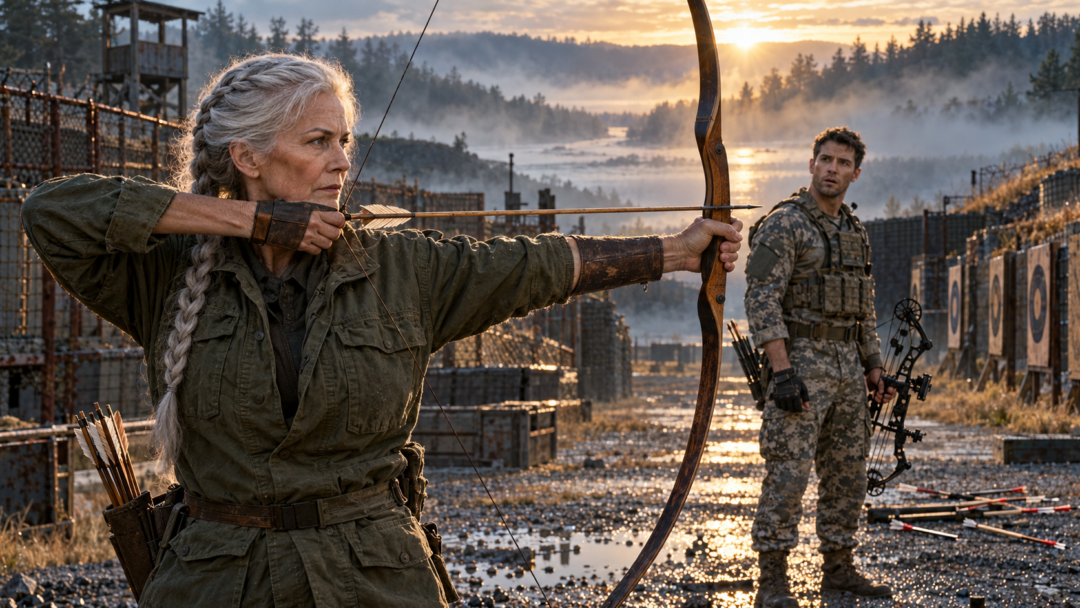
The Retired Archery Instructor Who Silenced The Arrogant Lieutenant’s Challenge
CHAPTER 1: THE WOODEN BOW ON THE MISTY RANGE
A biting, damp November fog rolled off the tidal marshes of the Delaware River, creeping through the dense pitch pines of the Pine Barrens before settling over the crushed-gravel firing lines of Fort Arden’s historic marksmanship range. Established during the First World War as a small-arms testing ground for the Ordnance Department, the installation was a utilitarian complex of weathered cedar-shingle barracks, rusted chain-link revetments, and towering earthen berms that had absorbed millions of rounds of lead, copper, and tungsten over a century of American military history. At six o’clock on a Tuesday morning, the air was a freezing blue-grey, smelling of damp pine needles, burnt cordite from yesterday’s night-fire exercises, machine sulfur, and the sharp, medicinal tang of gun oil drifting from the armory cleaning bays down the access road.
Sitting alone on an unpainted pine bench near the ninety-meter target line was Maren Holt.
Maren was sixty-eight years old, a retired master marksmanship instructor whose career spanned four decades of military small-arms, sniper training, and specialized kinetic projectile instruction. Her silver hair was pulled back into a severe French braid that reached between her shoulder blades, secured with an olive-drab elastic band that did not permit a single stray lock to drift across her brow. Her face was an austere, windswept ledger of outdoor ranges across five continents: deep crow’s feet around pale blue eyes that could spot a camouflaged sniper at four hundred yards, high cheekbones weathered by sun, salt, and sleet, and a firm, unyielding mouth that rarely required words to enforce military discipline. She wore a faded M-65 field jacket with the unit patches and rank insignia removed, dark canvas field trousers tucked into scuffed leather combat boots, and an ancient, sweat-darkened leather three-finger shooting tab strapped across her right palm.
Resting across her knees was an instrument that looked completely out of place in a modern military garrison: a vintage 1974 Bear Kodiak custom recurve bow. It was sixty inches of laminated hard rock maple and brown fiberglass, its limb tips reinforced with black micarta, strung with a hand-twisted Flemish bowstring of Dacron and beeswax. It possessed no sights, no counterweight stabilizers, no fiber-optic pins, and no mechanical pulleys. It was seventy pounds of raw mechanical potential, dependent entirely upon the bone structure, muscle memory, and instinct of the archer.
Underneath the right shoulder of Maren’s field jacket lay the hidden price of that bow.
Her right deltoid was a patchwork of puckered, fibrous scar tissue—the legacy of a burning command Humvee outside Fallujah in 2004, where she had hauled an unconscious nineteen-year-old radio technician through a shattered rear hatch while thirty-caliber machine-gun rounds chewed through the armored door. The field surgery and skin grafts had saved her arm, but the joint clicked with a deep, grinding ache whenever the temperature dropped below forty degrees. She had refused an honorable medical retirement then, spending her final active years teaching special operations teams how to shoot when electronic sights were destroyed by dust and salt. Even now, as the icy river mist penetrated the weave of her jacket, the dull throbbing pulse within the reconstructed glenohumeral joint served as an unrelenting metronome of her survival.
The rhythmic crunch of tactical boots on wet gravel broke the quiet morning hush.
Approaching the bench was Lieutenant Soren Vex, accompanied by four junior soldiers in crisp camouflage utilities. Vex was thirty-five years old, the newly appointed chief of specialized weapons doctrine at the post. He was tall, athletic, with an immaculate high-and-tight haircut, a clean-shaved jawline, and a permanent, razor-sharp smirk that broadcast absolute confidence in modern digital systems. Slung over his shoulder was a matte-black Hoyt carbon compound bow, fitted with a computerized laser rangefinder sight, five-pin illuminated fiber optics, and pneumatic vibration dampers.
Vex stopped two paces from Maren’s bench, looked down at her vintage wooden recurve bow, and let out a dry, dismissive snort that echoed across the wet boards.
“You’re Holt?” Vex asked, his voice sharp, condescending, and loud enough to ensure the four young privates heard every syllable. “Colonel Vance said he invited an old legend to review our kinetic curriculum. I expected someone who actually deployed with modern equipment. Not a museum curator with a piece of firewood.”
Maren did not look up from the bowstring she was checking with her thumb. She felt the micro-vibrations of the Dacron fibers, ensuring the center serving was aligned with the nocking point. “The wind is out of the northeast, Lieutenant. Twelve knots, gusting to eighteen at the berm. You might want to calibrate your electronic wind sensor before your laser scatters in the river fog.”
Vex sneered, pulling an aluminum clipboard from his armpit. He slapped a blank qualification score sheet onto the bench beside Maren’s leg with an aggressive, metallic snap.
“The war’s over, ma’am,” Vex said, leaning down so his face was level with hers, his breath misting between them in cold clouds. “Electronic rangefinders, smart optics, and mechanical release aids run modern kinetic warfare now. Human instinct is an obsolete liability that gets soldiers killed in the field. Go home to your garden.”
Maren paused her thumb on the Flemish string. Her pale blue eyes lifted slowly, meeting Vex’s contemptuous stare with an absolute, unblinking stillness that made the smirk on the young officer’s lips falter for a microsecond.
Then, Maren looked down at the paper Vex had slammed onto the bench.
Scrawled in red grease pencil across the score column, beside her name, was a single, mocking number: 0/100 – DISQUALIFIED DUE TO OBSOLETE HARDWARE. But beneath that insolent zero lay a handwritten postscript in Vex’s jagged scrawl that made Maren’s jaw set like iron: Your legacy belongs in a glass display case beside dead men who ran out of battery power.
CHAPTER 2: THE SCORE SHEET THROWN UPON THE BENCH
The silence that settled over the firing line was so complete that the distant dripping of condensation from the corrugated tin roof of the shooting shed sounded like a counting clock. The four junior soldiers standing behind Lieutenant Vex shifted their weight uncomfortably on the gravel, exchanging nervous glances. They knew who Maren Holt was; her portrait hung in the post headquarters hallway beside two Medal of Honor recipients, and every seasoned drill sergeant on the base had passed through her marksmanship classes before deploying overseas. To see a freshly minted lieutenant, three decades her junior, treat the master instructor like an unwelcome trespasser turned their stomachs with unease.
Maren did not reach for the clipboard. She did not raise her voice, nor did she offer a defensive speech about the history of traditional military archery or the seven commendations pinned to the velvet backing of her civilian shadow box.
She simply stood up.
Her sixty-eight-year-old spine straightened with a crisp, effortless alignment that seemed to add three inches to her height. Her right shoulder gave a faint, muffled click as the damaged deltoid rotated into its socket, but her face betrayed not a flicker of discomfort. She picked up the Bear Kodiak recurve by its contoured walnut grip, testing the seventy-pound draw with a smooth, three-inch pull of her right fingers. The seasoned maple limbs arched with a silent, menacing elegance, the Dacron string humming a low, pure note like a cello string tuned to concert pitch.
“You believe your carbon pulleys eliminate human error, Lieutenant?” Maren asked quietly, her voice level and dry as autumn grass.
“I believe in repeatable ballistics, Holt,” Vex countered, crossing his arms and tapping his modern compound bow with a manicured finger. “My compound bow produces three hundred and forty feet per second with an eighty-five percent let-off. My laser sight calculates elevation, temperature, and atmospheric pressure down to the millimeter. At eighty meters, my group is tighter than a silver dollar. Your wooden stick can’t even maintain arrow trajectory past sixty in this crosswind. The physics are completely against you.”
“Physics belong to the arrow, Lieutenant, not to the machine that launches it,” Maren said, stepping off the grass onto the firing line. “A machine does not know when the air shifts across the valley floor. It only knows what its glass sees.”
“Fine by me,” Vex said, a venomous smile returning to his face as he unclipped his Hoyt carbon bow from its carrying harness. “Let’s see the legend prove it on the official test course. Four stations. Station one: ninety meters, open field, crosswind. Station two: seventy meters, target concealed behind an eight-foot concrete revetment blind—an angle shot where direct line-of-sight is impossible. Station three: fifty meters, oscillating pendulum target moving at twelve miles an hour. And station four: sixty meters, double-release—two arrows striking the target core before the first one drops from the butt.”
Sergeant First Class Marcus Brody, the veteran range master who had been standing quietly beside the scoring shed with an arm lost in Kandahar replaced by a matte-black carbon prosthesis, stepped forward, his boots crunching in the gravel. Brody had served under Maren during her final operational tour in Djibouti, and the lines on his scarred face deepened with open alarm.
“Lieutenant,” Brody warned, his raspy voice tight with caution. “Station four hasn’t been scored on this post in thirty years. It requires a blind Comanche draw. It’s not in the current TRADOC manual, and the last time a soldier attempted it, he tore his rotator cuff off the bone and spent eight months in physical rehabilitation.”
“Then it’s the perfect test to prove traditional archery belongs in an antique shop,” Vex snapped, turning toward the soldiers. “Privates, log the targets! If she fails a single arrow, she signs a voluntary surrender of her civilian consultant credentials, vacates her advisory office by noon, and forfeits her pension supplement from the kinetic program.”
“And if I clear all four?” Maren asked, her gaze steady on Vex’s eyes, pinning him with a cold intensity that stripped away his practiced swagger.
Vex chuckled, arrogant and dismissive, though his left eyebrow twitched under her stare. “If you clear all four with that wooden stick, I’ll personally burn my carbon bow in the range barrel, resign my command of weapons doctrine, and take my squad through your six-week traditional kinetic course on my knees in full battle rattle.”
“Keep your knees for church, Lieutenant,” Maren said softly, reaching behind her shoulder into the quiver. “Just keep your eyes on the target.”
Maren reached into the canvas quiver slung across her back, pulling out a cedar hunting shaft fitted with five-inch turkey-feather fletchings and a one-hundred-grain field point. She inspected the grain of the wood, rolling the shaft between her calloused fingertips to check for micro-warping caused by the river moisture. Every grain line in the Port Orford cedar had been hand-trued on an oilstone by her own hands thirty winters ago.
She stepped to Station One.
Ninety meters downrange, the standard four-foot circular target butt was barely visible through the swirling river fog, appearing as a faint, blurred yellow circle floating above the frosted grass. The wind was gusting hard from the left, whistling through the chain-link fencing with an erratic, pulsing howl that pushed the birch trees fifty yards away into deep arcs.
Maren planted her boots shoulder-width apart, perpendicular to the target, her hips locked, her shoulders relaxed into an ancient shooting stance that traced its lineage through centuries of frontier warfare.
She nocked the cedar arrow onto the Flemish string.
Vex raised his binoculars, a mocking grin on his face. “Go ahead, old timer. Show us what 1974 looked like.”
Just as Maren raised the bow, a sudden, violent squall ripped off the Delaware riverbed, sending a wall of freezing mist across the gravel that completely swallowed the ninety-meter target from view.
CHAPTER 3: THE FIRST RELEASE THROUGH THE IRON FOG
The whiteout lasted four long seconds, wrapping the entire range in a curtain of swirling vapor. The four junior soldiers leaned forward, squinting into the mist, unable to see beyond forty yards. Even Lieutenant Vex’s high-end digital binoculars flared with white wash as the laser beam bounced off suspended water droplets, returning an erratic blinking hazard icon.
Yet Maren did not look for the target with her eyes.
Her pale blue eyes were fixed on the line of yellow prairie grass twenty yards downrange, reading the direction and frequency of the wind gusts through the bending stalks. She watched the heavy river fog drifting across the berm, calculating the moisture density that would add three grains of weight to the wooden shaft during its flight. In instinctual archery, the eyes do not aim at a point; they become the trajectory itself. The archer does not calculate math; she feels the density of the air as if her own skin were the fletching.
Maren raised the recurve bow.
There was no mechanical let-off to reduce the holding weight. Her right hand, anchored by three calloused leather-clad fingers, hauled the full seventy pounds of laminated maple and fiberglass straight back to her anchor point at the corner of her jawline.
Her drawing shoulder clicked—a sharp, dull thud of damaged cartilage grinding against bone. A flash of white-hot fire shot down the nerves of her right tricep, setting her arm ablaze with memory, but her posture did not waver by a single millimeter. Her breathing remained slow, rhythmic, and perfectly synchronized with the pulse of the wind. She inhaled the cold scent of damp pine, holding the draft in her diaphragm until her heart rate settled into a slow, twenty-beat cadence.
The wind surged, screaming through the fencing at eighteen knots.
Maren waited.
The gust peaked, shuddered against the earthen berm, and began its three-second lull.
Release.
Maren’s three fingers slipped cleanly off the Dacron string with zero plucking, zero lateral deflection.
TWANG.
The acoustic sound of the recurve was clean, visceral, and deep—a solid, resonant thrum of seasoned timber transferring kinetic energy into wood.
The cedar shaft vanished into the swirling fog.
For two long seconds, there was only the whistle of the turkey feathers cutting through the heavy, moisture-laden air. The arrow rose in a high, elegant parabolic arc, riding the edge of the fading wind shear, banking gently to the right as the gyroscopic spin stabilized its flight across the open field.
Ninety meters downrange, a concussive, heavy impact shattered the morning silence.
THWACK.
Vex lowered his binoculars by an inch, his mouth slightly ajar. He raised the optics again, frantically adjusting the focus wheel on the digital lens, muttering under his breath as he zoomed into the maximum magnification.
Through the mist, sitting dead center in the five-inch yellow bullseye—piercing the exact intersection of the concentric scoring rings—was Maren’s cedar arrow, its turkey feathers vibrating with dying kinetic energy.
“Dead center,” Sergeant Brody murmured from the shed, his gravel voice carrying an undercurrent of fierce pride. “X-ring. Ten points.”
The four junior soldiers behind Vex exchanged wide-eyed looks of astonishment. One of them, Private First Class Tyler Alvarez, let out an involuntary whisper: “Jesus. Through eighteen knots of crosswind without a scope.”
Vex’s jaw tightened until the muscles in his cheek stood out like knots. He stepped forward onto the gravel, his face flushed with defensive rage, refusing to concede an inch of ground. He shoved his hands deep into his tactical vest, his boots crunching violently into the gravel.
“A lucky wind read,” Vex snarled, pulling his modern compound bow off his shoulder. “The fog settled for a half-second. Anybody could catch a draft if they lobbed enough wood downrange. Let’s see you repeat it on Station Two.”
Vex walked to the second shooting peg. Station Two was an obstacle course nightmare: an eight-foot-tall, twelve-inch-thick reinforced concrete revetment stood fifty meters downrange, completely blocking the direct line of sight to the target butt positioned twenty meters behind it. The target was entirely invisible from the firing line, buried in an earthen reverse-slope trench designed to simulate bunker warfare.
Vex slotted a carbon-fiber arrow into his composite bow, clipped his mechanical caliper release to the D-loop, and raised the weapon.
He engaged his digital sight.
The optic projected a bright green aiming reticle onto the ocular glass, but the thick river fog, heavy with microscopic water droplets, caused the laser rangefinder to scatter violently. The digital display flickered erratically, reading eighty meters, then forty, then flashing a fatal red error code: LIDAR REFLECTION ERROR – MANUAL OVERRIDE REQUIRED.
Vex swore under his breath, his fingers beginning to tremble slightly on the grip as he tried to calculate the loft manually. He drew the eighty-pound compound bow, its mechanical cams rolling over with a metallic clack. He aimed high above the concrete wall, guessing the parabolic descent.
He triggered the mechanical release.
The carbon arrow screamed down the range at blistering speed.
It cleared the concrete revetment, but the flat trajectory was too shallow. The arrow struck the top rim of the concrete wall with an explosive screech, shattering into carbon fragments that rained harmlessly into the gravel pit.
Vex stood frozen, his hand still raised, his breath coming in short, furious gasps.
“Target missed,” Brody called out, his tone utterly neutral. “Zero points.”
Vex turned slowly toward Maren, his eyes bloodshot, his arrogance cracking into desperate humiliation.
“Let’s see the wooden stick do better,” Vex spat, “or admit this angle was designed to be impossible.”
CHAPTER 4: THE ANGLE BEHIND THE CONCRETE BLIND
Maren did not look at the shattered carbon fragments dusting the gravel downrange. She did not offer a smirk, nor did she comment on the failure of Vex’s twelve-hundred-dollar lidar optic. To gloat on a firing range was the mark of an amateur who shot to impress others rather than to master the weapon. In the field, an arrogant marksman was an open target.
She pulled a second cedar arrow from her back quiver.
The shaft was slightly heavier than the first—four hundred and twenty grains, fletched with a higher-profile parabolic feather cut designed to create stabilizing drag during a steep downward plunge. She rolled the arrow across her palm, feeling the cool wax coating the wood. She checked the spine rating: sixty-five to seventy pounds, matched perfectly to the flex of her maple limbs.
She stepped to Station Two, planting her boots exactly where Vex had stood.
Before her stood the eight-foot concrete blind, blank, gray, and solid, obscuring every inch of the target beyond. The target butt was twenty meters behind the wall, submerged in a depression in the earth designed to simulate an enemy mortar crew dug into a reverse-slope defilade. From the firing peg, there was no angle of direct sight; an archer could only see the concrete face and the tops of the pitch pines behind it.
Maren did not look at the concrete.
She looked up at the tops of the pitch pines flanking the range, reading the ceiling of the fog layer. To drop an arrow behind an eight-foot vertical obstruction at seventy meters, the projectile had to follow an extreme mortar trajectory: launch at an elevation angle of sixty-five degrees, achieve an apex of forty-five feet, stall out its forward momentum, and plummet almost vertically onto the reverse slope.
It was an ancient siege technique, developed by the Welsh longbowmen at Crécy and refined by frontier scouts who fought behind river bluffs along the Missouri.
Maren raised the Bear Kodiak recurve.
Her left arm extended toward the gray sky, angled high above the concrete revetment. Her right hand drew the seventy-pound string back to her collarbone.
Her damaged shoulder protested with a sharp, burning spasm that sent cold sweat down the back of her neck. The deep scar tissue pulled tight across the joint, threatening to buckle her elbow, but she clamped her core tight and grounded her boots into the earth. Her mind detached from the flesh, focusing entirely upon the invisible geometry of the flight path. She visualized the arc—not as a mathematical equation on a digital display, but as a living stream of air that would carry the feather-guided timber over the wall. She felt the gravity, the drag, the wind shear at thirty feet above the grass.
Draw. Settle. Release.
TWANG.
The bow hummed with deep, acoustic resonance.
The heavy cedar shaft shot upward into the fog, disappearing into the low-hanging cloud bank sixty feet above the ground.
For a full three seconds, the range went utterly, breathlessly silent. Vex, Brody, and the four young soldiers tilted their heads back, staring into the gray void where the arrow had vanished. The sound of the wind through the pines was the only witness.
Then, from the depression behind the eight-foot concrete wall, came the unmistakable, concussive impact of steel broadhead striking compressed straw.
THWACK.
Brody took his radio transceiver from his belt, keying the microphone to contact the range pit officer stationed behind the revetment.
“Pit two, report target two,” Brody commanded.
A crackle of static broke through the radio speaker, followed by the stunned, incredulous voice of the junior range technician:
“Range control… you’re not going to believe this. Arrow entered at an eighty-degree downward angle. Split the red inner ring, two inches off dead center. The arrow is buried five inches into the butt.”
The four junior soldiers behind Vex could not contain themselves. A collective gasp broke out, followed by a muffled cheer that Private Alvarez quickly stifled behind his fist. They looked at the sixty-eight-year-old woman with awe that verged on reverence.
Vex’s face had drained of all color. He looked from the concrete wall to Maren’s calm, weathered face, his hands shaking so violently that the modern compound bow tapped against his thigh with a faint metallic rattle.
“You’re a demon,” Vex whispered, his voice shaking with a mixture of terror and wounded pride. “Nobody calculates that angle without a trajectory table.”
“A table tells you what should happen, Lieutenant,” Maren said, lowering the bow to her hip. “Your eyes and your blood tell you what is happening. Now, station three.”
Vex swallowed hard, his throat dry as chalk. He stared at Maren’s hands, realizing for the first time that while his high-tech optic had crashed, her fingers had never even trembled. But the hardest trial remained ahead, where human reflexes alone decided life and death.
CHAPTER 5: THE TWO ARROWS IN THE SAME BREATH
Station Three was the oscillating pendulum target. Fifty meters downrange, suspended from an overhead steel cable by a twenty-foot steel wire, was a three-foot circular foam target moving continuously from left to right across a forty-foot window of fire. It accelerated toward the center, slowed at the apex of its swing, and reversed direction in an unpredictable, swinging rhythm driven by an electric motor.
Maren did not wait for Vex to take his shot or offer excuses about mechanical calibration.
“You wanted to see the moving target, Lieutenant,” Maren said, stepping directly to the line. “Watch closely.”
She drew a third cedar arrow, nocked it, and without pausing to anchor or aim, executed a snap-draw.
The bow arched, fired, and recovered in under two seconds.
The arrow met the pendulum target at the exact dead center of its swing, pinning the foam core through the yellow ring with an explosive thud. The target continued to swing, the wooden shaft vibrating like a tuning fork in the mist.
“Station three cleared,” Brody called out, his voice shaking with suppressed awe. “Ten points.”
Maren turned her gaze toward the final peg: Station Four.
This was the legendary Comanche rapid-fire challenge. Sixty meters downrange sat a stationary target. The rule required the archer to launch an arrow at the target, instantly nock a second arrow, draw, and release it before the first arrow struck the straw butt sixty meters away. Both arrows had to be in the air simultaneously. Both arrows had to strike within the four-inch center ring.
It required an arrow flight time of roughly 1.4 seconds, meaning the second draw and release had to be executed in under seven-tenths of a second. It was a test of raw physical reflexes and mental detachment that very few living humans had ever mastered.
“This is impossible with a seventy-pound recurve,” Vex croaked, stepping forward, his voice cracking. “The physical recovery of the wood alone takes a half-second. You’ll tear your shoulder apart.”
“Step back, Lieutenant,” Maren said quietly.
She reached into her quiver, withdrawing two identical cedar shafts.
She held the first arrow nocked on the string between her forefinger and thumb. The second arrow she held horizontally against the walnut riser of the bow, clamped lightly between her palm and the leather grip, its nock pre-aligned for an immediate, blind transfer.
She stood at the line, her feet digging into the crushed gravel.
The river fog was beginning to lift, burned away by the rising morning sun that cast long, golden beams across the firing line, illuminating every drop of moisture on the grass.
Maren took one breath.
Her right shoulder screamed as she hauled the seventy-pound string back to her jawline in an explosive, blinding motion.
Release.
TWANG.
The first arrow leaped from the shelf, whistling downrange like a silver streak of light.
Before the first arrow had traveled twenty yards, Maren’s left hand rolled the second shaft onto the wooden arrow rest. Her right fingers snapped down onto the nock, engaging the Dacron serving with a sharp, audible click.
In one continuous, blurred kinetic cycle that defied the human eye, she hauled the string back to her cheekbone and released.
TWANG.
The two arrows flew down the range five yards apart, their parabolic arcs perfectly parallel, their turkey feathers whistling in identical harmonic frequencies through the morning air.
Sixty meters away, two concussive impacts detonated against the straw butt in rapid-fire succession:
THWACK-THWACK.
The first arrow struck dead center in the X-ring.
The second arrow, arriving three-tenths of a second later, struck the wooden nock of the first arrow, splitting the cedar shaft clean in half before embedding itself directly beside it in the core of the yellow circle.
Robin Hood. Dead center.
Total, absolute, suffocating silence fell over Fort Arden’s firing range.
The four junior soldiers stood frozen at attention, their mouths open, staring down the range in paralyzed awe. Brody stood with his radio in his hand, a slow, broad grin spreading across his weathered face.
Beside Maren, Lieutenant Soren Vex stood completely motionless.
His arrogant smirk was dead. His cheeks were as pale as parchment. His knees were trembling, and his expensive Hoyt compound bow hung from his limp fingers like a useless toy.
Maren lowered her Bear Kodiak recurve.
She did not smile. She did not raise her arms in triumph. She did not even look at the target downrange.
She turned to Vex, looked him dead in the eye for one silent, crushing beat, and set the wooden recurve bow down upon the pine bench beside his discarded score sheet.
“Your father’s initials are carved beneath the leather grip on this riser, Soren,” Maren said in a low, quiet voice that made Vex flinch as if struck by a whip.
Then, she turned and began walking away down the gravel path toward the post headquarters.
CHAPTER 6: THE RECORD HIDDEN IN THE POST ARCHIVES
“Wait!”
The voice broke from Soren Vex’s throat—not with the sharp arrogance of a commanding officer, but with the raw, cracking desperation of a broken man.
He dropped his compound bow onto the gravel, not caring that the optical laser sight cracked against the stone, and ran down the path after Maren, his boots crunching frantically in the gravel.
“Holt! Please… wait! What did you say about my father?”
Maren stopped ten paces down the path, beneath the towering boughs of an ancient pitch pine, and turned slowly. Her eyes were deep pools of calm, waiting for the young officer to shed the armor of his false pride.
Vex caught up to her, his chest heaving, his face crimson with shame. He looked down at the gravel, unable to meet her gaze, his fingers clenching into fists at his sides.
“I… I had no right,” Vex whispered, his voice trembling so violently he could barely form the words. “I threw that score sheet at you because… because I was terrified.”
Maren stood with her hands in the pockets of her faded field jacket, her expression calm, patient, and unreadable. “Terrified of what, Lieutenant?”
“Terrified of being exposed as an imposter,” Vex said, tears of humiliation finally spilling over his lashes. “My father was Colonel Thomas Vex. He commanded the 3rd Battalion in Fallujah. He has five Silver Stars, a Distinguished Service Cross, and a monument on the parade ground. Everyone on this base expects me to be him. But I was stationed at a desk in Qatar during the entire war. I never fired a shot in anger. I bought the compound bows, the lasers, the digital sights… because I thought if the technology was perfect, nobody would ever see that I was a coward who didn’t know how to shoot from the heart.”
The young lieutenant covered his face with his gloved hands, his shoulders shaking with the suppressed agony of years spent living in the shadow of a hero. The four soldiers back on the range were silent, looking down, respecting their officer’s undoing.
Maren watched him, the sternness in her eyes softening into something profound and deeply sorrowful.
“Come with me, Soren,” Maren said gently, using his first name for the first time.
She led him away from the range, across the parade ground where the morning flag was being raised by the color guard, and into the red-brick building that housed the Fort Arden Post Historical Archives.
The basement archives smelled of aged paper, leather bindings, and military cedar chests. The fluorescent tubes flickered overhead, casting long shadows across rows of olive-drab steel lockers and bound battle logs dating back to the Korean War. Maren led Vex to the back of the room, to a heavy steel filing cabinet labeled OPERATION IRON HORIZON – 2004.
She unlocked the drawer with a small brass key from her chain, pulling out a thick, water-stained manila folder stamped CLASSIFIED – AFTER-ACTION LOGS.
She opened the file across a wooden reading table and slid it in front of Vex.
“Read page forty-two,” Maren instructed softly.
Vex leaned over the table, his eyes scanning the faded typewriter text:
CASUALTY EXTRACTION LOG – NOVEMBER 14, 2004 – 03:40 HRS:
Convoy Alpha ambushed in Sector 4. High-frequency electromagnetic jammer deployed by hostile insurgents. All vehicle electronics, thermal sights, and radio communications disabled. Master Sergeant Maren Holt engaged enemy sniper positions using silenced kinetic recurve weaponry from elevated rooftop, neutralizing four hostile targets without revealing convoy position. Master Sergeant Holt subsequently breached burning command Humvee, extracting Battalion Commander Lieutenant Colonel Thomas Vex under heavy fire. Master Sergeant Holt sustained severe third-degree burns and permanent neuromuscular trauma to right shoulder during extraction.
Vex stared at the page, his breath seizing in his throat. His fingers traced the faded signature at the bottom of the form—his father’s distinctive, sweeping hand.
“My… my father?” Vex whispered, looking up at Maren with wide, horrified eyes. “You pulled my father from the burning vehicle? The shoulder injury… it happened saving him?”
“Your father survived because he understood that when the batteries die and the screens go black, the only thing between a soldier and the grave is the courage in their chest and the fundamentals in their hands,” Maren said, her voice rich with memory. “Thomas Vex never thought you were an imposter, Soren. Before he died three years ago, he sent me a letter. He told me his son was brilliant, that his son understood modern ballistics better than anyone in the army… but that his son was hiding behind the metal because he was afraid of failing his father’s shadow.”
She reached inside the folder and drew out a second, smaller document—a handwritten letter on yellowed legal paper, addressed in Thomas Vex’s familiar handwriting to Master Sergeant Maren Holt. Soren’s breath stopped as he read the opening line: When my boy Soren comes to Fort Arden, test him hard. Break his pride, Maren, so you can give him back his soul.
CHAPTER 7: THE MASTER’S WALK INTO THE MORNING LIGHT
The morning sun had fully crested the eastern pines, flooding the Fort Arden parade ground in brilliant, warm autumn gold. The fog had completely dispersed, leaving the sky a crisp, endless vault of pale blue. Outside the archives, the base had roared to life: platoons of recruits were marching in cadence across the asphalt, the distant thud of artillery practice rolled across the testing grounds, and the smell of breakfast bacon and coffee drifted from the mess hall.
Standing together outside the post headquarters portico were Maren Holt, Lieutenant Soren Vex, and Colonel Arthur Vance.
Colonel Vance, a weathered veteran with salt-and-pepper hair and sharp green eyes, was looking down at the official scoring registry that Sergeant Brody had delivered from the range. Beside Brody stood Private Alvarez and the three other soldiers, their eyes bright with excitement, ready to swear to what they had seen with their own eyes.
Beside Maren’s name, written in bold, permanent black ink and stamped with the official seal of the post range master, was the score: 100/100 – RANGE RECORD – MASTER KINETIC QUALIFICATION.
Colonel Vance closed the ledger, a faint, proud smile touching his lips. He looked at Soren Vex, whose posture was straight and humble, stripped of all arrogance.
“Lieutenant Vex,” Colonel Vance said, looking at the young officer. “I understand there was a wager made on the range this morning.”
Vex stood at rigid attention, but for the first time in his life, his posture was not an arrogant performance; it was the honest, humble bearing of a soldier who had found his center.
“Sir,” Vex said clearly, his voice steady and resolute. “I am submitting a formal requisition to revise the post kinetic curriculum. Effective immediately, all advanced special operations teams will complete four weeks of traditional recurve marksmanship under Master Instructor Holt before receiving certification on modern optical systems.”
He turned to Maren, his eyes clear and shining with profound respect.
“And with the Colonel’s permission… I would like to request assignment as Master Holt’s primary student.”
Colonel Vance nodded, extending his hand to Maren. “Welcome back to active advisory, Maren. Fort Arden has missed its master. Your desk in the kinetic development wing has remained untouched since you left.”
“Thank you, Arthur,” Maren said, shaking the Colonel’s hand with her firm, calloused grip. “I’ll start Monday morning at zero six hundred.”
Colonel Vance turned and walked back into the headquarters building, leaving Maren and Vex standing together on the stone steps overlooking the sunlit grounds.
Vex reached into his pocket, pulling out the grease-pencil score sheet he had thrown at her bench two hours earlier. He held it out to her, his face flushed with honest contrition.
“I’m sorry for this, Maren,” Vex whispered. “I was an arrogant fool who hid behind glass and batteries.”
Maren took the paper from his hand. She did not tear it up; she folded it neatly and slipped it into the breast pocket of her M-65 field jacket, right over her heart.
“A reminder, Soren,” Maren said with a warm, genuine smile that softened every line of her weathered face. “The greatest archer isn’t the one who never misses. It’s the one who knows how to pick up the bow after the arrow goes wide. Pride misses the target every time because it aims at the applause instead of the center.”
She unstrapped a second, smaller leather case from her shoulder—a sixty-two-inch Damon Howatt recurve bow, thirty-five pounds of polished walnut and maple, perfectly balanced for learning pure instinctual draw.
She placed the bow into Soren Vex’s hands.
“Your father asked me to keep this for you until you were ready,” Maren said softly. “He bought it the day you graduated from the academy. He carved your name into the arrow shelf himself.”
Vex looked down at the wooden riser. There, carved into the polished maple beneath the clear lacquer, were the letters: S. VEX – AIM WITH YOUR HEART.
Tears welled in the young officer’s eyes, but he wiped them away with the back of his hand, gripping the wooden bow firmly. The balance was immaculate, fitting into his palm as if it had been carved for his hand twenty years ago.
“Come along, Lieutenant,” Maren said, turning toward the open range where the targets stood gleaming in the morning light. “The wind is shifting to the east. You have a lot of arrows to shoot.”
Soren Vex smiled—a true, quiet smile stripped of all arrogance—and fell into step beside the master, walking together across the sunlit grass toward the firing line.