The Veteran Combatives Instructor Who Humbled The Arrogant Lieutenant’s Challenge
CHAPTER 1: THE COLD SPILLED WATER IN THE MESS HALL
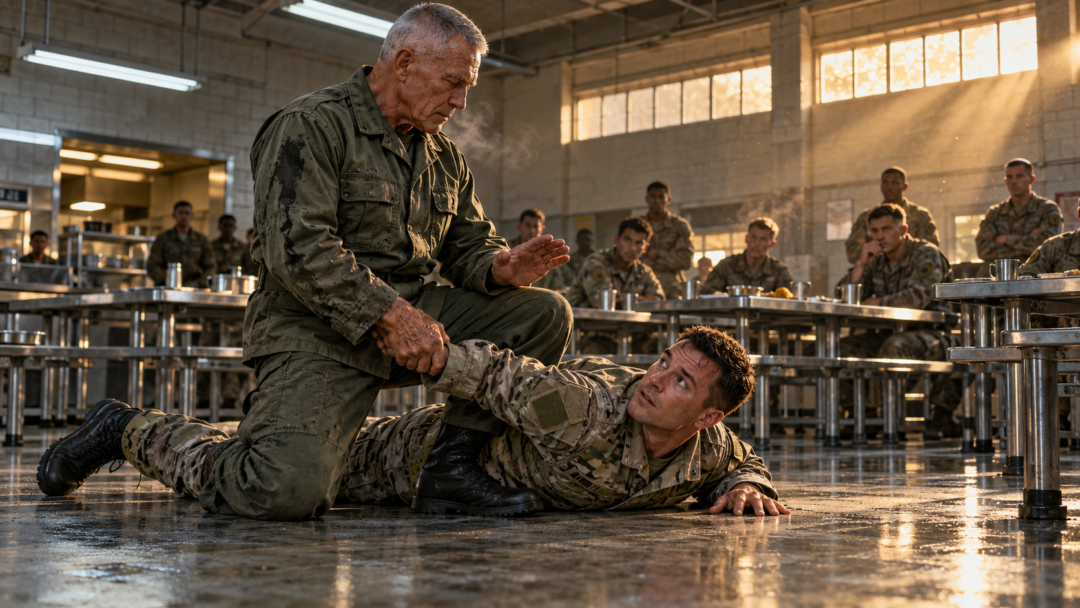
The cavernous interior of Mess Hall #3 at Fort Arden Military Reservation smelled of institutional morning sustenance: burnt chicory coffee, scorched oatmeal, canned peaches, industrial dishwashing detergent, and the damp wool of forty wet winter fatigue jackets drying in the steam heat. Built during the height of the Korean War out of cinder blocks and reinforced steel trusses, the dining facility was an unadorned vault of American military routine. Long stainless-steel tables ran in four rigid columns down the center of the hall, their surfaces scratched by millions of metal cafeteria trays. High on the eastern wall, narrow transom windows lined with wire safety glass admitted thin, grey spears of early November daylight that cut through the haze of grease and rising vapor, illuminating the drifting dust motes above the concrete floor.
At the far end of the third column, seated alone on a backless wooden bench, sat Sergeant Major Elias Voss.
Elias was seventy-four years old, a retired master of military hand-to-hand combatives who still served the garrison as a civilian subject-matter expert on small-arms retention and unarmed CQB defense. His hair was cropped into a close, silver buzz cut that showed the uneven ridges of his skull. His spine was as vertical and unyielding as an entrenching tool driven into frozen earth, his wide shoulders squared against the empty air behind him. His face was a stern, weathered topography carved by four decades of field service: deep nasal-labial grooves, a hawkish nose broken twice in training pits, and pale grey eyes that possessed the flat, quiet neutrality of open water under winter cloud cover. He wore a faded, freshly pressed set of olive-drab cotton fatigues with no rank insignia on the collar, scuffed leather combat boots shined to a dull satin sheen, and a white cotton undershirt showing beneath his unbuttoned top collar.
Resting on the laminate table before him was an empty ceramic coffee mug, an untouched biscuit, and his two hands.
Those hands were broad, thick-knuckled, and mapped with fine, silvery ribbons of scar tissue from knife blades, barbwire, and shrapnel. For the past five years, an involuntary, rhythmic resting tremor had taken up residence in the tendons of his right hand—a gentle, constant flutter that caused his fingertips to tap faintly against the plastic tabletop in an irregular cadence. To the young recruits who passed him in the corridors, the flutter was the visible signature of aging mortality, the unmistakable sign that the old warhorse was nearing his final grazing pasture.
Yet beneath the left breast pocket of his jacket, tucked securely behind his veteran’s pension identification card, rested an object far more delicate than any bone: a creased, black-and-white photograph of his late wife Martha. In the portrait, taken in 1968 outside an army chapel in Georgia, Martha wore a pale summer dress and laughed into the lens. In six years since her funeral on a rainy Tuesday in Burlington Cemetery, Elias had not spoken her name aloud. He carried her face against his ribs every waking hour, but the syllables of her name remained locked behind his teeth, guarded like the dead.
The clatter of metal silverware against steel trays began to subside in the central aisle.
A set of polished jump boots approached, their double-thick polyurethane soles striking the concrete floor with sharp, aggressive precision. Lieutenant Darren Kessler was thirty-four years old, the recently appointed director of the garrison’s modernized physical readiness doctrine. Kessler was a graduate of the Military Academy at West Point, possessing a physique honed on CrossFit rigs and commercial rowing machines, an immaculate set of modern multicam camouflage utilities, and a clean-shaven, handsome jaw that was set in an expression of chronic, theatrical contempt. Kessler had spent the previous six months lobbying the post commander to abolish the legacy combatives program, arguing that hand-to-hand grappling was an archaic waste of training hours that could be outsourced to private digital simulation contractors.
Kessler stopped directly behind Elias’s right shoulder. In his right hand, the young lieutenant held a translucent plastic cup filled to the brim with ice-cold drinking water from the dispensing machine.
Four junior recruits sitting at the adjacent table froze with their forks halfway to their mouths, exchanging wide-eyed glances of alarm. Two veteran master sergeants seated forty feet away at the senior NCO bench paused their conversation, their eyes narrowing with sudden, dangerous alertness.
“You’re taking up space on an active training morning, Voss,” Kessler said, his voice loud, crisp, and deliberately pitched to project across the rafters of the mess hall. “The modern army runs on efficiency, data analytics, and kinetic lethality. Not on seventy-four-year-old pensioners taking up a four-man bench to stare at cold bread.”
Elias did not turn around. His pale grey eyes remained fixed on the scratched stainless-steel tabletop before him. The slight tremor in his right hand continued its steady, quiet tapping.
“The coffee machine on your side is broken, Lieutenant,” Elias replied, his voice a deep, gravelly rasp that sounded like iron dragging across wet gravel. “Take your cup to table two.”
Kessler’s lip curled into a thin, insolent smirk. He tilted the plastic cup in his hand.
With deliberate, contemptuous slowness, Kessler inverted the cup directly over Elias’s right shoulder.
A stream of icy, clear water cascaded down the veteran’s starched cotton sleeve. The dark stain spread instantly across the olive-drab fabric, saturating the wool, pooling over the scarred forearm, and dripping steadily from the cuff onto Elias’s combat boot. Kessler placed the empty plastic cup upright on the center of the table with an exaggerated, hollow clack, then slid his hands into his utility pockets.
“Clean that up when you leave,” Kessler whispered, leaning down so his hot breath washed across the old man’s ear. “Or better yet, pack your locker before I draft an official memorandum to Garrison Command declaring your presence a liability to modern force readiness.”
CHAPTER 2: THE RISING TREMOR AND THE QUIET BREATH
The sound of dripping water in the silence of Mess Hall #3 was louder than a rifle bolt closing on an empty chamber.
Drip. Drip. Drip.
Each cold droplet fell from the soaked cuff of Elias Voss’s right sleeve, striking the polished black leather of his combat boot with a tiny, sharp splash. Around the room, thirty-five soldiers, NCOs, and civilian food service staff stood paralyzed. The hum of the industrial dishwashers in the rear kitchen seemed to drop an octave. In the military, an officer pouring liquid onto an enlisted veteran was not merely an act of petty bullying; it was an egregious breach of the unwritten compact of mutual honor that held an armed force together.
Lieutenant Kessler stood back, his chin raised, his weight settled casually on his rear foot. His handsome face was radiant with arrogant triumph. He believed he had calculated the outcome perfectly: either the old man would swallow the insult and slink away in public humiliation, proving his irrelevance, or the pensioner would throw a clumsy, geriatric punch that would justify an immediate summary court-martial and a permanent dishonorable barring from the base.
Elias did not look up immediately.
He turned his head slowly, looking down at his right arm. The fabric of his olive-drab fatigue jacket was black with cold moisture, clinging heavy and cold against his wrinkled forearm. He watched the water run between his knuckles, washing over the pale scar where a bayonet had grazed his bone during a night patrol in the A Shau Valley fifty-two years ago.
Then, he looked at his right hand.
The involuntary flutter in his fingers—the tremor that had plagued him for five winters—suddenly ceased. It was not a symptom of neurological decay or degenerative Parkinson’s, as the young base doctors had assumed when reviewing his medical file. It was the residual peripheral nerve trauma from a Soviet-made fragmentation grenade that had detonated against a sandbag parapet three feet from his trench during the siege of Firebase Ripcord in 1970. For decades, the scarred radial nerve had misfired whenever his body was at complete rest, an idle phantom of concussive force humming in his flesh.
Yet the moment his central nervous system detected a clear, existential tactical threat, that idle tremor vanished into pure, crystalline stillness. The sympathetic nervous system engaged with the practiced economy of forty years under arms. The shivering nerve pathways locked into alignment, their electrical pulses redirected from passive vibration into immediate, pre-programmed readiness.
Elias took one breath.
It was not a gasp of anger, nor was it a ragged inhalation of fear. It was an expansive, diaphragm-driven tactical breath: four seconds in through the nose, expanding the lower ribs and oxygenating the blood; four seconds held behind closed vocal cords, settling the arterial pressure; four seconds released softly through parted lips. The air tasted of damp wool, cold tap water, and the metallic tang of an adrenaline surge controlled by sheer willpower. His resting heart rate dropped from seventy-eight beats per minute to a calm, icy fifty-two.
He rose from the bench.
The movement was not the creaking, groaning struggle of an elderly man nursing arthritic joints. It was a single, fluid kinetic extension of his ankles, knees, hips, and spine that seemed to unfold his six-foot-one frame toward the rafters like an iron surveyor’s tripod. When he stood at full height, his broad chest blocked the cold light from the transom windows, casting a long, dark shadow across the floor.
Elias did not reach for a paper napkin to dry his sleeve. He did not curse. He reached up with both hands, took the lapels of his fatigue jacket, and gave them a crisp, single snap that aligned the collar with military perfection.
He stepped cleanly around the puddle of water on the floor. He did not acknowledge the spilled liquid with so much as a glance. He moved two paces into the open central aisle between the tables, turning to face Lieutenant Kessler squarely.
Kessler’s smirk wavered. For a fraction of a second, the young officer felt a cold shiver run through his spinal cord as he looked into the old man’s eyes. They were not the eyes of a pensioner. They were the eyes of a seasoned combatant who had survived three separate armed conflicts without ever needing to raise his voice to enforce authority.
“You should have kept your hands to yourself, son,” Elias said softly.
Kessler’s face flushed dark crimson with sudden, irrational rage. The humiliation of being called son by an old enlisted man in front of his prospective trainees cracked his veneer of administrative superiority. He clenched his right fist, his jaw tightening into a snarl.
“Step aside, Voss, before I have the Military Police carry your dead weight out of here!” Kessler hissed, stepping forward with his shoulder dropped, his arm cocking back into an aggressive, telegraphing strike.
CHAPTER 3: THE EIGHT REDIRECTIONS ON THE CONCRETE FLOOR
Kessler threw the punch.
It was a standard, high-velocity military overhand right, driven with the full kinetic rotation of his athletic hips and shoulders—a blow intended to break the old man’s jaw and end the altercation in a single concussive instant. It was fast, technically sound by the standards of a collegiate boxing ring, but in the realm of lethal close-quarters combatives, it was an open telegraph of intent that surrendered balance before impact.
Elias Voss did not flinch, did not duck, and did not step backward.
Move One: The Outside Lead Parry.
Before Kessler’s knuckles had traveled six inches through the cold air, Elias’s left palm rose from his waist like a ghost. His fingers did not swat at the incoming fist; instead, his open palm met the inside edge of Kessler’s wrist with the soft, yielding grace of water catching a falling stone. The contact redirected the trajectory of the punch two inches to the left, allowing the knuckles to graze harmlessly past the silver hair of Elias’s temple without touching a single follicle.
Move Two: The Centerline Breach.
Without pausing, Elias slid his right boot forward between Kessler’s wide-set feet, taking the center line of balance. In close-quarters combatives, he who controls the center line dictates the horizon of the fight. Elias’s broad chest was now pressed against Kessler’s right shoulder, collapsing the officer’s striking space down to zero and rendering his left arm completely trapped behind his own torso.
Move Three: The Wrist Compression Lock.
Elias’s left fingers wrapped around Kessler’s wrist like an iron clamp, while his right thumb found the sensitive radial nerve cluster between the officer’s forearm bones. A gentle, two-pound pulse of pressure caused Kessler’s fingers to spring wide open, his momentum instantly hijacked by his own forward inertia. The sudden neurologic shock deadened the young officer’s grip before he could even register pain.
Move Four: The Hip Pivot Redirection.
Elias did not push or shove. He rotated his hips forty-five degrees to the rear, matching the natural rotation of the Earth’s gravity. The sudden removal of resistance caused Kessler to lurch violently forward into empty space. To the watching soldiers, it appeared as though Kessler were an unruly child being gently guided by an adult around a sharp piece of furniture.
Move Five: The Ankle Reaping Sweep.
As Kessler’s weight shifted onto his right heel to avoid stumbling, the instep of Elias’s right boot lightly tapped the back of Kessler’s Achilles tendon. It was not a violent kick; it was a rhythmic reminder that gravity is an absolute law. The lieutenant’s lead leg floated into the air, severed from its structural base.
Move Six: The Descending Spiral Guide.
Kessler was falling, his eyes wide with sheer panic as the concrete floor rushed up to meet him. But Elias did not allow him to crash with bone-breaking force. Holding the lieutenant’s right wrist in one hand and supporting his tricep with the other, Elias decelerated the officer’s descent, controlling the vector of the fall so Kessler landed squarely on the flat of his muscular back with a loud, hollow thump that knocked the wind from his lungs but fractured not a single rib.
Move Seven: The Kimura Shoulder Isolation.
Before Kessler could twist or throw an elbow, Elias stepped his left knee into the hollow beneath Kessler’s right armpit, pinning the officer’s arm in an L-shaped Americana shoulder lock that immobilized his entire upper torso with less than five percent of Elias’s physical strength. The joint was isolated, locked, and completely neutralized.
Move Eight: The Silent Hover Pin.
Then came the final beat of absolute mastery.
Elias lowered his right knee until the heavy rubber sole of his combat boot was planted on the concrete, while his knee hovered exactly one half-inch above Kessler’s sternum. The veteran did not crush the officer’s ribs; he rested his knee against the air, allowing Kessler to feel the immense, potential lethality of eighty pounds of focused mass held back purely by self-discipline.
The silence that fell across Mess Hall #3 was so dense that the gentle hiss of steam from the coffee urn forty yards away sounded like escaping gas.
Kessler lay pinned on the damp concrete floor, his eyes bulging, his chest heaving as he fought to draw breath. His perfectly starched multicam uniform was rumpled, his hair disheveled, his arrogance completely shattered. He looked up into the face of Sergeant Major Elias Voss.
Elias’s face was an unreadable mask of calm. His breathing was slow and silent. His right sleeve was still wet, but his hands were as steady as granite.
For three long seconds, Elias held the hover pin.
Then, slowly, without a word, he released Kessler’s wrist. He rose to his feet, stepping backward two paces into the center of the aisle.
Kessler scrambled to his hands and knees, choking on his breath, his face burning with a mixture of terror, shock, and humiliated rage. He looked up at the circle of thirty soldiers who were watching him from the tables, their faces completely blank of expression.
“Assault…” Kessler wheezed, stumbling to his feet and pointing a trembling finger at the veteran. “You assaulted a commissioned officer! I’m going to the Provost Marshal! You’re going to Leavenworth for this, Voss! I swear to God, you’re done!”
Elias Voss did not even look back. He turned his shoulders, stepped into a steady, rhythmic march, and walked out the heavy swinging double doors of the mess hall into the cold morning air.
CHAPTER 4: THE SILENCE BEHIND THE STAINLESS STEEL TRAYS
Within ninety minutes, the story of the mess hall confrontation had spread through the brick barracks, maintenance motor pools, and administrative offices of Fort Arden like a brushfire fueled by kerosene.
In the motor pool bays, grease-stained mechanics leaned over open five-ton truck hoods, reenacting the eight-point redirection with heavy torque wrenches in their hands. In the recruit training barracks, squads of infantry trainees gathered in hushed circles around Private First Class Tyler Alvarez, who had sat three feet from the water spill, swearing on his mother’s Bible that the old master had dropped the lieutenant without tearing a single stitch of fabric. To the enlisted ranks, Elias Voss was already a legendary figure, but the elegance of his restraint—the refusal to inflict injury when he had every operational justification to destroy the younger man—elevated the incident into garrison folklore.
“He didn’t even drop his biscuit,” Alvarez whispered to a circle of wide-eyed privates in the dayroom. “The lieutenant threw an overhand haymaker meant to take his head off, and the Old Man just caught him by the sleeve like he was picking up an autumn leaf. Soft as down, and then boom—Kessler was staring at the acoustic ceiling tiles wondering what happened to his legs.”
However, in the pristine headquarters of the Garrison Provost Marshal, the mood was anything but celebratory.
At ten o’clock sharp, Lieutenant Darren Kessler marched into the office of Colonel Arthur Vance, the installation commander. Kessler had spent an hour in the base infirmary attempting to secure a medical slip documenting internal soft-tissue trauma, but the post physician had found nothing more than a superficial carpet scrape on his right elbow and had refused to write a disability waiver. Deprived of a medical casualty report, Kessler had doubled down on administrative fury. He had typed up a five-page formal sworn complaint alleging aggravated assault against a superior commissioned officer under Article 90 and Article 128 of the Uniform Code of Military Justice.
Colonel Vance sat behind a massive walnut desk, flanked by Command Sergeant Major Ray Colton. Vance was fifty-six years old, a career infantry officer who had survived roadside bomb blasts in Ramadi and possessed little tolerance for garrison melodrama. Beside him, Sergeant Major Colton stood with his arms crossed behind his back, his scarred face as unyielding as a bronze bust. Colton had served two tours in Iraq and one in Panama; he knew the exact difference between an unprovoked assault and a disciplined neutralization.
“Sit down, Darren,” Colonel Vance said, gesturing toward a leather armchair with the tip of his unlit cigar.
Kessler remained at rigid, trembling attention. “With respect, Colonel, I prefer to stand. I am here to request the immediate civilian apprehension and detention of retired Sergeant Major Elias Voss. He physically assaulted me in front of thirty junior enlisted personnel in the mess hall. It was a calculated, unprovoked attack on good order and military discipline. If this garrison permits an elderly civilian consultant to lay hands on a commissioned officer without immediate judicial punishment, the entire chain of command becomes a mockery.”
Colonel Vance did not touch the paper Kessler slid across the leather blotter. Instead, he looked at Colton.
“Sergeant Major Colton,” Vance asked calmly. “Have you reviewed the statements from the witnesses in Mess Hall Three?”
“I have, sir,” Colton replied, his voice a dry rumble that filled the quiet room. “Fourteen sworn statements collected by the Military Police before zero nine thirty. Every single witness—from the privates at the breakfast table to the civilian egg-cook behind the counter—reported the identical sequence of events.”
“And that sequence is?” Vance asked.
“Lieutenant Kessler approached Sergeant Major Voss’s table uninvited, issued verbal provocations regarding his age and retirement status, and then proceeded to empty an eight-ounce plastic tumbler of iced water directly over Sergeant Major Voss’s uniform,” Colton said, consulting a black leather notebook. “When Sergeant Major Voss stood up to leave the aisle, Lieutenant Kessler initiated physical contact by attempting to throw a closed-fist right hook to the sergeant major’s face. The sergeant major executed an eight-point non-lethal joint redirection, secured the lieutenant safely to the floor without injury, released him after a three-second hold, and vacated the premises.”
Kessler’s face drained of color. “That’s… that’s a coordinated enlisted fabrication! Those men are loyal to Voss because of his legacy! I am an officer of the United States Army! My word carries legal presumption over a room of trainees!”
Colonel Vance sighed, picking up a black remote control from his desk. He pointed it toward the sixty-five-inch flat-screen monitor mounted on the wood-paneled wall.
“Two weeks ago, Darren, the Directorate of Emergency Services installed four ultra-high-definition digital security cameras in Mess Hall Three to address inventory shrinkage from the food storage freezers,” Vance said quietly. “Let’s see what the lens has to say.”
Vance pressed a button, and the screen flickered to life.
CHAPTER 5: THE DISCIPLINARY HEARING IN THE PROVOST OFFICE
The video footage was recorded at sixty frames per second in crystal-clear, high-definition color, capturing every micro-expression and movement in the center aisle of Mess Hall #3 with clinical, unforgiving clarity.
On the screen, Lieutenant Kessler could be seen strutting down the aisle, his chest pushed out, stopping behind the elderly veteran. The camera angle was elevated slightly from the northern corner, providing an unobstructed view of the transaction. The monitor showed Kessler tilting the cup with deliberate, smiling cruelty, the water cascading across Elias’s shoulder. It showed Elias sitting in absolute stillness while the water dripped onto his boots. It captured the veteran rising with slow, monumental majesty, smoothing his jacket, and stepping cleanly around the puddle.
And then came the strike.
Colonel Vance pressed the slow-motion dial, reducing the playback speed to one-tenth.
On the screen, Kessler’s face twisted into an aggressive snarl as he wound up and threw the heavy right hook. Elias Voss’s left hand rose—smooth, economical, without an ounce of wasted kinetic energy. The parry, the breach of the center line, the soft rotation of the wrist, the light ankle reap, and the gentle glide to the polished concrete floor unfolded like a masterpiece of martial choreography. There was no rage, no violence, no excessive force. It was an exhibition of pure, compassionate mastery—a textbook neutralization that preserved the safety of both parties.
The clip ended with Elias hovering his knee an inch above Kessler’s chest, holding the quiet silence beat, releasing him, and walking away into the morning sun.
Colonel Vance paused the screen on the frame where Kessler was sitting on the concrete floor, his face white with shock and humiliation.
The office fell into a suffocating silence.
Kessler stood frozen before the desk. His hands were trembling, his throat working convulsively as he tried to find words. The five-page sworn complaint he had placed on the desk now looked like an open indictment of his own conduct. Under the Uniform Code of Military Justice, deliberately provoking an altercation, falsifying a sworn official report, and attempting to assault a civilian contractor while on duty was ground for an Article 133 charge: Conduct Unbecoming an Officer and a Gentleman.
“Darren,” Colonel Vance said, his voice dropping into a register of cold, quiet disappointment. “Do you have any idea what would happen if I forwarded this file to the Judge Advocate General’s corps?”
Kessler could not speak. He stared at the carpet, his chest heaving.
“Your commission would be rescinded before sundown,” Vance said. “You would be cashiered out of the service with an administrative discharge, your career in ruins, your pension forfeited, and your reputation permanently blacklisted across every defense consulting firm on the eastern seaboard. You threw a punch at a seventy-four-year-old Medal of Honor nominee and got tucked in like a child on live security feed. You made a fool of yourself, and worse, you disgraced the uniform.”
Command Sergeant Major Colton stepped forward, resting his heavy hand on the edge of the desk. “And what’s worse, Lieutenant, you did it because a civilian defense tech lobby promised you a vice presidency if you managed to shut down Fort Arden’s physical combatives school and replace it with their multi-million-dollar virtual reality headsets. You sold out your soldiers’ survival instincts for a corporate signing bonus.”
Kessler flinched, his jaw dropping in sheer horror as he realized that the garrison command had already traced his correspondence with the defense contractor. His entire administrative crusade had been exposed as self-serving corruption.
The door to the inner vestibule opened with a soft click.
Stepping into the office was Sergeant Major Elias Voss. His uniform was clean and dry; he had changed into a fresh olive-drab fatigue jacket. His posture was ramrod straight, his grey eyes calm and clear. He stood beside Kessler, coming to attention with effortless ease.
“Colonel Vance,” Elias said.
“Sergeant Major Voss,” Vance replied, his tone softening with profound respect. “We were just reviewing the mess hall footage. Lieutenant Kessler is facing immediate court-martial proceedings.”
“I request that you do not file charges, Colonel,” Elias said quietly.
Vance frowned, surprised. Beside him, Kessler looked up, his eyes wide with disbelief.
“He poured water on you and threw a punch, Elias,” Vance said. “That’s assault.”
“It was an error of judgment by a junior officer who has never been taught what true strength looks like,” Elias said, his voice deep and measured. “If you court-martial him, the army loses an officer with sharp logistical intelligence, and Darren Kessler leaves this post believing that power is nothing more than rank and punishment. Give me forty-eight hours with him in the old gym, sir. Alone. If he refuses, you can sign the paperwork on Friday.”
Colonel Vance looked at Elias for a long, searching moment. He saw the quiet determination in the old master’s face—a determination born of four decades of molding young men into leaders. Then, he looked at Kessler, whose face was streaked with silent tears of shame.
“Lieutenant Kessler,” Vance said. “Report to the unheated drill annex tonight at zero zero hundred. If you are thirty seconds late, your career is over.”
CHAPTER 6: THE RECORD OF THE FATHER WHO NEVER SPOKE
At midnight, the Fort Arden combatives drill annex was a frozen cavern of shadows. Built of uninsulated red brick in 1942, the building possessed no central heating; the winter wind whistled through the high eaves, rattling the corrugated iron roof and coating the olive-drab canvas wrestling mats with a thin skim of freezing pine-scented air. A single bare incandescent bulb hung from a frayed wire in the center of the hall, casting an amber cone of light across the mats.
Lieutenant Darren Kessler stood inside the doorway, shivering inside his winter fleece jacket. His eyes were red-rimmed, his hands jammed deep into his pockets. He expected Elias Voss to be waiting with a set of wooden pugil sticks or leather sparring gloves, prepared to mete out the physical beating that the young officer had so richly earned in the mess hall. He expected retribution, humiliation, and physical pain.
Instead, Elias Voss was sitting cross-legged on the canvas mat beneath the hanging bulb.
On the mat before him rested an old olive-drab canvas duffel bag and a thick, leather-bound ledger with brass corners, its pages yellowed and dog-eared with forty years of handling.
“Sit down, Darren,” Elias said softly, gesturing toward the canvas opposite him.
Kessler hesitated, then walked slowly to the edge of the light. He sank to his knees, sitting back on his calves, unable to meet the old man’s eyes.
“Why didn’t you let them court-martial me?” Kessler asked, his voice cracking with exhaustion. “I disgraced you in front of the base. I deserved to be thrown out. I tried to destroy your program because I wanted to prove that my generation didn’t need your kind of blood and grit.”
“You didn’t disgrace me, Darren,” Elias replied, his voice calm and gentle as falling snow. “A man cannot be disgraced by another man’s water. A man can only disgrace himself. You poured that water because you were suffocating under a ghost.”
Kessler flinched as if struck. “You don’t know anything about me.”
“I know your father,” Elias said.
The silence that followed was absolute. Outside, the pitch pines groaned against the perimeter fence.
Elias placed his scarred, steady hand on the leather-bound ledger. “In June of 1978, I was the First Sergeant of Charlie Company, 3rd Battalion, at Fort Benning. We received a batch of recruits from Pennsylvania. One of them was an eighteen-year-old farm boy named Thomas Kessler.”
Kessler’s breath caught in his throat. He looked up at the ledger, his eyes wide.
“My father… was your recruit?”
“He was my squad leader,” Elias said, turning the pages of the ledger with careful, reverent fingers until he reached an entry written in faded blue fountain-pen ink. “Thomas was the toughest, most relentless soldier I ever trained. He ran ten miles with a sixty-pound pack without a word of complaint. He became a master drill sergeant because he believed that if he made his men hard enough, none of them would ever die in the mud.”
Elias looked directly into Darren Kessler’s eyes.
“Your father spent twenty-four years in uniform, Darren. He buried thirty-two brothers across three continents. When he retired, the iron had entered his marrow. He didn’t know how to take off the armor when he walked through his own front door. He loved you more than his own life, but he was terrified that if he showed you warmth, if he told you he was proud of you, it would make you soft. He thought softness would get you killed.”
Tears began to spill silently down Kessler’s cheeks. “He never once hugged me. When I graduated from West Point, top ten percent of my class, he shook my hand like I was a stranger on a bus. He died of leukemia two years later, and the last thing he said to me was that my uniform looked wrinkled.”
Elias reached inside the ledger and pulled out a yellowed envelope, sealed with red wax, addressed in Thomas Kessler’s rigid, blocky handwriting: FOR FIRST SGT VOSS – TO BE OPENED WHEN MY BOY COMES HOME.
“Your father sent this to me six months before he passed,” Elias said, handing the letter across the canvas to the weeping officer. “Read the last paragraph.”
Kessler took the letter with trembling fingers, breaking the brittle wax. His eyes scanned the faded script:
Elias, if my son Darren ever ends up at Fort Arden, watch over him. He has my stubborn pride, but he doesn’t have the scars to understand what it means. If he loses his way, break his armor, First Sergeant. Don’t let him die inside the iron like I did. Tell him his old man saw every star on his shoulder, and loved him till the last breath.
Kessler bent forward until his forehead touched the cold canvas mat, his shoulders shaking with wracking, uncontrollable sobs as four decades of suppressed grief, longing, and unexpressed pain broke loose from his chest.
Elias Voss did not speak. He did not tell the young man to stand at attention or compose himself. He simply reached out across the dark canvas, laid his heavy, scarred palm gently upon the weeping officer’s shoulder, and held him steady through the storm.
CHAPTER 7: THE MASTER’S NAME SPOKEN IN THE MORNING LIGHT
Dawn broke over Fort Arden in a blaze of crisp, rose-gold light that washed across the frosty grass of the parade ground and illuminated the white-painted portico of garrison headquarters. The icy November fog had completely vanished, leaving the sky an immaculate vault of crystal blue. The distant rumble of five-ton trucks warming up in the motor pool signaled the start of another rigorous duty day across the installation.
Inside the drill annex, the morning light filtered through the high transom windows, casting brilliant geometric quadrangles of gold upon the green canvas mats.
Lieutenant Darren Kessler was dressed in a simple, unadorned grey PT uniform, his rank insignia removed, his hair damp from cold water from the annex sink. The arrogant sneer that had defined his features for years was gone, replaced by a quiet, centered humility that lent his jawline a new, authentic dignity.
Standing before him was Sergeant Major Elias Voss.
Elias unbuttoned the left breast pocket of his olive-drab fatigue jacket. With slow, reverent movements, he withdrew the creased, black-and-white photograph of his late wife. He held it in both hands, looking down at her laughing face in the Georgia sunlight.
“For six years, Darren,” Elias said, his voice clear and resonant in the quiet drill hall, “I carried this picture over my heart, and I never said her name. I thought if I spoke her name, the grief would break me. I thought silence was strength. I thought locking away love was the only way a soldier could keep standing after everyone he loved was buried.”
Elias looked up from the portrait, his pale grey eyes shining with peace.
“Her name was Martha,” Elias said, speaking the syllables aloud with a gentle, triumphant clarity that echoed off the brick walls. “Martha Voss. She was kind, she was brave, and she taught me that a warrior who cannot grieve is nothing more than a broken weapon.”
He tucked the photograph back into his pocket, buttoning the flap securely over his heart.
Darren Kessler stood motionless for a beat. Then, stepping forward onto the mat, the young lieutenant dropped to one knee upon the canvas, bowing his head in the ancient tradition of military discipleship.
“Sergeant Major Voss,” Kessler said, his voice steady, resolute, and clear. “I request your permission to become your student. Teach me how to move. Teach me how to hold my men. Teach me how to serve without armor.”
Elias Voss looked down at the kneeling officer, a faint, warm smile softening the weathered lines around his eyes. He extended his right hand—firm, rock-steady, without a trace of tremor.
“Rise, Lieutenant,” Elias said softly. “The mats are cold. We have work to do.”
Kessler took the master’s hand, rising to his feet on the canvas.
For the next two hours, the unheated drill annex echoed with the rhythmic slap of canvas, the shuffle of boots, and the quiet, patient instructions of the veteran instructor. Elias taught Kessler the foundational laws of kinetic balance: how to yield before force rather than oppose it; how to absorb momentum without absorbing damage; how to subdue an opponent without crushing his spirit. Every repetition stripped away another layer of Kessler’s residual arrogance, replacing it with the profound, grounded confidence of a man who no longer had anything to prove. When Kessler was thrown, he did not tense with angry resistance; he flowed into the mat, tapped out, and rose with gratitude in his eyes.
Later that afternoon, when Colonel Arthur Vance and Command Sergeant Major Colton walked into Mess Hall #3 for lunch, they witnessed a sight that would be remembered on Fort Arden for a generation.
At the center of the third column, seated together at the long stainless-steel table, were Sergeant Major Elias Voss and Lieutenant Darren Kessler. Before them sat two steaming mugs of black coffee and a fresh loaf of bread. On the floor between them, the concrete was swept clean and dry, the spilled plastic cup gone forever.
Beside Kessler lay a newly drafted requisition order—personally signed by the lieutenant—canceling the digital simulator procurement and reallocating the funds toward permanent refurbishment of Fort Arden’s hand-to-hand combatives gym.
As the junior recruits filed past the table, they did not see a relic or an arrogant bureaucrat. They saw a master and his apprentice, bound by an unbroken chain of honor, quiet discipline, and the enduring strength that outlasts every war.