The Bruised Boy In The Foundry And The Iron Frame Secret
CHAPTER 1: THE BARE METAL GROUND
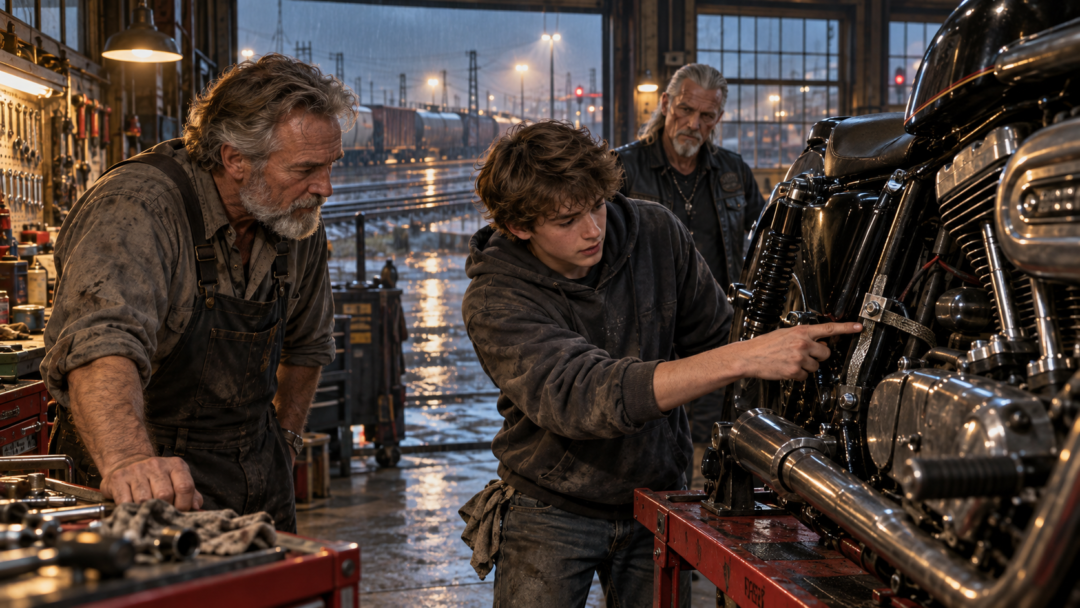
The rain over Spokane, Washington, fell in cold sheets, carrying the heavy soot of the Burlington Northern rail yards from beneath the Interstate 90 elevated overpass. Inside the brick service bay of Spokane River Iron Works, the air smelled of solvent, gear oil, and welding ozone.
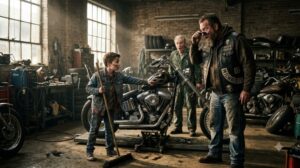
At the center of the bay, raised three feet on a heavy red hydraulic lift, sat a pristine black-and-chrome 2018 Harley-Davidson Heritage Classic.
Surrounding the motorcycle were three seasoned mechanics in grease-stained canvas overalls, their faces etched with exhaustion. For four hours, they had checked every component: rebuilt the fuel pump, tested every fuse, and verified fuel rail pressure. Yet every time Hank Barlow, the fifty-four-year-old shop foreman, thumbed the starter switch on the handlebar, the starter solenoid gave only an anemic, hollow click, refusing to turn the engine over.
Hank wiped his hands on a shop towel, his broad shoulders slumping as he stared at the machine. He had a full gray beard trimmed around a square jaw, clear hazel eyes, and thirty-five years of experience building custom American motorcycles.
“I don’t get it,” grunted Miller, a veteran tech. “Starter’s got twelve-point-six volts. Relays click. Battery tests at eight hundred cold cranking amps. It’s like the juice just vanishes into thin air.”
Hank sighed, rubbing the bridge of his nose. “Step back for five minutes, boys. Staring at it won’t make the electrons move.”
The heavy side pedestrian door to the alley creaked open, admitting a blast of freezing autumn wind and blowing mist.
A slender teenage boy slipped quietly into the workshop, closing the steel door behind him with exaggerated care, as if terrified that a loud latch might bring retribution.
He was sixteen, lean and slight, wearing a waterlogged khaki canvas hoodie and soaked jeans. Slung across his chest was a canvas messenger bag bulging with heavy metal tools. Tousled dark brown hair clung to his forehead in damp strands. But what arrested Hank’s attention was the boy’s face: on his left cheekbone sat a fresh, dark purple contusion the size of a silver dollar, surrounded by yellowing edges from an older blow, and his lower lip was split slightly near the corner.
The boy stood on the perimeter of the bay, his sneakers leaving damp mud prints on the clean gray epoxy floor. His bright amber-brown eyes darted across the workshop—taking in the overhead cranes, the heavy iron lathes, the rows of tool chests, and finally settling on the stalled Harley on the lift.
For thirty seconds, the boy watched in silence. His gaze traced the thick wiring harness from the battery under the seat, followed the insulated copper cables along the backbone, and stopped at the lower tubular steel frame near the rear swingarm pivot.
He took two hesitant steps forward, keeping his hands visible, his voice polite and steady.
“Sir… is that your ground strap?”
Hank turned around from his pegboard tool wall, blinking in mild surprise. Miller and the other tech glanced at each other, amusement flickering across their tired faces.
“Yeah, son,” Hank replied in his calm, gravelly baritone. “That’s the main battery ground terminal. Runs from the negative post down to the lower frame boss. Why do you ask?”
The boy stepped closer to the red lift, raising a slender, oil-stained index finger to point directly at the hexagon bolt securing the brass lug to the frame.
“It isn’t touching bare metal,” the boy said softly.
Hank stepped up to the frame rail, shining his inspection penlight directly onto the bolt.
The motorcycle had recently been through the paint shop. The frame had been stripped and coated in a mirror-finish high-gloss black powder coat. The assembly tech had bolted the heavy copper ground lug directly over the fresh, rock-hard powder coat finish, using a stainless-steel washer. The powder coat acted as an electrical insulator, blocking any path back to the battery negative.
Hank let out a sharp, quiet intake of breath. He stared at the bolt, then looked at the sixteen-year-old boy in utter disbelief. Four master mechanics with sixty years of combined experience had missed it. This runaway kid had spotted it in ten seconds from twenty feet away.
“Miller,” Hank murmured, his voice tight with awe. “Get me a half-inch box wrench and a strip of emery cloth.”
Hank backed the bolt out three threads. Before Hank could reach for the sandpaper, the boy had already dropped onto his knees on the cold concrete. He pulled a folded sheet of coarse sandpaper from his hoodie pocket, slid it behind the copper lug, and began sanding the frame boss with swift, rhythmic, practiced strokes.
SHHK-SHHK. SHHK-SHHK.
Within thirty seconds, the boy had scraped away a perfect circle of black powder coat, revealing bright, gleaming, raw structural steel. He blew the polymer dust away, retightened the bolt with two swift pulls of the wrench, and stepped back with quiet confidence.
“Try it now, sir,” the boy whispered.
Hank climbed onto the lift, swung his leg over the saddle, and turned the ignition key. The digital dash swept through its cycle. Hank pressed the starter button.
VROOM-CHUG-CHUG!
The massive engine exploded into life with a deafening roar. Twin chrome exhaust pipes barked with deep thunder, filling the shop with the powerful heartbeat of mechanical perfection.
Miller threw his hands into the air with a wild laugh. “I’ll be damned! That kid just schooled the whole shop!”
Hank blipped the throttle once, listening to the smooth, purring idle, then clicked the kill switch. He climbed down from the lift and walked toward the boy.
The boy stood clutching the strap of his canvas messenger bag with both hands, his bruised face tense with apprehension, his eyes darting to the exits as if bracing for an accusation of theft.
Hank stopped three feet away, his expression filled with profound respect and protective concern.
“Kid,” Hank said softly, his voice dropping into a gentle rumble. “That was one hell of an eye. Where did you learn to read a chassis like that?”
The boy looked down at his soaked sneakers, his voice barely audible. “My dad. He taught me before he passed.”
Hank looked at the dark purple bruise on the boy’s cheekbone, the shivering thinness of his frame, and the water dripping from his hoodie. “Kid… where are you living?”
The boy’s chin trembled slightly. He lifted his amber eyes with quiet humility and sorrow. “Behind the diner, sir. In the cardboard recycling shed.”
From the dark, shadowed loft above the service bay, a figure sat silently on an iron stool.
He had cropped silver hair, a neatly trimmed gray goatee, and a deep, stitched laceration above his left brow from a shrapnel wound taken thirty years ago. He wore a heavy black leather riding vest over a denim shirt, bearing the skull-and-anvil insignia of the Iron Foundry Brotherhood MC. His penetrating, unblinking gray eyes had watched the boy from the moment he entered.
As the boy spoke, the old patriarch leaned forward into the light, his gaze locked onto the worn canvas bag at the boy’s side with sudden, paralyzing intensity.