The Matte Gray Army Investigation Truck Hooked Beside the Sidewalk
CHAPTER 1: THE SLAP OF THE PAPER BAG
The morning quiet of Dogwood Meadow Court was broken by the guttural chug of an idling six-cylinder turbo-diesel flatbed. In the affluent Whispering Pines subdivision of western Loudoun County, Virginia, lawns were manicured by contracted landscape crews to an exact two-and-a-half-inch tolerance, garage doors conformed strictly to three approved shades of builder beige, and street parking was governed by a six-hundred-page manual of covenants, conditions, and restrictions enforced with bureaucratic zeal.
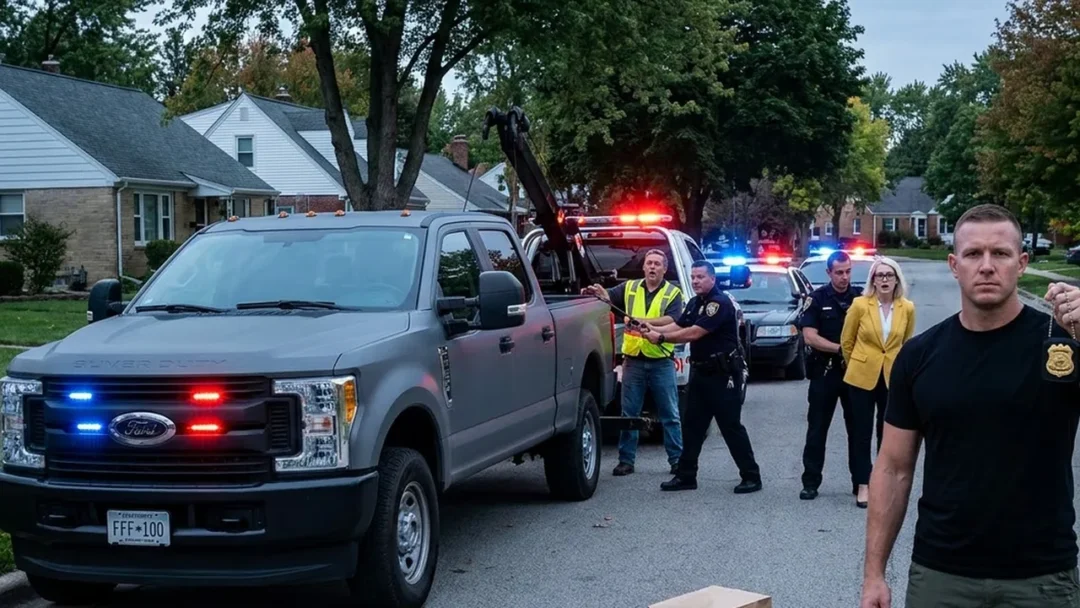
Parked parallel to the clean concrete curb in front of an empty grass lot between two sprawling executive brick estates was a heavy-duty Chevrolet Silverado 2500HD. The vehicle was finished in a non-reflective matte slate gray industrial coating, devoid of chrome trim, dealer badges, running boards, or decorative decals. Its heavy steel wheels were powder-coated satin black, wrapped in aggressive commercial all-terrain tires designed for rough government proving grounds. Bolted cleanly to the front and rear steel bumpers were small, unadorned blue-and-white license plates stamped with embossed black digits and the crisp federal header: U.S. GOVERNMENT – FOR OFFICIAL USE ONLY.
Inside the truck’s extended cab, concealed beneath a custom false floor in the rear footwell, hummed a specialized tactical signals intercept receiver, its cooling fans whispering softly against the acoustic insulation. For eight continuous hours through the chilly Virginia night, the receiver had been quietly vacuuming up high-frequency radio transmissions within a four-hundred-yard radius, recording every encrypted packet onto military solid-state drives.
Standing by the rear tailgate of the truck was a tall, broad-shouldered man in his mid-thirties. Special Agent Nathan Brody of the Army Criminal Investigation Division wore a plain black crewneck t-shirt that stretched tightly across a muscular back, washed olive tactical cargo pants, and scuffed brown leather combat boots. Brody had stepped away from his mobile stakeout only fifteen minutes earlier, executing a brief foot patrol to the local commercial corner on Route 15 to establish pattern-of-life camouflage. In his arms, he cradled a brown paper grocery bag filled with crisp Gala apples, artisan sourdough bread, a pound of dark-roast coffee beans, and a heavy double-walled stainless-steel travel tumbler of hot black coffee.
Marching down the sidewalk with the frantic energy of an attacking hornet was a woman in her early fifties. Brenda Sterling, President of the Whispering Pines Homeowners Association, wore a bright canary-yellow tailored blazer, dark pressed slacks, heavy pearl earrings, and cat-eye reading glasses perched on a silver neck chain. In her left hand, she brandished a pink laminated citation clipboard thick with violation notices; in her right hand, she held a smartphone displaying the neighborhood watch security portal.
Beside her lumbered Garth Boone, owner and sole operator of Boone’s Heavy Recovery. Boone was thick-necked and barrel-chested, wearing grease-stained blue denim overalls over a sleeveless gray undershirt, a dark wad of chewing tobacco bulging in his lower cheek. Behind them, his red-and-white dynamic wheel-lift wrecker was already backing down the cul-de-sac, its amber clearance lights flashing against the polished brick facades and ornamental hedges.
“Hook it up, driver!” Brenda shrilled, her voice cutting through the quiet morning like a circular saw biting into sheet metal. “I don’t care who he is, what he claims, or how long he’s been sitting here! I gave this entire neighborhood fair warning at the annual general meeting. We do not permit military-style vehicles, commercial fleet colors, or tactical equipment parked on our residential avenues! It lowers the property values and destroys the visual harmony of the entire cul-de-sac!”
Brody did not flinch. He turned slowly, holding the paper grocery bag against his ribs with one forearm. His posture was relaxed, yet his dark eyes were cold, assessing, and completely unblinking, tracking Boone’s hands and the wrecker’s hydraulic controls with the trained focus of an experienced federal investigator.
“The vehicle is legally parked on a public thoroughfare, ma’am,” Brody said. His voice was deep, dry, and exceptionally calm, carrying the distinct, clipped precision of a soldier used to delivering tactical briefings under fire. “The curb is unmarked. There are no municipal parking prohibitions, street cleaning restrictions, or emergency red zones posted anywhere within three hundred yards.”
“This is Whispering Pines, young man!” Brenda barked, stepping within two feet of him, waving her pink clipboard so close to his face that the laminated corner nearly clipped his cheek. “Our architectural guidelines supersede county traffic regulations! Bylaw Fourteen, Section Three: no unapproved matte, camouflage, or non-commercial industrial finishes are permitted within line of sight of private residences! This eyesore is being towed straight to the county salvage impound, and it will sit there until you pay the administrative fines!”
Boone spat a dark stream of tobacco juice onto the clean curb, chuckling with a low, menacing rasp as he reached for the wrecker’s auxiliary control levers. “You heard the lady, pal. Move away from the bumper before you get hurt. It’s four hundred dollars cash to drop the sling once the hydraulics touch iron. No checks, no credit cards.”
Brody looked at Boone, then back at Brenda. “I’m advising you both to step away from this vehicle. You are interfering with an active federal law enforcement asset on an authorized government assignment.”
“Federal asset?!” Brenda shrieked with theatrical mockery, throwing her head back in high-pitched laughter. “Look at you! You’re wearing surplus pants and buying groceries at the market! You think you can scare me with big words in my own neighborhood? You think a government sticker on the bumper frightens the Whispering Pines board?”
With a sudden, violent swipe of her laminated clipboard, Brenda slapped upward against the bottom of Brody’s paper grocery bag.
The thick brown paper tore open with a sharp, violent rip. A dozen red Gala apples spilled across the concrete sidewalk, bouncing into the gutter and rolling across the manicured lawn. The loaf of sourdough bread tumbled into the grass. The heavy stainless-steel coffee tumbler struck the concrete curb with an explosive metallic clang, spraying steaming dark coffee across the toes of Boone’s greasy work boots.
Boone cursed loudly, took two aggressive strides to the rear of the wrecker, grabbed the heavy steel hydraulic tow hook, and slammed it directly into the front crossmember of the matte-gray truck.
The instant the steel hook struck the truck’s frame, an ear-splitting, multi-tone electronic siren erupted from deep within the pickup’s chassis.
Concealed ultra-bright red and blue LED strobe arrays, hidden behind the matte black grille mesh and along the upper tint strip of the windshield, burst into a blinding, synchronized emergency flash. From the roof antenna array, a high-frequency satellite burst transmitter clicked into high-speed transmission mode, relaying an immediate priority distress code to military command.
Boone jumped back three feet, dropping his hydraulic remote onto the pavement in shock. “What the hell is that?!”
Brody did not pick up an apple. He did not look at his spilled coffee. With a smooth, practiced economy of motion, he reached inside the collar of his black t-shirt and pulled out a heavy gold shield suspended on a ball-chain lanyard.
The morning sunlight caught the polished gold surface. Inscribed in crisp blue enamel across the shield were the words: SPECIAL AGENT – UNITED STATES ARMY CRIMINAL INVESTIGATION DIVISION – FEDERAL AGENT 1142.
“That vehicle is a GPS-monitored United States Army Criminal Investigation Division surveillance truck,” Special Agent Nathan Brody said, his voice flat as a rifle barrel. “Tampering with an active military investigative asset automatically alerts regional dispatch to a felony in progress.”
Before Brenda could open her mouth to screech, the roar of screaming police sirens echoed off the brick homes at the entrance of the court. Two marked Loudoun County Sheriff’s cruisers blew through the neighborhood traffic circle, tires smoking as they slid sideways across the cul-de-sac, boxing the tow truck against the curb.