The Lane They Opened
Part I — The Ambulance in the Middle Lane
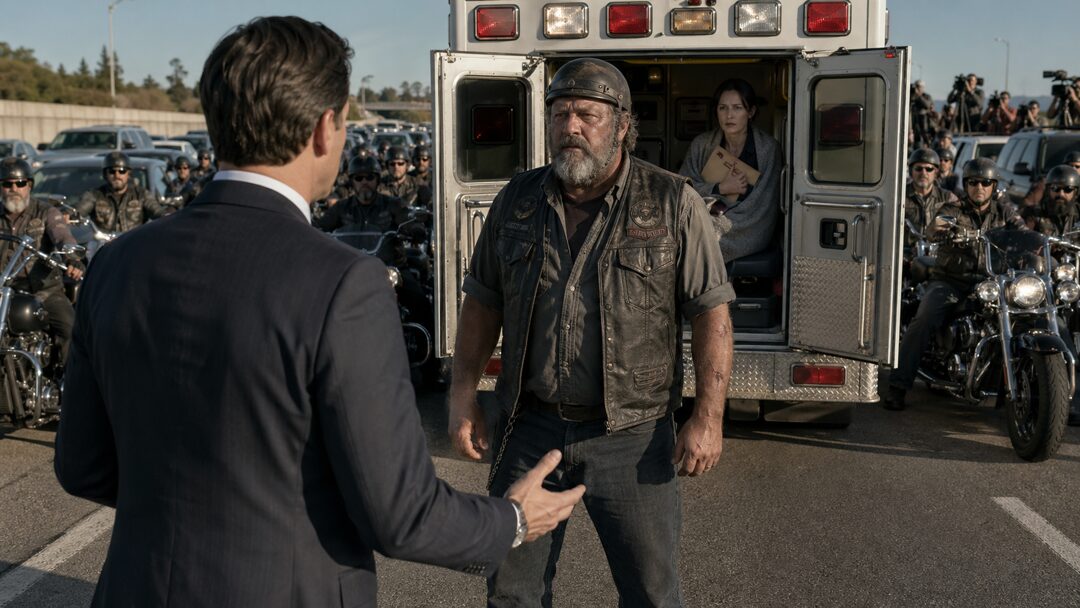
The ambulance stopped in the center lane of I-47 with its rear doors half-open, its engine shuddering, and a line of motorcycles spread across the highway like a black iron gate.
Behind it, traffic had frozen for nearly a mile.
In front of it stood Hank Vale.
He was a wide, gray-bearded man in a black leather rescue-riders vest, the kind of man people noticed before he spoke. Wind pressed his shirt against his chest. The sun flashed against the burn scar on his forearm. Two state troopers stood ten feet from him, hands near their belts, trying to look more certain than they were.
“Move the bikes,” one of them said.
Hank did not move.
Inside the ambulance, Mara Vale lay strapped to a stretcher with a blood pressure cuff loose around her arm and a sealed brown envelope crushed under her left hand.
She could hear everything.
The trooper’s voice came through the open doors.
“This patient is being rerouted under family authority.”
Mara laughed once.
It hurt.
The young EMT beside her, a freckled boy named Caleb who looked too young to have seen anyone die, glanced down at her. “Try not to move.”
“Family authority,” Mara whispered.
The words tasted like blood and old humiliation.
Family had been the word last night too.
Her mother had said it first in the courthouse corridor, pearls glowing against her throat, cameras thirty feet away.
Think about the family, Mara.
Her brother had said it next, sweating through his suit because Mercer money had kept his accounts alive for two years.
You don’t know what this will do to the family.
Then Julian, her husband, had taken her hand in front of everyone and pressed his thumb gently over her wedding ring.
For one second, she had thought he might choose her.
Instead, when the reporters turned, he slipped his own ring into his pocket.
As if she were contagious.
As if loving her had become a stain.
Her mother had faced the cameras with wet eyes and a steady mouth.
“My daughter has been under terrible strain,” she had said.
Mara remembered the floor tilting. The courthouse lights. The envelope against her ribs. The sound of her own name becoming a diagnosis.
Now she was in an ambulance, and the highway had stopped around her.
Hank’s voice rolled from outside, low and hard.
“She goes to County.”
“She goes where her family authorizes,” the trooper said.
Hank glanced over his shoulder.
Dozens of motorcycles blocked the lanes behind him. Men and women in black vests sat upright on their bikes, engines rumbling like restrained thunder. Some were retired firefighters. Some were off-duty medics. Some had held Mara when she was six years old and asleep on the dispatch room couch while her father ran calls through the night.
Behind them, cars stretched all the way back to the overpass.
A rescue procession.
A blockade.
A wall.
Mara tightened her fingers around the envelope.
Caleb noticed. “You still have it?”
“I’m not dead yet.”
His mouth twitched, but he did not smile.
Far ahead, beyond Hank and the troopers, three black SUVs appeared in the glare.
Mara did not need to see the license plates.
Her body knew before her mind did.
Julian had arrived.
Part II — My Poor Girl
Julian Mercer stepped out of the lead SUV as if the highway had been closed for him.
He wore a dark suit, no tie, white shirt open at the throat. Cameras loved him that way—controlled, human, expensive without trying. The wind lifted his hair slightly, and he pressed it back with one hand, the same hand Mara had once kissed in the kitchen at two in the morning after he told her she was the only person who made him feel real.
An attorney climbed out behind him.
Then another aide.
Then a woman with a phone already raised.
Julian looked first at the motorcycles, then at Hank.
“Mr. Vale,” he said.
Polite. Wounded. Perfect.
Hank’s jaw worked once. “She’s going to County.”
“She’s my wife.”
The words were soft enough for a microphone.
Mara closed her eyes.
That was Julian’s gift. He never sounded cruel when there was an audience. He sounded injured by your refusal to let him manage you.
“She collapsed in public,” Julian continued. “She’s confused, frightened, and being turned into a spectacle by people who should know better.”
Hank took one step forward. The trooper lifted a hand.
Julian did not flinch.
He looked past Hank toward the ambulance.
“Mara?” he called.
Her name in his mouth still found the weakest place in her.
Caleb leaned toward the open doors. “You don’t have to answer.”
She did not.
Julian turned to the paramedic near the bumper. “Has she been making sense?”
No one replied.
He let the silence work for him.
“My poor girl,” he said, not loudly, but loud enough.
Mara felt the words land on every rider, every trooper, every person trapped behind them with a phone held against the glass.
My poor girl.
Not Mara.
Not paramedic.
Not witness.
Not the woman holding evidence that could tear open Mercer Hospitals from the inside.
His poor girl.
The first time he called her that, she had liked it.
They had been married three months. She had burned dinner because she was still learning how to live in a house with marble counters and silent staff. Julian had come home from a donor dinner, taken one look at the smoke in the kitchen, and laughed until she did too.
“My poor girl,” he had said, pulling her against him. “You can pull a man out of a burning car, but pasta defeats you.”
Back then it sounded like fondness.
Later, it came after corrections.
My poor girl, you can’t wear that to my mother’s table.
My poor girl, you don’t need to tell every story like you’re still at a firehouse.
My poor girl, they don’t understand your humor.
My poor girl, let me answer that.
Love had not disappeared all at once. It had been trimmed. Hemmed. Reworded. Polished until it reflected him better than it held her.
Hank’s voice cut through the memory.
“You don’t get to call her that.”
Julian’s expression barely changed. “I’m trying to save her from humiliation.”
Mara opened her eyes.
Humiliation.
That was what he called it when she told the truth in public.
Not what happened when his mother seated her at the far end of charity dinners beside vendors and assistants.
Not what happened when Evelyn Vale smiled through introductions because her daughter had married into the family that could save them all.
Not what happened when Julian corrected Mara’s pronunciation of a donor’s name in front of twelve people and then rubbed her back under the table as if tenderness could erase the wound.
“I want five minutes with my wife,” Julian said.
“No,” Hank answered.
Mara lifted her head. The movement made the ambulance ceiling tilt.
“Yes,” she said.
Caleb looked down sharply. “Mara—”
“Open the door wider.”
Outside, Hank turned.
For the first time since the highway stopped, Mara saw her father’s face clearly. He looked older than he had last week. Older than he had the night before when he stood in the courthouse hallway and said nothing while her mother signed away her credibility with tears in her eyes.
His eyes did not hold.
That told her more than an apology would have.
Part III — What They Came to Protect
Julian climbed halfway into the ambulance like a man entering a room where the furniture might accuse him.
He was careful not to touch the metal rail with his suit sleeve.
Mara noticed.
She hated that she noticed.
“You need a hospital,” he said.
“I was on my way to one.”
“You were being taken to chaos.”
“County has investigators waiting.”
His eyes flickered to the envelope under her hand.
There it was.
Not fear exactly. Julian had been raised too well for fear to show plainly. It passed through him as irritation, then concern.
“Mara,” he said, lowering his voice. “Once you hand that over, there is no road back.”
She almost laughed again. “Look around.”
He glanced past her to the line of riders. “This is not protection. This is your father trying to look honorable before he loses everything.”
The truth in it hurt more because Julian did not say it cruelly.
Mara looked at Caleb.
The boy stared at the floor.
Her stomach tightened. “What does that mean?”
Julian said nothing.
Caleb swallowed.
Mara turned her head as much as the straps allowed. “Caleb.”
He looked like he might be sick. “Your dad heard they were going to blame the courthouse transport on Vale negligence. Say you were improperly handled after the collapse. Say the company’s crew created a medical risk.”
Mara stared at him.
Outside, the motorcycles idled in formation.
The heroic wall.
The faithful riders.
The people who had come roaring onto the highway like an answer to a prayer.
“For the company,” she said.
Caleb’s face reddened. “Some of them came for you too.”
Some.
It was a small word. A clean blade.
Mara’s grip on the envelope loosened, then tightened again.
She had spent her childhood inside Vale Emergency Transport. She knew the smell of diesel and coffee at dawn. She knew which dispatch chair squeaked. She knew the old vending machine needed to be kicked low on the left side. She had washed blood out of ambulance flooring before she was old enough to understand how much adults lied when they said the patient would be fine.
Hank had built that company with borrowed money and ruined knees.
Then Mercer money had saved it.
That was how the first compromise entered the family: not as corruption, but as oxygen.
After Mara saved Julian’s sister from a rollover on Route 9, the Mercers had treated the Vales like brave working people worth noticing. Julian brought flowers to the station. His father donated new stretchers. Evelyn started wearing better shoes.
Mara had mistaken attention for respect.
Julian had mistaken her courage for something he could collect.
At first, he loved everything about her that embarrassed his world. Her bluntness. Her dark jokes. Her refusal to pretend a hospital gala was more sacred than a night shift.
Then he began translating her.
“She means that kindly.”
“Mara’s direct. It’s part of her charm.”
“My wife has a very real relationship with working people.”
Working people.
As if she had married out of being one.
Now Julian sat beside her in the ambulance, offering his hand like they were alone.
She did not take it.
He lowered it slowly.
“My father did hide response delays,” he said.
Mara’s breath stopped.
Outside, a helicopter thudded faintly in the distance.
Julian leaned closer. “Not because he wanted anyone dead. The network was bleeding money. Rural transfers, uninsured trauma, overflow calls—it was a system failure.”
“My partner died in that system.”
His face tightened.
Lisa Grant had been thirty-four and loud and impossible to embarrass. She had taught Mara how to drive an ambulance fast without making the patient feel every turn. She had died after Mercer General refused an uninsured trauma intake for nineteen minutes and then rewrote the transfer log.
Mara had found the first altered record by accident.
Then another.
Then twelve.
Julian looked down at her hand, still wrapped around the envelope.
“I am telling you this because I still choose you,” he said.
The old ache opened.
It was unfair, how familiar love could still sound inside betrayal.
“Do you?” Mara whispered.
“Yes.”
“What am I allowed to be if you choose me?”
His silence answered first.
Then he said, “Alive. Safe. Away from this.”
“Hidden.”
“Protected.”
“There it is.”
He leaned in, the softness leaving him for one second. “You think those people out there will keep loving you when the company closes? When your father loses the house? When every Vale is blacklisted because you wanted to be right in public?”
Mara flinched.
Julian saw it. His face softened again immediately.
He had always known when to touch the bruise after pressing it.
“I can make sure your family is taken care of,” he said. “There can be a private separation after the election. You can live somewhere quiet. No hearings. No cameras. No one calling you unstable.”
“You mean no one hearing me.”
“I mean no one destroying you.”
Mara looked at the man she had loved.
He was beautiful in the terrible way a locked door could be beautiful from the outside.
“Julian,” she said, “you don’t want me saved. You want me removed.”
His jaw shifted.
Before he could answer, Hank appeared at the ambulance doors.
His shoulders filled the opening.
Julian turned. “We’re talking.”
Hank did not look at him. He looked at Mara.
“There’s something else.”
Mara already knew she did not want it.
Hank’s hands curled and uncurled once. “Your mother signed the petition.”
For a moment the highway made no sound.
Mara heard only the monitor beside her, the small electronic proof that her heart had not stopped.
“What petition?”
Julian stepped down from the ambulance.
Hank’s eyes followed him, then returned to Mara. “Mental-health hold. Temporary evaluation. If they serve it before you testify, they can keep you seventy-two hours.”
Mara’s mouth went dry.
“My mother signed that?”
Hank nodded once.
“Did you know?”
He did not answer fast enough.
That was another answer.
Mara turned her face away.
The envelope crinkled under her hand.
Everyone had come to protect something.
At last, she understood that almost none of them had begun with her.
Part IV — The Wife in Front of the Cameras
The helicopter arrived before the county investigator did.
Its shadow crossed the highway, dark and quick, then circled back.
Phones lifted from car windows. Reporters pushed along the shoulder, drawn by the impossible picture: motorcycles across the interstate, a white-and-red ambulance in the center lane, a bearded man in black standing like a guard at a tomb.
Julian saw the cameras and changed.
Not visibly to strangers.
To Mara, it was as clear as a siren.
His grief became cleaner. His posture softened. His eyes took on a shine that would read well from a distance.
He stepped away from the ambulance, then turned back toward it in full view of everyone.
“Mara,” he called. “Please.”
She knew that voice.
It was the one he used when donors needed to believe he felt more than ambition.
He walked to the rear of the ambulance and dropped to one knee on the asphalt.
The highway gasped.
Even some of the riders turned.
“My wife is ill,” Julian said, loud enough now. “She is frightened. I am begging her father to let me take her home.”
Home.
The word moved through the crowd.
Home sounded better than clinic.
Better than control.
Better than silence.
Mara pushed herself up on one elbow. Caleb reached for her shoulder, but she shook him off.
Through the open doors, she saw him kneeling.
Her husband.
The man who once slept on the floor beside her after a twelve-hour shift because she had nightmares about Lisa’s final call.
The man who had cried into her stomach when his sister survived the crash and told her he owed her everything.
The man now turning her injury into proof of his devotion.
“He’s good,” Caleb muttered before he could stop himself.
Mara looked at him.
He winced. “Sorry.”
“No,” she said. “He is.”
A black SUV door opened behind Julian.
Mara’s mother stepped out.
Evelyn Vale wore a beige coat and pearl earrings too formal for a highway shoulder. Her makeup was careful, but her hands trembled around a tissue.
For half a second, Mara’s body betrayed her. It wanted her mother.
It wanted the woman who used to bring her soup to the station during flu season. The woman who sat through every paramedic exam and prayed without making a sound. The woman who once told Mara that no man, rich or poor, had the right to make her smaller.
Evelyn did not run to the ambulance.
She went to Julian.
He rose and helped her across the lane.
A reporter thrust a microphone toward her. “Mrs. Vale, is your daughter being held against her will?”
Evelyn closed her eyes.
Hank whispered, “Don’t.”
But Evelyn was looking at the cameras, not at him.
“My daughter has been under terrible emotional strain,” she said.
Mara sat very still.
“She has suffered losses. She has been confused. We only want her safe.”
Hank’s face went white under his beard.
Julian placed a gentle hand at Evelyn’s back.
The image was complete now.
The devoted husband.
The grieving mother.
The stubborn father.
The unstable wife hidden inside an ambulance.
Mara understood the shape of it with a clarity so cold it steadied her.
Julian did not need to drag her anywhere.
He only needed everyone who loved her to agree that his control was care.
Caleb said something, but Mara did not hear it.
She was back in the courthouse corridor.
Evelyn’s fingers gripping her wrist hard enough to bruise.
“You don’t know what it is to almost lose everything,” her mother had whispered.
Mara had looked at her and said, “I almost lost myself.”
Evelyn had answered, “Then stop making it public.”
That had been the real crime.
Not pain.
Not truth.
Visibility.
Mara pulled at the strap across her waist.
Caleb’s eyes widened. “No. Absolutely not.”
“Unbuckle me.”
“You could drop right here.”
“Then I drop standing.”
“Mara—”
She looked toward the doors. “Unbuckle me.”
Hank heard her. “No.”
There it was.
The same word from the other side.
No, from Julian meant disappear.
No, from Hank meant stay protected.
No, from Evelyn meant do not shame us.
Different voices.
Same cage.
Mara turned her head toward her father.
“You don’t get to protect me by keeping me inside.”
The words crossed the space between them and landed harder than shouting.
Hank looked as if she had struck him.
Then he climbed one step into the ambulance, not all the way. He stopped at the threshold, his big hand gripping the doorframe.
“I thought I was keeping the doors open,” he said.
Mara said nothing.
His voice roughened. “When Lisa died, Mercer offered money. New contracts. New equipment. I told myself it kept us running. I told myself if ambulances stayed on the road, then it wasn’t betrayal.”
Mara’s throat tightened.
“Dad.”
He flinched at the word.
“Don’t ask me to make that better for you right now.”
He nodded.
Not forgiveness.
Not even close.
But he had heard her.
The sound of the helicopter thickened overhead.
Outside, Evelyn was still speaking. Julian stood beside her, grave and patient, letting the world watch him endure his wife’s breakdown.
Mara held out her hand.
“Help me stand,” she said.
Hank reached for her too quickly.
She pulled back.
His hand froze in the air.
“Only when I ask,” she said.
His eyes shone.
“All right.”
Caleb unbuckled the strap.
Mara swung her legs over the edge of the stretcher.
The world tilted so violently that the ambulance walls narrowed.
She tasted metal.
Hank’s hand hovered near her elbow.
He did not touch her.
Not yet.
That restraint cost him more than any apology.
Mara gathered the hospital blanket around her torn navy dress, tucked the envelope under her arm, and looked out at the highway full of witnesses.
“Open the doors,” she said.
Part V — What Love Was Not Allowed to Own
When the ambulance doors opened fully, the highway went quiet in a way no highway should.
Engines idled.
Cameras clicked.
The helicopter circled.
Mara stepped down barefoot onto the hot asphalt.
Her knees almost failed.
Hank’s hand moved toward her, then stopped.
She hated him for waiting.
She loved him for waiting.
She whispered, “Now.”
He took her elbow.
Only her elbow.
Only enough.
The crowd saw a woman in a hospital blanket, pale and shaking, dark hair coming loose from courthouse pins, one wrist marked by an old paramedic tattoo. They saw the envelope in her hand. They saw Julian move toward her with open palms.
“Mara,” he said.
His voice cracked beautifully.
She wondered if even that was practiced.
“Please,” he said. “Don’t do this to us.”
Mara looked at him for a long moment.
The man she married was still in there somewhere. She hated that she believed that. She hated that part of her still wanted him to make one honest choice.
“There was never an us,” she said, “when I had to disappear for you to look clean.”
Julian stopped.
A murmur moved through the crowd.
Evelyn stepped forward. “Mara, sweetheart, this isn’t you.”
Mara turned to her mother.
That one hurt differently.
Julian’s betrayal had edges. Evelyn’s had roots.
“Don’t call me sweetheart for the cameras,” Mara said.
Evelyn’s face collapsed for half a second, then repaired itself. “You’re not well.”
“No,” Mara said. “I’m not. That doesn’t make me a liar.”
A county sedan pulled onto the shoulder beyond the troopers. A woman in a dark blazer stepped out, badge clipped to her belt.
The investigator.
Julian saw her too.
His face changed again, but this time not fast enough.
Mara walked toward the woman.
Every step felt borrowed.
Hank walked beside her, not ahead.
The riders began to move without being told. They closed ranks—not between Mara and the world, but around the space she had chosen to cross. A corridor formed on the highway. Black vests. Weathered faces. Uneasy eyes.
Some of them looked ashamed.
Good, Mara thought.
Let shame do some work.
The investigator met her halfway. “Mara Vale?”
Mara held out the envelope.
“My testimony. Transfer logs. Internal routing records. Names of delayed intake patients. Including Lisa Grant.”
The investigator took it with both hands.
That small courtesy nearly broke her.
Julian moved again. “Mara, stop. You don’t understand what they’ll do with that.”
She turned.
“I know what you did with it.”
His composure cracked at the edges. “I tried to protect you.”
“No. You tried to protect the version of me you could still love.”
His eyes filled, and for one terrible second she believed him.
That was the cruelest part.
He did love her.
Not enough to let her exist beyond his control.
Not enough to lose gracefully.
Not enough to stand beside a truth that made his world ugly.
Evelyn came closer, trembling now. “Your father’s company will be ruined. Your brother will lose everything. We will be dragged through every paper in the state.”
Mara looked at her.
“You sold my silence and called it family.”
Evelyn recoiled as if the sentence had a hand.
“I did what I thought would keep us alive,” she whispered.
“So did Dad.”
Hank bowed his head.
Mara’s voice softened, which made it worse. “And all of you kept living in a house I couldn’t breathe in.”
Julian stepped close enough to reach her.
“Mara,” he said. Not for the cameras now. Just her name. Raw and low.
Her chest hurt.
He touched her wrist.
The old instinct rose: forgive the hand, because the hand was warm.
Hank moved between them.
Mara stopped him with one look.
“No,” she said.
Hank stepped back.
Mara pulled her wrist out of Julian’s grasp herself.
It was the smallest act of the day.
It felt like leaving a country.
Julian stared at his empty hand.
“I chose you,” he said.
“You chose keeping me.”
His mouth tightened. “You loved me.”
“Yes.”
The word came out clean.
She would not let him take that from her too.
“I loved you,” she said. “That is not the same as belonging to you.”
The reporters caught it.
So did the riders.
So did Evelyn, who covered her mouth.
Julian looked suddenly younger, almost lost. For the first time all day, he did not know what face to wear.
Mara turned back to the investigator.
“I’m ready to give a statement at County.”
Caleb appeared behind her with a wheelchair.
She almost refused out of pride.
Then she sat.
Not because they made her.
Because she chose what her body needed after using it as a battleground.
The investigator nodded to the troopers. “This ambulance goes to County.”
No one argued.
Not even Julian.
Part VI — The Lane They Opened
Afterward, no one knew what to do with the silence.
Julian’s attorney pulled him aside near the SUV and spoke quickly into his ear. Julian did not answer. He stood with one hand hanging at his side, the hand Mara had pulled away from, as if it had lost its purpose.
Evelyn tried to approach the ambulance.
“Mara.”
It was not the camera voice.
That made it harder.
Mara sat just inside the open doors again, blanket around her shoulders, the stretcher behind her, the envelope gone from her hand.
Her mother looked smaller without the microphone near her face.
“I was afraid,” Evelyn said.
Mara believed her.
That was not the same as forgiveness.
“I know,” Mara said.
Evelyn took one more step.
Mara did not move toward her.
The step died between them.
Hank stood near the rear bumper, looking at neither of them. His riders waited for him to give an order. For years, that had been his gift: men moved when Hank Vale lifted a hand.
This time, he looked at Mara first.
Not for permission to love her.
For permission to act.
She gave the smallest nod.
Hank turned to the riders. “Open a lane.”
Engines growled back to life.
One by one, the motorcycles shifted. The black wall loosened. A path opened through the center of the highway toward County.
Not away from the truth.
Toward it.
The riders formed up on both sides of the ambulance. Some touched two fingers to their helmets as Mara passed. Some could not look at her.
Hank stood in front of the ambulance for a final moment, broad and bearded beneath the blue sky, the same man who had stopped a highway and still failed to stop the hurt he helped build.
Then he stepped aside.
That was the image Mara kept.
Not the blockade.
Not Julian kneeling.
Not her mother crying in pearls on the asphalt.
Her father stepping out of the center.
The ambulance doors closed, but not all the way. Through the narrow gap, Mara saw the motorcycles become an escort.
Caleb settled beside her. “You okay?”
Mara let her head rest back.
“No.”
He nodded, accepting the answer like a vital sign.
The ambulance began to move.
Past Julian.
Past Evelyn.
Past the troopers and cameras and cars full of strangers who would tell the story badly before nightfall.
Mara looked through the rear window as the highway slowly rearranged itself behind her.
Her marriage was over, even if papers had not yet said so.
Her family was broken, even if blood would keep insisting otherwise.
Her father had protected her too late and still not uselessly.
Her mother had betrayed her from fear and would have to live with the shape of that fear.
Julian had loved her in the only way he knew how, and it had nearly erased her.
The ambulance picked up speed.
For the first time all day, no one was deciding where she belonged.
Ahead, County Hospital rose beyond the exit, ordinary and gray and waiting.
Mara closed her eyes.
She was not safe.
Not yet.
But she was visible.
And for now, that was the only kind of rescue she trusted.