The Smashed Retaining Wall And The Collapsing Luxury Motorhome
CHAPTER 1: THE CHISEL ON THE BENCH
The morning sun crested the jagged granite spires of Mount Olympus, casting long, sharp shadows across the terraced hillside of Ridgecrest Vista. Perched seven hundred feet above the Salt Lake Valley, the neighborhood was an architectural showcase of modern mountain homes stepped into the steep western slope of the Wasatch Range. Here, every square foot of flat land was an engineering triumph won through reinforced concrete, deep geotechnical borings, and tiered retaining walls. The mountain tolerated human habitation only when anchored by rigorous mathematics and unyielding steel.
On the lower terrace, Nathan Price knelt beside his meticulously maintained garden border, running a gloved hand along the textured face of an eight-foot-tall interlocking retaining wall. At forty-five, Nathan had spent over twenty years managing large-scale commercial civil construction projects across Utah and Nevada. He understood dirt, gravity, and shear stress better than most men understood their own bank accounts. When he and his wife Sarah had built their home six years earlier, they had invested eighty thousand dollars into this specific wall—poured on three-foot-thick spread footings keyed into solid mountain bedrock, reinforced with epoxy-coated grade-sixty rebar, and backfilled with seventy tons of washed drainage aggregate layered with high-tensile biaxial geogrid fabric. Every cubic yard of stone had been subjected to nuclear compaction density testing under licensed geotechnical supervision.
The wall was not merely decorative landscaping. It was a critical structural diaphragm designed to resist the immense lateral earth pressure of the sixty-degree hillside above, directly supporting the elevated asphalt parking pad belonging to his uphill neighbor, Bradley Caine. The natural angle of repose on this decomposed granite slope was thirty-four degrees; anything steeper required permanent mechanical retention. Nathan had spent weeks working with county engineers to design an engineered offset that allowed Bradley to enjoy a wide upper parking apron while guaranteeing that the lower garden terrace remained protected against catastrophic earth slides during the spring snowmelt.
A sharp, metallic clatter echoed from the upper driveway, followed by the heavy thud of an industrial tool case hitting the pavement.
Nathan stood, dusting crushed limestone from the knees of his Carhartt work trousers, and looked up toward the boundary line. Standing atop the retaining wall apron was Bradley Caine. Forty-nine years old, with slicked-back silver hair and wearing a designer mountain-fleece vest over a golf polo, Bradley was a senior partner at a downtown venture capital firm. He carried himself with the dismissive arrogance of a man accustomed to having his money bulldoze any minor inconvenience. Bradley had purchased the upper property twelve months earlier and immediately began treating the shared hillside as his personal playground, disregarding subdivision covenants and scoffing at municipal grading ordinances.
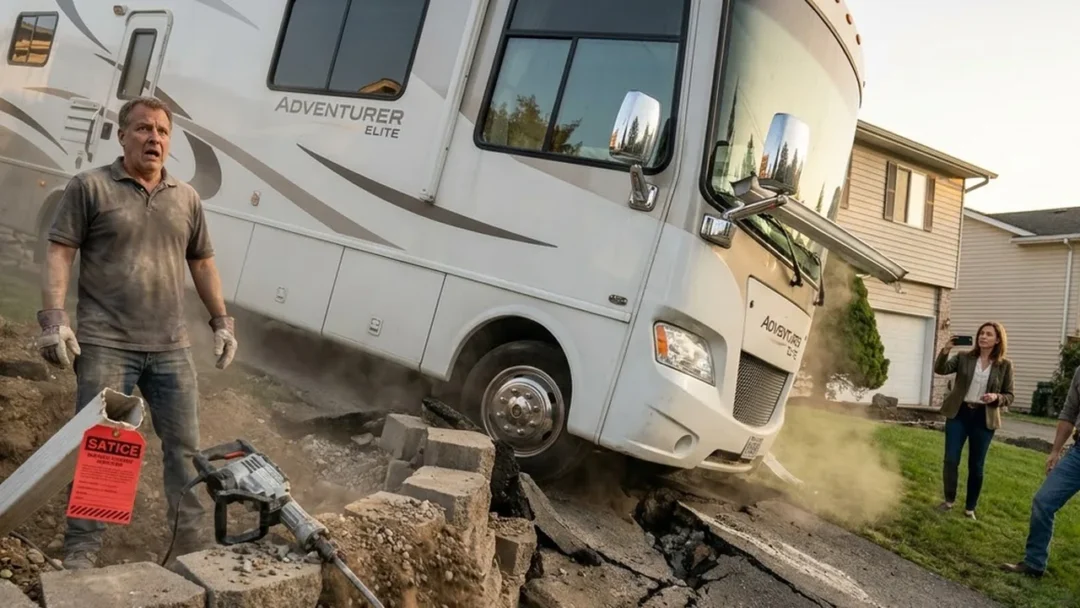
Directly behind Bradley, dominating the upper asphalt pad like an ocean liner docked at a wooden pier, sat his newest pride: a forty-five-foot, quad-slide Prevost custom diesel pusher motorhome. Finished in gleaming pearl-white lacquer with flowing metallic bronze ribbons, the vehicle weighed twenty-six tons, stood thirteen feet tall, and carried a window sticker well north of three hundred and eighty thousand dollars. Because of the tight radius of the hillside driveway, Bradley had struggled for weeks to back the behemoth into his parking space without scuffing the alloy wheels against the stone coping of Nathan’s wall. Instead of admitting that he had bought a commercial bus too large for a residential mountain lot, Bradley blamed the masonry.
Bradley kicked open a heavy yellow plastic case and lifted out a sixty-pound Bosch commercial demolition hammer. In his other hand, he held a long, hardened steel bull-point chisel. The heavy tool gleamed with fresh factory grease.
“Morning, Nathan,” Bradley shouted down, his voice echoing off the concrete terrace with aggressive familiarity. “I’m tired of doing a five-point turn every time I bring the coach back from Park City. This decorative corner block of yours is coming out today.”
Nathan walked steadily to the base of the wall, stopping beside a fluorescent wooden lathe stake pounded firmly into the grade. The stake was tied with surveyor’s ribbon and bore an official county inspection tag. Along the top course of the gray Keystone blocks, a neat line of orange stencil paint read: STRUCTURAL RETAINING WALL — DO NOT REMOVE — SLC PERMIT #8841.
“Bradley, leave the hammer in the case,” Nathan said, his voice measured, firm, and devoid of anger. “That wall isn’t decorative. It was engineered under Salt Lake County hillside building code. That corner block contains a two-inch solid fiberglass shear pin and holds the corner tension for the entire geogrid mattress beneath your driveway.”
Bradley scoffed, swinging the sixty-pound hammer easily in his hands, resting the chisel tip against the top cap of the corner stone. “Don’t lecture me on engineering, Nathan. It’s a dry-stacked garden wall. I had a paving contractor look at it from the street yesterday. He told me I can knock eighteen inches off this corner, pour a quick curb, and gain two full feet of swing clearance for my front steer axle.”
“Your paving contractor didn’t pull the civil blueprints from county records,” Nathan replied calmly, taking his phone from his chest pocket and tapping the screen to initiate 4K video recording. “If you touch that block, you violate Salt Lake County building code, and you compromise the lateral support of your own parking pad.”
Bradley sneered down from the coping, his eyes flashing with stubborn irritation. “I pay thirty thousand dollars a year in property taxes on this mountain, Price. I don’t need a city permit to chip away a few inches of rock on my boundary line.”
Bradley reached down, plugged the heavy yellow cord into a portable gas generator on his tailgate, and gripped the dual rubber handles of the demolition hammer. With an arrogant grin, he leveled the hardened chisel directly at the stamped municipal permit seal on the face of the stone.