The Smashed Retaining Wall And The Collapsing Luxury Motorhome
CHAPTER 3: THE SHUDDER OF THE WASATCH BEDROCK
A sharp, authoritative horn blast sounded from the street below. A white Ford F-250 pickup bearing the green emblem of the Salt Lake County Department of Public Works swung around the switchback curve, its amber rooftop light bar flashing slowly against the morning sun.
The driver’s door opened, and Arthur Sterling stepped out onto the roadway. At fifty-eight, Sterling had spent three decades inspecting municipal infrastructure, hillside stabilization projects, and seismic retrofits along the Wasatch Fault. He was a licensed professional engineer who carried himself with the quiet, unhurried gravitas of a man who dealt exclusively in immutable physical laws. He wore a crisp white hard hat, steel-toed field boots, a high-visibility surveyor’s vest lined with pockets of field calipers, and carried a heavy aluminum clipboard clamped with blue county site plans. Behind him, on the passenger seat of his county rig, an electronic laser transit and a seismic slope inclinometer sat ready for deployment.
“Turn off that generator right now!” Sterling shouted toward the upper driveway, his voice cutting through the mechanical din like a ship’s horn in dense fog.
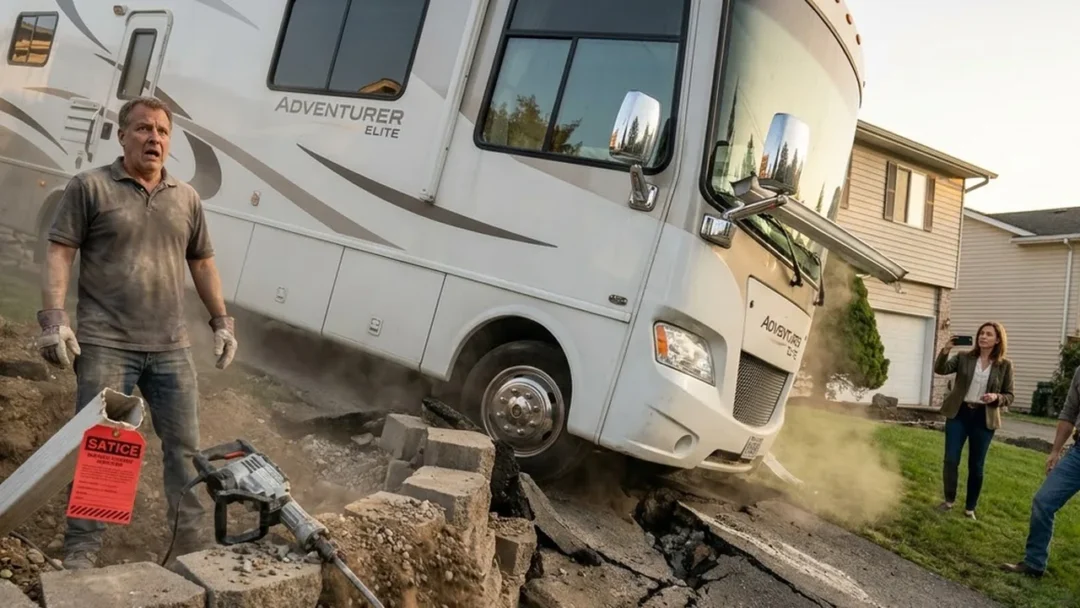
Bradley blinked down from the wall, his smirk freezing as he recognized the county truck and the unmistakable badge of a senior building inspector. With an annoyed flick of his wrist, he switched off the generator. The sudden silence that settled over Ridgecrest Vista was heavy, broken only by the steady whisper of mountain gravel sliding from the cracked retaining wall and the faint cawing of a raven circling above Mount Olympus.
“Who called the city?” Bradley demanded, wiping dust from his sleeves and scowling down at the inspector. “Sterling, what are you doing up here? This is private residential property. You don’t have an easement to conduct surprise spot-checks.”
Arthur Sterling walked deliberately up Nathan’s driveway, his eyes locked on the damaged stone face. He reached into his vest, pulled out a digital laser distance meter, and took three quick measurements of the wall’s vertical plumb, noting a three-degree outward tilt on the upper course.
“Mr. Caine,” Sterling said, his voice flat, icy, and unyielding. “I am here in response to an expedited priority notification regarding unpermitted excavation in a geologically hazardous hillside overlay zone. And looking at your hands on that sixty-pound demolition hammer, you are caught red-handed in active, flagrant violation of Salt Lake County Municipal Code chapter nineteen-seventy-six.”
“It’s my driveway!” Bradley protested, stepping down from the wall coping and tossing the chisel onto the asphalt with a defiant clatter. “The wall is encroaching on my access easement. I’m just trimming eighteen inches off the corner so I can park my coach. I have a right to access my own garage without tearing up my tires.”
Sterling turned and looked directly at the blue site plans on his clipboard, tracing an indelible red line with his thumbnail. “The wall is not encroaching. This retaining structure was surveyed, engineered, and permitted by Mr. Price in 2018. It sits four inches entirely on his side of the recorded property boundary. Furthermore, under Section Four of your subdivision’s master development agreement, this specific retaining wall is classified as a Critical Slope Support Structure.”
Sterling pointed a weathered finger at the broken Keystone block, where gravel was now pouring out in a steady, widening stream like water from an uncapped spigot. “That corner holds the deadman anchors for the geogrid reinforcing mesh that stabilizes the entire fill prism under your parking pad. You just sheared the master anchor pin, Mr. Caine. You relieved the confining pressure on sixty thousand pounds of compacted fill.”
“Don’t give me that bureaucratic nonsense,” Bradley snapped, crossing his arms over his fleece vest and puffing out his chest. “It’s a block of manufactured concrete. I can put some mortar and epoxy in it tomorrow morning. It’s not going to collapse. It’s held up fine for six years.”
“It held up because the engineered pins were intact!” Sterling shot back, stepping closer to the base of the wall. “You didn’t just chip stone; you severed the mechanical tension system!”
As if in direct, mocking response to Bradley’s words, a deep, hollow pop echoed from beneath the asphalt.
It was not a surface sound. It came from four feet underground—the distinct, violent sound of high-tensile polypropylene geogrid fabric snapping under sudden, unsupportable tensile loads.
Across the black asphalt of Bradley’s parking pad, directly beneath the massive rear dual wheels of the twenty-six-ton Prevost motorhome, a jagged hairline fracture tore through the surface. It raced three feet in half a second, splitting the sealcoat with the sound of ripping heavy canvas, heading straight for the foundation footer of Bradley’s three-car garage.