The Smashed Retaining Wall And The Collapsing Luxury Motorhome
CHAPTER 2: THE FRACTURE OF KEYSTONE SIX
The two-stroke generator sputtered, caught with a sharp puff of blue exhaust, and settled into a high-pitched mechanical drone that echoed off the granite cliffs. The noxious smell of unburned two-stroke fuel drifted across the morning air, competing with the clean alpine scent of scrub oak and pine.
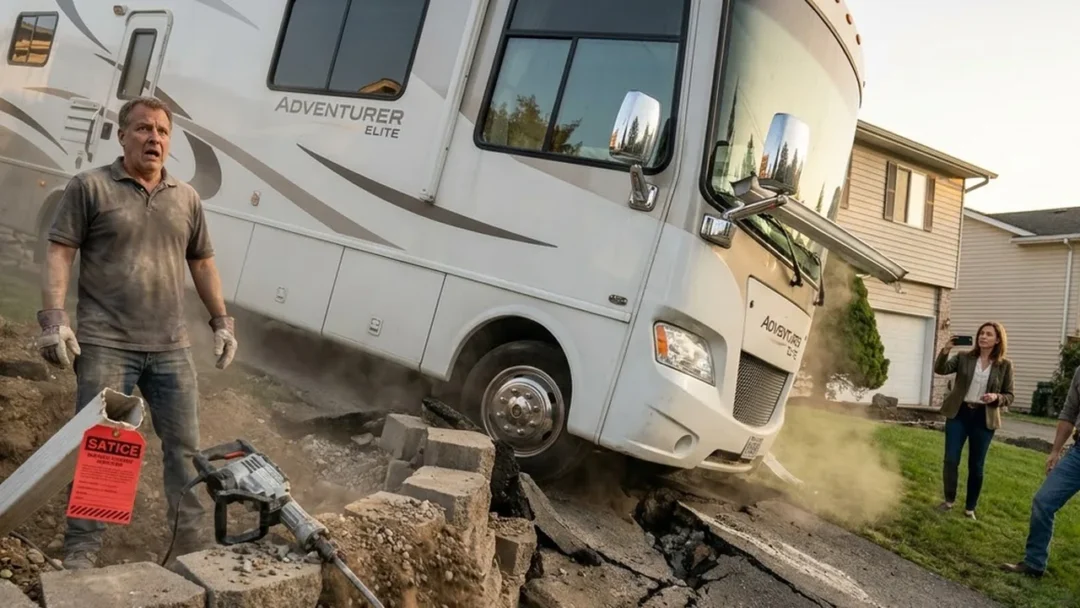
“Bradley, listen to me carefully,” Nathan called out, stepping back two paces to maintain a clear camera angle that framed Bradley, the demolition hammer, the motorhome above, and the painted county inspection markings on the retaining wall. “You are on recorded video. You have been formally served with notice that this wall is a permitted structural containment barrier. If you strike that block, every consequence is on you. Every dollar of structural failure will be traced directly back to your hands.”
Bradley’s only response was a mocking laugh. He planted his heavy work boots on the edge of the stone cap, raised his right leg, and delivered a violent kick to the orange surveyor’s stake. The wooden lathe snapped with a crisp crack, the fluorescent ribbon fluttering into the dirt swale below. Bradley ground the broken stub into the mud with the heel of his boot, glaring down at Nathan like an emperor dealing with a peasant.
“Consider your stake removed,” Bradley sneered. “I own this mountain air, Price. Watch how real men solve clearance problems.”
He squeezed the dual triggers of the Bosch breaker.
The electric motor roared, and the heavy pneumatic piston began reciprocating at eighteen hundred beats per minute. The hardened steel chisel bit into the textured face of the corner Keystone block with a deafening, violent chatter that shook the teeth in Bradley’s jaw. White concrete dust exploded in a choking cloud around Bradley’s shins, coating his designer boots and fleece vest in fine gray powder. High-velocity chips of fractured aggregate flew in all directions, pinging off the asphalt and clattering down into Nathan’s lower garden bed, severing stems of delicate ornamental grass.
Inside the hollow core of the block, the vertical fiberglass alignment pins—designed to transfer horizontal shear forces between the interlocking courses—began to groan under the brutal concussive blows. These pultruded composite pins possessed extraordinary tensile strength against steady lateral earth pressures, but they were never designed to withstand focused, localized concussive shattering from a sixty-pound demolition chisel.
Nathan stood motionless, holding his phone steady. Through the camera viewfinder, he watched the mechanical destruction with the trained eye of a structural builder. He didn’t yell. He didn’t try to wrestle the tool from his neighbor’s hands. In high-stakes civil disputes, physical interference only clouded the legal liability. Documentation was absolute; video timestamps, certified property markers, and municipal engineering blueprints were the only weapons that truly mattered in a courtroom. He kept his lens focused squarely on the fracture line propagating through the sixth course of stone.
“You see that?” Bradley yelled over the screaming motor, sweat beading across his forehead as he bore his full body weight down on the handles, his arms vibrating so violently that his watch bracelet jingled. “Chipping right through! Five minutes of work, and I’ll have my clearance! No city inspector, no contractor delay, no fifty-thousand-dollar retaining redesign!”
The chisel struck the central core of the sixth-course block. A sharp, explosive crack, like the report of a high-powered hunting rifle, sounded from within the stone.
The two-inch solid shear pin sheared cleanly in two.
Immediately, the rhythm of the demolition hammer changed. The solid, dull thud of stone against stone turned into a hollow, rattling vibration. The heavy corner block, deprived of its mechanical interlock, shifted outward by a quarter of an inch, twisting out of square with the lower tier.
Bradley let go of the trigger, panting heavily, wiping concrete grit from his brow with the back of his forearm. A triumphant smirk spread across his face as he looked down at the jagged gap he had created. “Look at that. Didn’t even take five minutes. You contractors make everything into a federal case.”
Nathan did not smile. He zoomed the camera lens into the widening fracture line.
From the dark crevice between the sixth and seventh courses of stone, a thin, steady trickle of dry, crushed drainage gravel began to pour outward. It was three-quarter-inch washed mountain chip, perfectly clean, falling like fine sand through the narrow neck of an hourglass. Behind the aggregate, a low, ominous hiss—the sound of seventy tons of compacted hillside fill beginning to decompress and lose its internal friction angle—drifted from deep inside the slope.
Above the wall, on the asphalt pad, the twenty-six-ton Prevost motorhome rocked gently on its pneumatic air suspension. The rear right tire, parked less than three feet from the crumbling edge, settled an eighth of an inch deeper into the roadbed as the asphalt lost its subterranean support.