The Piano They Took From Her
Part I — The Miracle Poster
The poster outside the Caldwell Arts Center had Emily’s face on it, but not her name.
Not where it mattered.
Her photograph sat beneath gold lettering that read A Night of Miracles, beside a smaller line about resilience, restoration, and the healing power of art. The picture was three years old, cropped from a hospital benefit Patricia had forced her to attend before Emily could sit upright for more than twenty minutes without shaking.
Tonight, under the glass case by the entrance, Emily looked younger than she felt. Softer. Useful.
Behind her, women in silk dresses stepped out of black cars. Men laughed into the cold evening, their watches flashing under the marquee lights. Everyone was arriving to save the Caldwell Arts Foundation.
Emily had been brought there to be proof it deserved saving.
She rested one hand on the wheel of her chair and the other on the silver ring she wore on her right hand, twisting it once. Her father’s ring. Too large for her finger, but she had never had it resized.
A black piano sat on the sidewalk ten feet away from the poster.
It was part of the foundation’s “music in public spaces” program, according to the small brass plaque screwed into its side. Children had scratched initials into the bench. The finish was weathered near the keys. Someone had left a coffee cup on top of it, rings drying in the varnish.
Emily looked at it longer than she meant to.
Something about the piano made her chest tighten.
Then a voice behind her said, “You still play?”
She did not turn at first.
She knew the voice before she saw the man. Calm. Low. Careful with its own beauty.
Michael stood beside the piano in a black suit, one hand resting lightly on the lid, as if he had been waiting inside a memory and had only just stepped out. His hair was darker at the temples than she remembered. His posture was still perfect. The kind of posture people trusted.
The last time Emily had seen him, he had been standing in the doorway of her hospital room with flowers he never gave her.
“You’re headlining,” she said.
“It’s Patricia’s gala.”
“That wasn’t an answer.”
His eyes flicked to the poster, then back to her. “Yes. I’m headlining.”
Emily smiled without warmth. “Of course you are.”
The door opened behind them, letting out a burst of strings from the rehearsal inside. The donors would hear Michael perform later. They would sip champagne and feel generous. They would look at Emily and feel grateful their tragedies had happened to other people.
Michael moved around the piano slowly.
“May I?” he asked, gesturing to the keys.
“You always did ask permission after you’d already decided.”
That landed. She saw it in his face.
Still, he lifted the fallboard. The keys appeared in the fading light, ivory and black, familiar enough to hurt. Emily’s fingers flexed once against her lap before she could stop them.
Michael saw.
“You still have pianist’s hands,” he said quietly.
“You lost the right to know what my hands are.”
He swallowed. “Emily—”
“No.”
Her voice was soft enough that passing guests would think they were speaking kindly.
Michael looked toward the entrance, then back at the piano. “The donors would be moved if they heard you play.”
The sentence hung between them.
There it was. Not music. Not her. The donors.
Emily rolled closer, not because she meant to play, but because anger had always moved her faster than hope. She placed two fingers over middle C. The key was cool beneath her skin.
For one second, she almost pressed down.
Then she pulled her hand back.
“I don’t want people clapping because they feel sorry for me.”
Michael’s face changed.
Not dramatically. He was too trained for that. But the polish cracked at the eyes.
Before he could answer, Patricia Caldwell appeared at the entrance in an immaculate cream suit, pearls bright against her throat, smile arranged for witnesses.
“Emily,” she said, as if she had found a misplaced centerpiece. “There you are.”
Her gaze moved from Emily to Michael to the piano.
The smile stayed.
“How touching,” Patricia said. “But we need you inside.”
Emily looked once more at the keys.
She did not touch them again.
Not yet.
Part II — The Role Written for Her
Inside, the Caldwell Arts Center had been dressed to look less desperate than it was.
White orchids lined the stage. Gold chairs faced a grand piano polished so thoroughly it reflected the chandelier. Waiters moved between tables with trays of champagne no one had paid for personally. Above the stage, a screen hung black and waiting.
Emily saw her place before anyone pointed it out.
A single chair onstage. Not a piano bench. Not near Michael. Centered beneath the screen like an exhibit.
Patricia approached it with brisk tenderness.
“You’ll only be up there for three minutes,” she said. “Five at most, depending on the video.”
Emily stopped. “What video?”
Patricia’s fingers adjusted the edge of a table card that did not need adjusting. “A short tribute.”
“To whom?”
“To you, darling.”
Michael stood several steps away, silent.
Emily noticed that first.
The old Michael would have interrupted. The teacher who once slapped music scores shut when Emily played too politely would have said, “No tribute before the performance. Let the work speak.”
This Michael studied the floor.
Patricia touched Emily’s shoulder. Emily hated that she still leaned into the warmth for half a second before she remembered it had a purpose.
“The donors need to understand why tonight matters,” Patricia said. “They need to see what this foundation preserves.”
“You mean who it uses.”
Patricia’s smile tightened, but only for Emily. To anyone else, it would have looked like patience.
“This is not the time for cruelty.”
Emily laughed once. “Mine or yours?”
A volunteer hurried past with a bouquet. Patricia waited until she was gone.
“The foundation is in danger,” she said quietly. “Programs will close. Teachers will be laid off. Scholarships will disappear. If your presence helps people remember the value of art—”
“My presence?”
“Your story.”
“My accident.”
Patricia’s eyes softened in a way that had fooled better people. “Your survival.”
There were words Emily had learned to recognize as cages. Strength. Courage. Survival. Miracle. People used them when they wanted to praise what they did not intend to understand.
Michael stepped closer. “Maybe we should talk about this somewhere private.”
Emily turned to him. “Did you know?”
His pause was short.
Too short to be innocence.
“I knew there would be a tribute,” he said.
Emily let out a breath through her nose. “A tribute.”
“Patricia said you approved the concept.”
Emily looked at her mother.
Patricia did not blink.
“You approved the invitation,” Patricia said. “You knew tonight was in your honor.”
“In my honor,” Emily repeated.
On the stage, the empty chair waited.
Three years ago, Emily had been twenty-four and learning a Liszt piece Michael said she was not ready for. She had been furious with him, which meant she practiced until her wrists ached. She had also been in love with him by then, though neither of them had named it in daylight.
Then the car crash happened on a rainy Tuesday. Afterward came surgeries, morphine, smiling visitors, and the strange discovery that people could mourn you while you were still alive.
Michael came once.
Her father had already died by then. Patricia had become efficient with grief. Michael had stood in the doorway with white lilies, seen Emily’s chair beside the bed, and said, “I’ll come back when you’re stronger.”
He never came back.
Now he stood beside her in a room built by her family’s money and her father’s name, asking her to believe this was care.
Patricia clapped her hands once, the sound delicate but final.
“Places, please. We need to run the introduction.”
A young technician at the back called, “Do you want the hospital footage first or after the childhood recital clips?”
Emily’s whole body went still.
Michael closed his eyes.
Patricia turned, her voice smooth. “After. We want to begin with promise.”
Promise.
Emily looked at the stage again, at the chair beneath the blank screen.
She understood then that tonight had already been written.
And she had been cast as the beautiful loss.
Part III — The Video They Made of Her
Emily found the video by accident because no one in the Caldwell Arts Center thought she would go looking.
That was one advantage of pity. People confused it with invisibility.
The rehearsal had broken for lunch. Patricia was with donors in the atrium. Michael had been taken to inspect the grand piano, as if he could not recognize a Steinway without supervision. Emily rolled down a service hallway looking for quiet and found the media room door propped open.
On a monitor, her face was frozen at age eleven.
She was sitting at a recital piano, chin lifted, hair pinned with a blue clip. Her father’s hand was visible at the edge of the frame, mid-clap before she had played a note. He used to applaud her entrances because he said courage started before the music did.
Emily moved closer.
The video resumed when her wheel bumped the desk.
Her childhood recital dissolved into newspaper headlines.
LOCAL PIANIST IN CRITICAL CONDITION.
CALDWELL FAMILY ASKS FOR PRIVACY.
ARTS COMMUNITY RALLIES AROUND BELOVED FOUNDATION HEIRESS.
Then hospital footage filled the screen.
Emily in bed. Emily pale. Emily half-asleep while Patricia spoke to someone off-camera. Emily’s hand twitching under a blanket.
She did not remember being filmed.
A soft female voiceover said, “When Emily Caldwell lost the dream she had spent her life building, she taught us that art is not only performance. It is endurance.”
Emily could not breathe properly.
The video cut to Michael at a piano, filmed recently. His hands moved over keys with unbearable grace.
“Tonight,” the voiceover continued, “world-renowned pianist Michael Hayes returns to dedicate his performance to Emily’s courage, and to the foundation that helped her live beyond the dream she lost.”
Emily gripped the ring on her finger so hard the metal hurt.
The dream she lost.
Not the dream they took away. Not the dream she had been too ashamed to touch because every room turned her into a lesson. Not the dream Michael abandoned when it no longer looked like applause.
The door opened behind her.
Michael stopped in the doorway.
For a moment, neither of them moved. The monitor painted his black suit in blue light.
“You saw it,” she said.
He did not ask what.
“Yes.”
“How long ago?”
His jaw worked once. “A week.”
Emily turned back to the screen. Her hospital self stared past the camera, drugged and defenseless.
“You let them use this.”
“I told Patricia it was too much.”
“But you didn’t stop it.”
“I didn’t think I had the right.”
Emily laughed, and this time it broke in the middle. “You didn’t think you had the right to stop them humiliating me, but you thought you had the right to ask me to play.”
Michael came closer, then stopped when she looked at him.
“I thought if people saw you again—”
“As what?”
He had no answer.
“As a warning?” Emily asked. “As a lesson? As the thing that makes rich people open their checkbooks between dessert and your encore?”
“That’s not fair.”
“No. It’s accurate.”
His eyes flashed, not with anger exactly. Pain with pride under it.
“You were gone,” he said. “You shut everyone out.”
“You left first.”
“I was scared.”
The confession came too late to be brave.
Emily looked at him then. Really looked. The tiredness around his mouth. The guilt he wore like another tailored layer. She had once believed his attention made her more real. When he listened to her play, she had felt chosen. When he corrected her, she had felt seen.
Now she understood the shape of that power.
“You loved me when I was becoming something,” she said. “You didn’t know what to do when I became inconvenient.”
Michael flinched.
“That isn’t true.”
“Then why are you here?”
“For you.”
“No.” Emily turned off the monitor. The screen went black, leaving both of them reflected in it. “You’re here because my mother needed a famous man beside my tragedy.”
He stepped toward her. “Emily, I wanted to help bring you back.”
There it was again.
Bring her back. As if she were somewhere he could retrieve her from. As if he could stand at the mouth of her grief and call her name prettily enough.
She moved past him toward the door.
His voice followed. “You still deserve to be heard.”
Emily stopped.
She did not turn around.
“Then stop trying to introduce me.”
Part IV — The Piano That Wasn’t Public
That evening, Emily returned to the black piano after the caterers had left and the gala lights had been tested.
The sidewalk was empty. The city had cooled into blue. Inside the arts center, Patricia’s staff were rehearsing generosity with clipboards.
Emily lifted the fallboard herself.
The keys waited.
She placed her fingers over them and pressed one note.
It came out slightly out of tune.
Her throat tightened.
Not because it was beautiful. Because it was not.
Real music had weight. It failed. It cracked. It did not wrap suffering in strings and ask for donations.
She played three notes from memory, then stopped.
Behind her, Michael said, “Your father wrote that.”
Emily closed the fallboard so hard the sound hit the street.
Michael stood at the curb with his hands in his coat pockets, no longer looking like a performer. Just a man who knew he had walked into the wrong moment again.
“What did you say?” Emily asked.
He looked at the piano.
“That phrase. Your father used to play it after board meetings. He said it was unfinished.”
Emily’s hand drifted to the side of the instrument. The plaque read:
Donated by Patricia Caldwell in support of music for all.
A strange calm entered her.
“My father’s piano was sold after he died,” she said.
Michael said nothing.
“Patricia told me it went to a collector in Boston.”
The silence became answer-shaped.
Emily touched the wood again. Beneath the scratches and public wear, beneath the paint and brass lie, she saw it: the shallow nick near the left corner where her father had dropped a metronome; the faint circle where he always set his coffee; the uneven middle C he refused to replace because he liked “a note with history.”
Her father had taught her the unfinished piece on this piano.
Not taught. Shared. He never wrote it down. He said music written too soon stopped growing.
Emily’s voice came out almost level. “How long have you known?”
Michael looked away.
“Michael.”
“Since yesterday.”
“Who told you?”
“Patricia mentioned it. She assumed I knew.”
Emily stared at the plaque.
Donated by Patricia Caldwell.
Her father had not donated anything. He had left the piano to Emily. She knew because his will had been read in the same room where Patricia later told her not to get upset over objects.
My studio piano goes to Emily, her father had written. For the music she has not made yet.
Emily remembered laughing through tears when the attorney read it. She had been in a hospital chair then too weak to sit through grief, and Patricia had squeezed her hand.
We’ll keep it safe, darling, Patricia had said.
Safe.
Emily turned toward the arts center.
Michael moved in front of her. “Don’t confront her tonight. Not like this.”
Emily looked up at him. “Move.”
“Emily, listen to me.”
“No.”
“If this explodes before the gala, she’ll bury it. She’s good at that.”
“My mother stole my father’s piano.”
“I know.”
“No, you know about it. You don’t know it.”
The words struck harder than she expected. For a second, Michael looked like the man from the poster should have looked: moved, helpless, late.
Emily rolled around him.
Inside, Patricia was in the atrium directing the placement of a donor wall. Names in gold vinyl climbed toward the ceiling. People who gave enough money would be remembered larger than people who had made the art.
“Mother,” Emily said.
Patricia turned. “Not now, please.”
“The piano outside belonged to Dad.”
The atrium quieted by degrees.
A florist looked down at her roses. A technician froze near the ladder. Patricia’s face did not change, which meant everything inside her had.
“It belonged to the foundation,” Patricia said.
“No. It belonged to me.”
Patricia’s smile sharpened. “You were in no condition to make decisions.”
“I didn’t have to make one. Dad already did.”
Michael had entered behind Emily. Patricia noticed him and understood, instantly, what had happened.
Her voice lowered. “You have no idea what I had to hold together after your father died.”
“So you held it together with what he left me?”
“I preserved it.”
“You put a plaque on it with your name.”
Patricia stepped closer, still careful, still elegant, still impossible to embarrass in her own building.
“You had not touched a piano in three years.”
Emily felt the room hear it.
There it was. The real sentence under all the soft ones.
Not courage. Not miracle. Not survival.
Useless.
Michael said, “Patricia.”
She ignored him.
“I did what was practical,” Patricia said. “What was generous. That piano has given music to hundreds of people.”
Emily nodded once.
Her face felt cold.
“Then tomorrow,” she said, “they can hear who it belonged to.”
Patricia’s eyes narrowed. “Do not threaten me on the eve of the most important night this family has had in years.”
Emily turned her chair toward the exit.
“I’m not threatening you,” she said. “I’m tuning myself.”
Part V — The Heart of Tonight’s Miracle
By gala night, Patricia had changed nothing.
That was her kind of war.
The poster remained outside. The plaque remained on the piano. The video remained cued behind the stage. Emily’s chair remained under the screen.
Only Patricia’s grip had changed.
She caught Emily in the private hallway ten minutes before the program began, cream suit flawless, pearls glowing, expression almost maternal.
“You will not punish innocent people because you are angry with me,” Patricia said.
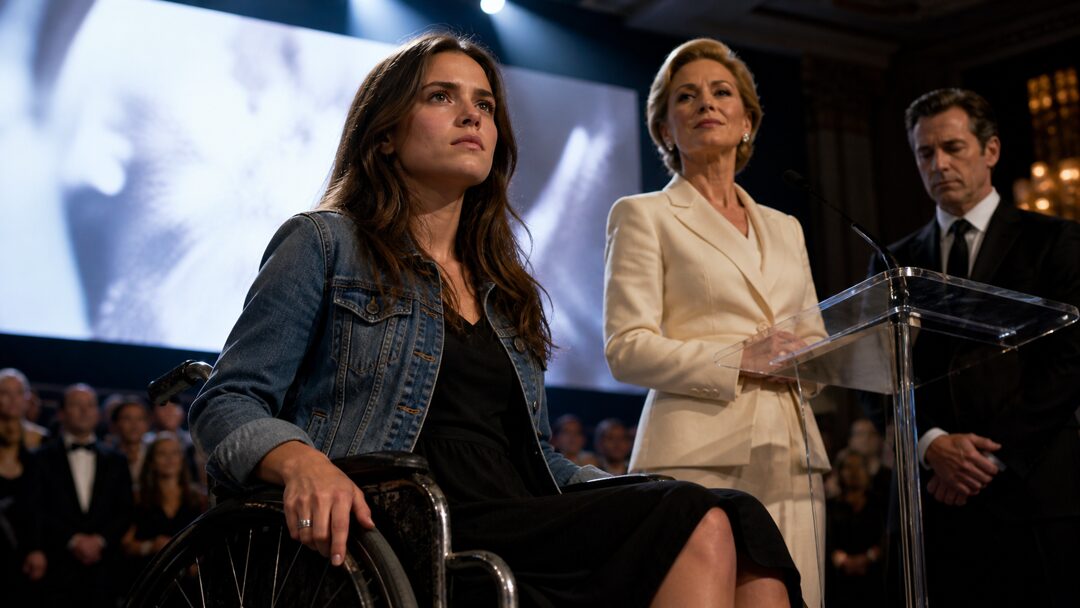
Emily had worn the black dress because refusing to dress up would have made Patricia too happy. Over it, she kept her denim jacket. Her father’s ring hung cold on her finger.
“Innocent people?” Emily asked.
“Teachers. Students. Staff. The children who need scholarships. If donors pull out tonight, programs die.”
“Then ask them for money without putting my hospital footage on a screen.”
Patricia’s mouth tightened. “You think dignity is never needing anyone. That is a young person’s fantasy.”
“No,” Emily said. “Dignity is knowing when love has become rent.”
For once, Patricia’s expression flickered.
Then Michael appeared at the end of the hall in his black suit.
He looked at Emily, then at Patricia, and understood he had walked into another room where he would be measured.
“We’re about to start,” he said.
Patricia looked relieved by his presence. “Please tell her.”
Emily almost laughed.
Michael came closer slowly.
“Get through tonight,” he said to Emily. “Afterward, we handle the piano. The video. All of it.”
“We?”
He heard it. Too late, but he heard it.
“I mean—”
“You mean I should sit there while they watch me lose my dream in high definition.”
His face tightened. “I mean don’t let this destroy you.”
Emily looked past him toward the stage doors. She could hear the audience settling. Glasses. Murmurs. The soft animal sound of wealth waiting to be moved.
“This already destroyed enough,” she said.
Patricia stepped in. Her voice was barely above a whisper. “If you walk away tonight, Emily, do not pretend there will be no consequences.”
Emily looked at her mother’s hand resting on the folder of prepared remarks.
“Consequences,” she said, “are the first honest thing anyone has offered me.”
A staff member opened the door.
Applause rolled into the hallway.
Patricia’s face rearranged itself into grace.
“Smile,” she said.
Emily did not.
The stage lights were hotter than she remembered. From the center of the room, she could see every face turned toward her with practiced tenderness. Donors leaned forward. Board members folded their hands. The screen behind her glowed blue.
Patricia stood at the podium.
“Tonight,” she began, “we celebrate the power of art to endure beyond loss. Many of you know my daughter Emily’s story. She is the heart of tonight’s miracle.”
The applause came gently, the way people clap near hospital beds.
Emily kept her hands still in her lap.
The video began.
Childhood Emily appeared on the screen. The audience softened.
Then the headlines.
Then the hospital footage.
A sound moved through the room. Not shock. Not outrage.
Appreciation.
They were being given pain at the correct distance.
Emily watched herself on the screen until she could not.
The voiceover said, “When Emily Caldwell lost the dream she had spent her life building—”
Emily unlocked her wheels.
Patricia turned from the podium.
Michael stood near the grand piano, frozen.
Emily moved.
At first, no one understood what they were seeing. A few people smiled, thinking perhaps this was part of the program. Patricia stepped away from the podium, whispering her name.
Emily did not stop.
She crossed the stage, down the side ramp, past the first table of donors, past a woman who reached as if to help and then thought better of it.
The video continued behind her.
“—she taught us that art is not only performance…”
Emily reached the glass doors.
A security guard opened one automatically, startled by his own obedience.
Cold air hit her face.
Outside, the black piano waited beneath the gala lights spilling onto the sidewalk.
Emily rolled to it.
Behind her, the room had begun to empty in murmurs.
Patricia came first because donors were watching.
Michael came after, but he stopped several feet away.
That was the first right thing he had done all night.
Emily lifted the fallboard.
Her fingers found the keys.
For one second, fear came so sharply she nearly laughed. Her hands were stiff. Her wrists had less endurance. Her body did not sit the way it once had. The old Emily would have hated the weakness.
But the old Emily had also wanted too badly to be chosen.
This Emily only wanted the first note to belong to her.
She pressed it.
The sound was imperfect.
Then she played the next.
And the next.
Her father’s unfinished piece came back in fragments, like a voice heard through walls. She did not play it the way he had. She could not. Her left hand simplified what it used to command. Her right hand trembled twice. The middle C wavered with its old flawed tone.
But the melody held.
People gathered in the doorway. Guests in silk and tuxedos. Waiters with trays lowered. Patricia stood behind Emily, speechless in public for the first time Emily could remember.
Michael watched her hands.
Not her chair.
Not her tragedy.
Her hands.
The piece reached the place where her father used to stop. The unfinished measure. The little cliff.
Emily had never known what came next.
That was why she had loved it.
She closed her eyes and played beyond him.
Not brilliantly. Not flawlessly.
Truthfully.
When the final chord came, it did not ring clean. One note was sour. One note faded too soon.
No one moved.
Then applause started from somewhere near the sidewalk.
Not the soft pity applause from the ballroom.
A single pair of hands.
Emily opened her eyes.
A young server stood by the door, crying without trying to be pretty about it.
Then another person clapped.
Then more.
Emily let the sound come, but she did not bow. She did not smile for them. She did not turn to Patricia for permission to exist in the room she had just altered.
Michael stepped forward once, then stopped himself.
Emily saw it.
She looked at him.
His eyes were wet.
For a moment, the old ache reached for her. The girl she had been would have wanted him beside her. The woman she was knew that being seen late was still not safety.
Patricia whispered, “Emily.”
Emily rested her hands on the keys.
“No,” she said.
Just that.
No explanation. No speech.
The night had already heard enough.
Part VI — The Girl Who Stopped
By morning, the video of Emily leaving the stage had been posted from twelve angles.
No one agreed on what it meant.
Some called it ungrateful. Some called it brave. One donor announced he was withdrawing his pledge until the foundation explained why Emily had never been listed as a performer. Another wrote that the most honest music of the evening had happened outside the doors.
Patricia called seven times.
Emily watched the screen light up and go dark.
On the eighth call, she turned the phone face down.
The black piano was still on the sidewalk when she arrived before nine. The street had not fully woken. A delivery truck idled at the curb. Someone had removed the coffee cup from the piano lid. The plaque remained.
Donated by Patricia Caldwell.
Emily ran her thumb over the brass edge.
Not yet, she thought.
Some battles needed lawyers. Some needed silence first.
Michael stood across the sidewalk near the arts center steps, holding two coffees like an apology he had not earned the right to give. He looked less composed in daylight. Older. More human. Less useful.
“I didn’t know if you’d come,” he said.
“I didn’t come for you.”
“I know.”
That was new.
He set one coffee on the top of the piano, then seemed to realize what he had done and removed it quickly. Emily almost smiled. Almost.
“I should have stopped the video,” he said.
“Yes.”
“I should have told you about the piano the moment I knew.”
“Yes.”
“I should have come back to the hospital.”
Emily looked at the keys. “Yes.”
He absorbed each answer like a sentence passed down without drama.
“I loved you,” he said.
She hated that those words still found a living place in her.
“I know.”
“I thought if I could help you play again, maybe…”
“Maybe it would make leaving me look like part of the story?”
He closed his eyes.
The silence between them was not empty. It had three years in it. Hospital lilies. Unanswered calls. Music lessons that became touches. A man who loved her talent and feared her need. A woman who mistook refusal for armor because needing had once cost too much.
“I was proud of you last night,” he said.
Emily looked at him then.
“That’s the problem, Michael.”
He flinched softly.
“You still think your pride is something I can use.”
The words did not come cruelly. That made them worse.
He nodded once. His hand flexed at his side, the old teacher’s hand, the lover’s hand, the hand that could have reached for hers and did not.
“What happens now?” he asked.
Emily looked toward the arts center. Patricia’s office window was lit though it was too early for staff. Of course she was there. Rearranging ruin into strategy. Calling trustees. Choosing language.
Emily could almost hear her.
A difficult evening. An emotional misunderstanding. A private family matter.
But the story was no longer only inside Patricia’s mouth.
“I play,” Emily said.
Michael waited for more.
She gave him nothing else.
After a moment, he stepped back from the piano. Not far enough to vanish. Far enough to leave the space hers.
It hurt more than if he had begged.
Emily lifted the fallboard.
The first notes came easier than the night before. Not easy. Easier. Her fingers still resisted. Her shoulders ached. Her left hand missed what it used to know and found a smaller truth instead.
Halfway through the piece, Patricia appeared behind the glass doors of the arts center.
Emily saw her reflection in the piano’s black surface.
Her mother did not come out.
That, too, was an answer.
Emily played past the unfinished measure again. This time, she changed it. She let the melody move lower, quieter, less like triumph and more like someone walking away without pretending not to look back.
A child stopped on the sidewalk.
She was maybe nine, wearing a yellow backpack, one hand held by her father. She did not look at Emily’s wheelchair first. She looked at the keys.
Then she looked at Emily’s face.
“Dad,” the girl whispered, “can we listen?”
Her father checked his watch.
Then he stopped.
They listened.
Emily kept playing.
The morning widened around the sound. Cars passed. A bus sighed at the corner. Somewhere behind her, Michael remained silent. Somewhere above her, Patricia watched from behind glass.
Emily did not play for either of them.
She did not play for donors, or forgiveness, or proof that pain could be polished into purpose.
She played because the piano had been left to her for the music she had not made yet.
When the last note faded, the little girl did not clap right away.
She only asked, “What’s that song called?”
Emily looked down at her father’s ring, then at the black piano, then at the open street in front of her.
“It isn’t finished,” she said.
The girl smiled as if that made perfect sense.
Emily placed her hands back on the keys.
This time, no one introduced her.