Sarah’s Table
Part I — The Plate No One Touched
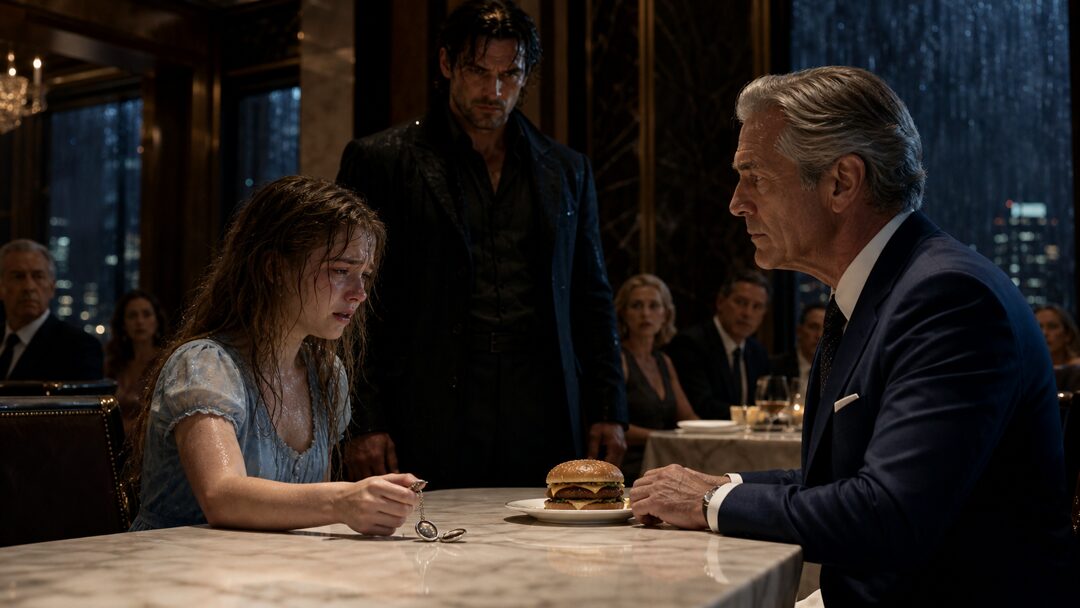
Emily had waited until the hamburger was close enough to smell before the man in the navy suit took it away.
Not snatched. Not yanked.
He slid the plate across the glowing marble table with two fingers, as if the food had embarrassed him by existing.
Around her, The Franklin Room went quiet in the way expensive rooms did. Not silent. Never that honest. Just quiet enough for Emily to hear the rain striking the glass walls and the soft clink of a fork being lowered by a woman in pearls.
The burger left a small circle of steam in front of her.
Emily stared at that empty place like it might give the food back.
The man’s name was Charles Franklin. She knew because his name was written in gold beside the door, under the restaurant’s crest. He was older than her mother had been, with silver hair combed back so carefully it looked permanent. His suit was dry. His shoes were dry. His hands were clean.
Everything about him looked untouched by weather.
“This dining room is for guests,” he said.
His voice was low enough that it did not disturb anyone’s dinner. That made it worse.
Emily’s fingers tightened around the silver locket in her lap. Her blue dress clung coldly to her knees. It had been pretty that morning, before the rain got through her coat and the taxi splashed dirty water over her shoes. Now the hem was dark and heavy. Her hair stuck to her cheeks in damp strings.
“I am a guest,” she said.
The waiter who had brought the burger looked at the floor.
Charles gave her a smile without warmth. “Guests are invited.”
A man at a nearby table glanced over the top of his wineglass. A woman whispered something to her husband and then pretended to look at the storm.
Emily had not known adults could watch a person become smaller and do nothing.
Her stomach hurt. Not the dramatic kind of hurt that made people care. Just the dull, folded-in pain of having eaten crackers from a bus station vending machine six hours ago because she was saving the last of her money for the address her mother had written down.
The Franklin Room.
Ask for Sarah’s table.
Bring the locket.
If anything happens to me, Emily, you go there. You make them look at you.
Emily had imagined someone would recognize the name. She had imagined a woman in a black dress leaning down and saying, Oh, sweetheart. We’ve been waiting.
Instead, the hostess had looked at her wet dress, then at the locket, then at the note in Emily’s hand. She had disappeared into the back.
Ten minutes later, Emily had been seated at a central table under a chandelier that looked like frozen rain.
Five minutes after that, someone had finally brought her food.
And now Charles Franklin had taken it away.
Emily swallowed hard. She did not want to cry in front of rich people. It felt like paying them.
“My mother told me to come here,” she said.
Charles’s face did not change, but the waiter’s shoulders tightened.
“And who is your mother?”
The locket dug into Emily’s palm.
“Sarah.”
The name moved through the room without sound.
Charles went still.
Not surprised, exactly.
Caught.
Emily saw it before he recovered. One flicker in the eyes. One second where his mouth forgot what shape to make.
Then a woman’s voice came from behind him.
“Dad?”
A tall woman in a fitted black dress stepped out from the private dining room at the back. She was beautiful in a clean, expensive way that made Emily suddenly aware of the mud on her socks. A diamond flashed on her left hand. Her dark hair was pinned smoothly at her neck.
She looked at Emily.
Then at the locket.
For half a second, her face opened.
Emily saw recognition there.
Then it closed.
“Ashley,” Charles said quietly. “Go back to your guests.”
But Ashley did not move.
Her eyes stayed on the locket. “What is that?”
Emily lifted it just enough for the silver oval to catch the chandelier light.
“My mother said to ask for Sarah’s table.”
Ashley’s smile appeared too quickly. “Oh, honey.”
Emily hated that word the moment it landed.
Ashley came closer and knelt beside her chair, lowering herself so everyone in the restaurant could mistake it for kindness.
“You must be freezing,” Ashley said softly. “And scared. Sometimes when people are frightened, they remember things wrong.”
“I’m not remembering wrong.”
“Children do that when they’re hungry.”
Emily’s cheeks burned.
Ashley glanced toward the empty space where the burger had been, then back at Emily.
It was the kind of look that said: I saw what happened, and I am choosing my side.
“My mom died three weeks ago,” Emily said.
Ashley’s breath caught.
There it was again. The crack.
Small, quick, gone.
Emily leaned forward, desperate now. “She told me if anything happened, I had to come here. She said Sarah Franklin—”
“Enough,” Charles said.
One word. No volume. The whole room obeyed it.
Ashley stood slowly. Her hand went to the diamond ring on her finger and turned it once.
“I’ll call someone,” she said.
Emily’s heart jumped. “Who?”
“Someone who can help you.”
But she was looking at the manager when she said it.
The manager nodded and took out his phone.
Emily understood then.
Help meant remove.
Help meant disappear.
Just like her mother’s voice on bad nights, when Sarah had stared at the locket and said, Some families don’t throw you out once. They keep doing it every time they refuse to say your name.
Emily stood so fast her chair scraped the floor.
Several people looked up.
“I’m not leaving without opening it,” she said.
Charles held out his hand.
“Give me the locket.”
Emily stepped back.
For the first time, his smile vanished.
Outside, thunder rolled hard enough to tremble against the glass.
Then headlights appeared in the rain.
Not one pair.
Several.
Low. Bright. Waiting.
The conversations near the windows thinned. A man by the bar turned his head. The valet outside stepped backward under the awning.
Motorcycles lined the curb like black animals in the storm.
And then the front door opened.
Part II — The Man from the Rain
The man who entered did not belong to the room, and the room knew it before anyone said a word.
Water ran from his black riding coat onto the polished floor. His boots were heavy, wrong-sounding against the marble. He was tall, broad through the shoulders, with rain-dark hair and a pale scar cutting through one eyebrow.
He did not look around like a customer.
He looked around like someone counting exits.
Emily’s first thought was: That’s him.
Her second was: Run.
Her mother had never shown her a picture of Mark Sullivan. Not directly. But Emily had heard the name enough to know it belonged to the part of Sarah’s life that made her go quiet.
Mark took everything from me, Sarah had once said.
Then, on another night, when she thought Emily was asleep: No. That isn’t fair. I let them make me believe he would.
That was the trouble with grown-ups. They told the truth in pieces, then expected children not to cut themselves on the edges.
Ashley had gone white.
Not pale.
White.
The diamond on her finger glittered as her hand closed around the back of a chair.
Charles turned, and for the first time since Emily had entered The Franklin Room, he looked less like the owner of it.
The man in black took two steps forward.
“Ashley,” he said.
Her name sounded old in his mouth.
Emily backed away.
Mark’s eyes moved from Ashley to Charles, then to the table, then to Emily.
He did not recognize her face.
She knew the moment he didn’t.
Something small and stupid inside her had hoped he would. Even if he was terrible. Even if he had hurt her mother. Some part of her had thought a man who mattered this much should look at her and know.
Instead, his eyes dropped to her dress.
Pale blue.
His expression changed.
It was not softness. It was impact.
Twelve years fell into his face all at once.
Emily turned and ran.
She did not know where she meant to go. Only away from Charles’s hand, Ashley’s honeyed voice, Mark’s stunned stare, the guests watching with their clean napkins and raised eyebrows.
Her wet shoes slipped on the marble.
The locket chain broke.
She felt it leave her hand.
“No,” she gasped, stopping too late.
The locket skidded across the floor and came to rest near Mark’s boot.
No one moved.
The little silver oval spun once, then lay still.
Mark bent slowly and picked it up.
Emily took one step toward him, then stopped. She wanted it back. She wanted him not to touch it. She wanted her mother.
Mark looked at the locket in his palm as if it were alive.
Ashley whispered, “Don’t.”
That was the wrong thing to say.
Mark opened it.
Inside was the picture Emily had looked at so many times the edges had softened: three teenagers outside a younger, plainer version of The Franklin Room. Sarah in the middle, laughing at whoever held the camera. Ashley beside her, thinner, younger, trying to smile. Mark on Sarah’s other side, one arm thrown around her shoulders, his face bright with a kind of happiness Emily had never seen in her mother’s eyes.
Mark stopped breathing.
Behind the photo, something white showed.
A folded strip of paper.
Emily had never noticed it. Or maybe she had been too afraid to pry at the lining.
Mark pulled it free with fingers that suddenly looked unsteady.
Two words showed on the outside.
Tell him.
Ashley made a sound. Not a word. Not quite a sob.
Charles stepped forward. “That belongs to the child.”
Mark looked at him.
Every person in the restaurant felt the temperature change.
“So now she’s a child,” Mark said.
Charles’s jaw tightened.
Emily stood between them, shaking. Her dress dripped onto the floor. Her hunger had become something else, something sharper.
Mark looked at her again.
“What’s your name?”
She almost did not answer.
“Emily.”
His face changed again. Smaller this time. Deeper.
“Emily what?”
She lifted her chin. “My mom’s name was Sarah.”
Mark closed his eyes for half a second.
When he opened them, he looked at Ashley.
“What did you do?”
Ashley’s lips parted, but no sound came.
A young man appeared behind her from the private dining room. Clean-cut, expensive watch, tailored charcoal suit. He looked confused in the way people looked when they had entered a scene that was already dangerous.
“Ash?” he said. “Is everything all right?”
No one answered him.
Mark slipped the folded note back behind the photo and closed the locket.
He did not give it to Charles.
He held it out to Emily.
She hesitated.
“You called the number inside,” he said quietly.
Emily stared at him. “I didn’t know it was yours.”
“I know.”
“You hurt her.”
The words came out before she could stop them.
Mark flinched.
Not like an innocent man.
Like a guilty one who had been struck in the right place.
“I thought she chose them,” he said.
Ashley’s eyes shone now. “Mark.”
He did not look away from Emily.
“I thought she chose money over me.”
Emily’s throat tightened. “She said you took money to leave.”
The restaurant seemed to lean in.
Mark turned to Ashley slowly.
And Ashley stepped backward.
Part III — The Hallway with No Witnesses
Ashley reached for Mark’s sleeve before he could say anything in front of everyone.
“Not here,” she whispered.
Mark looked down at her hand.
Once, that hand had written him notes on napkins when Sarah was late coming down from her room. Once, it had slipped into his jacket pocket to steal cigarettes and then scolded him for having them. Once, it had held his face after Sarah left and said, She made her choice.
He had believed Ashley because she had cried while saying it.
That was the thing he hated most now.
Not that she lied.
That she knew how to cry in the right direction.
Charles moved to block the view of the guests, his voice low. “Take this somewhere private.”
“Private is where your family does its best work,” Mark said.
Ashley’s face tightened.
“Please,” she said. “There are people here.”
“There were people here when he took food from her.”
Emily watched them from near the host stand, the locket against her chest again. She should have run while they were looking at each other. She should have kept going until the restaurant was only light behind rain.
But the note had said Tell him.
And no one had told anyone anything yet.
Ashley led Mark into the corridor beside the private dining room. The door did not close all the way. Emily moved without thinking, small enough to be missed, close enough to hear.
Ashley stopped under a framed photograph of a Franklin charity gala. She looked smaller away from the chandeliers.
“Sarah is dead?” Mark asked.
Ashley’s eyes lowered.
“Three weeks ago,” she said.
“And you knew she had a daughter?”
“I suspected.”
“That wasn’t my question.”
Ashley looked up. Her face was wet now, but she had not earned those tears in Emily’s mind.
“Yes.”
Mark’s silence was worse than yelling.
Ashley gripped her own wrist. “I was seventeen.”
“You were old enough to know what a lie was.”
“You think I don’t know that?”
“I think you got a life out of it.”
Her chin lifted, but it trembled. “You don’t know what it was like in that house.”
“I know Sarah left it pregnant and alone.”
Ashley’s eyes flashed. “She was never alone. That was the problem. Everyone saw her. Even when she ruined things, even when she screamed at Dad, even when she dragged you to the back door smelling like oil and cigarettes—everyone still looked at Sarah like she was the weather.”
Mark stared at her.
Ashley laughed once, a broken sound. “And I was furniture.”
“That’s your defense?”
“No.” She swallowed. “It’s the part I hate admitting.”
From the dining room came a burst of forced laughter, too loud, then silence again.
Ashley lowered her voice. “Dad wanted it gone. The whole mess. Sarah, the baby, you. He said he could handle her, but not if you stayed. I thought—”
“You thought what?”
“I thought if you believed she chose him, you’d stop waiting for her.”
“And Sarah?”
Ashley’s face crumpled for a second before she repaired it. “I told her you took the money.”
Mark stepped back as if the words had weight.
Emily pressed her hand over her mouth.
There it was.
Not the whole truth, maybe.
But enough to change the shape of her mother’s life.
“You told her I sold her?” Mark said.
Ashley whispered, “I told myself it was kinder.”
“No,” Mark said. “You told yourself it was useful.”
Ashley’s tears spilled over. “I loved you.”
The sentence sat between them, ugly and alive.
Mark looked at her like he finally understood the size of the room they had all been trapped in.
“You didn’t love me,” he said. “You wanted to win where she had been loved.”
Ashley slapped him.
The sound cracked through the corridor.
Then she covered her mouth, horrified by herself.
Mark did not move.
Emily backed away from the door before they could see her.
She had heard enough to know her mother had not lied.
Not about everything.
Maybe not about anything.
When she returned to the dining room, Charles was standing at her table with the manager beside him and two security guards near the entrance. Her burger was gone completely now. Not even the plate remained.
The guests pretended not to watch her.
Emily climbed onto the chair because standing on the floor made her feel too small.
Charles saw her too late.
She opened the locket.
“My mother was Sarah Franklin,” she said.
Her voice shook, but it carried.
A fork dropped somewhere.
Charles turned slowly.
“Get down from there,” he said.
Emily looked at him. “Was she your daughter?”
Charles’s face became very still.
The young man from the private dining room stepped closer. “Mr. Franklin?”
Charles did not blink. “I had one daughter. Ashley.”
Ashley appeared at the corridor entrance behind Mark.
Emily felt the denial land in her body before she understood it.
It was not that he had said no.
It was that he had said it easily.
The young man’s eyes moved to the locket. Then to the hallway behind Emily, where a framed photograph hung under a soft light. In it, Charles stood at a charity event years ago, one arm around Ashley, the other around a laughing young woman with Emily’s same chin.
The plaque beneath read:
THE FRANKLIN FOUNDATION FOR CHILDREN AND FAMILIES.
The young man stepped closer to the photo.
“Ashley,” he said slowly. “Who is that?”
Ashley did not answer.
He turned back, and now the whole room watched him understand.
“That’s Sarah,” he said. “Isn’t it?”
Charles’s eyes cut toward him. “Joseph.”
Joseph looked at Emily. Then at Charles. Then at Ashley.
“You told me she was a cousin.”
Ashley whispered, “Joseph, please.”
But some doors, once opened, did not care who was begging.
Part IV — Sarah’s Table
Charles tried to save the room by changing the shape of the scene.
It was almost impressive.
He smiled at the guests first. Not warmly. Professionally.
“My apologies,” he said. “A private family matter has clearly become more theatrical than necessary.”
Private family matter.
Emily heard the words and almost laughed.
Five minutes ago, she had been no one.
Now she was private.
Now she was family.
Charles turned to her and extended a hand.
“Emily,” he said, as if he had not just denied her mother. “Come sit with us. We’ll get you something proper.”
He glanced at the manager.
“Clear that away,” he said, though there was nothing left to clear. “Bring her the chicken consommé.”
Emily looked at him. “I ordered the burger.”
His smile tightened. “You didn’t know what to order.”
“I knew.”
“Emily,” Ashley said, stepping forward. Her voice had that softness again, but now it sounded tired. “Let us help you.”
Emily looked at her aunt. Aunt. The word felt strange and unwanted.
“Did my mom come here when she was hungry?”
Ashley went still.
Charles’s hand lowered.
Mark stood behind Emily now, close but not touching her. She could feel the size of him, the heat of his anger. But he did not speak for her.
That made her stand straighter.
“Did she?” Emily asked.
No one answered.
The silence told her more than yes would have.
Joseph turned to Ashley. “You knew.”
Ashley’s face twisted. “Not like this.”
“That isn’t an answer.”
“No,” she snapped, and the room heard the first honest sound she had made. “No, I didn’t know she would send her here soaked and starving with a locket like some ghost from our teenage years.”
Emily flinched.
Mark’s voice came low. “Careful.”
Ashley looked at him. “Don’t. Don’t stand there like you didn’t leave too.”
The words struck him.
Good, Emily thought, then hated herself for thinking it.
Mark did not defend himself.
“I believed you,” he said.
Ashley’s mouth trembled.
Charles stepped between them with the smooth authority of a man who had ended many scenes before they became dangerous.
“This can be resolved,” he said.
He looked at Mark. “Name your price.”
The room breathed in.
Mark smiled without humor. “You still think every wound has a number.”
Charles’s eyes hardened. “I think a man like you came here for something.”
“I came because she called.”
“She is not your responsibility.”
Mark looked down at Emily.
Not long. Not possessive.
Just enough.
“She might be,” he said.
Emily’s hand tightened around the locket.
Might be.
Not a promise. Not a claim. Not a rescue wrapped in a lie.
Just the truth as far as he had it.
Charles turned back to Emily. “If you want a future, you will stop making ugly scenes.”
That was when something in her settled.
Not healed.
Settled.
Her mother had been called ugly for needing things. Ugly for loving the wrong man. Ugly for getting bigger under loose sweaters. Ugly for standing outside a closed door.
Emily had thought dignity meant not crying.
Now she wondered if dignity meant refusing to become quiet just because someone rich had lowered his voice.
She placed the locket on the table.
It made a tiny sound against the marble.
Everyone heard it.
“Read it,” she said.
Mark looked at her.
“The note,” Emily said. “Read all of it.”
Ashley closed her eyes.
Mark opened the locket again.
His fingers were steadier now, but his face had gone pale under the rain and road dust. He unfolded the paper carefully. The strip was longer than it had looked, thin from being hidden, the creases soft with age.
He read silently first.
His jaw tightened.
Emily knew, before he spoke, that her mother was in the room now.
Not as a photograph.
As words.
Mark’s voice was rough when he began.
“Mark, if this ever reaches you, I need you to know I didn’t take his money.”
Charles looked away.
“I didn’t choose them over you. I was told you wanted the baby because you knew it would break them. I was told you said love was one thing and leverage was another.”
Mark stopped.
His eyes closed.
Emily watched his hand curl around the paper, then loosen because it was the only piece of Sarah he was holding.
He continued.
“I was proud. I was scared. I believed what hurt because it sounded like something the world would do. If I was wrong, I am sorry. If Emily finds you, don’t let them make her feel like a mistake. She was the only part of my life that never lied to me.”
The last sentence broke something in the room.
Not loudly.
But completely.
Ashley made a small sound and covered her face.
Charles remained still.
Joseph stared at the ring on Ashley’s finger as if it belonged to someone he had never met.
Mark folded the note once. Then again.
He looked at Ashley.
She was crying openly now.
“I told her,” Ashley said.
No one asked what.
She said it anyway.
“I told Sarah you took the money. I told Mark she chose Dad. I told myself it was already over and I was only making it cleaner.”
Her laugh was thin and terrible.
“I was seventeen. I was stupid. I was so tired of being the girl standing next to Sarah.”
Mark’s anger moved through his face so visibly that Emily stepped in front of him without thinking.
Ashley looked at her then.
Really looked.
And Emily saw something worse than cruelty there.
Recognition.
Too late.
“I’m sorry,” Ashley whispered.
Emily did not know what to do with those words. They were too small for what they were trying to carry.
So she did not pick them up.
Instead, she turned to Charles.
The room turned with her.
She could feel everyone waiting now. Not for her to be removed. For him to answer.
She did not ask him for money.
She did not ask for a room.
She did not ask for the Franklin name.
She asked for one sentence.
“Say it,” Emily said.
Charles’s face had gone empty.
“Say what?”
She lifted her chin.
“Sarah Franklin was my daughter.”
The restaurant held its breath.
Ashley lowered her hands.
Mark stood so still he seemed carved from the storm.
Joseph looked at Charles with the final hope of a man begging not to watch someone fail the easiest test in the world.
Charles opened his mouth.
Closed it.
Emily waited.
Rain hit the glass. Somewhere outside, a motorcycle engine idled low and patient.
Charles looked around the dining room.
At donors.
Investors.
Critics.
Friends.
People who had paid to sit under his lights and believe good taste was the same as goodness.
Then he looked back at Emily.
He said nothing.
That was the answer.
It entered Emily gently.
Not like a slap.
Like a door locking from the other side.
She nodded once.
Not because it was okay.
Because she understood.
Part V — What the Room Remembered
Mark moved first.
Not toward Charles.
That surprised everyone.
Maybe even him.
He walked to the side station where plates were stacked under silver covers and servers stood frozen in their uniforms. He lifted one cover, then another, until he found it.
The burger was cold now.
The bun had collapsed slightly. The fries beside it had gone soft. A smear of ketchup marked the edge of the plate.
He carried it back through the restaurant as if it were something ceremonial.
A few guests looked away.
Most did not.
Mark set the plate in front of Emily.
No flourish. No speech.
Just the meal she had been allowed to order before people decided her hunger needed permission.
Emily stared at it.
Her throat closed so hard she could barely breathe.
Charles said, “That is inappropriate.”
Mark did not look at him. “So was taking it.”
A woman near the window covered her mouth.
Ashley whispered Mark’s name, but he ignored her.
Emily sat down slowly.
Her dress was still wet. Her shoes were still muddy. Her hair still clung to her face. She was not cleaned up, not corrected, not made suitable.
For the first time since she entered The Franklin Room, no one reached to move the plate away.
She picked up one fry.
Her hand shook.
She ate it.
Then, after a moment, she took one bite of the burger.
It was cold. Too salty. The bun stuck to the roof of her mouth.
It was the best thing she had ever tasted.
Not because of the food.
Because no one had given it back to her quietly.
Mark stood beside her while she chewed. He did not touch her shoulder. He did not call her sweetheart. He did not ask for forgiveness with his eyes.
He only stood there, making himself a wall between her and the room.
Joseph removed the ring from Ashley’s finger without touching her hand. He did it carefully, almost kindly, which made it worse.
Ashley watched him place it on the white tablecloth.
“Joseph,” she said.
He looked at her with exhausted sadness. “I don’t know who I was engaged to.”
She flinched.
Charles spoke sharply. “This is absurd. We are not dismantling a family in front of strangers.”
Joseph looked around the dining room.
“No,” he said. “You did that before any of us got here.”
Ashley sat down as if her legs had stopped belonging to her.
Charles’s face flushed, then smoothed. He was already rebuilding himself. Emily could see it. Tomorrow there would be statements. Explanations. Lawyers. Soft phrases. A grieving private matter. A misunderstanding involving a distressed young relative.
But the room had heard his silence.
Some things could be polished.
Some things could not.
Emily pushed the plate away after three bites. She was still hungry, but her body had become too full of feeling.
Mark held out the locket.
She took it, then looked at the folded note inside.
Her mother’s words were smaller than she remembered her mother being. That felt unfair.
“Can we go?” Emily asked.
Mark nodded.
Charles stepped into their path. “Emily.”
She stopped.
There was a strange urgency in his face now, as if he had finally realized she might leave before he decided what she was worth.
“You don’t understand what you’re walking away from,” he said.
Emily looked at the chandeliers, the silverware, the smooth white plates, the people pretending not to listen anymore.
Then she looked at him.
“Yes, I do.”
Charles had no answer for that either.
Mark opened the door.
The rain came in cold and clean.
Part VI — The Locket in the Rain
Outside, Manhattan had turned silver under the storm.
The motorcycles waited at the curb, their headlights blurred by rain. Men in dark jackets stood under the awning, but none of them spoke. They looked at Mark, then at Emily, and seemed to understand there were questions a person did not ask in public.
The door closed behind them.
The warmth of The Franklin Room vanished.
Emily took one step into the rain, then another. It soaked her instantly, but she did not mind as much now. Inside, the warm air had made her feel like a stain on something expensive.
Outside, everyone was wet.
Mark stood beside her, hands open at his sides.
For a while, neither of them spoke.
Through the glass, Emily could see Ashley sitting alone at the table, black dress perfect, face ruined in a way makeup could not help. Joseph had gone. Charles stood near the bar with his phone in hand, already speaking to someone, already trying to turn truth into language he could manage.
Emily touched the locket.
“Did you love her?” she asked.
Mark looked at the restaurant.
Then at the street.
Then at Emily.
“Yes.”
She waited.
He swallowed.
“Not well enough.”
That answer hurt more than if he had said no.
Because it sounded like something her mother would have believed.
Emily looked down at her shoes. Muddy. Scuffed. Her mother had polished them the week before she got too tired to sit up for long.
“She said you destroyed her,” Emily said.
Mark’s face tightened. “Maybe I did part of it.”
“She said other things too.”
He nodded. “I believe that.”
The rain ran down his face, hiding whatever his eyes were doing.
Emily opened the locket. The tiny photograph glimmered under the awning light.
Sarah at seventeen.
Laughing.
Alive in a way Emily had never known her.
“Are you my father?” she asked.
Mark looked like the question had been waiting for him for twelve years and still found him unprepared.
“I don’t know,” he said.
Emily’s mouth trembled.
He crouched then, not too close, bringing himself down until she did not have to look up so far.
“But I’d like to find out the right way,” he said. “Not because they’re afraid. Not because I’m angry. Because you deserve the truth without someone using it.”
Emily studied his face.
The scar through his eyebrow. The tiredness around his eyes. The grief he did not ask her to comfort.
“You won’t take it?” she asked.
“What?”
“My locket.”
Mark shook his head. “No.”
“You already did.”
“I picked it up.”
“That’s not different when you’re twelve.”
For the first time, something almost like a smile touched his mouth. It left quickly.
“You’re right,” he said. “I’m sorry.”
Emily looked at the locket again.
Her mother had told her to bring it here. To make them look.
She had.
But now the locket felt too heavy to carry alone.
After a moment, she held it out to Mark.
His face changed. Not triumph. Not relief.
Fear.
“Emily—”
“Don’t lose it,” she said.
He took it with both hands.
Carefully.
Like it could still feel.
She did not take his hand after that. Not yet.
She walked beside him toward the motorcycles, leaving wet footprints on the sidewalk that the rain began erasing immediately.
Behind her, The Franklin Room shone gold and perfect through the glass.
Ahead, the street was dark, loud, uncertain.
Emily kept walking.
For the first time that night, no one told her where she was allowed to belong.