The Name Waiting Inside
Part I — The Photograph
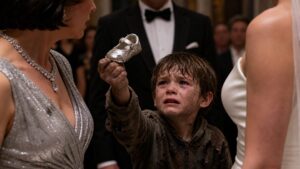
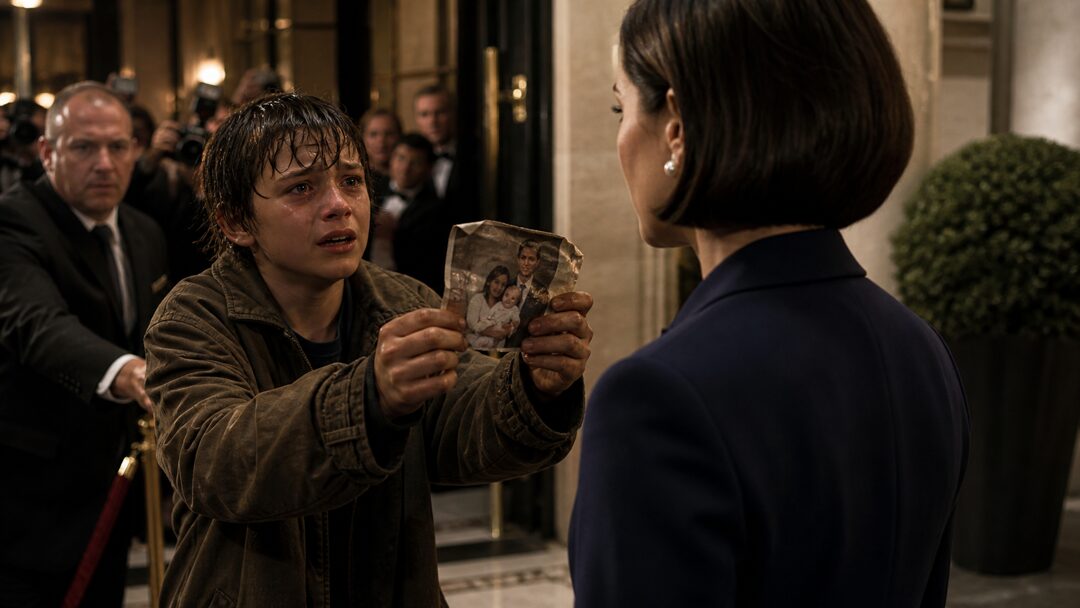
Elizabeth Carter had taken three steps from the black SUV when the boy broke through the line of security and held up a photograph that made every camera turn toward her.
His sneakers were soaked.
His jacket hung off one shoulder.
The photograph shook in both of his hands.
“You were there when I was born,” he said.
For one clean, terrible second, nobody moved.
The Manhattan hotel glowed behind Elizabeth, all gold windows and white flowers, its entrance crowded with donors, reporters, board members, and women in gowns pretending not to stare. The Carter Foundation gala had been planned for eight months. It was supposed to honor her late husband, William Carter, and the beautiful lie everyone still called his legacy.
Then this boy appeared like rainwater tracked across marble.
Security reached him first.
“Ma’am, step back.”
One guard grabbed the boy’s arm. Another blocked the cameras with his body, too late. Phones were already lifted. Red recording lights blinked like small warnings.
Elizabeth should have kept walking.
That was what Michael Grant would have told her. Keep moving. Smile. Let staff handle disruption. Never let private ugliness touch public glass.
But the boy’s eyes were fixed on her.
Not angry.
Worse.
Hopeful.
“Please,” he said, as the guard tightened his grip. “I just need to know.”
Elizabeth looked at the photograph.
It was old, folded too many times, the corners soft and gray from being carried. In it, a younger Elizabeth lay pale against white pillows, her hair loose, her face blurred by exhaustion. A newborn rested in her arms.
At first, she saw only herself.
Then she saw the hospital bracelet.
Then the edge of a man’s hand at the side of the frame.
William’s hand.
Elizabeth felt the cold climb from her fingertips to her throat.
“Let him go,” she said.
The guard hesitated.
“Mrs. Carter—”
“Let him go.”
The boy pulled his arm free, but he did not run. He held the photograph higher, as if it might vanish unless she looked hard enough.
“What’s your name?” Elizabeth asked.
“Joshua,” he said. “Joshua Miller.”
Behind him, the crowd murmured.
Inside the hotel entrance, between two columns wrapped in white orchids, Elizabeth’s younger sister stepped into view.
Laura Bennett wore cream silk and diamond earrings. She looked expensive, fragile, untouched.
Then she saw the photograph.
All the color left her face.
Elizabeth saw it.
So did Joshua.
So did every camera still pointed at them.
And in that moment, before anyone explained anything, Elizabeth understood one thing with perfect clarity.
This boy had not come to the wrong woman.
Part II — The Hallway
Elizabeth took Joshua through the service entrance because the lobby had become a theater.
Michael Grant followed them, speaking into his phone in a voice so calm it sounded rehearsed. Laura followed last, one hand pressed lightly to her stomach, as if she might come apart if she didn’t hold herself together.
The service hallway smelled of floor polish and warm bread. On one side, waiters moved silver trays toward the ballroom. On the other, a line of black coats hung beside a freight elevator.
Joshua stood beneath the harsh ceiling light and looked smaller than he had outside.
Elizabeth crouched, careful not to touch him.
“Joshua,” she said. “Where did you get that photograph?”
“My foster mom gave it to me.”
Laura’s breath caught.
Elizabeth looked at her, but Laura lowered her eyes.
Joshua kept talking. “She died three weeks ago. Before she did, she said if I ever wanted answers, I should find the woman in the navy suit.” He looked at Elizabeth’s jacket. “That was you.”
Elizabeth’s hand closed around the pearl bracelet on her wrist.
“What else did she tell you?”
“That my mother couldn’t keep me.”
The hallway went quiet in a way that was not empty. It was crowded with things nobody wanted to say.
Michael ended his call.
“Mrs. Carter,” he said, “we need to move quickly. The video is already spreading. I suggest we place the boy with hotel security, locate child services, and issue a short statement.”
Joshua flinched at the word place.
Elizabeth saw it and hated herself for noticing late.
“He is not luggage, Michael.”
“I didn’t say he was.”
“No. You only meant it.”
Michael’s expression did not change.
Laura stepped forward. “Elizabeth, maybe we should all just calm down.”
Elizabeth turned to her. “Do you know him?”
Laura’s lips parted.
“No.”
It came too quickly.
Joshua looked from one woman to the other.
Elizabeth tried to steady herself. The photograph still lay in his hands, accusing no one directly and everyone at once.
“I can help you,” she told him. “I can arrange a safe place tonight. A lawyer. A driver. Whatever you need.”
Joshua shook his head.
“I don’t want money.”
Michael gave a faint sigh, as if the child had declined water during a fire.
Joshua looked at Elizabeth with the stunned seriousness only children can have when adults keep missing the point.
“I just want to know,” he said. “Did she want me?”
Laura turned away.
Elizabeth felt something inside her split.
She had been asked many terrible questions in her life. What would happen to the foundation after William’s death? Would she remarry? Was she ready to speak publicly about the pregnancy she lost fifteen years ago?
But no one had ever asked her a question that small and that impossible.
Did she want me?
Elizabeth stood.
“Laura,” she said softly. “Look at him.”
Laura did not.
That was the first answer.
Part III — The Beautiful Lie
By the time they reached the private green room behind the ballroom, the gala had already changed shape.
The music still played. Glasses still chimed. On the stage, a large portrait of William Carter smiled down at three hundred wealthy guests who had paid twenty-five thousand dollars per table to remember him as generous.
Outside the green room door, reporters pressed questions at staff.
Inside, Michael placed his phone face-down on a table.
“We have fifteen minutes,” he said. “Maybe less.”
Elizabeth stood by the mirror, staring at Laura’s reflection.
Joshua sat on the sofa with the photograph in his lap. His feet did not touch the floor.
Laura remained near the door.
“Say it,” Elizabeth said.
Laura swallowed. “Say what?”
“Whatever you have spent eight years not saying.”
Laura laughed once. It was a broken little sound.
“You think I planned this?”
“I think you recognized him.”
Laura’s eyes filled, but Elizabeth did not soften. She had spent a lifetime softening first. Older sister. Better daughter. Composed wife. Public widow.
Laura had always been allowed to tremble.
Elizabeth had always been expected to hold the room steady.
Michael stepped between them.
“This is not the time for family emotion.”
Elizabeth looked at him. “Then it must be serious.”
His jaw tightened.
Laura wiped under one eye without disturbing her makeup. “His name was supposed to be Samuel.”
Joshua looked up.
The room stopped breathing.
Elizabeth felt the name land. Not Joshua. Samuel. A name chosen before he was removed, renamed, rewritten.
Laura covered her mouth.
“I didn’t mean—”
“But you knew,” Elizabeth said.
Laura whispered, “Yes.”
Joshua’s fingers curled around the photograph.
“Are you my mother?”
Laura closed her eyes.
Elizabeth waited for her sister to answer.
Laura did not say yes.
She did not say no.
She only cried.
And somehow that was crueler than either.
Joshua stood so quickly the photograph slipped from his lap. Elizabeth caught it before it hit the floor.
Her thumb brushed the crease across the hospital bed.
The memory came back in fragments.
White ceiling.
The sour smell of antiseptic.
Her body hollowed by loss.
William’s voice near her ear, gentle and commanding: “Hold him, Elizabeth. Just for a minute.”
She had thought someone was being kind.
A nurse had placed a newborn against her chest. Elizabeth had been half sedated, half broken, too empty to ask whose child she was holding. She remembered the weight. The heat. One tiny fist opening against her collarbone.
She had cried because her own son was gone.
William had taken a photograph.
Now, eight years later, the child in that photograph stood in front of her, asking whether he had been wanted.
Elizabeth looked at Laura.
“William was his father.”
Laura’s face crumpled.
“Yes.”
The word did not explode.
It sank.
Elizabeth put one hand on the table because the room tilted.
William, who had held her at fundraisers. William, who had kissed her temple in public. William, who had built a foundation around family grief after their son died.
William, who had handed her another woman’s newborn while she was mourning her own.
Not another woman.
Her sister.
Joshua stared at Laura.
“You gave me away?”
Laura took one step toward him.
“I was scared.”
He stepped back.
Laura stopped as if an invisible wall had risen between them.
“I was twenty-eight,” she said, voice shaking. “William said he loved me. He said he was going to leave Elizabeth. Then everything happened at once. Elizabeth lost the baby. The press was everywhere. The foundation was launching. Our parents said if anyone found out, it would ruin all of us.”
“All of us,” Elizabeth repeated.
Laura flinched.
“I thought you would hate me.”
“I do not know yet what I feel.”
That was not forgiveness.
Laura knew it.
Michael cleared his throat. “This history is regrettable. But publicly irrelevant.”
Elizabeth turned.
“Regrettable?”
He lifted both hands, lawyer-soft. “The donor base cannot process this tonight. William is the face of the foundation. Elizabeth is the face of continuity. The boy’s welfare can be handled privately.”
Joshua looked at him. “I’m right here.”
Michael paused, then adjusted.
“Joshua’s welfare can be handled privately.”
Joshua’s mouth tightened.
Elizabeth saw it then—the old machine. The beautiful, polished machine that took human pain and made it manageable for people in tuxedos.
Laura had fed her child into that machine.
William had built it.
Michael had maintained it.
And Elizabeth, by never asking the right questions, had stood smiling beside it.
Part IV — What They Chose
Michael opened a leather folder.
Elizabeth stared at it.
“What is that?”
“A contingency file.”
Laura looked up sharply.
Michael did not look at her.
“For years, William was aware there might be future claims. He prepared certain documents.”
Elizabeth’s voice went flat. “You knew.”
“I knew there was a possibility.”
“You knew he had a son.”
Michael’s silence was polished enough to serve drinks on.
Joshua went very still.
Elizabeth took the folder from him.
Inside was a copy of an amendment to William’s estate plan. It did not name Joshua. It called him the child. Funds were set aside. Education, care, housing. Quiet support through a third party.
The signature was William’s.
The date was five years ago.
Elizabeth looked at Michael.
“Why was this never executed?”
“Because William died before implementation.”
“You had five years.”
“The board determined disclosure would create more harm than benefit.”
“To whom?”
Michael said nothing.
Elizabeth laughed once. It sounded like glass cracking.
“To whom, Michael?”
He finally met her eyes.
“To the foundation. To the families we serve. To William’s work. To you.”
There it was.
The kindest cage.
We did it for you.
Elizabeth thought of every gala speech she had given. Every child scholarship in William’s name. Every portrait lit from below. Every donor telling her she was brave.
How many times had she stood on stage and asked strangers to protect vulnerable children while her husband’s own son had been hidden behind paperwork?
Joshua was reading her face.
Children who have been passed from adult to adult learn to read rooms faster than words.
“Did everybody know?” he asked.
Laura shook her head.
“No. Not everybody.”
“But enough,” Elizabeth said.
Michael closed the folder. “We can still contain this. A statement. A private trust. A family illness explanation for Laura’s absence. We do not need to destroy decades of goodwill because of one emotional night.”
Joshua’s eyes dropped to the carpet.
One emotional night.
Elizabeth understood then why cruelty from people like Michael often survived longer than open hatred. It sounded reasonable. It wore cufflinks. It lowered its voice and asked everyone to be practical.
Laura moved toward Joshua again.
“Come with me,” she said.
He stared at her.
“Where?”
“Somewhere quiet. Away from all this.”
Elizabeth watched her sister’s hand hover in the air, not touching him.
Laura’s voice softened. “You don’t understand what this will do to us.”
Joshua looked at her for a long time.
Then he said, “I know what it already did to me.”
No one spoke.
The line entered the room and changed its owner.
Until then, Joshua had been a problem to solve, a story to contain, a frightened boy with a photograph.
Now he was the only person in the room telling the truth without protecting himself first.
Elizabeth took the photograph from the table and gave it back to him.
He held it against his chest.
Michael checked his watch.
“They are waiting for you,” he told Elizabeth. “If you don’t speak now, they will write the story without you.”
Elizabeth looked toward the ballroom doors.
Through them came applause.
Her name, announced by someone on stage.
Mrs. Elizabeth Carter.
A woman shaped for entrance.
A widow shaped for grace.
A lie shaped like a legacy.
Laura grabbed her wrist.
“Elizabeth, please.”
Elizabeth looked at her sister’s hand.
For years, she had mistaken Laura’s helplessness for innocence. She had forgiven lateness, debts, tears, emergencies. She had let Laura live in the guesthouse after William died because family was family, and grief softened the edges of old discomfort.
But this was not helplessness.
This was survival purchased with a child’s disappearance.
Elizabeth gently removed Laura’s hand.
“No more side doors,” she said.
Part V — The Stage
The ballroom was all candlelight and money.
Three hundred faces turned as Elizabeth entered. Their applause swelled with relief. They wanted her calm. They wanted her navy suit and pearl earrings and steady voice. They wanted proof that whatever they had seen outside was not coming inside with them.
Michael followed close behind.
Laura stayed at the edge of the room.
Joshua stood beside Elizabeth, half-hidden by the curtain.
He looked at the crowd and shrank back.
“You don’t have to,” Elizabeth whispered.
He looked up at her. “If I don’t, will they say I made it up?”
Elizabeth could not answer quickly enough.
That was answer enough.
She stepped onto the stage alone first.
The applause grew.
On the screen behind her, William’s portrait smiled.
Elizabeth looked at it for a moment longer than usual.
Then she turned to the microphone.
“Thank you for being here tonight.”
Her voice sounded normal.
That almost frightened her.
“Many of you came to honor my husband’s work. Many of you knew William Carter as a generous man.”
Michael stood near the steps, eyes warning.
Elizabeth continued.
“I believed I knew him too.”
A ripple moved through the room.
Not noise. Recognition of danger.
Elizabeth looked toward the curtain.
“Joshua,” she said.
He did not move.
The room shifted. People turned. Phones rose again.
Elizabeth waited.
At last, Joshua stepped out.
He looked impossibly small against the stage lights.
Someone in the front row whispered. Someone else said, “Is that the boy?”
Michael moved toward the stairs.
Elizabeth lifted one hand.
He stopped.
Joshua came to stand beside her, clutching the photograph. His hair was still damp from the rain. His sneakers left faint dark marks on the polished stage.
Elizabeth faced the room.
“This is Joshua Miller,” she said. “He came here tonight carrying a photograph.”
Joshua’s grip tightened.
“He came looking for the woman who held him when he was born.”
A low murmur spread.
Elizabeth did not rush to silence it.
Let them feel uncomfortable, she thought.
Let discomfort finally belong to the people who can survive it.
She took a breath.
“I am the woman in that photograph. But I am not Joshua’s mother.”
Laura made a sound near the side wall.
Elizabeth looked at her sister.
“Joshua is the son of William Carter and Laura Bennett.”
The room fractured.
Gasps. Whispers. A chair scraping backward. Phones held higher.
Laura covered her face.
Michael’s expression hardened into something colder than panic.
Elizabeth kept speaking before anyone else could take the moment away.
“Years ago, this family made a choice. Adults made it. Lawyers protected it. Money softened it. Silence dressed it up until it looked almost respectable.”
She looked at Joshua.
“But a child paid for it.”
His eyes stayed on the floor.
Elizabeth lowered the microphone slightly, then raised it again.
“The foundation has known of Joshua’s existence. A financial amendment was created for his care and suppressed. Tonight, I am ordering its release and an independent review of every decision connected to it.”
Michael stepped onto the first stair.
“Elizabeth.”
She turned to him.
“Not now.”
The room heard it.
So did he.
For the first time all night, Michael Grant looked unsure of where power lived.
Elizabeth looked back at the crowd.
“I will not ask you to admire me for telling a truth I should have looked for sooner. I will not ask you to forgive my husband. I will not ask you to forgive my family.”
Her voice thinned, but did not break.
“And I will not allow this boy to leave through a side door so the rest of us can feel clean.”
The silence after that was enormous.
Joshua looked up.
Elizabeth knelt beside him.
Not for the cameras.
Not to perform tenderness.
Because he had spent too long looking up at adults who decided his life above his head.
She spoke softly, but the microphone caught enough.
“I am not your mother,” she said. “But I was there when they decided you should disappear. I should have asked whose baby I was holding.”
Joshua’s lips trembled.
Elizabeth held his gaze.
“I am asking now.”
For a moment, he did not move.
Then he handed her the photograph.
Not because he was giving it away.
Because he finally believed someone else could hold it without hiding it.
Part VI — The Place Beside Her
Three weeks later, the photograph sat in a silver frame on Elizabeth’s entry table.
Not in a drawer.
Not in a file.
Not inside the leather folder Michael had sent through an assistant before resigning from the board.
In the photograph, Elizabeth still looked pale and unaware. The newborn still slept against her. William’s hand still appeared at the edge, possessive even in the part of the image that did not fully include him.
Joshua saw it every morning.
Some mornings he ignored it.
Some mornings he stopped and stared.
Elizabeth never told him how to feel.
Temporary custody was the official phrase. Legal review was another. Independent inquiry appeared often in newspapers, beside photographs of William that now looked different to everyone who had once admired them.
Joshua did not care about most of those words.
He cared that his room had a blue blanket he had chosen himself.
He cared that nobody touched his backpack without asking.
He cared that Elizabeth did not make him call her anything.
Laura visited once.
She wore gray, not cream. Her hair was tied back. Without diamonds, she looked younger and older at the same time.
Joshua sat across from her in Elizabeth’s library while rain tapped the windows.
Laura cried before she spoke.
That made Joshua look away.
“I’m sorry,” she said.
He nodded, but the nod was not forgiveness. It was only proof that he had heard her.
Laura reached across the table, then stopped herself.
Her hand remained there, open and useless.
“I thought about you every day.”
Joshua looked at her then.
“Did that help me?”
Laura shut her eyes.
Elizabeth stood near the doorway, unseen enough to leave them space, close enough to stop anything that became too much.
Joshua looked down at his own hands.
Then he asked, “Did I look like him?”
Laura pressed her fingers to her mouth.
“Yes,” she whispered. “When you were born.”
Joshua absorbed this with the solemnity of someone receiving a gift he did not know whether to keep.
He did not ask if she loved him.
Not that day.
When Laura left, she paused in the foyer beneath the framed photograph.
Elizabeth stood beside her.
For a moment, neither sister spoke.
Then Laura said, “Do you hate me?”
Elizabeth looked at the photograph.
“I don’t know what word is large enough yet.”
Laura nodded as if she deserved that.
Maybe she did.
Maybe deserving was too small a language for what had happened.
At the door, Laura turned back toward the library, but Joshua did not come out.
She left without making him watch her go.
A week later, Elizabeth returned to the Carter Foundation building for the first time since the gala. Reporters waited behind metal barriers. Staff stood inside the glass doors, nervous and straight-backed.
Joshua came with her because he had asked to.
In the car, he sat silent, the sleeves of his new jacket pulled over his hands.
“You can stay inside,” Elizabeth said.
“I know.”
“You don’t have to stand with me.”
“I know.”
At the entrance, cameras began flashing.
This time security did not block him.
That seemed to frighten him more.
He stepped out after Elizabeth and looked at the place where everyone wanted him to become a symbol. The hidden son. The foundation scandal. The boy from the photograph.
Elizabeth saw his shoulders rise.
She wanted to take his hand.
She did not.
Choice had been stolen from him too many times by people calling it protection.
They walked toward the doors.
A reporter called, “Joshua, are you staying with Mrs. Carter?”
Another called, “Elizabeth, is he part of the family now?”
Joshua stopped.
The word family hovered between them, bright and dangerous.
Elizabeth looked down at him.
His face was tight, but he did not run.
Slowly, he reached for her hand.
He did not grab it.
He let his fingers touch hers first, asking without words.
Elizabeth opened her hand.
Joshua took it.
Together they walked through the doors, past the cameras, past the guards, past the place where a frightened boy had once been stopped for carrying the truth in both hands.
Inside, the framed portrait of William had been removed from the lobby wall.
For now, there was only a pale rectangle where it used to hang.
Joshua looked at the empty space.
Then he looked at Elizabeth.
“What goes there now?”
Elizabeth held his hand a little more carefully.
“I don’t know yet,” she said.
And for the first time, that answer did not feel like another lie.