The Night She Refused to Look Away
The Night She Refused to Look Away
Part I — The Man in the Rain
By the time the argument started, the whole diner had already gone quiet.
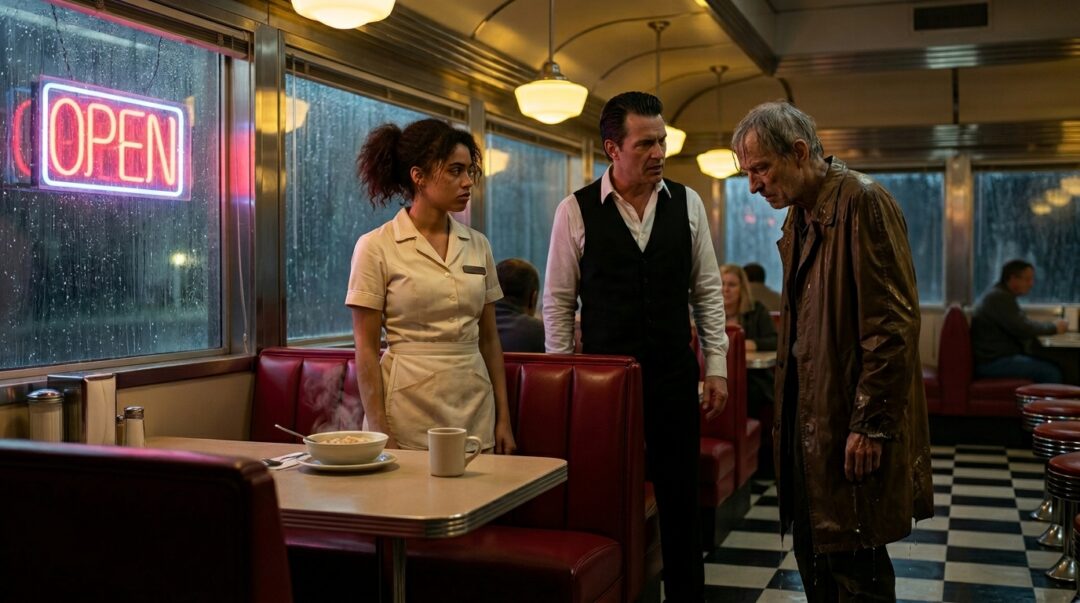
It was close to midnight, and the storm outside had turned the windows into sheets of trembling black glass. Rain ran down them so hard that the neon OPEN sign blurred into a pink-red smear. Inside, the diner glowed with tired warmth—yellow lights, polished chrome, cracked red booths, the smell of coffee that had been brewing too long and fries that had gone cold under heat lamps.
At the far end of the room, near the entrance, a man stood dripping onto the checkered floor.
His coat might once have been brown, but now it was the color of wet cardboard. One sleeve was torn at the wrist. Water ran from the hem and pooled around his shoes. He looked to be in his late sixties, maybe older, with a narrow face sharpened by hunger and cold. His hands shook so badly that he kept tucking them under his arms, as if trying to hold himself together.
And standing in front of him, one hand still on a tray, was Maren Cole.
“You served him food?” Brent snapped.
He did not lower his voice. That was the first cruelty.
Brent Holloway, the night floor manager, stood rigid in his black vest, his hair flattened back into place as if he feared even one strand might betray disorder. He had the kind of face that always looked offended by inconvenience, and at that moment he looked almost personally insulted by the old man’s existence.
Maren had placed a bowl of chicken soup and a mug of coffee in the empty booth by the window. Steam still curled off both. The scent of broth lifted into the warm air in pale ribbons. It should have been a small thing. A late-night kindness. A meal that would cost the diner almost nothing.
Instead it had become a scene.
“He was freezing,” Maren said.
She kept her voice calm, though her pulse had started to hammer. She was twenty-four, halfway through another double shift, her dark hair frizzing at the edges from the damp air every time the door opened. Her cream uniform shirt clung faintly at the wrists where she had rinsed dishes after the dishwasher jammed for the third time. She was tired enough to feel it in her teeth.
That did not matter to Brent.
“He can’t stay here.”
The old man lowered his eyes immediately, as if the sentence belonged to a language he had heard too often.
A truck driver at the counter turned slightly on his stool. A mother in a back booth stopped cutting pancakes for her little boy. Two college kids near the jukebox went very still, pretending not to stare while staring anyway.
Maren hated that part most. Not the anger. The watching.
She had grown up knowing what it was to be one unpaid bill away from becoming someone people looked at that way. Her mother had cleaned motel rooms off Highway 8 until her wrists swelled and her knees gave out. There had been winters when the landlord’s knock made Maren’s stomach clench so hard she thought she might be sick. She knew the expression on the old man’s face because she had seen versions of it all her childhood—on her mother, on men sleeping in cars behind the laundromat, on women counting change under fluorescent grocery lights.
It was the face of someone trying to make himself smaller before the world did it for him.
Brent glanced toward the windows as though worried the storm itself might be witnessing his inconvenience.
“Clear the table,” he said. “Now.”
The old man took one slow step back from the booth.
That was when Maren made the choice that changed everything.
Instead of lifting the tray, she set it down fully. Then she reached for the booth seat, pulled it out a little farther, and looked at the man—not over him, not around him, but directly at him.
“Sit down, sir.”
He blinked at her as though he had misheard.
Brent’s voice sharpened. “Maren.”
But she kept her hand on the booth and waited.
The old man looked from her to the soup, then to the floor. Shame moved across his face so clearly that it almost seemed physical. For one terrible second she thought he would turn and walk back into the rain.
Then, slowly, he sat.
The room did not exhale. It held its breath.
Brent stared at her, stunned not by the act itself but by the fact that she had done it publicly.
“You want to lose this job?” he asked.
Maren did not answer.
She slid the napkin closer to the bowl and noticed then how red the man’s knuckles were, how raw the skin across the back of his hands looked. He wrapped both palms around the mug before taking a sip, and even that simple motion had the reverence of prayer.
Outside, thunder rolled low over the highway.
Inside, something far more dangerous had begun.
Part II — Thin Ice
Maren had been on thin ice with Brent for weeks.
He never said it outright in front of customers, but she knew the list by heart because he liked to recite it when they were alone: too slow on refills, too soft with difficult customers, too willing to comp pie for widowers who reminded her of somebody’s father, too quick to stay past shift helping the dishwasher kid wipe down counters instead of clocking out exactly on time.
In Brent’s world, kindness was inefficiency wearing a smile.
The old man lifted the spoon, sipped the soup, and closed his eyes.
That tiny expression undid something in Maren’s chest.
Not because it was dramatic. Because it wasn’t. It was small, involuntary, and painfully human. The sort of relief a person only showed when he had been cold for too long.
Brent saw it too, and if it touched him at all, he buried it fast.
“This is a business,” he said, his voice lower now but no less hard. “You don’t get to turn it into a shelter.”
Maren straightened.
“It’s one bowl of soup.”
“It’s not about the soup.”
She knew that was true.
It was about appearances. About who belonged in a clean booth under soft yellow lights and who did not. About whether a paying customer’s comfort mattered more than someone else’s hunger. About whether compassion was acceptable only when it stayed invisible.
The mother in the back booth met Maren’s eyes for one brief second and then looked away. That hurt too, in its own way. Not judgment exactly. Something worse: relief that the decision was not hers to make.
The old man set the spoon down carefully, as though afraid even the sound might be too loud.
“I can go,” he murmured.
His voice was thin, almost papery.
Maren turned to him. “No.”
Just that one word. Soft, but certain.
Brent gave a short, incredulous laugh. “You’re serious.”
She was. More serious than she had been about anything all week.
The truth was, she had noticed the man almost twenty minutes earlier, standing under the awning beside the soda machine, not coming in, not leaving. Just standing there as rain bounced off the pavement and blew sideways across his clothes. Twice she had looked up from the register and found him still there, motionless except for shivering. By the third time, she had stopped pretending she could ignore him.
There were nights when the whole world seemed built to train people into looking away.
She had stepped outside with an umbrella and asked, “Would you like something hot?”
He had hesitated so long she had thought he might refuse. Then he had said, with visible effort, “Only if it won’t get you in trouble.”
That had been the moment that stayed with her. Not hunger. Not pride. The fact that he had measured his own need against a stranger’s risk.
Now Brent folded his arms and looked around the diner, making sure everyone understood that order had to be restored.
“This is your final warning,” he said. “Clear the booth, or you can clock out and not come back.”
A flush of heat rose along Maren’s neck.
She needed this job. Rent was due in six days. Her mother’s medication was waiting at the pharmacy because payday had not come yet. The transmission in her old Corolla jerked every time she accelerated uphill. She could not afford principle in the heroic, cinematic way people talked about online.
Real-life principle was uglier than that. It came with numbers attached.
For one sickening instant, Brent must have seen the calculation on her face, because his expression eased into something almost triumphant.
He thought he had won.
Then the old man tried to stand.
That was what decided it.
He pushed one trembling hand against the table edge and began to rise, every line of his body apologizing for the trouble of itself. Maren stepped forward so fast the coffee in the mug quivered.
“Please,” she said to him. “Don’t.”
Her voice broke on the last word.
Silence moved through the diner like a current.
The truck driver looked down into his coffee. One of the college kids swallowed hard. Brent’s face hardened again, because emotion made him uncomfortable when he could not control it.
“Maren,” he said sharply.
She turned to him then, really turned, and whatever he saw in her expression made him pause. She was not defiant in a dramatic way. She was exhausted. Frightened. Entirely aware of what this could cost her. And still she had not stepped aside.
That was when a chair scraped softly in the back of the diner.
It was such a small sound that no one would have noticed it on any other night.
But everyone noticed it then.
Part III — The Quiet Man at Booth Seven
The man who rose from Booth Seven had been there for almost an hour.
Most people in the diner had forgotten him the way people forget anyone quiet and well-dressed who keeps to himself. He wore a dark charcoal overcoat and had a newspaper folded beside his untouched coffee. Silver hair, neatly combed. Straight posture. A face lined not by softness but by restraint.
Maren had refilled his cup once. He had thanked her without looking up from the rain on the window.
Now he set one hand on the back of the booth, buttoned his coat with the other, and walked toward the front.
He did not hurry.
That, more than anything, changed the room.
Brent saw him and instantly adjusted his shoulders. It was a reflex so quick and obvious that Maren felt the first stir of confusion even before the man spoke. Brent, who treated everybody from delivery drivers to teenagers on first dates with the same brisk superiority, had just made himself smaller.
The old man at the booth froze, spoon halfway to the bowl.
The silver-haired man stopped beside Maren. Up close, he smelled faintly of cedar and rain. He took in the scene with one measured glance: the soaked coat, the steaming soup, Brent’s rigid stance, Maren’s white-knuckled hand resting against the edge of the table.
Then he looked at Brent.
“Why is she the only one acting human?”
No one moved.
The line did not need volume. It landed with the clean force of something precise and deserved.
Brent opened his mouth, then shut it. “Mr. Vale, I—”
Maren’s head turned sharply.
Mr. Vale.
She had seen that name once on framed photos in the hall near the office. Ellison Vale, owner of the diner and three others along the interstate. A man who never visited at predictable times and almost never announced himself when he did.
Brent recovered quickly, but not completely. “I was protecting the business.”
Ellison Vale glanced at the old man, then back at Brent.
“From what?”
The manager’s jaw tightened. “Customers don’t want—”
He stopped himself.
Didn’t want what? A poor man in wet clothes? A reminder that hunger existed five feet from a pie display? A waitress who cared more about decency than policy?
The unfinished sentence was answer enough.
Ellison’s gaze moved across the diner, not accusing, simply observant. The mother with the child. The truck driver. The two students. Every witness to the moment seemed to feel it: the room had become a mirror, and no one was entirely comfortable with what it showed.
Maren could hear her own heartbeat.
Ellison turned to her. “What’s your name?”
“Maren.”
“You brought him in?”
“Yes, sir.”
“Why?”
She could have said because he was cold. Because she had extra soup in the warmer. Because no one should have to ask permission to be treated like a person. Instead she told the plainest truth.
“Because he looked like no one had said yes to him all day.”
Something flickered in Ellison’s face then—not sentimentality, not surprise. Recognition.
The old man lowered his eyes again, but this time not from shame. It looked more like he was trying to hold something together inside himself.
Brent rushed to fill the silence. “With respect, sir, we have standards. We can’t just let anybody come in off the road and—”
“No,” Ellison said.
He did not raise his voice.
But Brent stopped.
“No,” Ellison repeated. “Standards are not what you use to protect people from discomfort. Standards are what you use to reveal character.”
The words settled over the room with the weight of finality.
Ellison stepped closer to the booth. For the first time, he addressed the old man directly.
“Please finish your meal.”
The old man nodded once, unable to speak.
Then Ellison reached toward Maren’s collar. She stiffened in surprise as he unclipped her name badge. Brent’s eyes widened, catching instantly on the gesture. A raw second of panic went through her. So this was it after all. Public correction, only performed more elegantly.
Then Ellison slid a different badge from his coat pocket.
He pinned it where the old one had been.
The metal caught the diner lights in a quick silver flash.
Shift Manager.
Maren stared at the words without understanding them.
“I’ve spent thirty years trying to figure out which employees know the difference between procedure and leadership,” Ellison said. “Most of the time, the answer comes when there’s nothing to gain.”
Her throat tightened so suddenly she had to swallow before she could breathe.
Brent went pale. “Sir, with all due respect—”
“No,” Ellison said again, and this time the single word ended everything.
He did not humiliate Brent further. He did not need to. The room had already seen enough.
The truck driver gave the smallest nod, almost to himself. The mother in the back booth smiled and brushed her son’s hair from his forehead. One of the students covered her mouth as if startled by how close she had come to crying over strangers in a diner.
Maren looked down at the badge one more time, then at the old man sitting before the steaming bowl.
Her hands were still shaking.
But now they were shaking for a different reason.
Part IV — Eat While It’s Hot
After that, the room seemed to breathe again.
Not all at once. Gradually. A fork lifted. A coffee cup clinked against a saucer. Rain kept beating against the windows, but inside the diner, the tension that had stretched every face thin began to loosen.
Maren slid the soup a little closer to the old man.
“Eat while it’s hot,” she said.
It was the simplest thing she had said all night, and somehow the most important.
His mouth trembled. “Thank you.”
Two words. Barely above a whisper. But they carried the ache of a man who had spent too long expecting doors to close.
Ellison inclined his head and returned to Booth Seven as quietly as he had left it. He did not linger to enjoy the effect of what he had done. That, Maren would remember later, mattered almost as much as the promotion itself. He had not rewarded her to perform goodness. He had recognized it and stepped back.
Brent retreated toward the office, his posture rigid enough to look fragile. She almost felt sorry for him. Almost. But pity and trust were not the same thing, and she knew some lessons only sounded noble when other people paid for them.
The rest of the shift passed in a strange, bright blur.
Customers who normally would have left exact change suddenly tipped generously. The truck driver asked for a second slice of pie and told Maren, without looking directly at her, that his mother had once worked nights too. The mother with the child stopped on her way out and squeezed Maren’s wrist lightly, saying, “My son saw everything. I’m glad he did.”
Near one in the morning, the old man finished his meal.
He ate slowly, carefully, as if he wanted to honor every bite. When he finally stood, he looked a little warmer, a little less transparent. He still wore the same torn coat. His life had not transformed in an hour. Rain still waited outside. Whatever had brought him to that doorway was still waiting too.
But something had changed.
Maren packed him two sandwiches and a slice of apple pie in a paper bag before he could protest. This time, no one tried to stop her.
At the door, he turned back. Under the neon spill from the sign, his face looked softer than when he had entered.
“My wife used to say,” he told her quietly, “that some people are a roof for five minutes. Long enough to keep the storm off.”
Maren felt tears press hot behind her eyes.
“I hope you find a better roof than this one,” she said.
He smiled—not broadly, but with a kind of weary grace—and stepped out into the rain.
The bell above the door jangled once, then settled.
By closing time, the storm had weakened to a cold mist. Maren wiped down the counter, stacked the mugs, and ran her thumb over the edge of the new badge as if it might vanish if she stopped touching it.
Shift Manager.
The words still felt unreal.
Ellison was waiting near the register when she clocked out.
“I didn’t do it for that,” she said before she could stop herself.
“I know,” he replied.
That answer undid the last of her restraint.
She laughed once, shakily, embarrassed by the sudden sting in her eyes. “I really thought I was about to get fired.”
“You might have,” he said. “In the wrong place.”
The honesty of that settled deeper than reassurance would have.
He studied her for a moment, then added, “The hardest thing to teach people is that a business is never only a business. Not when people walk into it hungry. Or grieving. Or ashamed. Or hoping not to be noticed. Someone always brings a life through the door with them.”
Maren thought of all the nights she had worked half-asleep, taking orders, pouring coffee, stacking plates, believing the real drama of other people’s lives happened elsewhere. She saw now how wrong that had been. Lives arrived in fragments. In coats wet from storms. In hands that shook. In little boys watching from booths. In managers deciding what mattered. In workers deciding what kind of person they would still be when no reward was promised.
“What if I’m not ready?” she asked quietly.
Ellison’s expression softened.
“Then you’re probably more ready than most.”
He left her with that and stepped into the misty dark.
Maren drove home just before dawn, the sky beginning to pale behind the gas stations and overpasses. Her Corolla coughed twice before the engine caught. On the passenger seat lay her apron, folded badly, and the old paper order pad she kept forgetting to throw away. Her hands ached. Her feet hurt. She still had rent to pay, bills to face, a mother to call before sleeping.
None of that had changed.
And yet the world felt fractionally different.
At a red light, she caught her reflection in the windshield—tired eyes, damp hair escaping its tie, cream uniform wrinkled from the shift, silver badge glinting near her collarbone.
For years, she had believed leadership was something handed down by people who already had power. A title. A key. A schedule clipboard. The right to tell other people what to do.
Now she understood something else.
Sometimes leadership began in the opposite place.
With risk.
With discomfort.
With choosing not to look away when it would be easier, safer, and smarter to do exactly that.
When she got home, her mother was asleep on the couch under a faded blanket, the television glowing soundlessly in the corner. Maren stood in the dim room for a long time without taking off her shoes.
Then she knelt beside the coffee table, pulled the pharmacy receipt from her pocket, and smiled to herself.
By afternoon, she would pick up the medication.
By tomorrow night, she would be back at the diner, this time opening the shift instead of simply surviving it.
There would be more hard choices. More people like Brent, in one form or another. More moments when kindness would look impractical. More nights when the storm outside seemed determined to make everyone inside a little less human.
But there would also be booths with hot coffee. Warm light on tired faces. Chances, small and easily missed, to become a roof for five minutes.
Years later, Maren would forget what song had been playing over the diner speakers that night. She would forget the exact amount on the old man’s bill, the color of the truck driver’s cap, whether the rain stopped before sunrise or after.
She would never forget the look on the old man’s face when she said he could stay.
And she would never forget the truth that followed it:
that dignity could be offered in a bowl of soup,
that cruelty often disguised itself as professionalism,
and that the people most worth following were usually the ones who chose kindness before anyone was watching.