What the Arena Remembered
Part I — The Envelope
The bull hit the gate so hard the bleachers flinched.
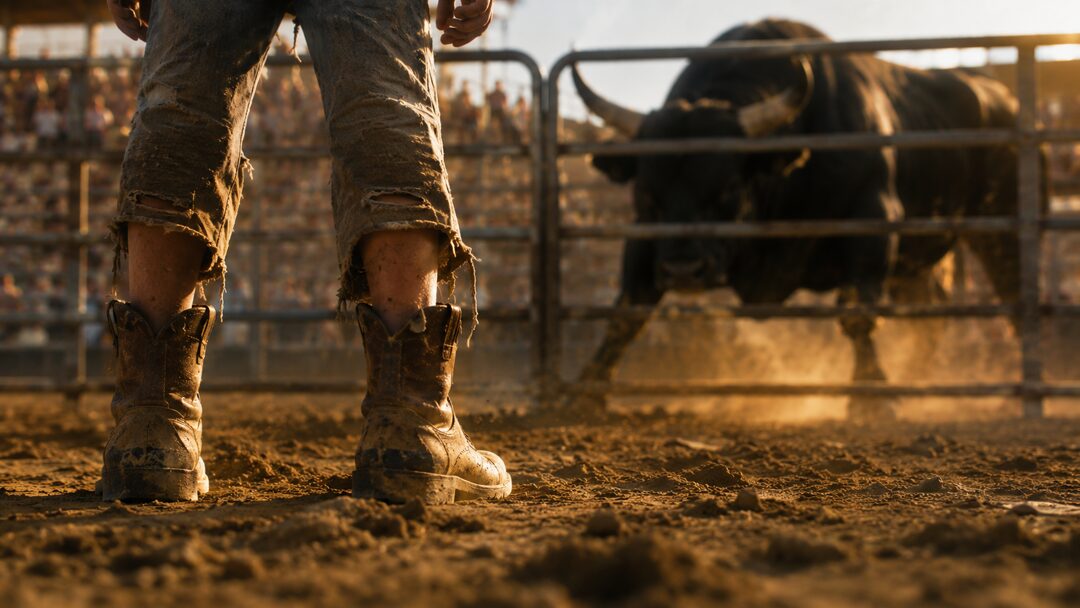
Dust burst up from the sun-baked arena floor, glowing gold in the late light. The massive black animal lowered its head again, horns cutting the air, shoulders rolling under hide like machinery built for rage. Behind the steel rails, grown men in cowboy hats laughed too loudly and held their beers too tight.
Then William stepped forward in a navy three-piece suit and lifted a brown envelope over his head.
“One hundred thousand dollars,” he called, “for anyone brave enough to face him.”
The crowd roared.
William smiled.
He always smiled when people were afraid.
He stood near the reinforced rail, polished boots planted in the dirt just long enough for every camera to catch him inside the arena. His white shirt was still clean. His tie did not move. Behind him, the bull slammed the chute again and sent a shudder through the metal.
William did not look back.
He knew exactly how far danger could reach.
“Come on,” he shouted, waving the envelope. “Where’s all that rodeo blood I keep hearing about?”
The crowd changed.
Laughter dipped into discomfort.
William heard it and pushed harder.
“Hundred grand,” he said. “Unless you’re all just cowards hiding behind your beers.”
Some men stood.
The bull rammed the gate again.
They sat.
The crowd laughed at them, then at itself, then at nothing.
In the third row, Mary tightened her fingers around her son’s sleeve.
“Don’t listen,” she said.
Joshua did not look at her.
He stared at William.
He was small for his age, all sharp elbows and sun-browned skin, with messy brown hair under an old hat that had once belonged to his father. His shirt was torn at the shoulder. His jeans were faded almost white at the knees. His scuffed cowboy boots barely reached the floor beneath the bleacher plank.
Around his neck, hidden under his shirt, a whistle rested against his chest.
His father’s whistle.
Mary knew the moment he touched it.
“Joshua,” she said.
He still did not look at her.
William lifted the envelope again. “No takers? Not one man here with the nerve?”
A few people booed. A few cheered. Most watched with the hungry unease of people waiting for someone else to be humiliated.
Mary leaned closer to Joshua.
“He’s selling noise,” she said. “That’s all.”
Joshua finally looked at her.
“Is that what he sold when Dad warned him?”
Mary’s face went still.
That was the problem with silence. You could use it to protect a child for years, and then one day the child grew old enough to hear everything inside it.
“Not here,” she whispered.
William’s voice cut across the arena again.
“Real courage doesn’t sit in the stands.”
Joshua looked down at her hand on his sleeve.
His mother’s knuckles were work-rough and pale from gripping him. On a chain beneath her shirt, she wore her old wedding ring because she had sold the gold band from her finger but refused to let it leave her body.
“Dad wasn’t a coward,” Joshua said.
“No.”
“Then why does everyone act like he was?”
Mary’s eyes shone, but she did not answer fast enough.
In the arena, William laughed into the microphone.
“That’s what I thought.”
Joshua slipped out of Mary’s grip.
For a second, she thought he was only standing.
Then he moved.
“Joshua!”
He vaulted the metal gate before anyone understood what he was doing.
The crowd gasped as his boots hit the dirt.
The sound rushed around the arena like wind changing direction.
William turned.
His smile dropped.
Part II — Anyone
Joshua landed badly, one knee buckling, but he caught himself and stood.
The arena looked wider from the ground.
The rails were higher. The bull was louder. The dust smelled of sweat, old hay, and sun-heated metal.
For a breath, the crowd laughed.
A boy had jumped into a man’s dare. A little ragged thing in torn clothes, standing in the dirt like courage could be inherited in a whistle and a pair of worn-out boots.
Then the bull slammed the chute again.
The laughter died.
William strode toward him, envelope still in one hand.
“Hey,” he shouted. “Kid, this ain’t a playground.”
Joshua did not move.
Someone from the rail yelled, “Get him out!”
William threw a glance toward the handlers. “Somebody grab him before he gets himself hurt.”
Joshua looked straight at him.
“You said anyone.”
The microphone caught it.
The words went thin and clear through the arena speakers.
The crowd went quiet.
William stopped.
“What?”
Joshua’s face was dirty, freckled, and still. His brown hair stuck to his forehead. He looked scared only if someone knew children well enough to see fear that had learned not to shake.
“You said anyone,” Joshua repeated. “Or were you lying?”
A few people made soft sounds.
Not laughter.
Recognition.
William looked around and saw the trap too late.
If he sent the boy out, he had lied.
If he let him stay, he was a monster.
He gave the crowd a smile, but this time it did not fit right.
“Listen, son,” he said, lowering the microphone. “This is grown-up business.”
Joshua’s eyes did not leave him.
“Was my dad grown-up enough?”
William’s face changed.
Only a little.
But Mary saw it from the rail as she fought her way down the aisle.
So did half the people who remembered Daniel Hayes.
Whispers began in the bleachers.
“That’s Mary’s boy.”
“Daniel’s kid?”
“Thought they moved away.”
“No, she works at the feed store.”
William’s grip tightened around the envelope.
Mary reached the rail and grabbed it with both hands.
“Joshua, come back now.”
He turned his head slightly.
For the first time since he jumped, he looked like a child.
“Mom—”
“Now,” she said.
William stepped closer to Mary, lowering his voice. The microphone still hung in his hand, but his thumb covered part of it.
“Get him out of there,” he said.
Mary looked at him through the rail. “You opened the gate with your mouth.”
His eyes hardened.
“Do not do this in front of my crowd.”
“Your crowd?” Her laugh was short and dry. “You already took enough from my family.”
The nearest spectators heard.
The whispering grew.
William looked at the bleachers, then toward the cameras mounted near the announcer booth.
Elizabeth stood beside the sponsor platform in a white rodeo-glam dress, blonde hair sleek under her hat, phone in hand. She was not looking at Joshua like a frightened woman.
She was looking at William like a publicist counting losses.
She touched her earpiece, spoke to someone, then started toward the rail.
Joshua saw her. He saw the way William checked her face before making his next move.
William lifted the envelope, forcing his smile back.
“All right,” he called to the crowd. “We’ve had our little moment.”
No one laughed.
Joshua said, “You don’t get to call it little.”
The line struck the arena harder than the bull.
Mary closed her eyes.
Because she heard Daniel in it.
Not his voice.
His steadiness.
Daniel had been steady too, right up until everyone called that steadiness panic.
William took another step toward Joshua.
The bull pawed behind the gate.
Dust rose.
Joshua’s hand moved to the whistle under his shirt.
William saw.
His eyes flicked down.
Then back up.
“What is that?” he asked.
Joshua pulled the whistle out.
The old silver thing caught the sun.
The whispers changed again.
Mary said, “Joshua, don’t.”
William’s face went almost blank.
He knew that whistle.
And for the first time all afternoon, the crowd saw William afraid of something smaller than the bull.
Part III — The Name No One Said
Elizabeth reached William before Mary could climb the rail.
“Smile,” Elizabeth said under her breath.
William did not look at her.
“Not now.”
“Yes, now.” Her voice stayed bright, her mouth barely moving. “Sponsors are watching. Cameras are watching. Get the kid out, blame the handlers, make the mother grateful.”
Mary heard enough.
“I know what grateful costs.”
Elizabeth turned toward her, polite as a blade.
“Mrs. Hayes, no one wants this to become uglier.”
Mary stared at her.
“Uglier than a grown man daring hungry people to risk themselves for money?”
Elizabeth’s eyes flicked to the crowd.
The microphone was still in William’s hand.
Michael, an old rodeo judge with a white mustache and a limp from a life spent too close to large animals, stood near the sound table. His hand moved slowly toward the control board, not to shut it off.
To keep it on.
Elizabeth noticed.
“Cut the arena mic,” she snapped at a young technician.
Michael stepped in front of him.
“Leave it.”
Elizabeth’s smile vanished. “This is not your event.”
“No,” Michael said. “But I was there the day Daniel died.”
The arena shifted again.
Mary’s face tightened at the name.
Joshua looked at Michael.
William said, “Nobody died here today, Michael. Let’s keep it that way.”
“Funny,” Michael said. “That’s almost what Daniel told you.”
William’s expression sharpened.
Elizabeth stepped between them. “This is not the place.”
Mary’s voice came through clear.
“It was never the place when it was my husband’s name.”
The crowd was silent now. Even the bull seemed to pause, head low, breath blowing dust under the chute rail.
William moved close to Mary, speaking softly enough to pretend mercy.
“Get your son out, and I’ll help you.”
Mary looked at the envelope.
He followed her eyes and opened it just enough to show the thick stack inside.
“Not all of it,” he said. “Enough.”
Joshua heard.
His hand closed around the whistle.
Mary’s face flushed, not with temptation alone, but with the shame of needing money badly enough that temptation had a shape.
Rent.
Boots.
Food.
The truck repair she kept delaying.
A winter coat Joshua had outgrown last year.
William saw her calculating.
That was his skill. Not bulls. Not courage. People. Their weak points. Their bills. Their grief.
Mary looked at the envelope for one second too long.
Then Joshua spoke.
“Is that how you paid for Dad?”
The arena did not breathe.
William turned slowly.
“What did you say?”
Joshua stood with the whistle hanging against his torn shirt.
“You bought everybody quiet then too.”
Mary gripped the rail. “Joshua.”
“No.” He looked at her, eyes burning now. “You said silence kept us alive. It didn’t. It just kept him ashamed.”
Mary flinched.
That hurt more than William’s offer.
Because it was not fully wrong.
William lifted the microphone again. “Ladies and gentlemen, this child has been fed a story he doesn’t understand.”
Michael stepped closer.
“Daniel Hayes told you that bull wasn’t ready for exhibition,” he said.
William swung toward him. “Careful.”
“He filed the warning.”
“There was no filed warning.”
Mary reached into the inside pocket of her denim jacket.
William saw the motion and went still.
Mary unfolded a plastic sleeve, creased from years of hiding.
Inside was a yellowed copy of a report.
No one in the upper bleachers could read it. They did not need to. William’s face read it for them.
Mary held it up.
“My husband wrote it the night before the show,” she said. “He said the animal was overworked, spooked, not safe for riders or handlers.”
William’s mouth tightened.
Elizabeth whispered, “Stop talking.”
Mary looked at her.
“No.”
It was a small word.
It sounded like a gate opening.
Mary turned back to William.
“You told him investors were coming. You told him rodeo men didn’t cry over rough stock. You told him real blood didn’t back down.”
Joshua’s eyes stayed on William.
“That’s what you said today.”
William’s face had gone hard now.
“That accident was investigated.”
“By men who liked your checks,” Mary said.
The crowd murmured.
Elizabeth stepped toward William. “Do something.”
William looked at Joshua in the dirt, Mary at the rail, Michael by the sound table, the crowd leaning forward, the envelope in his hand.
He was losing the story.
That frightened him more than the bull.
Then the gate behind Joshua clanged.
Everyone turned.
A handler shouted from the chute.
The bull surged forward.
Part IV — The Whistle
The gate had not opened all the way.
Not at first.
It jerked, caught, then gave with a scream of metal.
The bull exploded into the arena.
People screamed. The bleachers recoiled as if the animal had leapt into them. Dust swallowed the lower rail. The black bull came out hard, head low, shoulders pumping, hooves tearing the ground.
Joshua froze.
Mary screamed his name.
“Joshua!”
The sound ripped out of her, raw enough to tear every pretense from the arena.
William moved, then stopped.
For a fraction of a second, instinct and image fought inside him.
Elizabeth grabbed his sleeve.
“Don’t,” she hissed. “Let the handlers take it.”
Michael shouted, “Move, boy!”
Joshua did not run.
He lifted the whistle.
His hand shook now.
That mattered. He was not fearless. He was ten years old in an arena with a bull large enough to crush the breath out of the world.
But he lifted the whistle because his father had once sat him on a fence rail and said, “Bulls don’t understand pride, Josh. Only pressure. Space. Sound. Calm hands.”
Joshua had been five.
His father had placed the whistle in his palm.
“This doesn’t make you brave,” Daniel had said. “It reminds you to think before fear does.”
Now fear was everywhere.
In the crowd.
In Mary’s face.
In William’s frozen body.
In the bull’s charge.
Joshua put the whistle to his lips and blew.
Three notes.
Short. Long. Short.
The sound cut through the arena, thin and strange.
The bull did not stop.
But it changed.
Its head lifted. Its charge bent slightly left. The animal snorted, confused by a pattern older than this moment, older than William’s show, older than the lie.
Joshua backed one step.
Then another.
The bull swung wide, dirt flying from its hooves.
A barrel stood near the rail.
Too far.
William saw it at the same time Mary did.
This time, he moved.
He dropped the envelope in the dirt and ran into the open arena.
Elizabeth shouted after him, but her voice disappeared under the crowd.
William reached Joshua just as the bull turned again. He grabbed the boy around the waist and threw both of them behind the barrel. The bull thundered past so close its shoulder clipped the barrel and spun it half around.
Joshua hit the dirt hard but stayed conscious.
William landed beside him, breathing in ugly gasps, suit torn at one knee, dust across his white shirt.
For two seconds, no one moved.
Then the arena erupted.
Cheers.
Screams.
Cries.
Handlers rushed the bull toward the far rail. Michael shouted orders. Mary was climbing through the gate before anyone could stop her.
William pushed himself to his feet, staggering.
The cameras found him.
He found them back.
That old instinct returned like a trained dog.
He pulled Joshua upright by the shoulder and lifted one hand to the crowd.
The cheers swelled.
William’s mouth opened.
He was going to make it his.
The rescue.
The risk.
The story.
Joshua pulled away.
Not dramatically. Not with force.
Just enough.
William looked down at him.
Joshua’s face was streaked with dirt and tears he had not noticed falling. The whistle still hung from his neck.
“My father warned you,” Joshua said.
The microphone on the ground caught it.
The crowd quieted.
William’s raised hand lowered.
Joshua’s voice shook now, but it did not break.
“You called him a coward because he couldn’t answer back.”
Mary reached them then.
She dropped to her knees and grabbed Joshua’s face in both hands.
For a moment, she said nothing. She only checked his eyes, his arms, his chest, as if touch could count what fear had almost taken.
Then she stood.
Her hand stayed on Joshua’s shoulder.
William whispered, “Mary.”
She faced the crowd.
“My husband, Daniel Hayes, warned him,” she said. “William buried that warning. He let Daniel take the blame because a poor handler’s name was cheaper than his show.”
No one cheered now.
Mary’s voice carried over the arena, not loud, but clean.
“He bought silence then. He tried to buy mine today.”
Elizabeth stood near the rail, perfectly still.
Her phone hung at her side.
For once, she had no angle.
No caption.
No frame.
William looked at the envelope lying in the dirt.
So did everyone else.
The money was no longer a prize.
It was evidence.
Part V — What Courage Costs
The bull stood behind the far rail, breathing hard, no longer charging.
The crowd did not know what to do with itself.
Some booed William. Some shouted Mary’s name. Some sat silent, ashamed of how quickly they had laughed when the boy jumped the gate.
William bent and picked up the envelope.
His hand was shaking.
Dust clung to the navy fabric of his suit. One sleeve had torn at the cuff. He looked less like a promoter now and more like a man who had wandered into the truth dressed for a different event.
He walked toward Mary.
Elizabeth met him halfway.
“Don’t,” she said.
William looked at her.
She kept her voice low, but the microphones were still too near. “If you hand her that now, it looks like guilt.”
Mary laughed once.
A broken sound.
“It is guilt.”
Elizabeth’s eyes flashed. “You have no idea what you’re doing to him.”
Mary looked at Joshua, then back at Elizabeth.
“I know exactly what men like him do to boys like mine.”
Elizabeth’s face closed.
Whatever love she had for William lived inside limits. Sponsors. Cameras. Profit. Names on banners. Invitations. She could stand beside power when power looked clean.
She could not stand beside him covered in dirt with a dead man’s warning between them.
She stepped back.
William watched her go.
It hurt him.
Not enough to excuse him.
But enough for everyone to see that even his polished life had been a bargain.
He held the envelope out to Mary.
She did not take it.
“Keep your prize,” she said.
“It’s yours.”
“No,” Mary said. “It was never mine. It was bait.”
Joshua looked up at her.
Mary’s fingers tightened on his shoulder.
Then she reached out and took the envelope.
The crowd stirred.
William looked almost relieved.
Mary turned and handed it to Michael.
“Put it in Daniel Hayes’s name,” she said. “A fund for injured rodeo workers and their families. Every dollar public. Every donor public. Every report public.”
Michael took the envelope with both hands.
For a moment, his face bent under the weight of all the years he had said nothing because procedure was easier than courage.
“I’ll do it,” he said.
Mary looked at him.
“You’ll do it where people can see.”
Michael nodded.
William stood in front of them, breathing hard.
“I saved him,” he said.
The sentence came out small.
Maybe he meant it as defense.
Maybe as plea.
Mary looked at him for a long time.
“You were supposed to save the truth before a child had to stand in front of a bull for it.”
William had no answer.
Joshua touched the whistle.
His hand trembled again.
Mary saw and knelt in front of him.
“You don’t ever do that again,” she said.
His chin lifted. “But they heard.”
“I know.”
“Dad wasn’t a coward.”
“No.” Her voice cracked. “But you don’t have to become proof.”
That was the sentence that finally reached him.
Not William’s money.
Not the crowd’s respect.
Not even his father’s name.
His mother’s fear.
He had thought courage meant standing where everyone else was afraid to stand. Now, looking at Mary’s face, he understood that sometimes courage meant stepping back before the people who loved you lost everything again.
He nodded once.
Mary pulled him close.
He let her.
The crowd did not cheer.
Maybe they knew better now.
Maybe silence was the only honest thing left.
Together, Mary and Joshua walked toward the front arena gate.
Not the side exit near the workers’ pens.
Not the back path where poor families and injured riders disappeared.
The front gate.
People moved aside.
Joshua kept the whistle around his neck. His boots dragged in the dirt. His shoulders were still too small for what the day had asked of him.
Behind them, the bull stood calm behind the rail, sides heaving, black hide shining in the last gold of evening.
William remained alone in the arena, the crowd above him, the dirt under him, the empty space around him wider than before.
At the gate, Joshua stopped and looked back once.
Not at William.
At the bull.
Then at the arena that had finally said his father’s name without laughing.
Mary held out her hand.
Joshua took it.
They walked through the gate together, carrying no prize, no applause, and no easy victory—only the truth, which was heavier, and finally theirs.