The Names That Remained
Part I — Under the Noon Sun
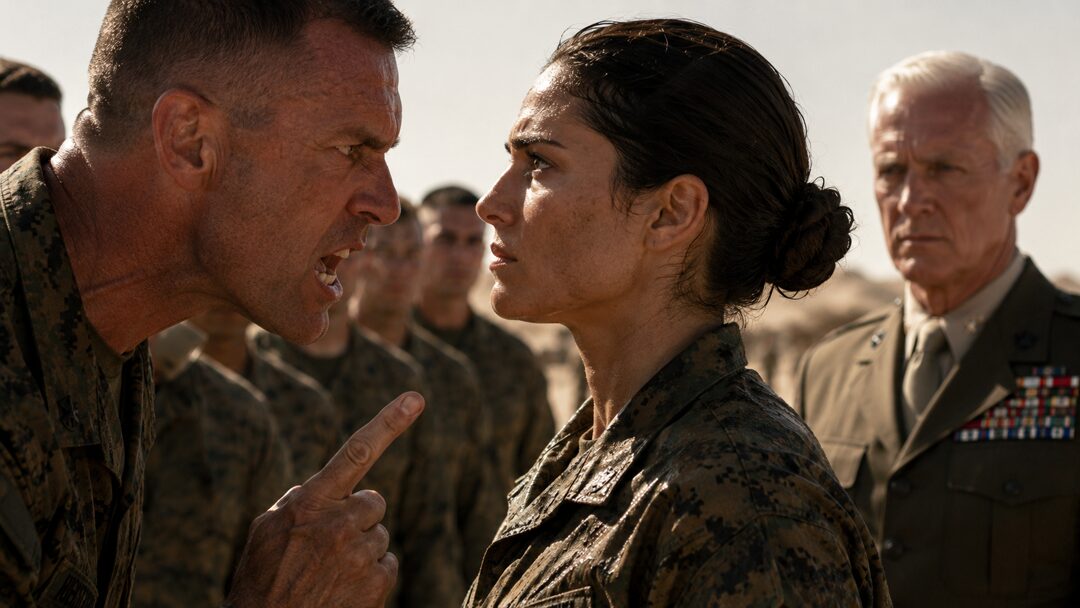
Master Sergeant Robert Hayes was close enough for Sarah Mitchell to see the pale line of an old scratch across his cheek when he shouted into her face.
“Sergeant Mitchell, I gave you a direct order.”
His voice cracked across the parade ground like a whip. Behind Sarah, forty soldiers stood frozen in formation beneath a white desert sky. Dust moved around their boots. Heat shimmered above the low buildings, the watchtowers, the distant brown mountains that looked close enough to touch and too far away to save anyone.
Sarah did not blink.
A bead of sweat slid from her temple to her jaw. Her dark hair, pinned tight at the back of her head, had begun to loosen at the edges. One strand clung to her cheek.
Hayes jabbed one finger toward her collar.
“You want to explain to this formation why you think the rules stop at your uniform?”
Sarah kept her eyes forward.
“No, Master Sergeant.”
“No?”
“No, Master Sergeant.”
The answer was calm. Too calm.
That was what made the younger soldiers nervous.
Private Emily Carter, third row, second from the end, felt her own fingers twitch against her trouser seam. She had seen Hayes tear into people before. Everyone had. Hayes did not shout because he was out of control. He shouted because he knew exactly where control lived and how to drag a person toward it.
Most soldiers cracked somewhere.
Their chin moved. Their eyes watered. Their shoulders tightened.
Sarah Mitchell did none of those things.
She stood in front of him as if she had arrived at this moment hours ago and had been waiting for everyone else to catch up.
At the edge of the parade ground, Colonel William Grant watched without moving.
He was the reason for the inspection.
White hair. Perfect posture. Polished boots that looked wrong in the dust. His uniform seemed untouched by heat, as if even the desert understood rank. Two officers stood behind him with clipboards and the thin, nervous faces of people who had been told not to ask questions.
The order had come down just after breakfast.
Uniform compliance. Identification verification. Unauthorized marking review.
The words had sounded boring enough that most of the platoon had groaned privately and lined up anyway. Sleeves checked. Collars checked. Boots, tags, undershirts, old scars, visible tattoos. The kind of inspection that made people feel less like soldiers than equipment.
Then Sarah Mitchell had said no.
Not loudly. Not dramatically.
Just no.
Hayes had given her a second chance.
She had said it again.
That was when the formation went silent.
Now Hayes leaned closer, his jaw hard.
“You are a decorated noncommissioned officer,” he said. “You know better than anyone what happens when one soldier decides she is above inspection.”
Sarah’s expression did not change.
“I’m not above inspection.”
“Then remove the top layer.”
“No, Master Sergeant.”
Emily heard someone behind her draw in a breath.
Grant’s eyes narrowed.
Hayes took half a step back, not because he was retreating, but because he wanted the whole platoon to see him looking at Sarah. He wanted her defiance placed under the sun.
“Look at me.”
Sarah did.
For one brief second, the fury in Hayes’s face seemed to meet something in hers that had no temperature at all.
Then she said, quietly enough that only the first two rows heard it, “Ask the colonel what Ghost Compass was.”
The words moved through the formation without anyone repeating them.
Ghost Compass.
Emily did not know what it meant.
But she saw Hayes hear it.
His anger did not vanish. It changed shape.
His mouth stayed hard, but something behind his eyes shifted, as if Sarah had opened a door in a building he thought had been sealed for years.
At the edge of the parade ground, Colonel Grant’s chin lifted a fraction.
That was all.
But Sarah saw it.
So did Hayes.
And once Emily saw both of them see it, the inspection stopped feeling like an inspection.
It felt like a trap someone had stepped into without knowing who had set it.
Part II — The Private Room She Refused
Hayes lowered his voice.
“Mitchell.”
The word came out differently now. Not soft. Never soft. But no longer meant for the whole formation.
Sarah kept her hands at her sides.
“Step out. We’ll handle this inside.”
Grant’s gaze sharpened.
The officers behind him looked down at their clipboards.
Sarah’s eyes stayed on Hayes.
“That is what he wants.”
The words were quiet, but Hayes flinched as if she had shouted them.
He moved closer again, blocking most of her from the platoon. To anyone farther back, it might have looked like the dressing-down was continuing. Emily could see the difference. Hayes’s shoulders had tightened. His anger had found an obstacle it had not expected.
“You are close to throwing away your career,” he said.
Sarah’s lips moved into something almost like a smile.
“No, Master Sergeant. I did that three years ago.”
Hayes’s face darkened.
“Don’t play games with me.”
“I’m not.”
“Then tell me what this is.”
Sarah glanced past him, toward Grant.
“He knows.”
Grant finally stepped forward.
Not far. Only enough to make every soldier on the parade ground aware that a colder authority had entered the heat.
“Master Sergeant Hayes,” Grant said, “remove Sergeant Mitchell from formation.”
His voice was clean. Paper clean. The kind of voice that never sounded cruel because it never sounded personal.
Hayes turned halfway.
“Sir, if there is a concern regarding—”
“The concern is insubordination.”
Sarah’s jaw tightened for the first time.
Grant noticed.
A faint satisfaction touched his face and disappeared.
“Sergeant Mitchell was given a lawful order during a scheduled inspection. She refused. Remove her.”
Hayes looked back at Sarah.
She had trained younger soldiers on this base for eleven months. She ran with them before dawn. Corrected their grip. Taught them how to breathe when the world got loud. When one of them froze in the obstacle pit, she did not call him weak. She climbed down, stood beside him, and said, “Fear is information. It is not an order.”
Emily had heard that line and carried it like a coin in her pocket.
Now Sarah stood under the same pressure she had taught them to survive.
Only this time, she was not trying to survive it quietly.
Hayes spoke through his teeth.
“Last chance. We go inside. You comply. This doesn’t become what you’re trying to make it.”
Sarah looked at him then, really looked.
“For years, every room I entered made it smaller.”
Hayes did not answer.
Sarah lifted both hands to her collar.
The movement rippled through the formation.
Emily’s breath caught.
Grant’s voice cut across the dust.
“Sergeant Mitchell, stop.”
Sarah did not.
Her fingers were steady as she unfastened the top button of her uniform jacket. Then the next. The fabric had darkened with sweat along her throat.
Hayes stared at her hands.
“Mitchell.”
She ignored him.
The jacket loosened.
The desert wind slipped beneath the collar and lifted the edge.
Hayes stepped behind her, not touching her yet, caught between stopping her and witnessing what he had helped bring into the open.
Sarah’s face was calm again.
Not empty.
Calm.
The kind of calm that did not mean nothing mattered.
The kind that meant everything did.
“Sergeant,” Hayes said, quieter now, “you don’t have to do it like this.”
Sarah’s fingers paused.
For a second, Emily thought she might stop.
Then Sarah said, “That’s what they said when they took their names off the wall.”
Hayes’s eyes flicked to Grant.
The colonel’s expression had gone flat.
Not confused.
Not surprised.
Flat.
Sarah pulled the jacket open.
Grant said, “Remove her now.”
No one moved.
Sarah slid the fabric down over her shoulders.
The formation forgot how to breathe.
Part III — The Wolf in the Compass
At first, all Emily saw was skin.
A bare back under the sun. Muscles held tight. Shoulder blades sharp with restraint.
Then the image resolved.
Across Sarah Mitchell’s back, from the top of her shoulders to the center of her spine, a wolf stared out from a circle of dark ink.
It was not decorative.
It did not curl prettily across her skin. It faced the world head-on, its eyes fixed and furious, its muzzle cut in black and gray shadows. Around it, a compass ring spread outward in precise lines. North, south, east, west. Thin arrows. Broken barbed-wire patterns. Narrow marks that ran down her spine like a path no one could walk twice.
Beneath the compass were seven empty spaces.
Not names.
Spaces.
That was somehow worse.
The tattoo looked like a monument built where monuments were not allowed.
The parade ground went dead quiet.
Even the flag rope near the administration building stopped tapping for a moment, or maybe Emily only imagined that because every other sound had become too large: the wind, the heat, the swallowed breaths of soldiers who suddenly understood they were not watching a uniform violation.
Hayes stood behind Sarah, close enough to see the lower edge of the compass.
His mouth parted.
The anger left his face so completely that what remained looked almost naked.
He whispered one word.
“Compass.”
Sarah’s shoulders rose once with breath.
Grant moved fast then.
“Cover yourself, Sergeant.”
Sarah did not.
“Now.”
The command snapped across the ground, but it did not land the way Hayes’s voice had landed. Hayes’s fury had weight. Grant’s order had polish. Under the heat, polish began to look thin.
Hayes stared at the tattoo, at the seven blank spaces.
“I trained two men,” he said slowly. “For a border recon attachment. They shipped out under a temporary designation. I asked where they went after.”
Grant said, “Master Sergeant.”
Hayes did not look at him.
“I was told there was a navigation failure.”
Sarah’s voice was low.
“There wasn’t.”
“I was told their team leader broke route.”
Sarah closed her eyes.
Only for a moment.
When she opened them, she was looking straight ahead again, not at Hayes, not at Grant, not at the soldiers.
“Say her name if you’re going to accuse her.”
Hayes frowned.
“Whose?”
“The team leader.”
Grant cut in. “This is enough.”
Sarah turned slightly, not enough to face them, only enough to let her voice carry.
“Captain Lisa Morgan.”
Hayes went still.
He knew that name.
Emily saw it hit him. Not as information. As memory.
Some names did not enter a room.
They returned to it.
Grant’s face hardened.
“Captain Morgan’s final report is classified.”
Sarah laughed once.
It was not loud.
It was not happy.
It was the smallest sound on the parade ground and somehow the sharpest.
“You classified a woman after you blamed her.”
The younger soldiers shifted, barely. Boots moved against dust. Someone in the back swallowed hard.
Hayes looked from Grant to Sarah.
“What is Ghost Compass?”
Grant answered before Sarah could.
“An unauthorized morale symbol associated with a failed attachment. Nothing more.”
Sarah reached over one shoulder, fingers brushing the edge of the compass ink.
“Authorized at departure. Deployed under sealed orders. Erased after recovery.”
Grant’s voice stayed level.
“You are misrepresenting events you were in no condition to understand.”
Sarah nodded once.
“I was in good enough condition to bury the ration box.”
The officers behind Grant looked up.
Hayes’s eyes narrowed.
“What ration box?”
Sarah’s mouth tightened.
For a moment the parade ground fell away from her, and she was somewhere colder than this heat.
A dark pass. Wind that smelled of metal and dust. Seven people sharing one dull pencil. The youngest among them, barely old enough to grow a beard worth shaving, drawing a wolf inside a compass on the back of a flattened ration box because someone had joked they needed a unit patch if command was going to keep pretending they did not exist.
Not a long memory.
Just one image.
A boy grinning with chapped lips, saying, “If we get out, Sergeant, you have to get it for real.”
Sarah had told him, “If we get out, you can get it yourself.”
He had laughed.
That was the part that still punished her.
The laugh.
Hayes’s voice pulled her back.
“Mitchell.”
Sarah opened her eyes.
“The design was drawn the night before the pass,” she said. “By Private Anthony Reed.”
Emily heard the name and felt it settle somewhere under her ribs.
Anthony Reed.
A real person, then.
Not an operation. Not a rumor.
A person who had drawn a wolf because people facing fear still make jokes, still make promises, still imagine afterward.
Grant’s lips thinned.
“Sergeant Mitchell is exploiting deceased personnel to excuse misconduct.”
The sentence was so neat it made Emily sick.
Sarah turned then.
Slowly.
Her jacket hung low on her arms. Her undershirt had been pushed down beneath the tattoo’s reach, enough to reveal the whole mark but not enough to make the moment shameful. She faced Grant with her shoulders bare and her chin level.
“I survived,” she said. “That is not the same as misconduct.”
Grant’s nostrils flared.
Hayes looked at her as if the person in front of him had become larger and more difficult to understand.
“You were blamed,” he said.
Sarah’s eyes moved to his.
“I was useful to blame.”
Part IV — The Order Beneath the Order
Grant took three steps forward.
That was all it took to remind everyone that he could still ruin the day, and perhaps more than the day.
“Master Sergeant Hayes,” he said, “you will detain Sergeant Mitchell for refusal to comply with inspection standards and conduct prejudicial to good order.”
Hayes did not answer.
Grant’s voice sharpened.
“That was an order.”
The word order moved through the formation like a hand closing.
Sarah had spent years obeying orders. Orders to move. Orders to wait. Orders to leave behind equipment, then vehicles, then bodies if recovery endangered the living. Orders phrased by men far from the pass. Orders that sounded clean until someone had to carry them.
She knew what an order could hide inside it.
Hayes knew too, though maybe he had forgotten.
Emily watched him from the third row. His face had changed again. Not soft. Not gentle. Something worse for a man like him.
Uncertain.
Grant saw it and moved to crush it.
“Master Sergeant, your personal curiosity is irrelevant.”
Hayes looked at Grant.
“With respect, sir, if she’s making a formal allegation—”
“She is making a spectacle.”
Sarah’s voice cut in.
“No. You made the spectacle.”
Grant turned on her.
“You were given every opportunity to handle this appropriately.”
Sarah’s gaze did not drop.
“Appropriately meant privately.”
“Yes.”
“Privately meant buried.”
Grant’s jaw worked once.
Hayes looked at the seven blank spaces beneath the compass.
He had trained two men who disappeared into that word: failed. It had been easy, then, to accept the report. Soldiers failed. Missions failed. Weather failed. Equipment failed. Whole lives could be folded into one sentence if the sentence sounded official enough.
He remembered one of those men laughing at the range after missing three targets in a row, then staying two hours late until he hit all of them clean.
Joseph Barnes.
Hayes had not thought the name in years.
He felt ashamed of how easily it came back.
“Who were the seven?” he asked.
Grant’s head snapped toward him.
“Master Sergeant.”
Sarah did not answer immediately.
Her eyes stayed on Hayes.
“Are you asking because you want to know,” she said, “or because you need me to say enough for him to punish?”
Hayes absorbed that.
The question landed harder than the shouting had.
Emily saw his throat move.
Sarah took one breath, slow and measured.
Then she said the line that changed the air.
“Are you giving an order, Master Sergeant, or hiding behind one?”
No one moved.
Not Grant.
Not the officers.
Not the platoon.
Even Hayes seemed to stop inside his own skin.
For a few seconds, the base became only heat and waiting.
Grant spoke first.
“Enough. Sergeant Mitchell, you are relieved from formation.”
Hayes turned fully toward him.
“Sir, I need clarification.”
Grant’s eyes cooled.
“You need to obey.”
Hayes stood in the space between Sarah and Grant, broad back rigid, hands at his sides.
For years, he had taught soldiers that discipline was doing what needed to be done when fear made it inconvenient. He had believed that. Built his life around it. Used it as a blade and shield.
Now the blade was in his hand, and for the first time he could see who it was pointed at.
He looked at Sarah.
She was not asking him to save her.
That was the worst part.
She was asking him to decide what kind of witness he was willing to be.
Hayes turned his head toward the formation.
“Platoon,” he barked.
Every spine straightened.
Grant’s face eased for half a second, mistaking volume for obedience.
Hayes said, “Stand fast.”
The words struck the ground.
Grant froze.
Sarah’s eyes lifted.
Hayes stepped beside her.
Not behind.
Beside.
The movement was small, but everyone saw it.
Grant said, “Master Sergeant, you are exceeding your authority.”
Hayes did not look away from the soldiers.
“Base recorder,” he called.
One of the officers behind Grant went pale.
Hayes raised his voice.
“Bring it forward.”
No one moved.
Then Emily saw a corporal near the administration line glance at Grant, then at Hayes, then at Sarah.
He stepped out with a tablet in his hand.
Grant’s voice turned dangerous.
“This is not a proceeding.”
Hayes looked at him then.
“No, sir. It’s an inspection.”
The silence after that was different.
It had teeth.
Part V — Seven Spaces
The corporal held the tablet as if it had become too heavy.
Hayes faced Sarah.
His voice, when he spoke, was formal enough to bruise.
“Sergeant Mitchell, identify the marking displayed.”
Sarah’s hands closed once around the sleeves hanging at her elbows.
For the first time all morning, Emily saw her hesitate.
Not from fear of Grant.
From the weight of permission.
Some doors are terrible because they are locked.
Some are worse when they open.
Sarah looked across the formation. Rows of young faces. Dust on cheeks. Sun in eyes. Men and women trying not to stare at her exposed back and failing, then realizing the shame was not hers.
Her gaze stopped briefly on Emily.
Emily did not know what to do, so she did the only thing that felt right.
She stood straighter.
Sarah turned back to Hayes.
“The mark is the Ghost Compass field design,” she said. “Drawn by Private Anthony Reed. Intended as a unit emblem for Reconnaissance Attachment Seven.”
Grant stepped forward.
“That designation is not recognized.”
Hayes did not turn.
“Let her finish.”
Grant’s face flushed.
Sarah continued.
“The wolf was the call sign. Not mine. The unit’s.”
She swallowed.
The first crack in her voice was small, but everyone heard it because everyone was listening now.
“We held North Pass for nine hours after extraction was denied.”
Grant said, “That is a classified operational matter.”
Sarah looked at him.
“You classified the denial. Not the courage.”
Hayes’s eyes lowered.
The line hit the formation with a force no shout could have carried.
Sarah turned slightly toward the recorder.
“Captain Lisa Morgan.”
The name went into the tablet.
“Staff Sergeant David Keller.”
A gust of wind moved dust across the boots of the front row.
“Sergeant Joseph Barnes.”
Hayes closed his eyes for half a second.
Emily saw it.
“Corporal Michelle Price.”
Sarah’s fingers tightened in the fabric of her sleeves.
“Specialist Daniel Brooks.”
Grant’s mouth formed the beginning of another interruption, then stopped when Hayes looked at him.
“Private Anthony Reed.”
The youngest.
The one with the pencil.
Sarah breathed in.
The seventh name cost more.
Everyone could see it coming before she said it.
“Specialist Karen Holt.”
The last name left her mouth like something pulled free.
For a moment, the whole parade ground held those seven people.
Not as report language.
Not as failed attachment.
Not as problem.
People.
Grant’s voice, when it came, was quieter than before.
“Sergeant Mitchell was not authorized to disclose—”
Hayes cut him off.
“Statement received.”
Grant stared at him.
Hayes held out his hand for the tablet.
The corporal hesitated, then gave it to him.
Hayes read the screen. His face revealed nothing. Then he added his own name as witness.
Robert Hayes.
His thumb hovered before he signed.
That pause was short.
But Sarah saw the cost of it.
So did Grant.
So did Emily.
Hayes pressed his thumb down.
The tablet chimed softly.
Such a small sound.
Too small for what had just happened.
Grant looked at Hayes as if seeing a piece of equipment fail in perfect weather.
“You understand there will be consequences.”
Hayes handed the tablet back.
“Yes, sir.”
Grant looked at Sarah.
“You will cover yourself.”
This time, Sarah did.
She pulled the uniform jacket back over her shoulders. The wolf disappeared beneath regulation fabric, but not the way it had been hidden before.
Everyone had seen it now.
That changed the weight of the cloth.
She fastened only the middle buttons. The collar remained open.
Hayes noticed.
He said nothing.
Grant turned away first.
That was how everyone knew he had lost something.
Not power.
Not yet.
But control.
Part VI — What the Formation Carried
Sarah was removed from inspection before noon.
No one clapped.
No one cheered.
No one made the moment cheap by pretending it was over.
Two officers escorted her toward the administration building while Grant walked ahead, already speaking in a low voice to someone on a secure line. Damage control had a posture. It leaned forward, spoke softly, and never looked back.
Hayes remained on the parade ground.
For several minutes, he said nothing.
The platoon stood under the sun with the knowledge of seven names pressing against them. Emily felt them arranging themselves inside her memory in the order Sarah had spoken them.
Lisa Morgan.
David Keller.
Joseph Barnes.
Michelle Price.
Daniel Brooks.
Anthony Reed.
Karen Holt.
She was afraid she would forget one.
That fear surprised her.
An hour ago, she had been afraid of being noticed.
Now she was afraid of failing people she had never met.
Hayes finally turned to the formation.
“Inspection continues at thirteen hundred,” he said.
His voice was rougher than before.
No one answered.
He looked across their faces.
“Dismissed.”
The soldiers broke formation slowly, as if movement itself needed permission. No one spoke at first. Then whispers started, scattered and low.
“What was that?”
“Did you see—”
“Ghost Compass?”
“Don’t say it too loud.”
Emily stayed where she was.
Hayes saw her.
“What is it, Carter?”
She almost said, Nothing, Master Sergeant.
The old answer.
The safe answer.
Instead, she said, “Sir… were they heroes?”
Hayes looked toward the administration building where Sarah had disappeared.
For a long moment, he did not speak.
Then he said, “That depends who gets to write it down.”
Emily thought about that all afternoon.
At the memorial ceremony, the formation was supposed to be perfect.
That was the word used in the schedule.
Perfect.
The parade ground had been swept. The flag line tightened. The chairs arranged for visiting officers. Grant appeared again in immaculate dress, his expression disciplined back into place. If the morning had shaken him, he had buried it beneath procedure.
Sarah was not in formation.
Emily searched for her anyway and found her at the far edge of the parade ground, near the shadow of the equipment shed.
Jacket on.
Collar open.
Hands clasped behind her back.
She was not smiling.
Not yet.
Hayes stood at the front of the platoon. He had a printed formation chart in one hand. Emily watched his thumb move once over the paper, then stop.
Grant approached him.
Their conversation was too quiet to hear.
Grant’s face stayed still.
Hayes’s did too.
Then Hayes turned back to the platoon.
“Adjust formation,” he said.
The soldiers looked at one another.
Hayes pointed.
“Leave a space in the first rank.”
A pause.
“Second rank, leave one.”
Grant’s head turned sharply.
Hayes continued.
“Third. Fourth. Fifth.”
By the time he finished, seven empty spaces cut through the formation like invisible people standing where they had always belonged.
No one explained it.
No one needed to.
Grant stared at the gaps.
He could have stopped it.
Maybe.
But stopping empty spaces required saying what they were.
For once, silence did not serve him.
The ceremony began.
An officer read from a prepared page about service, duty, sacrifice, commitment. The words were polished and broad. They floated above the parade ground without touching the earth.
Emily barely heard them.
She was looking at the empty space beside her.
There was no one there. Of course there was no one there.
But she found herself standing as if someone were.
When the officer paused before the final salute, Emily whispered the first name before she could lose courage.
“Lisa Morgan.”
The soldier beside her glanced over.
Emily stared forward, heart hammering.
Then, from somewhere behind her, another voice whispered, “David Keller.”
A third voice, low and uncertain: “Joseph Barnes.”
The names moved softly through the formation.
Michelle Price.
Daniel Brooks.
Anthony Reed.
Karen Holt.
Not loud enough to become rebellion.
Not quiet enough to disappear.
At the edge of the parade ground, Sarah Mitchell heard them.
Her eyes closed.
Only for a second.
When she opened them, Hayes was looking at her from the front of the formation.
He did not nod.
She did not nod back.
Some things become smaller when acknowledged too directly.
The salute was called.
Hands rose.
Seven spaces remained.
Sarah stood at the edge, collar open to the desert air, the wolf hidden beneath her jacket and somehow more visible than it had ever been.
Then, at last, she smiled.
It was faint.
It did not forgive everything.
It did not return anyone.
But it carried the names across the heat, past the clean speeches, past the polished boots, past the place where silence had once been mistaken for honor.
And this time, she was not carrying them alone.