The Song in the Blue Room
Part I — The Boy at the Door
Richard Whitman was telling four hundred people how much he understood the pain of waiting when the service doors opened behind the dessert tables.
At first, no one turned.
The Waldorf ballroom was too bright, too warm, too full of crystal and perfume and practiced sympathy. Waiters moved like shadows with silver trays. Donors in black tuxedos and satin gowns held champagne flutes and nodded at Richard as if grief itself had been elegantly catered.
Then a security guard said, “Sir, you can’t be in here.”
The room shifted.
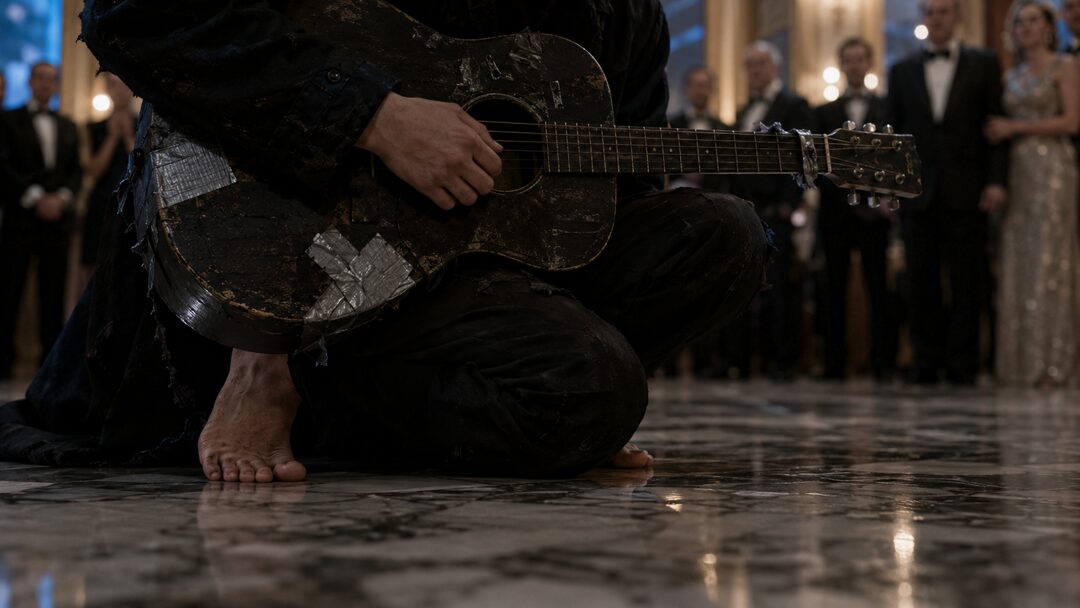
A teenage boy stood under the gold-trimmed archway, soaked from the May rain. His black coat hung off his shoulders like it belonged to someone larger. His hair was dark and wet against his forehead. His feet were bare on the marble.
In one hand, he held an old acoustic guitar patched along the side with a strip of silver tape.
Richard stopped speaking.
For half a second, the microphone carried only his breath.
Then the first whisper moved through the ballroom.
“Is he part of the program?”
“He’s barefoot.”
“Where are his shoes?”
Elizabeth Whitman, standing three steps behind Richard in pale satin, lowered her champagne glass. Her smile remained in place, but her fingers tightened around the stem.
The boy did not look at the guests.
He looked at Richard.
Not with fear. Not with pleading.
With patience.
That was what made Richard uneasy first.
The guard held the boy by the elbow. “He came in through the kitchen, Mr. Whitman. We’ll take care of it.”
Richard’s face hardened in the way everyone in the room knew and admired. It was the face that had closed deals, ended boardroom arguments, made weaker men apologize before they understood why.
He glanced at the boy’s guitar.
Then at the donors.
A small laugh escaped him, polished enough to pass as charm.
“Well,” Richard said into the microphone, “it seems our mission has found us tonight.”
The room gave a light, relieved laugh. Not because it was funny. Because Richard had shown them how to respond.
The boy said nothing.
Richard stepped down from the small stage. His shoes clicked against the marble. The boy’s bare toes curled slightly against the cold floor.
“What’s your name?” Richard asked.
The boy only looked at him.
Richard’s smile thinned. “No name?”
Silence.
A few donors leaned closer, hungry in that careful way wealthy people became when discomfort could still be mistaken for entertainment.
Richard turned back toward the room.
“Let him stay,” he said. “If he can play one good song, the foundation will find him a bed tonight.”
Elizabeth moved slightly. “Richard.”
He did not look at her.
“One song,” he said to the boy. His voice dropped, but the microphone still caught enough. “Play well, you eat. Play badly, and you go back to wherever you came from.”
A woman near the auction table gave a small laugh, then covered it with a cough.
The boy absorbed it without blinking.
That was the second thing Richard noticed.
Most people Richard humiliated tried to repair the room afterward. They smiled too hard. They explained. They begged without calling it begging.
This boy did none of that.
He simply walked past the guard, crossed the polished floor, and lowered himself to one knee beneath the chandelier.
The guitar looked ridiculous in that room. Cheap wood under million-dollar light. Silver tape against white orchids. Rainwater marking the marble beneath him in small dark prints.
Richard folded his arms.
“Whenever you’re ready.”
The boy ran his thumb across the strings once.
The first sound was soft.
Too soft, almost. Several people turned back toward their conversations, already bored by compassion now that it had no script.
Then the second phrase came.
Richard’s expression changed before anyone else understood why.
His mouth parted slightly.
Elizabeth went still.
The boy played with his head bowed. The melody was delicate, uneven in places, unfinished in a way that made it feel more private than beautiful. It was not a song made for stages. It was the kind of tune someone hummed in a dark room to make a child believe the world was smaller than it was.
Richard took one step back.
The microphone in his hand lowered.
A donor near the front whispered, “Isn’t that…”
Her husband touched her arm.
On the far wall, screens still displayed the gala’s slogan in gold letters:
BRING THEM HOME.
The boy kept playing.
Richard’s face drained of color.
“Stop,” he said.
The boy did not stop.
“Stop playing.”
The last note trembled in the ballroom and disappeared into the chandelier light.
No one laughed now.
Richard stared at the boy as if the marble floor had opened.
“Where did you hear that?” he asked.
The boy lifted his head.
His eyes were gray, or maybe the light made them seem that way. Hollowed by exhaustion. Sharper than a hungry boy’s eyes should have been.
Elizabeth’s glass slipped half an inch in her fingers.
Richard’s voice dropped to something rawer.
“That song was never published.”
The boy held the guitar close.
Richard swallowed.
“I wrote that for my son.”
The room seemed to lean forward.
The boy’s answer was quiet enough that only those closest heard it.
“You never finished it.”
Part II — One Good Song
Richard moved before the murmurs could become words.
He handed the microphone to the nearest board member, gripped the boy’s upper arm, and guided him toward the side corridor with a force that looked almost gentle from a distance.
Elizabeth followed.
Two security guards came too, but Richard snapped, “Not you.”
The door closed behind them.
The ballroom noise softened to a golden hum.
In the private salon, everything was smaller and colder. A marble fireplace. Green velvet chairs. A table with untouched pastries and bottled water. On the wall hung framed photographs of children found through the Whitman Foundation—smiling children, grateful parents, safe endings arranged in tasteful black frames.
Samuel looked at them once and then looked away.
Richard released him as if the contact burned.
“Who are you?”
The boy rubbed the place where Richard’s fingers had been. “You asked me that already.”
“Answer me.”
Elizabeth shut the door with careful quiet. “Richard, he could have seen an interview. Years ago, you hummed a little of it on that morning show.”
“I hummed two notes,” Richard said.
“Enough for a fraud with a good ear.”
The boy looked at her then.
Elizabeth’s smile appeared. It was not kind, but it was civilized. “You’re very talented. And very young. If someone sent you here, you should tell us now.”
“No one sent me.”
“You walked barefoot into a private gala by accident?”
“I walked through the kitchen because the front door had a guest list.”
Richard stared at him.
The boy had a bruise along one cheekbone, yellowing at the edge. His knuckles were rough. His coat smelled faintly of rain, subway metal, and cheap laundry soap. But he did not speak like a boy who had wandered in confused.
Richard’s eyes dropped to the guitar.
“Play it again.”
“No.”
Elizabeth gave a short breath. “Excuse me?”
The boy rested both hands on the guitar. “You heard it.”
Richard stepped closer. “You don’t get to walk into my gala, play my song, and then decide what happens next.”
The boy’s gaze moved over Richard’s tuxedo, his silver watch, the cufflinks engraved with his initials.
“You decided plenty already.”
The words landed cleanly.
Richard flinched, then covered it with anger. “What do you want? Money?”
“No.”
“Food?”
“No.”
“A place to sleep?”
Samuel’s mouth almost moved. Not a smile. Something colder.
“That was your offer, wasn’t it?”
Richard looked away first.
Elizabeth crossed to the table and picked up a bottle of water. She held it out like a solution.
“Drink this,” she said. “Then tell us who taught you that song.”
The boy did not take it.
Richard’s voice softened suddenly. That was more frightening than the anger.
“What’s your name?”
The boy’s fingers tightened over the guitar neck.
“Do you still keep the blue room locked?”
Elizabeth went white.
Richard did not speak.
The boy continued, each word small and exact. “Top floor. East side. Blue wallpaper with white ships. There was a crack near the window where the paint bubbled because the radiator leaked.”
Richard’s throat moved.
“There was a wooden moon above the crib,” the boy said. “You told reporters you couldn’t take it down.”
Elizabeth set the water bottle on the table too hard.
“That was in magazines,” she said.
“The moon wasn’t.”
Richard turned to her.
She looked back too quickly. “Richard, don’t.”
The boy watched them watch each other.
For the first time since he entered the ballroom, his expression almost broke. Not with sadness. With recognition.
“You told people you searched everywhere,” he said.
Richard’s face twisted. “I did.”
“You made a foundation.”
“Yes.”
“You put my room in a magazine.”
Richard froze.
Elizabeth’s voice cut through the salon. “Enough.”
The boy looked at her.
She had recovered her color. Her posture was perfect again. She was beautiful in the hard, expensive way that made people assume discipline was the same as goodness.
“You are not the first person to come near this family with a story,” she said. “You are not the first to use grief because you think grief makes rich people stupid.”
Richard did not correct her.
The boy heard that silence.
It changed something in him.
He reached inside the body of the guitar.
Richard stepped forward. “What are you doing?”
The boy pulled out a folded cloth, gray with age. Inside it was a small plastic bracelet.
The kind hospitals placed on newborns.
Richard stared.
Elizabeth did not.
She looked at the boy.
That was how he knew.
Richard took the bracelet with fingers that shook despite his effort to stop them. The plastic had yellowed. The printed letters were faded but still visible.
SAMUEL WHITMAN.
DOB: 05/14.
Richard sat down without meaning to.
The room seemed to drop with him.
Elizabeth whispered, “Richard.”
He lifted the bracelet closer to his face.
For years, Richard had held photographs. News clippings. Police reports. Foundation brochures. He had stood in front of cameras and said his son’s name with controlled grief. He had made donors cry with the story of a child taken from his crib of life, as if grief had no messy custody filings, no angry lawyers, no exhausted mother driving north in the rain.
But he had not held this.
This belonged to the child before the story.
His lips parted.
“Samuel?”
The boy’s face did not soften.
“Don’t say it like you found me.”
Part III — The Letters
The gala did not wait politely.
Outside the salon, rumors moved faster than staff could contain them. A board member knocked twice, opened the door an inch, and said there were questions. Richard told him to close it.
His voice had lost command.
That frightened Elizabeth more than the boy did.
Richard looked at Samuel as if staring hard enough might restore years. “Where have you been?”
Samuel laughed once. It had no humor in it.
“That’s the first thing?”
Richard stood. “I have spent twelve years—”
“Looking?”
“Yes.”
Samuel reached into his coat and removed a stack of folded envelopes. They were soft at the corners, handled too many times. Six of them.
He placed them on the table between the bottled water and the untouched pastries.
Richard looked down.
The top envelope was addressed in uneven handwriting to the Whitman Foundation.
ATTN: RICHARD WHITMAN.
No stamp remained on it, only an old postal mark from Pennsylvania.
Richard did not touch it.
Samuel said, “I wrote the first one when I was eleven. The woman I was staying with said not to expect anything. She said rich people have assistants for things they don’t want to feel.”
Elizabeth closed her eyes.
Only for a second.
Samuel saw.
Richard did not.
“I wrote again from Newark,” Samuel said. “Then Queens. Then from a church basement in Allentown. One from a youth shelter. One from a library because the librarian said foundations have email, but I didn’t know which address got to you.”
Richard’s voice was barely there. “I never saw these.”
Samuel nodded as if he had expected that exact sentence.
“Of course.”
“No,” Richard said sharply. “No. Look at me. I never saw them.”
Samuel looked at him.
For the first time, the boy’s composure thinned. Beneath it was something younger. Not softer. Just more wounded.
“I used to think you had,” he said. “That was easier.”
Richard swallowed. “Easier?”
“If you read them and didn’t come, then you were just cruel.”
The room held still.
“If you never got them,” Samuel said, “then I spent five years asking the wrong door to open.”
Richard reached for the letters.
Elizabeth moved first.
“Richard, don’t.”
Both of them looked at her.
Her hand hovered over the envelopes, not touching them. Her face had gone calm in the way a locked door was calm.
“We need attorneys present,” she said.
Richard stared. “Attorneys?”
“This is now a legal matter.”
Samuel’s eyes stayed on her. “You sound exactly like the checks.”
Richard turned slowly. “What checks?”
Elizabeth’s hand lowered.
Samuel reached into the cloth inside the guitar again and took out a torn envelope. This one was different. Cream paper. No foundation logo. No name, only cash once tucked inside and a printed slip.
FOR CLOTHES AND FOOD. DO NOT COME TO THE OFFICE AGAIN.
Richard took it.
Elizabeth said, “Richard.”
He read it once. Then again.
“When?” he asked.
Samuel answered, “After the third letter. I came to the foundation in person. A woman at the desk recognized the name and got scared. The next week, an envelope came to the shelter. Then another. Not enough to live. Enough to go away quietly.”
Richard lifted his eyes to Elizabeth.
She did not deny it.
That was worse.
The private salon felt suddenly too small for all its expensive air.
Elizabeth took a breath. “You need to understand the timing.”
Richard’s face changed.
No anger yet. That would have been cleaner. This was emptier.
“The timing,” he repeated.
She turned to him fully. “You were under investigation. The custody filings were still being used against you in the press. Your first wife had taken him and disappeared. Then years later, these letters start arriving from a boy claiming to be Samuel—no proof, no guardian, no stability, no way to know what was true.”
“I sent the song,” Samuel said.
Elizabeth looked at him. “You sent a melody any number of people could have learned.”
“I sent the blue room.”
“Details from articles.”
“I sent the hospital bracelet.”
Her mouth tightened.
Richard heard that silence too late.
He looked at the bracelet in his hand. “You saw this?”
Elizabeth’s eyes shone, but she did not cry.
“I saw a photocopy.”
Richard stepped back.
Samuel watched him with brutal attention.
This was the part he had come for, and still it hurt more than he expected. He had wanted Richard guilty. Clear guilt was easier to carry than this. Richard looked destroyed, but destruction was not the same as repair.
“You knew?” Richard asked.
Elizabeth’s voice lowered. “I knew there was a possibility.”
“A possibility?”
“A dangerous one.”
“He was my son.”
“He was also a story that could have ruined everything we rebuilt.”
Samuel’s expression did not change, but his fingers dug into the guitar strap.
Elizabeth turned toward him, and for one ugly second her composure made her almost gentle.
“You think I hated you,” she said. “I didn’t. I sent money.”
Samuel’s laugh was quiet. “That’s what you call it?”
“I kept you alive.”
“No,” he said. “You kept me out.”
Richard shut his eyes.
Elizabeth’s face trembled once, then hardened around the tremor.
“You were not the only child in this family,” she said.
Richard looked at her. “Ashley?”
Elizabeth’s jaw tightened.
“You had a daughter,” she said. “You had a foundation. You had a reputation that finally meant something good after years of headlines. If a sixteen-year-old boy came forward with your first wife’s accusations still attached to him, everything would have reopened.”
Samuel said, “So you closed me instead.”
No one spoke.
The ballroom applause swelled faintly through the wall. Someone outside was trying to keep the evening alive.
Richard looked at the door.
Samuel saw it.
The old reflex. The room. The donors. The speech. The story that had to be managed.
“Go,” Samuel said.
Richard turned back.
“You want to.”
“I don’t.”
“You do,” Samuel said. “They’re waiting for you.”
Elizabeth seized the opening. “Richard, listen to me. We can handle this properly. Quietly. We confirm the facts. We issue a statement tomorrow. We bring him somewhere safe tonight.”
“Somewhere safe,” Samuel repeated.
Richard’s face twisted at the echo.
Elizabeth stepped closer to him. Her voice softened into the voice she used when cameras were nearby and private disasters needed velvet around them.
“Think of the family we still have.”
Samuel flinched.
Not much.
Enough.
Richard saw it.
So did Elizabeth.
And for once, neither of them could pretend not to.
Part IV — The Family We Still Have
Ashley Whitman stood in the hallway in a navy dress, listening to adults break the world in pieces.
No one had told her to come. No one ever told her anything directly when it mattered.
She had slipped away from the table where her mother’s friends were discussing boarding schools and auction bids, followed the tension in the staff’s faces, and found the salon door not quite closed.
Now she stood frozen beside a marble column, one hand pressed against the ribbon in her hair.
She had grown up with Samuel as a photograph.
Not a brother.
A photograph.
A little boy with dark hair in a blue room, held in a silver frame her father never touched when anyone was watching. Her mother said some grief was sacred. Her father said very little.
Ashley had once asked if Samuel would still be older than her if he came back.
Her mother had said, “Don’t do that to your father.”
So Ashley had learned not to do things to people by asking what they had done.
Inside the salon, Richard said, “Ashley has nothing to do with this.”
Elizabeth answered too quickly. “She has everything to do with this.”
Samuel looked toward the door.
Ashley stepped back, but the floor gave her away. Her heel clicked against marble.
The door opened.
For a moment, she saw them all as a painting that had been slashed through the middle.
Her father holding a yellowed hospital bracelet.
Her mother pale and bright as glass.
The barefoot boy with the guitar.
Samuel looked at her shoes first.
Polished navy flats. Dry. Clean. Chosen.
Ashley felt ashamed before she knew why.
Elizabeth crossed the room. “Ashley, go back inside.”
“Is he…” Ashley’s voice caught. She looked at Richard. “Is he Samuel?”
Richard did not answer.
That was enough.
Ashley’s face changed slowly. Not shock exactly. More like a math problem she had been given backward all her life.
Samuel looked away.
He had expected to hate her.
He did not.
That annoyed him.
Elizabeth placed a hand on Ashley’s shoulder. “This is an adult matter.”
Ashley shrugged it off.
It was a small motion. In that family, it was almost violence.
“You knew?” Ashley asked.
Elizabeth’s lips parted.
Ashley looked at Samuel. “Did you write to us?”
Samuel nodded once.
“How many times?”
“Six.”
Ashley turned back to her mother.
Elizabeth’s voice sharpened. “You are thirteen. You do not understand what adults have to protect.”
Ashley’s eyes filled, but she did not cry.
“You protected me with him outside?”
Elizabeth recoiled as if her own child had raised a hand.
Richard moved toward Ashley, then stopped. He seemed suddenly unsure what fatherhood permitted him to do.
A knock struck the door.
The board member again, more urgent now. “Richard. They’re asking if you’re coming back. Press is starting to pick up chatter online.”
Elizabeth turned immediately toward Richard.
There it was.
The room returning to claim him.
Richard looked at Samuel. “Come with me.”
Samuel’s mouth tightened. “Where?”
“Back into the ballroom.”
Elizabeth grabbed his arm. “Richard.”
He shook her off, but not strongly enough to mean it.
Samuel watched that too.
Richard said, “I’ll say there’s been a family matter. I’ll ask for privacy.”
Samuel stared at him.
“Privacy,” he said.
Richard’s eyes flickered.
“I need time,” Richard said. “You think I can walk out there and say—”
“My name?”
Richard stopped.
Samuel stepped closer, the guitar knocking softly against his hip.
“You said I could eat if I played well enough. You said it in front of everyone.”
Richard’s face folded.
Samuel’s voice stayed quiet. “Now you need time to say I’m yours.”
Elizabeth whispered, “This is exactly why we can’t let emotion decide.”
Samuel turned to her. “Emotion didn’t decide when you sent the money?”
Her eyes flashed. “You have no idea what I prevented.”
“I know what you prevented me from being called.”
A silence followed that no one could decorate.
Then the ballroom announcer’s voice boomed through the speakers beyond the wall.
“Ladies and gentlemen, please welcome back our founder, Richard Whitman.”
Applause rose.
Richard looked toward the door like a man being summoned to his own sentence.
Samuel picked up his guitar.
Elizabeth saw the motion first. “What are you doing?”
Samuel slipped the strap over his shoulder.
Richard said, “Samuel.”
The name hung between them.
It was the first time Richard had said it without questioning it.
Samuel looked at him, and for a second the boy inside him answered. Something in his face opened, just enough to hurt.
Then it closed.
“I’m finishing the song,” he said.
Part V — The Unfinished Verse
The ballroom brightened when Richard returned, because expensive rooms were trained to forgive whatever returned with confidence.
But Richard had none left.
He walked to the stage with the hospital bracelet still in his fist. Elizabeth followed behind him, smiling at no one. Ashley came after them, silent and pale.
Samuel entered last.
The room saw the guitar and remembered its discomfort.
Whispers rose instantly.
Richard took the microphone from the stand.
“Thank you for your patience,” he began.
His voice sounded almost normal. That was his gift and his sickness.
“We had an unexpected interruption tonight. A personal matter. Out of respect for everyone involved, I’ll be ending the formal program here and—”
Samuel stepped onto the stage.
Richard stopped.
Elizabeth moved forward. “Security.”
“No,” Ashley said.
It was not loud, but Elizabeth heard it.
So did Richard.
So did the guard nearest the curtain, who froze because rich families gave orders in layers and it was not always clear which one would matter tomorrow.
Samuel stood beside Richard beneath the foundation logo.
BRING THEM HOME.
He did not touch the microphone yet.
He knelt as he had before, but this time it did not look like submission. It looked like choosing the ground before anyone could push him to it.
The guitar rested across his knee.
Richard whispered, “Don’t do it this way.”
Samuel looked up at him.
“How else would you hear me?”
Richard had no answer.
Samuel began to play.
The room went still faster this time.
The melody returned, fragile and familiar now, but changed by everything the room knew and did not know. People who had laughed earlier stared at the boy’s bare feet. At Richard’s face. At Elizabeth’s hand gripping Ashley’s wrist until Ashley pulled free.
Richard stood beside Samuel with the microphone hanging uselessly from his hand.
When the unfinished place came, the place where the lullaby had always faded into humming, Samuel did not stop.
He sang.
His voice was not polished. It was rough, low, almost too thin for the ballroom, but the sound cut through every expensive thing in the room.
“Sleep where the moon can see you,
wait where the ships come home,
if no one opens the blue room,
make yourself known.”
Richard’s hand went to his mouth.
Elizabeth’s face crumpled, but she did not weep. She looked suddenly older. Not innocent. Not redeemed. Just caught.
Samuel played the final chord.
Then he stood.
He reached for the microphone.
Richard did not give it to him.
For one terrible second, father and son held opposite ends of the same object.
The room saw.
Richard saw the room seeing.
Samuel let go first.
It looked like surrender.
Then Richard, shaking, placed the microphone in his hand.
Samuel faced the donors.
He was still barefoot. Still wet at the cuffs. Still bruised. Still holding a guitar that did not belong in that room.
“My name is Samuel Whitman,” he said.
The room inhaled.
Richard closed his eyes.
Samuel continued, “I wrote to this foundation six times.”
Someone dropped a glass near the back.
He did not look toward it.
“I came here tonight because private doors did not open.”
Elizabeth whispered his name, though she had never earned it.
Samuel looked at her once.
Only once.
Then he turned back to the crowd.
“I was told this place brings people home.”
The words were simple.
That was why they hurt.
Richard took a step forward, not to stop him now, but because standing still had become unbearable.
Samuel handed him the microphone.
Not gently.
Not cruelly.
Just finished.
Richard looked at the crowd. At the board members. At the donors. At the cameras some guests had lowered but not turned off. At his wife. At Ashley. At the boy whose first cry he had once heard and whose voice he had spent years not receiving.
He raised the microphone.
“This is my son,” Richard said.
The ballroom made no sound.
Richard’s voice broke on the next word.
“Samuel.”
The boy’s eyes lowered.
He had imagined that moment so many times that the real thing felt smaller. No music swelled. No room became home. No lost years gathered themselves obediently and returned.
But the name was real.
That was something.
It was not enough.
That was also real.
Richard tried to continue. “I didn’t know—”
Samuel looked up.
Richard stopped.
Because the rest would have been for the room.
Elizabeth stepped backward.
No one stopped her.
She walked down the side steps, past the white orchids, past the donors who had once envied her, past the foundation photographs of smiling children brought safely home. Her satin dress brushed the service corridor door.
For a second, she looked back at Ashley.
Ashley did not follow.
Elizabeth left through the same kind of door Samuel had entered.
The room noticed.
Of course it did.
Rooms like that noticed everything except the people outside them.
Part VI — What Came Home
Afterward, everyone wanted to help.
That was the worst part.
A donor offered her driver. A board member offered a private doctor. Someone from the press asked one question too loudly and was removed by a guard who had not moved nearly as fast when Samuel entered barefoot.
Richard took off his tuxedo jacket and held it out.
Samuel looked at it.
Then at him.
“I’m not cold.”
“You’re shaking.”
Samuel hated him for noticing.
He hated himself more for being glad.
Ashley stood a few feet away, arms wrapped around herself. She had not spoken since the stage. Her ribbon had come loose, and for the first time all night, she looked like a child.
Samuel glanced at her. “You didn’t do it.”
Ashley’s eyes filled.
“I lived in the house,” she said.
Samuel did not know what to say to that.
Neither did she.
Richard stepped closer. “Come upstairs with me. Please. Just tonight. We’ll figure everything out tomorrow.”
Samuel’s laugh was soft and tired. “Still tomorrow.”
Richard absorbed that.
The words hit exactly where they were aimed.
“I don’t know how to do this,” Richard said.
Samuel looked at him for a long moment.
For the first time, Richard did not sound like a man managing damage. He sounded like a man standing inside it.
Samuel wanted to punish him.
He wanted to step forward.
He wanted to ask about the blue room. Whether the wooden moon was really still there. Whether his mother had been hated or missed or carefully edited. Whether Richard had ever woken at three in the morning and thought he heard a child in the hall.
Instead, he said, “I want my guitar.”
Richard looked down.
One of the staff had taken it after the stage, carefully, as if it were now an artifact. Richard retrieved it himself from beside the podium and carried it back.
Samuel took it.
Their hands touched briefly on the neck.
Both of them froze.
Richard’s eyes filled, but he held the tears back. Maybe pride. Maybe mercy. Maybe he understood that his grief no longer deserved the center of the room.
Samuel slid the strap over his shoulder.
Richard held out the jacket again.
This time Samuel took it.
He did not put it on at first. He carried it over one arm, feeling its weight. Expensive wool. Rain-warm from Richard’s body. A father’s coat, twelve years late.
At the service doors, Samuel stopped.
Behind him, the ballroom looked smaller now. The gold less golden. The chandeliers just lights.
Richard stood a few steps away, not following.
That restraint cost him. Samuel could see it.
Good, he thought.
Then hated the thought.
Ashley moved beside her father. She did not reach for his hand. She only stood there, watching Samuel as if memorizing the shape of a brother she had not been allowed to know.
“Will you come back?” she asked.
Elizabeth would have told her not to ask it that way.
Richard would have promised too much.
Samuel respected the question because it had no decoration.
He shifted the guitar on his shoulder.
“I don’t know.”
Ashley nodded.
Richard’s face tightened, but he did not argue.
Samuel pushed one arm into the jacket, then the other. It hung too large, almost like the coat he had arrived in, but warmer. Cleaner. Not his, and not nothing.
Richard said his name once more.
“Samuel.”
No proof in it this time.
No performance.
No claim strong enough to become a cage.
Samuel turned.
For a moment, he saw the man he had wanted to find and the man who had failed to find him standing in the same body.
That was the part no song could finish.
He stepped through the service doors into the corridor, barefoot still, guitar against his back, Richard’s coat on his shoulders.
Outside, the rain had softened.
Samuel did not look back until he reached the end of the hall.
When he did, Richard was still there.
Not calling.
Not explaining.
Just standing in the open doorway, finally waiting.