What She Refused to See
Part I — The Ceremony at Golden Hour
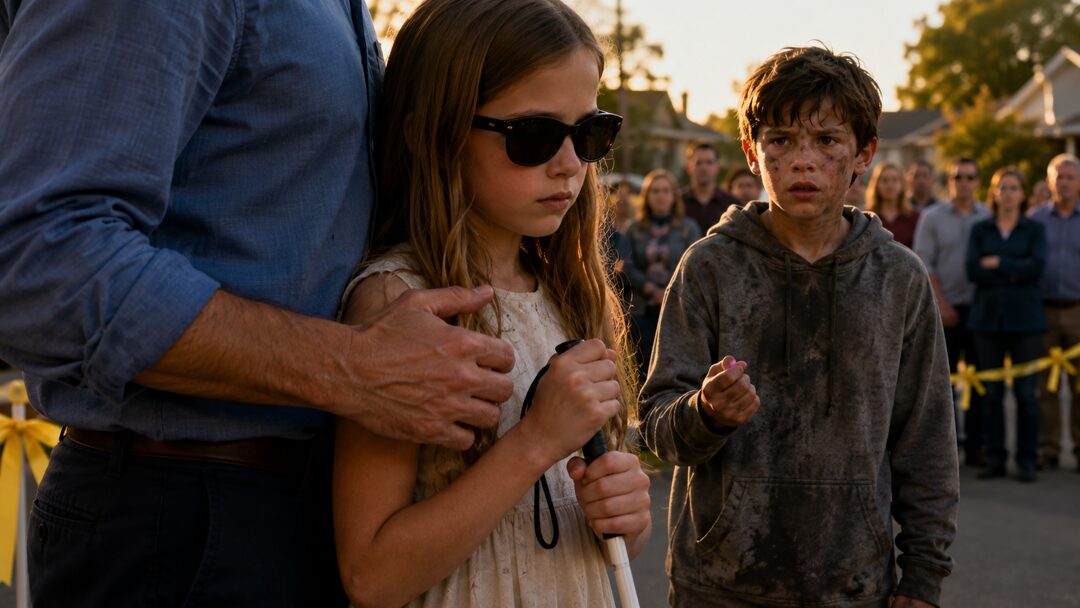
Ryan came back during the ribbon ceremony, barefoot on the warm pavement, while Mark was holding his daughter’s white cane like proof that he had suffered beautifully.
For one perfect second, no one moved.
The cul-de-sac had been arranged to look gentle. Folding chairs on trimmed lawns. White ribbons tied around the young maple trees. A small table with lemonade, cookies, and donation envelopes for the Sarah Whitman Memorial Foundation. The late sun made every driveway glow.
Mark stood in front of the neighborhood with his hand on Emily’s shoulder.
Emily wore a pale blue dress, dark glasses, and a face so still it made adults lower their voices around her.
Mark had dressed carefully for grief. Blue button-down. Gray slacks. Polished shoes. Expensive watch turned slightly inward, as if even time had become too private for him.
He had just said, “Sarah taught us that family is something you choose every day,” when someone at the back of the crowd gasped.
Ryan was at the end of the street.
At first Mark did not recognize him. The boy looked smaller than eleven, thinner than before, with dirt on his hoodie and dried red-brown streaks under one sleeve. His hair stuck to his forehead. His eyes were too awake.
A woman whispered, “Is that the Miller boy?”
Another said, “I thought he ran away.”
Mark’s fingers tightened on Emily’s shoulder.
Emily did not turn her head.
Ryan walked straight down the middle of the cul-de-sac, past the parked SUVs, past the white ribbons, past Mrs. Atkins holding a paper cup halfway to her mouth.
He stopped five feet from Mark and pointed at Emily.
“She’s not blind,” he said.
The air changed. Not loudly. Worse than that.
It changed politely.
Mark smiled the way men smile when a room has embarrassed them. “Ryan,” he said, soft and dangerous, “you need help.”
Ryan did not look at him.
“She’s just done looking at you.”
A neighbor made a small, shocked sound. Someone’s phone dipped, then lifted again.
Mark felt the crowd watching him not as a grieving husband now, not as the brave father of a blind child, but as a man being accused by a filthy boy in the middle of his own ceremony.
“Enough,” Mark said.
Emily’s hand tightened around the handle of her cane.
That was the first thing Mark hated her for that day.
Not enough to call it hate. He would never have used that word. He would have called it fear. Confusion. A father’s pain.
But deep inside him, something hard and ugly opened its eyes.
Because Emily understood.
Ryan stepped closer.
Mark moved in front of his daughter. “Where have you been?”
Ryan reached into the pocket of his hoodie.
Three men in the crowd shifted, ready to be useful.
Ryan pulled out a small pink hair clip.
It was plastic, cheap, shaped like a bow. One tooth was broken. There had been two of them once.
Sarah wore them in the garden when she didn’t want her hair in her face.
Mark stared at it so long that he forgot to look confused.
Ryan held the clip up between them.
“Ask your wife where the other one is.”
A murmur ran through the neighbors.
Mark’s mouth went dry. “My wife is gone.”
Ryan’s eyes finally moved to him.
“No,” he said. “She’s in your kitchen.”
The white ribbons fluttered in a breeze that no one felt.
Ryan leaned toward Emily. He spoke quietly, but not quietly enough.
“She saw everything,” he said. “She saw when your wife switched places.”
Emily’s face did not change.
Mark’s did.
And every person on the cul-de-sac saw it.
Part II — The Woman in the Kitchen
Mark did not remember dragging Emily into the house.
Later, he would remember Ryan shouting behind him. He would remember Mrs. Atkins saying his name in the fragile tone people used when they wanted access to disaster. He would remember the cane knocking once against the front step because he had pulled Emily too fast.
But he would not remember opening the door.
Only the kitchen.
Only Sarah standing by the sink, trimming stems from white roses.
She wore a cream sweater, pearl earrings, and the other pink hair clip.
Her hair was pinned back with it.
As if she had chosen it for the occasion.
As if she had been waiting for the object to return.
“What happened?” she asked, looking first at Mark, then at Emily.
Her voice was warm. Controlled. Almost amused.
Mark shut the door behind them and locked it. Outside, voices gathered on the lawn.
Emily stood beside the island, her sunglasses reflecting the kitchen lights. Her cane pointed toward the floor between her feet like a boundary line.
“Ryan came back,” Mark said.
Sarah’s hand paused over the roses.
Then she smiled, gently. “Poor boy.”
“He had your clip.”
Sarah touched the clip in her hair with two fingers. “My clip?”
“The other one.”
“Oh.” She looked down at the flowers. “I must have lost it.”
Emily made a sound.
Not a word. Barely even a breath.
Sarah looked at her.
“Something you want to say, sweetheart?”
Mark hated the sweetness of it. He loved it too. That was the sickness he had been living with for six months.
Sarah could make a room feel normal just by standing in it.
Before the accident, before the basement, before the missing weeks and the closed curtains and Emily’s sudden refusal to open her eyes, Mark had never understood how much he needed normal. Not happiness. Not truth. Just breakfast plates in the dishwasher. A wife’s voice from upstairs. A child at the table. Neighbors waving as if nothing in the world could rot beneath a lawn.
Sarah took three steps toward Emily.
Emily turned her face away.
Sarah stopped.
There it was again, that tiny wound in Sarah’s expression. Not guilt. Something sharper.
Insult.
“Ryan is traumatized,” Sarah said. “You know that.”
Mark stared at the pink clip.
“What did he mean?”
“Children make stories out of fear.”
“What did he mean, Sarah?”
She set the pruning scissors down.
Her eyes softened, but the softness did not reach the room. It aimed only at him.
“Mark,” she said, “look at me.”
That was how she did it.
Not with orders. With permission.
He looked.
She came close enough to touch his sleeve. “You have held this family together through things most men couldn’t survive. Don’t let a disturbed child take that from you in front of people who were waiting for you to fall apart.”
The words entered him exactly where she intended.
In front of people.
Waiting for you.
Fall apart.
Outside, someone knocked on the door.
“Mark?” Mrs. Atkins called. “Is everything all right?”
Sarah’s hand slid down his arm.
“Tell them Emily is overwhelmed,” she whispered. “Tell them Ryan needs help. They will believe you if you stop looking frightened.”
Emily spoke then.
Her voice was small, flat, and clear.
“You always tell him where to stand.”
Sarah turned.
Mark did too.
Emily had not spoken more than three words at a time in weeks.
Sarah smiled. “What was that, honey?”
Emily’s mouth pressed shut.
The knock came again.
Mark opened the door only enough to show his face. The neighbors crowded the porch and walkway, pretending not to crowd.
“Everything’s fine,” Mark said. His voice was steady now. Sarah had given it back to him. “Ryan is obviously in distress. I’ll call someone.”
“Is Emily okay?” Mrs. Atkins asked.
Mark glanced back.
Emily stood in the kitchen, dark glasses on, cane still in hand.
Sarah rested her palm on Emily’s hair like a blessing.
Emily did not move away.
But Mark saw her fingers bend around the cane until her knuckles whitened.
“She’s overwhelmed,” Mark said.
The neighbors nodded, relieved to be given a version they could repeat.
Behind him, Sarah whispered to Emily, “Good girl.”
Emily flinched.
Mark saw it.
He closed the door anyway.
Part III — The Garage Door Left Open
That night, Ryan hid in Mark’s garage.
Emily found him because she knew where things were.
She had always known.
The house had tried to rearrange itself after Sarah came back. Cups in the wrong cabinet. Towels folded too tightly. Her mother’s lavender soap replaced with expensive white bars that smelled like hotel rooms. The piano bench moved three inches from the wall.
Emily noticed all of it.
Blind girls were not supposed to notice three inches.
That was why she kept the glasses on.
At midnight, she stepped into the hallway with her cane, not tapping it, just carrying it. Her father’s bedroom door was closed. Low voices moved behind it.
Sarah’s voice first.
Then Mark’s.
Emily went downstairs.
The garage smelled like dust, gasoline, and cut grass. Ryan sat behind a stack of storage bins with his knees pulled to his chest.
“You shouldn’t be here,” Emily whispered.
“You shouldn’t be in there.”
His voice shook, but his eyes were steady.
Emily closed the door behind her.
Ryan looked worse under the garage light. Scratches on his cheek. One sleeve stiff and dark. A bruise at his jaw.
“Where were you?” Emily asked.
Ryan swallowed.
“You know where.”
Emily’s hand went to her glasses.
Ryan noticed and looked away. It was the kindest thing anyone had done for her in six months.
“She kept me in the old cellar behind the Miller house,” he said. “The one my dad said was sealed.”
Emily remembered.
She remembered the day before the accident, her mother laughing in the garden with both pink clips in her hair. She remembered Sarah going down to the basement because the washing machine had made a strange clanking sound.
She remembered the scream that stopped halfway through, like someone had put a hand over the world.
Then the thing that came upstairs.
Wearing her mother’s face.
Not perfectly. Not at first.
The smile was close, but not worn in the same place. The hands were Sarah’s hands, but they touched the banister as if learning what wood was. The voice said Emily’s name too slowly.
Emily had seen Ryan in the basement doorway behind it, pale and shaking.
Then Mark came home.
Emily had tried to tell him.
He had looked at Sarah, then at the thing that looked like Sarah, then at Emily.
And he had chosen the room to remain standing.
“She’s in shock,” he kept saying.
By morning, Emily had stopped opening her eyes.
“I came back because she’s wearing your mother’s face wrong,” Ryan said.
Emily turned toward him sharply.
The sentence hurt because it was exact.
Ryan pulled the pink clip from his pocket and placed it on a paint can between them.
“I took this from the basement. The real one had both. That thing put one in before she even knew how your mom parted her hair.”
“Don’t call her that.”
“What?”
“That thing.”
Ryan stared at her.
Emily’s throat tightened.
“If she’s a thing, then everyone should have known,” she said. “But Dad didn’t. Or he did. I don’t know which is worse.”
The door to the house opened.
Light fell across the garage floor.
Mark stood there in pajama pants and a T-shirt, his hair flattened on one side. For one second, without the watch and the polished shoes, he looked like a tired father.
Then he saw Ryan.
“You,” Mark said.
Ryan grabbed the clip.
Emily stepped between them before either boy or man could move.
Mark’s face changed when she did that. She felt it without seeing. A heat in the air. A father insulted by protection he had not been asked to give.
“Emily,” he said carefully, “come inside.”
“No.”
Ryan’s breath caught.
Mark took one step down into the garage. “I am trying to keep this family together.”
Emily laughed once.
It was a terrible little sound. Rusted from lack of use.
“You wanted people to stop bringing casseroles.”
Mark stopped.
The words struck him harder than shouting would have.
“Sweetheart,” he said.
Emily lifted her cane.
Not like a weapon. Like a door closing.
“Don’t.”
Behind Mark, Sarah appeared in the doorway in a silk robe, hair loose, pink clip gone.
She looked at Ryan first.
Not surprised.
Disappointed.
“You found your way out,” she said softly.
Ryan backed into the bins.
Mark turned to her.
The garage went silent.
Sarah’s eyes returned to Mark. “We need to talk.”
For the first time, she did not sound like his wife.
She sounded like someone removing a mask because the room had become too small for it.
Part IV — The Family He Chose
Mark followed Sarah into the study because she told him to, and because that was what frightened him most.
He still obeyed her.
The study was the only room she had not changed. His law books. His framed college diploma. The photo of Sarah and Emily at Lake Erie, both laughing into the wind. Real Sarah had hated that photo because her hair was in her mouth.
This Sarah kept it dusted.
She closed the door.
“Tell me what you are,” Mark said.
She looked almost sad.
“Still asking the least useful question.”
“Tell me.”
“I am what stayed.”
His hands trembled, so he put them in his pockets.
Sarah moved to the bookshelf and touched the lake photo.
“She was tired, Mark.”
“Don’t.”
“She was tired of the house. Tired of being grateful. Tired of you needing admiration more than intimacy.”
His face tightened. “You don’t get to talk about her.”
“I have her memories in pieces. Not all. Enough.”
“That’s not possible.”
Sarah turned back to him.
“Neither was your wife walking into the kitchen three days after you identified her body and making you coffee exactly the way you liked it. But you drank it.”
Mark said nothing.
There it was.
The cleanest accusation in the world.
You drank it.
He remembered that morning with a clarity that made him sick. Sarah at the stove. Blue robe. Hair damp. The smell of coffee. Emily standing frozen in the hallway.
Mark had not asked the right questions because the wrong answer would have destroyed him.
Sarah came closer.
“You knew something was different.”
“I thought—”
“You thought if you called it grief, everyone would leave you alone.”
His eyes burned. “I loved her.”
“I know.” Sarah’s voice lowered. “That’s why I became easier to love.”
He looked at her then, really looked.
She was beautiful in Sarah’s shape. Calm in Sarah’s kitchen. Warm in Sarah’s bed. She remembered his mother’s birthday and the name of his first boss and the way he hated tomatoes on sandwiches. She laughed at his jokes again. She hosted neighbors without getting tired. She looked at him as if he had rescued the family simply by remaining in it.
Real Sarah had stopped looking at him that way years ago.
That was the truth he had built a house over.
“What did Emily see?” he asked.
Sarah’s expression hardened by one degree.
“She saw too much.”
“What did she see?”
“She saw me learning.”
His stomach turned.
Sarah stepped close enough for him to smell her perfume. The same brand Sarah used, but applied too carefully.
“She saw your wife come apart from the life she no longer wanted,” she said. “She saw me take what was left. She saw Ryan try to pull her away. She saw you come home and decide a blind daughter was easier than an accusing one.”
Mark shook his head.
“No.”
Sarah touched his cheek.
“You called doctors. You accepted sympathy. You let people praise your strength. And every night, when Emily refused to remove those glasses at dinner, you let her sit there because her silence made your life possible.”
He grabbed her wrist.
For a moment, anger helped him feel innocent.
Sarah did not pull away.
“Careful,” she whispered. “You’re not angry because I lied. You’re angry because I said it in your voice.”
He let go.
Outside the study, the hallway creaked.
Emily.
Mark knew it, and Sarah knew he knew.
Sarah smiled toward the door.
“Come in, sweetheart.”
No answer.
Mark opened the door.
The hallway was empty.
But at the far end, Emily’s bedroom door closed with one quiet click.
The sound was worse than a scream.
The next morning, Sarah chose Emily’s dress for the foundation dinner.
A white one.
“People love you in white,” Sarah said, brushing Emily’s hair at the vanity. “It makes them feel brave for looking at you.”
Emily sat still.
Sarah clipped one side of Emily’s hair back with a silver barrette.
Not pink.
Never pink.
Mark watched from the doorway.
He wanted to stop it. He wanted to say, Leave her alone. He wanted to kneel beside Emily and confess everything badly enough to deserve being hated.
Instead he said, “The dinner starts at seven.”
Emily’s face in the mirror remained hidden behind dark glasses.
Sarah smiled at Mark’s reflection.
“Then we should all try to look like a family.”
Part V — The Dinner in Her Name
The Sarah Whitman Foundation dinner was held in the community clubhouse, under warm lights and white tablecloths.
By seven-thirty, everyone had heard about Ryan.
By seven-forty, everyone pretended they had not.
That was how the neighborhood protected itself. It made a buffet line out of fear. It passed concern from mouth to mouth on toothpicks.
Mark stood near the podium, shaking hands.
“Remarkable work you’re doing.”
“So brave, Mark.”
“Emily looks beautiful.”
Each compliment struck him as both praise and threat.
Emily stood beside him, one hand on her cane, the other resting lightly against her dress. Sarah had positioned her there before disappearing into the crowd with a wine glass and a gentle smile.
“She likes to feel where I am,” Mark told people.
Emily did not correct him.
That was her punishment.
Across the room, Ryan entered with his aunt, a tired woman named Linda who looked like she had spent the last six months being told her nephew was troubled by people who wanted that to be true.
The room stiffened.
Mark stepped away from the podium.
Linda lifted her chin before he reached them.
“He asked to come,” she said. “I said yes.”
“This is not appropriate.”
Ryan looked past him, at Emily.
“She’s here,” Ryan said. “So I’m here.”
Mark lowered his voice. “You need to stop this.”
Ryan’s hand went into his hoodie pocket.
Mark saw the movement and felt the whole room tilt.
“Don’t,” he said.
Ryan pulled out a folded paper instead.
A foundation brochure.
He opened it and held it up.
“You printed these before the certificate came,” Ryan said.
Mark stared.
“What?”
Ryan’s voice shook, but it carried. “The foundation was registered before they even finished saying what happened to her. My aunt found the date.”
The room went quiet in layers.
First the people nearby.
Then the tables.
Then even the servers at the back.
Mark felt eyes move onto him. Not sympathy now. Calculation.
“That is not what you think,” he said.
Mrs. Atkins looked down at her program. Someone else did too.
Dates were small things until they weren’t.
Sarah appeared beside Mark as if summoned by humiliation.
Her hand slid into his.
A perfect wife’s gesture.
To the room, it looked like support.
To Mark, it felt like a lock clicking.
“Poor Ryan,” she said softly. “He’s been through so much.”
Ryan stepped back as if she had touched him.
Emily turned her face toward the sound of Sarah’s voice.
Sarah noticed.
She leaned close to Mark, smiling for the room.
“I let him out,” she whispered.
Mark went cold.
“What?”
Still smiling, she adjusted his collar.
“I wanted to know if you would choose me when people were watching.”
His mouth opened.
No sound came.
Sarah’s smile widened for Mrs. Atkins, who was pretending not to stare.
“You did beautifully for a while,” Sarah whispered. “Then you started looking at me like a question.”
Mark pulled his hand away.
Too late.
The room saw.
Sarah’s eyes cooled.
At the podium, the microphone gave a soft squeal as someone adjusted it.
The foundation board chair, a red-faced neighbor from two streets over, cleared his throat. “Mark, whenever you’re ready.”
Mark looked at Emily.
His daughter stood alone beside the podium, white dress bright under the lights, sunglasses dark as closed doors. Everyone in the room could see her. Everyone had been invited to pity her.
He had made sure of it.
Sarah crossed to Emily and bent down, smoothing a wrinkle from her sleeve.
“No one will believe a child who decided not to see,” she whispered.
Emily did not move.
Ryan heard it. Mark saw that he heard it.
The boy crossed the room before anyone could stop him and placed the pink hair clip in Emily’s palm.
Not dramatically. Not like evidence.
Like returning something borrowed.
“You don’t have to save me,” Ryan said. “Or him. Or her.”
Emily’s fingers closed around the clip.
Sarah straightened.
Mark stepped to the podium because there was nowhere else to go.
He had built the stage.
Now he had to stand on it.
Part VI — What She Carried Away
Mark looked out at the room and saw every version of himself he had ever tried to sell.
Good husband.
Steady father.
Man of faith.
Man of grief.
Man who had endured the impossible without making others uncomfortable.
The microphone waited.
Sarah sat at the front table, hands folded, face serene.
Emily stood three feet away.
Mark began to read from the paper in front of him.
“Sarah was the heart of this family.”
His voice cracked on heart.
He swallowed.
“She taught me that love is not only what we feel, but what we choose to protect.”
Emily lifted her head.
Mark saw the movement from the corner of his eye.
So did Sarah.
So did Ryan.
Emily raised both hands to her sunglasses.
A strange sound moved through the room. Not a gasp. A preparation for one.
Mark stopped speaking.
“Emily,” he said.
She removed the glasses.
Her eyes were open.
Blue-gray, like Sarah’s had been in winter light.
For six months, Mark had imagined that if she ever looked at him again, he would feel forgiven.
Instead he felt seen.
Emily turned her face toward him fully.
The room vanished from his mind, then returned worse than before. Every neighbor. Every donor. Every person who had admired him for carrying a burden he had arranged into a display.
Emily’s voice was quiet.
“I saw you let her stay.”
No one moved.
Sarah’s expression did not change, but one hand tightened around the stem of her wine glass.
Mark stepped away from the microphone.
“Emily, sweetheart—”
She looked past him.
At Sarah.
“And I saw you put my mother’s clip in your hair before you learned her name.”
The room broke open.
Not loudly at first. A chair scraped. Someone whispered, “Oh my God.” Mrs. Atkins covered her mouth. Linda put a hand on Ryan’s shoulder. Phones appeared, then disappeared, then appeared again.
Sarah stood.
For the first time, she looked almost uncertain.
Almost.
Emily held up the pink clip.
“It was on the basement floor,” she said. “Mom had two. You took one. Ryan took one.”
Mark’s knees weakened.
“Emily,” he said, and this time his voice was not controlled. “Please. Come home with me. We can—”
“No.”
One word.
Clean enough to end a life without raising its voice.
Mark reached for her, then stopped because the whole room was watching and because for once, even he understood the ugliness of making her step back in public.
Emily put the sunglasses into his hand.
He took them because he did not know what else to do.
“They helped,” she said.
Then she picked up her white cane.
Sarah moved toward the side exit.
Mark saw her going.
So did Emily.
No one stopped her. Maybe because no one understood what she was. Maybe because everyone understood enough not to touch her.
At the door, Sarah turned back.
Her eyes found Mark’s.
For one painful second, she looked exactly like the woman he had missed.
Then she smiled, not kindly.
And left.
The door closed behind her with a soft, ordinary sound.
That was the last anyone saw of Sarah Whitman.
Or the woman who had answered to her name.
Afterward came questions, but not answers.
There were calls. Statements. Neighbors on sidewalks in low voices. Cars slowing outside the house at night. The foundation website vanished by morning. The white ribbons were removed from the trees, one by one, as if the street could become innocent again through tidiness.
Mark’s house stayed lit.
Kitchen. Hallway. Study.
Sometimes Emily saw him through the front window when Linda drove her past. He stood in rooms as if waiting for someone to tell him where to place his hands.
Emily stayed with Ryan and his aunt in the small brick house two streets over. Linda did not ask her to talk more than she wanted. Ryan did not ask her to take off the glasses when she wore them on hard mornings.
The cane stayed beside her bed.
She did not need it anymore.
She kept it anyway.
Some things that help you survive do not have to be thrown away the moment other people understand.
A week later, Emily walked with Ryan to the community board outside the clubhouse.
There were flyers for dog walkers, piano lessons, lawn care, a missing orange cat named Pumpkin.
In the corner, half-covered by a notice for summer tennis, was an old flyer with Sarah’s face on it.
MISSING.
The word looked wrong now. Too small. Too late.
Emily took the pink hair clip from her pocket.
Ryan watched her but said nothing.
She clipped it to the bottom of the flyer, where the paper had curled from rain.
It did not prove anything.
It did not bring anyone back.
It was only a small pink thing holding paper in place.
Emily stepped back.
For a moment, she let herself look at her mother’s face.
Really look.
Then she picked up her cane, turned toward the sidewalk, and walked home with Ryan beside her, both of them quiet in the golden evening, carrying more truth than any child should have to carry, and not enough truth to make them whole.