What Remained in the Suitcase
Part I — The Counter
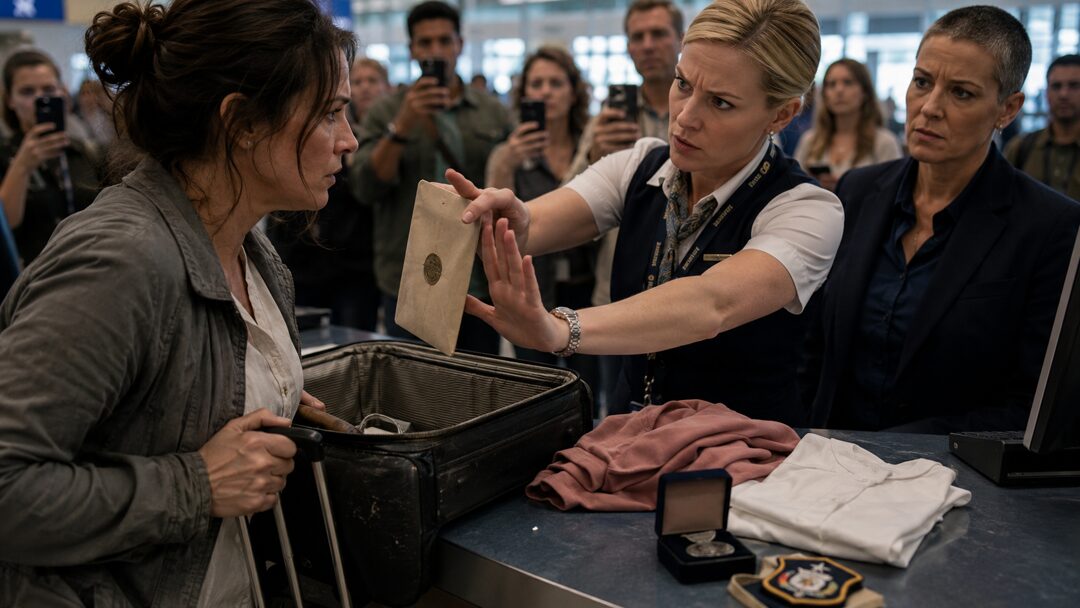
Karen Miller unzipped Emily Carter’s black suitcase before Emily could stop her, then reached in with both hands and threw the first folded shirt onto the airline counter.
The shirt landed beside a boarding pass, a half-empty plastic cup, and a small velvet box that Karen had already dragged out and dropped like spare change.
Behind Emily, someone whispered, “Oh my God.”
Another person raised a phone.
Emily saw the red recording light before she saw the face behind it.
“Ma’am,” Emily said, keeping one hand on the suitcase handle, “please close it.”
Karen didn’t look at her. Her blonde hair was pinned so tightly it pulled at her temples, and her name badge flashed every time she moved. She wore the kind of smile people used when they wanted to prove they were still being polite.
“You had your chance to answer basic questions,” Karen said. “Now we’re going to see what you’re carrying.”
“I answered.”
“You refused to explain these items.”
“They’re personal.”
Karen gave a short laugh and lifted a sealed plastic pouch from inside the suitcase. “Personal doesn’t mean exempt.”
The line behind Emily shifted with the restless irritation of delayed travelers. The terminal lights were too bright. The check-in screens blinked over the counter. Somewhere overhead, an announcement dissolved into static, then returned with the name of a flight Emily could not miss.
Her flight.
Denver. Gate B18. Final boarding soon.
Emily had been awake for nearly twenty-six hours. Her first flight had sat on the runway through lightning. Her second had been canceled. Her rebooked connection had been moved twice, then delayed again. She had stopped feeling tired somewhere over Kansas and started feeling hollow instead.
All she had to do now was get through this counter.
All she had to do was keep the suitcase closed.
Karen pulled out another item, a pink sweatshirt, soft and faded at the cuffs. She shook it once, as if looking for something hidden inside. The sweatshirt unfolded in the air.
Someone behind Emily gave a nervous little laugh.
Karen’s mouth tightened. “So we have military items, sealed documents, and a pink hoodie. Interesting combination.”
Emily’s fingers flexed around the suitcase handle.
“That belongs in the bag,” she said.
Karen’s eyes snapped up. “Do not tell me how to do my job.”
A man in line muttered, “Just let them check it.”
Emily didn’t turn around. She could feel the phones now. Not just one. Several. Raised slightly above shoulders, angled over luggage, catching her face, Karen’s hands, the open suitcase, the growing scatter of private things on a public counter.
She had treated men who screamed for their mothers with half their uniforms cut away. She had held pressure on wounds while shells fell close enough to shake dust from ceiling beams. She had learned to make her face still because panic spread faster than blood.
But this was different.
This was her brother’s suitcase.
Karen dug deeper and lifted out a bundle wrapped in brown paper and tied with white string.
Emily moved before she could stop herself.
“Don’t.”
Her hand reached across the counter, not fast, not threatening, just desperate enough to be honest.
Karen slapped her wrist away.
The sound was small.
The whole line heard it.
Emily froze.
Karen pointed at her. “You do not touch anything until I finish this inspection. Do you understand me?”
The phones stayed up.
Emily lowered her hand to her side. The skin at her wrist burned where Karen’s palm had struck it. She could feel her pulse there, sharp and humiliating.
“I need to make that flight,” Emily said.
“You should have thought of that before you made this difficult.”
“I’m not making anything difficult.”
“You’re refusing to cooperate.”
Emily looked at the suitcase. The brown-paper bundle had rolled against the edge of the counter. The velvet box sat open now, its hinge crooked. A strip of ribbon had slipped halfway out.
Karen noticed Emily looking at it.
“What is this?” she asked.
Emily’s throat closed.
“Please,” she said. “Put it back.”
Karen picked up the little box. She turned it in her hand, irritated by its silence, by Emily’s silence, by the crowd watching her handle something she did not understand.
“Ma’am, if you cannot explain what you’re transporting, we may not be able to allow it on the aircraft.”
“It’s not dangerous.”
“Then explain it.”
Emily said nothing.
That was her mistake.
She knew it even as she made it. Silence was supposed to protect what words would cheapen. Silence was how she had survived all the calls, all the paperwork, all the careful voices saying they were sorry for her loss in tones polished smooth by repetition.
But silence looked like guilt when strangers wanted a show.
Karen leaned closer. “Whose things are these?”
Emily’s jaw tightened.
Karen reached back into the suitcase and pulled out an envelope.
It was cream-colored, stiff, sealed, and marked in black ink with a name Emily had written herself because she had not trusted anyone else to write it correctly.
Samuel Carter.
Karen read it aloud.
The sound of his name in her mouth made the terminal tilt.
“Who is Samuel Carter?” Karen asked.
Emily’s hand closed around nothing.
“My brother.”
“Is he traveling with you?”
“No.”
“Then why are you carrying his documents?”
Emily stared at the envelope.
Because his hands could not carry them anymore.
Because their mother was waiting in a black dress she had bought without trying on.
Because the memorial program had his picture on the front, but Emily had the things that still smelled faintly of cedar, laundry soap, and the impossible past.
Because someone had to bring him home in the only way left.
Instead she said, “Please don’t open that.”
Karen’s face changed.
Not softened. Hardened.
“Oh, now we’re being specific.”
The crowd pressed closer without moving. Emily felt it, the silent appetite. Everyone tired. Everyone inconvenienced. Everyone grateful the problem belonged to someone else.
Overhead, the speaker crackled again.
“Final boarding call for Flight 417 to Denver. All remaining passengers should proceed to Gate B18 immediately.”
Emily looked up.
Karen smiled without warmth. “Then you should answer quickly.”
Part II — The Name on the Envelope
The suitcase had been Samuel’s long before it was Emily’s.
He had bought it at a discount store outside Fort Benning because the zipper on his old duffel had failed and spilled socks across a bus station floor. He had sent Emily a picture of it the day he bought it, one boot propped on the wheel, one thumb up, grinning like a man proud of a bargain.
Big enough for everything, he had texted.
It was not big enough now.
Nothing was.
Emily could have checked the suitcase. The airline had asked her to. Twice.
But she had seen what baggage belts did to luggage. She had seen suitcases split open and shirts dragging behind carts in the rain. She had seen strangers kick fallen socks aside with their shoes.
So she paid the extra fee. She argued politely at the first counter. She showed the paperwork when asked. She kept the suitcase with her through three airports and one sleepless night.
Then Karen Miller saw the sealed pouches through the X-ray note attached by the previous agent, frowned at the military-looking tags, and asked why Emily was transporting another person’s property.
Emily had said, “They’re family items.”
Karen had said, “That’s not an answer.”
Then the line had grown.
Then the flight had started boarding.
Then Karen had decided the only way to win was to make Emily small enough to manage.
“Ma’am.” Karen tapped the envelope against the counter. “Last time. What is inside this?”
Emily’s mouth tasted like metal.
“Letters.”
“From Samuel Carter?”
Emily nodded once.
“To you?”
Some were.
Some were not.
One was to their mother. One was to Samuel’s son, who was four and believed his father lived inside every airplane that crossed the sky. One was sealed in Samuel’s own handwriting and marked with no name at all.
The envelope Karen held was the one Emily had not opened.
It had been handed to her in a room with gray carpet and folded flags and coffee no one drank. A chaplain had said Samuel had left instructions. A captain had said the rest of his effects would arrive separately. Emily had stared at the envelope until the captain’s face blurred.
Now Karen pressed her thumb beneath the flap.
Emily stepped forward.
“Don’t.”
Karen’s eyes flashed.
“You need to back up.”
“That one stays sealed.”
“You don’t decide that.”
“It isn’t yours.”
“And it isn’t yours if it belongs to someone who isn’t present.”
A woman near the front of the line murmured, “That’s not right.”
Karen heard her and flushed. The first crack in her control showed in her hands. She set the envelope down too sharply, then grabbed the pink sweatshirt again.
“This is what I’m talking about,” Karen said, louder now. “Half the time people get emotional when we ask standard questions, then expect us to ignore policy.”
Emily stared at the sweatshirt.
It had been hers once. Samuel stole it during Christmas leave six years earlier and refused to give it back because he said it made him look “approachable.” Emily had found it in his effects, washed and folded, a note in the pocket that said, You can have it back when I’m done being charming.
He had always made a joke before leaving.
As if leaving was harmless.
Karen shook the sweatshirt again, and a small cloth patch slipped from the folds and fell to the floor behind the counter.
Emily saw it drop.
So did someone else.
A woman three places back inhaled sharply, the sound almost swallowed by the terminal.
Emily looked toward her and saw a Black woman in a navy blazer standing still beside a rolling carry-on. She had close-cropped hair, a straight back, and the watchful stillness of someone who knew how to wait until the exact second waiting became wrong.
Her eyes were on the patch.
Then on the envelope.
Then on Emily.
Karen did not notice. She was busy performing certainty.
“Do you see the position you’re putting me in?” she said. “You’re carrying another person’s documents, sealed materials, military insignia, and you refuse to provide a clear explanation.”
Emily heard the word military ripple through the crowd.
It changed things.
People leaned in with new interest, as if the suitcase had become a headline.
One teenager in a red hoodie lifted his phone higher.
Emily looked at him.
He looked away, but he did not lower it.
Karen pointed toward the scattered items. “For all I know, this could be stolen property.”
That did it.
Emily had been holding herself so tightly that everything inside her had gone white and quiet. But those words struck something still living.
She looked at Karen.
“Say that again.”
Karen blinked. “Excuse me?”
“Say that again while you’re touching his things.”
The line went still.
Karen’s face colored. “I am conducting—”
“You’re making guesses in front of strangers.”
“And you’re refusing to cooperate in a secure area.”
The woman in the navy blazer stepped forward.
Her voice was low, but it cut cleanly through Karen’s.
“That’s enough.”
Karen turned, grateful for a new target. “Ma’am, please stay behind the marked line.”
The woman did not move back.
“I said that’s enough.”
“This is an airline matter.”
The woman reached down, picked up the fallen patch from the floor, and held it in her palm.
Something changed in her face.
Not surprise.
Recognition.
She looked at Emily again, more carefully this time.
“Is Samuel Carter your brother?”
Emily’s chest tightened.
The terminal noise thinned until there was only the hum of fluorescent lights and the tiny plastic wheels of a suitcase rolling somewhere far away.
Karen looked between them. “Do you know this passenger?”
The woman did not answer Karen.
She said to Emily, “My name is Lisa Bennett.”
Emily had not heard that name spoken aloud in two years.
She had read it.
Once.
In Samuel’s last letter home.
Major Bennett made the call, he had written. Don’t blame her if this gets ugly. She had less time than anyone will admit.
Emily looked at the patch in Lisa’s hand.
Then at Lisa.
And whatever relief might have come from being recognized turned cold before it reached her.
“I know who you are,” Emily said.
Part III — The Woman Who Stepped In
Lisa Bennett’s expression did not break.
That was the first thing Emily hated about her.
Not because Lisa looked careless. She didn’t. Her face held grief the way disciplined people held weight: close to the body, without asking anyone to notice.
But she did not flinch.
Emily wanted her to.
Karen seized the silence. “If you two are traveling together, that should have been disclosed.”
Lisa turned to her. “We are not traveling together.”
“Then please step back.”
“No.”
The single word landed harder than Karen’s raised voice had.
Karen’s posture shifted. She glanced over the counter, then toward a younger employee who had been pretending not to watch. “Call security.”
The younger employee hesitated.
Karen snapped, “Now.”
Lisa placed the patch on the counter, carefully, away from the coffee cup and the edge. “You need to stop touching her belongings.”
Karen gave a short laugh. “And you are?”
“Major Lisa Bennett.”
Karen’s mouth opened, then closed. The title did not make her respectful. It made her defensive.
“Then you should understand procedure.”
“I understand chain of custody. I understand sealed personal effects. I understand that you have spread a family’s private property across a public counter while people film it.”
At the word film, several phones dipped.
Not all.
Emily saw the teenager in the red hoodie still recording, his face uncertain now, caught between shame and the thrill of having captured something.
Karen looked around and seemed to notice the crowd again. Her jaw tightened. “I asked routine questions. She refused to answer. I have a responsibility to—”
“To inspect,” Lisa said. “Not to punish.”
The words were so close to Emily’s own thoughts that she resented them.
She did not want Lisa Bennett saying the right thing.
She did not want to owe her anything.
Karen picked up the sealed envelope again.
Emily’s body reacted before her mind did. Every muscle tightened.
Lisa saw it.
So did Karen.
A thin, ugly satisfaction crossed Karen’s face. “This appears to be the item causing the issue.”
“Set it down,” Lisa said.
Karen held it higher. “If it contains documentation relevant to the transportation of these items, I am entitled to review—”
“No, you are not.”
The crowd seemed to breathe in as one.
Karen’s fingers moved toward the flap.
Emily heard herself say, “Please.”
It came out smaller than she intended.
That was worse than anger.
Karen heard the weakness and mistook it for victory.
The flap bent under her thumb.
Lisa’s hand came down flat on the counter.
“That envelope stays closed.”
Not loud.
Not dramatic.
Final.
Karen froze.
For a moment, nobody moved.
Then a tall man in a dark suit came through the side corridor with an earpiece at his collar and a badge clipped near his belt. He had the tired calm of someone who had spent years entering rooms after people had already made them worse.
“Karen,” he said. “What’s going on?”
Karen exhaled, relieved. “Michael, thank you. This passenger refused to provide proper information regarding suspicious personal effects, interfered with inspection, and this woman is obstructing—”
Michael Harris raised one hand.
Karen stopped.
His eyes moved across the counter.
Pink sweatshirt. White shirt. Velvet box. Brown-paper bundle. Ribbon. Patch. Envelope.
Then Emily.
Then Lisa.
“What flight?” he asked.
Emily answered before Karen could. “Four-seventeen. Denver.”
Michael glanced toward the monitors. “Final boarding.”
“Yes.”
Karen cut in. “She created this delay.”
Michael looked at her. “Did you remove these items?”
Karen straightened. “As part of inspection.”
“Did you ask her to move to a private area?”
Karen’s mouth tightened.
The answer was on her face.
Michael looked at the phones in the crowd.
Then back at Karen.
“Step away from the suitcase.”
Karen stared at him. “Excuse me?”
“Step away.”
The power left her in pieces.
First her shoulders. Then her chin. Then the hand holding the envelope, which lowered slowly toward the counter.
Emily reached for it.
Karen pulled it back a fraction, not enough to be useful, just enough to prove she still existed.
Michael’s voice dropped. “Karen.”
She let go.
Emily took the envelope and held it against her chest.
The paper was warm from Karen’s hand.
That made Emily want to tear the whole terminal apart.
Instead she slipped it under her arm and reached for the brown-paper bundle.
Lisa moved at the same time, then stopped herself.
Emily noticed.
Lisa’s hand remained half-raised, then lowered.
“May I help?” Lisa asked.
Emily looked at her.
The answer rose fast and bitter.
No, you have helped enough.
No, you don’t get to touch what he carried back.
No, you don’t get to stand here like the decent one when your name was on the last page he wrote.
But the gate was closing.
The suitcase was open.
Samuel’s things were scattered under fluorescent lights.
And Karen muttered, just loud enough, “I was just doing my job.”
Emily turned.
Her voice surprised her. It was steady now. Not loud. Not broken.
“Your job was to check a bag,” she said. “Not punish me for not explaining my brother fast enough.”
Karen’s lips parted.
Emily continued, because once the words began, silence no longer felt like dignity. It felt like permission.
“He is not here to answer you. I am. And I asked you not to open one envelope.”
No one in line spoke.
The teenager lowered his phone halfway.
Not all the way.
Lisa closed her eyes for one brief second.
Michael looked down at the counter again, but his face had changed. He was no longer measuring a disturbance. He was seeing the scene.
The little velvet box lay open beside the coffee cup.
Inside was a medal ribbon, bent from the fall.
Michael said, quietly, “Karen, go to the back office.”
Karen stared at him. “Michael—”
“Now.”
“This is going to look like I did something wrong.”
Lisa’s voice was calm. “You did.”
Karen looked at her with sudden, naked anger. “You don’t get to walk in here and judge me. You don’t know what kind of day this has been.”
Emily almost laughed.
It would have sounded terrible if she had.
Lisa looked at Karen for a long moment.
“No,” she said. “I don’t.”
Then she turned to Emily.
“And you don’t owe any of us a performance of your worst day.”
Emily felt that line go through the crowd like a door shutting.
Something in her loosened.
Not enough to forgive.
Enough to breathe.
Part IV — The Order
The gate agent’s voice sounded over the speaker again, sharper now.
“Passenger Emily Carter for Flight 417 to Denver, please proceed immediately to Gate B18. Doors are closing.”
Emily looked toward the concourse.
Too far.
The suitcase was still half open. The ribbon was bent. The patch was on the counter near Lisa’s hand. The brown-paper bundle had a dent in one corner. The sweatshirt lay exposed, pink and absurdly soft under the lights.
“I can’t leave it like this,” Emily said.
Michael turned to the younger employee. “Call the gate. Tell them we have the passenger here and she is being escorted through.”
The employee nodded quickly and grabbed the phone.
Karen had not moved.
Michael looked at her.
This time, she did.
She stepped away from the counter, her face stiff, her eyes bright with a humiliation she had not expected to feel herself. She did not apologize. Maybe she could not yet find the shape of the word. Maybe she did not believe she owed it.
But she looked at the suitcase once before she walked toward the office.
For the first time, she looked afraid of what she had touched.
Emily gathered the envelope, the pouch, the shirt.
Her hands were shaking now.
She hated that too.
Lisa stood on the other side of the counter, still as a post.
“Emily,” she said.
Hearing her name from Lisa’s mouth felt like a trespass.
Emily kept folding. “Don’t.”
Lisa nodded once. “All right.”
The restraint was worse than argument.
Emily slid the letters into the side pocket. She picked up the velvet box and tried to straighten the ribbon, but her fingers would not obey. It kept bending wrong. The metal clasp caught on the lining.
A memory flashed, sudden and cruel: Samuel at fourteen, trying to fix a church tie before their father’s memorial, laughing because he had made the knot the size of a peach.
You do it, Em. Your hands listen better.
Her hands did not listen now.
The ribbon blurred.
Lisa spoke, softer. “Samuel was at Kadesh Crossing.”
Emily stopped.
Michael looked up.
The crowd did not understand the name, but they understood the change in air.
Emily said, “Don’t say it like you knew him.”
Lisa accepted that without defense.
“I knew his voice on the radio.”
Emily’s throat tightened.
Lisa continued, each word careful. “I knew he stayed on the east approach after I told his team to hold five more minutes.”
Emily looked at her then.
The whole terminal seemed to drop away.
Five more minutes.
The phrase had lived in Emily’s head for two years. It had been in reports, in fragments, in a letter Samuel had written before everything happened. Five more minutes could be nothing. Five more minutes could be a lifetime. Five more minutes could be the distance between coming home and being folded into ceremony.
“You gave the order,” Emily said.
Lisa did not look away.
“I did.”
There were no excuses in it. That was almost unbearable.
Emily wanted anger to stay simple. She wanted Lisa to say it had been necessary, or that anyone would have done the same, or that Samuel knew the risk. She wanted something she could strike.
Lisa gave her nothing but the truth.
“We underestimated how many people were still trapped,” Lisa said. “The road was closing. The convoy was exposed. I had to choose between pulling back and leaving them, or holding the route longer than it was safe to hold.”
Emily’s nails dug into the velvet box.
Lisa’s face remained controlled, but her voice shifted at the edge.
“Samuel stayed where he was ordered. Then he stayed longer than that.”
Emily heard a sound behind her. Someone crying quietly. Maybe the woman who had murmured earlier. Maybe someone else. She did not turn to see.
Lisa looked at the items on the counter. “He got seventeen more people through.”
Seventeen.
Emily hated the number.
She loved it.
She wanted it to mean he had died for something. She wanted it not to be used as payment. She wanted both things at once, and that split in her felt older than the airport, older than grief.
“You wrote my mother,” Emily said.
“Yes.”
“You said he was brave.”
“He was.”
“You didn’t say you were the reason he was still there.”
Michael’s eyes flicked toward Lisa.
The crowd held still.
Lisa took the blow. She did not dress it up.
“No,” she said. “I didn’t.”
Emily waited for more.
Lisa gave it.
“I should have.”
That was the first thing Lisa said that made Emily look away.
Not because it healed anything.
Because it cost something.
The teenager in the red hoodie lowered his phone fully now. His arm dropped to his side as if it had become too heavy.
Karen, halfway to the office door, had stopped. She was watching from the corridor, her face pale.
Lisa turned slightly, not away from Emily, but enough that everyone could hear.
“Samuel Carter died holding a route open after command got the count wrong. He carried people out when he could have stayed behind cover. These are not props. They are not suspicious because a grieving woman refuses to explain them quickly enough for a line.”
No one moved.
Lisa’s gaze returned to Emily.
“I am not asking you to forgive me.”
Emily’s voice came thin. “Good.”
Lisa nodded. “I’m asking permission to help you put his things back before your flight leaves.”
Emily looked down at the suitcase.
The pink sweatshirt. The white shirt. The letters. The pouch. The patch.
Everything that had been handled like clutter.
Her first answer was still no.
Then she saw Samuel in her mind, not as ceremony, not as a folded flag, but leaning in the doorway of her apartment wearing that stolen pink sweatshirt and eating cereal straight from the box.
Don’t be dramatic, Em. Let people carry stuff.
She almost smiled.
It hurt too much to become one.
Emily picked up the brown-paper bundle and placed it into the suitcase herself.
Then she looked at the patch near Lisa’s hand.
“You can hand me that,” she said.
Lisa picked it up between both hands, as if weight had nothing to do with size.
She did not reach into the suitcase.
She held it out.
Emily took it.
For a moment their fingers nearly touched.
They did not.
Part V — What Was Carried Forward
Michael escorted Emily through the terminal himself.
Not with a hand on her arm. Not like she was a problem being moved. He walked beside her, clearing space with a quiet “Excuse us” whenever the crowd failed to part quickly enough.
Lisa followed a few steps behind, carrying her own bag.
Emily pulled Samuel’s suitcase with one hand and held the envelope under her jacket with the other. She could feel the sealed edge against her ribs. Still closed. Still his.
The crowd had changed shape.
No one cheered. Thank God. Emily could not have survived applause.
But phones lowered as she passed. A woman near the counter pressed her palm to her mouth. A businessman stared at the floor. The teenager in the red hoodie crouched suddenly beside the counter and reached under the metal lip.
“Wait,” he said.
Emily stopped.
He came up holding a narrow ribbon that must have slipped from the velvet box when Karen dropped it. It was dusty from the floor.
His face was red.
“I’m sorry,” he said, and held it out.
Emily looked at him for one second longer than he could bear.
Then she took it.
“Thank you.”
He nodded too fast.
Michael said, “We need to move.”
At Gate B18, the agent was waiting with the door still open and impatience barely hidden beneath professional concern.
“This is Ms. Carter,” Michael said. “She is cleared.”
The gate agent scanned Emily’s boarding pass without comment. The machine beeped green.
That small sound nearly broke her.
Not the raised voices. Not Karen’s hands. Not Lisa’s confession. The beep. The ordinary permission to continue.
Emily stepped toward the jet bridge.
Behind her, Lisa said, “Emily.”
She should have kept walking.
She didn’t.
Lisa stood just outside the gate, not following, not asking. The navy blazer looked almost black under the terminal lights. For the first time, she looked tired in a way rank could not hide.
Emily waited.
Lisa said, “He talked about you.”
Emily’s grip tightened on the suitcase handle.
“He said you were the person who taught him how not to panic.”
Emily swallowed.
Lisa’s mouth moved as if there was more. Maybe there was. Maybe there were a hundred things that could be said and none that would change the weight of the suitcase.
“I should have written the truth better,” Lisa said.
Emily looked down the jet bridge. The plane waited. Her mother waited. A room full of people would stand and say Samuel’s name carefully, as if it might shatter.
Emily could not give Lisa forgiveness at an airport gate.
She could give one true thing.
“He hated being called brave,” she said.
Lisa’s face shifted, just barely.
Emily continued, “He said people used that word when they didn’t want to say scared.”
Lisa nodded once.
“Then he was scared,” she said. “And he stayed.”
Emily closed her eyes.
There it was.
Not comfort.
Something closer to respect.
She turned before Lisa could see too much of her face and walked down the jet bridge.
Inside the plane, people looked up as she entered. A flight attendant glanced at the suitcase, then at Emily’s face, and seemed to decide not to ask anything at all.
Emily found her seat near the back. Window. Samuel always liked the window, even though he pretended not to care. He said clouds looked fake from above, like someone had forgotten to finish painting the world.
She slid the black suitcase carefully under the seat in front of her, then changed her mind and pulled it back.
Not yet.
She set it on her lap, ignoring the impatient movement of the man beside her.
Her hands found the zipper.
Only a few inches, she told herself.
Just enough to check.
The envelope was there, tucked into the side pocket, its seal unbroken.
The brown-paper bundle sat firm beneath the folded white shirt. The velvet box was closed. The dusty ribbon from the teenager lay beside it. Emily smoothed it once with her thumb.
Then she lifted the pink sweatshirt.
The unit patch was underneath, placed exactly where Samuel used to keep it when he packed: inside the sweatshirt, over the left side, like a heart no one else could see.
Emily knew she had not put it there.
Lisa had not reached into the suitcase. Not after asking. Not after Emily refused.
But when Emily had turned to take the ribbon from the teenager, when Michael had lifted the suitcase down from the counter, when the world had been full of movement, the patch had somehow found its way home.
For one breath, Emily wanted to be angry about it.
Then she saw how carefully it had been placed.
Not displayed.
Not claimed.
Returned.
The plane door closed.
The engines began their low, patient roar.
Emily rested her hand over the sweatshirt and the hidden patch beneath it. She did not cry loudly. She did not fold over. She did not become something strangers could watch.
One tear slipped down, quiet and hot, and landed on the sleeve Samuel had stolen years ago.
She let it stay there.
Outside the window, the terminal pulled away slowly, full of bright counters and rushing people and stories no one had time to understand.
Emily held the suitcase until the flight attendant came by and gently asked her to stow it.
This time, Emily nodded.
This time, when she let go, it was not because someone had taken it from her.
It was because she was carrying it forward.