She Opened the Tanker Valve While the Whole County Waited for the Pond to Live Again
Chapter 1: The Tanker Waited Beside a Silent Pond
“The fish may never touch this water.”
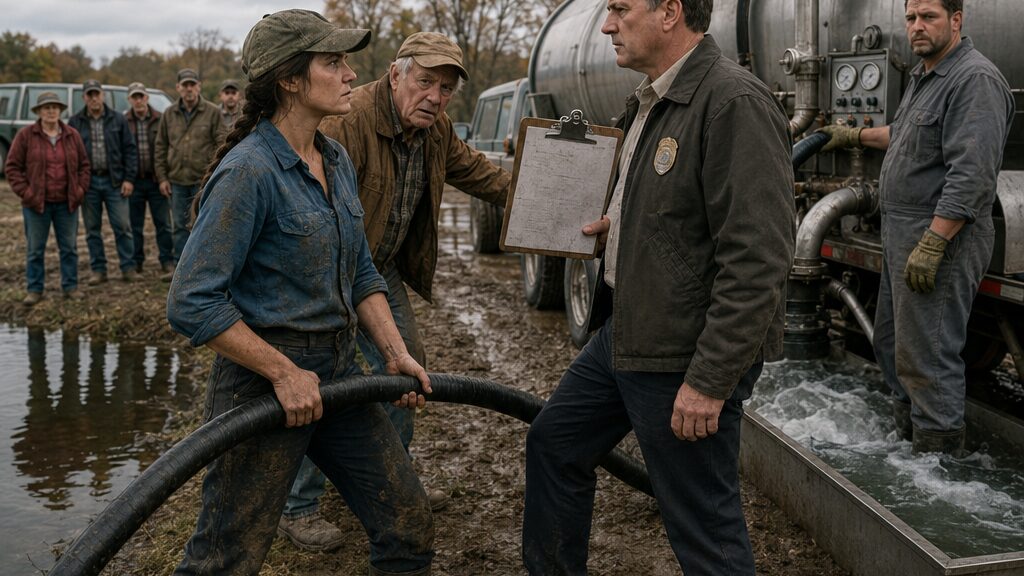
Brandon Mitchell said it from ten feet away, but the words seemed to travel through the heavy black hose in Rebecca Taylor’s hands.
The hose lay across the gravel bank like something asleep, its open end angled over the pond. Behind Rebecca, the silver tanker’s aeration pumps hummed with a steady mechanical pulse. Every few seconds, water shifted inside the tank with a deep, crowded slosh.
Nearly four thousand finger-length bass and bluegill were sealed inside.
Rebecca kept both hands around the hose coupling. “My permit was cleared yesterday.”
“It was conditionally cleared.”
“You signed the field sheet.”
“I signed the current-water inspection.” Brandon held a yellow folder against his dark county jacket. “That is not the same as final authorization to stock.”
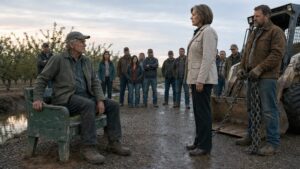
The people gathered behind him shifted uneasily. Neighboring landowners stood near their pickups. Two seasonal farmhands waited beside the portable oxygen cylinders. Carol Adams had parked her truck sideways at the edge of the access road, as if she expected someone to try leaving in a hurry.
Rebecca’s father stood closest to the tanker.
George Taylor wore the same faded canvas coat he had used for twenty winters. He looked smaller than he had a year ago, but his jaw still set the same way whenever someone from the county stepped onto his land.
Tyler Brown climbed down from the tanker platform and checked the gauge near the rear hatch. “I need a decision soon,” he said. “The water temperature is climbing.”
Brandon did not look at him. “The fish stay in the truck.”
“For how long?” Rebecca asked.
“Until I verify the file.”
“You had three weeks.”
“And I had three weeks of reports submitted by you.”
The sentence landed differently from an accusation, but only because Brandon kept his voice level.
Rebecca saw Carol’s eyes move from him to her.
Last summer, the pond had turned gray at the edges. Dead fish had surfaced by the hundreds, their pale bellies rocking against the reeds. For two days Rebecca and the farmhands had dragged them out with nets and loaded them into grain sacks because there had been too many for buckets.
The county called it a drought-related oxygen collapse.
Rebecca had let them.
Since then she had drained the shallow end, replaced two aerators, rebuilt the intake channel, planted grass barriers above the bank, and spent money the farm did not have. The stocking was supposed to mark the point where repair became recovery.
Instead, everyone was watching her hold an empty hose.
Brandon opened the folder. “The lab samples from Monday are clean. Dissolved oxygen is acceptable. Nitrate, phosphate, and ammonia levels are within range.”
A small release of breath passed through the workers.
Rebecca nodded once. “Then move aside.”
“I’m not finished.”
George stepped nearer to her shoulder. His voice was low enough that only Rebecca could hear. “Open it.”
She turned her head slightly. “No.”
“He doesn’t have the written stop order yet.”
“Dad.”
“The fish die in that truck, we still pay for them.”
Tyler looked toward the sky, then at his watch. He had heard enough to understand the argument, though he pretended to study the gauge.
George’s hand touched the valve wheel mounted at the tanker outlet.
Rebecca caught his wrist.
For a second neither moved.
Then she said, quietly, “Take your hand off it.”
His face hardened. “This is our pond.”
“And those are live animals.”
“So let them out.”
“Not like this.”
Brandon watched them with a guarded expression. Rebecca could see the conclusion forming behind his eyes: desperate landowners trying to force an approval through spectacle.
She released George’s wrist and faced the inspector.
“You said the current tests passed.”
“They did.”
“You inspected the new aeration lines.”
“Yes.”
“You walked the diversion berm.”
“Yes.”
“And you watched the downstream sample get sealed.”
“I did.”
“Then tell them that.”
Brandon glanced toward the neighbors. “The present conditions appear suitable.”
Carol folded her arms. “Appear?”
“The current samples are compliant,” he said. “But a required maintenance report from the previous incident is missing.”
The pond seemed to go quieter.
Rebecca’s grip tightened around the hose.
Brandon removed a checklist from the folder. “The file contains the fish-loss report, rainfall data, photographs, repair invoices, and your rehabilitation plan. It does not contain the drainage-control maintenance report for the month before the kill.”
“There wasn’t one,” Rebecca said.
“That is not what the county log says.”
George stared past Brandon toward the far bank.
Rebecca noticed.
Brandon continued. “The log records a report received from Taylor Farm on August fourteenth. It is listed, numbered, and initialed. The document itself is gone.”
Carol stepped closer. “What drainage control?”
“The gate above the north field,” Brandon said.
Rebecca kept her eyes on her father. “The old overflow gate?”
“The same.”
“That had nothing to do with the pond.”
Brandon’s mouth tightened. “Then the report should prove it.”
Tyler descended from the platform again. “We’re at sixty-seven degrees. If we sit another two hours, I need to add ice and oxygen. After that, the hatchery may order me back.”
Rebecca looked at the tanker. The metal skin vibrated faintly beneath the pumps. Inside, thousands of fish circled in darkness, using oxygen that cost money by the minute.
George leaned toward her. “This is exactly what they do. They wait until you’ve got no choice.”
Brandon heard him. “I am trying to prevent another kill.”
“You’re trying to make your office look careful after the fact,” George said.
“And you’re trying to make a dead pond look repaired before anyone asks why it died.”
The words cut through the bank.
Rebecca turned on Brandon. “You don’t get to say that unless you have evidence.”
“I have a missing report.”
“You have a filing problem.”
“I have a filing problem tied to a drainage structure that was replaced two days after hundreds of fish died.”
Carol’s expression changed.
Not certainty. Not yet.
Recognition.
Rebecca felt the shift travel through the group. The release was no longer a delayed farm job. It had become a public question about whether the Taylors were hiding something beneath the clean water.
She reached into her coat and pulled out a clear plastic sleeve containing the latest laboratory results.
“These are independent tests,” she said. “Three sampling points. Two weeks apart. The county observed the final collection. Whatever happened last summer, this water is safe now.”
Brandon accepted the sleeve but did not lower the folder. “That answers today’s chemistry.”
“It answers whether the fish can go in.”
“It does not answer whether the repaired system will hold during the next storm.”
Rebecca wanted to say it would. She had dug the diversion trench herself. She had watched the new gate installed. She had measured the pond after every autumn rain.
But George was still looking toward the far bank instead of at her.
Brandon closed the folder.
“I’m placing a temporary hold on the stocking permit pending an emergency review at two this afternoon.”
Tyler swore under his breath.
Rebecca stepped between Brandon and the tanker valve. “You cannot hold livestock indefinitely over a missing piece of paper.”
“I know.”
“Then inspect the gate again.”
“I will.”
“Take another sample.”
“I will.”
“Call whoever logged the report.”
“I already did. The clerk remembers receiving it from this farm.”
Rebecca’s throat tightened. “From whom?”
“She doesn’t remember.”
Brandon removed a narrow red security seal from his pocket.
George moved first. “You’re not putting that on my equipment.”
“It is the contractor’s valve, and I have statutory authority during a permit hold.”
George took another step, but Rebecca blocked him with the hose.
“Stop.”
He looked at her as if she had chosen Brandon.
She had not.
That was the problem. She was still trying not to choose at all.
Brandon threaded the seal through the valve handle and snapped it shut. The small plastic click sounded louder than the tanker pumps.
“No discharge until the review concludes,” he said.
He handed Rebecca the written notice.
At the bottom, beneath the time and county stamp, one line had been typed in bold:
UNRESOLVED MAINTENANCE RECORD—NORTH DRAINAGE CONTROL.
Rebecca read it twice.
When she looked up, George was walking toward the equipment shed without waiting for her.
Chapter 2: The Dead Fish Beneath Last Summer
The brass padlock on the maintenance cabinet was new.
Rebecca knew because the old lock had a dent across its face from the winter George had tried to break ice off it with a wrench. This one was clean, bright, and fitted through the metal latch as if it had been installed that morning.
She stood inside the equipment shed with the county notice folded in her pocket.
Behind her, the portable aerator coughed to life, then settled into a rough vibration. Coiled beside an empty sorting tank lay an older discharge hose, faded nearly gray from sun and mineral deposits.
George came through the doorway carrying a socket set.
“Where’s the key?” Rebecca asked.
He did not slow. “To what?”
She touched the new lock.
He placed the socket set on the workbench. “Cabinet stuck.”
“So you replaced the lock?”
“That generally follows.”
“Where’s the key?”
“In the house.”
“Get it.”
George took off his cap and rubbed the flattened gray hair beneath it. “We have pumps to check.”
“We have a county review in less than three hours.”
“And standing here accusing me won’t change what’s in their file.”
“I haven’t accused you of anything.”
“No. You just keep saying every word like it has a hook in it.”
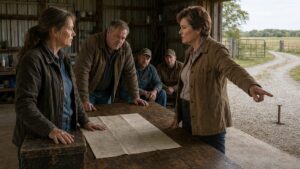
Rebecca stepped closer to the cabinet. Through the narrow gap between the doors, she could see the corners of binders and old service manuals. The records inside went back years—fuel purchases, feed bills, equipment repairs, chemical applications, water tests, handwritten notes that George trusted more than any digital system.
The missing maintenance report should have been there.
Outside, Tyler called from the pond bank. “Rebecca.”
She left George in the shed and walked down the slope.
The tanker pumps were louder now. Tyler stood on the rear platform with a thermometer probe in one hand.
“We’re at sixty-eight and a half,” he said. “Oxygen is stable, but density this high gets risky as the water warms.”
“How long?”
“I can manage until early afternoon. Maybe longer with ice, but the hatchery will make the call. They don’t want a truckload lost on someone else’s permit dispute.”
“They won’t be lost.”
“I hope not.”
His tone carried no accusation, which made it harder to hear.
Rebecca looked through the round inspection port. Shapes moved beneath the dark surface in tight flashes. Thousands of small bodies turned together, pressing against one another because there was nowhere else to go.
“If the county says no?” she asked.
“I return them.”
“And the contract?”
“You pay transport, holding, and restocking charges. Assuming the hatchery can take them back.”
Rebecca calculated without meaning to. Fuel. oxygen. labor. the second trip. The loan had covered the fish, but only barely. A failed delivery would erase the money she had reserved for winter feed.
Tyler lowered his voice. “This looked political when I pulled in. It doesn’t anymore.”
“What does it look like?”
“Like there’s something nobody wants to name.”
Rebecca turned toward the shed.
George was no longer in the doorway.
She crossed the yard to the farm office, a narrow room attached to the sorting barn. The desk held labeled folders from the rehabilitation project. Rebecca opened them one after another.
Aeration purchase.
Pond excavation.
Water-testing contract.
Diversion berm materials.
Every receipt represented a conversation in which George had said the same thing: too expensive, too much county interference, too little proof it would matter.
Rebecca had done it anyway.
She found the installation invoices beneath a binder of bank papers. Two new aerators had been mounted in September. A contractor had reinforced the spillway and replaced the cracked intake pipe. The work matched the dates she had submitted.
For a moment, relief loosened her shoulders.
The repairs were real. The clean tests were real. Brandon could distrust her motives, but he could not say the pond was only appearance.
Then a thin invoice slipped from between two thicker sheets and floated to the floor.
Rebecca picked it up.
EMERGENCY DRAINAGE-GATE REMOVAL AND REPLACEMENT.
The service date was two days after the fish kill.
A brown tide mark stained the lower corner.
The listed work included removal of a warped gate, disposal of damaged hardware, excavation around the north channel, and installation of a temporary barrier.
Rebecca read the total.
Then the handwritten note beneath it.
Old gate removed before county site visit at owner request.
She sat down slowly.
A memory came back in pieces: last summer’s storm, rain beating against the office windows, George arriving after midnight with mud to his knees. He had said the upper field was flooding. He had said the north channel had failed.
The next morning the pond had smelled metallic and sour.
By noon, fish had begun surfacing.
Rebecca had blamed the heat because George had.
She carried the invoice to the shed.
The cabinet stood open.
George was sorting through a stack of binders as if the lock had never mattered.
Rebecca placed the invoice on the workbench.
“Why was the gate removed before the county came?”
George did not look at it. “It was broken.”
“That’s not what I asked.”
“It had to be replaced.”
“Why before the inspection?”
“Because leaving failed equipment in the ground doesn’t fix anything.”
“The contractor wrote that you ordered it.”
“I hired him. Of course I ordered it.”
Rebecca pressed the invoice flat with her palm. “The pond died two days before this.”
George’s hands stopped among the binders.
Outside, one of the aerators sent a hollow slap across the water.
Rebecca said, “Did the gate fail during the storm?”
“It was old.”
“Did it fail?”
He shut the binder in front of him. “There was more rain that night than the county gauge recorded.”
“That isn’t an answer.”
“The upper field was under water.”
“And the pond?”
His eyes lifted then.
For the first time that morning, Rebecca saw fear rather than anger.
It vanished quickly.
“You rebuilt the system,” he said. “The tests are clean. That is what matters now.”
“It matters to Brandon. It matters to Carol. It matters to every farm below us.”
“What matters to them is having someone upstream to blame.”
She held up the invoice. “Where is the maintenance report?”
George’s gaze flicked toward the cabinet.
Rebecca moved past him and pulled the binders out one at a time. Equipment logs. Chemical records. Pump schedules. Nothing from August.
A dark rectangle marked the dust on the bottom shelf where one binder had recently been removed.
“You changed the lock,” she said.
“To keep county people from walking in here whenever they please.”
“They weren’t here.”
“No.”
“You were keeping me out.”
George’s mouth tightened.
Tyler appeared at the shed entrance. “Rebecca, I need you for a second.”
She did not turn.
“Say it from there.”
“The hatchery wants the truck rolling by five if there’s no release. We cannot hold overnight.”
The deadline dropped into the room and stayed there.
Rebecca looked at George. “At two o’clock, Brandon will ask what happened to that report.”
“Tell him you don’t know.”
“That would be true only if you keep lying to me.”
George picked up the invoice, folded it once, and put it back on the bench.
“I had the gate removed,” he said.
Rebecca waited.
His voice grew quieter. “Before the inspectors arrived.”
The shed seemed to narrow around them.
“Why?”
George looked past her at the silent pond.
“That,” he said, “is the part you’re not ready to hear.”
Chapter 3: The County Called It a Performance
The first image on the county meeting-room screen showed Rebecca holding the sealed discharge hose.
Someone had taken the photograph from across the pond. The tanker rose behind her, silver and enormous, while George stood near the valve and Brandon faced them with the yellow folder in his hand.
From that angle, Rebecca looked less like a farmer waiting for a permit decision and more like someone staging a confrontation.
A local reporter sat in the second row with a laptop open.
Rebecca stopped in the doorway.
Brandon was connecting his computer to the projector. “That photograph was submitted with a public complaint.”
“By whom?”
“It was unsigned.”
Carol Adams sat near the front beside two neighboring landowners. She did not meet Rebecca’s eyes.
George entered behind Rebecca and muttered, “They called a reporter.”
“No,” Rebecca said. “Someone called a reporter.”
The distinction did not calm him.
Two county board members took their seats behind a long table. One adjusted a stack of papers while the other read the emergency review notice.
Rebecca and George sat together, though a space remained between their chairs.
Brandon began with the current conditions.
“The Taylor pond passed the latest observed sampling. Dissolved oxygen, ammonia, nitrate, and phosphate readings were within stocking limits as of Monday.”
Rebecca felt several people behind her shift. That mattered. She had expected Brandon to bury the clean results beneath the missing report.
He continued. “The aeration equipment is installed and operational. The diversion berm meets the submitted design. On present chemistry alone, the pond appears suitable.”
The first board member looked up. “Then why are we here?”
“Because present chemistry does not explain the previous failure or establish whether the drainage system is reliable under storm conditions.”
George leaned toward Rebecca. “There it is.”
She kept her eyes forward.
Brandon clicked to the next slide.
A county log entry appeared, dated the week before the fish kill.
NORTH DRAINAGE MAINTENANCE REPORT—RECEIVED.
“The report itself is absent,” Brandon said. “The log shows it was received and indexed. No digital copy exists.”
The second board member addressed Rebecca. “Did you submit this report?”
“I submitted several records during the rehabilitation review.”
“That was not the question.”
Rebecca glanced at George. He stared at the screen.
“I don’t remember submitting that specific document,” she said.
The local reporter’s fingers began moving.
Brandon’s expression tightened. “The report was received under the Taylor Farm account.”
George spoke without raising his hand. “A line in a county log doesn’t prove anything.”
“It proves a document existed.”
“It proves somebody typed a line.”
The first board member warned him to wait his turn.
Brandon changed the slide again. The photograph of Rebecca returned, now beside an image of the tanker valve sealed with red plastic.
“The public concern,” he said, “is that the stocking was scheduled and witnesses were gathered before the unresolved record issue was addressed.”
Rebecca looked at him. “Witnesses were not gathered. Neighbors came because a tanker on a farm road is hard to miss.”
Carol finally turned around. “The cooperative was notified.”
“By the hatchery schedule,” Rebecca said. “Not by me.”
Brandon said, “Intent is part of what we are reviewing.”
“What intent?”
“To create pressure for approval by placing live fish on site before all conditions were satisfied.”
The word fraud did not appear, but everyone heard its shape.
Rebecca stood. “You inspected the pond Friday.”
“Yes.”
“You told me the remaining authorization was administrative.”
“I said I expected it to be administrative.”
“You knew the delivery date.”
“I did.”
“You waited until the truck was connected before you stopped it.”
A faint flush rose along Brandon’s neck. “I received confirmation of the missing report this morning.”
“And decided my stocking was a performance.”
“I said the circumstances create that concern.”
“No. You put my photograph on a screen and invited people to reach the word you don’t want to say.”
The room went still.
Brandon closed his laptop halfway. “Then answer the missing-record question.”
Rebecca remained standing.
She could say George removed the old gate. She could place the full weight of suspicion on him and keep herself clean.
Instead she sat down.
The first board member turned to Carol. “You requested time to present information.”
Carol rose with a plastic document sleeve in her hand.
Rebecca felt George stiffen beside her.
Carol approached the table and withdrew a laboratory sheet. “This sample was taken from my irrigation pond the morning after the Taylor fish kill.”
“Was it collected under county observation?” Brandon asked.
“No. I took it to the agricultural extension lab myself.”
“Then it cannot be treated as enforcement-grade evidence.”
“I know what it cannot be treated as.” Carol placed it on the table. “I also know what it cost me.”
The board member examined the sheet.
Carol continued. “The nitrate level was more than four times my normal seasonal reading. I shut down irrigation for twelve days. I lost half an acre of late beans because I would not pump that water onto them.”
Rebecca turned fully toward her.
Carol’s face held no triumph.
Only exhaustion.
“You never told me,” Rebecca said.
“I told George.”
George’s hands closed around the brim of his cap.
“When?” Rebecca asked.
“The day after I got the result.”
George said, “Her sample wasn’t official.”
Carol looked at him. “My dead plants were official enough.”
A murmur moved through the room.
Rebecca remembered Carol at the feed store last fall, asking whether the pond repairs were holding. Rebecca had answered with aerator specifications and lab numbers. Carol had listened without mentioning the irrigation shutdown.
Because she had already spoken to George.
And because George had taught everyone around him that concerns brought privately would remain private until they disappeared.
The second board member addressed Brandon. “Does this downstream result change your assessment?”
“It supports the possibility that runoff contributed to the fish kill. It does not identify the source.”
“But combined with the missing drainage report?”
“It justifies continued suspension.”
Rebecca looked at Carol. “Has your pond recovered?”
“Mostly.”
“Mostly isn’t an answer.”
“The nitrate levels returned to normal after the fall rains. The soil tests improved in spring.”
A small piece of pressure inside Rebecca released. The damage had not been permanent.
But Carol had paid for George’s silence in lost crop and fear.
Brandon reopened his laptop. “The county must also consider whether material information was omitted from the rehabilitation application.”
Rebecca’s attention snapped back to him.
“What material information?”
“The emergency replacement of the north drainage gate.”
George said nothing.
Brandon placed a copy of the stained invoice on the screen.
Rebecca stared at it.
She had left the original in the shed.
“You entered our office?” she asked.
“No. A contractor confirmed the work order after I called this morning.”
The listed note was visible to the entire room: old gate removed before county site visit at owner request.
The reporter’s typing quickened.
Brandon said, “If this invoice was known to the applicant and intentionally excluded, the county may refer the matter for permit falsification review.”
Rebecca felt every eye turn toward her.
She could still say she had never seen it until that morning.
That would be true.
But only narrowly.
Months earlier, while assembling the application, she had found a bank payment to the same contractor. George had told her it covered storm cleanup. She had accepted the explanation because pressing him would have delayed the permit and because some part of her had not wanted the details.
Silence had not begun with the missing invoice.
It had begun with the question she chose not to ask.
The first board member spoke more gently. “Ms. Taylor, were you aware the gate had been replaced?”
Rebecca looked at George.
He did not ask her to protect him.
He did not need to.
“I knew work had been done after the storm,” she said.
“Did you know the old gate was removed before inspection?”
“Not until today.”
“Did you disclose the repair payment?”
Rebecca’s mouth went dry. “No.”
Brandon’s face changed—not satisfaction, but confirmation of something he had feared.
The board members called a brief recess.
Rebecca walked into the hallway before George could follow.
Carol came out behind her.
“I wasn’t trying to ruin you,” Carol said.
Rebecca stared through the glass doors toward the parking lot. “You thought I knew.”
“I thought you knew enough.”
That was worse because it was true.
Her phone vibrated.
The caller was the bank loan officer.
Rebecca answered.
The officer’s voice was formal and apologetic. The rehabilitation loan had been placed under immediate review. No additional funds would be released until the county resolved the permit and disclosure questions.
Rebecca looked through the glass at George approaching from the meeting room.
“How much is frozen?” she asked.
“All remaining disbursements.”
“That includes winter feed.”
“Yes.”
“And the hatchery balance.”
A pause.
“Yes.”
George stopped when he saw her face.
Rebecca ended the call.
For the first time all day, he looked uncertain.
“What happened?” he asked.
“The bank froze the loan.”
His shoulders dropped a fraction.
Rebecca put the phone in her pocket.
“At home,” she said, “you are going to show me the missing report.”
George looked toward the meeting room, where the photograph of her holding the sealed hose still glowed on the screen.
Then he said, “There’s something on it you need to understand before you decide whose fault this is.”
Chapter 4: What George Saved During the Flood
The missing report lay in the middle of the kitchen table, but George kept one page folded beneath his hand.
Rebecca remained standing.
The county notice was still in her coat pocket. The bank’s words—immediate review, no additional disbursements—seemed to have followed her into the farmhouse and settled among the unpaid invoices, the chipped salt shaker, and the clock ticking above the sink.
“Move your hand,” she said.
George looked at the report instead of her. “You wanted to know what happened.”
“I want the whole report.”
“You need the order of it.”
“That sounds like you deciding which truth I can handle.”
His fingers stayed on the folded page.
Rebecca pulled out the chair across from him but did not sit. Through the window behind George, the upper field sloped toward the dark line of the north channel. In autumn it looked harmless—cut rows, pale stubble, a drainage ditch no wider than a truck bed.
Last summer, water had covered nearly all of it.
George unfolded the first pages. Handwritten maintenance notes filled the margins beside typed inspection boxes. The gate had shown corrosion in spring. The hinge assembly had shifted by early June. A contractor recommended full replacement before storm season.
“You knew it was failing,” Rebecca said.
“I knew it needed work.”
“That means yes.”
“It means the estimate was thirty-eight thousand dollars.”
“We spent more than that rebuilding the pond.”
“After the operating loan came through.”
“The loan you may have just cost us.”
George’s jaw tightened, but he did not argue.
He turned to a rainfall map and tapped a blue line with one blunt finger. “The storm stalled over the ridge. The county gauge caught four inches. We got closer to seven.”
Rebecca remembered the sound on the metal roof that night. It had been too loud for conversation. She had gone home early because George insisted he could handle the runoff checks.
“You should have called me.”
“You had been awake thirty hours during calving.”
“This was my farm too.”
“Not on the bank papers.”
The sentence struck with the old precision of a tool kept sharp.
Rebecca finally sat.
George continued. “The north gate jammed half-open. Water backed across the upper field. Corn was already under contract. If we lost that crop, the bank took the operating line.”
“So you opened the channel.”
“I tried to clear the gate.”
“With what?”
“The loader.”
Rebecca stared at him.
George rubbed his thumb along the report’s edge. “The frame twisted. Once it moved, it would not close.”
The north channel did not lead directly to the pond. It crossed behind the equipment shed, collected runoff from the upper field, and emptied into a settling basin before reaching the pond’s shallow end.
Unless the settling basin overflowed.
Unless years of sediment had reduced its capacity.
Unless fertilizer and chemical residue had been carried with the floodwater.
“What was on the field?” Rebecca asked.
“Same application as every season.”
“What was on it that week?”
George looked toward the window.
“Dad.”
“Nitrogen. Herbicide from the first pass. Nothing outside label.”
“That isn’t what I asked.”
He leaned back. “You want me to say poison because it makes the story simpler.”
“I want you to say what went into the pond.”
“Runoff.”
“From a field you chose to save.”
“A field that paid the mortgage.”
“And the pond paid for it.”
George’s chair scraped as he stood. “You think I don’t know that?”
The room went still.
His voice had risen only once, but it changed him. For months Rebecca had seen him treat the fish kill like a problem of weather, equipment, and paperwork. Now his face held the strain of someone who had replayed the same decision too many times.
He walked to the sink and gripped its edge.
“The bank called three days before the storm,” he said. “They were not extending us again. Not after the feed losses. Not after your mother’s hospital bills. The upper field was the only crop already contracted at a price that covered the note.”
Rebecca looked down at the report.
Her mother had died two winters earlier. The bills had come long after the funeral, each envelope reopening a fact the house had barely learned to hold.
“You never told me the bank was that close.”
“You had just come back.”
“I came back to help.”
“You came back because you promised her.”
Rebecca’s head lifted.
George did not turn. “That is not the same thing.”
The words hurt because she had wondered the same thing on nights when the farm felt less like a choice than an instruction left by the dead.
He continued. “If the field went under, the bank sold the place. House, pond, barn, all of it. I had maybe twenty minutes before the water crossed the access road.”
“So you used the loader.”
“I pulled the gate clear.”
“And sent everything downhill.”
“I sent water where the channel was built to carry it.”
“You knew the basin had not been dredged.”
His silence answered.
Rebecca pressed both palms against the table.
For the first time, she could see the decision as he had seen it: darkness, floodwater rising against a crop, a bank deadline, an old machine, no time to call anyone. Not cruelty. Not indifference.
Desperation sharpened into action.
But the fish had still surfaced by the hundreds.
Carol had still shut down her irrigation.
George returned to the table and sat.
“I thought the basin would hold,” he said. “By the time I knew it had overtopped, the pond was already taking brown water.”
“What did you do then?”
“Started the aerators. Called the feed-store owner for extra pumps. Called you at dawn.”
“You told me the gate failed.”
“It did.”
“You did not tell me you tore it out.”
“No.”
“Why remove it before the county inspection?”
“Because the frame showed loader damage.”
Rebecca closed her eyes briefly.
There it was.
Not one desperate decision, but the second decision afterward. The one made in daylight.
George pushed the first pages toward her. “The contractor replaced it. I filed the maintenance report. I did not erase the county log.”
“But you took the report.”
“Yes.”
“From the county office?”
“No. The clerk called because the attachments were incomplete. I said I would bring a corrected copy. She let me take the original.”
“And you never brought it back.”
“No.”
Rebecca looked at the folded page beneath his hand.
“What is on that one?”
George’s face changed again. The anger left it. What remained was worse.
He moved his hand.
Rebecca unfolded the page.
It was an inspection checklist dated six weeks before the storm. The north gate’s hinge condition was marked acceptable. The settling basin was marked clear. The monthly review box carried a set of initials.
R.T.
For several seconds she did not understand.
Then the memory arrived.
It had been a hot June afternoon. George had left the checklist on the truck seat with a note asking her to sign before she drove into town. She had been late for a hatchery meeting. She had glanced at the previous month’s entries, assumed nothing had changed, and written her initials.
She had not walked the channel.
She had not checked the basin.
She had signed because George always handled the upper drainage and because arguing over paperwork took longer than trusting him.
“I didn’t inspect it,” she said.
“I know.”
“You submitted this.”
“You were the designated operator by then. The county needed your initials.”
“You asked me to sign something you knew was false.”
“I asked you to sign a routine sheet.”
“It was not routine if the gate was failing.”
“The worst hinge movement happened later.”
“But the basin was already full of sediment.”
George looked down.
Rebecca heard the faint rattle of the old window frame. Outside, near the equipment shed, a hose pumped muddy water from a low trench left by the storm. Its uneven flow struck a steel drain pan—rush, pause, rush again.
“You could have shown me this before the application,” she said.
“I was trying to keep your name out of it.”
“My name is already on it.”
“I could say you signed at my direction.”
“That would be true.”
“I could take responsibility.”
“You cannot take my hand and make it write initials.”
George’s shoulders sagged.
Rebecca studied the page again. Her own handwriting looked careless, almost casual. She had spent months believing she was repairing damage that belonged to her father.
Now the paper showed something harder.
She had helped create the conditions for the lie because silence had been easier long before the fish died.
George reached for the report.
Rebecca pulled it away.
“I’m taking this to Brandon.”
“If you do, they may revoke your operator status.”
“They may do worse if they find it another way.”
“The farm will not survive a full investigation.”
“The bank already froze the loan.”
“I can sell equipment.”
“And then what? Pretend the next storm won’t come?”
George’s eyes hardened with old instinct. “You think confession will make them fair?”
“No.”
“Then what does it make?”
Rebecca folded the report carefully and slipped it into the plastic sleeve with the county notice.
“It makes the record true.”
George stared at her as if she had answered in a language he did not trust.
She stood and walked toward the door.
Behind her, he said, “You signed it because I told you everything was fine.”
Rebecca stopped with her hand on the knob.
“That is why I believed you,” she said. “It is not why I chose not to look.”
Chapter 5: The Truth Rebecca Had Already Seen
Carol found Rebecca kneeling beside the downstream culvert before sunrise, filling a glass sample bottle with water that numbed her fingers.
“You planning to hide that test too?”
Rebecca nearly dropped the cap.
Carol stood on the bank in rubber boots and a heavy coat, holding a flashlight low against her leg. The beam caught wet grass, rusted fencing, and the narrow current flowing from the Taylor pond toward her property.
Rebecca tightened the cap. “You always walk drainage ditches in the dark?”
“Only when my neighbor calls a county meeting and forgets to tell me why.”
“I haven’t called one yet.”
“You will.”
Rebecca placed the bottle in the cooler beside three others. “How do you know?”
“Because you are either out here collecting proof for another argument, or you finally decided proof isn’t the only thing missing.”
The water moved between them with a soft, continuous sound.
Rebecca stood and wiped her hand on her jeans. “The old gate was failing before the storm.”
Carol’s expression remained guarded.
“George knew,” Rebecca continued. “He pulled it out with the loader to save the upper field. The settling basin overflowed into the pond.”
Carol looked toward the dark ridge. “That explains the nitrate.”
“There was also herbicide residue. Probably diluted, but enough combined with the oxygen crash.”
“Probably?”
“I’m not going to give you certainty I don’t have.”
“That would be new.”
Rebecca accepted the blow.
Carol shifted the flashlight toward the cooler. “What are you testing now?”
“Nitrate, phosphate, ammonia, herbicide screen, dissolved oxygen. Here, the pond outlet, your intake, and below your lower field.”
“You already passed the county tests.”
“I need to know whether the clean result holds all the way down.”
Carol studied her face. “What changed since yesterday?”
Rebecca opened the truck door and removed the plastic sleeve containing the report. She handed it over.
Carol read beside the flashlight. When she reached the signed checklist, she looked up.
“Those are your initials.”
“Yes.”
“You inspected the gate?”
“No.”
The single word seemed to alter the temperature between them.
Carol lowered the paper. “Then you were part of it.”
“Yes.”
Rebecca expected anger. Instead Carol sat on the truck’s running board as if the answer had removed strength from her knees.
“You stood in that county room and let me think George had kept all of it from you.”
“He kept the storm decision from me.”
“That was not what I said.”
“No.”
Carol read the page again. “When did you first suspect runoff?”
Rebecca looked toward the culvert.
The honest answer had several dates.
The morning of the kill, when the water smelled wrong.
The week after, when she found brown sediment beyond the basin.
Months later, when the contractor payment appeared in the bank records.
She had treated each sign as incomplete because incomplete signs did not force complete decisions.
“Before I filed the rehabilitation application,” she said.
Carol folded the report along its existing crease. “How much before?”
“Two months.”
“And you left out the gate invoice.”
“I had not seen the invoice itself.”
“But you saw the payment.”
“Yes.”
Carol handed back the report. “You are careful with words.”
“I have been.”
“That is not the same as being truthful.”
“No.”
The admission seemed to surprise them both.
Carol stared at the current. “My insurer wanted proof the contamination was not ongoing. I paid for three private tests because the county could not identify the source. My operating line went up because the claim stayed open.”
“I did not know.”
“You did not ask.”
Rebecca closed the cooler.
“No,” she said. “I didn’t.”
A truck engine sounded on the farm road. Tyler’s tanker lights appeared through the trees, moving slowly toward the pond.
Carol rose. “What happens to the fish?”
“If the permit stays frozen, Tyler takes them back.”
“And your money?”
“Most of it goes with them.”
Carol’s mouth tightened. She knew what that meant in a county where farms rarely failed all at once. They lost one machine, one field, one season at a time until there was nothing left worth calling a farm.
“Your upper field still carries the mortgage?” she asked.
“Yes.”
“What will you do if the bank closes the line?”
“Lease part of it. Sell the newer tractor. Cut winter production.”
“George agree to that?”
“He does not know yet.”
Carol gave a short breath that was almost laughter. “You are planning honesty in sections.”
Rebecca looked at her.
Carol stepped closer. “I will support the stocking if the water is safe.”
Rebecca waited.
“But only if you tell the county everything. The gate. The report. Your initials. The application omission.”
“That could end the farm.”
“So could another storm.”
“The new system is stronger.”
“That is what George thought about the basin.”
Rebecca felt the sentence settle where argument could not dislodge it.
Carol pointed toward the sample cooler. “If those results are clean, I will say so publicly. I will also ask for shared monitoring at my intake.”
“For how long?”
“As long as Brandon thinks the system needs proving.”
“That could be years.”
“Yes.”
Rebecca looked back at the pond. From here, through the trees, its surface was invisible. She could hear the aerators, though—a low mechanical churn against the morning quiet.
“What do you get out of supporting me?” she asked.
Carol’s face hardened. “Do not make this smaller than it is.”
“I need to know.”
“I get a neighbor who stops deciding what information I can afford to live without.”
That answer was enough.
They drove back separately.
At the pond, Tyler stood beside the tanker with his phone pressed to his ear. George waited near the valve, arms folded.
Rebecca had barely stepped from the truck when Tyler ended the call.
“Hatchery wants me rolling by noon,” he said. “No extension.”
“It is not even seven.”
“They need tank space. If these fish return stressed, they have to separate and monitor them. They will not accept a night arrival.”
“What if approval comes at eleven-thirty?”
“We stock.”
“And if it comes at twelve-oh-five?”
“I follow the hatchery order.”
George stepped forward. “We can have them in the pond in ten minutes.”
Rebecca ignored him. “How are the oxygen levels?”
“Acceptable. Temperature held overnight because we added ice. But we are at the edge of what I’m willing to call routine.”
Carol parked beside the access road and walked toward them.
George saw the report sleeve under Rebecca’s arm.
“What did you do?”
“Tested downstream.”
“That is not what I asked.”
“I showed Carol the report.”
His face closed.
“You had no right.”
“It has my initials on it.”
“It is farm business.”
“It became her business when the runoff reached her pond.”
Tyler moved away toward the cab, giving them the small privacy available in an open field.
George lowered his voice. “You hand that to Brandon and he will bury us.”
“He already has the contractor invoice.”
“Not this page.”
“He needs it.”
“You need the stocking.”
Rebecca looked at the hose. Mud had dried inside the lower section where it had rested on the bank. She carried it toward the utility spigot, connected a smaller rinse line, and opened the water.
Brown residue ran from the hose mouth into the gravel.
George watched her. “What are you doing?”
“Cleaning it.”
“We cleaned it yesterday.”
“Not inside the last bend.”
The water cleared slowly.
She remembered how she had approached every part of the rehabilitation: scrape, replace, test, document. Physical work had rules. Dirt came loose or it did not. Pumps ran or failed. Water crossed a marked line.
Truth did not behave that way. It remained in the shape of what had carried it.
Tyler returned from the cab. “Ten minutes until I start disconnecting auxiliary lines for transport prep.”
Rebecca shut off the rinse water.
She took out her phone and called Brandon.
He answered on the fourth ring. “Mitchell.”
“This is Rebecca Taylor.”
“I know.”
“I have the missing maintenance report.”
Silence.
“All pages?” he asked.
“Yes.”
“Where did you get it?”
“From my father.”
Another pause. “Bring it to the office.”
“No. Come to the pond.”
“Ms. Taylor—”
“Bring the board members. Bring the county sampler. Bring whatever transfer forms you need.”
“For what?”
Rebecca looked at George.
His face carried anger, fear, and something that might have been recognition.
“For the truth you were missing,” she said. “And for conditions under which these fish can legally go into the water.”
“You understand disclosure does not guarantee approval.”
“I understand.”
“It may trigger enforcement.”
“I understand that too.”
Brandon’s voice softened, but only slightly. “How soon?”
“Before noon.”
She ended the call.
George stared at her. “You just gave him the knife.”
“No,” Rebecca said. “I stopped pretending it wasn’t already in the wound.”
Chapter 6: She Stopped the Release Herself
Water jolted through the hose before Brandon finished reading the first condition.
The black line kicked against the gravel, wrenching sideways in Rebecca’s hands. A burst of cloudy water struck the pond bank, and the gathered neighbors stumbled back.
“Close it!” Tyler shouted.
Rebecca turned toward the tanker.
George stood at the valve wheel.
The red county seal hung broken from the metal housing.
For one second, no one moved. Then pressure built again, swelling the hose beneath Rebecca’s grip.
“Dad!”
“The fish are going in,” George said.
Brandon dropped the document folder. “Shut that valve now.”
George turned the wheel farther.
Water surged.
Rebecca threw her weight across the hose, forcing the mouth away from the pond. It bucked against her hip. The flow carved a trench through the gravel and splashed mud over her jeans.
Tyler ran toward the valve, but George blocked him with one arm.
“You send them back now, half will die,” George said.
“You open without equalizing pressure, you can kill them here,” Tyler snapped.
Rebecca dragged the hose toward the steel clamp mounted on the sorting stand. Her boots slid in the wash. The pond was less than six feet away.
Someone shouted for her to let go.
She did not.
She jammed the hose into the clamp cradle and pulled the lever down. It stopped halfway as pressure fought the jaws.
Brandon reached her first. “Release it before it throws you.”
“Push the lever.”
“We need the main valve closed.”
“Push.”
He put both hands over hers.
Together they forced the lever down until the clamp locked with a metallic crack.
The hose swelled hard between the tanker and the stand. The flow stopped at its mouth.
Tyler slipped past George and spun the main valve closed. The pumps continued humming. Inside the tanker, water struck metal in uneven waves.
Rebecca stood bent over the clamp, breathing through her teeth.
Mud ran from her sleeves.
George stared at her.
“You chose him,” he said.
Rebecca straightened slowly. “I chose not to dump live fish into a pond under a broken order.”
“The order was about paperwork.”
“The order is about us.”
The county board members had arrived minutes earlier with Brandon. Carol stood near them holding copies of the new downstream test results, which had come back clean on the rapid screen. The local reporter remained beside a pickup, phone lowered now, her face pale from the sudden surge.
Brandon retrieved his folder from the mud.
“The unauthorized discharge is another violation,” he said, but his voice lacked the sharpness it had carried the day before.
Rebecca looked at the broken seal. “Put it on my record.”
George stepped toward her. “You think taking every blame they offer makes you honest?”
“No.”
“Then stop helping them ruin us.”
Rebecca pulled the plastic sleeve from beneath her coat. The report inside had stayed dry.
“I am going to read what happened,” she said.
“Rebecca.”
“All of it.”
The neighbors formed a loose half-circle around the tanker. No one had been invited to speak, yet no one left.
Rebecca gave the report to Brandon.
He examined the pages, stopping at the checklist bearing her initials.
“You signed this inspection?” he asked.
“Yes.”
“Did you perform it?”
“No.”
George said, “I told her the gate was fine.”
Rebecca did not look at him. “I signed without checking. Later, while preparing the rehabilitation application, I found a contractor payment that suggested drainage work after the storm. I did not ask for the invoice. I submitted the application without disclosing the payment.”
Brandon’s eyes lifted. “Why?”
“Because I believed the pond was repaired.”
“That is not an answer.”
The words were the same ones Rebecca had used on George.
She understood now why they hurt.
“Because asking would have delayed the permit,” she said. “And because I suspected the answer would involve my father.”
George turned away.
Rebecca continued before she could soften it.
“During the storm, the north gate jammed. My father used the loader to pull it out so water would drain from the upper field. The settling basin overflowed. Runoff entered the pond and traveled downstream.”
One of the neighbors swore quietly.
Carol did not move.
George faced the group. “The field was under contract. The bank was days from foreclosure.”
Rebecca looked at him then.
He held himself rigid, but his hands trembled.
“I thought the basin would carry it,” he said. “It did not. I had the damaged gate removed before the county inspection because the loader marks would have shown what I did.”
Brandon asked, “And the maintenance report?”
“I took it back from the clerk and never returned it.”
The first board member wrote something on a legal pad. “You understand those admissions may result in penalties.”
George gave a tired nod. “I understand.”
Rebecca stepped beside him, not in front.
“The current system is repaired,” she said. “The clean tests are real. But I will not ask you to trust one morning’s samples or my word.”
She handed Brandon a single page she had drafted in the farm office.
“I will accept independent monitoring at the pond outlet and Carol’s intake after every qualifying storm. I will place drainage inspection under the watershed cooperative, not the farm alone. All reports go directly to the county and affected downstream owners.”
Carol read over Brandon’s shoulder.
“For how long?” the second board member asked.
“Three years minimum. Longer if the county’s thresholds are exceeded.”
George’s head snapped toward her. “Do you know what that costs?”
“Yes.”
“We cannot pay it.”
“We lease part of the upper field.”
His face went still.
Rebecca continued. “We cut winter production. Sell the newer tractor if we have to.”
“That field keeps this place alive.”
“It nearly killed everything below it.”
George stepped close enough that only she could hear. “Your mother asked you to keep the farm.”
“She did not ask me to keep every acre under our control.”
The words left him with nothing immediate to fight.
Tyler checked the tanker gauge again. “Forty minutes.”
Brandon looked from the report to the pond. “I need to be clear. Disclosure does not erase the violation.”
“I know.”
“The permit could still be suspended.”
“I know.”
“And the unauthorized opening just now—”
“Was not Rebecca,” Carol said. “We all saw who broke the seal.”
George looked at her.
Carol held his gaze. “That does not make her omission disappear. It makes the record accurate.”
Brandon rubbed mud from the folder’s edge. “Yesterday I suggested the stocking may have been staged to force county approval.”
Rebecca waited.
“I did not have sufficient evidence to characterize it as fraud,” he said. “I should not have allowed that implication into a public review.”
The reporter raised her phone again.
Brandon noticed and spoke more carefully. “The restoration work is substantial and the current tests are compliant. My concern was driven by the missing record and by a previous rehabilitation failure I approved in another county. That does not excuse an unsupported accusation.”
It was not an apology polished for comfort. It was narrower and more useful.
Rebecca nodded once.
The first board member asked Brandon, “Can conditional stocking proceed under emergency livestock authority?”
“Only if operational control is assigned to the permit holder who disclosed the violation, the monitoring agreement is executed, and Mr. Taylor is removed from drainage and pond decisions pending enforcement review.”
George laughed once without humor. “Removed from my own farm.”
“From regulated operations,” Brandon said. “Ownership is separate.”
Rebecca took the transfer form from the folder.
The line naming the responsible operator was blank.
She signed first.
Then she placed the pen in front of George.
He did not touch it.
Tyler called, “Thirty minutes.”
The tanker pumps seemed louder than before. The fish inside could not understand permits, family promises, or old storms. Their world had narrowed to temperature, oxygen, and time.
George looked at the upper field beyond the pond.
“I built that drainage line with my father,” he said.
Rebecca waited.
“He never asked the county before he changed anything on his land.”
“That is part of how we got here.”
George’s mouth tightened.
She pushed the form closer. “Signing does not make you nothing.”
“It makes me a guest.”
“It makes you my father instead of my operator.”
His eyes lifted to hers.
For months she had feared that truth would reduce him to his worst choice. Standing beside the broken seal, she saw the other danger: allowing him to remain only the man who controlled the farm because neither of them knew what else they could be to each other.
George took the pen.
He signed.
The first board member added the county approval beneath it. Carol signed the shared-monitoring agreement. Brandon attached a new seal tag but left it unfastened, waiting for the final valve authorization.
Tyler began reconnecting the release line.
Rebecca checked the clamp, flushed the hose, and positioned its mouth over the pond.
No one spoke while she worked.
George stood behind her, farther from the valve than he had ever stood during a stocking.
When everything was ready, Brandon handed her the authorization sheet.
“Under the conditions listed,” he said, “the release may proceed.”
Rebecca read every line.
Then George spoke behind her.
His voice was quiet, stripped of command.
“Open it properly.”
Chapter 7: When the Water Finally Moved
Rebecca opened the valve while every person on the pond bank watched the water.
The wheel resisted at first. Mud had dried inside its grooves, and her palms were still raw from forcing the clamp shut. She adjusted her grip and turned again.
Behind her, Tyler called, “Slow. Let the line fill.”
The tanker shuddered as water entered the hose. Its black length rose from the gravel one section at a time, swelling with pressure until it formed a heavy curve between the truck and the pond.
Rebecca held the discharge end over the bank.
Nothing came out.
The pumps continued their steady hum. Water moved inside the tanker, but the hose remained silent.
Tyler glanced at the pressure gauge. “Air pocket.”
“How long?” Carol asked.
“A few seconds.”
Ten passed.
The gathered neighbors stood without speaking. The county sampler waited beside an open equipment case. One board member held the signed monitoring agreement against his coat to keep the pages from lifting in the breeze.
George remained behind the marked line Brandon had established around the valve controls. His hands hung empty at his sides.
Rebecca felt the hose pulse.
A weak stream spilled from its mouth and ran down the bank. The water was clear except for a trace of sediment from the line.
No fish appeared.
Tyler stepped closer. “Increase it one quarter turn.”
Rebecca looked toward Brandon.
He nodded.
She turned the valve.
The stream thickened into a hard arc that struck the pond with a bright, hollow splash. Foam spread across the surface. The force of the discharge pulled at Rebecca’s shoulders, but she kept the hose steady.
Still no fish.
A hatchery worker climbed onto the tanker platform and looked through the inspection port.
“What do you see?” Tyler called.
“They’re moving.”
“Toward the outlet?”
A pause.
“Hard to tell.”
Rebecca’s stomach tightened.
The fish had been held through the night, chilled, aerated, disturbed by the false start, then shut behind a clamped line while people argued over documents. Transport stress could weaken them without leaving an obvious sign.
The water pouring into the pond looked clean and lifeless.
George took one step toward the boundary.
Brandon raised a hand. “Stay back.”
“I’m not touching anything.”
“Then stay where you are.”
George stopped.
Rebecca did not turn toward either man. She watched the widening circle of foam, searching for a flash of silver or the dark line of a fin.
Tyler checked the gauge. “Open another quarter.”
“That much pressure could bruise them,” Rebecca said.
“Not at this drop. We need enough flow to carry them through the bend.”
She turned the wheel again.
The hose kicked once.
Something small struck the surface and vanished.
Rebecca leaned forward.
A second shape slid through the water, rolled on its side, then righted itself and darted beneath the foam.
“There,” Carol said.
Another fish emerged.
Then five.
Then the hose seemed to release everything it had been holding.
Bass and bluegill poured into the pond in a dense, flashing surge. Their bodies struck the surface in overlapping arcs, turning the quiet water white. Some vanished immediately into the deeper channel. Others circled near the discharge, disoriented by sudden space and daylight.
The pond erupted around them.
A neighbor laughed once in disbelief. The sound was swallowed by rushing water and the slap of fish against the surface.
Rebecca tightened her grip as the hose shifted under the weight of the living stream. Tyler stood beside her, one hand near the clamp but not interfering.
“Flow is good,” he said. “Keep that angle.”
She lowered the mouth slightly so the fish entered with the water rather than falling through open air.
For several minutes there was no room in her mind for the county, the bank, or the report. There was only pressure through the hose, the trembling in her arms, and the movement spreading outward across the pond.
The first fish reached the shadow beneath the far-bank reeds.
Then another school followed.
They did not remain crowded at the release point. They dispersed into the restored channels Rebecca had deepened, past the new aerator lines and toward the cooler center water.
That mattered more than the spectacle.
It meant they were strong enough to choose where to go.
The discharge weakened as the tanker emptied. Tyler signaled Rebecca to reduce the valve. The final fish slid through among bubbles and a wash of clear water.
“Hold it,” he said.
She kept the line open until the hatchery worker confirmed the tank was empty.
Then Rebecca closed the valve.
The hose softened in her hands.
For the first time since the truck had arrived, the pond was no longer silent. Aerators churned at the far end. Small fish broke the surface near the bank. Water tapped steadily from the hose mouth onto the gravel.
No one applauded.
The board members collected their documents. The county sampler began filling bottles at the outlet. Neighbors spoke in low voices about testing schedules and access to the monitoring station.
The practical world returned immediately.
Brandon approached Rebecca with a carbon copy of the agreement.
“First storm inspection is mandatory if rainfall exceeds two inches in twenty-four hours,” he said.
“I read it.”
“Results go to the county and cooperative simultaneously.”
“I know.”
“If the downstream threshold is exceeded, stocking density will be reduced next season.”
Rebecca folded the copy and placed it in her coat. “I understand.”
Brandon looked at the pond. “The release appeared healthy.”
“That is not the same as survival.”
“No.”
They stood together for a moment, watching the foam clear.
Then he said, “The enforcement review will still proceed.”
“I expected it.”
“Your operator certification may be placed on probation.”
“I expected that too.”
He looked as if he wanted to say something more, but settled for a nod before joining the sampler.
Carol came next.
“The rapid screen from the culvert was clean,” she said. “Full lab results take three days.”
Rebecca looked downstream. “You will have them before I do.”
“That was the agreement.”
“Yes.”
Carol pushed her hands into her coat pockets. “I meant what I said. I’ll support the farm while the system proves itself.”
“That is not forgiveness.”
“No.”
Rebecca appreciated that Carol did not offer it.
George waited until the others had begun leaving.
He approached the pond but stopped several feet from Rebecca. The signed transfer form had removed him from the operation with a few lines of ink, yet habit still drew his eyes toward every gauge and connection.
“The angle was good,” he said.
Rebecca looked at him.
“For the hose,” he added. “Kept them from dropping too hard.”
“Tyler showed me years ago.”
George nodded as though he had forgotten.
The tanker engine started behind them. Tyler and the hatchery workers drained the remaining lines and secured the fittings. Soon the truck pulled away, leaving deep tire impressions in the damp access road.
Without it, the pond bank seemed wider.
George looked toward the upper field. “You really mean to lease it?”
“Part of it.”
“To whom?”
“The feed-store owner knows a farmer looking for additional acreage.”
“He will run soybeans into the ground.”
“The lease will include a conservation plan.”
George gave her a sidelong glance. “You put conditions on everything now.”
“I should have sooner.”
He accepted that without answering.
The financial changes came over the next several weeks.
The newer tractor was sold to cover the hatchery balance and the first year of monitoring. The upper field was divided, with the steepest section converted to permanent grass above the drainage channel. Winter production was reduced. Rebecca canceled equipment purchases she had considered essential and repaired older machinery instead.
The farm survived, but not in the shape George had spent his life defending.
He stopped coming to the daily work meetings after the county placed his operational restriction in writing. At first he remained in the farmhouse whenever inspectors visited. Later, he began driving into town during sampling days.
Rebecca did not ask whether it was anger or shame.
She had learned what happened when silence was mistaken for patience, but she had not learned how to force words from someone without repeating the same kind of control.
The first heavy winter rain came in December.
Rebecca and Carol met at the monitoring station before dawn. Water moved strongly through the culvert, but the new basin held. The gate closed cleanly. Samples from the outlet and Carol’s intake returned below county thresholds.
In January, another storm passed.
The results held again.
By early spring, the pond no longer required Rebecca to imagine whether the stocking had survived. Fingerlings appeared in the shallows on warm afternoons. Larger fish struck insects near the aerators at dusk.
One evening, Rebecca finished checking the downstream gauge and heard a sharp splash behind her.
Then another.
The sound carried across the pond—quick, alive, impossible to confuse with a pump.
She wrote the readings in the monitoring log and locked the station cabinet.
When she turned toward the access road, George stood outside the new fence.
The county had required the fence around the operational area after the broken seal. George could enter the farmhouse and fields, but the pond controls were now under Rebecca’s key.
He rested one hand on the top rail.
“You left the lower gate open,” he said.
“The livestock gate, yes.”
“This one is locked.”
“Yes.”
He looked past her toward the pond. A fish broke the surface near the reeds, leaving rings that widened through the evening light.
“I heard them from the road,” he said.
Rebecca took the key from her jacket.
For a moment, the old reflex returned: make him explain why he had come, decide whether he had earned entry, protect the fragile order she had built.
Then she understood that the fence marked authority, not affection.
She unlocked the gate and swung it inward.
George did not move immediately.
“You cannot touch the controls,” she said.
“I know.”
“You cannot sign inspections.”
“I know.”
“If you see something wrong, you tell me. You do not fix it first and explain later.”
His mouth tightened, but he nodded.
Rebecca stepped aside.
George entered without looking at the valve station. He walked to the bank and stopped where the discharge hose had once lain silent across the gravel.
Another fish struck the surface.
He watched the rings spread.
Rebecca stood beside him, close enough that their shoulders nearly touched, but neither pretended the distance between them had disappeared.
The pond kept moving anyway.
The story has ended.