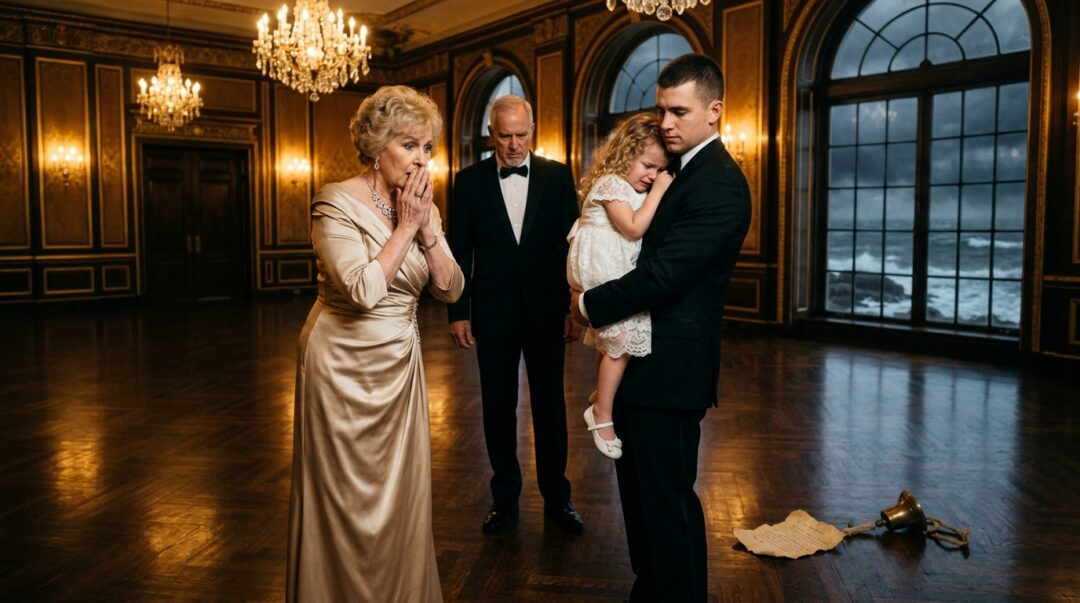
The Brass Bell That Uncovered The Buried Fortune Of Newport
CHAPTER 1: THE BRONZE RECKONING
The October gale drove salt-frosted rain against the twelve-foot leaded windows of Miramar Manor, but inside the gilded ballroom of the Newport estate, the scent of white gardenias and vintage champagne suffocated the air. Two hundred members of the Atlantic maritime aristocracy milled beneath crystal chandeliers that tinkled like crystal knives whenever the wind shook the slate roof. Julian Vance adjusted the starched collar of his tuxedo, his gaze never drifting far from his five-year-old niece. Clara looked small and radiant in her ivory flower-girl dress, her honey-blonde curls bouncing as she carefully gathered fallen satin ribbons near the dessert banquet.
Julian’s family had once owned the deep-water moorings visible through the rain-streaked glass. That was before October of 1996, before the cargo vessel Vance Mariner broke apart in the outer harbor and took his father Thomas to the bottom of Narragansett Bay. The state inquiry had branded Thomas Vance a negligent gambler who scuttled his own vessel for insurance, leaving the family name in ashes and clearing the way for Sterling Maritime Logistics to seize the entire deep-water waterfront. Julian had spent his entire youth carrying that shame through the Coast Guard Academy, enduring the sideways glances and whispered insults of men whose families made fortunes on the docks his father had built.
Across the polished parquet floor, Victoria Sterling held court. At fifty-six, the chairperson of Sterling Maritime possessed the rigid posture of a marble column, draped in shimmering champagne silk that brushed the floor. Her French twist was immaculate, her sapphire eyes sharp and predatory. Julian watched her set her heavy, beaded evening clutch on a velvet settee before turning to flatter an associate justice of the Rhode Island Supreme Court. Every move she made was calculated theater, the practiced choreography of an empress who had built her empire on the wreckage of another man’s life.
Clara wandered past the settee, drawn by the glitter of the glass beads and the delicate floral embroidery of the clutch. Julian took two steps forward to steer the child away, but Clara had already knelt. Her small fingers brushed the open clasp of the designer bag. When her hand emerged, she was not holding candy or a trinket. Her fingers gripped a heavy, salt-pitted vintage brass handbell, its contours worn smooth by decades of sea spray and nervous handling. It looked ancient, foreign to the polished luxury of the ballroom, carrying the unmistakable greenish verdigris of deep tidal brine.
Before Julian could call out, Victoria’s head snapped toward the settee. Her polished social smile vanished, replaced by an expression of raw, feral panic. She abandoned her conversation mid-sentence, the silk of her champagne gown hissing against the carpet as she closed the distance in four furious strides.
“Give me the bell,” Victoria commanded, her voice dropping to a harsh, venomous whisper that sliced through the chamber music.
Clara recoiled, clutching the cold metal against the lace bodice of her ivory dress. “No. It was in your bag, but it has my name on it.”
“Give it to me right now, you wretched little thief,” Victoria hissed, lunging forward with her manicured hand outstretched, fingers curled like talons. Her nails grazed Clara’s forearm, tearing a small thread from the lace sleeve.
Clara let out a sharp, terrified cry that instantly cut through the ballroom murmurs.
Julian crossed the remaining ten yards in a blur. He wedged his six-foot-two frame directly between the billionaire heiress and his sobbing niece, scooping Clara into the crook of his left arm while his right hand came up to block Victoria’s wrist in mid-air. The physical contact was electric and sharp. Several champagne flutes clinked nervously on silver trays as conversations died across the perimeter of the room.
“Keep your hands off my niece, Mrs. Sterling,” Julian said, his voice flat, low, and vibrating with naval authority.
Victoria snatched her arm back, her face mottled with furious crimson beneath her foundation. “That child reached into my personal purse. She is a common pickpocket, Julian, just like the worthless father who raised you. Hand over what she stole, or I will have the private security detail drag you both out through the service entrance in handcuffs.”
“She’s five years old,” Julian countered, feeling Clara’s small frame shuddering against his ribs. “And you look terrified over a hunk of scrap brass.”
From the edge of the terrace doors, a rhythmic, heavy footstep sounded against the parquet. Arthur Vance, seventy-two years old and towering in his tailored black tuxedo, moved through the parting guests. The retired federal maritime magistrate carried a walnut cane, but his back was straight, his silver hair swept back like an eagle’s crest. His gray eyes were fixed not on Victoria, nor on Julian, but on the small brass bell Clara held in her trembling fingers.
“That bell never belonged in any designer purse, Victoria,” Arthur said, his resonant baritone filling the vault of the ballroom with judicial weight. “That is the bridge signal bell from the Vance Mariner. It vanished from the Coast Guard impound yard twenty-eight years ago tonight.”
Victoria’s breath hitched. Her hand drifted unconsciously toward her throat, her knuckles white against her three-strand pearl choker. “Arthur, you are an old man indulging in senile delusions. It’s an antique curiosity I bought at an estate auction in Boston.”
“Then you won’t mind if we examine the serial stamp on the crown,” Julian said.
Clara, overwhelmed by the towering circle of adults and the rising tension, loosened her grip. The heavy brass bell slipped from her small fingers. It tumbled through the air and struck the hard oak parquet with a resounding, metallic clatter that rang out like a gunshot under the chandeliers.
The bell bounced once, rolled onto its side, and spun in a lazy circle. The violent impact jarred the threaded clapper screw loose from the inside of the bronze bell crown. As the clapper dropped free, a tightly rolled cylinder of aged, paraffin-sealed parchment slipped out from the hollow interior, coming to rest against the hem of Victoria’s champagne gown.
Julian knelt instantly, but Arthur’s cane was faster, pinning the parchment cylinder against the floor before Victoria’s silver-pointed shoe could crush it. Arthur picked up the weathered roll with steady fingers, broke the brittle wax seal, and let the parchment unfurl.
Julian looked over his uncle’s shoulder. Written in dark, faded iron-gall ink across the top of the parchment was his father’s distinctive naval cursive, dated October 14, 1996. Beneath the signature was a sworn notary stamp bearing Victoria Sterling’s maiden name—and a single sentence declaring that forty percent of Sterling Maritime had been signed over to the Vance trust to prevent the intentional sinking of the harbor fleet.
CHAPTER 2: THE WATERMARK OF GUILT
The silence in the grand ballroom of Miramar Manor was so dense that the howling Atlantic gale outside sounded like a creature clawing at the windowpanes. Arthur Vance did not blink as he smoothed the parchment across the polished surface of a nearby mahogany display table. The yellowed cotton rag paper bore the distinct embossed seal of the United States District Court for the District of Rhode Island, a watermark Arthur himself had authorized during his second year on the maritime bench.
Victoria Sterling took a ragged, shallow breath. The imperious composure that had governed Rhode Island maritime politics for three decades was cracking along the edges. “This is an outrageous fabrication,” she said, her voice rising half an octave, pitching toward shrillness. “Thomas Vance was a bankrupt degenerate who forged signatures when his creditors came knocking. Arthur, you cannot honestly stand here in front of the governor and the state press and pretend this scrap of paper has legal merit.”
“The watermark is twenty-eight years old, Victoria,” Arthur said calmly, adjusting his wire-rimmed spectacles. “The notary registration number belongs to your personal logbook from the year you clerked for the harbor commission. And more importantly, the clapper cavity of this signal bell was engineered with a custom reverse-threaded tap that only my brother Thomas and his head machinist knew how to operate. You did not buy this at an estate auction. You stole it from the evidence locker at the Wickford Coast Guard station before the investigative grand jury could convene.”
Clara remained nestled against Julian’s chest, her small arms wrapped tightly around his neck, her breathing soft and hitched with leftover sobs. Julian kept his gaze fixed on Victoria’s private security detail, three burly men in matching charcoal suits who had begun drifting toward the terrace exits, subtly cutting off the ballroom doors. Julian had spent six years in Coast Guard tactical law enforcement; he recognized the body language of hired muscle preparing to breach and clear a crowded perimeter.
“Julian,” Arthur said quietly without looking up from the text. “Call the state police barracks in Wickford. Request Captain Reynolds personally. Tell him we have recovered physical evidence in the 1996 Vance Mariner maritime casualty.”
“Nobody is calling the state police,” Victoria snapped. She stepped forward, her eyes flashing with cold, calculated fury. She signaled with a subtle flick of two manicured fingers. The largest of the three security guards, a scarred former dockmaster named Henderson, stepped into Julian’s peripheral vision.
“Mr. Vance,” Henderson said, his voice a gravelly rumble. “Mrs. Sterling has requested that all private personal property removed from her evening bag be returned immediately. Step into the library so we can sort this out without disturbing the charity guests.”
“Touch either of us, Henderson, and you’ll find out how well your civilian liability insurance covers maritime obstruction of justice,” Julian replied evenly. He shifted Clara slightly, planting his boots firmly onto the parquet. “You remember me from the Point Judith docks? I’m the guy who pulled your cousin out of an engine fire while you were busy stealing salvage fuel. Try putting a hand on me, and I will break your wrist in three places before your partners clear their holsters.”
Henderson hesitated, his thick jaw tightening, his eyes darting toward the assembled crowd of judges and politicians who were now watching the standoff in open bewilderment.
Victoria stepped closer to the mahogany table, her eyes glittering. “Arthur, let us be reasonable. Even if that paper is authentic, it represents an unrecorded private agreement that was superseded by the bankruptcy court decree of 1997. The Vance estate was liquidated. Sterling Maritime holds clear, unencumbered title to every berth from Goat Island to Castle Hill. You are embarrassing yourself and your family name over an abandoned ghost.”
“A bankruptcy decree obtained through fraudulent concealment is void ab initio,” Arthur replied, his voice ringing with judicial severity that turned heads across the room. “You knew Thomas signed this escrow declaration twenty-four hours before his ship went down. You knew he had transferred forty percent of your family’s holding company to secure our harbor patents. And yet, when the salvage divers testified at the inquiry, you swore under oath that my brother had never entered into any agreement with Sterling Maritime.”
Arthur lifted the document toward the chandelier light, angling the paper so the attendees standing nearby—including two state senators and the president of the Newport Historical Society—could clearly see the embossed notary impression.
“Look at the margin,” Arthur continued, pointing a trembling, ink-stained finger at the edge. “There is a second set of handwritten coordinates scrawled along the lower crease. Latitude forty-one degrees, twenty-nine minutes north. Longitude seventy-one degrees, twenty minutes west. Inscribed in indelible grease pencil.”
Julian’s pulse kicked like a tripped turbine. “That isn’t the outer reef where the Coast Guard recovered the wheelhouse. That’s Pier 17, inside the sheltered inner basin.”
Victoria lunged. Her silver rings flashed in the chandelier light as her hand tore across the mahogany table, her manicured nails digging into the top corner of the paper. Arthur’s cane came down instantly, not on her flesh, but with a sharp crack against the polished tabletop an inch from her fingertips. The sharp sound made Victoria jump backward, clutching her gown, her breath whistling through her teeth.
“You always were reckless when cornered, Victoria,” Arthur remarked coldly.
“You don’t know what you’re doing,” Victoria whispered, her voice shaking with an emotion that sounded terrifyingly close to malice. “You think you’re vindicating your dead brother. You think you’re reclaiming some glorious family legacy for that orphan child. But if you open that coordinates marker, Arthur, you won’t just find an old contract. You will unearth the diver’s sealed deposition that was stolen from the federal courthouse vault the night your brother died—and it lists your own name as the magistrate who authorized the scuttling warrant.”
CHAPTER 3: THE DECONSTRUCTED ARCHIVE
Julian Vance felt the air leave his lungs as though he had taken a heavy deck cleat directly to the solar plexus. Across the mahogany table, Arthur Vance stood completely motionless. For a fraction of a second, the older man’s weathered face appeared carved from Rhode Island granite, the faint twitch of a muscle along his jawline the only sign of life. The murmurs in the ballroom flared into an agitated buzz. Several prominent socialites gathered their wraps and took hurried steps backward, unwilling to stand within the fallout zone of a decades-old blood feud that was suddenly threatening to tear down Newport’s most gilded names.
“That is an outright lie,” Julian said, his voice cutting through the rising noise with surgical precision. “Arthur was presiding over the admiralty docket in Boston when the Vance Mariner went down. He didn’t even arrive in Newport until three days after the Coast Guard called off the search. Every logbook from the First Circuit confirms his presence in Massachusetts.”
Victoria smoothed the champagne silk over her hips, her posture straightening as she smelled hesitation. A thin, triumphant smirk touched the corners of her painted lips, her eyes glittering with venomous amusement. “Check the emergency docket books in the Providence archives, Julian. October 13, 1996. Emergency in-camera hearing at eight in the evening. A sealed warrant was issued authorizing federal customs agents to board the Vance Mariner off Brenton Reef on suspicion of munitions smuggling. The presiding judge who signed the order was Arthur Vance. My father didn’t sabotage your ship, Julian. Your own uncle authorized the armed boarding that went catastrophic.”
Clara whimpered, burying her face in the hollow of Julian’s shoulder, her small fingers gripping the lapel of his tuxedo. “Uncle Julian, I want to go home. The pretty bell is loud and scary, and the lady is mean.”
“We’re going in a minute, sweetheart,” Julian murmured, rubbing her back while keeping his tactical gaze locked on the perimeter. He looked at Arthur.
Arthur’s gray eyes were steady, but a deep, sorrowful shadow had fallen across his brow. “Victoria’s father did indeed present a warrant application on October 13th, Julian. But I refused to sign it. The affidavit was riddled with fabrications, based on the testimony of a disgraced harbor pilot named Donovan Vance—your father’s second cousin. When I denied the warrant, Richard Sterling told me I had forty-eight hours before he took the matter into his own hands. By midnight the following evening, Thomas was dead, and the court docket for October 13th had been torn cleanly from the binder.”
“A convenient fairy tale,” Victoria scoffed, waving a dismissive hand. “And with both my father and your brother dead, you can invent whatever sanctimonious history helps you sleep at night. But you don’t have the docket sheet. And without it, that rolled paper in your pocket is nothing more than inadmissible hearsay from a discredited family.”
“We don’t need the docket sheet,” Julian said, his naval training reasserting itself with icy clarity. He looked down at the brass handbell resting on the parquet floor. He bent his knees, keeping Clara balanced on his hip, and scooped the heavy bell with his free hand. He inverted it under the direct beam of the chandelier.
Near the base of the flaring bronze lip, partially obscured by decades of salt-crust and verdigris, were three distinct strike-marks from a center punch.
Julian knew those marks intimately. Every apprentice who worked in the Vance Shipyard in the nineteen-nineties was taught to mark custom valves with three punch marks before pressure testing. His father had used the same mark on the sea-chest valves of the Vance Mariner.
“Henderson,” Victoria commanded, her patience evaporating entirely. “Take the child’s basket and clear the room. Now.”
Henderson took two heavy steps forward, reaching into his charcoal jacket for a stun baton. But Julian was already moving. He didn’t retreat toward the main grand staircase where the other two security men were posturing. Instead, he swung Clara behind his back and drove his shoulder straight into the double brass latch of the service pantry door behind the dessert station.
The service door swung inward with a crash, revealing the stainless-steel prep kitchen where half a dozen caterers stood frozen with carving knives and trays of canapes.
“Arthur! Through the scullery!” Julian shouted.
Despite his cane, Arthur moved with surprising agility, slipping through the doorway just as Henderson lunged. Julian kicked the heavy oak service door shut and dropped the commercial sliding brass bolt into place. An instant later, Henderson’s heavy bulk slammed against the wood, making the frame shudder and dust fall from the lintel.
“Out the delivery ramp,” Julian told the stunned head chef. “Call the local police. Tell them there is an armed altercation in the main hall.”
Julian, Arthur, and Clara moved down the damp concrete corridor beneath the manor, the salt air growing stronger with every step as they neared the subterranean loading docks. The service tunnel opened onto the rain-lashed gravel drive overlooking Narragansett Bay. The wind tore at their formal wear, soaking Julian’s lapels in seconds and plastering Arthur’s silver hair to his forehead.
Julian unlocked the heavy iron door of his 1988 Land Rover Defender, placing Clara safely onto the worn leather bench seat and wrapping his dry wool overcoat around her shoulders. Arthur climbed into the passenger seat, breathing heavily, his cane resting between his knees.
Julian climbed behind the wheel, started the diesel engine, and flicked on the headlights, their amber beams cutting through the driving deluge.
“Arthur,” Julian said as he shifted into reverse, spraying wet gravel against the stone seawall. “Tell me the truth. Did my father know about that warrant before he set sail?”
Arthur pulled the rolled parchment from his pocket and stared out into the darkness where the green flashing beacon of Castle Hill Lighthouse marked the mouth of the bay.
“Your father called me from the ship’s radio forty minutes before the explosion,” Arthur whispered, his voice cracking with old grief. “He told me he had caught Donovan cutting the bilge lines. He said he was locking Donovan in the paint locker with the ship’s logbook. If that ship went down in the inner basin at Pier 17, Julian, then Donovan never left that hull alive—and Victoria knows the diver found his remains.”
CHAPTER 4: THE SUBMERGED VAULT
The Land Rover cut through sheets of blinding rain along Ocean Drive, its heavy wipers slapping rhythmically against the flat windshield. Behind them, the headlights of a black commercial SUV appeared three hundred yards back, maintaining an aggressive pursuit through the serpentine turns of the rocky coastline. Julian glanced in the rearview mirror; Clara had curled into a small ball under the heavy wool coat, lulled to sleep by the deep drone of the diesel engine and the exhaustion of fear.
“They’re not trying to ram us,” Julian observed, his hands steady on the thin steering wheel as he downshifted into third gear to take a flooded turn. “They want to see where we take the bell. If they wanted us dead on the road, they would have PIT-maneuvered us on the causeway.”
“They know where we have to go,” Arthur said quietly, wiping condensation from the passenger window with his silk handkerchief. “Pier 17 was decommissioned in 2002 after the state widened the shipping channel. Sterling Maritime bought the surrounding acreage for pennies, threw up an eight-foot chain-link fence, and posted private security guards around the clock. For twenty-two years, no civilian vessel has been permitted to moor within two hundred yards of that slip.”
“Because the hull isn’t at the bottom of the outer passage,” Julian said, the puzzle pieces locking into place with terrifying speed. “The Coast Guard found scattered deck cargo near Brenton Reef because Donovan had jettisoned flotsam to stage a fake wreck site miles out to sea. But the core hull—the engine room, the keel, and the bridge superstructure—sank right inside the sheltered commercial basin.”
“Under sixteen feet of harbor silt and industrial slag,” Arthur added. “And inside that hull is the titanium ship’s safe that Thomas had bolted into the engine bulkhead. A safe containing every duplicate contract and bank transfer slip he ever executed.”
Julian took a sharp right turn onto an unpaved access road lined with overgrown sea grass and rusted iron bollards. The tires bounced violently over cracked asphalt before stopping beside the rusted gates of the abandoned Vance Shipyard pier. Julian killed the headlights, leaving only the amber marker lamps glowing in the driving gale.
Through the darkness, the massive wooden pilings of Pier 17 stood like decaying sentinels in the tidal chop. A corrugated iron maintenance shed leaned against the seawall, its roof panels groaning and rattling in the squall. The pursuing SUV’s headlights swept across the access road a quarter-mile behind them, slowing down as its driver scanned the turnoffs.
“Stay here with Clara,” Julian said, unbuckling his harness. He reached under the driver’s seat and pulled out an industrial waterproof dive flashlight, a heavy steel crowbar, and his old Coast Guard issue rescue knife.
“Julian, you cannot dive into that basin tonight,” Arthur warned, gripping his nephew’s forearm with surprising strength. “The tidal surge from this storm will pin you against the pilings. If the bulkhead has collapsed, you’ll be trapped in the silt.”
“I don’t have to dive the whole basin,” Julian said, pointing his flashlight beam at the brass handbell resting on the floorboard between them. “The clapper wasn’t just holding a paper, Arthur. Look at the thread pitch on the screw.”
Julian unscrewed the brass clapper completely, tapping the threaded steel pin against his palm. A tiny, precision-machined brass key—no longer than a child’s little finger—dropped onto his palm. Engraved on the key’s flag were three letters: L-O-C.
“Locker,” Julian said. “The maintenance shed on Pier 17 was where my father kept his emergency dive gear and the shore-side telemetry receiver. Victoria was looking for this key. She didn’t care about the parchment; she already knew what the contract said. She wanted the key to the shore locker before we figured out it still existed.”
Julian stepped out into the freezing deluge, the wind tearing at his soaked dress shirt and soaking him to the skin within seconds. He sprinted low across the slick timbers of the pier, keeping beneath the shadow of the rotting railing. The padlock on the maintenance shed was covered in thick grease and rust, but when Julian slid the miniature brass key into the core, the internal tumblers turned with a smooth, oiled click that spoke of airtight brass preservation.
The heavy wooden door creaked open, admitting the smell of stagnant sea water, mildewed canvas, and old motor oil. Julian swept his flashlight across the shadows. Inside stood a line of green-painted steel maritime lockers, preserved from the weather by heavy zinc primer. The third locker bore the stenciled name: CAPT. T. VANCE.
Julian jammed the crowbar into the seam and pried with all his weight. The steel gave way with a screech of shearing rivets.
Inside sat a heavy, fireproof surveyor’s dispatch case, coated in green marine wax. Julian pulled the case onto the workbench and snapped the brass latches. Inside were not financial ledgers or dry legal briefs.
Resting in fitted velvet foam were three micro-cassette audio tapes, a waterlogged diver’s logbook dated November 1996, and a sealed clear polyethylene bag containing a corroded brass valve assembly. Attached to the valve was a red tag inscribed in indelible ink: SCUTTLE VALVE – PORT SEA CHEST – SEVERED WITH OXY-ACETYLENE TORCH.
Before Julian could close the case, the shed door was kicked violently against the corrugated wall. Standing in the doorway, rain streaming down his trench coat and a black semi-automatic pistol leveled at Julian’s chest, stood Henderson. Behind him, holding a dripping umbrella over her hair, was Victoria Sterling.
“Step away from the case, Julian,” Victoria said softly, her voice barely carrying over the howling storm. “You really should have left that bell on the ballroom floor. Because now, neither you nor that old judge will leave this pier alive.”
CHAPTER 5: THE SEVERED TORCH
The beam of Julian’s waterproof flashlight caught the slick black sheen of Henderson’s pistol barrel. Outside, the tide surged against the pilings of Pier 17, sending plumes of freezing spray through the cracked floorboards of the maintenance shed. Julian did not raise his hands. His fingers remained touching the cold rim of the surveyor’s case, his mind calculating distances, angles, and reaction times with the cold detached logic of a naval officer under fire.
“Henderson won’t pull that trigger, Victoria,” Julian said, his voice dropping below the roar of the gale. “You shoot a former Coast Guard lieutenant on private property, and every federal agency from Boston to New London will tear this pier apart plank by plank. And the first thing they’ll dredge up from that basin is the scuttled hull of the Vance Mariner.”
Victoria stepped into the shed, her champagne satin gown ruined, the hem dragging through oily silt and sea muck. Her face was pale, stripped of its polished social veneer, leaving only the raw, desperate hunger of a cornered predator. “By morning, Julian, this pier will be an industrial fire zone. A catastrophic fuel vapor explosion. The local fire marshal is on my payroll; he will rule that an old fuel tank in this abandoned shed ignited during the storm. Tragic accident. Three Vance family members lost in a single night.”
“You forgot one thing, Victoria,” Julian replied, his eyes narrowing.
“And what would that be?” she mocked, gesturing for Henderson to advance.
“You forgot that my father didn’t keep his radio telemetry on shore,” Julian said. “He wired the receiver directly into the municipal emergency network.”
Julian’s hand moved not toward the surveyor’s case, but downward toward the workbench kneehole. His fingers caught the heavy toggle switch of the shed’s original maritime foghorn compressor—a 1970s pneumatic air horn powered by a charged industrial nitrogen cylinder. Julian slammed the toggle downward.
A deafening, earth-shaking blast of compressed sound erupted from the roof of the shed. The two-hundred-decibel horn shook the corrugated steel walls, shattering the dry-rotted windowpanes and sending Henderson stumbling backward with his hands flying to his ears in agony. The sudden acoustic shockwave tore through the confined space like a physical wall.
Julian lunged forward across the workbench. He grabbed the heavy steel crowbar and swung it in a rising arc, striking Henderson’s wrist. The semi-automatic pistol flew into the darkness, clattering through a gap in the floorboards and splashing into the churning black tide below.
Henderson roared in fury, throwing a wild right hook that grazed Julian’s cheekbone, splitting the skin. Julian absorbed the blow, stepped inside Henderson’s reach, and drove his forearm into the larger man’s throat, following with a violent hip toss that sent Henderson crashing onto the concrete floor atop a pile of rusted anchor chain.
Victoria shrieked, backing toward the doorway. Julian grabbed the green wax surveyor’s case and sprinted out into the rain.
Across the gravel apron, the Land Rover’s headlights suddenly flared to life. Arthur had climbed behind the wheel, gunning the diesel engine and sending the heavy four-wheel-drive vehicle sliding across the slick mud toward the shed. The passenger door swung open.
“Get in, Julian!” Arthur shouted over the engine roar.
Julian threw the case onto the floorboards and vaulted into the passenger seat, slamming the door. Arthur slammed the transmission into reverse, whipping the Defender around in a spraying arc that caught the front fender of Victoria’s idling SUV, crumpling its radiator with a crunch of metal and hissing steam.
“Look at Clara!” Arthur called out, nodding toward the rear seat.
Clara was awake, sitting upright with her small hands clamped over her ears from the foghorn blast, but her blue eyes were wide and resolute. Clutched in her small lap was the brass ship’s bell.
“Uncle Julian,” Clara whispered, pointing toward the glove compartment. “Grandpa’s picture is inside the clock.”
Julian clicked on the interior dome light and snapped open the surveyor’s case. He pulled out the first micro-cassette tape, labeled in his father’s handwriting: RADIO LOG – OCT 14, 1996 – BRIDGE RECORDER. He jammed the miniature tape into the Land Rover’s vintage dashboard player and pressed the play button.
The speakers hissed with tape hiss, followed by the crackle of a marine VHF radio. Then, clear and unmistakable, came the voice of Thomas Vance, shouting over the sound of rushing water and groaning steel:
“This is Captain Thomas Vance of the Vance Mariner. We are taking on water in the inner basin. Donovan Vance has sabotaged the sea chest. He had an acetylene torch in the lower hold. He told me Richard Sterling paid him fifty thousand in bearer bonds to put this hull on the bottom before the federal audit at dawn. Victoria Sterling is standing on Pier 17 with the offshore transfer papers. If you are hearing this recording, Arthur, arrest her before she boards the morning flight to Zurich.”
Julian felt a tear trace the blood drying on his cheek. “It wasn’t suicide. It was an execution.”
“And she is still running the same playbook,” Arthur said grimly, checking his rearview mirror. “Look down at the dispatch case. There is a flight itinerary tucked in the diver’s envelope.”
Julian pulled out a stamped manifest dated that very afternoon. “She chartered a private Gulfstream out of Quonset Point for midnight. She isn’t just trying to bury this evidence, Arthur. She has already liquidated the offshore accounts. In thirty minutes, she will be over international waters.”
CHAPTER 6: THE AIRPORT INTERCEPT
The Land Rover roared north along Route 4, its tires cutting through the standing water of the highway as the gale began to pivot east toward the open Atlantic. Julian kept the surveyor’s dispatch case balanced on his knees, his Coast Guard knife cutting through the water-damaged pages of the diver’s sworn logbook. Every page was a death sentence for Victoria Sterling’s empire.
The diver, a retired naval salvage contractor named Frank Driscoll, had recorded every detail of his secret November 1996 dive into the Pier 17 basin: the severed sea-chest piping, the intact cargo holds proving no munitions were ever aboard, and the recovery of Donovan Vance’s body from the paint locker where Thomas had locked him before the bulkhead collapsed. Driscoll had noted that Victoria Sterling personally paid him one hundred thousand dollars in cash to bury his inspection report and deliver the bridge signal bell to her private residence.
“Driscoll didn’t destroy his copy,” Julian said, reading the final handwritten entry. “He kept the original negatives of the torch cuts in an offshore safety deposit box in Bermuda, keyed to the serial number on this brass bell.”
Arthur gripped the steering wheel, his jaw set like iron as he glanced at the digital clock on the dashboard. It was 11:42 PM. “Quonset State Airport is five miles ahead. If she reaches that runway, federal marshals won’t be able to touch her until she lands in Switzerland, and extradition from Zurich on thirty-year-old maritime fraud charges could take a decade.”
“She won’t reach the runway,” Julian said, picking up Arthur’s cell phone. He dialed the direct emergency line for the Coast Guard Sector Southeastern New England command center in Woods Hole.
“Commander Miller,” Julian said as soon as the line connected. “This is former Lieutenant Julian Vance, service number 449-82. I am calling under Title 14 emergency maritime interdiction protocol. We have active intelligence regarding a fugitive vessel operator attempting an unauthorized air departure from Quonset Point with classified maritime accident evidence.”
There was a three-second pause on the other end, followed by the brisk voice of an officer who remembered Julian’s service during the Nantucket harbor rescue. “Julian? We’ve got state police chatter on your frequency. What do you have?”
“I have the intact bridge audio recording and physical scuttle valves from the Vance Mariner,” Julian replied, his voice ringing with absolute certainty. “Target is Victoria Sterling, tail number November-Seven-Zero-Two-Lima-Bravo. She is attempting to breach federal jurisdiction before the Wickford barracks can issue an amber notice. Ground that aircraft under Coast Guard port safety authority immediately.”
“Stand by, Julian. Verifying flight plan with FAA Boston Center.”
The Land Rover crested the hill overlooking Quonset Point. Across the perimeter fence, the airport tarmac was bathed in high-pressure sodium floodlights, the wet asphalt glistening like polished slate. Sitting outside the private executive terminal, its twin jet engines spooling up with a high-pitched turbine whine, was a sleek white Gulfstream G550.
Through the rain-streaked chain-link gate, Julian saw Victoria’s silver SUV idling beside the airstair. Two men in raincoats were loading aluminum flight cases into the aft cargo bay, while Victoria herself, wrapped in a black cashmere trench coat, stood on the top step of the boarding ladder, clutching a satellite phone.
“She’s boarding!” Arthur shouted, swinging the Defender toward the airport security checkpoint.
The automated gate was down, its red warning lights flashing. Julian leaned forward, unbuckling his seatbelt. “Arthur, don’t stop.”
Arthur didn’t hesitate. He slammed his foot onto the accelerator. The heavy steel brush guard of the Defender struck the wooden barrier arm at forty miles an hour, splintering the arm and tearing through the light aluminum security gate. The Land Rover surged onto the active taxiway, its tires screaming across the wet asphalt as Arthur headed directly toward the Gulfstream’s starboard wing.
The private jet’s captain saw the charging vehicle and immediately applied the toe brakes, the aircraft shuddering to a halt sixty feet before the taxiway centerline.
Victoria turned on the airstair, her cashmere coat billowing in the jet blast. Her eyes widened in sheer, disbelieving horror as the Defender slid to a halt twenty yards away, blocking the aircraft’s turning radius.
Julian kicked open the passenger door and stepped onto the tarmac into the full glare of the aircraft’s landing lights. In his right hand, he held the antique brass handbell, its clapper exposed, swinging in the wind. In his left hand, he held the waterproof diver’s cassette player, wired to the Land Rover’s exterior public address horn.
Across the tarmac, the sirens of four Rhode Island State Police cruisers came screaming through the shattered security gate, their blue and red strobes painting the Gulfstream’s fuselage in pulsing flashes of crimson and cobalt.
Victoria dropped the satellite phone. It tumbled down the metal stairs, bouncing off the runway and shattering on the tarmac.
From the executive terminal doors, a state trooper with an assault rifle stepped into the floodlights, flanked by an officer in Coast Guard dress blues carrying an arrest warrant.
Victoria stared at the brass bell in Julian’s hand, her lips trembling. But then her eyes shifted toward the rear door of the Land Rover.
The rear window rolled down. Clara looked out into the floodlights, holding up a small white envelope she had pulled from the lining of her wicker basket. Across the envelope, written in faded crayon, was a name neither Julian nor Arthur had ever seen before—and on the tarmac, the Coast Guard officer stepped forward and addressed Victoria not as a corporate heiress, but as an escaped felon using a dead sister’s identity.
CHAPTER 7: THE DAWN HARBOR
The pale gray light of dawn broke over Narragansett Bay, turning the choppy waters of Newport Harbor from deep Atlantic ink to burnished silver. The storm had blown itself out toward the Grand Banks, leaving the autumn air clean, sharp, and smelling of ozone, wet stone, and spruce pine needles. Along the stone promenade of the Newport Historical Wharf, twenty small commercial fishing trawlers and five vintage wooden schooners had cut their diesel engines, their crews standing quietly in yellow oilskins on the wet timber decks to watch the solemn ceremony unfold under the morning sky.
On the massive granite steps of the Rhode Island State Pier, Arthur Vance stood tall and unyielding, his heavy black wool overcoat unbuttoned against the rising sun, his left hand resting lightly on Julian’s shoulder. Standing beside them was Clara, her cheeks flushed pink from the brisk morning breeze, wearing a warm navy wool sailor coat over her ivory flower-girl dress. Clutched securely in her small, mittened hands was the restored bridge signal bell of the Vance Mariner, its heavy brass polished to a deep, mirror-like luster that reflected the amber sunrise breaking over the headlands.
Standing at the official mahogany podium was the United States Attorney for the District of Rhode Island, his expression grave and resolute as he addressed a dense bank of television cameras and print reporters gathered along the historic waterfront.
“At six o’clock this morning,” the federal prosecutor announced, his voice amplified by the harbor public address horns and carrying clearly across the quiet basin, “a federal grand jury convened in Providence and returned a forty-two count criminal indictment against the estate of Richard Sterling and the individual known publicly as Victoria Sterling—whose true legal identity has now been confirmed by federal authorities as Eleanor Sterling, a former maritime customs auditor who unlawfully assumed her deceased sister’s identity in November of 1996 to evade financial scrutiny.”
The assembled press pool erupted in a storm of frantic shouts and flashing strobe lights, but the prosecutor held up a firm hand, commanding silence from the podium.
“The physical evidence recovered last night by retired Magistrate Arthur Vance and former Coast Guard Lieutenant Julian Vance—including the intact scuttle valves with documented torch cuts, the diver’s authenticated inspection log, and Captain Thomas Vance’s original bridge recording—proves conclusively that the sinking of the Vance Mariner twenty-eight years ago was not the result of pilot error or insurance fraud, but an act of premeditated corporate sabotage designed to unlawfully seize the deep-water harbor patents. Captain Thomas Vance acted with extraordinary bravery and technical discipline in his final hours, securing the lives of his crew, confronting the saboteur, and preserving the legal deeds that rightfully belong to his heirs. The State of Rhode Island and the Department of Transportation hereby formally vacate all prior administrative findings of fault against Captain Thomas Vance and restore the Vance family title to Piers 14 through 18 in perpetuity.”
Julian let out a long, shuddering breath, feeling the tension that had gripped his chest for nearly three decades slowly unravel. For twenty-eight years, the weight of a manufactured disgrace had hung over his family like a lead shroud. It had cost his father his life, driven his mother into an early grave, and cast a persistent shadow over his own naval career. He looked down at his niece. Clara was looking not at the cameras, nor at the rows of state troopers standing at attention, but out toward the mouth of the bay where Castle Hill Lighthouse blinked softly against the morning horizon.
“Uncle Julian,” Clara whispered, her cobalt-blue eyes wide and luminous as she tugged gently at his coat sleeve. “Does Grandpa know his bell came home to the water?”
Julian knelt on the cold, wet granite, wrapping his arms around her small shoulders, uncaring of the salt spray that dampened his trousers. “He knows, sweetheart. He heard it the very second your little hands pulled it out of that bag in the ballroom. He was watching over you the whole time.”
Arthur stepped forward and took the heavy brass bell from Clara’s hands with ceremonial reverence. He walked to the edge of the granite pier, where the bronze commemorative plaque honoring the lost mariners of Narragansett Bay was mounted permanently into the seawall. Using a polished brass wrench, Arthur carefully secured the vintage signal bell onto the heavy iron memorial stanchion that overlooked the deep-water channel where cargo vessels entered from the open sea.
“Julian,” Arthur said, turning back with tears glistening in the deep furrows of his weathered cheeks, his voice trembling with an emotion he had kept locked away for half a lifetime. “It’s time to let the harbor hear him again.”
Julian lifted Clara gently into his arms, bringing her within reach of the braided cotton bell lanyard. Clara reached out her small hand, grasped the thick white cord with both fists, took a deep breath of the cold ocean air, and pulled down with all her weight.
The brass clapper swung cleanly and struck the bronze lip.
A deep, sweet, resonant chime rang out across the waters of Newport Harbor. It was a pure, unwavering tone that carried over the gentle tidal chop, echoing off the wooden hulls of the fishing fleet and rising toward the historic cliffside mansions of Bellevue Avenue. It sounded like an iron heart beating once more after twenty-eight years of silence.
Across the water, the foghorns of three Coast Guard cutters anchored off Goat Island sounded in solemn unison, their deep diesel sirens joining the chime in a magnificent, earth-shaking chorus of honor, restitution, and remembrance. On the decks of the fishing boats, hardened scallopers and draggermen took off their wool caps and bowed their heads, saluting the name of a captain who had refused to sell out his harbor.
Julian looked out across the glistening waters, feeling the cold morning sun warm his face as the shadows retreated from the coast. The empire built on lies and forgery had crumbled into ruin in a single night, and the harbor was free once more. Clara rested her small head against Julian’s shoulder, listening to the bell sing out across the bay, safe in the knowledge that truth, like the eternal rising tide, could never be held back forever.