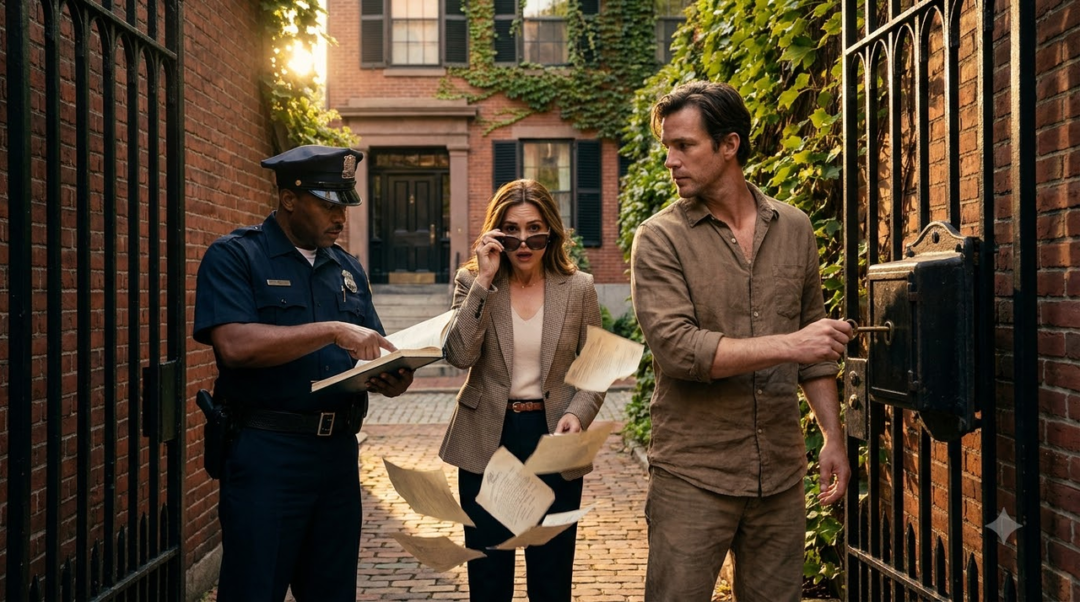
The Brass Master Key In The Historic Brownstone Courtyard Alley
CHAPTER 5: THE HISTORIC COMMISSION SHOWDOWN
At nine o’clock the following morning, the grand hearing room of the Boston Landmarks Commission inside City Hall was packed to overflowing.
Sunlight poured through the towering two-story arched windows, illuminating fifty rows of mahogany spectator benches occupied by Beacon Hill residents, historic preservationists, architectural historians, city reporters, and worried neighborhood shop owners. At the elevated curved dais sat the seven appointed commissioners of the Landmarks Commission, their faces solemn and grim behind stacks of municipal zoning dossiers.
Standing at the petitioner’s lectern was Camille Dupont, flanked by two high-priced commercial defense litigators from a prominent Financial District law firm.
Camille was performing with every ounce of dramatic indignation she could muster. She wore an elegant navy wool dress, modest pearls, and delicate gold glasses, dabbing at her dry eyes with a monogrammed lace handkerchief.
“Distinguished Commissioners,” Camille’s lead attorney, Lawrence Sterling-Phelps, argued passionately, projecting his voice across the chamber. “My client is a self-made female entrepreneur who has poured her life savings into elevating the prestige of the Beacon Hill Historic District. What we are witnessing today is a vicious, unprovoked campaign of predatory harassment by a corporate real estate conglomerate! Sterling Heritage Holdings purchased this property yesterday morning and immediately launched an illegal, retaliatory effort to destroy a thriving small business!”
Camille leaned into the microphone, her voice trembling in theatrical sorrow. “I have created jobs! I have brought international prestige to Blackwood Alley! And now, this new landlord enters my private courtyard in filthy work clothes, assaults my character, and threatens to throw my bridal gowns into the rain! I am asking this commission to issue an immediate emergency restraining order prohibiting Sterling Heritage from interfering with my business operations or entering the courtyard!”
A murmur of sympathy rippled through several spectator benches unfamiliar with the facts of the case.
The Chairman of the Commission, a distinguished seventy-year-old architectural historian named Dr. Thaddeus Vance, leaned forward and adjusted his spectacles.
“The Commission will now hear from the respondent,” Dr. Vance announced. “Mr. Alistair Sterling.”
Alistair rose from the respondent’s table. He had changed into a clean, well-tailored tweed sport coat over an open-collared linen shirt, his calm, authoritative demeanor commanding the entire chamber the moment he took his place at the lectern.
He didn’t bring a team of lawyers. He brought two items: a slim black laptop connected to the chamber’s overhead projection system, and an antique leather-bound surveyor’s journal.
“Mr. Chairman, members of the Commission,” Alistair began, his voice deep, resonant, and carrying the quiet, absolute authority of forensic truth. “We are not here to debate commercial aesthetics. We are here to address an active, life-threatening structural emergency created by deliberate criminal negligence.”
Alistair tapped a key on his laptop.
Instantly, the massive high-definition screens mounted above the dais illuminated with three-dimensional laser interferometry scans of 14 Blackwood Alley. The images displayed the subterranean foundation in vibrant color-coded stress gradients.
“These scans were captured at dawn this morning by our structural engineering team,” Alistair explained, using a laser pointer to trace the vivid red and purple stress concentrations radiating beneath the building. “As you can see, the central masonry spine of Number Fourteen has suffered sixteen millimeters of outward shear. And the cause is displayed on your screen right now.”
Alistair switched the display to a series of high-resolution photographs taken inside the basement of Maison Dupont.
A collective, horrified gasp echoed across the fifty rows of spectators.
The photographs clearly revealed the hollowed-out subterranean space: the two demolished 1840 load-bearing brick arches, the fractured granite footers, the four-by-four timber posts bowing under thousands of tons of masonry, and the severed two-inch steam riser that had left seventy-six-year-old Eleanor Vance shivering without heat on the fourth floor.
“Ms. Dupont did not maintain a historic boutique,” Alistair stated, his voice cutting through the chamber like a chilled razor. “She illegally excavated a protected landmark basement to construct an unpermitted VIP champagne bar. In doing so, she placed the structural load of four residential stories onto temporary timber props that are currently within forty-eight hours of catastrophic gravitational failure.”
The commissioners stared at the screens in stunned, horrified disbelief. Chairman Vance’s face turned an angry, mottled crimson.
Camille’s attorney sprang to his feet, waving his arms frantically. “Objection! These engineering reports have not been vetted by the municipal inspection division! Deputy Commissioner Harold Vane issued a valid emergency permit for this excavation!”
The heavy oak double doors at the back of the hearing chamber swung open with a resounding thud.
Walking down the center aisle, accompanied by two armed Special Agents from the United States Department of Homeland Security’s Office of the Inspector General, was Assistant United States Attorney Marcus Vance.
The federal prosecutor walked straight to the front of the chamber, presenting a red-ribboned document bearing the golden seal of the United States District Court to Chairman Vance.
“Distinguished Commissioners,” AUSA Vance announced, his voice ringing out with federal finality. “Deputy Commissioner Harold Vane was arrested two hours ago by federal agents in his office. He has been indicted on fourteen counts of honest-services wire fraud, commercial extortion, and accepting unlawful gratuities. Every municipal permit bearing his signature regarding Fourteen Blackwood Alley is declared null, void, and fraudulent ab initio.”
Camille Dupont gasped, her lace handkerchief dropping from her trembling fingers to the parquet floor.
“Furthermore,” AUSA Vance continued, turning his icy gaze directly toward the defense table where Camille stood frozen in shock, “federal authorities have just executed a search-and-seizure warrant on the premises of Maison Dupont. We are not merely dealing with structural fraud, Commissioners.”
The prosecutor raised a sealed federal affidavit. “We are dealing with a major international criminal smuggling enterprise.”