The Brass Master Key In The Historic Brownstone Courtyard Alley
CHAPTER 2: THE CRACKED HEARTHSTONE
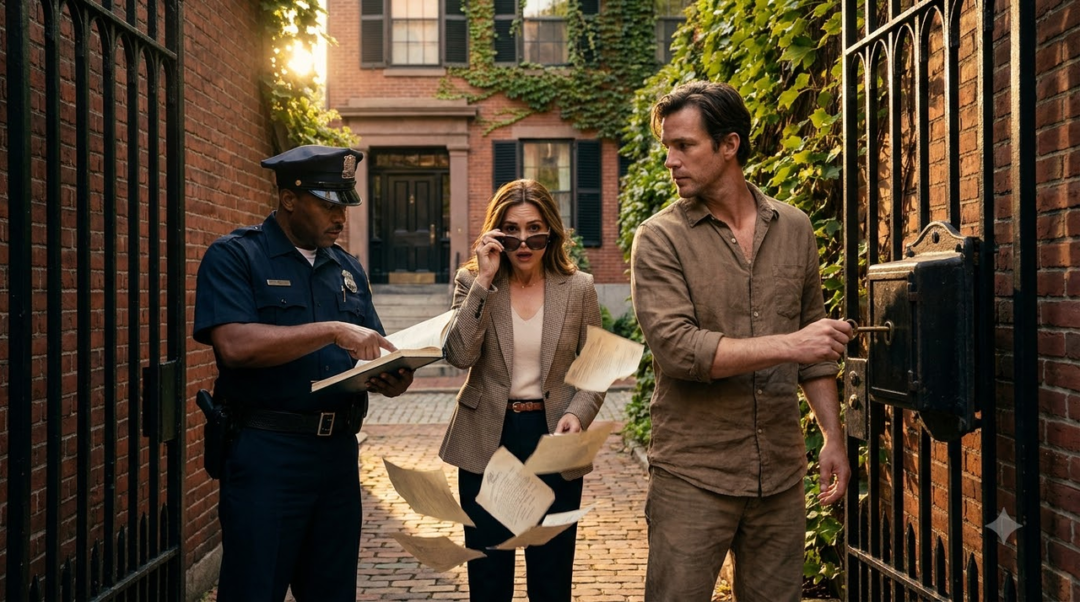
The courtyard fell into an uneasy, suffocating silence as Camille Dupont stood paralyzed, clutching her houndstooth cape around her throat.
“You… you can’t do that,” Camille stammered, her voice stripped of its arrogant veneer, reduced to a desperate, brittle whisper. “I’ve invested three hundred thousand dollars in this boutique! Maison Dupont is the crown jewel of Beacon Hill retail! My clients include senators’ wives and European ambassadors! You can’t just terminate a commercial lease with three days’ notice!”
“Under Chapter One Hundred and Eighty-Six, Section Thirteen of the General Laws, an unregistered commercial tenancy-at-will in a designated historic landmark structure requires thirty days’ written notice,” Alistair replied smoothly, his voice unwavering. “The thirty days began when the legal notice was served to your registered agent on September fifteenth by the previous estate trustee. Today is the final week. Friday at five o’clock is your statutory deadline.”
Camille backed away from him, her stilettos wobbling precariously on the damp cobblestones, before spinning on her heel and ducking inside her boutique, slamming the heavy glass door so hard the brass bell above it chimed in wild, frantic protest. Through the window, Alistair and Officer Drake watched as she grabbed a cordless telephone from the marble checkout counter, screaming into the receiver with wild, frantic gestures.
Alistair turned his attention back to the ground. He knelt beside the brick gatepost, pulling a calibrated six-inch steel rule and a high-intensity penlight from his tool pouch.
“Officer Drake,” Alistair said, shining the narrow beam of light along the base of the brownstone’s foundation where the Flemish-bond brick met the rough-hewn Quincy granite footers. “Look here.”
Drake stepped over, leaning down to inspect the masonry. Where the granite foundation stone met the damp cobblestones, a jagged, diagonal fracture had torn through the mortar joint. The gap was nearly three-quarters of an inch wide, and when Alistair inserted his steel rule, the metal slipped three inches into the foundation void without encountering resistance.
“Settlement?” Drake asked, his brow furrowing with professional concern. “These brownstones have been standing on marine clay since 1840. They settle an eighth of an inch every fifty years.”
“This isn’t settlement,” Alistair said grimly, running his fingers over the fresh, unweathered edges of fractured brick. “This fracture is active. The mortar dust is white and powdery—it crumbled within the last seventy-two hours. And look at the shear angle. The building isn’t sinking down; the south foundation wall is kicking outward toward the alley.”
Alistair stood up and looked up at the four-story facade. Above the boutique, the upper three floors were residential. On the second floor, antique wavy glass windowpanes sat slightly askew in their frames. On the fourth floor, behind a large arched window that had once served as an artist’s northern-light garret, a faint, flickering candlelight was visible in the gathering dusk.
“Who lives on the top floor?” Alistair asked.
“Eleanor Vance,” Drake replied, his tone softening with immediate warmth and respect. “Seventy-six years old. Her late husband was a professor of botany at Harvard. She’s been living in that studio since 1982. She illustrates botanical field guides for the Massachusetts Horticultural Society. A wonderful, sweet lady. But she’s been under tremendous pressure lately.”
“Pressure from whom?”
“From Ms. Dupont,” Drake said with a heavy sigh, nodding toward the boutique. “Dupont has been trying to force Eleanor out for over a year. She wants to knock down the residential ceilings and build a multi-level bridal salon with a private elevator. Dupont’s business partner, Marcus Bell, has been filing bogus noise complaints, claiming Eleanor’s radiator valves are leaking, even trying to get the board of health to condemn the unit.”
Alistair’s expression darkened. “Has the city inspected the heating infrastructure?”
“Eleanor called my office two weeks ago,” Drake said. “She told me her steam heat had completely stopped working. When I came out to inspect, Dupont claimed the central boiler had cracked and was beyond repair, and that parts were back-ordered from Germany. Eleanor’s been up there with space heaters and woolen blankets while the temperature drops into the forties at night.”
“Let’s go into the basement,” Alistair said, pulling a heavy master ring of forged iron keys from his pocket.
They walked around to the low wooden service hatch located at the side of the courtyard. Alistair unlocked the padlock, hauled open the angled storm doors, and led Drake down a steep flight of stone stairs into the subterranean depths of Number 14.
The basement was cold, smelling of damp earth, old coal dust, and aged heart-pine joists. But as they reached the concrete floor, Alistair stopped dead in his tracks.
The original basement had been violently partitioned.
Where two massive, load-bearing brick arches had stood for one hundred and eighty years to support the central chimney breast and the four-story timber spine of the building, the brick had been completely ripped away. In their place stood temporary, unbraced four-by-four timber posts, bowed under the immense gravitational load of the floors above. The central granite footers had been chipped away with jackhammers to make room for a sunken, poured-concrete lounge area complete with modern recessed lighting, exposed copper plumbing pipes, and plush velvet banquettes.
“Mother of God,” Officer Drake breathed, shining his flashlight on the bowed timber posts. “She dug out the basement?”
“She didn’t just dig it out,” Alistair whispered, his voice trembling with contained rage. “She removed the primary structural transfer arches. The entire four-story masonry core of this building is currently resting on four pieces of soft construction lumber.”
Alistair walked over to the central steam boiler. The heavy cast-iron boiler was fully functional, but the main two-inch brass steam riser feeding the upper residential floors had been severed with a reciprocating saw. A threaded brass plug had been screwed into the line, while a diverted branch line ran directly into the new basement VIP lounge to feed radiant underfloor heating beneath Camille’s private marble bar.
“She didn’t have a broken boiler,” Drake said, his fists clenching at his sides. “She cut Eleanor’s heat off with a hacksaw so she could warm her private champagne cellar.”
Alistair shined his penlight behind the severed steam riser, where the fresh drywall met the historic foundation wall.
Tucked into an unmortared cavity behind the chimney breast, a small black electronic device caught his eye. It was a digital data-logger, wired to three crack-monitoring strain gauges epoxied across the granite footers. The device was blinking with a rapid green LED, transmitting real-time structural stress telemetry over a cellular modem.
Alistair knelt down, inspecting the manufacturer’s label on the transmitter: CITY OF BOSTON INSPECTIONAL SERVICES – TEMPORARY SEISMIC TELEMETRY.
“Drake,” Alistair said quietly, pointing to the blinking unit. “This isn’t an unrecorded renovation. The city’s building department knew the foundation was failing. Someone inside the municipal inspection division has been monitoring this structural collapse in real-time—and deliberately hiding it from the public.”