The Buried Bamboo Rhizomes And The Beeping Root Ball Tracker
CHAPTER 1: THE RIBBON ON WHISPERING PINES
The humid North Carolina morning air hung thick, warm, and sweet among the stately longleaf pines of northern Cumberland County, carrying the resinous fragrance of sun-warmed pine straw and flowering confederate jasmine. At half-past seven, eighty-year-old Harold Henderson stood on the front porch of his brick craftsman cottage on Whispering Pines Boulevard, holding a polished brass watering wand connected to a coiled green hose. He wore faded dark-blue canvas work overalls, a soft chambray work shirt with sleeves rolled neatly to the elbows, and a battered canvas sun hat that had shaded his brow through thirty years as a senior research botanist with the state agricultural extension service.
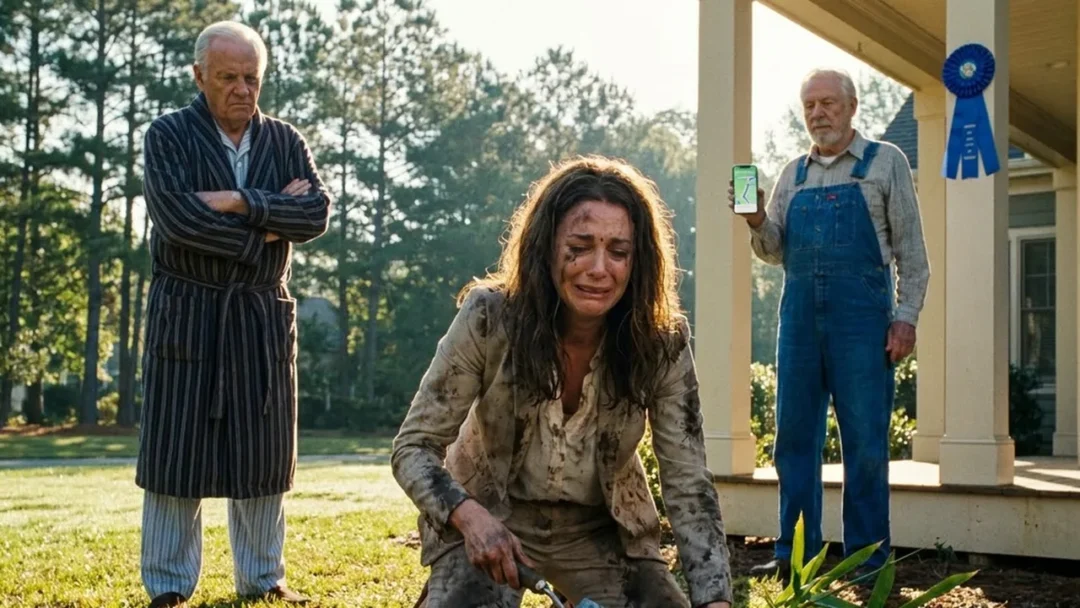
Pinned firmly and securely to the cedar post beside his front steps was a pristine satin rosette ribbon of royal blue and gold leaf. The ribbon fluttered gently in the humid southern breeze, its gold tassels catching the morning sun like spun brass. To the casual driver passing along Whispering Pines Boulevard, it was simply an elegant ornament of community pride. But to Harold, it stood as a testament to the quiet persistence of natural beauty over sterile conformity. He had built every raised bed with his own hands, hauled every bag of pine straw from local timber stands, and nurtured every cutting through winter frosts with patient, unwavering care. The embossed script read: WHISPERING PINES COMMUNITY ASSOCIATION — YARD OF THE MONTH — FIRST PLACE.
For Harold, the ribbon was not a trophy of vain suburban competition; it was an acknowledgment of fifty years of patient soil stewardship. During his tenure at the North Carolina State Extension Service in Raleigh, Harold had walked thousands of acres of tobacco fields, sweet potato patches, and peach orchards across the coastal plain. He had advised three generations of small family farmers on crop rotation, mycorrhizal inoculation, and integrated pest management, teaching them that healthy crops were not built with chemical sprays from a tanker truck, but through the patient cultivation of living soil biology. When he retired to Whispering Pines, he brought that same quiet scientific philosophy to his home garden, creating an ecosystem that attracted bluebirds, honeybees, and praying mantises while his neighbors poured thousands of dollars each month into synthetic herbicides that left their yards sterile and dead. His quarter-acre lot was an organic botanical sanctuary in an ocean of sterile, chemical-soaked subdivision turf. He cultivated heirloom camellias, drought-hardy native azaleas, and rare ornamental grasses, feeding his beds with composted leaf mold and worm castings rather than synthetic nitrogen fertilizers.
Across the low split-rail cedar fence that divided Harold’s garden from Number 18, Karen Whitmore paced along her flagstone terrace like a caged panther.
At forty-six years old, Karen was the self-styled social arbiter of Whispering Pines and an ambitious member of the HOA Beautification Committee. Her own front lawn was an engineered expanse of emerald-green hybrid Bermuda sod, mowed three times weekly by commercial contractors and dosed with industrial fungicides. For three consecutive years, Karen had campaigned ruthlessly to win the Yard of the Month ribbon, hosting lavish backyard cocktail parties for committee members and filing dozens of anonymous compliance complaints against her neighbors. Her sense of entitlement was legendary throughout the subdivision. Karen viewed Whispering Pines not as a community of neighbors, but as a private stage for her curated social media persona. She maintained an Instagram account with forty thousand followers where she posted staged photos of her outdoor kitchen, her imported Italian stone planters, and her perfectly edged grass lines. In her rigid worldview, wealth and expensive contractors entitled her to undisputed social supremacy. The fact that an eighty-year-old widower living on a state pension had defeated her with a garden of native wildflowers and weathered cedar trellises was a humiliating defeat she could not endure. When the committee had voted unanimously on Monday to award the blue rosette to Harold’s naturalistic cottage garden, Karen had viewed the decision as a catastrophic public insult to her social status.
Harold paid her no mind as he gently misted his hanging Boston ferns. The ferns had been divided from an heirloom mother plant given to his late wife, Eleanor, on their wedding anniversary in nineteen seventy-two. Every delicate frond was a living link to fifty years of shared memory, quiet morning conversations on the porch, and the deep, enduring peace of their home. Harold had survived two combat winters in the frozen valleys near the Chosin Reservoir during his service with the Army Signal Corps; a bitter neighbor throwing envious glances across a garden fence was nothing more than autumn leaves blowing across a pond. When the baskets were thoroughly soaked, he turned the brass shut-off valve, hung the hose neatly on its wrought-iron bracket, and walked along the flagstone path toward his private rear deck to inspect his specimen collection.
On the cedar bench at the center of the deck sat his most prized botanical project: a collection of rare Asian bamboo cultivars he had been evaluating for cold-hardiness and non-invasive root architecture. Among them was a quarantined five-gallon nursery container housing a dwarf variegated bamboo specimen he had hybridized over four years of painstaking division.
Harold stopped dead in his tracks. The cedar deck boards beneath his boots felt cold and hollow. In his long scientific career, Harold had encountered severe hurricanes that stripped experimental crops, hailstorms that shattered greenhouse panes, and fungal epidemics that devastated entire orchards in a weekend. Natural disasters were part of life; a grower accepted them with humility and replanted. But the calculated, covetous hand of a neighbor who would trespass in the dead of night to steal a living creature of botanical science was an act of venomous deceit that struck at the very core of human decency. His heart contracted with sudden, protective grief. The dwarf variegated hybrid was not merely a decorative houseplant; it was the culmination of forty-eight months of controlled pollination, cross-breeding cold-tolerant cultivars from the high elevations of Taiwan with heat-hardy southern clumping varieties. He had submitted preliminary phenotypic data to the horticultural department at NC State, hoping to register the cultivar as a non-invasive ornamental alternative for urban home gardeners across the humid southeast. To see the plant stolen like common lawn furniture was an act of personal and scientific desecration.
The three-tiered cedar plant stand was empty. The five-gallon container was gone.
In its place on the weathered cedar planks lay only a smear of damp black potting soil and a fresh, unmistakable scrape mark made by the rubber edge of a heavy wheelbarrow. Harold knelt and touched the rubber mark with his thumb. The tread pattern was a diamond-knobby design typical of commercial contractor wheelbarrows. A few grains of coarse red horticultural grit were scattered across the cedar planks, matching the specialized drainage mix Harold formulated exclusively for his bamboo trials. The thief had moved with hurried, clumsy haste, leaving a trail of physical breadcrumbs that a trained botanist could decipher in seconds.
Curiosity Lock: Harold knelt down and touched the moist soil, his experienced eyes noting that the theft had occurred within the last eight hours, just as the distant, shrill scream of Karen Whitmore echoed from the front street, calling out for the HOA president.