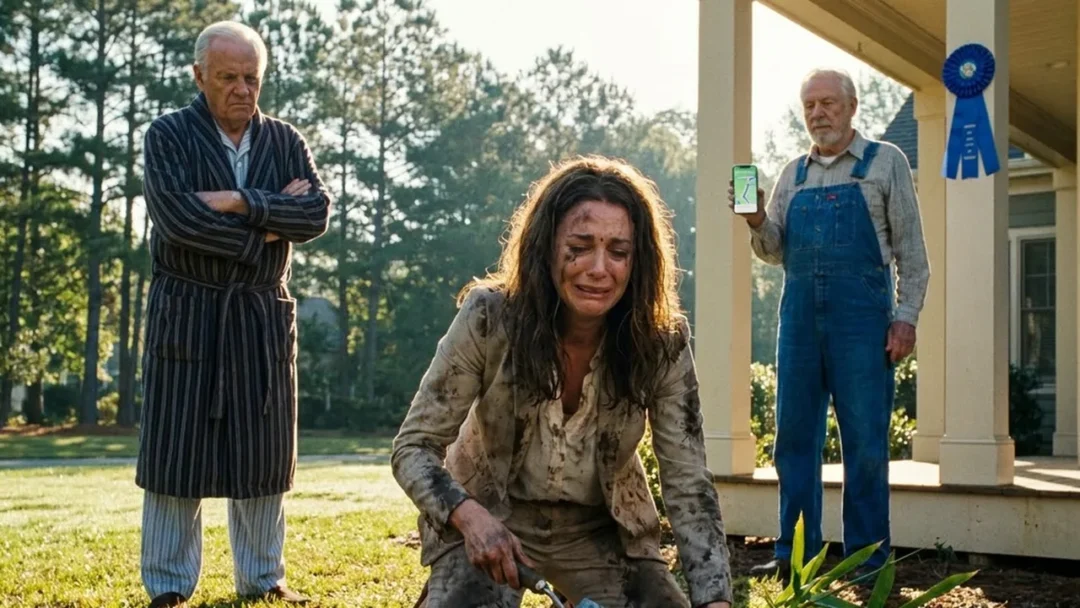
The Buried Bamboo Rhizomes And The Beeping Root Ball Tracker
CHAPTER 3: THE GEOMETRY OF A FRAME
Across the street, curtains were twitching in every window. Neighbors were stepping out onto their manicured porches, whispering among themselves as they watched the public confrontation.
Karen Whitmore stepped up beside Margaret, folding her arms across her chest, a venomous smirk curling her lips. “Don’t bother listening to his excuses, Margaret. Senile old men always try to play the victim when they get caught. The proof is right in front of your eyes: the empty nursery pot is on his porch, the dirty trowel is on his steps, and the illegal shoots are choking your turf. He probably stole the rhizomes from the state extension nursery because he couldn’t stand seeing someone else with better grass.”
Harold did not raise his voice. He took off his canvas sun hat, wiping his brow with a clean blue bandanna, his weathered gray eyes surveying Karen with the calm, clinical detachment of a scientist examining a diseased leaf specimen. Through decades of academic research and field extension work, Harold had presented complex scientific findings before contentious state legislative committees, hostile county commissions, and corporate agribusiness boards. He had learned that emotional volume was always the refuge of those whose arguments lacked factual foundation. When you possess the immutable physical truth of soil chemistry, plant anatomy, and verifiable data, you never need to shout.
“Karen,” Harold said softly, “that specimen in Margaret’s grass isn’t wild running bamboo from the highway median. “There are over fourteen hundred species of bamboo in the world, divided into two distinct botanical categories: monopodial running varieties and sympodial clumping varieties. Running species produce leptomorph rhizomes that spread aggressively through the soil like underground torpedoes, whereas clumping varieties produce pachymorph root systems that grow tightly inward around a central fibrous crown. The plant sitting in that trench is a hybridized dwarf clumping specimen developed from Bambusa multiplex cultivars. It is physically incapable of invading surrounding turf or spreading beyond a twenty-four-inch root circumference. Anyone with a basic understanding of horticulture would recognize the node structure instantly.” That is a dwarf clumping hybrid—a rare variegated cultivar that took me four years of genetic cross-pollination to stabilize in my shade house. It doesn’t have creeping runners, it doesn’t invade turf, and it doesn’t spread beyond its root crown. It is completely non-invasive.”
“Oh, now he’s an expert geneticist!” Karen laughed mockingly, turning to the gathering crowd of neighbors. “A plant is a plant, Harold! You buried it in Margaret’s grass, and the empty container is sitting on your own welcome mat!”
“I didn’t bury it in Margaret’s grass,” Harold replied, his voice rock-steady. “That five-gallon container was sitting on my private back deck at nine o’clock last night when I locked my greenhouse. Somebody walked through my side gate under cover of darkness, hauled the pot out in a wheelbarrow, took it somewhere to stage this little performance, and then dumped the pot and trowel on my front steps twenty minutes ago.”
“That’s a lie!” Karen snapped, her voice rising an octave. “You expect us to believe someone broke into your yard, stole a plant, and planted it in Margaret’s lawn just to frame you? That is the most pathetic, desperate fairy tale I’ve ever heard! Show us proof! Show us one single shred of evidence, Harold, or take down that blue ribbon and write the check!”
Harold looked down at Karen’s hands. He noted the fine dusting of red clay clinging beneath her manicured acrylic fingernails, and the faint reddish smudge along the cuff of her cream linen blouse where she had leaned over the damp earth. Red clay in Cumberland County had a unique mineral composition, rich in oxidized iron and fine kaolinite silts that bound indelibly to cotton fibers. Harold’s garden beds were enriched with dark coastal peat, leaf compost, and coarse river sand; he had zero red subsoil on his property. The red clay on Karen’s fingers matched only one location on the entire street: the sub-base trench excavated along Margaret Calhoun’s curb.
“Evidence,” Harold murmured, a faint, patient smile touching the corners of his eyes. “In the natural world, every living organism leaves a signature: tree rings record droughts, soil strata reveal floods, and pollen grains preserve centuries of climate. Human beings always believe their actions vanish into thin air, but the world around us remembers everything.” “In botany, as in criminal law, evidence isn’t about what people say. It’s about what the specimen remembers.”
Harold reached into the deep bib pocket of his canvas overalls.
He did not pull out a legal document, a magnifying glass, or a seed catalog.
He pulled out a sleek, modern smartphone in a rugged black case.
Margaret Calhoun frowned, tapping her foot with impatient irritation. “Harold, what is this nonsense? Are you calling an attorney? Because no lawyer in North Carolina can explain away an empty pot on your porch!”
“I’m not calling an attorney, Margaret,” Harold said calmly, unlocking the screen with his thumb. “When you spend four years developing an irreplaceable botanical hybrid worth several thousand dollars to university research collections, you don’t leave it unprotected on a backyard patio. Modern botanists use modern tools.”
Curiosity Lock: Harold tapped a blue icon on his screen labeled ‘Find My’, selected the item labeled ‘Dwarf Bamboo Hybrid Specimen #4’, and pressed the blue button that read ‘PLAY SOUND’. The application established an immediate ultra-wideband radio handshake with the embedded Apple U1 chip buried beneath the loam. Modern consumer tracking beacons utilize high-precision directional Bluetooth frequencies that can penetrate up to six inches of moist soil and dense organic material, triggering an eighty-five-decibel piezoelectric speaker sealed inside the waterproof casing. To the human ear, the high-frequency electronic melody was unmistakable, piercing the humid morning air with the clean, undeniable authority of digital geometry.