The Fallen Heroes Memorial Plaza Defended by the United Marines
CHAPTER 3: THE CAVITY BEHIND THE SUBWOOFERS
Officer Clara Diaz walked around the warped rear quarter-panel of the wrecked sports car, her eyes narrowing as she peered into the jagged fracture of the fiberglass subwoofer box. With gloved fingers, she reached inside the broken composite housing, carefully navigating around the frayed speaker wiring, and lifted out the top plastic-wrapped brick.
It was not narcotics, as she had first suspected. Inside the heavy four-mil commercial plastic was a banded, pristine stack of three hundred blank white polyvinyl chloride smart cards, each equipped with an embedded EMV security microchip and an unencoded magnetic stripe along the back. Beneath that initial stack sat a second brick containing five thousand dollars in crisp, sequential hundred-dollar bills, accompanied by three compact, battery-powered skimmers of the exact type used by organized crime rings to compromise retail point-of-sale terminals.
Clara looked up from the evidence, her eyes locking onto Treyce Lamont’s pale, sweat-streaked face. “Blank chipped cards, skimming readers, encoding software, and unregistered cash. This isn’t streetwear merchandise, Treyce. This is an industrial identity theft and bank fraud operation.”
Lamont’s bravado had completely dissolved into frantic stammering. His chest heaved against the warm hood of his car, his designer fur collar soaked with cold sweat. “That’s not mine! I swear to God that’s not mine! I bought this car used from an exotic vehicle broker in Miami two months ago! Whatever is hidden in those speaker boxes was left there by the previous owner! You can’t pin that on me! You don’t have my prints on those cards!”
“Save your defense for the federal magistrate,” Clara replied coldly. She turned to Gunnery Sergeant Miller. “Gunny, keep this vehicle secure. Nobody touches this car until the crime-scene technicians and the Secret Service financial crimes task force arrive on scene.”
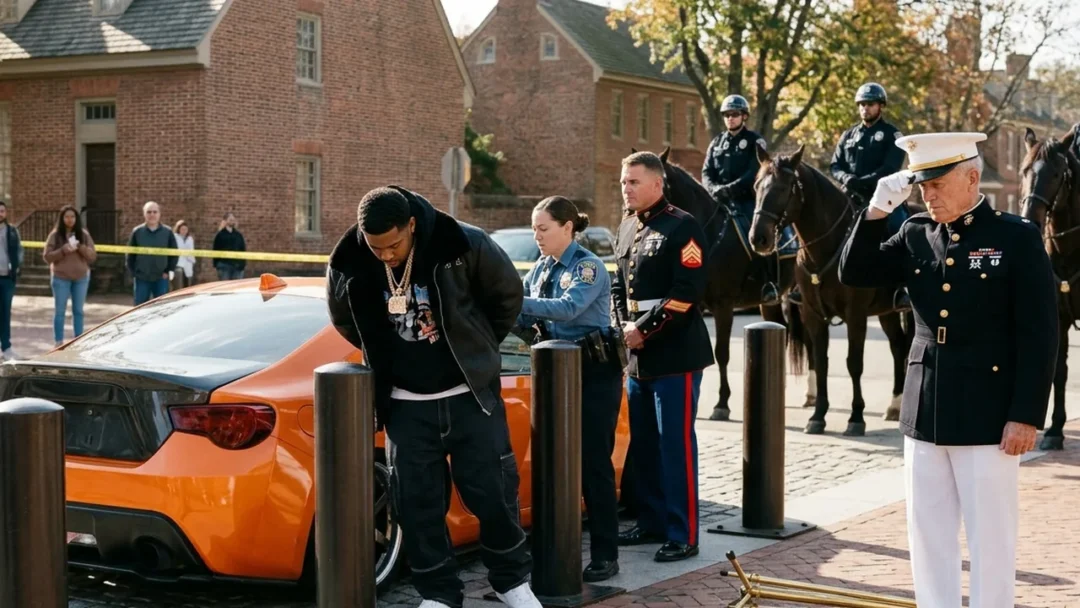
“Understood, Officer,” Miller said, snapping his fingers with military authority. Four armed Marines immediately took up guard positions at the four corners of the orange sports car, their rigid, unblinking presence creating a perimeter that kept the murmuring crowd of several hundred onlookers fifty feet back behind the police tape.
Clara walked to the driver’s door, opened the glove compartment with a gloved hand, and extracted the vehicle’s leather registration packet and insurance folder. Tucked inside an accordion organizer alongside the registration was an official-looking certificate printed on heavy cream stock, embossed with a gold state seal.
Clara read the document aloud, her voice hardening with every syllable: “COMMONWEALTH OF VIRGINIA NON-PROFIT SALES TAX EXEMPTION CERTIFICATE: ISSUED TO THE CORPORAL RAYMOND HARRIS VETERANS REHABILITATION COALITION.“
Standing five feet away, holding his white dress service cap with both hands, Thomas Sterling froze. His breath hitched audibly in his throat, and for the first time that afternoon, his stoic, weathered composure cracked.
“What did you just read, Officer Diaz?” Sterling asked, his voice shaking with a quiet, terrible intensity that stopped Clara in her tracks. “What name was on that certificate?”
Clara looked up, surprised by the elderly Marine’s sudden reaction. “Corporal Raymond Harris, sir. The corporate filing shows this LLC is registered as a veteran-owned non-profit entity. Lamont has been using this tax exemption certificate to import overseas textiles, luxury vehicle components, and commercial embroidery machines without paying state sales taxes or federal import tariffs.”
Thomas Sterling closed his eyes for a long, heavy moment, his head bowed. When he opened them, the sorrow in his gaze had turned into cold, unyielding iron.
“Raymond Harris was twenty-one years old when he died at the Hue Citadel,” Sterling said softly, his voice cutting through the quiet square like a surgical blade. “He was my squad’s radioman. When an enemy mortar shell landed inside our trench on February 12th, 1968, Ray threw his body across two wounded nineteen-year-old privates. He took the shrapnel in his back. He died in my arms twenty minutes later. He never made it home to his mother in Richmond.”
Sterling took three heavy, deliberate steps toward Lamont, looking down at the handcuffed young promoter who was trembling violently against the crushed orange fender.
“You stole the name of a boy who died saving his brothers,” Sterling said, his voice dropping into a register that made the hair on the back of Clara’s neck stand up. “You stole a fallen Marine’s identity to dodge taxes on your fake designer jackets.”
Lamont swallowed hard, unable to meet the old veteran’s eyes. “I… I bought the LLC package from a corporate broker online! They told me it was a dormant shell company! I didn’t know who the guy was! I didn’t know he was a soldier!”
Before Sterling could respond, the smartphone in Lamont’s front jacket pocket vibrated violently against the hood of the car.
Clara reached into his pocket and extracted the encrypted device. On the lock screen, an incoming message flashed from an unsaved number labeled simply BALTIMORE HUB: COURIER IS AT THE SQUARE NOW. HE HAS THE HARD DRIVE FOR THE FALL LINE. CONFIRM YOU HAVE THE CHIPS.
Clara looked across the courtyard toward the historic brick fountain, where several hundred tourists and local residents were gathered behind the yellow police tape.
“The courier is here,” Clara whispered to Miller. “Right now, in this crowd.”