The Fallen Heroes Memorial Plaza Defended by the United Marines
CHAPTER 5: THE COURIER IN THE CROWD
Within forty-five minutes of the courier’s arrest in the Carlyle alleyway, Market Square had been transformed into an inter-agency federal tactical command center. Special agents from the United States Secret Service Financial Crimes Task Force, investigators from the Federal Bureau of Investigation, and postal inspectors from the Department of Justice had descended upon the historic plaza in unmarked black SUVs, establishing a secure perimeter around the crime scene.
On folding tables set up beneath the shade of the City Hall portico, federal forensic technicians were methodically cataloging the contents of Lamont’s crushed sports car. Beside the three hundred blank smart cards, the magnetic stripe encoder, and the skimming hardware sat six heavy cardboard cartons retrieved from the vehicle’s front trunk compartment. Inside were thousands of counterfeit luxury embroidered patches, forged customs seals, and tax-exemption certificates bearing the forged signatures of Virginia and Maryland state officials.
Special Agent David Vance of the Secret Service—an experienced federal investigator with twenty years in financial crimes—walked over to where Clara Diaz and Thomas Sterling stood near the base of the memorial obelisk.
“Officer Diaz, Master Sergeant Sterling,” Agent Vance said, offering a firm, respectful handshake to both of them. “I want to thank you. For six months, our Baltimore field office has been tracking a sophisticated criminal network that was utilizing fraudulent 501(c)(3) veteran charities to import hundreds of thousands of dollars in counterfeit goods without paying import duties or sales taxes. We had the warehouse locations, but we couldn’t link the physical distribution to the digital financial accounts.”
Agent Vance gestured toward the encrypted hard drive sitting in a static-shielded evidence bag on the table.
“The drive your suspect dropped contains the entire financial architecture,” Vance continued, his tone filled with professional admiration. “It holds the private encryption keys to their offshore accounts in Cyprus, the shipping manifests for three cargo containers currently docking in Baltimore, and the digital logs proving Treyce Lamont personally selected the names of deceased combat veterans from military cemetery registries to establish his tax-exempt front companies.”
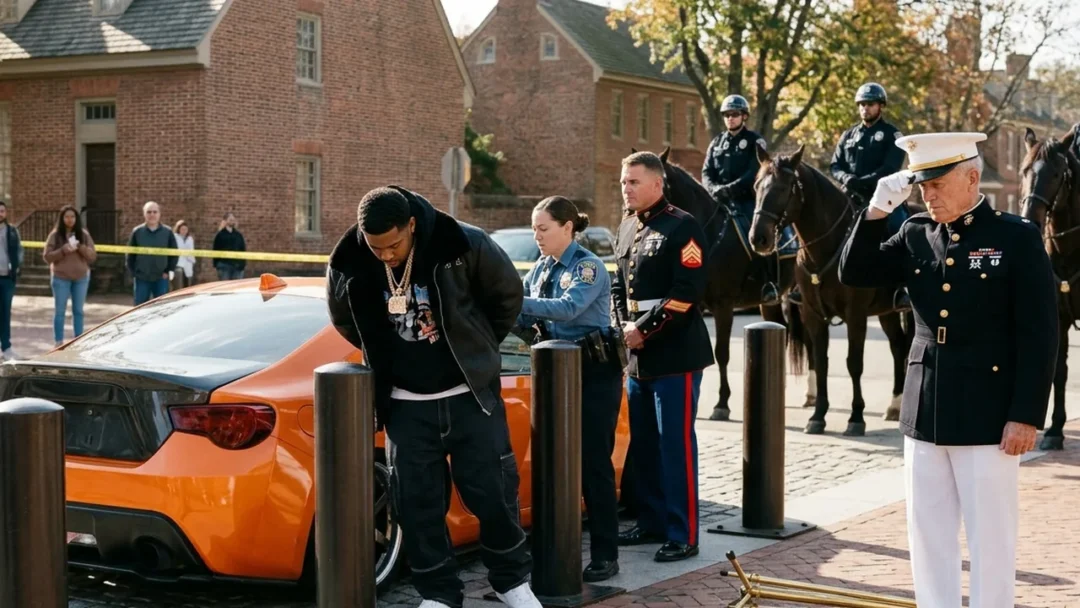
Across the plaza, Treyce Lamont sat in the rear of a reinforced Alexandria Police prisoner transport van, his face pale, hollow, and streaked with dried tears. His expensive shearling coat had been confiscated as physical evidence, leaving him in a thin white undershirt that did nothing to keep out the chilly autumn breeze. He watched through the wire-reinforced window as federal agents attached heavy yellow evidence seals across the doors and hood of his crushed orange sports car.
A commercial heavy-duty flatbed tow truck from the city impound division backed into the square, its heavy steel winch cables clanking rhythmically. Two municipal mechanics engaged the hydraulic controls, lowering the steel bollards into the ground to allow the flatbed to winch the battered lowrider up onto the diamond-plate bed.
Lamont’s attorney, a frantic corporate lawyer in an expensive pinstripe suit who had rushed down from Washington, stepped out of the police station doors and approached the federal agents with an armful of legal folders.
“Agent Vance! This is an unconstitutional vehicle seizure!” the lawyer argued, waving a stack of legal briefs. “My client is a prominent creative entrepreneur! The vehicle damage alone exceeds two hundred thousand dollars! We are demanding immediate bail and the return of his personal property!”
Agent Vance didn’t even blink. He handed the lawyer a freshly printed document bearing the signature of a federal magistrate judge.
“Counselor, your client just had his bail denied by the United States District Court for the Eastern District of Virginia,” Agent Vance said with chilling calm. “He is charged with twenty-four counts of aggravated federal identity theft, interstate wire fraud, trafficking in counterfeit goods, and felony assault on a protected elderly person. Furthermore, under Title 18 U.S. Code Section 981, this vehicle and all associated financial assets have been placed under federal civil asset forfeiture.”
The lawyer’s mouth opened, then snapped shut as he read the magistrate’s order.
Agent Vance turned his back on the attorney and looked at Thomas Sterling. “Master Sergeant, under the federal forfeiture statutes, when assets are seized from crimes involving the exploitation of veterans, seventy percent of the liquidated proceeds are redirected to local veteran assistance organizations. When that orange sports car and Lamont’s shell company accounts are auctioned off, more than eight hundred thousand dollars will be transferred directly to the Alexandria Veterans Housing and Rehabilitation Fund.”
Thomas Sterling looked at the crushed sports car being hoisted onto the flatbed, his weathered face breaking into a soft, dignified smile.
“Raymond Harris would have liked that,” Sterling said quietly. “He always looked out for the boys who needed help.”