The Gold Judicial Medallion And The Arrested Patrol Officer
CHAPTER 3: THE THIRD PRECINCT FORTRESSThe Third Precinct station house of the Henrico County Police was a reinforced brick-and-concrete fortress situated along Broad Street, surrounded by security fencing and perimeter surveillance cameras. For eight years, the precinct had been the personal kingdom of Captain Donald Croft—a twenty-eight-year veteran of county law enforcement whose political connections to county developers had insulated his shift from external oversight.
At four o’clock that afternoon, Commander Sarah Reyes and Senior Judge William Vance strode through the heavy ballistic-glass front doors of the station house.
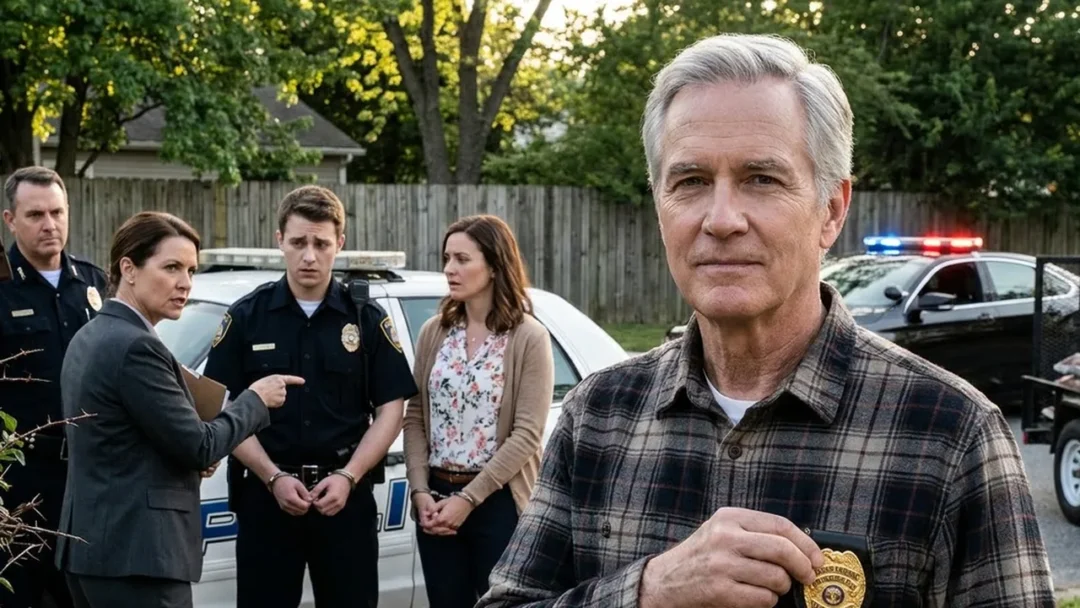
William Vance was still dressed in his red flannel shirt and work boots, but his presence was commanding, his silver hair and the gold federal judicial shield pinned to his chest parting the uniformed patrolmen in the lobby like the Red Sea. Behind them marched six State Police Major Crimes investigators in dark tactical windbreakers, carrying heavy aluminum evidence crates and forensic cyber-cloning terminals.
The desk sergeant looked up, saw the gold stars on Judge Vance’s medallion, and immediately dropped his pen, standing at rigid attention.
Commander Reyes walked straight past the front desk, using her master executive smart-card to bypass the secure electronic turnstiles leading to the administration wing. She kicked open the frosted-glass door of the corner executive suite:
CAPTAIN DONALD CROFT – COMMANDING OFFICER.
Inside the spacious mahogany-paneled office, Captain Croft was leaning back in an oversized leather executive chair, smoking a cigar, on a speakerphone call with an executive at Dominion Impound Solutions. On his desk sat a heavy, open ledger bound in black leather and a glass of bourbon.
“Captain Croft,” Commander Reyes announced, her voice echoing off the paneled walls. “Hang up the phone. Step away from your desk.”
Croft blinked through the blue cigar smoke, his heavy eyebrows knitting together in furious disbelief. He was fifty-six, thick-necked, with a florid, red face and a bristling grey mustache.
“Reyes?” Croft scoffed, sitting upright and slamming his hand onto the speakerphone to end the call. “What the hell do you think you’re doing barging into my command office with tactical units? You’re the Internal Affairs Chief, not the Chief of Police. Get these troopers out of my station house!”
Commander Reyes stepped aside, revealing William Vance standing quietly in the doorway.
Croft’s eyes dropped to the gold federal judicial medallion. He squinted, his face tightening with sudden, uneasy recognition. “Who is this old man?”
“This ‘old man’ is Senior Judge William Vance of the United States Veterans Court of Appeals, Captain Croft,” Commander Reyes said, her voice dropping into a lethal, quiet register. “And an hour ago, your personal protégé and patrol officer, Kevin Miller, unlawfully detained him on his private property at gunpoint, threw his federal credentials into a thorn bush, and attempted to arrest him on fabricated HOA violations.”
Croft’s cigar slipped from his fingers, falling onto the polished blotter with a tiny hiss. All the arrogance drained from his eyes, replaced by an expression of cold, sickening realization. “Kevin did what?”
“Kevin was carrying out the standard enforcement protocol you established for his aunt, Beatrice Miller,” William Vance said, his deep, resonant voice filling the room with terrifying authority. “Over the past twenty-four months, Captain Croft, you and Beatrice Miller have weaponized the Third Precinct patrol division to conduct an organized vehicle-theft and property-extortion ring across Shady Hollow Estates.”
Vance pulled a white federal court order from his pocket, laying it flat on the desk blotter.
“This is an emergency Title 18 search and seizure warrant, signed forty-five minutes ago by Chief Judge Eleanor Hayes of the United States District Court for the Eastern District of Virginia. It authorizes the immediate seizure of all Third Precinct computer servers, dispatch logs, towing manifests, and personal financial safes.”
Two State Police forensic investigators stepped forward, sliding high-speed data cables into the USB ports of Croft’s desktop computer and precinct network server.
Detective Sergeant Ortiz opened the black leather ledger resting on Croft’s desk.
“Commander,” Ortiz reported, her eyes scanning the handwritten rows. “The black ledger contains thirty-eight separate entries over the past eighteen months. Every time Officer Kevin Miller issued a fraudulent municipal citation for an unapproved trailer, classic vehicle, or landscape equipment, Dominion Impound Solutions dispatched a flatbed within twenty minutes. The vehicles were towed to an unmonitored private lot in Hanover County.”
Ortiz pointed to a column titled DISBURSEMENT SPLIT:
“Each vehicle was held for thirty days under fabricated administrative storage fees exceeding three thousand dollars. When the elderly owners couldn’t pay cash, the titles were fraudulently reassigned and sold at private auctions. Captain Croft received a twenty-five-percent cash kickback on every vehicle liquidated—totaling over three hundred and forty thousand dollars in cash bribes.”
Commander Reyes leaned over the desk, her face inches from Croft’s sweating forehead.
“Three hundred and forty thousand dollars, Donald,” Reyes said softly. “You sold out your uniform, your oath, and your department to run an auto-theft ring with an HOA president.”
Croft lunged for the telephone on his credenza, but two state troopers seized his arms, twisting them behind his back and forcing his face against the cold mahogany desk.
SNAP-CLICK!
The heavy stainless-steel handcuffs locked onto the precinct captain’s wrists.
“You can’t arrest a precinct commander in his own station!” Croft roared, his face turning an apoplectic purple. “I will have the Police Association strike! I will shut this county down!”
“The Police Association represents honorable men and women, Donald,” Commander Reyes said, stripping the gold captain’s insignia from his collar. “They don’t represent thieves.”
Captain Donald Croft’s corruption was an open secret among veteran patrolmen in the Third Precinct. Over a twenty-year career, Croft had systematically promoted pliant, compromised officers while transferring honest deputies to isolated night shifts in rural county sectors. He had created an internal precinct culture that prioritized private towing kickbacks and corporate favors over constitutional policing. As State Police forensic technicians unplugged Croft’s private desktop terminal and sealed his personal files, several young patrolmen in the bullpen exchanged quiet, relieved glances. The suffocating reign of intimidation that had compromised the precinct house for nearly a decade was finally coming to an end.